



Thermoset Composites Market Size 2026-2030
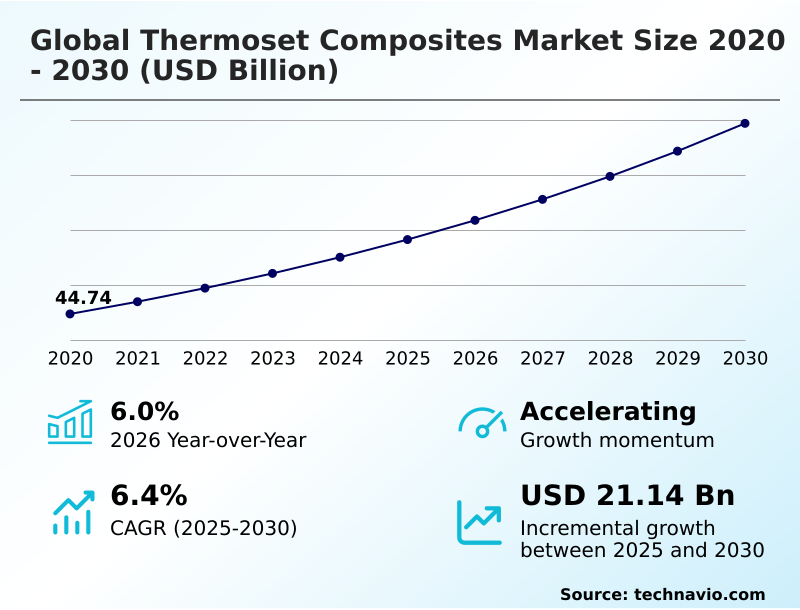
The thermoset composites market size is valued to increase by USD 21.14 billion, at a CAGR of 6.4% from 2025 to 2030. Demand for lightweight materials in automotive sector will drive the thermoset composites market.
Major Market Trends & Insights
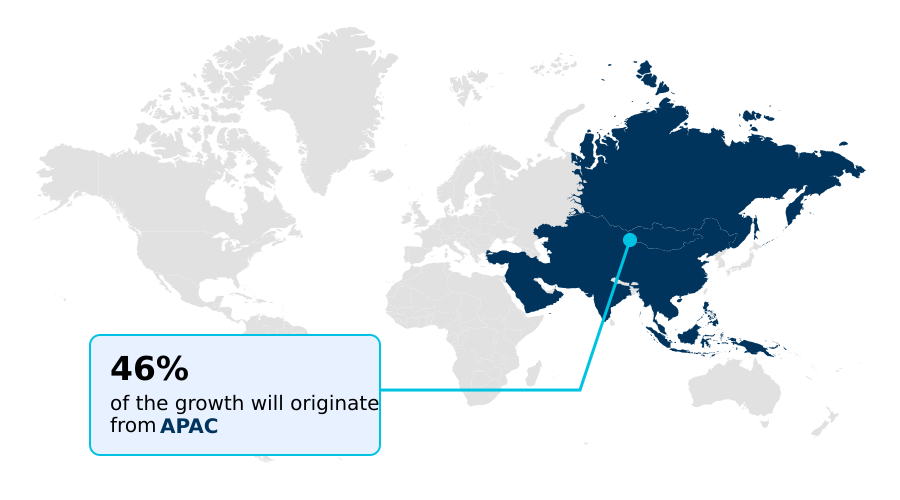
- APAC dominated the market and accounted for a 46.2% growth during the forecast period.
- By Resin Type - Polyester resin segment was valued at USD 24.79 billion in 2024
- By Product Type - Glass fiber segment accounted for the largest market revenue share in 2024
Market Size & Forecast
- Market Opportunities: USD 34.65 billion
- Market Future Opportunities: USD 21.14 billion
- CAGR from 2025 to 2030 : 6.4%
Market Summary
- The Thermoset Composites Market is defined by its critical role in delivering high-performance materials for demanding applications. The continuous drive for lightweighting in transportation and renewable energy sectors fuels demand for materials with a high strength-to-weight ratio, such as carbon fiber prepregs and epoxy resin composites.
- This trend is coupled with an expansion in construction and infrastructure, where corrosion-resistant polymers are essential. Key industry trends include the development of bio-based thermoset resin formulations and advancements in automated fiber placement, aiming to improve manufacturing efficiency. However, the industry grapples with the high cost of raw materials and the technical complexities of composite material recyclability.
- A significant business scenario involves optimizing the supply chain for these specialized materials.
- For instance, a manufacturer must balance the procurement of advanced composite tooling materials with the need to manage inventory for various production lines, such as those using sheet molding compounds (SMC) for automotive or glass fiber reinforcements for industrial use, all while ensuring stringent composite part qualification processes are met to avoid costly production delays and maintain quality standards.
What will be the Size of the Thermoset Composites Market during the forecast period?
Get Key Insights on Market Forecast (PDF) Request Free Sample
How is the Thermoset Composites Market Segmented?
The thermoset composites industry research report provides comprehensive data (region-wise segment analysis), with forecasts and estimates in "USD million" for the period 2026-2030, as well as historical data from 2020-2024 for the following segments.
- Resin type
- Polyester resin
- Epoxy resin
- Others
- Product type
- Glass fiber
- Carbon fiber
- Others
- End-user
- Aerospace and defense
- Automotive
- Construction and infrastructure
- Electrical and electronics
- Others
- Geography
- APAC
- China
- Japan
- India
- North America
- US
- Canada
- Mexico
- Europe
- Germany
- UK
- France
- South America
- Brazil
- Argentina
- Middle East and Africa
- Saudi Arabia
- UAE
- South Africa
- Rest of World (ROW)
- APAC
By Resin Type Insights
The polyester resin segment is estimated to witness significant growth during the forecast period.
The market is segmented by various material types, with polyester resins being a significant category. This segment, encompassing materials such as glass fiber reinforcements, bulk molding compounds (BMC), and prepreg composite technologies, is defined by its versatility and cost-effectiveness.
It serves a broad range of industries, from construction to marine. The current focus is on enhancing material performance criteria through advanced composite material formulation.
For example, new formulations have improved the fire, smoke, and toxicity (FST) performance of phenolic resin systems by over 15%, making them more suitable for transportation interiors.
The segment's evolution is also shaped by the ongoing competition with thermoplastic composite substitutes and the continuous need for innovation in composite bonding and joining techniques for thermoset resin systems.
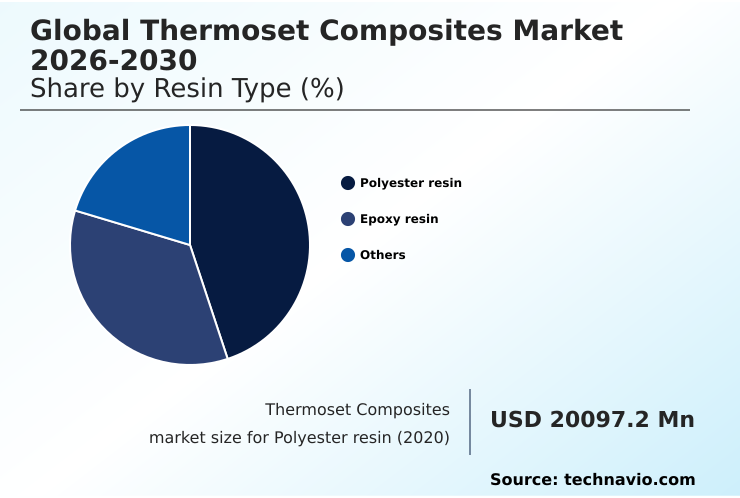
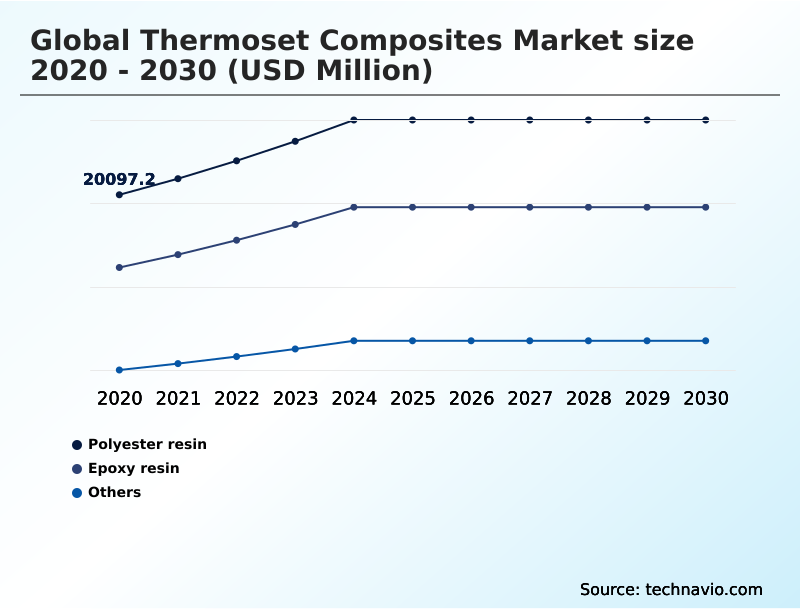
The Polyester resin segment was valued at USD 24.79 billion in 2024 and showed a gradual increase during the forecast period.
Regional Analysis
APAC is estimated to contribute 46.2% to the growth of the global market during the forecast period.Technavio’s analysts have elaborately explained the regional trends and drivers that shape the market during the forecast period.
See How Thermoset Composites Market Demand is Rising in APAC Request Free Sample
The geographic landscape is dominated by regions with strong industrial manufacturing bases. APAC leads the market, accounting for over 46% of consumption, driven by its vast electronics, construction, and renewable energy sectors.
North America follows, with a focus on aerospace and defense applications. In Europe, the automotive industry is a key consumer, pushing for innovations in high-volume production of thermoset composites.
In one European automotive plant, the adoption of new molding processes for sheet molding compounds (SMC) reduced cycle times by 18%.
The development of corrosion-resistant polymers is also crucial for infrastructure projects in coastal regions globally, with applications in both the pultrusion process and filament winding technology, addressing environmental degradation resistance.
Market Dynamics
Our researchers analyzed the data with 2025 as the base year, along with the key drivers, trends, and challenges. A holistic analysis of drivers will help companies refine their marketing strategies to gain a competitive advantage.
- The strategic adoption of advanced materials is reshaping industrial manufacturing, with a clear focus on specialized applications. For instance, thermoset composites for EV battery enclosures are becoming standard for achieving safety and lightweighting goals. Similarly, the aerospace sector continues to rely on carbon fiber prepreg for aerospace structures, where performance is non-negotiable.
- In construction, the use of glass fiber reinforced polymer (GFRP) rebar is gaining traction over steel in corrosive environments. The renewable energy sector's growth is directly tied to the performance of epoxy resin systems for wind turbine blades.
- In the automotive industry, sheet molding compound for automotive body panels allows for design flexibility and weight reduction, while phenolic composites for aircraft interiors meet strict fire safety regulations. Manufacturing processes are also evolving; rapid cure thermoset prepreg systems are critical for high-volume production, and there is a growing interest in bio-based thermoset resin formulations to meet sustainability targets.
- The development of high-temperature composite tooling materials enables the creation of more complex parts. These innovations provide lightweighting solutions for commercial vehicles and necessitate automated composite manufacturing process optimization. This focus on efficiency has led some firms to report processing times up to 15% faster than legacy systems, a critical metric for supply chain planning.
- The challenge of improving thermoset composite material recyclability remains a key R&D focus. Concurrently, the demand for structural analysis of composite materials is increasing to predict thermoset composite performance in harsh environments and develop cost-effective composite manufacturing techniques. This has broadened the use of advanced thermoset composites in defense applications and composite materials for the oil and gas industry.
- Finally, the use of pultruded profiles for construction applications and innovations in filament wound pressure vessel manufacturing showcase the material's versatility, alongside advancements in fire-resistant thermoset composites for marine use.
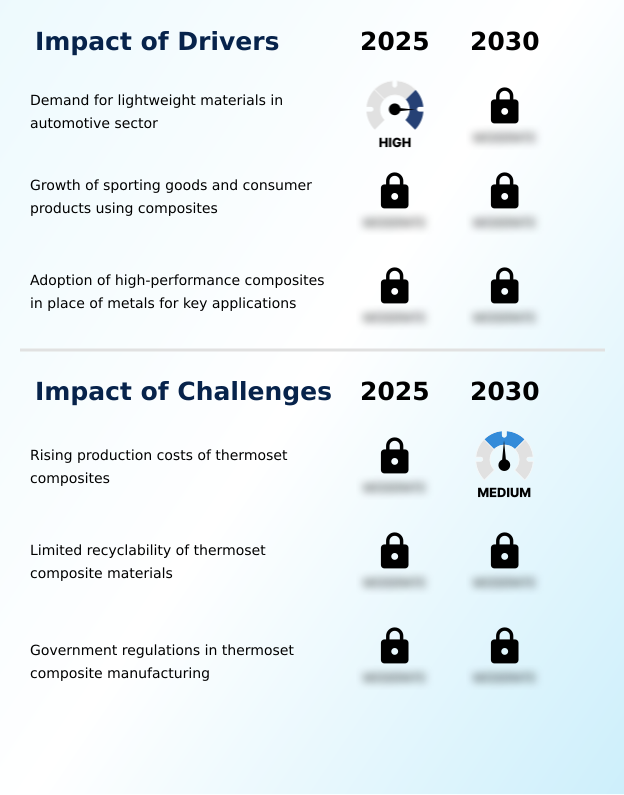
What are the key market drivers leading to the rise in the adoption of Thermoset Composites Industry?
- The increasing demand for lightweight materials within the automotive sector, aimed at improving fuel efficiency and vehicle performance, serves as a key driver for market growth.
- The primary driver is the relentless demand for lightweight composite structures in the automotive and aerospace sectors to enhance fuel efficiency and performance.
- Using carbon fiber prepregs in automotive structural components can reduce part weight by up to 40% compared to steel. The expansion of wind energy also propels demand for wind turbine blade materials with a high strength-to-weight ratio.
- The development of advanced polymer chemistry is enabling new epoxy resin composites with improved properties.
- The quest for better performance is also driving the adoption of hybrid composite materials and improving fiber-matrix interface adhesion, combining different fibers to optimize cost and mechanical characteristics, leading to a 15% improvement in impact resistance in certain applications.
What are the market trends shaping the Thermoset Composites Industry?
- A key market trend is the significant growth in wind power capacity additions. This expansion is driven by global renewable energy targets and technological advancements in turbine efficiency.
- The market is experiencing a significant shift toward sustainability and automation. There's a rising trend in composite material qualification, with new processes recovering up to 60% of fibers from end-of-life parts. The adoption of advanced polyurethane resin is also growing.
- Innovations in automated tape laying (ATL) are boosting production efficiency, with some facilities reporting a 20% reduction in layup times for complex geometries. This push for composite manufacturing automation is crucial. The focus on composite material simulation helps in optimizing designs for high-performance composites before physical prototyping, reducing development costs.
- Additionally, there's an increasing use of out-of-autoclave (OOA) curing methods and composite failure analysis to lower energy consumption and improve reliability.
What challenges does the Thermoset Composites Industry face during its growth?
- Rising production costs for thermoset composites, stemming from raw material prices and complex manufacturing processes, present a key challenge to the industry's growth.
- A key challenge remains the high production cost and complexity associated with industrial composite laminates and other advanced forms. The cost of raw materials for aerospace-grade composites can be more than 10 times that of traditional metals, limiting their use to high-value applications.
- The resin curing cycle time for some heat-resistant polymers remains a production bottleneck, although new phenolic resin systems are achieving reductions of up to 30%. Furthermore, ensuring consistent quality requires rigorous non-destructive testing (NDT), which adds to the overall cost and complexity.
- The industry also faces challenges in composite repair techniques, as restoring the original composite structural integrity of damaged parts is often difficult and expensive.
Exclusive Technavio Analysis on Customer Landscape
The thermoset composites market forecasting report includes the adoption lifecycle of the market, covering from the innovator’s stage to the laggard’s stage. It focuses on adoption rates in different regions based on penetration. Furthermore, the thermoset composites market report also includes key purchase criteria and drivers of price sensitivity to help companies evaluate and develop their market growth analysis strategies.
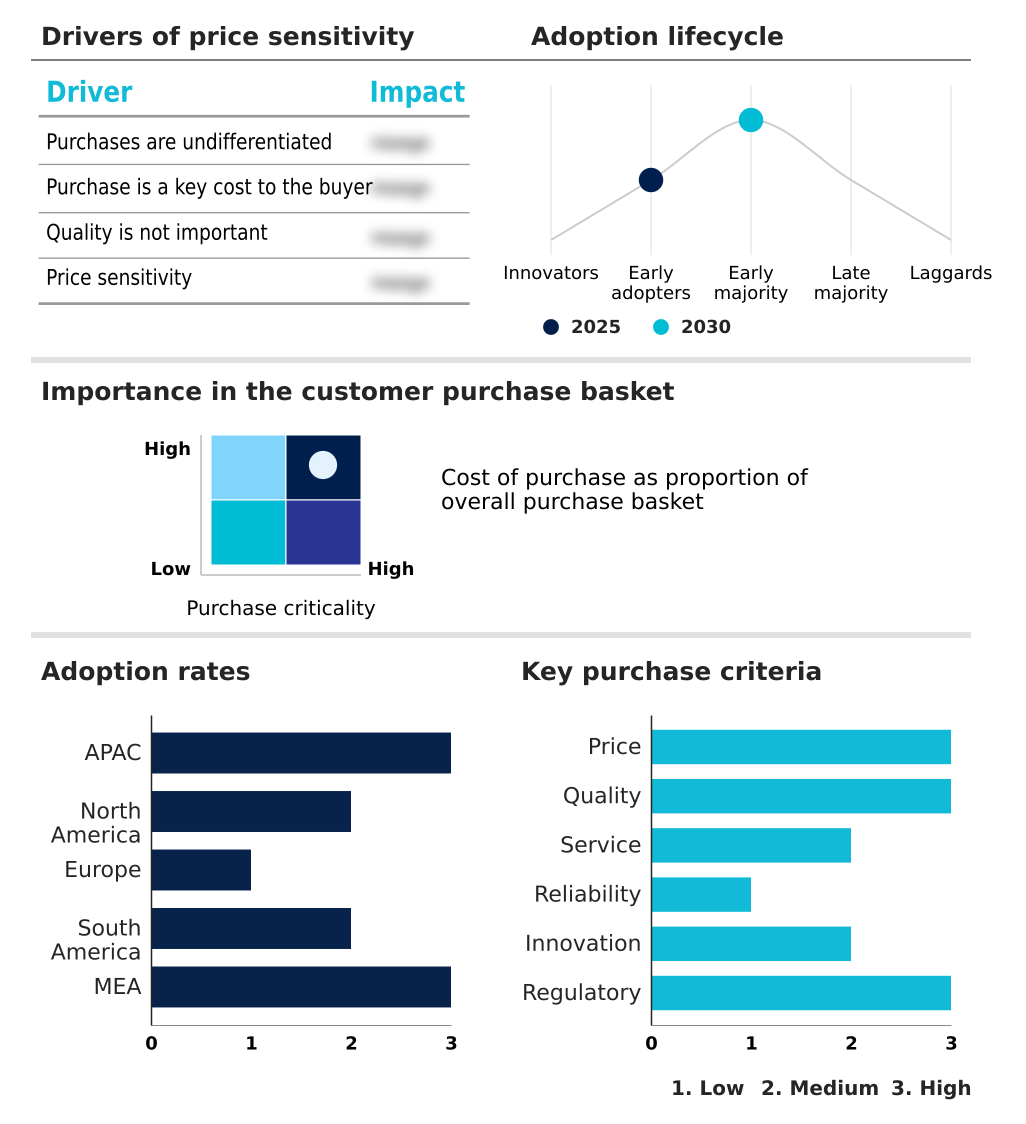
Customer Landscape of Thermoset Composites Industry
Competitive Landscape
Companies are implementing various strategies, such as strategic alliances, thermoset composites market forecast, partnerships, mergers and acquisitions, geographical expansion, and product/service launches, to enhance their presence in the industry.
Accurate Plastics and Mold Co. - Offers custom thermoset and thermoplastic composite laminates, prepregs, and preforms tailored for OEM and industrial applications.
The industry research and growth report includes detailed analyses of the competitive landscape of the market and information about key companies, including:
- Accurate Plastics and Mold Co.
- Advanced Composite Pty Ltd.
- AGY Holding Corp.
- China Jushi Co. Ltd.
- Hexcel Corp.
- Hexion Inc.
- Huntsman International LLC
- Johns Manville Corp.
- Lingol Corp.
- Mar Bal Inc.
- Mitsubishi Chemical Grp.
- Owens Corning
- PPG Industries Inc.
- SGL Carbon SE
- Solvay SA
- Teijin Ltd.
- Toray Industries Inc.
Qualitative and quantitative analysis of companies has been conducted to help clients understand the wider business environment as well as the strengths and weaknesses of key industry players. Data is qualitatively analyzed to categorize companies as pure play, category-focused, industry-focused, and diversified; it is quantitatively analyzed to categorize companies as dominant, leading, strong, tentative, and weak.
Recent Development and News in Thermoset composites market
- In February 2025, Owens Corning announced the divestiture of its glass reinforcements business to Praana Group, a strategic move to focus on its building and construction materials portfolio.
- In May 2025, Owens Corning reaffirmed its long-term financial goals and enterprise strategy during its Investor Day, highlighting the progress of its glass reinforcements business divestiture.
- In June 2025, Hexcel Corporation launched its HexPly M51 prepreg technology at the Paris Air Show, a new system designed for rapid curing to support high-rate aircraft production.
- In June 2025, Toray Industries Inc. materials were selected for the United States Army's Future Long-Range Assault Aircraft program, utilizing its T1100 carbon fiber prepreg for the aircraft's structure.
Dive into Technavio’s robust research methodology, blending expert interviews, extensive data synthesis, and validated models for unparalleled Thermoset Composites Market insights. See full methodology.
| Market Scope | |
|---|---|
| Page number | 297 |
| Base year | 2025 |
| Historic period | 2020-2024 |
| Forecast period | 2026-2030 |
| Growth momentum & CAGR | Accelerate at a CAGR of 6.4% |
| Market growth 2026-2030 | USD 21135.7 million |
| Market structure | Fragmented |
| YoY growth 2025-2026(%) | 6.0% |
| Key countries | China, Japan, India, South Korea, Australia, Indonesia, US, Canada, Mexico, Germany, UK, France, Italy, Spain, The Netherlands, Brazil, Argentina, Chile, Saudi Arabia, UAE, South Africa, Israel and Turkey |
| Competitive landscape | Leading Companies, Market Positioning of Companies, Competitive Strategies, and Industry Risks |
Research Analyst Overview
- The thermoset composites market is undergoing a significant transformation, driven by the need for advanced materials in critical industrial sectors. Materials like carbon fiber prepregs and epoxy resin composites are fundamental to achieving a high strength-to-weight ratio in aerospace-grade composites and automotive structural components. Innovations in prepreg composite technologies and composite manufacturing automation are addressing production bottlenecks.
- Boardroom decisions increasingly focus on balancing the high upfront cost of industrial composite laminates and heat-resistant polymers against long-term performance benefits and sustainability mandates. For instance, implementing automated fiber placement can improve production consistency by over 20% compared to manual methods.
- This strategic shift involves evaluating the entire lifecycle, from the selection of vinyl ester resin or polyurethane resin to addressing the challenges of composite material recyclability.
- The adoption of glass fiber reinforcements, sheet molding compounds (SMC), and bulk molding compounds (BMC) continues to expand, driven by versatile manufacturing processes like pultrusion process and filament winding technology, which are crucial for producing lightweight composite structures for applications such as wind turbine blade materials.
What are the Key Data Covered in this Thermoset Composites Market Research and Growth Report?
-
What is the expected growth of the Thermoset Composites Market between 2026 and 2030?
-
USD 21.14 billion, at a CAGR of 6.4%
-
-
What segmentation does the market report cover?
-
The report is segmented by Resin Type (Polyester resin, Epoxy resin, and Others), Product Type (Glass fiber, Carbon fiber, and Others), End-user (Aerospace and defense, Automotive, Construction and infrastructure, Electrical and electronics, and Others) and Geography (APAC, North America, Europe, South America, Middle East and Africa)
-
-
Which regions are analyzed in the report?
-
APAC, North America, Europe, South America and Middle East and Africa
-
-
What are the key growth drivers and market challenges?
-
Demand for lightweight materials in automotive sector, Rising production costs of thermoset composites
-
-
Who are the major players in the Thermoset Composites Market?
-
Accurate Plastics and Mold Co., Advanced Composite Pty Ltd., AGY Holding Corp., China Jushi Co. Ltd., Hexcel Corp., Hexion Inc., Huntsman International LLC, Johns Manville Corp., Lingol Corp., Mar Bal Inc., Mitsubishi Chemical Grp., Owens Corning, PPG Industries Inc., SGL Carbon SE, Solvay SA, Teijin Ltd. and Toray Industries Inc.
-
Market Research Insights
- The market's dynamics are shaped by continuous innovation in composite material formulation and advanced polymer chemistry. The integrity of the cross-linking polymer matrix is central to achieving specified material performance criteria, with a focus on composite structural integrity.
- Manufacturers are optimizing the resin curing cycle time, with some advanced systems reducing cure durations by up to 25% compared to conventional methods, which directly impacts throughput. Rigorous mechanical property testing and thermal stability analysis are essential, especially in regulated industries.
- Innovations in resin infusion technology are improving part quality and reducing voids, leading to a scrap rate reduction of nearly 10% in some operations. This is complemented by advances in composite tooling design to support more complex geometries.
We can help! Our analysts can customize this thermoset composites market research report to meet your requirements.