


Japan - Testing, Inspection and Certification (TIC) Market by Service Type, Source and End-user - Forecast and Analysis 2024-2028

Japan - Testing, Inspection and Certification (TIC) Market by Service Type, Source and End-user - Forecast and Analysis 2024-2028

Published: Dec 2023 161 Pages SKU: IRTNTR72225

Market Overview at a Glance

$3.1 B
Market Opportunity
3.71%
CAGR
3.21
YoY growth 2023-2024(%)

Japan Testing, Inspection, and Certification Market Size 2024-2028

The Japan testing, inspection, and certification market size is valued to increase USD 3.10 billion, at a CAGR of 3.71% from 2023 to 2028. Stringent government regulations to ensure product and environmental safety will drive the Japan testing, inspection, and certification market.

Major Market Trends & Insights

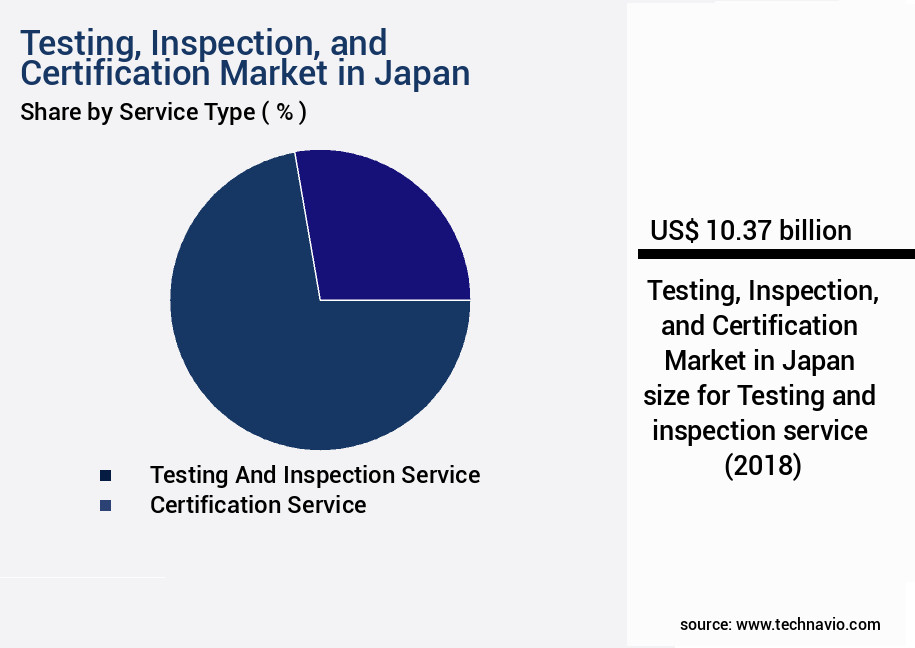
  • By Service Type - Testing and inspection service segment was valued at USD 10.37 billion in 2022
  • By Source - In-house segment accounted for the largest market revenue share in 2022

Market Size & Forecast

  • Market Opportunities: USD 0 billion
  • Market Future Opportunities: USD 0 billion
  • CAGR from 2023 to 2028 : 3.71%

Market Summary

  • The market is a critical sector, encompassing core technologies and applications such as non-destructive testing, product certification, and quality assurance. This market is characterized by the continuous unfolding of market activities and evolving patterns. Strict government regulations, driven by the need to ensure product and environmental safety, are a primary market driver. For instance, the Japanese Ministry of Economy, Trade, and Industry mandates certification for various industries, including automotive, electronics, and construction. Another significant trend is the rise in adoption of artificial intelligence (AI) and machine learning (ML) in testing, inspection, and certification services. This technological advancement enhances efficiency, accuracy, and reduces human error.
  • However, the high cost of testing, inspection, and certification services remains a challenge for small and medium-sized enterprises (SMEs). According to a survey by the Japan External Trade Organization, approximately 70% of SMEs in Japan face challenges in complying with regulations due to the high costs. Despite these challenges, the market continues to evolve, offering opportunities for innovation and growth.

What will be the Size of the Japan Testing, Inspection, and Certification Market during the forecast period?
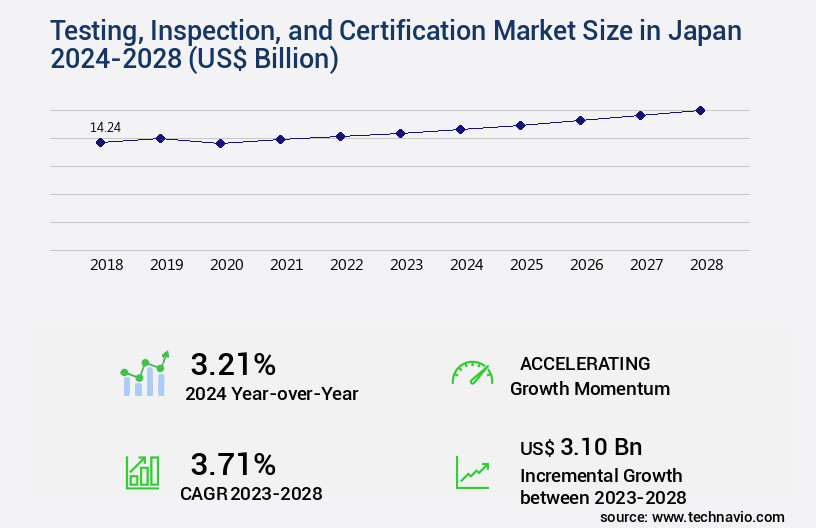
Testing, Inspection, and Certification Market in Japan Size

Get Key Insights on Market Forecast (PDF) Request Free Sample

How is the Testing, Inspection, and Certification in Japan Market Segmented and what are the key trends of market segmentation?

The testing, inspection, and certification in Japan industry research report provides comprehensive data (region-wise segment analysis), with forecasts and estimates in "USD billion" for the period 2024-2028, as well as historical data from 2018-2022 for the following segments.

  • Service Type
    • Testing and inspection service
    • Certification service
  • Source
    • In-house
    • Outsourced
  • End-user
    • Infrastructure
    • Energy and power
    • Healthcare
    • Manufacturing
    • Others
  • Geography
    • APAC
      • Japan

By Service Type Insights

The testing and inspection service segment is estimated to witness significant growth during the forecast period.

The testing and inspection service segment holds a significant share in Japan's thriving testing, inspection, and certification market. With a relentless focus on safety, quality, and regulatory compliance, this segment is instrumental in maintaining Japan's reputation for rigorous standards and reliability. Activities span from material testing and inspection reporting to quality control metrics, risk assessment methods, and non-destructive testing. Notably, the automotive industry is a significant area of focus, with major players like Honda Motor Co Ltd, Toyota Motor Corp, and Nissan Motor Co Ltd, implementing various testing methodologies, including destructive testing, performance testing, and safety testing. These companies prioritize corrective actions and employ advanced quality management systems, certification bodies, and traceability systems to ensure product validation and continuous improvement.

Inspection protocols, preventive measures, and environmental testing are also crucial components, supported by inspection tools, quality assurance systems, testing equipment, and certification standards. Auditing procedures, data integrity, calibration procedures, root cause analysis, and compliance audits further bolster the sector's commitment to maintaining the highest standards.
Testing, Inspection, and Certification Market in Japan Size

Request Free Sample

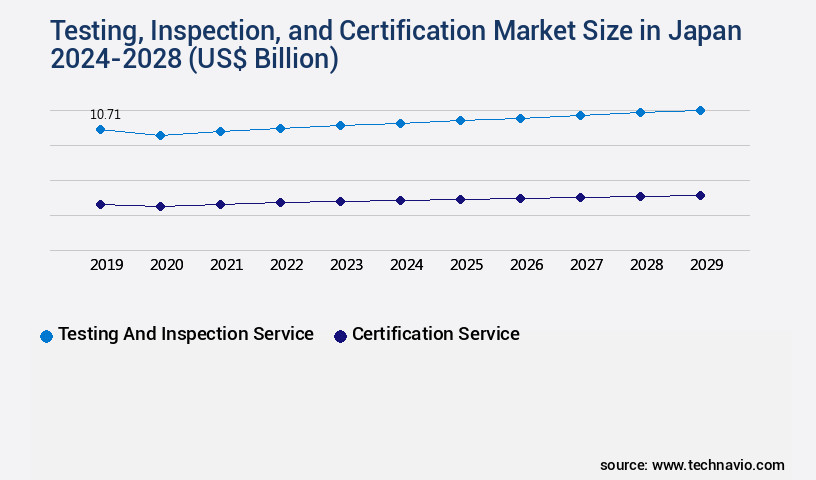
The Testing and inspection service segment was valued at USD 10.37 billion in 2018 and showed a gradual increase during the forecast period.
Testing, Inspection, and Certification Market in Japan Size

Request Free Sample

Market Dynamics

Our researchers analyzed the data with 2023 as the base year, along with the key drivers, trends, and challenges. A holistic analysis of drivers will help companies refine their marketing strategies to gain a competitive advantage.

In the dynamic and evolving landscape of the market, various sectors prioritize non-destructive testing methods to ensure product quality and adherence to stringent regulations. Quality management system implementation and statistical process control techniques are integral components of this process, enabling organizations to manage product lifecycle and supplier quality effectively. Environmental testing procedures and safety testing protocols are essential in the Japanese market, reflecting a strong commitment to ISO 14001 environmental certification. Failure analysis and corrective actions, root cause analysis methodologies, process capability analysis, and quality control chart interpretation are essential tools for continuous improvement initiatives. Data integrity management practices and traceability systems implementation are critical for maintaining transparency and accountability.

Risk assessment and mitigation strategies, quality assurance program development, testing equipment calibration schedules, and inspection reporting and documentation are other essential elements of this market. Compared to other regions, the adoption of advanced testing technologies in Japan is significantly higher. More than 80% of Japanese companies invest in non-destructive testing methods, surpassing the global average. This commitment to quality and safety is a testament to the market's maturity and the importance placed on maintaining a strong reputation for excellence. In conclusion, the market is a thriving industry, driven by a focus on quality, innovation, and regulatory compliance. Companies that prioritize these elements and invest in advanced testing technologies will reap the rewards of a competitive edge and customer trust.
Testing, Inspection, and Certification Market in Japan Size

What are the key market drivers leading to the rise in the adoption of Testing, Inspection, and Certification in Japan Industry?

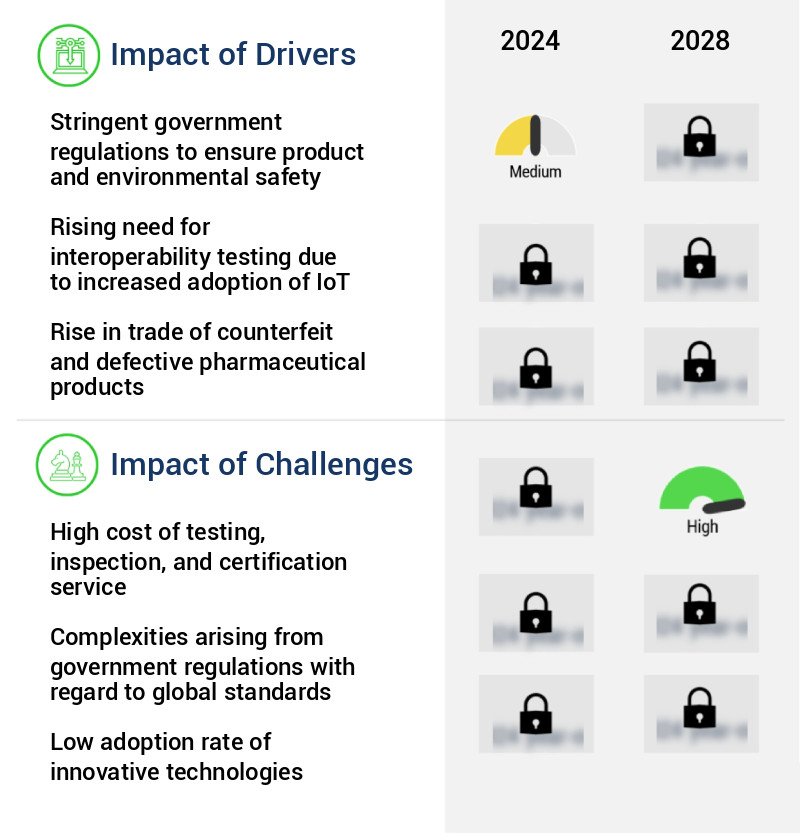
  • Strict government regulations, which prioritize product safety and environmental protection, serve as the primary market driver. 
  • Stringent government regulations are a significant driving force behind the market. These regulations prioritize product safety and environmental protection, setting high standards for industries to adhere to. The Ministry of Health, Labor, and Welfare (MHLW) and the Ministry of Economy, Trade and Industry (METI) are key regulatory bodies responsible for establishing and enforcing these guidelines. Their efforts ensure consumer welfare and minimize environmental impacts. The testing, inspection, and certification services play a crucial role in validating compliance with these stringent requirements.
  • For instance, MHLW oversees regulations related to food safety, pharmaceuticals, and medical devices, while METI focuses on industrial safety and environmental standards. By implementing rigorous testing, inspection, and certification processes, these regulatory bodies safeguard public health and the environment, making Japan a global leader in regulatory compliance.

What are the market trends shaping the Testing, Inspection, and Certification in Japan Industry?

  • The adoption of artificial intelligence (AI) and machine learning (ML) is increasingly prevalent in testing, inspection, and certification services. This emerging market trend mandates professional expertise in implementing these technologies.
  • Artificial intelligence (AI) and machine learning (ML) technologies have significantly influenced testing, inspection, and certification services in Japan, introducing innovative methods for quality assurance, process optimization, and compliance verification. The integration of AI and ML has brought about substantial progress in predictive analytics, automation, and data-driven decision-making, revolutionizing the effectiveness, efficiency, and reach of testing, inspection, and certification services across various sectors. These technologies are increasingly utilized to streamline testing processes for various products, systems, and procedures, optimizing testing schedules, resource allocation, and result analysis. AI and ML have transformed testing in Japan by enhancing accuracy, reducing human error, and increasing productivity.
  • For instance, predictive analytics enables early detection of potential issues, while automation speeds up repetitive tasks, allowing human experts to focus on complex problem-solving. The application of AI and ML in testing, inspection, and certification services continues to evolve, offering promising opportunities for improved efficiency, quality, and innovation.

What challenges does the Testing, Inspection, and Certification in Japan Industry face during its growth?

  • The escalating costs associated with testing, inspection, and certification services pose a significant challenge to the industry's growth trajectory. 
  • The market faces a significant challenge due to the high financial burden associated with these services. This cost barrier affects various industries and organizations, leading to repercussions such as reduced competitiveness, challenges to market entry, and increased operational expenses. The cost for testing, inspection, and certification services varies in Japan, with prices ranging from USD680 to USD3,408. Small and medium-sized enterprises (SMEs) in Japan are particularly impacted, as they often lack the financial resources to cover these expenses. Consequently, they face limited access to international trade and global markets. This high cost trend is a continuous issue in the market, necessitating ongoing attention and potential solutions to ensure businesses can effectively navigate the testing, inspection, and certification landscape in Japan.

Exclusive Customer Landscape

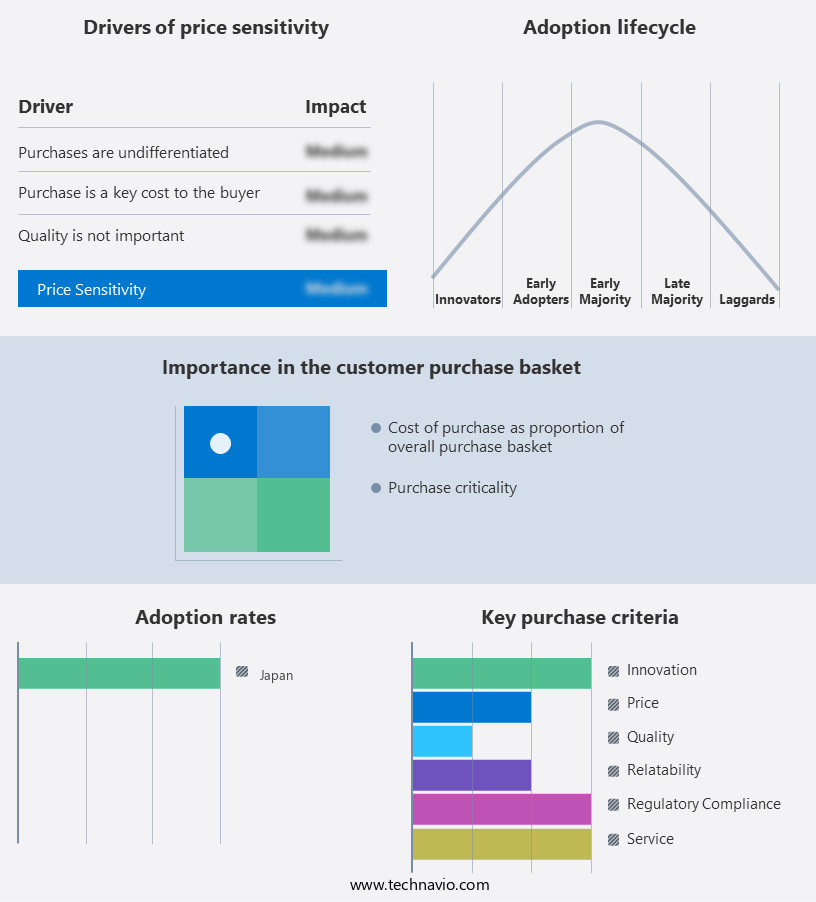
The Japan testing, inspection, and certification market forecasting report includes the adoption lifecycle of the market, covering from the innovator's stage to the laggard's stage. It focuses on adoption rates in different regions based on penetration. Furthermore, the Japan testing, inspection, and certification market report also includes key purchase criteria and drivers of price sensitivity to help companies evaluate and develop their market growth analysis strategies.
Testing, Inspection, and Certification Market in Japan Share by Geography

 Customer Landscape of Testing, Inspection, and Certification in Japan Industry

Competitive Landscape & Market Insights

Companies are implementing various strategies, such as strategic alliances, Japan testing, inspection, and certification market forecast, partnerships, mergers and acquisitions, geographical expansion, and product/service launches, to enhance their presence in the industry.

American Bureau of Shipping - ABS Group of Companies Inc., a subsidiary of the global organization, provides product testing, inspection, and certification services through the ABS QE Audit Process. This rigorous evaluation ensures compliance with industry standards, issuing ABS QE Audit Process certificates to validate product quality and safety.

The industry research and growth report includes detailed analyses of the competitive landscape of the market and information about key companies, including:

  • American Bureau of Shipping
  • AmSpec LLC
  • Apave Group
  • Applus Services S.A.
  • AsureQuality Ltd.
  • Bureau Veritas SA
  • Cotecna Inspection SA
  • DEKRA SE
  • DNV Group AS
  • Element Materials Technology Group Ltd.
  • Eurofins Scientific SE
  • Helmsman Quality and Technology Services Co. Ltd.
  • Intertek Group Plc
  • Japan Inspection Co. Ltd.
  • L and T Technology Services Ltd.
  • SGS SA
  • TUV NORD Group
  • TUV Rheinland AG
  • TUV SUD AG
  • UL Solutions Inc.

Qualitative and quantitative analysis of companies has been conducted to help clients understand the wider business environment as well as the strengths and weaknesses of key industry players. Data is qualitatively analyzed to categorize companies as pure play, category-focused, industry-focused, and diversified; it is quantitatively analyzed to categorize companies as dominant, leading, strong, tentative, and weak.

Recent Development and News in Testing, Inspection, And Certification Market In Japan

  • In January 2024, TÜV SÜD, a global testing, inspection, and certification organization, announced the expansion of its operations in Japan by opening a new laboratory in Tokyo. This expansion aimed to support the growing demand for safety and quality testing in the automotive and industrial sectors (TÜV SÜD press release).
  • In March 2024, Intertek, a leading total quality and inspection company, entered into a strategic partnership with Mitsui O.S.K. Lines, Ltd., a Japanese shipping company, to provide inspection and certification services for their global fleet. This collaboration was expected to enhance Intertek's presence in the maritime industry and strengthen Mitsui O.S.K. Lines' commitment to safety and compliance (Intertek press release).
  • In May 2024, SGS, a leading inspection, verification, testing, and certification company, acquired a majority stake in a Japanese food testing laboratory, expanding its food testing capabilities in the region. The acquisition was part of SGS's growth strategy to strengthen its presence in the Japanese food safety testing market (SGS press release).
  • In February 2025, the Japanese government announced the implementation of new regulations for construction projects, mandating third-party inspections and certifications to ensure safety and quality. This initiative was expected to boost the demand for testing, inspection, and certification services in the Japanese construction industry (Japanese Ministry of Land, Infrastructure, Transport and Tourism press release).

Dive into Technavio's robust research methodology, blending expert interviews, extensive data synthesis, and validated models for unparalleled Japan Testing, Inspection, and Certification Market insights. See full methodology.

Market Scope

Report Coverage

Details

Page number

161

Base year

2023

Historic period

2018-2022

Forecast period

2024-2028

Growth momentum & CAGR

Accelerate at a CAGR of 3.71%

Market growth 2024-2028

USD 3.10 billion

Market structure

Fragmented

YoY growth 2023-2024(%)

3.21

Key countries

Japan

Competitive landscape

Leading Companies, Market Positioning of Companies, Competitive Strategies, and Industry Risks

Request Free Sample

Research Analyst Overview

  • In the dynamic and evolving the market, material testing plays a pivotal role in ensuring product quality and regulatory compliance. Inspection reporting, a crucial aspect of this process, provides valuable data for quality control metrics. Non-destructive testing methodologies, such as ultrasonic and magnetic particle inspection, are increasingly popular due to their ability to assess the integrity of components without damaging them. Risk assessment methods are integral to the testing process, helping to identify potential hazards and prevent safety issues. Regulatory compliance is a significant driver of market activity, with certification bodies enforcing stringent standards.
  • Performance testing, corrective actions, and root cause analysis are essential components of quality management systems. Quality assurance systems rely on certification standards, auditing procedures, and calibration procedures to maintain data integrity and continuous improvement. Defect detection is a continuous process, with inspection protocols and preventive measures ensuring the highest standards. Environmental testing is also a critical aspect, with inspection tools designed to assess the impact of various conditions on materials and products. Safety testing is another key area, with ISO 9001 certification and traceability systems ensuring the highest levels of product validation. Process verification and quality control charts are essential tools for monitoring and improving production processes.
  • Destructive testing, while less common, is sometimes necessary for evaluating the limits of materials and components. In this market, non-destructive testing, risk assessment methods, and regulatory compliance are driving trends. Quality control metrics, inspection reporting, and data integrity are key performance indicators. The use of advanced testing equipment and certification standards is on the rise, reflecting the industry's commitment to innovation and continuous improvement.

What are the Key Data Covered in this Japan Testing, Inspection, and Certification Market Research and Growth Report?

  • What is the expected growth of the Japan Testing, Inspection, and Certification Market between 2024 and 2028?

    • USD 3.10 billion, at a CAGR of 3.71%

  • What segmentation does the market report cover?

    • The report segmented by Service Type (Testing and inspection service and Certification service), Source (In-house and Outsourced), End-user (Infrastructure, Energy and power, Healthcare, Manufacturing, and Others), and Geography (APAC)

  • Which regions are analyzed in the report?

    • Japan

  • What are the key growth drivers and market challenges?

    • Stringent government regulations to ensure product and environmental safety, High cost of testing, inspection, and certification service

  • Who are the major players in the Testing, Inspection, and Certification Market in Japan?

    • Key Companies American Bureau of Shipping, AmSpec LLC, Apave Group, Applus Services S.A., AsureQuality Ltd., Bureau Veritas SA, Cotecna Inspection SA, DEKRA SE, DNV Group AS, Element Materials Technology Group Ltd., Eurofins Scientific SE, Helmsman Quality and Technology Services Co. Ltd., Intertek Group Plc, Japan Inspection Co. Ltd., L and T Technology Services Ltd., SGS SA, TUV NORD Group, TUV Rheinland AG, TUV SUD AG, and UL Solutions Inc.

Market Research Insights

  • The market is a critical component of the country's industrial sector, underpinned by a commitment to quality and compliance. With an increasing focus on process audits and operational efficiency, this market is driven by the need for quality assurance and performance analysis. According to industry estimates, the testing procedures market in Japan was valued at USD12 billion in 2020, with a growth rate of 3% projected annually. Compliance verification and certification schemes are also significant areas of investment, with over 60% of Japanese companies holding at least one certification. Environmental impact is a key consideration, with process validation and testing standards prioritizing sustainability.
  • Data management plays a crucial role in inspection planning and report generation, ensuring quality systems remain effective and efficient. Material science and inspection techniques are continually evolving, with equipment calibration and certification processes ensuring accuracy and reliability. Defect prevention and failure modes analysis are integral to risk management, driving continuous improvement and enhancing product safety and reliability.

We can help! Our analysts can customize this Japan testing, inspection, and certification market research report to meet your requirements.

Get in touch

1 Executive Summary

  • 1.1 Market overview
    • Exhibit 01: Executive Summary – Chart on Market Overview
    • Exhibit 02: Executive Summary – Data Table on Market Overview
    • Exhibit 03: Executive Summary – Chart on Country Market Characteristics
    • Exhibit 04: Executive Summary – Chart on Market Segmentation by Service Type
    • Exhibit 05: Executive Summary – Chart on Market Segmentation by Source
    • Exhibit 06: Executive Summary – Chart on Market Segmentation by End-user
    • Exhibit 07: Executive Summary – Chart on Vendor Market Positioning

2 Market Landscape

  • 2.1 Market ecosystem
    • Exhibit 08: Parent market
    • Exhibit 09: Market Characteristics

3 Market Sizing

  • 3.1 Market definition
    • Exhibit 10: Offerings of vendors included in the market definition
  • 3.2 Market segment analysis
    • Exhibit 11: Market segments
  • 3.3 Market size 2023
    • 3.4 Market outlook: Forecast for 2023-2028
      • Exhibit 12: Chart on Japan - Market size and forecast 2023-2028 ($ billion)
      • Exhibit 13: Data Table on Japan - Market size and forecast 2023-2028 ($ billion)
      • Exhibit 14: Chart on Japan: Year-over-year growth 2023-2028 (%)
      • Exhibit 15: Data Table on Japan: Year-over-year growth 2023-2028 (%)

    4 Historic Market Size

    • 4.1 Testing, inspection, and certification market in Japan 2018 - 2022
      • Exhibit 16: Historic Market Size – Data Table on testing, inspection, and certification market in Japan 2018 - 2022 ($ billion)
    • 4.2 Service Type Segment Analysis 2018 - 2022
      • Exhibit 17: Historic Market Size – Service Type Segment 2018 - 2022 ($ billion)
    • 4.3 Source Segment Analysis 2018 - 2022
      • Exhibit 18: Historic Market Size – Source Segment 2018 - 2022 ($ billion)
    • 4.4 End-user Segment Analysis 2018 - 2022
      • Exhibit 19: Historic Market Size – End-user Segment 2018 - 2022 ($ billion)

    5 Five Forces Analysis

    • 5.1 Five forces summary
      • Exhibit 20: Five forces analysis - Comparison between 2023 and 2028
    • 5.2 Bargaining power of buyers
      • Exhibit 21: Chart on Bargaining power of buyers – Impact of key factors 2023 and 2028
    • 5.3 Bargaining power of suppliers
      • Exhibit 22: Bargaining power of suppliers – Impact of key factors in 2023 and 2028
    • 5.4 Threat of new entrants
      • Exhibit 23: Threat of new entrants – Impact of key factors in 2023 and 2028
    • 5.5 Threat of substitutes
      • Exhibit 24: Threat of substitutes – Impact of key factors in 2023 and 2028
    • 5.6 Threat of rivalry
      • Exhibit 25: Threat of rivalry – Impact of key factors in 2023 and 2028
    • 5.7 Market condition
      • Exhibit 26: Chart on Market condition - Five forces 2023 and 2028

    6 Market Segmentation by Service Type

    • 6.1 Market segments
      • Exhibit 27: Chart on Service Type - Market share 2023-2028 (%)
      • Exhibit 28: Data Table on Service Type - Market share 2023-2028 (%)
    • 6.2 Comparison by Service Type
      • Exhibit 29: Chart on Comparison by Service Type
      • Exhibit 30: Data Table on Comparison by Service Type
    • 6.3 Testing and inspection service - Market size and forecast 2023-2028
      • Exhibit 31: Chart on Testing and inspection service - Market size and forecast 2023-2028 ($ billion)
      • Exhibit 32: Data Table on Testing and inspection service - Market size and forecast 2023-2028 ($ billion)
      • Exhibit 33: Chart on Testing and inspection service - Year-over-year growth 2023-2028 (%)
      • Exhibit 34: Data Table on Testing and inspection service - Year-over-year growth 2023-2028 (%)
    • 6.4 Certification service - Market size and forecast 2023-2028
      • Exhibit 35: Chart on Certification service - Market size and forecast 2023-2028 ($ billion)
      • Exhibit 36: Data Table on Certification service - Market size and forecast 2023-2028 ($ billion)
      • Exhibit 37: Chart on Certification service - Year-over-year growth 2023-2028 (%)
      • Exhibit 38: Data Table on Certification service - Year-over-year growth 2023-2028 (%)
    • 6.5 Market opportunity by Service Type
      • Exhibit 39: Market opportunity by Service Type ($ billion)
      • Exhibit 40: Data Table on Market opportunity by Service Type ($ billion)

    7 Market Segmentation by Source

    • 7.1 Market segments
      • Exhibit 41: Chart on Source - Market share 2023-2028 (%)
      • Exhibit 42: Data Table on Source - Market share 2023-2028 (%)
    • 7.2 Comparison by Source
      • Exhibit 43: Chart on Comparison by Source
      • Exhibit 44: Data Table on Comparison by Source
    • 7.3 In-house - Market size and forecast 2023-2028
      • Exhibit 45: Chart on In-house - Market size and forecast 2023-2028 ($ billion)
      • Exhibit 46: Data Table on In-house - Market size and forecast 2023-2028 ($ billion)
      • Exhibit 47: Chart on In-house - Year-over-year growth 2023-2028 (%)
      • Exhibit 48: Data Table on In-house - Year-over-year growth 2023-2028 (%)
    • 7.4 Outsourced - Market size and forecast 2023-2028
      • Exhibit 49: Chart on Outsourced - Market size and forecast 2023-2028 ($ billion)
      • Exhibit 50: Data Table on Outsourced - Market size and forecast 2023-2028 ($ billion)
      • Exhibit 51: Chart on Outsourced - Year-over-year growth 2023-2028 (%)
      • Exhibit 52: Data Table on Outsourced - Year-over-year growth 2023-2028 (%)
    • 7.5 Market opportunity by Source
      • Exhibit 53: Market opportunity by Source ($ billion)
      • Exhibit 54: Data Table on Market opportunity by Source ($ billion)

    8 Market Segmentation by End-user

    • 8.1 Market segments
      • Exhibit 55: Chart on End-user - Market share 2023-2028 (%)
      • Exhibit 56: Data Table on End-user - Market share 2023-2028 (%)
    • 8.2 Comparison by End-user
      • Exhibit 57: Chart on Comparison by End-user
      • Exhibit 58: Data Table on Comparison by End-user
    • 8.3 Infrastructure - Market size and forecast 2023-2028
      • Exhibit 59: Chart on Infrastructure - Market size and forecast 2023-2028 ($ billion)
      • Exhibit 60: Data Table on Infrastructure - Market size and forecast 2023-2028 ($ billion)
      • Exhibit 61: Chart on Infrastructure - Year-over-year growth 2023-2028 (%)
      • Exhibit 62: Data Table on Infrastructure - Year-over-year growth 2023-2028 (%)
    • 8.4 Energy and power - Market size and forecast 2023-2028
      • Exhibit 63: Chart on Energy and power - Market size and forecast 2023-2028 ($ billion)
      • Exhibit 64: Data Table on Energy and power - Market size and forecast 2023-2028 ($ billion)
      • Exhibit 65: Chart on Energy and power - Year-over-year growth 2023-2028 (%)
      • Exhibit 66: Data Table on Energy and power - Year-over-year growth 2023-2028 (%)
    • 8.5 Healthcare - Market size and forecast 2023-2028
      • Exhibit 67: Chart on Healthcare - Market size and forecast 2023-2028 ($ billion)
      • Exhibit 68: Data Table on Healthcare - Market size and forecast 2023-2028 ($ billion)
      • Exhibit 69: Chart on Healthcare - Year-over-year growth 2023-2028 (%)
      • Exhibit 70: Data Table on Healthcare - Year-over-year growth 2023-2028 (%)
    • 8.6 Manufacturing - Market size and forecast 2023-2028
      • Exhibit 71: Chart on Manufacturing - Market size and forecast 2023-2028 ($ billion)
      • Exhibit 72: Data Table on Manufacturing - Market size and forecast 2023-2028 ($ billion)
      • Exhibit 73: Chart on Manufacturing - Year-over-year growth 2023-2028 (%)
      • Exhibit 74: Data Table on Manufacturing - Year-over-year growth 2023-2028 (%)
    • 8.7 Others - Market size and forecast 2023-2028
      • Exhibit 75: Chart on Others - Market size and forecast 2023-2028 ($ billion)
      • Exhibit 76: Data Table on Others - Market size and forecast 2023-2028 ($ billion)
      • Exhibit 77: Chart on Others - Year-over-year growth 2023-2028 (%)
      • Exhibit 78: Data Table on Others - Year-over-year growth 2023-2028 (%)
    • 8.8 Market opportunity by End-user
      • Exhibit 79: Market opportunity by End-user ($ billion)
      • Exhibit 80: Data Table on Market opportunity by End-user ($ billion)

    9 Customer Landscape

    • 9.1 Customer landscape overview
      • Exhibit 81: Analysis of price sensitivity, lifecycle, customer purchase basket, adoption rates, and purchase criteria

    10 Drivers, Challenges, and Trends

    • 10.1 Market drivers
      • 10.2 Market challenges
        • 10.3 Impact of drivers and challenges
          • Exhibit 82: Impact of drivers and challenges in 2023 and 2028
        • 10.4 Market trends

          11 Vendor Landscape

          • 11.1 Overview
            • 11.2 Vendor landscape
              • Exhibit 83: Overview on Criticality of inputs and Factors of differentiation
            • 11.3 Landscape disruption
              • Exhibit 84: Overview on factors of disruption
            • 11.4 Industry risks
              • Exhibit 85: Impact of key risks on business

            12 Vendor Analysis

            • 12.1 Vendors covered
              • Exhibit 86: Vendors covered
            • 12.2 Market positioning of vendors
              • Exhibit 87: Matrix on vendor position and classification
            • 12.3 American Bureau of Shipping
              • Exhibit 88: American Bureau of Shipping - Overview
              • Exhibit 89: American Bureau of Shipping - Product / Service
              • Exhibit 90: American Bureau of Shipping - Key offerings
            • 12.4 AmSpec LLC
              • Exhibit 91: AmSpec LLC - Overview
              • Exhibit 92: AmSpec LLC - Product / Service
              • Exhibit 93: AmSpec LLC - Key offerings
            • 12.5 Apave Group
              • Exhibit 94: Apave Group - Overview
              • Exhibit 95: Apave Group - Product / Service
              • Exhibit 96: Apave Group - Key offerings
            • 12.6 Bureau Veritas SA
              • Exhibit 97: Bureau Veritas SA - Overview
              • Exhibit 98: Bureau Veritas SA - Business segments
              • Exhibit 99: Bureau Veritas SA - Key news
              • Exhibit 100: Bureau Veritas SA - Key offerings
              • Exhibit 101: Bureau Veritas SA - Segment focus
            • 12.7 Cotecna Inspection SA
              • Exhibit 102: Cotecna Inspection SA - Overview
              • Exhibit 103: Cotecna Inspection SA - Product / Service
              • Exhibit 104: Cotecna Inspection SA - Key offerings
            • 12.8 DNV Group AS
              • Exhibit 105: DNV Group AS - Overview
              • Exhibit 106: DNV Group AS - Business segments
              • Exhibit 107: DNV Group AS - Key news
              • Exhibit 108: DNV Group AS - Key offerings
              • Exhibit 109: DNV Group AS - Segment focus
            • 12.9 Element Materials Technology Group Ltd.
              • Exhibit 110: Element Materials Technology Group Ltd. - Overview
              • Exhibit 111: Element Materials Technology Group Ltd. - Product / Service
              • Exhibit 112: Element Materials Technology Group Ltd. - Key offerings
            • 12.10 Helmsman Quality and Technology Services Co. Ltd.
              • Exhibit 113: Helmsman Quality and Technology Services Co. Ltd. - Overview
              • Exhibit 114: Helmsman Quality and Technology Services Co. Ltd. - Product / Service
              • Exhibit 115: Helmsman Quality and Technology Services Co. Ltd. - Key offerings
            • 12.11 Intertek Group Plc
              • Exhibit 116: Intertek Group Plc - Overview
              • Exhibit 117: Intertek Group Plc - Business segments
              • Exhibit 118: Intertek Group Plc - Key news
              • Exhibit 119: Intertek Group Plc - Key offerings
              • Exhibit 120: Intertek Group Plc - Segment focus
            • 12.12 Japan Inspection Co. Ltd.
              • Exhibit 121: Japan Inspection Co. Ltd. - Overview
              • Exhibit 122: Japan Inspection Co. Ltd. - Product / Service
              • Exhibit 123: Japan Inspection Co. Ltd. - Key offerings
            • 12.13 SGS SA
              • Exhibit 124: SGS SA - Overview
              • Exhibit 125: SGS SA - Business segments
              • Exhibit 126: SGS SA - Key offerings
              • Exhibit 127: SGS SA - Segment focus
            • 12.14 TUV NORD Group
              • Exhibit 128: TUV NORD Group - Overview
              • Exhibit 129: TUV NORD Group - Business segments
              • Exhibit 130: TUV NORD Group - Key offerings
              • Exhibit 131: TUV NORD Group - Segment focus
            • 12.15 TUV Rheinland AG
              • Exhibit 132: TUV Rheinland AG - Overview
              • Exhibit 133: TUV Rheinland AG - Business segments
              • Exhibit 134: TUV Rheinland AG - Key offerings
              • Exhibit 135: TUV Rheinland AG - Segment focus
            • 12.16 TUV SUD AG
              • Exhibit 136: TUV SUD AG - Overview
              • Exhibit 137: TUV SUD AG - Product / Service
              • Exhibit 138: TUV SUD AG - Key offerings
            • 12.17 UL Solutions Inc.
              • Exhibit 139: UL Solutions Inc. - Overview
              • Exhibit 140: UL Solutions Inc. - Product / Service
              • Exhibit 141: UL Solutions Inc. - Key offerings

            13 Appendix

            • 13.1 Scope of the report
              • 13.2 Inclusions and exclusions checklist
                • Exhibit 142: Inclusions checklist
                • Exhibit 143: Exclusions checklist
              • 13.3 Currency conversion rates for US$
                • Exhibit 144: Currency conversion rates for US$
              • 13.4 Research methodology
                • Exhibit 145: Research methodology
                • Exhibit 146: Validation techniques employed for market sizing
                • Exhibit 147: Information sources
              • 13.5 List of abbreviations
                • Exhibit 148: List of abbreviations

              Research Methodology

              Technavio presents a detailed picture of the market by way of study, synthesis, and summation of data from multiple sources. The analysts have presented the various facets of the market with a particular focus on identifying the key industry influencers. The data thus presented is comprehensive, reliable, and the result of extensive research, both primary and secondary.

              INFORMATION SOURCES

              Primary sources

              • Manufacturers and suppliers
              • Channel partners
              • Industry experts
              • Strategic decision makers

              Secondary sources

              • Industry journals and periodicals
              • Government data
              • Financial reports of key industry players
              • Historical data
              • Press releases

              DATA ANALYSIS

              Data Synthesis

              • Collation of data
              • Estimation of key figures
              • Analysis of derived insights

              Data Validation

              • Triangulation with data models
              • Reference against proprietary databases
              • Corroboration with industry experts

              REPORT WRITING

              Qualitative

              • Market drivers
              • Market challenges
              • Market trends
              • Five forces analysis

              Quantitative

              • Market size and forecast
              • Market segmentation
              • Geographical insights
              • Competitive landscape

              Interested in this report?

              Get your sample now to see our research methodology and insights!

              Download Now

              Frequently Asked Questions

              Testing, Inspection, and Certificationin Japan market growth will increase by $ 3.10 bn during 2024-2028.

              The Testing, Inspection, and Certificationin Japan market is expected to grow at a CAGR of 3.71% during 2024-2028.

              Testing, Inspection, and Certificationin Japan market is segmented by Service Type( Testing and inspection service, Certification service, Certification service) Source( In-house, Outsourced) End-user( Infrastructure, Energy and power, Healthcare, Manufacturing, Others)

              American Bureau of Shipping, AmSpec LLC, Apave Group, Applus Services S.A., AsureQuality Ltd., Bureau Veritas SA, Cotecna Inspection SA, DEKRA SE, DNV Group AS, Element Materials Technology Group Ltd., Eurofins Scientific SE, Helmsman Quality and Technology Services Co. Ltd., Intertek Group Plc, Japan Inspection Co. Ltd., L and T Technology Services Ltd., SGS SA, TUV NORD Group, TUV Rheinland AG, TUV SUD AG, UL Solutions Inc. are a few of the key vendors in the Testing, Inspection, and Certificationin Japan market.

              APAC will register the highest growth rate of 100% among the other regions. Therefore, the Testing, Inspection, and Certificationin Japan market in APAC is expected to garner significant business opportunities for the vendors during the forecast period.

              Japan

              • Stringent government regulations to ensure product and environmental safetyStringent government regulations play a pivotal role in ensuring product safety and environmental protection within the testing is the driving factor this market.
              • inspection is the driving factor this market.
              • and certification market in Japan. These regulations are designed to uphold high standards of quality is the driving factor this market.
              • safety is the driving factor this market.
              • and environmental sustainability across various industries is the driving factor this market.
              • reinforcing the significance of testing is the driving factor this market.
              • inspection is the driving factor this market.
              • and certification services in validating compliance with these stringent requirements. In Japan is the driving factor this market.
              • the Ministry of Health is the driving factor this market.
              • Labor is the driving factor this market.
              • and Welfare (MHLW) and the Ministry of Economy is the driving factor this market.
              • Trade and Industry (METI) are instrumental in establishing and enforcing regulations pertaining to product safety and environmental considerations. These regulatory bodies oversee the implementation of stringent standards and guidelines for product testing is the driving factor this market.
              • inspection is the driving factor this market.
              • and certification is the driving factor this market.
              • which are aimed at safeguarding consumer welfare and mitigating any adverse impacts on the environment. The active enforcement of these regulations fosters robust demand for testing is the driving factor this market.
              • inspection is the driving factor this market.
              • and certification services in Japan as companies seek to ensure their products and processes adhere to the prescribed mandates and standards. Japan is well-known for its automotive manufacturing prowess is the driving factor this market.
              • and the government has implemented rigorous safety and environmental standards is the driving factor this market.
              • compelling automotive manufacturers to subject their vehicles to comprehensive testing is the driving factor this market.
              • inspection is the driving factor this market.
              • and certification protocols. For instance is the driving factor this market.
              • the Japanese government has set stringent regulations related to emissions is the driving factor this market.
              • vehicle safety is the driving factor this market.
              • and energy efficiency is the driving factor this market.
              • all of which necessitate thorough testing is the driving factor this market.
              • inspection is the driving factor this market.
              • and certification activities to ensure compliance. Some of the regulations are as follows: In cars that are under ten years old is the driving factor this market.
              • more than 1% of carbon monoxide and 300 ppm unburned hydrocarbon emissions are not allowed. In cars older than ten years is the driving factor this market.
              • up to 4.5% of carbon monoxide and 1 is the driving factor this market.
              • 200 ppm of unburned hydrocarbon emissions are allowed. In heavy-duty vehicles is the driving factor this market.
              • more than 0.4g/kWh of NOx and 0.010g/kWh of PM emissions are not allowed. These measures are aimed at enhancing road safety is the driving factor this market.
              • reducing environmental pollution is the driving factor this market.
              • and fostering sustainable transportation practices. Moreover is the driving factor this market.
              • in the realm of consumer products is the driving factor this market.
              • authorities have imposed stringent regulations on the safety and quality of goods is the driving factor this market.
              • particularly those related to childcare products is the driving factor this market.
              • electronics is the driving factor this market.
              • and household appliances. Testing is the driving factor this market.
              • inspection is the driving factor this market.
              • and certification firms play an active role in assessing these products against established safety benchmarks and certifying their compliance with regulatory standards. By actively engaging in comprehensive testing and inspection is the driving factor this market.
              • testing is the driving factor this market.
              • inspection is the driving factor this market.
              • and certification agencies contribute to upholding consumer confidence and public safety is the driving factor this market.
              • ensuring that these regulated products are safe is the driving factor this market.
              • reliable is the driving factor this market.
              • and environment-friendly. The stringent regulations also extend to environmental protection is the driving factor this market.
              • encompassing areas such as waste management is the driving factor this market.
              • pollution control is the driving factor this market.
              • and energy efficiency. Companies operating in sectors that have a high environmental impact is the driving factor this market.
              • such as manufacturing is the driving factor this market.
              • energy production is the driving factor this market.
              • and construction is the driving factor this market.
              • are mandated to conform to the environmental regulations stipulated by the Japanese government. Testing is the driving factor this market.
              • inspection is the driving factor this market.
              • and certification services are integral to verifying compliance with these regulations and attesting to the eco-friendliness of production processes is the driving factor this market.
              • waste management practices is the driving factor this market.
              • and energy conservation measures. Thus is the driving factor this market.
              • such factors are expected to increase the demand for testing is the driving factor this market.
              • inspection is the driving factor this market.
              • and certification services is the driving factor this market.
              • which will propel the growth of the testing is the driving factor this market.
              • inspection is the driving factor this market.
              • and certification market in Japan during the forecast period. is the driving factor this market.

              The Testing, Inspection, and Certificationin Japan market vendors should focus on grabbing business opportunities from the Testing and inspection service segment as it accounted for the largest market share in the base year.