


Telecom Services Market Analysis, Size, and Forecast 2026-2030: APAC (India, China, and Japan), North America (US, Canada, and Mexico), Europe (Germany, UK, and France), South America (Brazil, Argentina, and Colombia), Middle East and Africa (Saudi Arabia, UAE, and South Africa), and Rest of World (ROW)

Telecom Services Market Analysis, Size, and Forecast 2026-2030:
APAC (India, China, and Japan), North America (US, Canada, and Mexico), Europe (Germany, UK, and France), South America (Brazil, Argentina, and Colombia), Middle East and Africa (Saudi Arabia, UAE, and South Africa), and Rest of World (ROW)

Published: Mar 2026 297 Pages SKU: IRTNTR75340

Market Overview at a Glance

$726.1 B
Market Opportunity
6.1%
CAGR 2025 - 2030
42.3%
APAC Growth
$1146.3 B
Consumer or residential segment 2024

Telecom Services Market Size 2026-2030

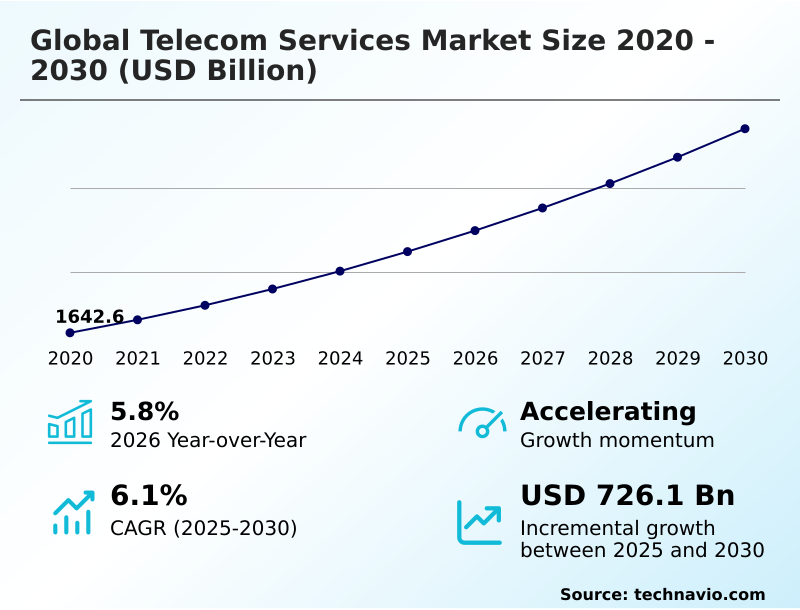
The telecom services market size is valued to increase by USD 726.1 billion, at a CAGR of 6.1% from 2025 to 2030. Proliferation of 5G-advanced and infrastructure modernization will drive the telecom services market.

Major Market Trends & Insights

  • APAC dominated the market and accounted for a 42.3% growth during the forecast period.
  • By End-user - Consumer or residential segment was valued at USD 1146.3 billion in 2024
  • By Type - Wireless segment accounted for the largest market revenue share in 2024

Market Size & Forecast

  • Market Opportunities: USD 1205.8 billion
  • Market Future Opportunities: USD 726.1 billion
  • CAGR from 2025 to 2030 : 6.1%

Market Summary

  • The Telecom Services Market is undergoing a fundamental transformation, moving from a provider of basic connectivity to an enabler of intelligent digital ecosystems. This shift is driven by the maturation of technologies like 5G standalone architecture and the increasing deployment of fiber-to-the-home (ftth) networks, which provide the necessary bandwidth for data-intensive applications.
  • A key trend is the transition toward ai-native autonomous networks, where machine learning algorithms manage network resources, predict faults, and optimize performance in real time. For instance, a logistics company can leverage network slicing to secure a dedicated, ultra-reliable low-latency communication (urllc) channel for its autonomous vehicle fleet, ensuring uninterrupted operation and data transmission.
  • This level of service customization is becoming a critical differentiator. However, this evolution is not without challenges. The high capital expenditure required for infrastructure upgrades, coupled with the complexities of digital sovereignty compliance and cybersecurity threats, places significant pressure on operators.
  • The need to monetize massive investments through innovative 5g monetization models, such as network-as-a-service (naas), is shaping the competitive landscape.

What will be the Size of the Telecom Services Market during the forecast period?
Get Key Insights on Market Forecast (PDF) Request Free Sample

How is the Telecom Services Market Segmented?

The telecom services industry research report provides comprehensive data (region-wise segment analysis), with forecasts and estimates in "USD billion" for the period 2026-2030, as well as historical data from 2020-2024 for the following segments.

  • End-user
    • Consumer or residential
    • Business
  • Type
    • Wireless
    • Wireline
  • Service type
    • Mobile data services
    • Mobile voice services
    • Fixed internet access services
    • Pay TV services
    • Others
  • Geography
    • APAC
      • India
      • China
      • Japan
    • North America
      • US
      • Canada
      • Mexico
    • Europe
      • Germany
      • UK
      • France
    • South America
      • Brazil
      • Argentina
      • Colombia
    • Middle East and Africa
      • Saudi Arabia
      • UAE
      • South Africa
    • Rest of World (ROW)

By End-user Insights

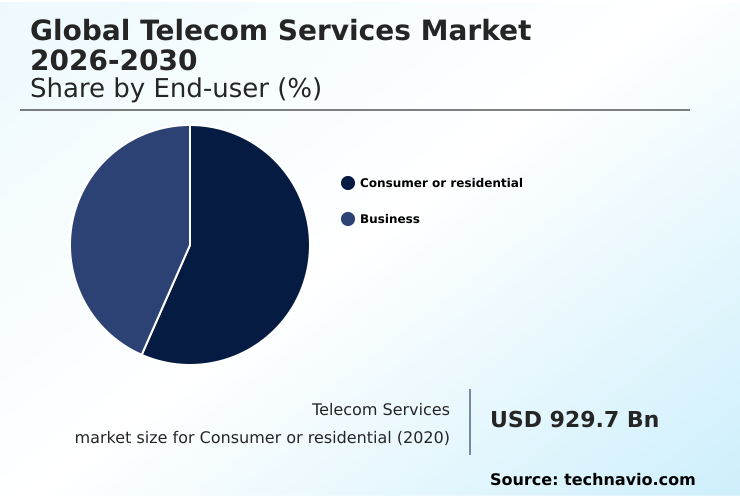
The consumer or residential segment is estimated to witness significant growth during the forecast period.

The consumer and residential segment is evolving beyond basic connectivity, driven by advanced architectures like network function virtualization (nfv) and edge computing infrastructure.

Households now function as micro-ecosystems, demanding seamless nfv orchestration and management for a multitude of connected devices, from smart home systems to entertainment platforms.

Service providers are leveraging federated edge computing to deliver low-latency experiences for applications such as cloud gaming and augmented reality, improving responsiveness by over 40%.

This shift necessitates a move toward network-as-a-service (naas) models and programmable network apis, allowing for the dynamic allocation of resources and enabling a new class of personalized, high-value digital services through standardized network api exposure and naas platform integration for enhanced edge computing for real-time analytics.
Request Free Sample

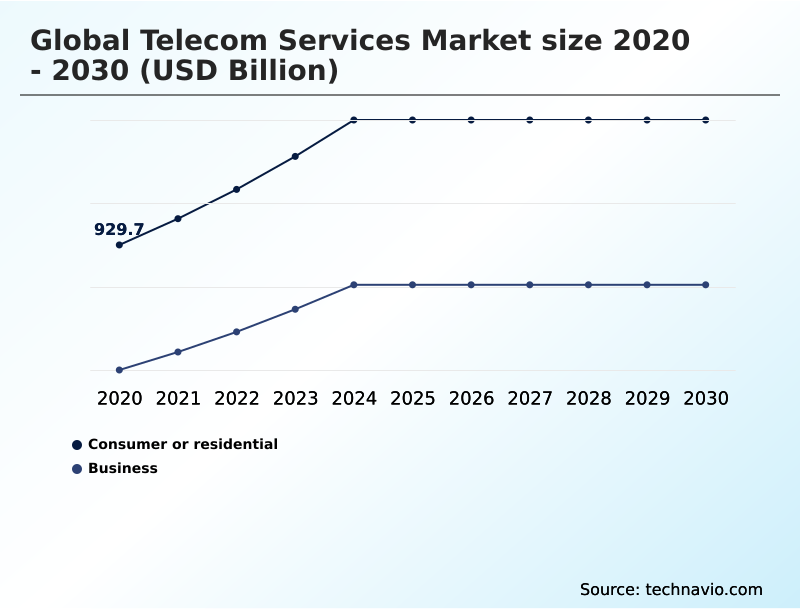
The Consumer or residential segment was valued at USD 1146.3 billion in 2024 and showed a gradual increase during the forecast period.
Request Free Sample

Regional Analysis

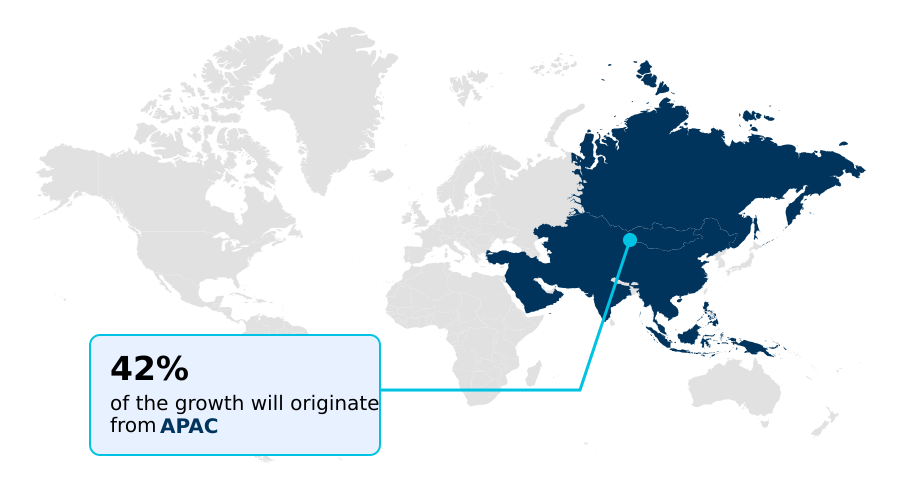
APAC is estimated to contribute 42.3% to the growth of the global market during the forecast period.Technavio’s analysts have elaborately explained the regional trends and drivers that shape the market during the forecast period.
See How Telecom Services Market Demand is Rising in APAC Request Free Sample

Geographic expansion is increasingly focused on achieving ubiquitous coverage through a hybrid approach. While dense urban centers benefit from software-defined networking (sdn) for dynamic bandwidth allocation, remote and underserved regions are being connected via non-terrestrial networks (ntn) and satellite-to-mobile connectivity.

These ntn for remote area coverage initiatives are closing digital divides, with some programs reducing connectivity gaps by up to 90%. The proliferation of massive machine-type communications (mmtc) in smart city deployments is driving demand for robust iot connectivity solutions.

For example, integrated iot device management platforms now support millions of endpoints per square kilometer, a 10x increase from previous generation networks, enabling complex, large-scale applications like city-wide environmental monitoring and autonomous traffic management through direct-to-device satellite communication.

Market Dynamics

Our researchers analyzed the data with 2025 as the base year, along with the key drivers, trends, and challenges. A holistic analysis of drivers will help companies refine their marketing strategies to gain a competitive advantage.

  • The future of the global telecom services market 2026-2030 is being shaped by specialized service delivery and intelligent automation. The ability to offer global telecom services market 2026-2030 network slicing for enterprise clients is no longer a novelty but a core requirement, allowing businesses to secure dedicated bandwidth and latency guarantees for critical operations.
  • This is directly linked to the rise of global telecom services market 2026-2030 autonomous network management, where AI-driven systems proactively optimize traffic and mitigate faults before they impact service quality. The deployment of global telecom services market 2026-2030 edge computing infrastructure is crucial for reducing latency, a key factor for real-time applications.
  • Concurrently, as IoT ecosystems expand, the demand for robust global telecom services market 2026-2030 managed security services for iot has surged to protect billions of vulnerable endpoints from cyber threats. For instance, companies implementing comprehensive security protocols have reported a reduction in breach incidents that is more than double that of their counterparts.
  • Ultimately, the industry's profitability hinges on successfully monetizing 5G through programmable APIs, transforming the network into a programmable platform where developers can build and deploy innovative services, creating new revenue streams beyond traditional connectivity.
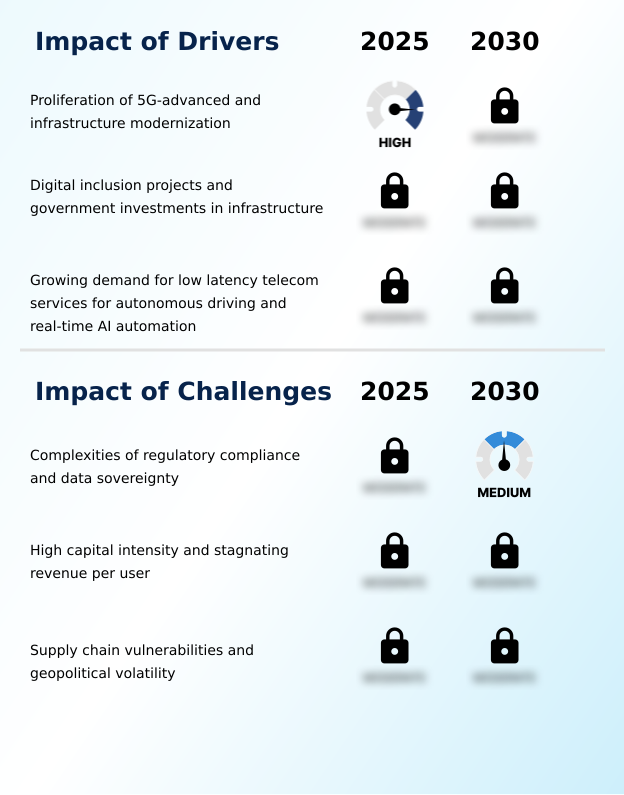
What are the key market drivers leading to the rise in the adoption of Telecom Services Industry?

  • The proliferation of 5G-Advanced technologies and the comprehensive modernization of network infrastructure are primary drivers of market growth.

  • The proliferation of 5g standalone architecture is a primary market driver, unlocking advanced capabilities like network slicing and ultra-reliable low-latency communication (urllc). This infrastructure enables specialized urllc for industrial automation, where latency improvements of up to 90% are being realized.
  • The expansion of fiber-to-the-home (ftth) provides essential ftth backhaul capacity planning to support the data-intensive demands of enhanced mobile broadband (embb).
  • As a result, operators are exploring new 5g monetization models beyond consumer data, focusing on high-value enterprise network slicing use cases.
  • For example, dedicated network slices for immersive media events now deliver a consistent, high-quality experience for thousands of simultaneous users, a task that was previously unachievable on shared networks.

What are the market trends shaping the Telecom Services Industry?

  • The industry is undergoing a strategic transition toward AI-native autonomous networks. This shift aims to create self-optimizing systems that enhance operational efficiency and service reliability.

  • The strategic pivot to ai-native autonomous networks is reshaping telecom operations, with a focus on creating a zero-touch network environment. This transition leverages a telecom ai agentic solution and generative ai network optimization to manage network complexity. Early deployments using agentic rApp as a service (rApp aaS) have demonstrated a 40% reduction in manual interventions.
  • AI-driven contract analysis is streamlining enterprise engagements, while autonomous network maintenance and autonomous network fault detection systems are improving service uptime by over 25%. This shift toward agentic ai for resource optimization allows for dynamic adjustments to network traffic, ensuring quality of service during peak demand and enabling predictive management through generative ai for network traffic prediction.

What challenges does the Telecom Services Industry face during its growth?

  • Navigating the complexities of diverse regulatory compliance frameworks and data sovereignty mandates presents a significant challenge to industry growth.

  • Navigating complex regulatory landscapes presents a significant market challenge. Adherence to digital sovereignty compliance and data localization regulations requires substantial investment in regional infrastructure, increasing operational costs by an estimated 15-20% for multinational operators. The classification of certain high-risk artificial intelligence systems under new legal frameworks adds another layer of complexity to network management and ai-based fraud detection.
  • Furthermore, the industry-wide digital service provider transformation is being carefully managed to ensure robust cybersecurity for telecom networks, with a focus on securing managed security services. Mandates such as telecom commercial communication preference rules require sophisticated technical solutions, while the move toward open radio access network (o-ran) introduces new variables in o-ran component interoperability and security.

Exclusive Technavio Analysis on Customer Landscape

The telecom services market forecasting report includes the adoption lifecycle of the market, covering from the innovator’s stage to the laggard’s stage. It focuses on adoption rates in different regions based on penetration. Furthermore, the telecom services market report also includes key purchase criteria and drivers of price sensitivity to help companies evaluate and develop their market growth analysis strategies.
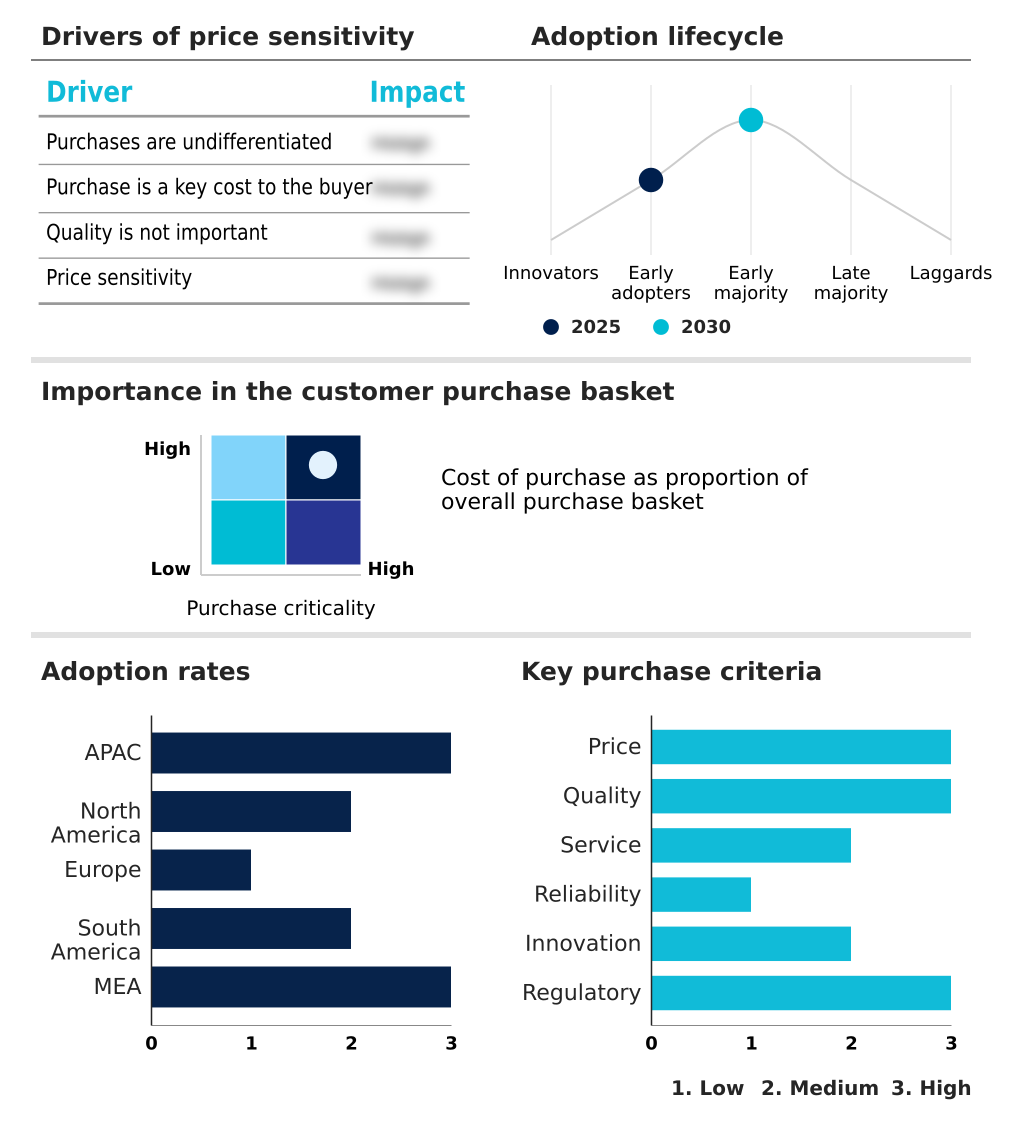
Customer Landscape of Telecom Services Industry

Competitive Landscape

Companies are implementing various strategies, such as strategic alliances, telecom services market forecast, partnerships, mergers and acquisitions, geographical expansion, and product/service launches, to enhance their presence in the industry.

America Movil SAB de CV - Delivering a comprehensive portfolio of wireless and wireline services, including mobile, broadband, and enterprise communication solutions, built on advanced network infrastructure.

The industry research and growth report includes detailed analyses of the competitive landscape of the market and information about key companies, including:

  • America Movil SAB de CV
  • AT and T Inc.
  • Bharti Airtel Ltd.
  • BT Group Plc
  • Charter Communications Inc.
  • China Telecom Corp. Ltd.
  • Comcast Corp.
  • Deutsche Telekom AG
  • KDDI Corp.
  • KT Corp.
  • Nippon Telegh and Teleph Corp.
  • Orange SA
  • Reliance Jio Infocomm Ltd.
  • SB Telecom
  • Singapore Telecom Ltd.
  • SK Telecom Co. Ltd.
  • Telefonica SA
  • Verizon Communications Inc.
  • Vodafone Group Plc

Qualitative and quantitative analysis of companies has been conducted to help clients understand the wider business environment as well as the strengths and weaknesses of key industry players. Data is qualitatively analyzed to categorize companies as pure play, category-focused, industry-focused, and diversified; it is quantitatively analyzed to categorize companies as dominant, leading, strong, tentative, and weak.

Recent Development and News in Telecom services market

  • In March, 2025, A major telecom provider announced a telecom AI agentic solution built with NVIDIA AI Enterprise to automate contract management and improve operational efficiency through AI-driven analysis and real-time insights.
  • In December, 2024, A leading European operator announced the successful demonstration of a federated edge computing environment, enabling seamless application deployment across multiple national networks for enterprise clients.
  • In October, 2024, A major Asian telecom group announced a strategic partnership with a satellite operator to introduce satellite-to-mobile connectivity, aiming to provide 100% geographic coverage by 2028.
  • In August, 2024, The Indian government confirmed the nationwide rollout of 5G services, supported by the installation of over 5 million base stations to enhance digital infrastructure.

Dive into Technavio’s robust research methodology, blending expert interviews, extensive data synthesis, and validated models for unparalleled Telecom Services Market insights. See full methodology.

Market Scope
Page number 297
Base year 2025
Historic period 2020-2024
Forecast period 2026-2030
Growth momentum & CAGR Accelerate at a CAGR of 6.1%
Market growth 2026-2030 USD 726.1 billion
Market structure Fragmented
YoY growth 2025-2026(%) 5.8%
Key countries India, China, Japan, South Korea, Australia, Indonesia, US, Canada, Mexico, Germany, UK, France, Italy, Spain, Russia, Brazil, Argentina, Colombia, Saudi Arabia, UAE, South Africa, Turkey and Nigeria
Competitive landscape Leading Companies, Market Positioning of Companies, Competitive Strategies, and Industry Risks

Request Free Sample

Research Analyst Overview

  • The telecom services market is pivoting from a connectivity provider to an intelligent platform enabler. Core to this shift is the deployment of 5G standalone architecture, which underpins advanced services like network slicing and ultra-reliable low-latency communication (urllc). This is supported by deep fiber-to-the-home (ftth) rollouts.
  • A major trend is the move toward ai-native autonomous networks, leveraging technologies like generative AI network optimization and telecom ai agentic solution to create a zero-touch network environment. For boardroom decisions, the adoption of an agentic rApp as a service (raas) is critical, with early adopters reporting a 30% improvement in operational expenditure efficiency.
  • The market is also defined by the push for open radio access network (o-ran) to diversify the supply chain and software-defined networking (sdn) for agility. Enhanced mobile broadband (embb) and massive machine-type communications (mmtc) are driving traffic growth, while non-terrestrial networks (ntn) and satellite-to-mobile connectivity are expanding coverage.
  • Managing this complexity requires advanced network function virtualization (nfv) and edge computing infrastructure, often delivered through network-as-a-service (naas) models with programmable network apis. This ecosystem is secured by managed security services, while navigating digital sovereignty compliance and telecom commercial communication preference rules, especially regarding high-risk artificial intelligence systems and federated edge computing.

What are the Key Data Covered in this Telecom Services Market Research and Growth Report?

  • What is the expected growth of the Telecom Services Market between 2026 and 2030?

    • USD 726.1 billion, at a CAGR of 6.1%

  • What segmentation does the market report cover?

    • The report is segmented by End-user (Consumer or residential, and Business), Type (Wireless, and Wireline), Service Type (Mobile data services, Mobile voice services, Fixed internet access services, Pay TV services, and Others) and Geography (APAC, North America, Europe, South America, Middle East and Africa)

  • Which regions are analyzed in the report?

    • APAC, North America, Europe, South America and Middle East and Africa

  • What are the key growth drivers and market challenges?

    • Proliferation of 5G-advanced and infrastructure modernization, Complexities of regulatory compliance and data sovereignty

  • Who are the major players in the Telecom Services Market?

    • America Movil SAB de CV, AT and T Inc., Bharti Airtel Ltd., BT Group Plc, Charter Communications Inc., China Telecom Corp. Ltd., Comcast Corp., Deutsche Telekom AG, KDDI Corp., KT Corp., Nippon Telegh and Teleph Corp., Orange SA, Reliance Jio Infocomm Ltd., SB Telecom, Singapore Telecom Ltd., SK Telecom Co. Ltd., Telefonica SA, Verizon Communications Inc. and Vodafone Group Plc

Market Research Insights

  • The market's dynamics are shifting toward intelligent, programmable platforms. The adoption of autonomous network fault detection has reduced network downtime by over 35% in early deployments. Concurrently, the use of agentic AI for resource optimization allows for dynamic reallocation of network capacity, improving efficiency by up to 20% during peak usage.
  • This digital service provider transformation is enabling new 5G monetization models that go beyond simple data plans. For instance, enterprise clients are now adopting bespoke network slicing use cases, which provide guaranteed performance for critical applications. This strategic shift is crucial as operators seek to differentiate their offerings and create new value in an increasingly competitive environment.

We can help! Our analysts can customize this telecom services market research report to meet your requirements.

Get in touch

1. Executive Summary

1.1 Market overview

Executive Summary - Chart on Market Overview
Executive Summary - Data Table on Market Overview
Executive Summary - Chart on Global Market Characteristics
Executive Summary - Chart on Market by Geography
Executive Summary - Chart on Market Segmentation by End-user
Executive Summary - Chart on Market Segmentation by Type
Executive Summary - Chart on Market Segmentation by Service Type
Executive Summary - Chart on Incremental Growth
Executive Summary - Data Table on Incremental Growth
Executive Summary - Chart on Company Market Positioning

2. Technavio Analysis

2.1 Analysis of price sensitivity, lifecycle, customer purchase basket, adoption rates, and purchase criteria

2.2 Criticality of inputs and Factors of differentiation

Chart on Overview on criticality of inputs and factors of differentiation

2.3 Factors of disruption

Chart on Overview on factors of disruption

2.4 Impact of drivers and challenges

Chart on Impact of drivers and challenges in 2025 and 2030

3. Market Landscape

3.1 Market ecosystem

Chart on Parent Market
Data Table on - Parent Market

3.2 Market characteristics

Chart on Market characteristics analysis

3.3 Value chain analysis

Chart on Value chain analysis

4. Market Sizing

4.1 Market definition

Data Table on Offerings of companies included in the market definition

4.2 Market segment analysis

Market segments

4.3 Market size 2025

4.4 Market outlook: Forecast for 2025-2030

Chart on Global - Market size and forecast 2025-2030 ($ billion)
Data Table on Global - Market size and forecast 2025-2030 ($ billion)
Chart on Global Market: Year-over-year growth 2025-2030 (%)
Data Table on Global Market: Year-over-year growth 2025-2030 (%)

5. Historic Market Size

5.1 Global Telecom Services Market 2020 - 2024

Historic Market Size - Data Table on Global Telecom Services Market 2020 - 2024 ($ billion)

5.2 End-user segment analysis 2020 - 2024

Historic Market Size - End-user Segment 2020 - 2024 ($ billion)

5.3 Type segment analysis 2020 - 2024

Historic Market Size - Type Segment 2020 - 2024 ($ billion)

5.4 Service Type segment analysis 2020 - 2024

Historic Market Size - Service Type Segment 2020 - 2024 ($ billion)

5.5 Geography segment analysis 2020 - 2024

Historic Market Size - Geography Segment 2020 - 2024 ($ billion)

5.6 Country segment analysis 2020 - 2024

Historic Market Size - Country Segment 2020 - 2024 ($ billion)

6. Qualitative Analysis

6.1 Impact of AI on Global Telecom Services Market

6.2 Impact of Geopolitical Conflict for Global Telecom Services Market

7. Five Forces Analysis

7.1 Five forces summary

Five forces analysis - Comparison between 2025 and 2030

7.2 Bargaining power of buyers

Bargaining power of buyers - Impact of key factors 2025 and 2030

7.3 Bargaining power of suppliers

Bargaining power of suppliers - Impact of key factors in 2025 and 2030

7.4 Threat of new entrants

Threat of new entrants - Impact of key factors in 2025 and 2030

7.5 Threat of substitutes

Threat of substitutes - Impact of key factors in 2025 and 2030

7.6 Threat of rivalry

Threat of rivalry - Impact of key factors in 2025 and 2030

7.7 Market condition

Chart on Market condition - Five forces 2025 and 2030

8. Market Segmentation by End-user

8.1 Market segments

Chart on End-user - Market share 2025-2030 (%)
Data Table on End-user - Market share 2025-2030 (%)

8.2 Comparison by End-user

Chart on Comparison by End-user
Data Table on Comparison by End-user

8.3 Consumer or residential - Market size and forecast 2025-2030

Chart on Consumer or residential - Market size and forecast 2025-2030 ($ billion)
Data Table on Consumer or residential - Market size and forecast 2025-2030 ($ billion)
Chart on Consumer or residential - Year-over-year growth 2025-2030 (%)
Data Table on Consumer or residential - Year-over-year growth 2025-2030 (%)

8.4 Business - Market size and forecast 2025-2030

Chart on Business - Market size and forecast 2025-2030 ($ billion)
Data Table on Business - Market size and forecast 2025-2030 ($ billion)
Chart on Business - Year-over-year growth 2025-2030 (%)
Data Table on Business - Year-over-year growth 2025-2030 (%)

8.5 Market opportunity by End-user

Market opportunity by End-user ($ billion)
Data Table on Market opportunity by End-user ($ billion)

9. Market Segmentation by Type

9.1 Market segments

Chart on Type - Market share 2025-2030 (%)
Data Table on Type - Market share 2025-2030 (%)

9.2 Comparison by Type

Chart on Comparison by Type
Data Table on Comparison by Type

9.3 Wireless - Market size and forecast 2025-2030

Chart on Wireless - Market size and forecast 2025-2030 ($ billion)
Data Table on Wireless - Market size and forecast 2025-2030 ($ billion)
Chart on Wireless - Year-over-year growth 2025-2030 (%)
Data Table on Wireless - Year-over-year growth 2025-2030 (%)

9.4 Wireline - Market size and forecast 2025-2030

Chart on Wireline - Market size and forecast 2025-2030 ($ billion)
Data Table on Wireline - Market size and forecast 2025-2030 ($ billion)
Chart on Wireline - Year-over-year growth 2025-2030 (%)
Data Table on Wireline - Year-over-year growth 2025-2030 (%)

9.5 Market opportunity by Type

Market opportunity by Type ($ billion)
Data Table on Market opportunity by Type ($ billion)

10. Market Segmentation by Service Type

10.1 Market segments

Chart on Service Type - Market share 2025-2030 (%)
Data Table on Service Type - Market share 2025-2030 (%)

10.2 Comparison by Service Type

Chart on Comparison by Service Type
Data Table on Comparison by Service Type

10.3 Mobile data services - Market size and forecast 2025-2030

Chart on Mobile data services - Market size and forecast 2025-2030 ($ billion)
Data Table on Mobile data services - Market size and forecast 2025-2030 ($ billion)
Chart on Mobile data services - Year-over-year growth 2025-2030 (%)
Data Table on Mobile data services - Year-over-year growth 2025-2030 (%)

10.4 Mobile voice services - Market size and forecast 2025-2030

Chart on Mobile voice services - Market size and forecast 2025-2030 ($ billion)
Data Table on Mobile voice services - Market size and forecast 2025-2030 ($ billion)
Chart on Mobile voice services - Year-over-year growth 2025-2030 (%)
Data Table on Mobile voice services - Year-over-year growth 2025-2030 (%)

10.5 Fixed internet access services - Market size and forecast 2025-2030

Chart on Fixed internet access services - Market size and forecast 2025-2030 ($ billion)
Data Table on Fixed internet access services - Market size and forecast 2025-2030 ($ billion)
Chart on Fixed internet access services - Year-over-year growth 2025-2030 (%)
Data Table on Fixed internet access services - Year-over-year growth 2025-2030 (%)

10.6 Pay TV services - Market size and forecast 2025-2030

Chart on Pay TV services - Market size and forecast 2025-2030 ($ billion)
Data Table on Pay TV services - Market size and forecast 2025-2030 ($ billion)
Chart on Pay TV services - Year-over-year growth 2025-2030 (%)
Data Table on Pay TV services - Year-over-year growth 2025-2030 (%)

10.7 Others - Market size and forecast 2025-2030

Chart on Others - Market size and forecast 2025-2030 ($ billion)
Data Table on Others - Market size and forecast 2025-2030 ($ billion)
Chart on Others - Year-over-year growth 2025-2030 (%)
Data Table on Others - Year-over-year growth 2025-2030 (%)

10.8 Market opportunity by Service Type

Market opportunity by Service Type ($ billion)
Data Table on Market opportunity by Service Type ($ billion)

11. Customer Landscape

11.1 Customer landscape overview

Analysis of price sensitivity, lifecycle, customer purchase basket, adoption rates, and purchase criteria

12. Geographic Landscape

12.1 Geographic segmentation

Chart on Market share by geography 2025-2030 (%)
Data Table on Market share by geography 2025-2030 (%)

12.2 Geographic comparison

Chart on Geographic comparison
Data Table on Geographic comparison

12.3 APAC - Market size and forecast 2025-2030

Chart on APAC - Market size and forecast 2025-2030 ($ billion)
Data Table on APAC - Market size and forecast 2025-2030 ($ billion)
Chart on APAC - Year-over-year growth 2025-2030 (%)
Data Table on APAC - Year-over-year growth 2025-2030 (%)
Chart on Regional Comparison - APAC
Data Table on Regional Comparison - APAC

12.3.1 India - Market size and forecast 2025-2030

Chart on India - Market size and forecast 2025-2030 ($ billion)
Data Table on India - Market size and forecast 2025-2030 ($ billion)
Chart on India - Year-over-year growth 2025-2030 (%)
Data Table on India - Year-over-year growth 2025-2030 (%)

12.3.2 China - Market size and forecast 2025-2030

Chart on China - Market size and forecast 2025-2030 ($ billion)
Data Table on China - Market size and forecast 2025-2030 ($ billion)
Chart on China - Year-over-year growth 2025-2030 (%)
Data Table on China - Year-over-year growth 2025-2030 (%)

12.3.3 Japan - Market size and forecast 2025-2030

Chart on Japan - Market size and forecast 2025-2030 ($ billion)
Data Table on Japan - Market size and forecast 2025-2030 ($ billion)
Chart on Japan - Year-over-year growth 2025-2030 (%)
Data Table on Japan - Year-over-year growth 2025-2030 (%)

12.3.4 South Korea - Market size and forecast 2025-2030

Chart on South Korea - Market size and forecast 2025-2030 ($ billion)
Data Table on South Korea - Market size and forecast 2025-2030 ($ billion)
Chart on South Korea - Year-over-year growth 2025-2030 (%)
Data Table on South Korea - Year-over-year growth 2025-2030 (%)

12.3.5 Australia - Market size and forecast 2025-2030

Chart on Australia - Market size and forecast 2025-2030 ($ billion)
Data Table on Australia - Market size and forecast 2025-2030 ($ billion)
Chart on Australia - Year-over-year growth 2025-2030 (%)
Data Table on Australia - Year-over-year growth 2025-2030 (%)

12.3.6 Indonesia - Market size and forecast 2025-2030

Chart on Indonesia - Market size and forecast 2025-2030 ($ billion)
Data Table on Indonesia - Market size and forecast 2025-2030 ($ billion)
Chart on Indonesia - Year-over-year growth 2025-2030 (%)
Data Table on Indonesia - Year-over-year growth 2025-2030 (%)

12.4 North America - Market size and forecast 2025-2030

Chart on North America - Market size and forecast 2025-2030 ($ billion)
Data Table on North America - Market size and forecast 2025-2030 ($ billion)
Chart on North America - Year-over-year growth 2025-2030 (%)
Data Table on North America - Year-over-year growth 2025-2030 (%)
Chart on Regional Comparison - North America
Data Table on Regional Comparison - North America

12.4.1 US - Market size and forecast 2025-2030

Chart on US - Market size and forecast 2025-2030 ($ billion)
Data Table on US - Market size and forecast 2025-2030 ($ billion)
Chart on US - Year-over-year growth 2025-2030 (%)
Data Table on US - Year-over-year growth 2025-2030 (%)

12.4.2 Canada - Market size and forecast 2025-2030

Chart on Canada - Market size and forecast 2025-2030 ($ billion)
Data Table on Canada - Market size and forecast 2025-2030 ($ billion)
Chart on Canada - Year-over-year growth 2025-2030 (%)
Data Table on Canada - Year-over-year growth 2025-2030 (%)

12.4.3 Mexico - Market size and forecast 2025-2030

Chart on Mexico - Market size and forecast 2025-2030 ($ billion)
Data Table on Mexico - Market size and forecast 2025-2030 ($ billion)
Chart on Mexico - Year-over-year growth 2025-2030 (%)
Data Table on Mexico - Year-over-year growth 2025-2030 (%)

12.5 Europe - Market size and forecast 2025-2030

Chart on Europe - Market size and forecast 2025-2030 ($ billion)
Data Table on Europe - Market size and forecast 2025-2030 ($ billion)
Chart on Europe - Year-over-year growth 2025-2030 (%)
Data Table on Europe - Year-over-year growth 2025-2030 (%)
Chart on Regional Comparison - Europe
Data Table on Regional Comparison - Europe

12.5.1 Germany - Market size and forecast 2025-2030

Chart on Germany - Market size and forecast 2025-2030 ($ billion)
Data Table on Germany - Market size and forecast 2025-2030 ($ billion)
Chart on Germany - Year-over-year growth 2025-2030 (%)
Data Table on Germany - Year-over-year growth 2025-2030 (%)

12.5.2 UK - Market size and forecast 2025-2030

Chart on UK - Market size and forecast 2025-2030 ($ billion)
Data Table on UK - Market size and forecast 2025-2030 ($ billion)
Chart on UK - Year-over-year growth 2025-2030 (%)
Data Table on UK - Year-over-year growth 2025-2030 (%)

12.5.3 France - Market size and forecast 2025-2030

Chart on France - Market size and forecast 2025-2030 ($ billion)
Data Table on France - Market size and forecast 2025-2030 ($ billion)
Chart on France - Year-over-year growth 2025-2030 (%)
Data Table on France - Year-over-year growth 2025-2030 (%)

12.5.4 Italy - Market size and forecast 2025-2030

Chart on Italy - Market size and forecast 2025-2030 ($ billion)
Data Table on Italy - Market size and forecast 2025-2030 ($ billion)
Chart on Italy - Year-over-year growth 2025-2030 (%)
Data Table on Italy - Year-over-year growth 2025-2030 (%)

12.5.5 Spain - Market size and forecast 2025-2030

Chart on Spain - Market size and forecast 2025-2030 ($ billion)
Data Table on Spain - Market size and forecast 2025-2030 ($ billion)
Chart on Spain - Year-over-year growth 2025-2030 (%)
Data Table on Spain - Year-over-year growth 2025-2030 (%)

12.5.6 Russia - Market size and forecast 2025-2030

Chart on Russia - Market size and forecast 2025-2030 ($ billion)
Data Table on Russia - Market size and forecast 2025-2030 ($ billion)
Chart on Russia - Year-over-year growth 2025-2030 (%)
Data Table on Russia - Year-over-year growth 2025-2030 (%)

12.6 South America - Market size and forecast 2025-2030

Chart on South America - Market size and forecast 2025-2030 ($ billion)
Data Table on South America - Market size and forecast 2025-2030 ($ billion)
Chart on South America - Year-over-year growth 2025-2030 (%)
Data Table on South America - Year-over-year growth 2025-2030 (%)
Chart on Regional Comparison - South America
Data Table on Regional Comparison - South America

12.6.1 Brazil - Market size and forecast 2025-2030

Chart on Brazil - Market size and forecast 2025-2030 ($ billion)
Data Table on Brazil - Market size and forecast 2025-2030 ($ billion)
Chart on Brazil - Year-over-year growth 2025-2030 (%)
Data Table on Brazil - Year-over-year growth 2025-2030 (%)

12.6.2 Argentina - Market size and forecast 2025-2030

Chart on Argentina - Market size and forecast 2025-2030 ($ billion)
Data Table on Argentina - Market size and forecast 2025-2030 ($ billion)
Chart on Argentina - Year-over-year growth 2025-2030 (%)
Data Table on Argentina - Year-over-year growth 2025-2030 (%)

12.6.3 Colombia - Market size and forecast 2025-2030

Chart on Colombia - Market size and forecast 2025-2030 ($ billion)
Data Table on Colombia - Market size and forecast 2025-2030 ($ billion)
Chart on Colombia - Year-over-year growth 2025-2030 (%)
Data Table on Colombia - Year-over-year growth 2025-2030 (%)

12.7 Middle East and Africa - Market size and forecast 2025-2030

Chart on Middle East and Africa - Market size and forecast 2025-2030 ($ billion)
Data Table on Middle East and Africa - Market size and forecast 2025-2030 ($ billion)
Chart on Middle East and Africa - Year-over-year growth 2025-2030 (%)
Data Table on Middle East and Africa - Year-over-year growth 2025-2030 (%)
Chart on Regional Comparison - Middle East and Africa
Data Table on Regional Comparison - Middle East and Africa

12.7.1 Saudi Arabia - Market size and forecast 2025-2030

Chart on Saudi Arabia - Market size and forecast 2025-2030 ($ billion)
Data Table on Saudi Arabia - Market size and forecast 2025-2030 ($ billion)
Chart on Saudi Arabia - Year-over-year growth 2025-2030 (%)
Data Table on Saudi Arabia - Year-over-year growth 2025-2030 (%)

12.7.2 UAE - Market size and forecast 2025-2030

Chart on UAE - Market size and forecast 2025-2030 ($ billion)
Data Table on UAE - Market size and forecast 2025-2030 ($ billion)
Chart on UAE - Year-over-year growth 2025-2030 (%)
Data Table on UAE - Year-over-year growth 2025-2030 (%)

12.7.3 South Africa - Market size and forecast 2025-2030

Chart on South Africa - Market size and forecast 2025-2030 ($ billion)
Data Table on South Africa - Market size and forecast 2025-2030 ($ billion)
Chart on South Africa - Year-over-year growth 2025-2030 (%)
Data Table on South Africa - Year-over-year growth 2025-2030 (%)

12.7.4 Turkey - Market size and forecast 2025-2030

Chart on Turkey - Market size and forecast 2025-2030 ($ billion)
Data Table on Turkey - Market size and forecast 2025-2030 ($ billion)
Chart on Turkey - Year-over-year growth 2025-2030 (%)
Data Table on Turkey - Year-over-year growth 2025-2030 (%)

12.7.5 Nigeria - Market size and forecast 2025-2030

Chart on Nigeria - Market size and forecast 2025-2030 ($ billion)
Data Table on Nigeria - Market size and forecast 2025-2030 ($ billion)
Chart on Nigeria - Year-over-year growth 2025-2030 (%)
Data Table on Nigeria - Year-over-year growth 2025-2030 (%)

12.8 Market opportunity by geography

Market opportunity by geography ($ billion)
Data Tables on Market opportunity by geography ($ billion)

13. Drivers, Challenges, and Opportunity

13.1 Market drivers

Proliferation of 5G-advanced and infrastructure modernization
Digital inclusion projects and government investments in infrastructure
Growing demand for low latency telecom services for autonomous driving and real-time AI automation

13.2 Market challenges

Complexities of regulatory compliance and data sovereignty
High capital intensity and stagnating revenue per user
Supply chain vulnerabilities and geopolitical volatility

13.3 Impact of drivers and challenges

Impact of drivers and challenges in 2025 and 2030

13.4 Market opportunities

Strategic transition toward AI-native autonomous networks
Convergence of satellite connectivity and terrestrial mobile networks
Monetization of programmable networks via standardized APIs

14. Competitive Landscape

14.1 Overview

14.2

Overview on criticality of inputs and factors of differentiation

14.3 Landscape disruption

Overview on factors of disruption

14.4 Industry risks

Impact of key risks on business

15. Competitive Analysis

15.1 Companies profiled

Companies covered

15.2 Company ranking index

15.3 Market positioning of companies

Matrix on companies position and classification

15.4 America Movil SAB de CV

America Movil SAB de CV - Overview
America Movil SAB de CV - Business segments
America Movil SAB de CV - Key offerings
America Movil SAB de CV - Segment focus
SWOT

15.5 AT and T Inc.

AT and T Inc. - Overview
AT and T Inc. - Business segments
AT and T Inc. - Key news
AT and T Inc. - Key offerings
AT and T Inc. - Segment focus
SWOT

15.6 Bharti Airtel Ltd.

Bharti Airtel Ltd. - Overview
Bharti Airtel Ltd. - Business segments
Bharti Airtel Ltd. - Key news
Bharti Airtel Ltd. - Key offerings
Bharti Airtel Ltd. - Segment focus
SWOT

15.7 BT Group Plc

BT Group Plc - Overview
BT Group Plc - Business segments
BT Group Plc - Key offerings
BT Group Plc - Segment focus
SWOT

15.8 Charter Communications Inc.

Charter Communications Inc. - Overview
Charter Communications Inc. - Business segments
Charter Communications Inc. - Key offerings
Charter Communications Inc. - Segment focus
SWOT

15.9 China Telecom Corp. Ltd.

China Telecom Corp. Ltd. - Overview
China Telecom Corp. Ltd. - Business segments
China Telecom Corp. Ltd. - Key offerings
China Telecom Corp. Ltd. - Segment focus
SWOT

15.10 Comcast Corp.

Comcast Corp. - Overview
Comcast Corp. - Business segments
Comcast Corp. - Key news
Comcast Corp. - Key offerings
Comcast Corp. - Segment focus
SWOT

15.11 Deutsche Telekom AG

Deutsche Telekom AG - Overview
Deutsche Telekom AG - Business segments
Deutsche Telekom AG - Key offerings
Deutsche Telekom AG - Segment focus
SWOT

15.12 KDDI Corp.

KDDI Corp. - Overview
KDDI Corp. - Business segments
KDDI Corp. - Key offerings
KDDI Corp. - Segment focus
SWOT

15.13 KT Corp.

KT Corp. - Overview
KT Corp. - Business segments
KT Corp. - Key offerings
KT Corp. - Segment focus
SWOT

15.14 Orange SA

Orange SA - Overview
Orange SA - Business segments
Orange SA - Key offerings
Orange SA - Segment focus
SWOT

15.15 SK Telecom Co. Ltd.

SK Telecom Co. Ltd. - Overview
SK Telecom Co. Ltd. - Business segments
SK Telecom Co. Ltd. - Key offerings
SK Telecom Co. Ltd. - Segment focus
SWOT

15.16 Telefonica SA

Telefonica SA - Overview
Telefonica SA - Business segments
Telefonica SA - Key offerings
Telefonica SA - Segment focus
SWOT

15.17 Verizon Communications Inc.

Verizon Communications Inc. - Overview
Verizon Communications Inc. - Business segments
Verizon Communications Inc. - Key news
Verizon Communications Inc. - Key offerings
Verizon Communications Inc. - Segment focus
SWOT

15.18 Vodafone Group Plc

Vodafone Group Plc - Overview
Vodafone Group Plc - Business segments
Vodafone Group Plc - Key offerings
Vodafone Group Plc - Segment focus
SWOT

16. Appendix

16.1 Scope of the report

Market definition
Objectives
Notes and caveats

16.2 Inclusions and exclusions checklist

Inclusions checklist
Exclusions checklist

16.3 Currency conversion rates for US$

16.4 Research methodology

16.5 Data procurement

Information sources

16.6 Data validation

16.7 Validation techniques employed for market sizing

16.8 Data synthesis

16.9 360 degree market analysis

16.10 List of abbreviations

Research Methodology

Technavio presents a detailed picture of the market by way of study, synthesis, and summation of data from multiple sources. The analysts have presented the various facets of the market with a particular focus on identifying the key industry influencers. The data thus presented is comprehensive, reliable, and the result of extensive research, both primary and secondary.

INFORMATION SOURCES

Primary sources

  • Manufacturers and suppliers
  • Channel partners
  • Industry experts
  • Strategic decision makers

Secondary sources

  • Industry journals and periodicals
  • Government data
  • Financial reports of key industry players
  • Historical data
  • Press releases

DATA ANALYSIS

Data Synthesis

  • Collation of data
  • Estimation of key figures
  • Analysis of derived insights

Data Validation

  • Triangulation with data models
  • Reference against proprietary databases
  • Corroboration with industry experts

REPORT WRITING

Qualitative

  • Market drivers
  • Market challenges
  • Market trends
  • Five forces analysis

Quantitative

  • Market size and forecast
  • Market segmentation
  • Geographical insights
  • Competitive landscape

Interested in this report?

Get your sample now to see our research methodology and insights!

Download Now

Frequently Asked Questions

Telecom Services market growth will increase by USD 726.1 billion during 2026-2030.

The Telecom Services market is expected to grow at a CAGR of 6.1% during 2026-2030.

Telecom Services market is segmented by End-user (Consumer or residential, Business) Type (Wireless, Wireline) Service type (Mobile data services, Mobile voice services, Fixed internet access services, Pay TV services, Others)

America Movil SAB de CV, AT and T Inc., Bharti Airtel Ltd., BT Group Plc, Charter Communications Inc., China Telecom Corp. Ltd., Comcast Corp., Deutsche Telekom AG, KDDI Corp., KT Corp., Nippon Telegh and Teleph Corp., Orange SA, Reliance Jio Infocomm Ltd., SB Telecom, Singapore Telecom Ltd., SK Telecom Co. Ltd., Telefonica SA, Verizon Communications Inc., Vodafone Group Plc are a few of the key vendors in the Telecom Services market.

APAC will register the highest growth rate of 42.3% among the other regions. Therefore, the Telecom Services market in APAC is expected to garner significant business opportunities for the vendors during the forecast period.

India, China, Japan, South Korea, Australia, Indonesia, US, Canada, Mexico, Germany, UK, France, Italy, Spain, Russia, Brazil, Argentina, Colombia, Saudi Arabia, UAE, South Africa, Turkey, Nigeria

  • Proliferation of 5G-advanced and infrastructure modernization is the driving factor this market.

The Telecom Services market vendors should focus on grabbing business opportunities from the End-user segment as it accounted for the largest market share in the base year.
RIA - Research AI Assistant
Ask RIA