


Space Tourism Market Size 2025-2029
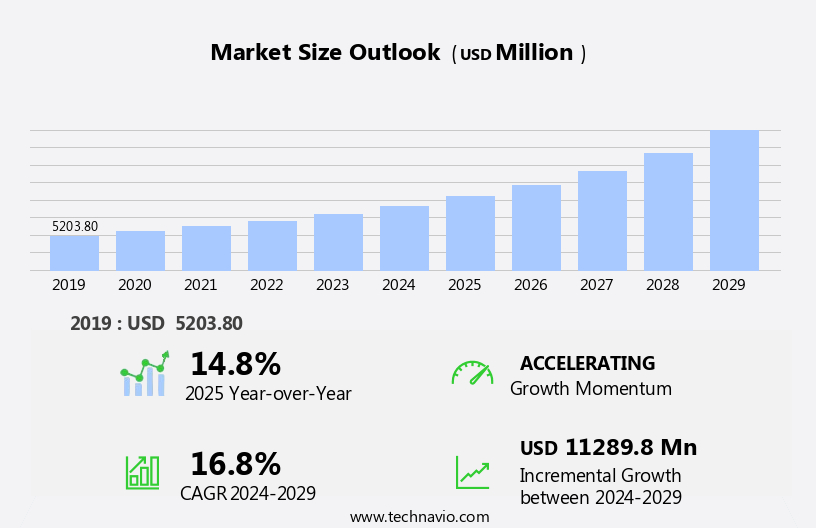
The space tourism market size is forecast to increase by USD 11.29 billion at a CAGR of 16.8% between 2024 and 2029.
- The market is experiencing significant growth, driven by increasing investments from both public and private sectors. This trend is expected to continue, fueled by the advancement of reusable launch rocket technology, which is making space travel more cost-effective and accessible. However, high costs remain a major challenge for the industry, limiting the number of potential customers and hindering its expansion. Despite this, opportunities abound for companies that can successfully navigate these challenges and offer innovative solutions to make space tourism more affordable and accessible to a wider audience. The successful integration of reusable rocket technology is poised to revolutionize the industry, making space travel a reality for an increasing number of individuals and organizations.
- However, the high costs associated with space tourism remain a significant obstacle that must be addressed in order to maximize market potential and ensure long-term success. Companies seeking to capitalize on the growing demand for space tourism must focus on finding ways to reduce costs while maintaining safety and quality, making it an exciting and challenging market for innovation and growth.
What will be the Size of the Space Tourism Market during the forecast period?
- Space tourism, an emerging market characterized by the provision of commercial space travel experiences, continues to evolve with ongoing research and innovation. Operators explore various sectors, including suborbital flights, orbital spaceflight satellite propulsion systems, and lunar tourism, pushing the boundaries of technology and psychology. Competition intensifies as new players enter the scene, driving advancements in affordability, accessibility, and sustainability. Space tourism's future lies in the development of launch vehicles, space stations, and infrastructure that cater to diverse demographics. Marketing strategies focus on branding, certification, and training to ensure safety and ethical standards. Space tourism industry growth is influenced by regulations, investment, and simulation technologies, creating a dynamic landscape.
- Space suits, luxury space travel, and space hotels are becoming increasingly accessible, attracting a wider audience. Space tourism experiences offer unique perspectives and opportunities for exploration, fostering a growing interest in this burgeoning industry. The continuous unfolding of market activities and evolving patterns underscores the importance of staying informed and adaptive in this ever-changing landscape.
How is this Space Tourism Industry segmented?
The space tourism industry research report provides comprehensive data (region-wise segment analysis), with forecasts and estimates in "USD million" for the period 2025-2029, as well as historical data from 2019-2023 for the following segments.
- Type
- Suborbital tourism
- Orbital tourism
- End-user
- Commercial
- Government
- Service Type
- Transportation
- Entertainment and leisure
- Training and simulation
- Accommodation
- Application
- Leisure Tourism
- Scientific Research
- Commercial Ventures
- Geography
- North America
- US
- Canada
- Mexico
- Europe
- France
- Germany
- Italy
- Russia
- UK
- Middle East and Africa
- UAE
- APAC
- China
- India
- Rest of World (ROW)
- North America
By Type Insights
The suborbital tourism segment is estimated to witness significant growth during the forecast period.
Space tourism is an emerging industry offering unique experiences to individuals seeking to venture beyond Earth's boundaries. Operators like SpaceX, Blue Origin, and Virgin Galactic are pioneering suborbital and orbital flights, with suborbital tours providing a more affordable alternative to orbital visits. These tours offer passengers the thrill of rocket launch acceleration, weightlessness, and a breathtaking view of Earth from space. However, space travel inherently carries risks, despite adherence to safety regulations. Training for suborbital space tourism ranges from one to four weeks, preparing passengers for the experience. The cost of a spaceflight ticket, ranging from USD100,000 to USD500,000, is significantly less than the expenses NASA incurs to send astronauts into space.
The development of space tourism is driven by continuous research, innovation, and advancements in technology, including reusable rockets and space stations. The industry is also focused on sustainability, with efforts to minimize the environmental impact of space travel. As the market grows, competition intensifies, leading to improvements in safety, affordability, and accessibility. Space tourism certification, licensing, and insurance are crucial components, ensuring a harmonious balance between risk and reward. The future of space tourism holds exciting possibilities, with lunar tourism and orbital spaceflights on the horizon. The industry's ethical considerations, branding, and marketing strategies continue to evolve, creating new opportunities for employment and experiences in this innovative field.
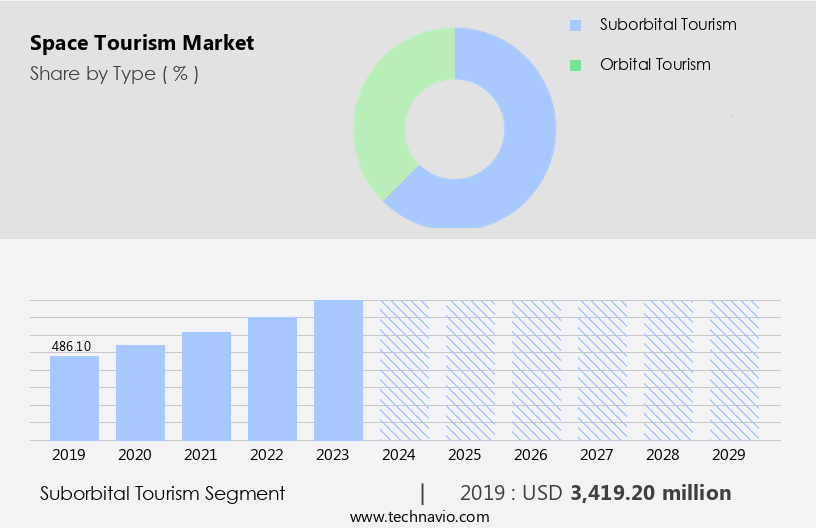
The Suborbital tourism segment was valued at USD 3.42 billion in 2019 and showed a gradual increase during the forecast period.
Regional Analysis
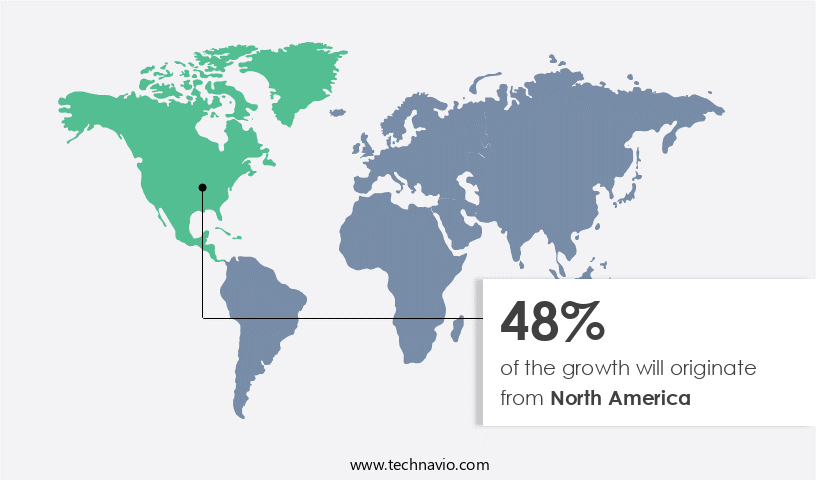
North America is estimated to contribute 48% to the growth of the global market during the forecast period.Technavio's analysts have elaborately explained the regional trends and drivers that shape the market during the forecast period.
The North American the market is primarily driven by the United States, which hosts the greatest number of commercial space tourists and space stations. With the highest average disposable income among regional populations, the US presents an attractive market for space tourism. Companies are investing substantially in infrastructure and technology development, including spacecraft, to facilitate space travel. The emergence of innovative concepts in space tourism is expected to propel the advancement of technology in North America, as leading stakeholders such as Virgin Galactic, Blue Origin, and SpaceX are headquartered in this region. Space tourism research focuses on various aspects, including affordability, certification, liability, training, insurance, sustainability, and regulations.
Space tourism experiences encompass suborbital flights, orbital spaceflights, lunar tourism, and luxury space travel. The industry is also concerned with safety, ethics, accessibility, marketing, and branding standards. Space technology innovations, such as reusable rockets and space hotels, are shaping the future of the market. Space tourism development includes launch vehicles, space stations, and space suits. The market is competitive, with various players vying for a share in the growing industry. Space tourism education and employment opportunities are also significant aspects of the market.
Market Dynamics
Our researchers analyzed the data with 2024 as the base year, along with the key drivers, trends, and challenges. A holistic analysis of drivers will help companies refine their marketing strategies to gain a competitive advantage.
The space tourism industry is rapidly transforming the future of travel, offering once-unimaginable experiences for adventurous and affluent travelers. Suborbital flights for luxury travel provide a taste of space with breathtaking views and brief zero-gravity moments. Catering to the elite, space tourism for high-net-worth individuals includes exclusive packages aboard reusable spacecraft for orbital tours. Thrill-seekers can enjoy zero-gravity experiences for adventure tourism, while future space hotel stays for luxury travelers promise comfort in orbit. Enhanced safety and efficiency are achieved through augmented reality and AI-driven navigation for space travel. Ground training includes VR training for astronaut programs to prepare passengers for the journey. For the scientifically curious, lunar flybys for scientific tourism offer unprecedented perspectives, supported by eco-friendly propulsion for space tourism and even spacewalk packages for extreme sports enthusiasts.
What are the key market drivers leading to the rise in the adoption of Space Tourism Industry?
- The significant growth in space tourism investments serves as the primary catalyst for market expansion. Space tourism is experiencing significant growth as major operators, such as SpaceX, Boeing Co., Virgin Galactic LLC, and Airbus, invest heavily in the industry. These companies are developing the necessary infrastructure and technology to cater to the increasing demand for space travel. For instance, Blue Origin has invested over USD2.5 billion in the New Glenn, a reusable heavy-lift launch vehicle, while SpaceX raised USD750 million in new financing, bringing its valuation to USD137 billion. The future of space tourism holds immense potential, with research indicating a diverse demographic of potential customers. However, liability concerns and affordability remain significant challenges.
- To ensure safety and quality, certification and licensing are essential. The market is expected to continue its development, with competition intensifying as more players enter the scene. Education and training will also play a crucial role in the industry's growth. Despite these challenges, the market's future looks promising, with investments continuing to surge and innovation driving progress.
What are the market trends shaping the Space Tourism Industry?
- Reusable rocket technology is gaining increasing popularity in the space tourism industry, marking a significant market trend. This innovative approach to space travel is expected to revolutionize the industry and make space exploration more accessible and affordable for a larger audience.
- The market is experiencing significant growth due to advancements in reusable rocket technology. Companies such as SpaceX, Blue Origin, and Rocket Lab are leading this transformation with their innovative approaches. For instance, SpaceX's Falcon 9, a partially reusable rocket, has achieved numerous successful landings and reuses, making space missions more cost-effective. SpaceX's Starship project, which aims to create a fully reusable spacecraft for lunar tourism and orbital spaceflights, is another example of this trend. Blue Origin's New Shepard rocket, designed for suborbital flights, also utilizes reusable technology, making space tourism more accessible. Space tourism training, insurance, sustainability, advertising, and investment are key market dynamics.
- Space tourism training prepares individuals for the physical and mental challenges of space travel. Insurance companies offer coverage for space tourists, addressing potential risks. Sustainability is crucial as the industry grows, with companies implementing eco-friendly practices. Advertising and marketing efforts promote space tourism packages to potential customers. Investment in space tourism continues to increase as the market expands. Regulations play a significant role in the space tourism industry, ensuring safety and ethical practices. Simulation training is essential for astronauts and space tourists to prepare for the unique conditions of space travel. Orbital spaceflights offer longer durations and more extensive exploration opportunities, while suborbital flights provide shorter, more affordable experiences. Both types of space travel cater to diverse customer preferences and contribute to the market's growth.
What challenges does the Space Tourism Industry face during its growth?
- Space tourism faces significant growth impediments due to high costs associated with the industry. Space tourism represents an innovative and exciting industry, driven by technological advancements and a growing consumer interest in unique experiences. Companies like SpaceX, Blue Origin, and Virgin Galactic are pioneering this field, offering diverse space travel opportunities at premium prices. For instance, a seat on SpaceX's Crew Dragon capsule, which includes missions to the International Space Station, costs approximately USD55 million per person. Blue Origin's suborbital flights on the New Shepard rocket are priced between USD200,000 and USD500,000 per seat. Virgin Galactic, known for its suborbital spaceflights, charges approximately USD 450,000 per ticket. The high costs associated with space tourism are a significant challenge for potential customers, reflecting the advanced technology and safety measures required.
- Space tourism psychology plays a crucial role in attracting customers, emphasizing the harmonious and immersive nature of these experiences. The industry's infrastructure is continually evolving, with an increasing focus on launch vehicles and space stations. Ethical considerations are also essential, as the industry navigates the complexities of space travel and accessibility. Marketing strategies are essential for reaching potential customers and showcasing the benefits of space tourism. These strategies should highlight the unique experiences, technological innovations, and safety measures that set space tourism apart from other forms of travel. By focusing on these aspects, the space tourism industry can continue to grow and attract a diverse customer base.
Exclusive Customer Landscape
The space tourism market forecasting report includes the adoption lifecycle of the market, covering from the innovator's stage to the laggard's stage. It focuses on adoption rates in different regions based on penetration. Furthermore, the space tourism market report also includes key purchase criteria and drivers of price sensitivity to help companies evaluate and develop their market growth analysis strategies.
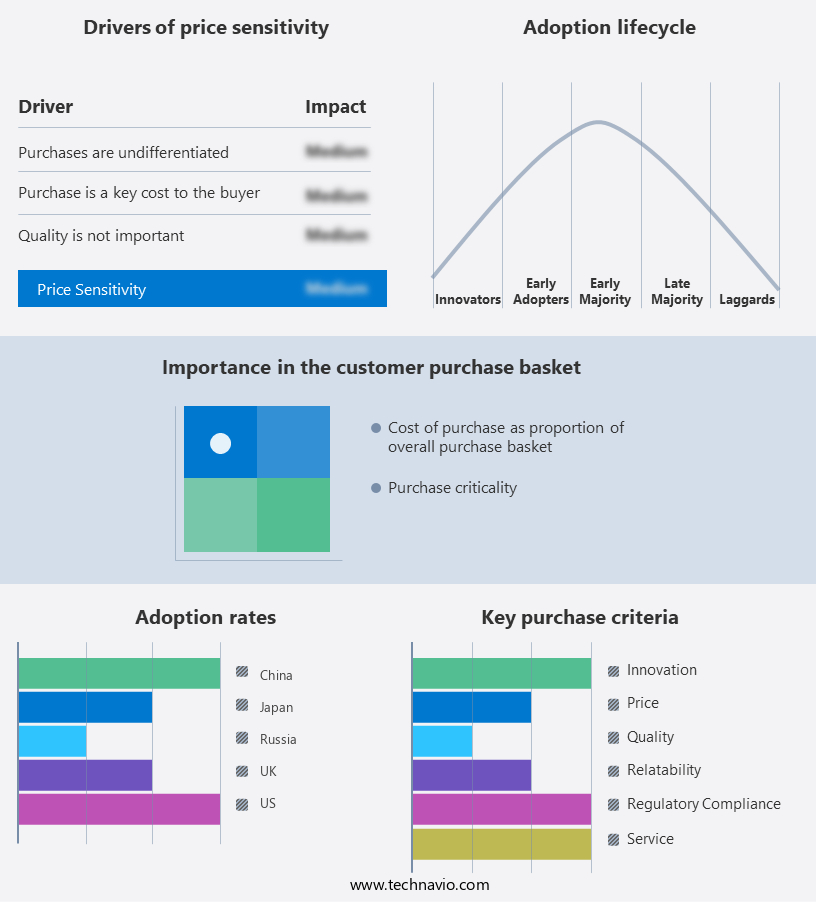
Customer Landscape
Key Companies & Market Insights
Companies are implementing various strategies, such as strategic alliances, space tourism market forecast, partnerships, mergers and acquisitions, geographical expansion, and product/service launches, to enhance their presence in the industry.
Axiom Space - The company specializes in providing exclusive astronaut training programs for private space travelers at renowned space agency facilities. Through this unique offering, participants gain access to cutting-edge space technology and expertise, ultimately preparing them for a once-in-a-lifetime experience in zero gravity environments.
The industry research and growth report includes detailed analyses of the competitive landscape of the market and information about key companies, including:
- Axiom Space
- Bigelow Aerospace
- Blue Origin
- Boeing
- Firefly Aerospace
- Lockheed Martin
- Maxar Technologies
- NanoRacks
- Northrop Grumman
- Orbital Sciences
- Orion Span
- Rocket Lab
- Sierra Nevada Corporation
- Space Adventures
- Space Perspective
- SpaceX
- The Spaceship Company
- Virgin Galactic
- World View Enterprises
- Zero Gravity Corporation
Qualitative and quantitative analysis of companies has been conducted to help clients understand the wider business environment as well as the strengths and weaknesses of key industry players. Data is qualitatively analyzed to categorize companies as pure play, category-focused, industry-focused, and diversified; it is quantitatively analyzed to categorize companies as dominant, leading, strong, tentative, and weak.
Recent Development and News in Space Tourism Market
- In February 2024, SpaceX, the leading player in the market, announced the successful completion of its Starship spacecraft's first orbital flight with astronauts onboard, marking a significant milestone in commercial space travel (SpaceX Press Release, 2024). This achievement opened new opportunities for space tourism, as the Starship is designed to carry up to 100 passengers, significantly expanding the market's capacity (SpaceX, 2024).
- In December 2024, NASA and SpaceX signed a landmark agreement to collaborate on the development of the Artemis lunar program, which includes the provision of crewed spaceflights for NASA astronauts to the Moon (NASA, 2024). This strategic partnership is expected to boost the market, as it increases public interest in space travel and paves the way for further advancements in the industry.
- In May 2025, Virgin Galactic, the pioneer in suborbital space tourism, raised USD200 million in a funding round, led by Social Capital and other investors (Virgin Galactic, 2025). This significant investment will support the company's efforts to expand its operations and increase its market share in the rapidly growing space tourism sector.
Research Analyst Overview
Space tourism, a niche market characterized by exclusive experiences in Earth's orbit and beyond, continues to evolve with innovative itineraries and destinations. Space tourism policy and regulations play a crucial role in shaping this industry, ensuring safety and accessibility for consumers. Orbital tourism ventures offer diverse experiences, from spacewalks and microgravity sports to astronaut training and entertainment. Space tourism activities extend beyond the confines of Earth, with destinations such as the International Space Station and the Moon becoming increasingly popular.
The market is accelerating with groundbreaking innovations that ensure safety, comfort, and efficiency for civilian space travelers. Reusable rockets and space capsule systems are key to reducing costs and enabling frequent missions. Passengers travel in high-tech space capsules equipped with life support systems, thermal protection systems, and automated docking capabilities. Navigation systems and AI navigation systems provide precise route control, while real-time telemetry and telemetry systems ensure constant communication with ground control systems. Safety is further enhanced by thermal shields, space suits, and zero-gravity technology. To prepare for spaceflight, travelers undergo virtual reality training, training simulators, and VR simulators. Powered by advanced propulsion, these missions rely on complex molecules and aerospace engineering, pushing the boundaries of modern tourism into orbit and beyond.
As the market matures, space tourism experiences are becoming more accessible, attracting a broader demographic of adventurous tourisms business travelers. Regulations and entertainment are integral components of this industry, with regulations ensuring safety and entertainment providing an unforgettable journey. Space tourism destinations and ventures continue to push the boundaries of human exploration, offering unique experiences for the affluent business traveler.
Dive into Technavio's robust research methodology, blending expert interviews, extensive data synthesis, and validated models for unparalleled Space Tourism Market insights. See full methodology.
|
Market Scope |
|
|
Report Coverage |
Details |
|
Page number |
213 |
|
Base year |
2024 |
|
Historic period |
2019-2023 |
|
Forecast period |
2025-2029 |
|
Growth momentum & CAGR |
Accelerate at a CAGR of 16.8% |
|
Market growth 2025-2029 |
USD 11289.8 million |
|
Market structure |
Fragmented |
|
YoY growth 2024-2025(%) |
14.8 |
|
Key countries |
US, Canada, Mexico, Russia, UK, Germany, France, China, Italy, India, Rest of World (ROW), , and UAE |
|
Competitive landscape |
Leading Companies, Market Positioning of Companies, Competitive Strategies, and Industry Risks |
What are the Key Data Covered in this Space Tourism Market Research and Growth Report?
- CAGR of the Space Tourism industry during the forecast period
- Detailed information on factors that will drive the growth and forecasting between 2025 and 2029
- Precise estimation of the size of the market and its contribution of the industry in focus to the parent market
- Accurate predictions about upcoming growth and trends and changes in consumer behaviour
- Growth of the market across North America, Europe, Asia, and Rest of World (ROW)
- Thorough analysis of the market's competitive landscape and detailed information about companies
- Comprehensive analysis of factors that will challenge the space tourism market growth of industry companies
We can help! Our analysts can customize this space tourism market research report to meet your requirements.
 RIA -
RIA -