


Solar Batteries Market Size 2026-2030
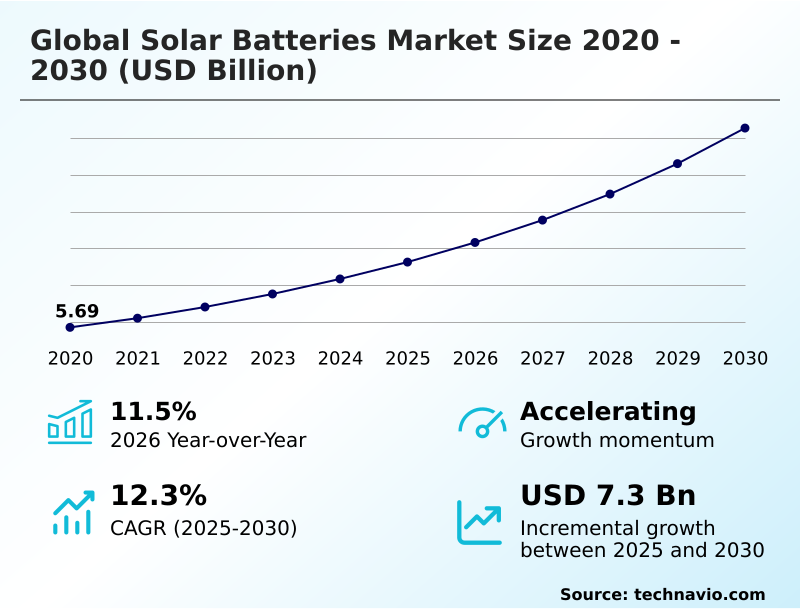
The solar batteries market size is valued to increase by USD 7.30 billion, at a CAGR of 12.3% from 2025 to 2030. Proliferation of supportive policies and financial incentives will drive the solar batteries market.
Major Market Trends & Insights
- APAC dominated the market and accounted for a 39% growth during the forecast period.
- By Technology - Li-ion segment was valued at USD 4.16 billion in 2024
- By End-user - Industrial segment accounted for the largest market revenue share in 2024
Market Size & Forecast
- Market Opportunities: USD 10.87 billion
- Market Future Opportunities: USD 7.30 billion
- CAGR from 2025 to 2030 : 12.3%
Market Summary
- The solar batteries market is undergoing a critical transformation, evolving from a niche backup power solution into an essential component of modern energy infrastructure. This expansion is propelled by the urgent need for grid stabilization amid the increasing penetration of intermittent renewable sources. Technological advancements are central to this evolution, with a decisive shift toward safer and more durable chemistries.
- Concurrently, the integration of artificial intelligence into energy management platforms is enabling sophisticated optimization of battery performance, maximizing economic returns for asset owners. However, the industry grapples with significant challenges, including supply chain volatility, which complicates project timelines and cost structures.
- For instance, a commercial facility can leverage an intelligent solar-plus-storage system to execute automated peak shaving, drawing from the battery during high-cost tariff periods to reduce operational energy expenditures by a significant margin.
- This dynamic illustrates the convergence of technology, economics, and regulatory frameworks shaping the deployment of energy storage solutions worldwide, making them indispensable for achieving both energy independence and decarbonization goals.
What will be the Size of the Solar Batteries Market during the forecast period?
Get Key Insights on Market Forecast (PDF) Request Free Sample
How is the Solar Batteries Market Segmented?
The solar batteries industry research report provides comprehensive data (region-wise segment analysis), with forecasts and estimates in "USD million" for the period 2026-2030, as well as historical data from 2020-2024 for the following segments.
- Technology
- Li-ion
- Lead acid
- Sodium-based
- Others
- End-user
- Industrial
- Commercial
- Residential
- Capacity
- Below 10 kWh
- Between 10 to 50 kWh
- Above 50 kWh
- Geography
- APAC
- China
- Australia
- Japan
- North America
- US
- Canada
- Mexico
- Europe
- Germany
- UK
- Italy
- Middle East and Africa
- South Africa
- UAE
- Saudi Arabia
- South America
- Brazil
- Argentina
- Rest of World (ROW)
- APAC
By Technology Insights
The li-ion segment is estimated to witness significant growth during the forecast period.
The Li-ion segment commands a dominant position, underpinned by its high energy density and decreasing costs. A notable shift is occurring toward lithium iron phosphate (LFP) chemistries, favored for their enhanced safety and longer lifecycles in stationary solar-plus-storage systems.
This preference is particularly strong in grid-scale energy storage and long-duration energy storage applications where stability is paramount. The integration of advanced battery management systems (BMS) further optimizes performance and lifespan.
However, the segment is not immune to economic pressures, as import tariffs on specific chemistries have driven up project costs by over 50% in certain markets, influencing procurement strategies and altering the financial models for large-scale deployments.
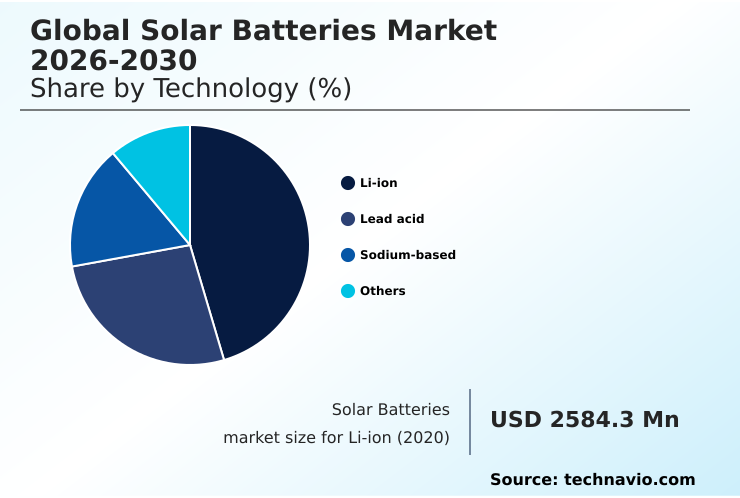
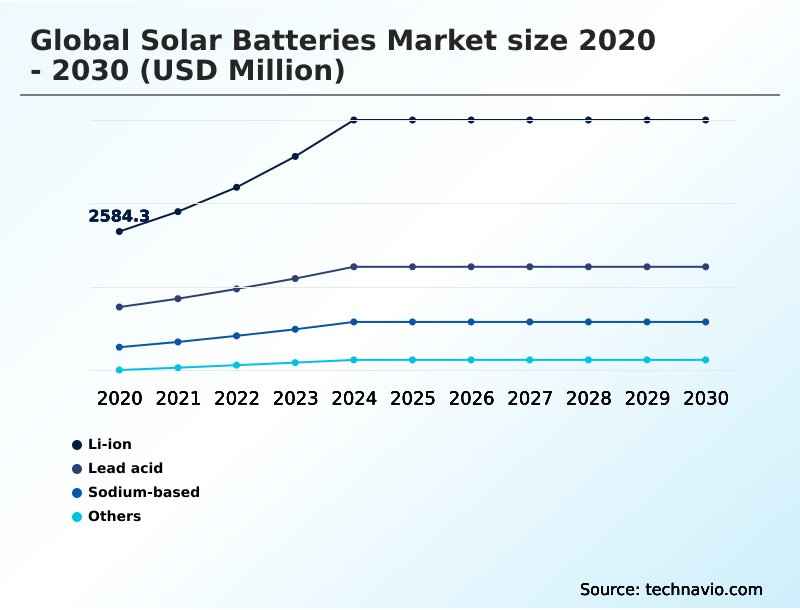
The Li-ion segment was valued at USD 4.16 billion in 2024 and showed a gradual increase during the forecast period.
Regional Analysis
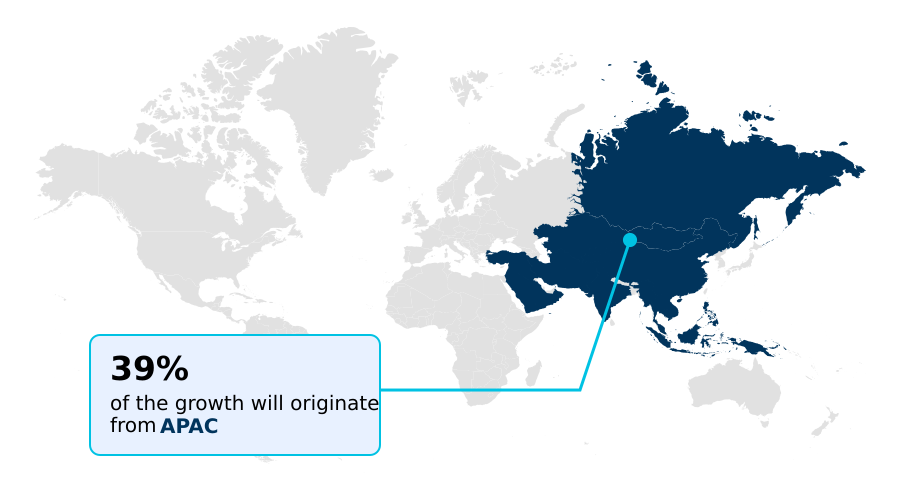
APAC is estimated to contribute 39% to the growth of the global market during the forecast period.Technavio’s analysts have elaborately explained the regional trends and drivers that shape the market during the forecast period.
See How Solar Batteries Market Demand is Rising in APAC Request Free Sample
The geographic landscape of the solar batteries market is characterized by diverse regional dynamics and growth trajectories.
APAC is projected to contribute nearly 39% of the market's incremental growth, driven by extensive manufacturing capabilities and ambitious renewable energy targets in countries like China.
In North America, regulatory support and the necessity for grid resilience are fueling rapid deployment, with over 18 gigawatts of new utility-scale battery energy storage systems (BESS) anticipated to come online in a single year.
Europe maintains its focus on energy security, with significant investments in flow batteries and commercial energy storage to support its decarbonization goals.
Across these regions, the emphasis is on enhancing grid stability services and developing alternative technologies like solid-state batteries to move beyond traditional nickel manganese cobalt (NMC) chemistries.
Market Dynamics
Our researchers analyzed the data with 2025 as the base year, along with the key drivers, trends, and challenges. A holistic analysis of drivers will help companies refine their marketing strategies to gain a competitive advantage.
- Strategic decision-making in the solar batteries market now involves nuanced technical and economic trade-offs. The process of comparing lfp and nmc for solar applications requires balancing the superior safety and longevity of Lithium Iron Phosphate against the higher energy density of Nickel Manganese Cobalt chemistries.
- Concurrently, the emergence of sodium-ion battery for residential solar presents a compelling alternative, mitigating concerns around raw material price volatility and supply chain constraints. For asset owners, optimizing solar battery life with AI has become critical for maximizing return on investment, with advanced algorithms extending operational lifespans by up to 15% compared to static control systems.
- This is particularly relevant when integrating solar batteries with EV charging, a use case that places significant demands on the system. To accommodate this, modular solar battery system expansion is becoming a standard feature, allowing users to scale their storage capacity in line with their evolving energy needs.
- The ability to seamlessly expand a system is a key factor in future-proofing residential and commercial energy investments, ensuring long-term viability.
What are the key market drivers leading to the rise in the adoption of Solar Batteries Industry?
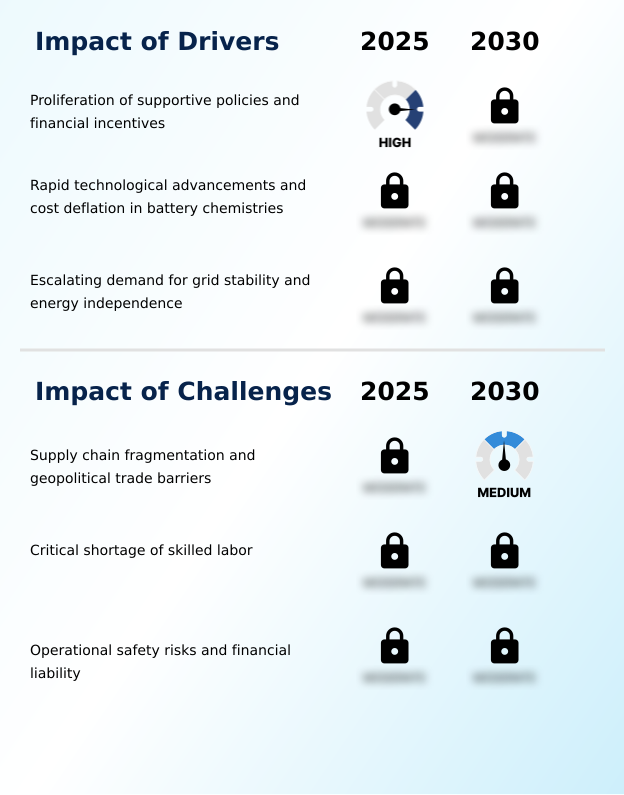
- The proliferation of supportive policies and financial incentives serves as a key driver for market growth.
- Market expansion is heavily driven by supportive government policies and the rapid pace of technological innovation, which together improve the economic viability of storage solutions.
- Government incentives, including aid packages exceeding EUR 800 million in some regions, are critical for de-risking private investment in utility-scale applications and behind-the-meter storage.
- Concurrently, technological breakthroughs are lowering the levelized cost of storage (LCOS) and extending asset lifecycles, with new systems demonstrating zero degradation for the first five years of operation.
- This progress enables industrial consumers to implement effective peak shaving capabilities and supports the growth of decentralized energy resources (DERs), fostering greater energy independence solutions for end-users.
What are the market trends shaping the Solar Batteries Industry?
- A key market trend is the diversification of battery chemistries beyond lithium-ion. The rise of sodium-ion technology is emerging as a significant development.
- Key market trends are reshaping the competitive landscape, led by the commercialization of alternative technologies such as sodium-ion battery chemistry. This shift allows for greater supply chain stability compared to lithium-based options. Another significant trend is the institutionalization of virtual power plants (VPPs), which aggregate distributed residential energy storage assets into dispatchable grid resources.
- These networks enable participation in demand response programs, allowing homeowners to monetize their systems by reacting to complex time-of-use (TOU) tariffs. The integration of advanced energy management systems (EMS) is central to this model, with some platforms allowing over 50,000 users to automatically bid stored energy into wholesale markets.
- This software-driven approach is improving asset utilization by more than 20% in certain programs.
What challenges does the Solar Batteries Industry face during its growth?
- Supply chain fragmentation and geopolitical trade barriers represent a key challenge affecting industry growth.
- The market faces considerable headwinds from supply chain disruptions and operational risks. The imposition of new trade tariffs has increased the landed cost of key battery components, including deep-cycle batteries and advanced lead-acid battery alternatives, by over 50% in certain key markets.
- Concurrently, safety remains a paramount concern, as incidents can trigger immediate double-digit percentage increases in insurance premiums, impacting project profitability. These challenges are compelling the industry to focus on designs with robust thermal runaway protection and to adopt circular economy principles to secure material supply.
- Furthermore, a shortage of skilled labor complicates the installation of systems featuring newer technologies like DC-coupled architecture, creating project delays and increasing costs.
Exclusive Technavio Analysis on Customer Landscape
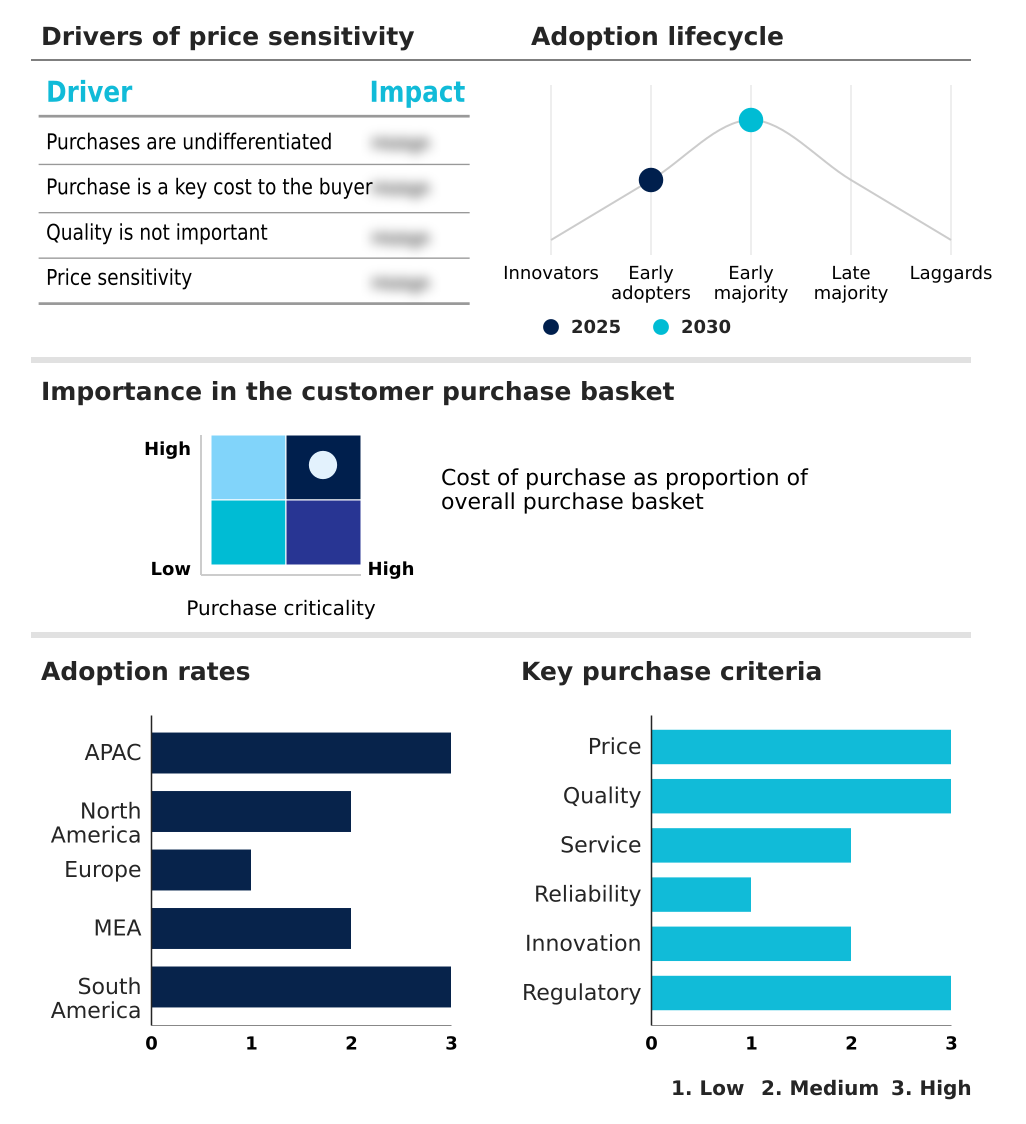
The solar batteries market forecasting report includes the adoption lifecycle of the market, covering from the innovator’s stage to the laggard’s stage. It focuses on adoption rates in different regions based on penetration. Furthermore, the solar batteries market report also includes key purchase criteria and drivers of price sensitivity to help companies evaluate and develop their market growth analysis strategies.
Customer Landscape of Solar Batteries Industry
Competitive Landscape
Companies are implementing various strategies, such as strategic alliances, solar batteries market forecast, partnerships, mergers and acquisitions, geographical expansion, and product/service launches, to enhance their presence in the industry.
A123 Systems LLC - Analysis indicates a focus on providing advanced lithium-ion phosphate cells, engineered for high-performance energy storage and power delivery applications across multiple sectors.
The industry research and growth report includes detailed analyses of the competitive landscape of the market and information about key companies, including:
- A123 Systems LLC
- Alpha ESS Co.Ltd.
- BYD Co. Ltd.
- Contemporary Amperex Ltd.
- East Penn Manufacture Co. Inc.
- EnerSys
- Exide Industries Ltd.
- GS Yuasa International Ltd.
- LG Energy Solution Ltd.
- Loom Solar Pvt. Ltd.
- Primus Power Solutions
- Renon Power Technology Inc.
- Samsung SDI Co. Ltd.
- SolarEdge Technologies Inc.
- Sunergy Solar
- Tesla Inc.
Qualitative and quantitative analysis of companies has been conducted to help clients understand the wider business environment as well as the strengths and weaknesses of key industry players. Data is qualitatively analyzed to categorize companies as pure play, category-focused, industry-focused, and diversified; it is quantitatively analyzed to categorize companies as dominant, leading, strong, tentative, and weak.
Recent Development and News in Solar batteries market
- In May 2025, Contemporary Amperex Technology Co. Limited launched the TENER Stack, a mass-producible energy storage system featuring zero degradation over the first five years of use.
- In April 2025, the United States government implemented a sweeping expansion of trade tariffs on battery components of Chinese origin, with duties on some chemistries exceeding 50%.
- In April 2025, Contemporary Amperex Technology Co. Limited commenced the global distribution of its second-generation sodium-ion battery packs tailored for the residential solar storage sector.
- In March 2025, the European Commission approved an EUR 826 million aid scheme to support the deployment of energy storage solutions in Spain, aiming to foster the integration of renewables.
Dive into Technavio’s robust research methodology, blending expert interviews, extensive data synthesis, and validated models for unparalleled Solar Batteries Market insights. See full methodology.
| Market Scope | |
|---|---|
| Page number | 295 |
| Base year | 2025 |
| Historic period | 2020-2024 |
| Forecast period | 2026-2030 |
| Growth momentum & CAGR | Accelerate at a CAGR of 12.3% |
| Market growth 2026-2030 | USD 7302.4 million |
| Market structure | Fragmented |
| YoY growth 2025-2026(%) | 11.5% |
| Key countries | China, Australia, Japan, India, South Korea, Indonesia, US, Canada, Mexico, Germany, UK, Italy, France, Spain, The Netherlands, South Africa, UAE, Saudi Arabia, Israel, Egypt, Brazil, Chile and Argentina |
| Competitive landscape | Leading Companies, Market Positioning of Companies, Competitive Strategies, and Industry Risks |
Research Analyst Overview
- The solar batteries market has matured beyond simple backup power, now serving as a critical pillar of grid infrastructure through the deployment of grid-scale energy storage and behind-the-meter storage solutions. The sector's trajectory is dictated by continuous innovation in battery chemistry and intelligent system control.
- At the boardroom level, decisions are increasingly focused on supply chain resilience, prompting a strategic diversification away from conventional chemistries toward alternatives like sodium-ion battery chemistry, flow batteries, and solid-state batteries to mitigate risks associated with raw material volatility.
- The refinement of technologies such as lithium iron phosphate (LFP) and even advanced absorbent glass mat (AGM) and deep-cycle batteries continues, driven by the need to lower the levelized cost of storage (LCOS).
- This is happening alongside the integration of sophisticated battery management systems (BMS) and energy management systems (EMS) that offer enhanced thermal runaway protection and enable peak shaving capabilities. The establishment of virtual power plants (VPPs) represents a paradigm shift, transforming distributed assets into dispatchable grid resources.
- However, geopolitical factors remain a challenge, with new trade policies increasing the landed cost of certain battery components by over 50%, directly impacting project economics.
What are the Key Data Covered in this Solar Batteries Market Research and Growth Report?
-
What is the expected growth of the Solar Batteries Market between 2026 and 2030?
-
USD 7.30 billion, at a CAGR of 12.3%
-
-
What segmentation does the market report cover?
-
The report is segmented by Technology (Li-ion, Lead acid, Sodium-based, and Others), End-user (Industrial, Commercial, and Residential), Capacity (Below 10 kWh, Between 10 to 50 kWh, and Above 50 kWh) and Geography (APAC, North America, Europe, Middle East and Africa, South America)
-
-
Which regions are analyzed in the report?
-
APAC, North America, Europe, Middle East and Africa and South America
-
-
What are the key growth drivers and market challenges?
-
Proliferation of supportive policies and financial incentives, Supply chain fragmentation and geopolitical trade barriers
-
-
Who are the major players in the Solar Batteries Market?
-
A123 Systems LLC, Alpha ESS Co.Ltd., BYD Co. Ltd., Contemporary Amperex Ltd., East Penn Manufacture Co. Inc., EnerSys, Exide Industries Ltd., GS Yuasa International Ltd., LG Energy Solution Ltd., Loom Solar Pvt. Ltd., Primus Power Solutions, Renon Power Technology Inc., Samsung SDI Co. Ltd., SolarEdge Technologies Inc., Sunergy Solar and Tesla Inc.
-
Market Research Insights
- The solar batteries market is shaped by a confluence of technological innovation and evolving grid requirements. The deployment of decentralized energy resources (DERs) is accelerating, with a focus on both residential and commercial energy storage. These solar-plus-storage systems provide critical energy independence solutions.
- The adoption of advanced battery energy storage systems (BESS) has led to notable efficiency gains, with some DC-coupled architecture designs reducing energy conversion losses by up to 8%. Furthermore, participation in demand response programs, enabled by these systems, can reduce an enterprise's energy costs by over 15% through strategic responses to time-of-use (TOU) tariffs.
- The market is also moving toward long-duration energy storage to provide enhanced grid stability services.
We can help! Our analysts can customize this solar batteries market research report to meet your requirements.