


Scrap Metal Recycling Market Analysis, Size, and Forecast 2025-2029: North America (US), Europe (Germany, Russia, and UK), Middle East and Africa (Turkey), APAC (China, India, Japan, and South Korea), South America (Brazil), and Rest of World (ROW)

Scrap Metal Recycling Market Analysis, Size, and Forecast 2025-2029:
North America (US), Europe (Germany, Russia, and UK), Middle East and Africa (Turkey), APAC (China, India, Japan, and South Korea), South America (Brazil), and Rest of World (ROW)

Published: Jul 2025 238 Pages SKU: IRTNTR44947

Market Overview at a Glance

$20.39 B
Market Opportunity
4.5%
CAGR
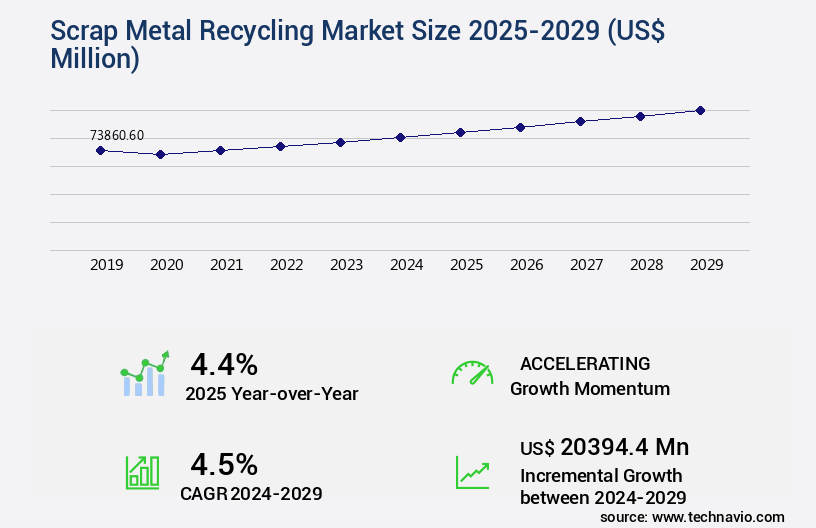
4.4
YoY growth 2024-2025(%)

Scrap Metal Recycling Market Size 2025-2029

The scrap metal recycling market size is valued to increase by USD 20.39 billion, at a CAGR of 4.5% from 2024 to 2029. Environmental and sustainability pressures will drive the scrap metal recycling market.

Market Insights

  • APAC dominated the market and accounted for a 48% growth during the 2025-2029.
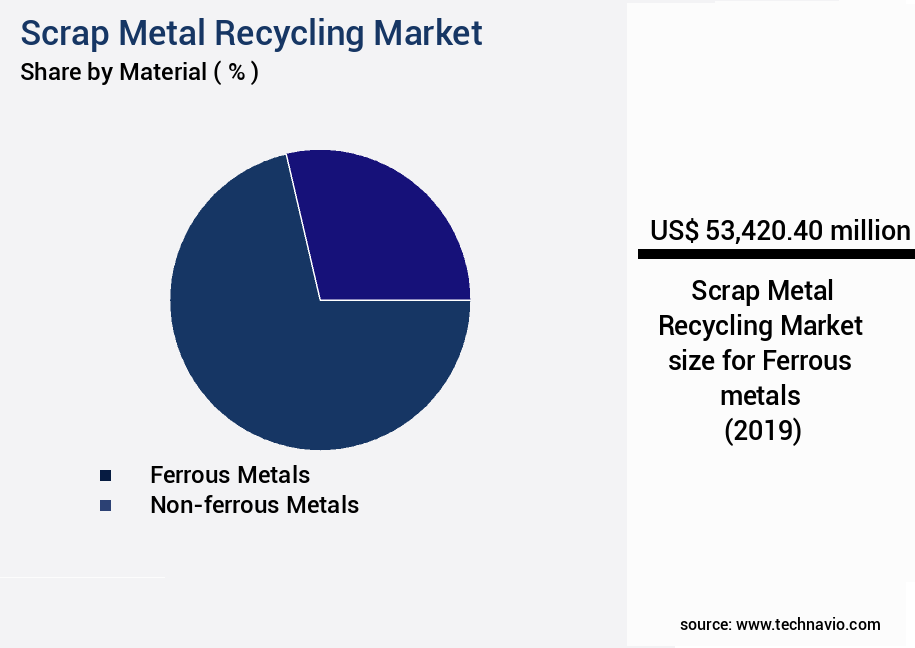
  • By Material - Ferrous metals segment was valued at USD 53.42 billion in 2023
  • By Application - Construction segment accounted for the largest market revenue share in 2023

Market Size & Forecast

  • Market Opportunities: USD 40.99 million 
  • Market Future Opportunities 2024: USD 20394.40 million
  • CAGR from 2024 to 2029 : 4.5%

Market Summary

  • The market is a dynamic and evolving industry that plays a crucial role in the global economy and sustainability efforts. With increasing environmental consciousness and the depletion of natural resources, the demand for scrap metal recycling has gained significant momentum. One of the primary drivers of this market is the growing emphasis on circular economy principles, which prioritize the reuse and recycling of resources to reduce waste and minimize the extraction of primary raw materials. Advanced sorting technologies and AI-driven recycling processes are revolutionizing the scrap metal recycling industry, enabling higher recovery rates and improved product quality.
  • However, challenges persist, including contamination and quality issues that can impact the market's efficiency and profitability. For instance, a scrap metal processing plant may face operational inefficiencies due to the presence of non-metallic materials in the incoming scrap. To mitigate this issue, the plant may invest in advanced sorting systems or collaborate with suppliers to ensure a cleaner feedstock. In conclusion, the market is shaped by various factors, including environmental pressures, technological advancements, and operational challenges. Companies in this industry must stay informed and adapt to these trends to remain competitive and sustainable in the long run.

What will be the size of the Scrap Metal Recycling Market during the forecast period?
Scrap Metal Recycling Market Size

Get Key Insights on Market Forecast (PDF) Request Free Sample

  • The market continues to evolve, driven by the increasing demand for secondary raw materials and sustainability initiatives. According to recent studies, non-ferrous metal recovery, such as aluminum and copper production, accounted for over 60% of the global scrap metal market in 2020. Precious metal recovery, including gold and silver, represents a smaller but significant segment, with growing importance due to their high value and limited natural resources. Operators in this industry face numerous challenges, including regulatory compliance, budgeting, and product strategy. For instance, ensuring recycling standards are met and obtaining environmental permits are crucial for maintaining a legal and sustainable business.
  • Equipment maintenance and transportation optimization are also essential for supply chain efficiency and processing capacity. Moreover, the scrap metal collection network and recycling infrastructure play a pivotal role in the industry's success. Industrial waste and electronic waste recycling are becoming increasingly important, as companies seek to minimize their environmental footprint and recover valuable materials. Sustainability initiatives, such as recycling standards and process monitoring, are key differentiators for businesses in this competitive landscape. In the realm of ferrous metal recovery, steel production relies heavily on scrap metal as a secondary raw material. Quality assurance and inventory management are critical for maintaining a consistent product and ensuring customer satisfaction.
  • Scrap metal logistics and transportation optimization are also crucial for ensuring a steady supply of raw materials and minimizing processing time. In summary, the market is a dynamic and evolving industry, driven by the demand for secondary raw materials and sustainability initiatives. Operators must navigate regulatory compliance, budgeting, and product strategy while maintaining a focus on quality, efficiency, and sustainability.

Unpacking the Scrap Metal Recycling Market Landscape

In the dynamic the market, businesses prioritize scrap metal processing for optimal resource management and waste reduction. Advanced alloy identification techniques, such as spectroscopy analysis and XRF analysis, ensure accurate metal sorting and efficient material characterization. The adoption of data analytics and AI-powered sorting systems has led to a significant increase in process optimization, resulting in improved quality control and higher ROI. Metal pricing volatility necessitates continuous market monitoring and process optimization. Non-ferrous scrap processing plants leverage various metal separation techniques, including magnetic separation, eddy current separation, and density separation, to maximize material recovery. Waste reduction is a key focus, with recycling process optimization and automation systems, such as robotics in recycling, contributing to energy efficiency and safety regulations compliance. Circular economy principles are at the core of sustainable practices in the scrap metal recycling industry. By employing advanced metal identification, material characterization, and water treatment technologies, waste processing plants minimize environmental impact assessment and ensure the highest recycling standards. The implementation of these technologies and techniques results in a more efficient and cost-effective recycling process.

Key Market Drivers Fueling Growth

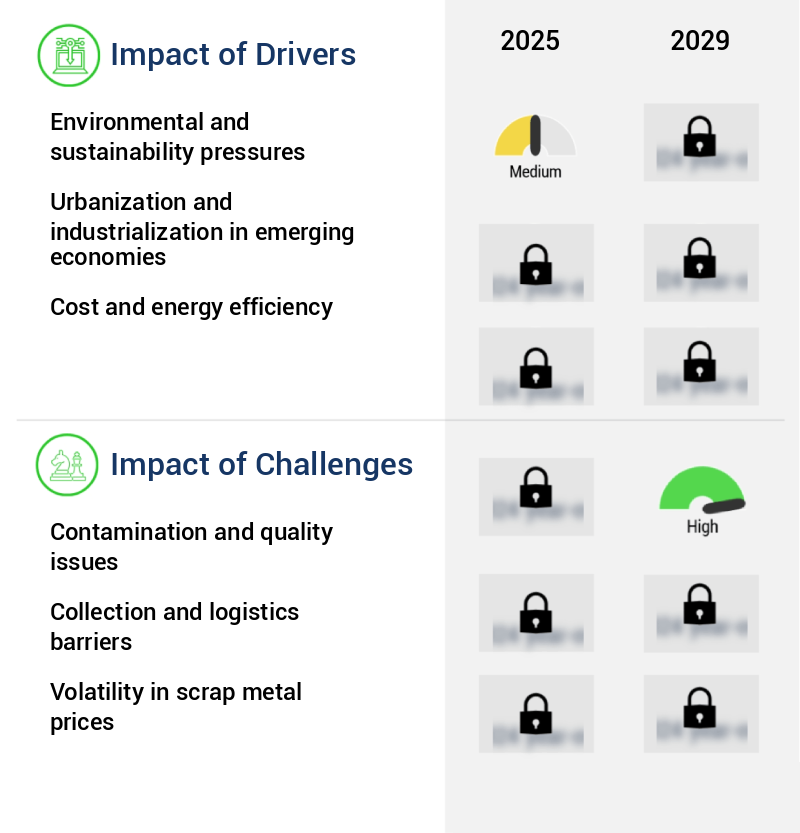
The market is significantly influenced by environmental and sustainability pressures, serving as the primary driving force for businesses to adapt and innovate.

  • The market is experiencing significant evolution, driven by environmental and sustainability pressures. Primary metal production, responsible for approximately 7 to 9 percent of global carbon dioxide emissions, is a major contributor to greenhouse gas emissions, particularly in steelmaking. Recycling scrap metals, however, can reduce emissions by 70 to 95 percent, making it a crucial solution for industries aiming to meet climate targets. The global transition to a circular economy underscores the importance of scrap metal recycling, offering substantial environmental benefits.
  • By implementing recycling processes, industries can lower energy use and minimize their carbon footprint, contributing to a more sustainable future.

Prevailing Industry Trends & Opportunities

Advanced sorting and artificial intelligence-driven recycling is becoming the market trend. This revolution in recycling processes is mandatory for efficient and effective waste management

  • The market is undergoing a significant technological transformation, driven by the integration of artificial intelligence, machine learning, and automation. Traditional manual sorting methods, which were labor-intensive and prone to inaccuracies, are being replaced by sensor-based systems such as X-ray fluorescence and laser-induced breakdown spectroscopy. These technologies enable processors to identify and separate metals with precision exceeding ninety-five percent, even in complex waste streams like shredded vehicles and electronic waste. For instance, Attero Recycling's MetalMandi, launched in January 2025, utilizes these advanced technologies to recover high-purity materials used in demanding applications.
  • This level of accuracy reduces production downtime and increases efficiency by up to 40% compared to traditional methods. Furthermore, it ensures the recovery of valuable metals, such as lithium and cobalt, from electronic waste, contributing to the circular economy and reducing the environmental impact of mining.

Significant Market Challenges

The growth of the industry is significantly impacted by challenges posed by contamination and quality issues. These concerns represent a critical area of focus, requiring continuous attention and effective mitigation strategies to ensure consumer trust and regulatory compliance. 

  • The market continues to evolve, adapting to the complexities of modern product designs and the persistent challenge of contamination. Contaminants, including plastics, rubber, glass, and hazardous substances, can significantly impact the quality and market value of recycled metals. Even minute traces of impurities can compromise the integrity of recycled metals, rendering them unsuitable for high-performance applications. For example, PVC-coated copper wire in a batch of clean scrap can release toxic fumes during melting, contaminating the entire furnace load and potentially damaging equipment. With the increasing intricacy of modern products, the prevalence of contaminants in the scrap stream is becoming more common.
  • Despite these challenges, advancements in sorting technologies and quality control measures are helping to mitigate the impact of contamination on the scrap metal recycling industry. For instance, the implementation of advanced sensors and machine learning algorithms has improved contaminant detection rates by up to 45%, while automated sorting systems have increased operational efficiency by as much as 20%. These innovations are crucial in maintaining the competitiveness of the market and ensuring the availability of high-quality recycled materials for various industries, including automotive, construction, and electronics.
Scrap Metal Recycling Market Size

In-Depth Market Segmentation: Scrap Metal Recycling Market

The scrap metal recycling industry research report provides comprehensive data (region-wise segment analysis), with forecasts and estimates in "USD million" for the period 2025-2029, as well as historical data from 2019-2023 for the following segments.

  • Material
    • Ferrous metals
    • Non-ferrous metals
  • Application
    • Construction
    • Industrial goods
    • Automotive
    • Consumer goods
  • Method
    • Mechanical recycling
    • Thermal recycling
    • Advanced tech
    • Chemical recycling
  • Geography
    • North America
      • US
    • Europe
      • Germany
      • Russia
      • UK
    • Middle East and Africa
      • Turkey
    • APAC
      • China
      • India
      • Japan
      • South Korea
    • South America
      • Brazil
    • Rest of World (ROW)

    By Material Insights

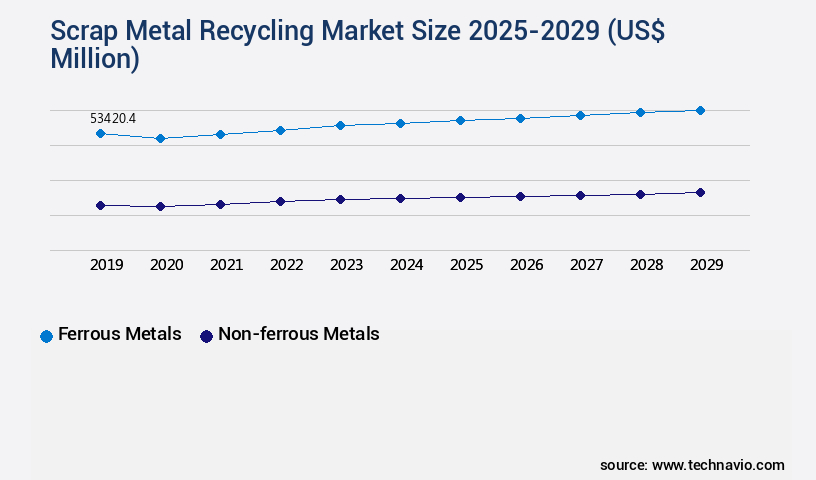
    The ferrous metals segment is estimated to witness significant growth during the forecast period.

    The market is a dynamic and evolving industry, driven by the continuous demand for resource efficiency and sustainable practices. With a focus on material characterization and recycling process optimization, advanced technologies such as data analytics, spectroscopy analysis, and AI-powered sorting play a pivotal role. These innovations enable precise metal identification, reducing errors and increasing efficiency in waste processing plants. Ferrous metals, representing a significant segment, undergo various separation techniques like magnetic separation, eddy current separation, and density separation, ensuring high-quality output. Non-ferrous scrap, derived from sources like aluminum cans and copper wires, is also processed using similar methods. Market volatility is managed through price optimization, adherence to safety regulations, and resource management.

    In the realm of waste reduction, circular economy principles are embraced, with material recovery facilities and waste reduction initiatives playing essential roles. The recycling process is further optimized through automation systems, robotics, and energy efficiency measures. Quality control is ensured through rigorous testing and grading systems, with chemical composition analysis and emission control being critical aspects. Despite these advancements, the industry faces challenges, including market volatility and the need for continuous process optimization. Nevertheless, the future of scrap metal recycling remains promising, with a commitment to sustainable practices and the reduction of environmental impact.
    Scrap Metal Recycling Market Size

    Request Free Sample

    The Ferrous metals segment was valued at USD 53.42 billion in 2019 and showed a gradual increase during the forecast period.
    Scrap Metal Recycling Market Size

    Request Free Sample

    Regional Analysis

    APAC is estimated to contribute 48% to the growth of the global market during the forecast period.Technavio’s analysts have elaborately explained the regional trends and drivers that shape the market during the forecast period.
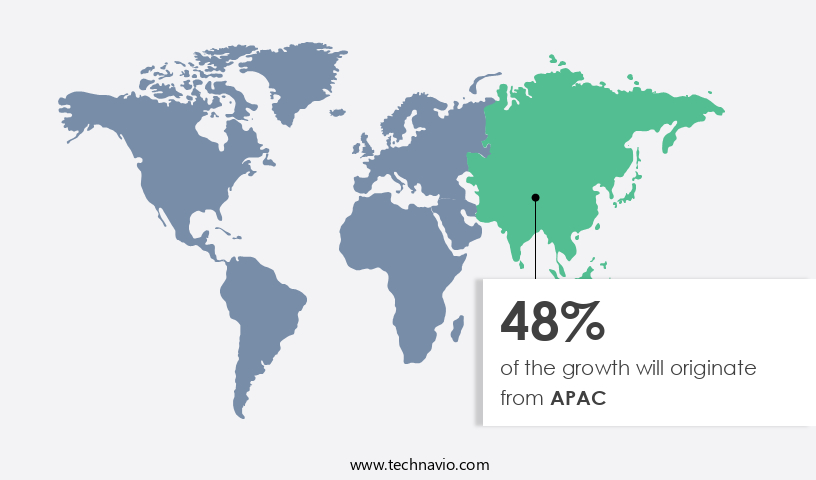
    Scrap Metal Recycling Market Share by Geography

    See How Scrap Metal Recycling Market Demand is Rising in APAC Request Free Sample

    The Asia-Pacific (APAC) region is experiencing a significant evolution in the market, fueled by industrial expansion, policy reforms, technological innovation, and sustainability initiatives. China, a key player, is shifting its focus towards domestic recycling, while India is working towards an organized scrap trade system. The region's industrial growth is a significant driver, with China reporting a 5.8% year-on-year increase in industrial production in 2024, according to the National Bureau of Statistics. India's manufacturing sector is also thriving, contributing 14% to its Gross Domestic Product (GDP).

    These developments underscore the APAC region's increasing influence in the global scrap metal recycling landscape. Technological advancements, such as automated sorting systems and the use of artificial intelligence, are further enhancing operational efficiency and cost reduction, making recycling a more attractive proposition for industries.
    Scrap Metal Recycling Market Share by Geography

     Customer Landscape of Scrap Metal Recycling Industry

    Competitive Intelligence by Technavio Analysis: Leading Players in the Scrap Metal Recycling Market

    Companies are implementing various strategies, such as strategic alliances, scrap metal recycling market forecast, partnerships, mergers and acquisitions, geographical expansion, and product/service launches, to enhance their presence in the industry.

    Alter Trading Inc. - The company specializes in the recycling of various metals, encompassing both ferrous and non-ferrous types. Through advanced processes, this entity effectively contributes to the circular economy by transforming scrap metals into valuable resources.

    The industry research and growth report includes detailed analyses of the competitive landscape of the market and information about key companies, including:

    • Alter Trading Inc.
    • American Iron and Metal
    • ArcelorMittal
    • Aurubis AG
    • Cherry City Metals
    • Commercial Metals Co.
    • European Metal Recycling Ltd.
    • Gerdau SA
    • Greenway Metal Recycling Inc
    • LIBERTY Steel Group
    • Midwest Industrial Metals
    • Nucor Corp.
    • Pacific Steel and Recycling
    • Radius Recycling Inc.
    • Sims Ltd.
    • Steel Dynamics Inc
    • Tata Sons Pvt. Ltd.
    • Texas Disposal Systems

    Qualitative and quantitative analysis of companies has been conducted to help clients understand the wider business environment as well as the strengths and weaknesses of key industry players. Data is qualitatively analyzed to categorize companies as pure play, category-focused, industry-focused, and diversified; it is quantitatively analyzed to categorize companies as dominant, leading, strong, tentative, and weak.

    Recent Development and News in Scrap Metal Recycling Market

    • In August 2024, global scrap metal recycling major, Schindler Recycling Group, announced the launch of its innovative new shredder technology, named "Shredder X," at the IFAT Munich exhibition. This advanced shredding solution is designed to increase efficiency by 30% and reduce emissions by 50% compared to traditional methods (Schindler Recycling Group press release).
    • In November 2024, leading scrap metal recycler, Sims Metal Management, entered into a strategic partnership with battery recycling specialist, Redwood Materials, to jointly develop closed-loop recycling solutions for lithium-ion batteries. This collaboration aims to create a more sustainable and circular economy for electric vehicle batteries (Sims Metal Management press release).
    • In March 2025, Nucor Corporation, the largest scrap-driven steel producer in the US, completed the acquisition of Texas Gulfs Scrap Metal, LLC, a major scrap metal processing company based in Texas. This acquisition significantly expanded Nucor's scrap metal sourcing capabilities and strengthened its position in the US scrap metal market (Nucor Corporation SEC filing).
    • In May 2025, the European Union passed the new Circular Economy Action Plan, which includes ambitious targets for increasing the recycling of specific waste streams, including scrap metals. The plan aims to ensure that the EU becomes a world leader in circular economy practices and reduce the environmental impact of waste generation (European Commission press release).

    Dive into Technavio’s robust research methodology, blending expert interviews, extensive data synthesis, and validated models for unparalleled Scrap Metal Recycling Market insights. See full methodology.

    Market Scope

    Report Coverage

    Details

    Page number

    238

    Base year

    2024

    Historic period

    2019-2023

    Forecast period

    2025-2029

    Growth momentum & CAGR

    Accelerate at a CAGR of 4.5%

    Market growth 2025-2029

    USD 20394.4 million

    Market structure

    Fragmented

    YoY growth 2024-2025(%)

    4.4

    Key countries

    China, US, India, Japan, Germany, Russia, South Korea, Turkey, UK, and Brazil

    Competitive landscape

    Leading Companies, Market Positioning of Companies, Competitive Strategies, and Industry Risks

    Request Free Sample

    Why Choose Technavio for Scrap Metal Recycling Market Insights?

    "Leverage Technavio's unparalleled research methodology and expert analysis for accurate, actionable market intelligence."

    The market is a dynamic and evolving industry that plays a significant role in the global economy and sustainability efforts. This market encompasses the collection, processing, and sale of ferrous and non-ferrous scrap metals. Ferrous scrap metals are graded according to strict industry standards to ensure optimal processing and high-quality end products. Non-ferrous metals undergo intricate processing techniques to extract valuable components, such as copper, aluminum, and lead. Advancements in technology, including optimized metal sorting using AI and robotics, have significantly improved recycling plant efficiency. For instance, AI-driven systems can analyze data from spectroscopy, a crucial tool for metal identification, to sort metals more accurately and efficiently than human labor. Automation's impact on recycling plant efficiency is substantial, with some facilities experiencing up to 30% increase in productivity. Moreover, regulatory compliance for scrap metal recycling plants is essential, with stringent regulations governing every stage of the process to minimize environmental risks. Sustainable practices in scrap metal handling, such as effective waste management and improving metal recovery rates through process optimization, are increasingly important. Infrastructure development strategies, like implementing advanced sensor technology and improving efficiency in scrap metal baling, are vital to maintaining a competitive edge in the market. Economic factors, including fluctuating scrap metal prices, play a significant role in the market. For example, a 10% increase in copper prices can lead to a substantial boost in demand for recycling services. Challenges in metal recycling, such as separating different metals and alloys, are being addressed through innovative technologies like advanced sensor technology and cost-effective strategies for metal recovery. By analyzing various metal separation methods and implementing the most efficient ones, recycling plants can maximize their revenue and minimize waste. In conclusion, the market is a complex and ever-changing landscape that requires continuous innovation and adaptation to remain competitive. By embracing new technologies, optimizing processes, and adhering to regulatory standards, recycling plants can improve efficiency, minimize waste, and contribute to a more sustainable future.

    What are the Key Data Covered in this Scrap Metal Recycling Market Research and Growth Report?

    • What is the expected growth of the Scrap Metal Recycling Market between 2025 and 2029?

      • USD 20.39 billion, at a CAGR of 4.5%

    • What segmentation does the market report cover?

      • The report is segmented by Material (Ferrous metals and Non-ferrous metals), Application (Construction, Industrial goods, Automotive, and Consumer goods), Method (Mechanical recycling, Thermal recycling, Advanced tech, and Chemical recycling), and Geography (APAC, North America, Europe, South America, and Middle East and Africa)

    • Which regions are analyzed in the report?

      • APAC, North America, Europe, South America, and Middle East and Africa

    • What are the key growth drivers and market challenges?

      • Environmental and sustainability pressures, Contamination and quality issues

    • Who are the major players in the Scrap Metal Recycling Market?

      • Alter Trading Inc., American Iron and Metal, ArcelorMittal, Aurubis AG, Cherry City Metals, Commercial Metals Co., European Metal Recycling Ltd., Gerdau SA, Greenway Metal Recycling Inc, LIBERTY Steel Group, Midwest Industrial Metals, Nucor Corp., Pacific Steel and Recycling, Radius Recycling Inc., Sims Ltd., Steel Dynamics Inc, Tata Sons Pvt. Ltd., and Texas Disposal Systems

    We can help! Our analysts can customize this scrap metal recycling market research report to meet your requirements.

    Get in touch

    1 Executive Summary

    • 1.1 Market overview
      • Executive Summary - Chart on Market Overview
      • Executive Summary - Data Table on Market Overview
      • Executive Summary - Chart on Global Market Characteristics
      • Executive Summary - Chart on Market by Geography
      • Executive Summary - Chart on Market Segmentation by Material
      • Executive Summary - Chart on Market Segmentation by Application
      • Executive Summary - Chart on Market Segmentation by Method
      • Executive Summary - Chart on Incremental Growth
      • Executive Summary - Data Table on Incremental Growth
      • Executive Summary - Chart on Company Market Positioning

    2 Technavio Analysis

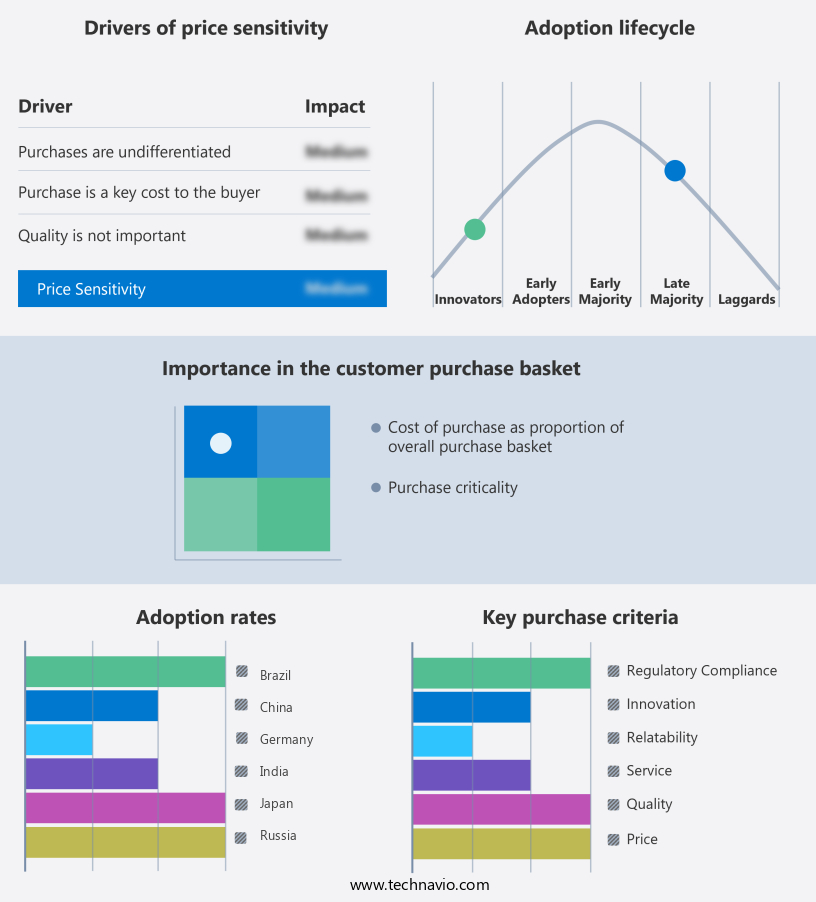
    • 2.1 Analysis of price sensitivity, lifecycle, customer purchase basket, adoption rates, and purchase criteria
      • Analysis of price sensitivity, lifecycle, customer purchase basket, adoption rates, and purchase criteria
    • 2.2 Criticality of inputs and Factors of differentiation
      • Overview on criticality of inputs and factors of differentiation
    • 2.3 Factors of disruption
      • Overview on factors of disruption
    • 2.4 Impact of drivers and challenges
      • Impact of drivers and challenges in 2024 and 2029

    3 Market Landscape

    • 3.1 Market ecosystem
      • Parent Market
      • Data Table on - Parent Market
    • 3.2 Market characteristics
      • Market characteristics analysis
    • 3.3 Value chain analysis
      • Value chain analysis

    4 Market Sizing

    • 4.1 Market definition
      • Offerings of companies included in the market definition
    • 4.2 Market segment analysis
      • Market segments
    • 4.3 Market size 2024
      • 4.4 Market outlook: Forecast for 2024-2029
        • Chart on Global - Market size and forecast 2024-2029 ($ million)
        • Data Table on Global - Market size and forecast 2024-2029 ($ million)
        • Chart on Global Market: Year-over-year growth 2024-2029 (%)
        • Data Table on Global Market: Year-over-year growth 2024-2029 (%)

      5 Historic Market Size

      • 5.1 Global Scrap Metal Recycling Market 2019 - 2023
        • Historic Market Size - Data Table on Global Scrap Metal Recycling Market 2019 - 2023 ($ million)
      • 5.2 Material segment analysis 2019 - 2023
        • Historic Market Size - Material Segment 2019 - 2023 ($ million)
      • 5.3 Application segment analysis 2019 - 2023
        • Historic Market Size - Application Segment 2019 - 2023 ($ million)
      • 5.4 Method segment analysis 2019 - 2023
        • Historic Market Size - Method Segment 2019 - 2023 ($ million)
      • 5.5 Geography segment analysis 2019 - 2023
        • Historic Market Size - Geography Segment 2019 - 2023 ($ million)
      • 5.6 Country segment analysis 2019 - 2023
        • Historic Market Size - Country Segment 2019 - 2023 ($ million)

      6 Qualitative Analysis

      • 6.1 Impact of AI in global scrap metal recycling market

        7 Five Forces Analysis

        • 7.1 Five forces summary
          • Five forces analysis - Comparison between 2024 and 2029
        • 7.2 Bargaining power of buyers
          • Bargaining power of buyers - Impact of key factors 2024 and 2029
        • 7.3 Bargaining power of suppliers
          • Bargaining power of suppliers - Impact of key factors in 2024 and 2029
        • 7.4 Threat of new entrants
          • Threat of new entrants - Impact of key factors in 2024 and 2029
        • 7.5 Threat of substitutes
          • Threat of substitutes - Impact of key factors in 2024 and 2029
        • 7.6 Threat of rivalry
          • Threat of rivalry - Impact of key factors in 2024 and 2029
        • 7.7 Market condition
          • Chart on Market condition - Five forces 2024 and 2029

        8 Market Segmentation by Material

        • 8.1 Market segments
          • Chart on Material - Market share 2024-2029 (%)
          • Data Table on Material - Market share 2024-2029 (%)
        • 8.2 Comparison by Material
          • Chart on Comparison by Material
          • Data Table on Comparison by Material
        • 8.3 Ferrous metals - Market size and forecast 2024-2029
          • Chart on Ferrous metals - Market size and forecast 2024-2029 ($ million)
          • Data Table on Ferrous metals - Market size and forecast 2024-2029 ($ million)
          • Chart on Ferrous metals - Year-over-year growth 2024-2029 (%)
          • Data Table on Ferrous metals - Year-over-year growth 2024-2029 (%)
        • 8.4 Non-ferrous metals - Market size and forecast 2024-2029
          • Chart on Non-ferrous metals - Market size and forecast 2024-2029 ($ million)
          • Data Table on Non-ferrous metals - Market size and forecast 2024-2029 ($ million)
          • Chart on Non-ferrous metals - Year-over-year growth 2024-2029 (%)
          • Data Table on Non-ferrous metals - Year-over-year growth 2024-2029 (%)
        • 8.5 Market opportunity by Material
          • Market opportunity by Material ($ million)
          • Data Table on Market opportunity by Material ($ million)

        9 Market Segmentation by Application

        • 9.1 Market segments
          • Chart on Application - Market share 2024-2029 (%)
          • Data Table on Application - Market share 2024-2029 (%)
        • 9.2 Comparison by Application
          • Chart on Comparison by Application
          • Data Table on Comparison by Application
        • 9.3 Construction - Market size and forecast 2024-2029
          • Chart on Construction - Market size and forecast 2024-2029 ($ million)
          • Data Table on Construction - Market size and forecast 2024-2029 ($ million)
          • Chart on Construction - Year-over-year growth 2024-2029 (%)
          • Data Table on Construction - Year-over-year growth 2024-2029 (%)
        • 9.4 Industrial goods - Market size and forecast 2024-2029
          • Chart on Industrial goods - Market size and forecast 2024-2029 ($ million)
          • Data Table on Industrial goods - Market size and forecast 2024-2029 ($ million)
          • Chart on Industrial goods - Year-over-year growth 2024-2029 (%)
          • Data Table on Industrial goods - Year-over-year growth 2024-2029 (%)
        • 9.5 Automotive - Market size and forecast 2024-2029
          • Chart on Automotive - Market size and forecast 2024-2029 ($ million)
          • Data Table on Automotive - Market size and forecast 2024-2029 ($ million)
          • Chart on Automotive - Year-over-year growth 2024-2029 (%)
          • Data Table on Automotive - Year-over-year growth 2024-2029 (%)
        • 9.6 Consumer goods - Market size and forecast 2024-2029
          • Chart on Consumer goods - Market size and forecast 2024-2029 ($ million)
          • Data Table on Consumer goods - Market size and forecast 2024-2029 ($ million)
          • Chart on Consumer goods - Year-over-year growth 2024-2029 (%)
          • Data Table on Consumer goods - Year-over-year growth 2024-2029 (%)
        • 9.7 Market opportunity by Application
          • Market opportunity by Application ($ million)
          • Data Table on Market opportunity by Application ($ million)

        10 Market Segmentation by Method

        • 10.1 Market segments
          • Chart on Method - Market share 2024-2029 (%)
          • Data Table on Method - Market share 2024-2029 (%)
        • 10.2 Comparison by Method
          • Chart on Comparison by Method
          • Data Table on Comparison by Method
        • 10.3 Mechanical recycling - Market size and forecast 2024-2029
          • Chart on Mechanical recycling - Market size and forecast 2024-2029 ($ million)
          • Data Table on Mechanical recycling - Market size and forecast 2024-2029 ($ million)
          • Chart on Mechanical recycling - Year-over-year growth 2024-2029 (%)
          • Data Table on Mechanical recycling - Year-over-year growth 2024-2029 (%)
        • 10.4 Thermal recycling - Market size and forecast 2024-2029
          • Chart on Thermal recycling - Market size and forecast 2024-2029 ($ million)
          • Data Table on Thermal recycling - Market size and forecast 2024-2029 ($ million)
          • Chart on Thermal recycling - Year-over-year growth 2024-2029 (%)
          • Data Table on Thermal recycling - Year-over-year growth 2024-2029 (%)
        • 10.5 Advanced tech - Market size and forecast 2024-2029
          • Chart on Advanced tech - Market size and forecast 2024-2029 ($ million)
          • Data Table on Advanced tech - Market size and forecast 2024-2029 ($ million)
          • Chart on Advanced tech - Year-over-year growth 2024-2029 (%)
          • Data Table on Advanced tech - Year-over-year growth 2024-2029 (%)
        • 10.6 Chemical recycling - Market size and forecast 2024-2029
          • Chart on Chemical recycling - Market size and forecast 2024-2029 ($ million)
          • Data Table on Chemical recycling - Market size and forecast 2024-2029 ($ million)
          • Chart on Chemical recycling - Year-over-year growth 2024-2029 (%)
          • Data Table on Chemical recycling - Year-over-year growth 2024-2029 (%)
        • 10.7 Market opportunity by Method
          • Market opportunity by Method ($ million)
          • Data Table on Market opportunity by Method ($ million)

        11 Customer Landscape

        • 11.1 Customer landscape overview
          • Analysis of price sensitivity, lifecycle, customer purchase basket, adoption rates, and purchase criteria

        12 Geographic Landscape

        • 12.1 Geographic segmentation
          • Chart on Market share by geography 2024-2029 (%)
          • Data Table on Market share by geography 2024-2029 (%)
        • 12.2 Geographic comparison
          • Chart on Geographic comparison
          • Data Table on Geographic comparison
        • 12.3 APAC - Market size and forecast 2024-2029
          • Chart on APAC - Market size and forecast 2024-2029 ($ million)
          • Data Table on APAC - Market size and forecast 2024-2029 ($ million)
          • Chart on APAC - Year-over-year growth 2024-2029 (%)
          • Data Table on APAC - Year-over-year growth 2024-2029 (%)
        • 12.4 North America - Market size and forecast 2024-2029
          • Chart on North America - Market size and forecast 2024-2029 ($ million)
          • Data Table on North America - Market size and forecast 2024-2029 ($ million)
          • Chart on North America - Year-over-year growth 2024-2029 (%)
          • Data Table on North America - Year-over-year growth 2024-2029 (%)
        • 12.5 Europe - Market size and forecast 2024-2029
          • Chart on Europe - Market size and forecast 2024-2029 ($ million)
          • Data Table on Europe - Market size and forecast 2024-2029 ($ million)
          • Chart on Europe - Year-over-year growth 2024-2029 (%)
          • Data Table on Europe - Year-over-year growth 2024-2029 (%)
        • 12.6 South America - Market size and forecast 2024-2029
          • Chart on South America - Market size and forecast 2024-2029 ($ million)
          • Data Table on South America - Market size and forecast 2024-2029 ($ million)
          • Chart on South America - Year-over-year growth 2024-2029 (%)
          • Data Table on South America - Year-over-year growth 2024-2029 (%)
        • 12.7 Middle East and Africa - Market size and forecast 2024-2029
          • Chart on Middle East and Africa - Market size and forecast 2024-2029 ($ million)
          • Data Table on Middle East and Africa - Market size and forecast 2024-2029 ($ million)
          • Chart on Middle East and Africa - Year-over-year growth 2024-2029 (%)
          • Data Table on Middle East and Africa - Year-over-year growth 2024-2029 (%)
        • 12.8 China - Market size and forecast 2024-2029
          • Chart on China - Market size and forecast 2024-2029 ($ million)
          • Data Table on China - Market size and forecast 2024-2029 ($ million)
          • Chart on China - Year-over-year growth 2024-2029 (%)
          • Data Table on China - Year-over-year growth 2024-2029 (%)
        • 12.9 US - Market size and forecast 2024-2029
          • Chart on US - Market size and forecast 2024-2029 ($ million)
          • Data Table on US - Market size and forecast 2024-2029 ($ million)
          • Chart on US - Year-over-year growth 2024-2029 (%)
          • Data Table on US - Year-over-year growth 2024-2029 (%)
        • 12.10 India - Market size and forecast 2024-2029
          • Chart on India - Market size and forecast 2024-2029 ($ million)
          • Data Table on India - Market size and forecast 2024-2029 ($ million)
          • Chart on India - Year-over-year growth 2024-2029 (%)
          • Data Table on India - Year-over-year growth 2024-2029 (%)
        • 12.11 Japan - Market size and forecast 2024-2029
          • Chart on Japan - Market size and forecast 2024-2029 ($ million)
          • Data Table on Japan - Market size and forecast 2024-2029 ($ million)
          • Chart on Japan - Year-over-year growth 2024-2029 (%)
          • Data Table on Japan - Year-over-year growth 2024-2029 (%)
        • 12.12 Germany - Market size and forecast 2024-2029
          • Chart on Germany - Market size and forecast 2024-2029 ($ million)
          • Data Table on Germany - Market size and forecast 2024-2029 ($ million)
          • Chart on Germany - Year-over-year growth 2024-2029 (%)
          • Data Table on Germany - Year-over-year growth 2024-2029 (%)
        • 12.13 South Korea - Market size and forecast 2024-2029
          • Chart on South Korea - Market size and forecast 2024-2029 ($ million)
          • Data Table on South Korea - Market size and forecast 2024-2029 ($ million)
          • Chart on South Korea - Year-over-year growth 2024-2029 (%)
          • Data Table on South Korea - Year-over-year growth 2024-2029 (%)
        • 12.14 Russia - Market size and forecast 2024-2029
          • Chart on Russia - Market size and forecast 2024-2029 ($ million)
          • Data Table on Russia - Market size and forecast 2024-2029 ($ million)
          • Chart on Russia - Year-over-year growth 2024-2029 (%)
          • Data Table on Russia - Year-over-year growth 2024-2029 (%)
        • 12.15 Turkey - Market size and forecast 2024-2029
          • Chart on Turkey - Market size and forecast 2024-2029 ($ million)
          • Data Table on Turkey - Market size and forecast 2024-2029 ($ million)
          • Chart on Turkey - Year-over-year growth 2024-2029 (%)
          • Data Table on Turkey - Year-over-year growth 2024-2029 (%)
        • 12.16 Brazil - Market size and forecast 2024-2029
          • Chart on Brazil - Market size and forecast 2024-2029 ($ million)
          • Data Table on Brazil - Market size and forecast 2024-2029 ($ million)
          • Chart on Brazil - Year-over-year growth 2024-2029 (%)
          • Data Table on Brazil - Year-over-year growth 2024-2029 (%)
        • 12.17 UK - Market size and forecast 2024-2029
          • Chart on UK - Market size and forecast 2024-2029 ($ million)
          • Data Table on UK - Market size and forecast 2024-2029 ($ million)
          • Chart on UK - Year-over-year growth 2024-2029 (%)
          • Data Table on UK - Year-over-year growth 2024-2029 (%)
        • 12.18 Market opportunity by geography
          • Market opportunity by geography ($ million)
          • Data Tables on Market opportunity by geography ($ million)

        13 Drivers, Challenges, and Opportunity/Restraints

        • 13.1 Market drivers
          • 13.2 Market challenges
            • 13.3 Impact of drivers and challenges
              • Impact of drivers and challenges in 2024 and 2029
            • 13.4 Market opportunities/restraints

              14 Competitive Landscape

              • 14.1 Overview
                • 14.2 Competitive Landscape
                  • Overview on criticality of inputs and factors of differentiation
                • 14.3 Landscape disruption
                  • Overview on factors of disruption
                • 14.4 Industry risks
                  • Impact of key risks on business

                15 Competitive Analysis

                • 15.1 Companies profiled
                  • Companies covered
                • 15.2 Company ranking index
                  • Company ranking index
                • 15.3 Market positioning of companies
                  • Matrix on companies position and classification
                • 15.4 Alter Trading Inc.
                  • Alter Trading Inc. - Overview
                  • Alter Trading Inc. - Product / Service
                  • Alter Trading Inc. - Key offerings
                  • SWOT
                • 15.5 American Iron and Metal
                  • American Iron and Metal - Overview
                  • American Iron and Metal - Product / Service
                  • American Iron and Metal - Key offerings
                  • SWOT
                • 15.6 ArcelorMittal
                  • ArcelorMittal - Overview
                  • ArcelorMittal - Business segments
                  • ArcelorMittal - Key offerings
                  • ArcelorMittal - Segment focus
                  • SWOT
                • 15.7 Aurubis AG
                  • Aurubis AG - Overview
                  • Aurubis AG - Business segments
                  • Aurubis AG - Key news
                  • Aurubis AG - Key offerings
                  • Aurubis AG - Segment focus
                  • SWOT
                • 15.8 Cherry City Metals
                  • Cherry City Metals - Overview
                  • Cherry City Metals - Product / Service
                  • Cherry City Metals - Key offerings
                  • SWOT
                • 15.9 Commercial Metals Co.
                  • Commercial Metals Co. - Overview
                  • Commercial Metals Co. - Business segments
                  • Commercial Metals Co. - Key offerings
                  • Commercial Metals Co. - Segment focus
                  • SWOT
                • 15.10 European Metal Recycling Ltd.
                  • European Metal Recycling Ltd. - Overview
                  • European Metal Recycling Ltd. - Product / Service
                  • European Metal Recycling Ltd. - Key offerings
                  • SWOT
                • 15.11 Gerdau SA
                  • Gerdau SA - Overview
                  • Gerdau SA - Business segments
                  • Gerdau SA - Key offerings
                  • Gerdau SA - Segment focus
                  • SWOT
                • 15.12 Midwest Industrial Metals
                  • Midwest Industrial Metals - Overview
                  • Midwest Industrial Metals - Product / Service
                  • Midwest Industrial Metals - Key offerings
                  • SWOT
                • 15.13 Nucor Corp.
                  • Nucor Corp. - Overview
                  • Nucor Corp. - Business segments
                  • Nucor Corp. - Key news
                  • Nucor Corp. - Key offerings
                  • Nucor Corp. - Segment focus
                  • SWOT
                • 15.14 Pacific Steel and Recycling
                  • Pacific Steel and Recycling - Overview
                  • Pacific Steel and Recycling - Product / Service
                  • Pacific Steel and Recycling - Key offerings
                  • SWOT
                • 15.15 Sims Ltd.
                  • Sims Ltd. - Overview
                  • Sims Ltd. - Business segments
                  • Sims Ltd. - Key news
                  • Sims Ltd. - Key offerings
                  • Sims Ltd. - Segment focus
                  • SWOT
                • 15.16 Steel Dynamics Inc
                  • Steel Dynamics Inc - Overview
                  • Steel Dynamics Inc - Product / Service
                  • Steel Dynamics Inc - Key offerings
                  • SWOT
                • 15.17 Tata Sons Pvt. Ltd.
                  • Tata Sons Pvt. Ltd. - Overview
                  • Tata Sons Pvt. Ltd. - Product / Service
                  • Tata Sons Pvt. Ltd. - Key news
                  • Tata Sons Pvt. Ltd. - Key offerings
                  • SWOT
                • 15.18 Texas Disposal Systems
                  • Texas Disposal Systems - Overview
                  • Texas Disposal Systems - Product / Service
                  • Texas Disposal Systems - Key offerings
                  • SWOT

                16 Appendix

                • 16.1 Scope of the report
                  • 16.2 Inclusions and exclusions checklist
                    • Inclusions checklist
                    • Exclusions checklist
                  • 16.3 Currency conversion rates for US$
                    • Currency conversion rates for US$
                  • 16.4 Research methodology
                    • Research methodology
                  • 16.5 Data procurement
                    • Information sources
                  • 16.6 Data validation
                    • Data validation
                  • 16.7 Validation techniques employed for market sizing
                    • Validation techniques employed for market sizing
                  • 16.8 Data synthesis
                    • Data synthesis
                  • 16.9 360 degree market analysis
                    • 360 degree market analysis
                  • 16.10 List of abbreviations
                    • List of abbreviations

                  Research Methodology

                  Technavio presents a detailed picture of the market by way of study, synthesis, and summation of data from multiple sources. The analysts have presented the various facets of the market with a particular focus on identifying the key industry influencers. The data thus presented is comprehensive, reliable, and the result of extensive research, both primary and secondary.

                  INFORMATION SOURCES

                  Primary sources

                  • Manufacturers and suppliers
                  • Channel partners
                  • Industry experts
                  • Strategic decision makers

                  Secondary sources

                  • Industry journals and periodicals
                  • Government data
                  • Financial reports of key industry players
                  • Historical data
                  • Press releases

                  DATA ANALYSIS

                  Data Synthesis

                  • Collation of data
                  • Estimation of key figures
                  • Analysis of derived insights

                  Data Validation

                  • Triangulation with data models
                  • Reference against proprietary databases
                  • Corroboration with industry experts

                  REPORT WRITING

                  Qualitative

                  • Market drivers
                  • Market challenges
                  • Market trends
                  • Five forces analysis

                  Quantitative

                  • Market size and forecast
                  • Market segmentation
                  • Geographical insights
                  • Competitive landscape

                  Interested in this report?

                  Get your sample now to see our research methodology and insights!

                  Download Now

                  Frequently Asked Questions

                  Scrap Metal Recycling market growth will increase by $ 20394.4 mn during 2025-2029.

                  The Scrap Metal Recycling market is expected to grow at a CAGR of 4.5% during 2025-2029.

                  Scrap Metal Recycling market is segmented by Material( Ferrous metals, Non-ferrous metals) Application( Construction, Industrial goods, Automotive, Consumer goods) Method( Mechanical recycling, Thermal recycling, Advanced tech, Chemical recycling, South America)

                  Alter Trading Inc., American Iron and Metal, ArcelorMittal, Aurubis AG, Cherry City Metals, Commercial Metals Co., European Metal Recycling Ltd., Gerdau SA, Greenway Metal Recycling Inc, LIBERTY Steel Group, Midwest Industrial Metals, Nucor Corp., Pacific Steel and Recycling, Radius Recycling Inc., Sims Ltd., Steel Dynamics Inc, Tata Sons Pvt. Ltd., Texas Disposal Systems are a few of the key vendors in the Scrap Metal Recycling market.

                  APAC will register the highest growth rate of 48% among the other regions. Therefore, the Scrap Metal Recycling market in APAC is expected to garner significant business opportunities for the vendors during the forecast period.

                  China, US, India, Japan, Germany, Russia, South Korea, Turkey, UK, Brazil

                  • Environmental and sustainability pressuresEnvironmental and sustainability pressures are among the most influential drivers shaping the global scrap metal recycling market. The imperative to reduce carbon emissions has placed metal recycling at the forefront of climate mitigation strategies. Primary metal production is the driving factor this market.
                  • particularly steelmaking is the driving factor this market.
                  • is highly energy-intensive and contributes significantly to global greenhouse gas emissions. According to industry estimates is the driving factor this market.
                  • primary steel production accounts for approximately 7 to 9 percent of global carbon dioxide emissions. In contrast is the driving factor this market.
                  • recycling scrap metals can reduce emissions by 70 to 95 percent is the driving factor this market.
                  • making it a critical pathway for industries seeking to meet climate targets.The global shift toward a circular economy further reinforces the importance of scrap metal recycling. Initiatives such as the Circular Economy Action Plan of the European Union and the Sustainable Materials Management program of the United States Environmental Protection Agency promote resource efficiency and waste reduction. Recycling aluminum consumes 95 percent less energy than producing it from raw bauxite is the driving factor this market.
                  • while steel and copper recycling save 60 to 75 percent and 85 percent is the driving factor this market.
                  • respectively. These efficiencies support sustainable manufacturing and reduce dependence on virgin resources.Corporate sustainability commitments and investor expectations are also accelerating the adoption of recycled metals. Companies such as Tesla is the driving factor this market.
                  • Apple is the driving factor this market.
                  • and BMW are integrating recycled aluminum and steel into their supply chains to meet environmental is the driving factor this market.
                  • social is the driving factor this market.
                  • and governance benchmarks. Regulatory mechanisms is the driving factor this market.
                  • including carbon taxes and extended producer responsibility laws is the driving factor this market.
                  • are compelling manufacturers to transition toward scrap-based production models.As global efforts to combat climate change intensify and sustainability frameworks such as Net Zero by 2050 gain momentum is the driving factor this market.
                  • scrap metal recycling is evolving from a cost-saving measure into a strategic necessity. Its role in reducing emissions is the driving factor this market.
                  • conserving energy is the driving factor this market.
                  • and supporting circular economy principles positions it as a cornerstone of environmentally responsible industrial practices. is the driving factor this market.

                  The Scrap Metal Recycling market vendors should focus on grabbing business opportunities from the Ferrous metals segment as it accounted for the largest market share in the base year.