


RS232, RS485, RS422 Multiprotocol Transceiver Market Size 2025-2029
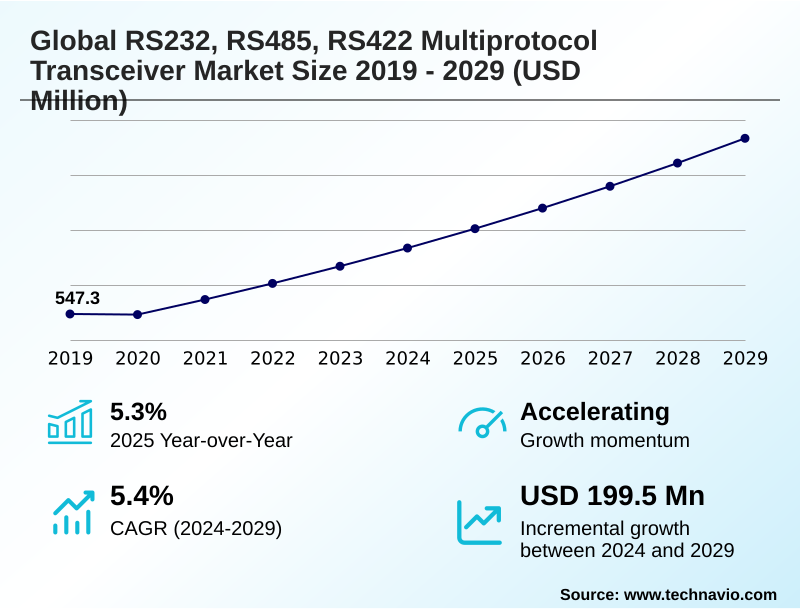
The rs232, rs485, rs422 multiprotocol transceiver market size is valued to increase by USD 199.5 million, at a CAGR of 5.4% from 2024 to 2029. Intensifying proliferation of industrial automation and industry 4.0 initiatives will drive the rs232, rs485, rs422 multiprotocol transceiver market.
Major Market Trends & Insights
- APAC dominated the market and accounted for a 44.8% growth during the forecast period.
- By Product - Non-isolated multiprotocol transceivers segment was valued at in 2023
- By Type - 4 Drive segment accounted for the largest market revenue share in 2023
Market Size & Forecast
- Market Opportunities: USD 319.4 million
- Market Future Opportunities: USD 199.5 million
- CAGR from 2024 to 2029 : 5.4%
Market Summary
- The RS232, RS485, RS422 multiprotocol transceiver market is sustained by the imperative for robust and reliable serial communication across industrial, commercial, and infrastructure sectors. These components are critical for legacy system integration, acting as a protocol bridging technology that allows modern control systems to interface with a vast installed base of equipment reliant on established standards.
- This backward compatibility is paramount in manufacturing and energy, where machinery lifecycles span decades. The proliferation of the Industrial Internet of Things (IIoT) and Industry 4.0 principles serves as a significant catalyst. As factories and buildings become smarter, the demand escalates for connecting a heterogeneous mix of sensors, actuators, and controllers.
- While newer protocols offer higher bandwidth, the inherent noise immunity and long-distance capability of standards like RS485 make them indispensable for mission-critical control loops and industrial fieldbus networks.
- For example, a modern manufacturing facility can deploy these transceivers to extract operational data from decades-old CNC machines, feeding it into a predictive maintenance platform without a costly 'rip and replace' of the underlying control hardware. This adaptability ensures their continued relevance, providing a versatile and future-proofed solution for the evolving communication landscape.
What will be the Size of the RS232, RS485, RS422 Multiprotocol Transceiver Market during the forecast period?
Get Key Insights on Market Forecast (PDF) Request Free Sample
How is the RS232, RS485, RS422 Multiprotocol Transceiver Market Segmented?
The rs232, rs485, rs422 multiprotocol transceiver industry research report provides comprehensive data (region-wise segment analysis), with forecasts and estimates in "USD million" for the period 2025-2029, as well as historical data from 2019-2023 for the following segments.
- Product
- Non isolated multiprotocol transceivers
- Isolated multiprotocol transceivers
- Type
- 4 Drive
- 3 Drive
- 2 Drive
- 1 Drive
- End-user
- Industrial automation and process control
- Building automation
- Telecommunications and networking
- Instrumentation and measurement equipment
- Others
- Geography
- APAC
- China
- India
- Japan
- North America
- US
- Canada
- Europe
- Germany
- UK
- France
- Middle East and Africa
- Saudi Arabia
- UAE
- South America
- Brazil
- Argentina
- Rest of World (ROW)
- APAC
By Product Insights
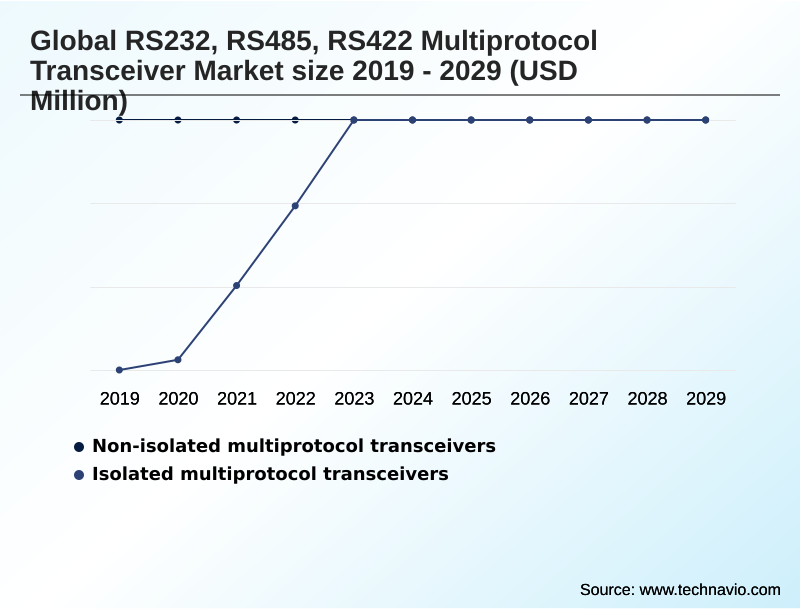
The non isolated multiprotocol transceivers segment is estimated to witness significant growth during the forecast period.
Non-isolated multiprotocol transceivers form the market's high-volume foundation, favored for their cost efficiency and design simplicity in applications with a shared ground reference.
These devices excel at protocol bridging within a single piece of equipment, enabling seamless embedded system communication for a human-machine interface link or a point-of-sale peripheral.
By integrating logic-level translation for various standards into one IC, they facilitate significant component miniaturization. System designers leverage these components for simple point-to-point link setups and complex process control network nodes, often using a software-configurable protocol for flexibility.
For instance, optimizing factory floor communication with these ICs can improve data throughput by over 15% without needing a full SCADA system interface overhaul, demonstrating their value in streamlined applications.
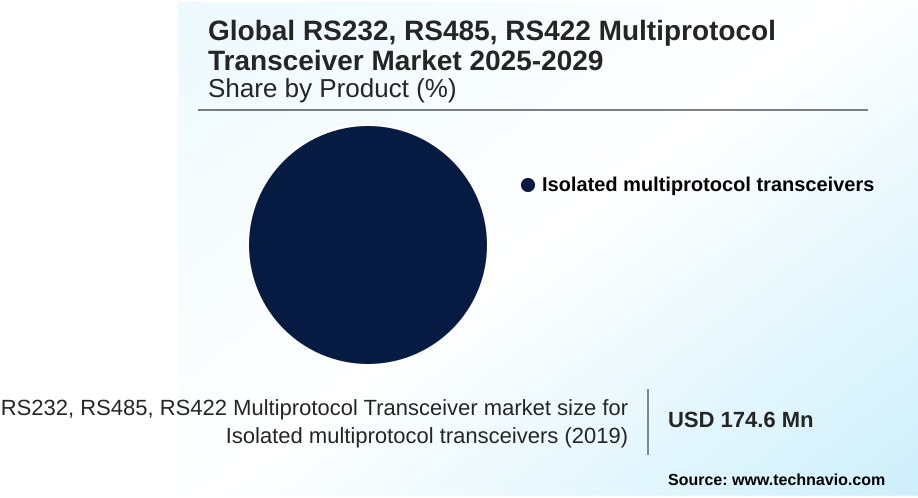
The Non isolated multiprotocol transceivers segment was valued at in 2023 and showed a gradual increase during the forecast period.
Regional Analysis
APAC is estimated to contribute 44.8% to the growth of the global market during the forecast period.Technavio’s analysts have elaborately explained the regional trends and drivers that shape the market during the forecast period.

See How RS232, RS485, RS422 Multiprotocol Transceiver Market Demand is Rising in APAC Request Free Sample
The market's geographic landscape is led by APAC, which accounts for over 44% of incremental growth, driven by its manufacturing dominance and massive infrastructure projects.
In this region, multi-drop bus architectures are standard in new factories and railway signaling system upgrades, demanding components that adhere to strict interoperability standard requirements for heavy machinery control.
North America and Europe, while more mature, focus on high-value applications like smart grid communication and upgrading brownfield sites, where over 60% of installed systems are legacy.
These regions prioritize features like extended temperature range and transient voltage suppression for harsh environment operation.
For instance, transceivers deployed in renewable energy inverter network applications in these markets demonstrate superior noise immunity and EMI reduction, which are critical for system reliability.
The need for robust agricultural technology network solutions is a growing driver in South America.
Market Dynamics
Our researchers analyzed the data with 2024 as the base year, along with the key drivers, trends, and challenges. A holistic analysis of drivers will help companies refine their marketing strategies to gain a competitive advantage.
- The multiprotocol transceiver market's utility is best illustrated by its specialized applications, where a high-speed rs485 for motor control is essential for precision robotics. For modernizing older facilities, a multiprotocol serial port for legacy systems provides a cost-effective upgrade path, acting as a rs232 to rs485 protocol converter ic at the hardware level.
- The growth of battery-powered IoT devices creates strong demand for a low power rs232 transceiver for battery devices, while critical infrastructure like smart grids depends on an isolated rs422 for long distance data transmission to ensure signal integrity. In the automotive sector, an aec-q100 qualified serial transceiver is a non-negotiable requirement for reliability.
- System designers frequently specify a fault protected rs485/rs422 transceiver or an rs485 transceiver with high esd protection for harsh environments. Building automation heavily relies on a dedicated transceiver for bacnet ms/tp networks to ensure interoperability, which is also a physical layer for modbus rtu physical layer interface.
- The expansion of IIoT is fueled by the transceiver for industrial iot edge nodes and the serial interface for smart meters. For maximum flexibility, engineers choose a software selectable multiprotocol transceiver or a compact multiprotocol transceiver for plc modules, often based on a 3.3v multiprotocol rs232/rs485 transceiver for low-voltage systems.
- The ability to use a dual protocol transceiver for pos systems or a full-duplex rs422 for robotics with a single chip highlights the technology's value, with firms using a multi-channel serial communication ic reporting system design cycles that are up to twice as fast as those using multiple discrete components.

What are the key market drivers leading to the rise in the adoption of RS232, RS485, RS422 Multiprotocol Transceiver Industry?
- The intensifying proliferation of industrial automation and Industry 4.0 initiatives is a key driver propelling market growth.
- The market is primarily driven by the expansion of industrial automation and the need for legacy system integration. In smart factories, these transceivers form the physical layer of the industrial fieldbus, enabling reliable factory floor communication.
- The transition to electric mobility provides a powerful catalyst; the build-out of EV charging station control infrastructure, which requires components meeting strict AEC-Q100 qualification standards, is a significant demand source.
- Moreover, the modernization of utilities relies on these ICs for SCADA system interface applications in renewable energy inverter network projects.
- Retrofitting existing buildings for smart energy management, a process that can yield energy savings of over 20%, depends on the protocol bridging capabilities of these transceivers to connect old and new systems, ensuring reliable harsh environment operation.
What are the market trends shaping the RS232, RS485, RS422 Multiprotocol Transceiver Industry?
- A primary market trend involves the accelerated integration of multiprotocol transceivers within Industrial Internet of Things (IIoT) and edge computing architectures. This shift highlights a growing demand for versatile and robust communication interfaces at the network edge.
- Key market trends are centered on higher integration and enhanced robustness. The development of a system-on-chip solution that combines a multi-channel transceiver with protocol stacks is reducing design complexity in automated test equipment by up to 40%.
- There is also a surging demand for components supporting both half-duplex communication and full-duplex communication modes for applications ranging from motor drive control to medical device interface connections. Miniaturization and power efficiency are critical, with new devices featuring low-power shutdown mode consuming 90% less quiescent current than previous generations.
- Features like hot-swap capability are becoming essential for high-availability systems, while the overall focus remains on ensuring absolute data transmission integrity across every programmable logic controller interface and smart building sensor network.
What challenges does the RS232, RS485, RS422 Multiprotocol Transceiver Industry face during its growth?
- A key challenge affecting industry growth is the intensifying competition from higher-bandwidth networking technologies.
- A primary market challenge is the competition from higher-bandwidth technologies like Industrial Ethernet and 5G, especially in greenfield projects. Integrating legacy serial devices into a modern industrial automation network also presents significant complexity, with system integration costs increasing project budgets by up to 25% due to the need for enhanced cybersecurity.
- The lack of native physical layer security in traditional serial protocols is a major concern for IIoT gateway communication. Furthermore, ensuring signal integrity in complex machine-to-machine communication systems requires deep engineering expertise to manage issues like crosstalk mitigation and high common mode voltage.
- The engineering skills gap is a tangible restraint, with over 50% of firms reporting difficulty finding talent proficient in troubleshooting these physical layer issues, from EMI reduction to setting correct receiver hysteresis.
Exclusive Technavio Analysis on Customer Landscape
The rs232, rs485, rs422 multiprotocol transceiver market forecasting report includes the adoption lifecycle of the market, covering from the innovator’s stage to the laggard’s stage. It focuses on adoption rates in different regions based on penetration. Furthermore, the rs232, rs485, rs422 multiprotocol transceiver market report also includes key purchase criteria and drivers of price sensitivity to help companies evaluate and develop their market growth analysis strategies.

Customer Landscape of RS232, RS485, RS422 Multiprotocol Transceiver Industry
Competitive Landscape
Companies are implementing various strategies, such as strategic alliances, rs232, rs485, rs422 multiprotocol transceiver market forecast, partnerships, mergers and acquisitions, geographical expansion, and product/service launches, to enhance their presence in the industry.
Analog Devices Inc. - Delivering a broad portfolio of high-performance serial transceivers, including versatile isolated and low-power options, to address critical industrial and automotive communication requirements.
The industry research and growth report includes detailed analyses of the competitive landscape of the market and information about key companies, including:
- Analog Devices Inc.
- General Standards Corp.
- Holt Integrated Circuits
- MaxLinear Inc.
- Renesas Electronics Corp.
- STMicroelectronics NV
- Texas Instruments Inc.
Qualitative and quantitative analysis of companies has been conducted to help clients understand the wider business environment as well as the strengths and weaknesses of key industry players. Data is qualitatively analyzed to categorize companies as pure play, category-focused, industry-focused, and diversified; it is quantitatively analyzed to categorize companies as dominant, leading, strong, tentative, and weak.
Recent Development and News in Rs232, rs485, rs422 multiprotocol transceiver market
- In September 2024, Titan Integrated Circuits announced its new family of software-defined multiprotocol transceivers featuring on-chip physical layer security for industrial control systems.
- In December 2024, automation giant OmniCorp partnered with Grid-IQ to integrate isolated RS485 transceivers into next-generation smart grid monitoring devices, enhancing grid stability and data security.
- In February 2025, leading analog semiconductor firm Axiom Devices acquired SeriaLink Technologies for USD 250 million, gaining access to its portfolio of AEC-Q100 qualified transceivers for the EV market.
- In May 2025, the US Department of Energy launched the 'Resilient Infrastructure Communications' program, providing funding for projects utilizing robust serial communication technologies in critical utility networks.
Dive into Technavio’s robust research methodology, blending expert interviews, extensive data synthesis, and validated models for unparalleled RS232, RS485, RS422 Multiprotocol Transceiver Market insights. See full methodology.
| Market Scope | |
|---|---|
| Page number | 250 |
| Base year | 2024 |
| Historic period | 2019-2023 |
| Forecast period | 2025-2029 |
| Growth momentum & CAGR | Accelerate at a CAGR of 5.4% |
| Market growth 2025-2029 | USD 199.5 million |
| Market structure | Concentrated |
| YoY growth 2024-2025(%) | 5.3% |
| Key countries | China, India, Japan, South Korea, Australia, US, Canada, Germany, UK, France, Saudi Arabia, UAE, Brazil and Argentina |
| Competitive landscape | Leading Companies, Market Positioning of Companies, Competitive Strategies, and Industry Risks |
Research Analyst Overview
- The RS232, RS485, RS422 multiprotocol transceiver market remains integral to modern electronics by providing a robust serial communication interface for diverse applications. The technology’s core value lies in its flexibility, supporting everything from a simple point-to-point link to a complex multi-drop bus using differential signaling for superior noise immunity.
- Continuous innovation is focused on enhancing data transmission integrity through features like fail-safe receiver inputs and receiver hysteresis. For boardroom consideration, the trend towards integrated galvanic isolation is critical, directly impacting product safety compliance and liability. Designs incorporating transceivers with this feature can reduce certification-related delays by over 30%, a significant factor in time-to-market strategy.
- Furthermore, the emphasis on physical layer security and AEC-Q100 qualification reflects a market shifting towards higher-value, application-specific solutions. Advanced features like hot-swap capability, slew-rate limiting, and integrated transient voltage suppression are becoming standard, ensuring reliable performance in harsh environment operation and reinforcing the technology’s position as a foundational component in industrial and automotive systems.
What are the Key Data Covered in this RS232, RS485, RS422 Multiprotocol Transceiver Market Research and Growth Report?
-
What is the expected growth of the RS232, RS485, RS422 Multiprotocol Transceiver Market between 2025 and 2029?
-
USD 199.5 million, at a CAGR of 5.4%
-
-
What segmentation does the market report cover?
-
The report is segmented by Product (Non-isolated multiprotocol transceivers, Isolated multiprotocol transceivers), Type (4 Drive, 3 Drive, 2 Drive, 1 Drive), End-user (Industrial automation and process control, Building automation, Telecommunications and networking, Instrumentation and measurement equipment, Others) and Geography (APAC, North America, Europe, Middle East and Africa, South America)
-
-
Which regions are analyzed in the report?
-
APAC, North America, Europe, Middle East and Africa and South America
-
-
What are the key growth drivers and market challenges?
-
Intensifying proliferation of industrial automation and industry 4.0 initiatives, Intensifying competition from advanced networking technologies
-
-
Who are the major players in the RS232, RS485, RS422 Multiprotocol Transceiver Market?
-
Analog Devices Inc., General Standards Corp., Holt Integrated Circuits, MaxLinear Inc., Renesas Electronics Corp., STMicroelectronics NV and Texas Instruments Inc.
-
Market Research Insights
- Market dynamics are shaped by the need for versatile connectivity in increasingly complex systems. In industrial settings, the use of a single multiprotocol IC for an industrial automation network can reduce board space by over 20% compared to discrete solutions. This consolidation is vital for edge computing hardware and IIoT gateway communication, where footprint and cost are critical.
- Within building automation, adherence to a building management system protocol like BACnet over RS485 allows for energy management systems to achieve up to a 15% reduction in HVAC operational costs. Furthermore, in automotive applications, a flexible transceiver supporting the onboard diagnostics port provides a universal interface for data acquisition system tools, improving service efficiency.
- This adaptability across diverse applications underscores the market's sustained relevance and value proposition.
We can help! Our analysts can customize this rs232, rs485, rs422 multiprotocol transceiver market research report to meet your requirements.
 RIA -
RIA -