


Residential Washing Machine Market Size 2026-2030
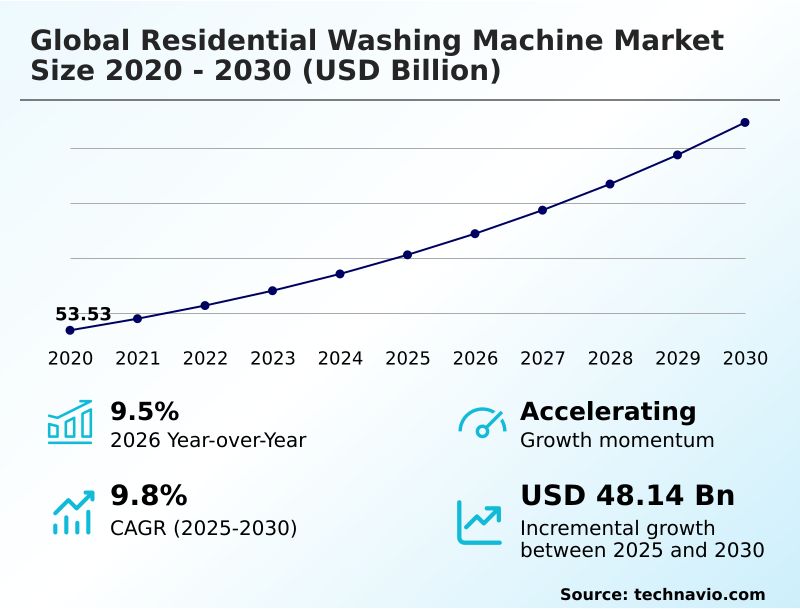
The residential washing machine market size is valued to increase by USD 48.14 billion, at a CAGR of 9.8% from 2025 to 2030. Increasing urbanization and nuclearization of families will drive the residential washing machine market.
Major Market Trends & Insights
- APAC dominated the market and accounted for a 53.3% growth during the forecast period.
- By Product - Top load segment was valued at USD 38.21 billion in 2024
- By Technology - Fully automatic segment accounted for the largest market revenue share in 2024
Market Size & Forecast
- Market Opportunities: USD 75.58 billion
- Market Future Opportunities: USD 48.14 billion
- CAGR from 2025 to 2030 : 9.8%
Market Summary
- The residential washing machine market has evolved into a highly dynamic and technologically advanced sector, driven by changing consumer lifestyles and a strong emphasis on sustainability. The transition from basic utility appliances to sophisticated smart home-integrated systems is a defining characteristic of the current landscape.
- Key drivers include rising disposable incomes in emerging economies, increasing urbanization leading to a higher number of individual households, and a growing consumer demand for convenience and efficiency. A significant business challenge involves managing volatile raw material costs within the supply chain, which can impact profitability for even a high-efficiency (HE) washer.
- Manufacturers are responding with innovations in laundry care technology, such as AI-powered fabric care and automatic detergent dispensing, which optimize resource usage and improve cleaning performance. The front-load washing machine continues to gain market share due to its superior water and energy efficiency, while the top-load washing machine remains popular for its ergonomic benefits and affordability, particularly in certain regions.
- The focus on an improved appliance energy label is pushing the industry toward greater sustainability.
What will be the Size of the Residential Washing Machine Market during the forecast period?
Get Key Insights on Market Forecast (PDF) Request Free Sample
How is the Residential Washing Machine Market Segmented?
The residential washing machine industry research report provides comprehensive data (region-wise segment analysis), with forecasts and estimates in "USD million" for the period 2026-2030, as well as historical data from 2020-2024 for the following segments.
- Product
- Top load
- Front load
- Technology
- Fully automatic
- Semi automatic
- Distribution channel
- Offline
- Online
- Geography
- APAC
- China
- India
- Japan
- Europe
- Germany
- UK
- France
- North America
- US
- Canada
- Mexico
- Middle East and Africa
- Saudi Arabia
- UAE
- South Africa
- South America
- Brazil
- Argentina
- Colombia
- Rest of World (ROW)
- APAC
By Product Insights
The top load segment is estimated to witness significant growth during the forecast period.
The top-load washing machine segment maintains a significant market position, valued for its ergonomic design and operational simplicity. Traditionally appealing to budget-conscious households, this residential laundry appliance category is evolving beyond basic agitator models.
Modern impeller-based units offer gentler fabric care and a large capacity washer format, addressing diverse consumer needs.
Innovation is centered on efficiency, with new models incorporating load sensing technology and advanced water level sensors to optimize resource use, with some high-efficiency units reducing water consumption by over 20% compared to older models.
Features such as a specialized drum cleaning cycle, a fabric softness sensor, and proprietary no-holes tub design are enhancing performance and user convenience, making the top-load washer a competitive choice.
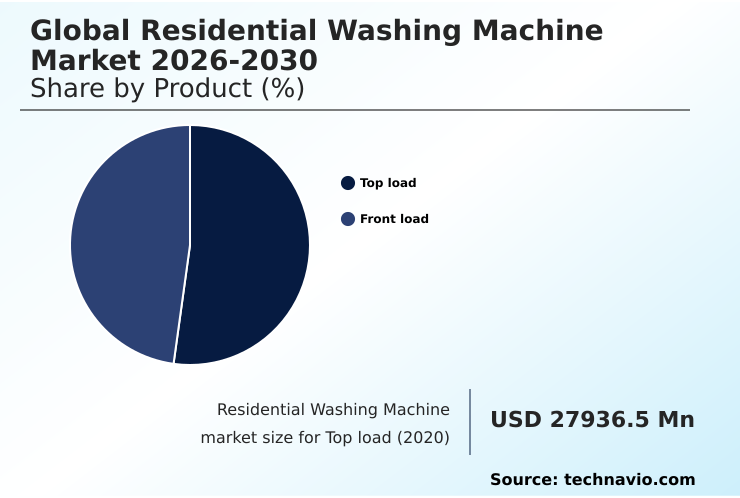
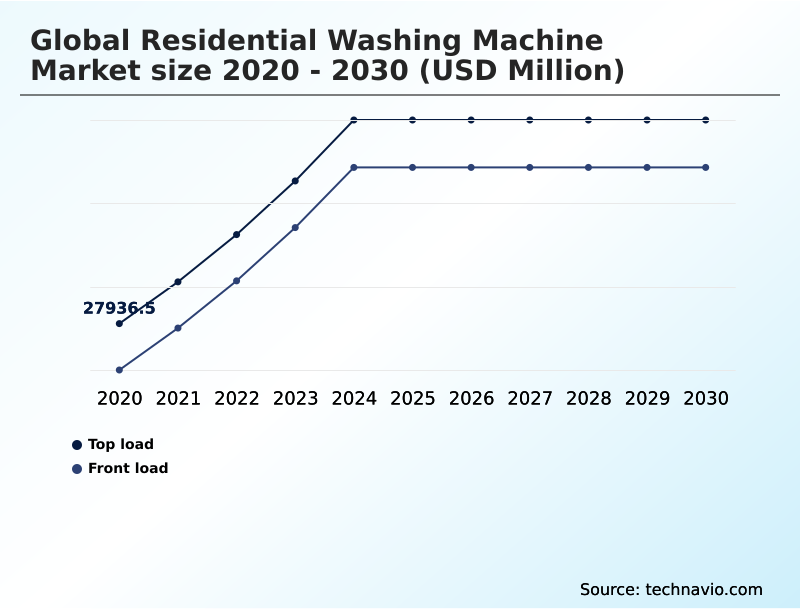
The Top load segment was valued at USD 38.21 billion in 2024 and showed a gradual increase during the forecast period.
Regional Analysis
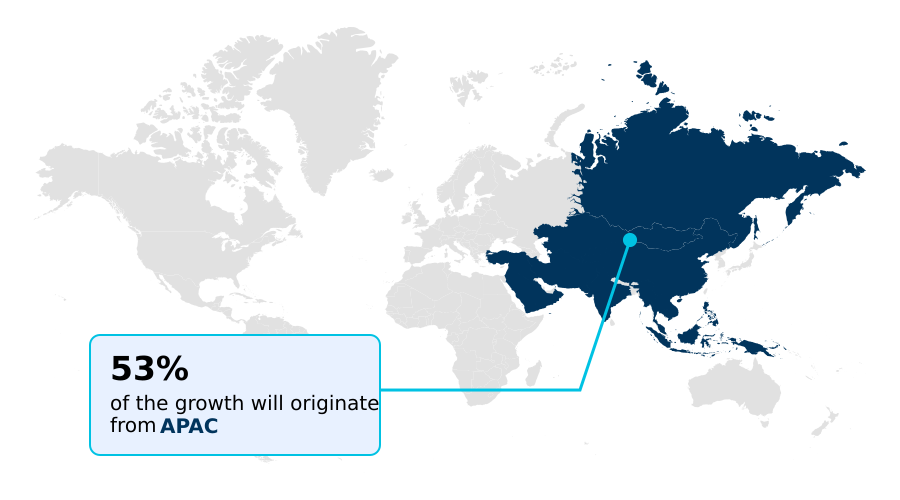
APAC is estimated to contribute 53.3% to the growth of the global market during the forecast period.Technavio’s analysts have elaborately explained the regional trends and drivers that shape the market during the forecast period.
See How Residential Washing Machine Market Demand is Rising in APAC Request Free Sample
The global laundry appliance market exhibits significant regional disparities, with APAC accounting for over 53% of incremental growth. This is driven by rapid urbanization and a rising middle class.
In contrast, mature markets in North America and Europe focus on premiumization and home appliance innovation, with a strong demand for water-efficient laundry solutions. In dense urban areas, the compact washing machine and portable washing machine are gaining popularity.
Advanced features like the auto-dosing system and sensorwash technology are becoming standard in high-end models. The integration of a smart diagnosis feature is also critical, reducing service calls by approximately 30%.
Technologies like the ultramix system and automatic detergent dispensing are key differentiators for vendors targeting discerning consumers in developed regions.
Market Dynamics
Our researchers analyzed the data with 2025 as the base year, along with the key drivers, trends, and challenges. A holistic analysis of drivers will help companies refine their marketing strategies to gain a competitive advantage.
- Strategic decision-making in the residential washing machine sector increasingly hinges on a granular understanding of long-tail consumer priorities. While the energy efficiency of front load vs top load models remains a primary consideration, buyers now scrutinize the specific benefits of inverter motor in washing machines, which can reduce energy use by up to 30% over a product's lifecycle.
- The demand for AI powered wash cycle optimization is reshaping product development, as consumers expect machines to intelligently adapt to different fabrics and soil levels. Smart washing machine remote control features are no longer a novelty but a core expectation for convenience.
- Furthermore, health and hygiene concerns drive interest in understanding how steam cycles improve washer hygiene and which models offer a certified washing machine with allergen removal certification. For urban consumers, finding the best washing machine for small apartments is a critical search, while the quest for the quietest washing machines for open-plan homes influences design choices.
- In a broader context, factors like washing machine durability and repairability are gaining importance, aligning with sustainability trends focused on reducing microplastic pollution from laundry. Technical comparisons, such as the comparison of direct drive and belt drive motors and the precision of automatic detergent dispenser accuracy, are crucial for discerning buyers.
- Moreover, the impact of hard water on washing machines necessitates specialized water saving technologies in modern washers. Innovations in top load washer with gentle fabric care and washer technology for cold water washing cater to niche but growing segments.
- The landscape is also shaped by the latest innovations in washer dryer combos, advanced features in premium washing machines, and robust connectivity options for smart washing machines, making smart diagnosis for appliance maintenance a standard expectation.
What are the key market drivers leading to the rise in the adoption of Residential Washing Machine Industry?
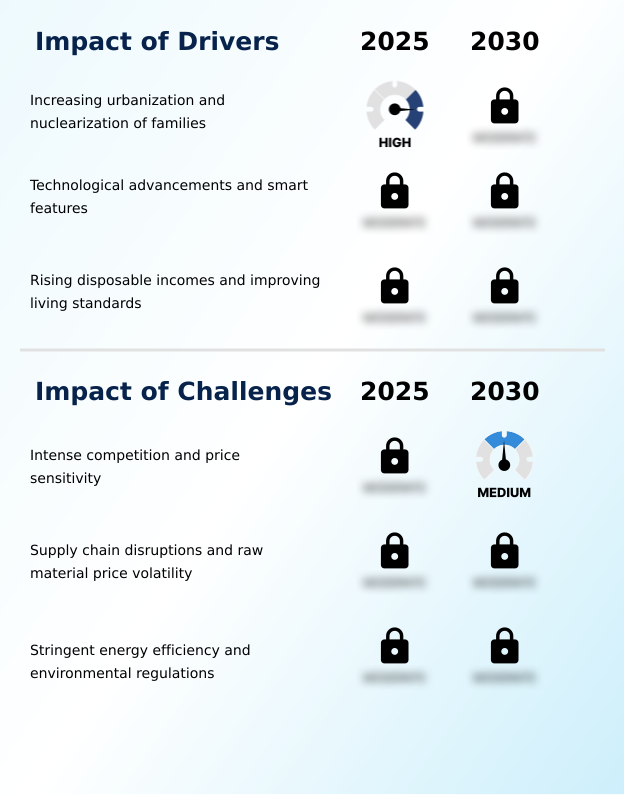
- Increasing urbanization and the global trend toward nuclear family structures are key drivers expanding the customer base for residential washing machines.
- The transition from manual laundry methods to automated household laundry solutions is a primary market driver, especially in emerging economies.
- The adoption of the semi-automatic washing machine in entry-level segments and the fully automatic washing machine in mid-tier markets is accelerating. This shift is supported by rising disposable incomes, enabling households to invest in more advanced residential clothes washer models.
- The emphasis on efficiency is driving demand for inverter motor technology, which enhances durability and lowers electricity bills. This focus on energy consumption optimization, coupled with high spin speed efficiency for shorter drying times, delivers tangible benefits.
- Features like the anti-allergen cycle and eco-friendly wash programs further appeal to health-conscious and environmentally aware consumers, fueling replacement demand.
What are the market trends shaping the Residential Washing Machine Industry?
- The integration of smart home technology and Artificial Intelligence is a transformative trend, redefining user experience and operational efficiency in the residential washing machine market.
- A key trend is the deeper smart home appliance integration, transforming the smart connected washing machine from a standalone device into a networked hub for laundry management. This evolution in clothes washing technology now includes predictive maintenance alerts, which can reduce appliance downtime by up to 25%.
- The AI-powered fabric care optimizes cycles for different textiles, while features like the steam sanitization cycle address growing consumer demand for hygiene. As environmental concerns mount, innovations such as advanced microplastic filtration system technology are becoming critical differentiators.
- Furthermore, the washer-dryer combo unit is gaining traction in urban areas, with some models featuring smart grid integration to run during off-peak hours, lowering energy costs by 15-20%.
What challenges does the Residential Washing Machine Industry face during its growth?
- Intense market competition, coupled with significant price sensitivity among consumers, presents a primary challenge to profitability and growth in the industry.
- Intense competition creates significant margin pressure, particularly for the front-load washing machine category, where differentiating on features is crucial. Adherence to stringent standards for the appliance energy label, such as the energy star certified washer program, requires substantial R&D investment, increasing production costs by as much as 10-15%. This challenges manufacturers to innovate in laundry care technology without escalating prices.
- The commoditization of core components like the direct drive motor and vibration reduction technology makes differentiation difficult. Furthermore, achieving a quiet operation design that meets consumer expectations for high-efficiency (HE) washer models, sometimes incorporating specialized systems like plasmacluster ion technology, adds another layer of complexity and cost to manufacturing processes.
Exclusive Technavio Analysis on Customer Landscape
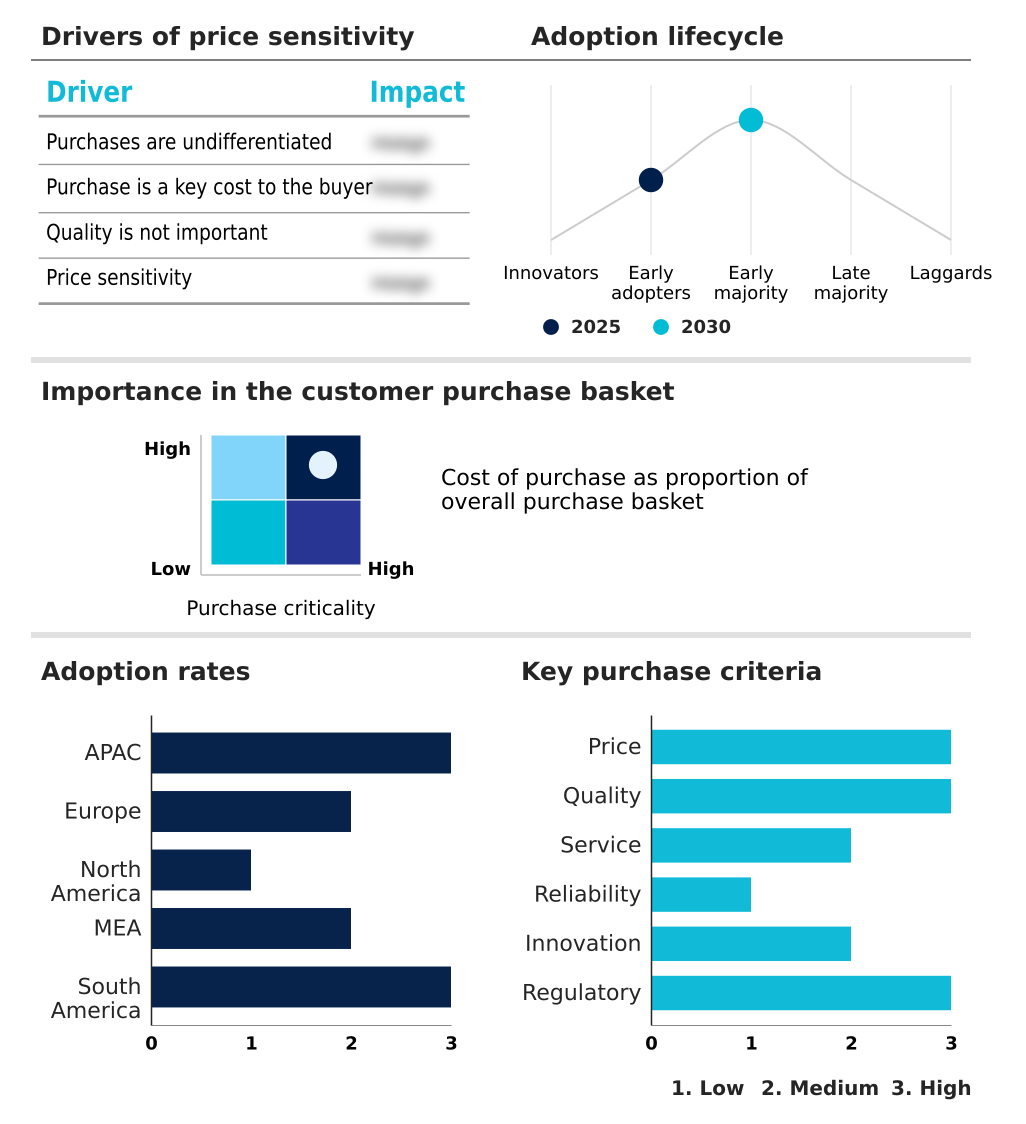
The residential washing machine market forecasting report includes the adoption lifecycle of the market, covering from the innovator’s stage to the laggard’s stage. It focuses on adoption rates in different regions based on penetration. Furthermore, the residential washing machine market report also includes key purchase criteria and drivers of price sensitivity to help companies evaluate and develop their market growth analysis strategies.
Customer Landscape of Residential Washing Machine Industry
Competitive Landscape
Companies are implementing various strategies, such as strategic alliances, residential washing machine market forecast, partnerships, mergers and acquisitions, geographical expansion, and product/service launches, to enhance their presence in the industry.
AB Electrolux - Offers advanced residential washing machines with sensor-driven technologies and proprietary systems, focusing on optimized fabric care, resource efficiency, and enhanced user convenience in a competitive market.
The industry research and growth report includes detailed analyses of the competitive landscape of the market and information about key companies, including:
- AB Electrolux
- Alliance Laundry System LLC
- Avanti Products LLC
- Godrej Enterprises Group
- Haier Smart Home Co. Ltd.
- Hitachi Ltd.
- IFB Industries Ltd.
- LG Corp.
- Miele and Cie. KG
- MIRC Electronics Ltd.
- Panasonic Holdings Corp.
- Robert Bosch Stiftung GmbH
- Samsung Electronics Co. Ltd.
- Sharp Corp.
- Siemens AG
- Smeg S.p.a.
- TCL Industries Holdings Ltd.
- Toshiba Corp.
- Whirlpool Corp.
- Xiaomi Inc.
Qualitative and quantitative analysis of companies has been conducted to help clients understand the wider business environment as well as the strengths and weaknesses of key industry players. Data is qualitatively analyzed to categorize companies as pure play, category-focused, industry-focused, and diversified; it is quantitatively analyzed to categorize companies as dominant, leading, strong, tentative, and weak.
Recent Development and News in Residential washing machine market
- In November 2024, Samsung Electronics Co. Ltd. launched a new line of AI-powered washing machines, focusing on intelligent fabric care and energy optimization through advanced AI algorithms.
- In January 2025, LG Electronics unveiled its latest AI-powered washing machines, highlighting enhanced fabric care, predictive maintenance capabilities, and deeper integration with smart home ecosystems.
- In March 2025, the European Union implemented updated ecodesign and energy labelling regulations for household washing machines, mandating stricter energy efficiency classes and compelling manufacturers to innovate in resource conservation.
- In May 2025, Whirlpool Corp. announced a major initiative focused on circular economy principles, aiming to increase the use of recycled materials and improve the reparability of its washing machines to extend product lifespan.
Dive into Technavio’s robust research methodology, blending expert interviews, extensive data synthesis, and validated models for unparalleled Residential Washing Machine Market insights. See full methodology.
| Market Scope | |
|---|---|
| Page number | 297 |
| Base year | 2025 |
| Historic period | 2020-2024 |
| Forecast period | 2026-2030 |
| Growth momentum & CAGR | Accelerate at a CAGR of 9.8% |
| Market growth 2026-2030 | USD 48136.5 million |
| Market structure | Fragmented |
| YoY growth 2025-2026(%) | 9.5% |
| Key countries | China, India, Japan, South Korea, Australia, Indonesia, Germany, UK, France, Italy, The Netherlands, Spain, US, Canada, Mexico, Saudi Arabia, UAE, South Africa, Israel, Turkey, Brazil, Argentina and Colombia |
| Competitive landscape | Leading Companies, Market Positioning of Companies, Competitive Strategies, and Industry Risks |
Research Analyst Overview
- The residential washing machine market is undergoing a significant technological transformation, moving beyond basic functionality to intelligent laundry care. Boardroom-level decisions are increasingly focused on R&D investment in AI-powered fabric care and predictive maintenance alerts, which are becoming key differentiators.
- Innovations such as inverter motor technology and direct drive motor designs are central to achieving superior energy consumption optimization and quiet operation design. The integration of a smart diagnosis feature and an auto-dosing system improves user convenience and reduces service costs.
- Advanced functionalities, including a steam sanitization cycle, anti-allergen cycle, and microplastic filtration system, address consumer demand for health and sustainability. Furthermore, proprietary technologies like sensorwash technology, ultramix system, and plasmacluster ion technology are crucial for maintaining a competitive edge in a crowded marketplace, where a 15% improvement in efficiency can drive significant market share gains.
What are the Key Data Covered in this Residential Washing Machine Market Research and Growth Report?
-
What is the expected growth of the Residential Washing Machine Market between 2026 and 2030?
-
USD 48.14 billion, at a CAGR of 9.8%
-
-
What segmentation does the market report cover?
-
The report is segmented by Product (Top load, and Front load), Technology (Fully automatic, and Semi automatic), Distribution Channel (Offline, and Online) and Geography (APAC, Europe, North America, Middle East and Africa, South America)
-
-
Which regions are analyzed in the report?
-
APAC, Europe, North America, Middle East and Africa and South America
-
-
What are the key growth drivers and market challenges?
-
Increasing urbanization and nuclearization of families, Intense competition and price sensitivity
-
-
Who are the major players in the Residential Washing Machine Market?
-
AB Electrolux, Alliance Laundry System LLC, Avanti Products LLC, Godrej Enterprises Group, Haier Smart Home Co. Ltd., Hitachi Ltd., IFB Industries Ltd., LG Corp., Miele and Cie. KG, MIRC Electronics Ltd., Panasonic Holdings Corp., Robert Bosch Stiftung GmbH, Samsung Electronics Co. Ltd., Sharp Corp., Siemens AG, Smeg S.p.a., TCL Industries Holdings Ltd., Toshiba Corp., Whirlpool Corp. and Xiaomi Inc.
-
Market Research Insights
- Market dynamics are shaped by a pronounced consumer shift toward premium, feature-rich appliances. The adoption of integrated washing machine models and stackable laundry units has increased by over 25% in new urban residential constructions, reflecting a demand for space efficiency.
- Price sensitivity remains a factor, yet models with verified efficiency improvements, such as a 40% reduction in water usage, command higher price points and faster sales cycles. This premiumization trend pressures manufacturers to innovate continuously, balancing advanced features with cost-effective production to maintain competitive positioning across diverse consumer segments.
We can help! Our analysts can customize this residential washing machine market research report to meet your requirements.