

Radio Frequency (RF) Signal Generator Market Size 2025-2029
The radio frequency (RF) signal generator market size is forecast to increase by USD 1.15 billion at a CAGR of 9% between 2024 and 2029.
- The RF Signal Generator market is experiencing significant growth, driven by the increasing number of partnerships between companies and value chain members. The RF generator market caters to various industries, including telecommunications, defense, aerospace, and smart devices, and offers solutions for OTA calibration, satellite communications, and fieldfox range testing. These collaborations are fostering innovation and expanding the market's reach. Moreover, the outsourcing trend is gaining momentum, leading to an increased demand for rental test equipment. This trend enables organizations to access advanced technology without the need for substantial upfront investment.
- However, challenges persist, including the need for high-performance, cost-effective solutions and the growing complexity of RF technologies. Companies seeking to capitalize on market opportunities must focus on delivering innovative, cost-effective RF Signal Generators while navigating the challenges of technological complexity and evolving customer demands. In scientific research, RF signal generators play a crucial role in radio broadcasting and radio frequency identification (RFID) systems.
What will be the Size of the Radio Frequency (RF) Signal Generator Market during the forecast period?
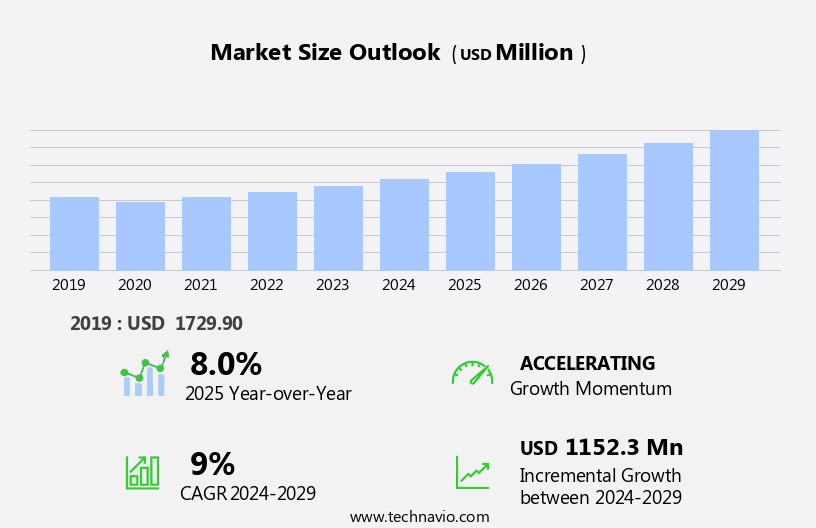
Explore in-depth regional segment analysis with market size data - historical 2019-2023 and forecasts 2025-2029 - in the full report.
Request Free Sample
- The RF signal generator market encompasses a diverse range of technologies, including RF power amplifiers, transmission lines, frequency response modules, and control systems. These components play a crucial role in ensuring RF signals maintain optimal propagation, synchronization, and linearity. RF power amplifiers amplify signals to the required power level for transmission, while RF transmission lines facilitate signal transfer with minimal loss and distortion. RF frequency response is a critical factor, as it determines the generator's ability to produce accurate and stable signals across a wide bandwidth. RF jitter, dynamic range, sensitivity, and noise are essential performance metrics for RF signal generators. Smartphone users and the proliferation of wireless communications, wireless standards, and emerging technologies such as electric cars, autonomous vehicles, and hybrid powertrains are further fueling market growth.
- RF jitter impacts signal timing precision, while dynamic range determines the ability to handle large input signal levels. RF sensitivity refers to the generator's ability to accurately produce low-level signals, and noise affects signal-to-noise ratio. RF inductors, capacitors, and diodes are essential components in RF signal conditioning and filtering. Intermodulation and harmonics can cause unwanted emissions and interference, making RF linearity and phase noise essential for maintaining signal purity. RF transistors and transceivers are key building blocks for RF systems, while RF propagation and synchronization are essential for reliable communication. RF antennas play a crucial role in transmitting and receiving signals, and RF timing is essential for synchronizing multiple systems.
How is this Radio Frequency (RF) Signal Generator Industry segmented?
The radio frequency (RF) signal generator industry research report provides comprehensive data (region-wise segment analysis), with forecasts and estimates in "USD million" for the period 2025-2029, as well as historical data from 2019-2023 for the following segments.
- Application
- Telecommunications
- Aerospace and defense
- Mechanical
- Electronics
- Distribution Channel
- Offline
- Online
- Type
- Continuous wave (CW) RF generators
- Pulsed RF generators
- Geography
- North America
- US
- Canada
- Europe
- France
- Germany
- UK
- APAC
- China
- India
- Japan
- South Korea
- South America
- Brazil
- Rest of World (ROW)
- North America
By Application Insights
The telecommunications segment is estimated to witness significant growth during the forecast period. RF signal generators play a pivotal role in the telecommunications industry, particularly in the context of upgrading wireless technologies and testing various communication channels. These generators produce signals at different frequencies, which are essential for evaluating the performance of wireless communication systems and components in signal towers. The expansion of wireless communication services, driven by increasing subscriber bases and investments in advanced technologies such as LTE-A and the commercialization of 5G, fuels the demand for RF signal generators. Satellite communication, industrial automation, radar systems, and scientific research also rely on RF signal generation for various applications. RF system design, signal integrity, and electromagnetic compatibility (EMC) are critical considerations in RF signal generation for these industries.
RF amplifiers, filters, oscillators, and other components are used to ensure signal quality and compliance with regulations. RF testing laboratories utilize RF signal generators for testing and certifying RF equipment, including RF power meters, RF mixers, and RF attenuators. RF shielding, grounding, and sweeping are essential techniques used in RF testing to minimize electromagnetic interference (EMI) and ensure signal accuracy. RF simulation software, vector network analyzers, and frequency synthesizers are used in RF design and development to optimize signal processing and ensure signal integrity. RF modulation techniques, such as frequency hopping and spread spectrum, are used to enhance signal security and reliability. The market is expanding as advancements in consumer electronics and the rapid deployment of 5G technology drive the need for precise signal testing and measurement solutions.
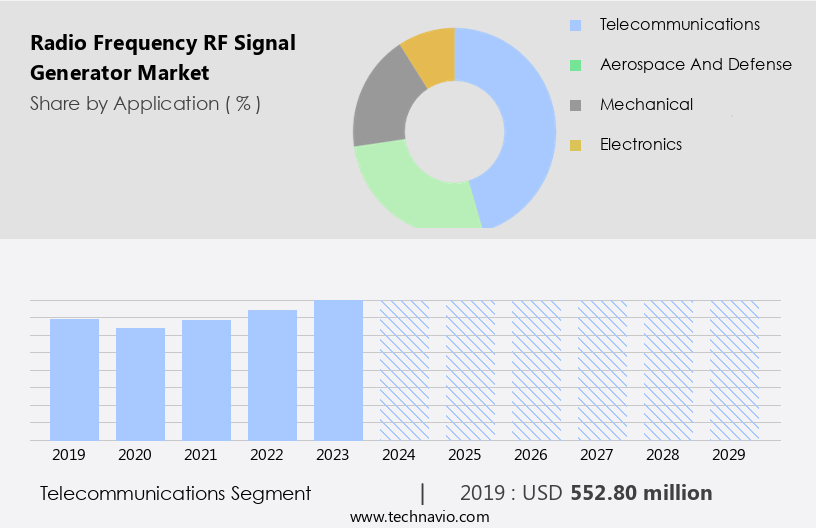
The Telecommunications segment was valued at USD 552.80 billion in 2019 and showed a gradual increase during the forecast period.
Medical imaging and navigation systems also benefit from RF signal generation, as do RF compliance testing, RF safety, and RF testing for cellular communication and radio broadcasting. RF circuit design and RF equipment manufacturing companies rely on RF signal generators for research and development, as well as for production testing. The RF signal generator market is dynamic and evolving, driven by the growth of the telecommunications industry and the increasing adoption of RF technology in various industries, including satellite communication, industrial automation, radar systems, scientific research, and medical imaging. RF signal generators are essential tools for ensuring signal quality, compliance, and accuracy in RF systems and components.
The Radio Frequency (RF) Signal Generator Market is advancing with innovations in RF transceivers, RF diodes, and RF capacitors to enhance signal integrity. Managing RF interference, RF noise, and RF distortion is crucial for ensuring optimal performance. Expanding RF bandwidth and improving RF power output support high-frequency applications. A wide RF dynamic range minimizes signal degradation, while controlling RF intermodulation and RF spurious emissions maintains spectral purity. Addressing RF harmonics ensures stable frequency transmission. Advanced RF synchronization enables precise timing in communication systems. Reliable RF control systems optimize signal modulation, and RF data acquisition enhances monitoring capabilities.
Regional Analysis
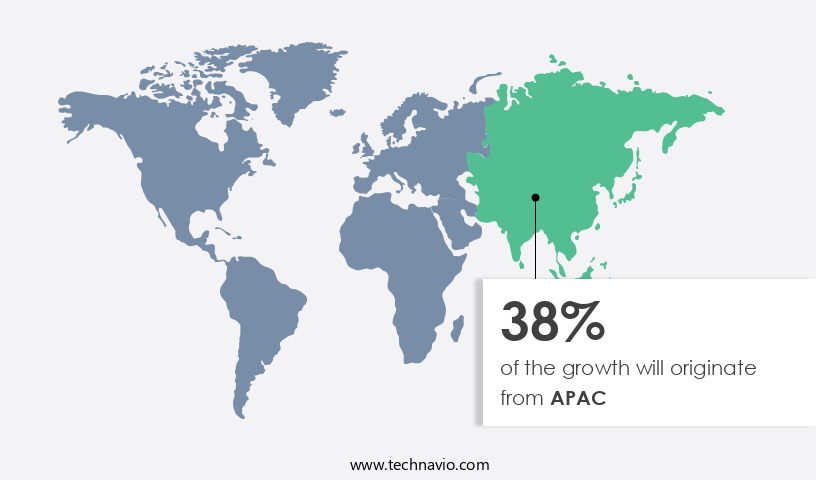
APAC is estimated to contribute 38% to the growth of the global market during the forecast period. Technavio's analysts have elaborately explained the regional trends and drivers that shape the market during the forecast period.
In the dynamic and evolving world of radio frequency (RF) technology, various industries are witnessing significant growth and innovation. RF signal generators, a crucial component in RF system design, are gaining increasing importance in several sectors. APAC, home to a large number of consumer electronic device and electronic component manufacturers, is a major contributor to the RF signal generator market. The region's growing urbanization and rising disposable income are fueling the demand for consumer electronic devices, necessitating advanced RF testing and measurement solutions. Moreover, the industrial sector, particularly in emerging economies like India and China, is adopting automation solutions at an accelerated pace.
This trend is driving the demand for RF instruments in various industries, including automotive and food and beverages. The region's favorable business environment, with low labor costs and abundant raw materials, has attracted several manufacturers to establish production sites in APAC. Satellite communication, wireless communication, and radar systems are other significant markets for RF signal generators. RF simulation software, vector network analyzers, and RF spectrum analyzers are essential tools for RF system design, ensuring signal integrity and compliance with RF standards. RF amplifiers, mixers, and power meters are integral components in RF testing laboratories, while RF filters and oscillators are essential in RF circuit design.
In the scientific research sector, RF signal generators play a pivotal role in electromagnetic compatibility (EMC) testing, microwave design, and medical imaging. Navigation systems, cellular communication, and radio broadcasting also rely on RF technology for their functioning. RF regulations and safety standards continue to evolve, necessitating advanced RF testing and measurement solutions. RF equipment manufacturers are constantly innovating to meet the evolving demands of various industries. Function generators, pulse generators, frequency synthesizers, and sweep generators are some of the RF instruments that are in high demand. Phase-locked loops (PLLs) and digital-to-analog converters (DACs) are essential components in RF signal processing.
RF shielding, grounding, and demodulation are critical aspects of RF safety and compliance. The RF signal generator market is witnessing significant growth and innovation, driven by the increasing demand for advanced RF testing and measurement solutions in various industries. The APAC region, with its large consumer base and favorable business environment, is a major contributor to this market. RF technology continues to play a pivotal role in satellite communication, wireless communication, radar systems, and scientific research, among others. RF equipment manufacturers are constantly innovating to meet the evolving demands of the market, ensuring the continued growth and development of RF technology.
Market Dynamics
Our researchers analyzed the data with 2024 as the base year, along with the key drivers, trends, and challenges. A holistic analysis of drivers will help companies refine their marketing strategies to gain a competitive advantage.
What are the Radio Frequency (RF) Signal Generator market drivers leading to the rise in the adoption of Industry?
- Establishing and expanding collaborative relationships between companies and value chain participants is a primary catalyst for market growth. The RF signal generator market is witnessing significant growth due to the increasing demand for advanced testing solutions in various industries, particularly wireless communication. RF testing laboratories rely on RF signal generators for measuring and analyzing electromagnetic interference (EMI), ensuring compliance with RF standards. To meet the evolving requirements of RF design and testing, companies are investing in RF filters, pulse generators, frequency synthesizers, RF measurements, signal processing, RF oscillators, and arbitrary waveform generators. Moreover, partnerships between RF signal generator manufacturers and value chain members are crucial for staying updated on the latest RF standards and technologies.
- Such strategic partnerships enable the development of sophisticated equipment for testing receivers, test systems, and electronic components across industries. Furthermore, RF signal generators find extensive applications in medical imaging, where precise and accurate signal generation is essential. The integration of RF technology in medical equipment necessitates stringent testing and calibration, further fueling the demand for RF signal generators. The RF signal generator market is driven by the need for advanced testing solutions, upgrades in RF standards, and strategic partnerships between manufacturers and value chain members. The increasing adoption of RF technology in various industries, including telecommunication and medical imaging, is expected to further boost market growth.
What are the Radio Frequency (RF) Signal Generator market trends shaping the Industry?
- The trend in the business world is shifting towards increased outsourcing due to growing demand. This market tendency mandates organizations to seek professional assistance from external providers to manage their non-core functions effectively. The RF signal generator market is poised for growth due to the increasing demand for ensuring the quality and strength of radio frequency signals in various applications. With the commercialization of 5G technology by 2023, the need to test and verify the signal frequency and quality of cellular networks will become increasingly important. Telecommunication companies require RF signal generators to test various technologies and maintain optimal network performance.
- The market is driven by the need for RF certification and RF testing in various industries, including telecommunications, defense, and scientific research. Outsourcing the testing process to third-party companies has become a popular trend, allowing companies to save time and improve efficiency. RF equipment manufacturers supply essential components such as RF switches, RF power meters, RF mixers, RF attenuators, RF circuit design tools, digital-to-analog converters (DACs), and RF modulation equipment to meet the growing demand for RF signal generators. The market is also witnessing growth due to the increasing demand for digital RF generators in OTA calibration, satellite communications, and spectrum analyzer applications.
How does Radio Frequency (RF) Signal Generator market face challenges during its growth?
- The rental market for test equipment is experiencing significant growth, posing a crucial challenge to the industry's expansion due to increasing demand. RF signal generators are essential testing instruments for various industries, including aerospace and defense, telecommunications, and semiconductors. These industries invest heavily in high-performance RF signal generators for specific applications, which comes with a significant capital expenditure (CAPEX). To mitigate this cost, end-users in these industries prefer renting or leasing RF signal generators instead of making a large upfront investment.
- Several market players, such as Keysight Technologies and ROHDE & SCHWARZ, have recognized this trend and have partnered with rental and leasing companies to cater to the demand for T&M equipment on a rental basis. This collaboration benefits both parties, as RF signal generator manufacturers can expand their customer base, while end-users can access high-performance equipment at a lower cost. This trend is particularly prevalent due to the high cost of RF signal generators and the need for frequent upgrades to comply with RF regulations and support advanced technologies like microwave design, navigation systems, spectrum analysis, RF grounding, sweep generators, phase-locked loops (PLLs), electromagnetic compatibility (EMC), frequency hopping, spread spectrum, analog-to-digital converters (ADCs), RF signal analysis, RF demodulation, and RF safety.
Exclusive Customer Landscape
The radio frequency (RF) signal generator market forecasting report includes the adoption lifecycle of the market, covering from the innovator's stage to the laggard's stage. It focuses on adoption rates in different regions based on penetration. Furthermore, the radio frequency (RF) signal generator market report also includes key purchase criteria and drivers of price sensitivity to help companies evaluate and develop their market growth analysis strategies.
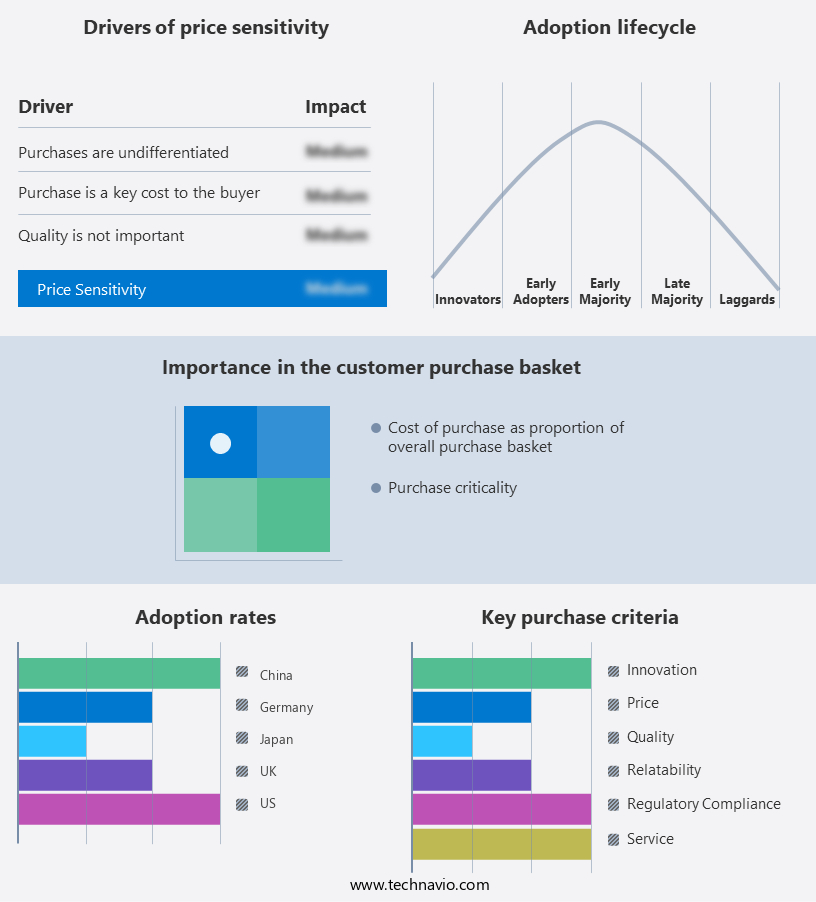
Customer Landscape
Key Companies & Market Insights
Companies are implementing various strategies, such as strategic alliances, radio frequency (rf) signal generator market forecast, partnerships, mergers and acquisitions, geographical expansion, and product/service launches, to enhance their presence in the industry.
Aaronia AG - The company specializes in the Radio Frequency (RF) Signal Generator Market, offering advanced RF signal generators.
The industry research and growth report includes detailed analyses of the competitive landscape of the market and information about key companies, including:
- Aaronia AG
- Aim and Thurlby Thandar Instruments
- Anritsu Corp.
- B and K Precision Corp.
- Berkeley Nucleonics Corp.
- DS INSTRUMENTS
- Fortive Corp.
- Keysight Technologies Inc.
- Maury Microwave Corp.
- National Instruments Corp.
- Novatech Instruments
- Pico Technology Ltd.
- RF Lambda
- Rigol Technologies Inc.
- Rohde and Schwarz GmbH and Co. KG
- Saluki Technology Inc.
- Signalcore Inc.
- Teledyne Technologies Inc.
- Texas Instruments Inc.
- Vaunix Technology Corp.
Qualitative and quantitative analysis of companies has been conducted to help clients understand the wider business environment as well as the strengths and weaknesses of key industry players. Data is qualitatively analyzed to categorize companies as pure play, category-focused, industry-focused, and diversified; it is quantitatively analyzed to categorize companies as dominant, leading, strong, tentative, and weak.
Recent Development and News in Radio Frequency (RF) Signal Generator Market
- In February 2024, Rohde & Schwarz, a leading provider of wireless testing and network infrastructure solutions, introduced the R&S SMW200A vector signal generator. This innovative product supports frequencies up to 70 GHz, catering to the growing demand for high-frequency applications in the telecommunications and automotive industries (Rohde & Schwarz press release).
- In May 2024, Anritsu Corporation and Keysight Technologies, two major players in the RF signal generator market, announced a strategic partnership to expand their joint offering in 5G test solutions. This collaboration combines Anritsu's 5G test chamber technology with Keysight's 5G test software, aiming to provide a comprehensive solution for 5G network testing (Anritsu press release).
- In October 2024, National Instruments, a leading supplier of automated test equipment and virtual instrumentation systems, acquired Signal Hound, a manufacturer of affordable RF signal generators and analyzers. This acquisition strengthens National Instruments' position in the RF market and allows them to offer a more comprehensive product portfolio to their customers (National Instruments press release).
- In January 2025, the European Union approved the Horizon Europe research and innovation program, which includes a significant focus on advancing 5G technology and its applications. This initiative will provide substantial funding for research and development projects related to RF signal generators and related technologies, driving innovation and growth in the European market (European Commission press release).
Research Analyst Overview
The RF signal generator market is characterized by its continuous evolution, driven by the dynamic needs of various sectors. RF shielding solutions protect sensitive electronic components from external interference, while RF switches facilitate signal routing in complex systems. RF power meters measure power levels, ensuring efficient energy usage in RF applications. RF mixers enable frequency conversion, a crucial process in radio broadcasting and cellular communication. RF certification and testing play a vital role in ensuring regulatory compliance, with RF regulations governing the electromagnetic compatibility (EMC) and radio frequency interference (RFI) of RF equipment. In scientific research, RF modulation and digital-to-analog converters (DACs) are integral to the development of advanced RF systems.
The RF industry's unfolding patterns are evident in the increasing adoption of RF technology in wireless communication, satellite communication, and microwave design. RF system design, signal integrity, and spectrum analysis are essential aspects of these applications. RF amplifiers, oscillators, and filters are critical components in RF equipment manufacturing. Navigation systems, radar systems, and medical imaging are just a few sectors that rely on RF technology for their operation. RF simulation software and vector network analyzers aid in the design and optimization of RF systems, while pulse generators and frequency synthesizers facilitate precise signal generation. The ongoing development of RF technology is further highlighted by the emergence of advanced technologies such as phase-locked loops (PLLs), frequency hopping, and spread spectrum. Moreover, the proliferation of smartphones, smart devices, electric vehicles, autonomous driving, connected cars, and radar-based systems in various industries is fueling the demand for RF generators.
RF grounding and sweep generators are essential in managing electromagnetic interference (EMI) and ensuring signal processing accuracy. In the realm of RF testing laboratories, RF measurements and signal processing techniques are continually advancing to meet the evolving demands of the industry. RF safety remains a top priority, with rigorous testing and certification processes in place to ensure the safe operation of RF equipment. The RF market's continuous dynamism is reflected in the ongoing research and innovation in RF circuit design, RF equipment manufacturing, and RF regulations. Analog-to-digital converters (ADCs) and RF signal analysis tools enable the demodulation and processing of complex RF signals, further expanding the potential applications of RF technology. RF phase noise, distortion, and interference are common challenges in RF systems, requiring advanced signal processing techniques and control systems to mitigate their impact. Overall, the RF signal generator market is driven by the increasing demand for high-performance wireless communication systems, satellite communication, and radar applications.
Dive into Technavio's robust research methodology, blending expert interviews, extensive data synthesis, and validated models for unparalleled Radio Frequency (RF) Signal Generator Market insights. See full methodology.
|
Market Scope |
|
|
Report Coverage |
Details |
|
Page number |
216 |
|
Base year |
2024 |
|
Historic period |
2019-2023 |
|
Forecast period |
2025-2029 |
|
Growth momentum & CAGR |
Accelerate at a CAGR of 9% |
|
Market growth 2025-2029 |
USD 1.15 billion |
|
Market structure |
Fragmented |
|
YoY growth 2024-2025(%) |
8.0 |
|
Key countries |
US, China, Germany, India, UK, Japan, South Korea, France, Canada, and Brazil |
|
Competitive landscape |
Leading Companies, Market Positioning of Companies, Competitive Strategies, and Industry Risks |
What are the Key Data Covered in this Radio Frequency (RF) Signal Generator Market Research and Growth Report?
- CAGR of the Radio Frequency (RF) Signal Generator industry during the forecast period
- Detailed information on factors that will drive the growth and forecasting between 2025 and 2029
- Precise estimation of the size of the market and its contribution of the industry in focus to the parent market
- Accurate predictions about upcoming growth and trends and changes in consumer behaviour
- Growth of the market across APAC, North America, Europe, South America, and Middle East and Africa
- Thorough analysis of the market's competitive landscape and detailed information about companies
- Comprehensive analysis of factors that will challenge the radio frequency (rf) signal generator market growth of industry companies
We can help! Our analysts can customize this radio frequency (rf) signal generator market research report to meet your requirements.
 RIA -
RIA -