


India Online Grocery Market Size 2025-2029
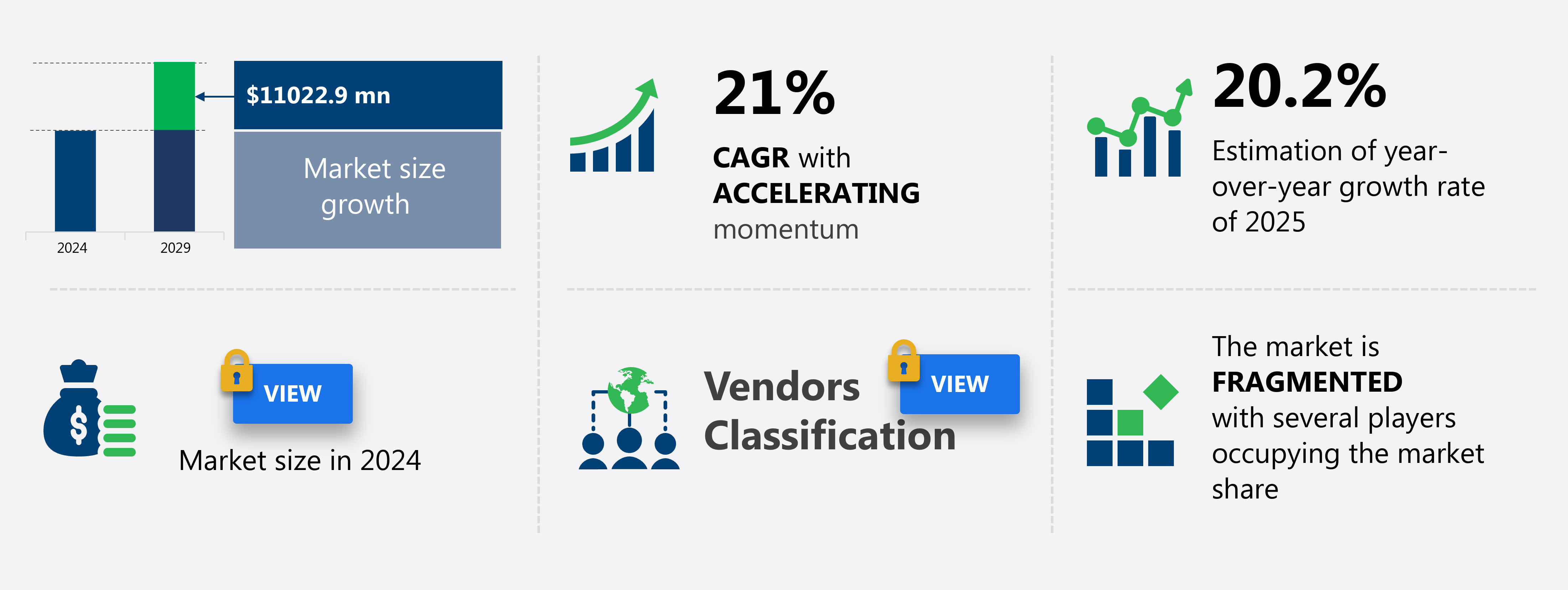
The online grocery market in India size is forecast to increase by USD 11.02 billion at a CAGR of 21% between 2024 and 2029.
- The online grocery market is witnessing significant growth due to the increasing popularity of e-commerce platforms and the convenience they offer. The trend toward functional foods and beverages, such as antioxidant-rich fruits and vegetables, coffee, tea, and spices, is driving demand in this market. However, challenges remain, including the need for efficient logistics and last-mile delivery solutions, advanced payment gateways, and effective packaging to maintain the freshness of perishable items like bread, cheese, and pet care products. E-commerce technology continues to evolve, with LED lights and smartphone apps enhancing the shopping experience. Dried fruits and nuts, personal care items, and a variety of other groceries are also readily available online. As consumers increasingly turn to digital payment methods for convenience and security, the online grocery market is poised for continued growth.
What will be the Size of the market During the Forecast Period?
- The online grocery market has experienced significant growth in recent years, fueled by urbanization, increasing internet penetration, and the widespread adoption of smartphones. This digital transformation has led to the emergence of various business models, including service portals, food-delivery platforms, and e-commerce portals, catering to consumers' convenience and time-saving benefits. Small-scale grocers have also joined the fray, leveraging virtual supermarkets and logistics solutions to compete with larger players. E-commerce platforms have become integral to this sector, offering payment gateways, last-mile delivery solutions, and promotional strategies such as subscription models and membership programs. Delivery options have evolved, with scheduled deliveries and real-time food preparation becoming increasingly popular. Overall, the online grocery market is poised for continued expansion, driven by the convenience and efficiency offered by digital platforms.
How is this market segmented and which is the largest segment?
The market research report provides comprehensive data (region-wise segment analysis), with forecasts and estimates in "USD billion" for the period 2025-2029, as well as historical data from 2019-2023 for the following segments.
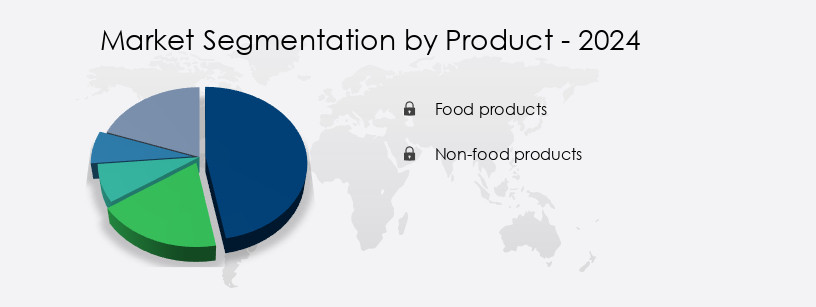
- Product
- Food products
- Non-food products
- Type
- Online
- Cash on delivery
- Platform
- Website
- Mobile
- Geography
- India
By Product Insights
- The food products segment is estimated to witness significant growth during the forecast period.
Online grocery sales have experienced significant growth due to urbanization and the increasing use of digital platforms for shopping. Consumers value the convenience and time-saving benefits of online grocery marketplaces, which offer a wide range of products from food grains and dairy products to fruits, vegetables, and specialty items. E-commerce portals and food-delivery platforms have disrupted traditional brick-and-mortar stores by providing customized and personalized shopping experiences. Quick commerce business models, such as those employed by companies like Instacart and Shipt, offer scheduled deliveries and subscription models, further enhancing the convenience factor. Small-scale grocers and local producers have also joined the online grocery market, expanding product offerings.
Swift delivery processes, integrated return policies, and easy digital payment methods, including cash on delivery and digital payments, add to the appeal of online grocery shopping. The internet and smartphones have made virtual supermarkets accessible to urban consumers, enabling price comparison and product selection from the comfort of their homes. E-commerce technology, including mobile applications, logistics, and payment gateways, streamline the shopping experience. Trust and security are ensured through promotional strategies and membership programs. Overall, the online grocery market offers a convenient and efficient solution for consumers seeking high-quality food products.
Get a glance at the market report of share of various segments Request Free Sample
Key Companies & Market Insights
Companies are implementing various strategies, such as strategic alliances, market forecast , partnerships, mergers and acquisitions, geographical expansion, and product/service launches, to enhance their presence In the market.
Amazon.com Inc. - The company provides a selection of fresh produce, including fruits and vegetables, dairy products such as cheese, dry fruits, lentils, and home care items for purchase via its platform.
The market research and growth report includes detailed analyses of the competitive landscape of the market and information about key companies, including:
- Amazon.com Inc.
- Avenue Supermarts Ltd.
- B L Agro Industries Ltd.
- Blink Commerce Pvt. Ltd.
- Brisam Retail Pvt. Ltd.
- Dookan Technologies s.r.o
- Dunzo Digital Pvt. Ltd.
- Flipkart Internet Pvt. Ltd.
- Flora foods
- FRESHTOHOME FOODS Pvt. Ltd.
- GFOI retail Pvt. Ltd.
- Heritage Foods Ltd.
- Innovative Retail Concepts Pvt. Ltd.
- JioMart
- One97 Communications Ltd.
- Satvika Bio Foods India Pvt. Ltd.
- SPAR Group Inc.
- Spencers
- Zepto
Qualitative and quantitative analysis of companies has been conducted to help clients understand the wider business environment as well as the strengths and weaknesses of key market players. Data is qualitatively analyzed to categorize companies as pure play, category-focused, industry-focused, and diversified; it is quantitatively analyzed to categorize companies as dominant, leading, strong, tentative, and weak.
Market Dynamics
Our India Online Grocery Market researchers analyzed the data with 2024 as the base year, along with the key drivers, trends, and challenges. A holistic analysis of drivers will help companies refine their marketing strategies to gain a competitive advantage.
What are the key market drivers leading to the rise in adoption of India Online Grocery Market?
Increased popularity and rise in e-commerce platforms is the key driver of the market.
- Online grocers have gained significant traction in India due to urbanization and the increasing use of digital platforms for shopping. With the rise of e-commerce portals and food-delivery platforms, consumers now have the convenience of ordering a wide range of grocery products online, including fresh produce, pantry staples, and specialty items. Brick-and-mortar stores face limitations in offering the same product range and variety due to limited shelf space. E-commerce technology, such as mobile applications and logistics solutions, enables quick commerce business models, offering same-day delivery options. Small-scale grocers and manufacturers can leverage these platforms to reach a larger audience and increase sales.
- Product offerings include food grains, bread, dairy products, fruits, vegetables, personal care items, dry products, baking products, household products, beverages, and meat products. Consumers value the time-saving benefits of online grocery shopping, as well as the ability to compare prices and have access to promotional strategies such as subscription models and membership programs. Payment methods include cash on delivery and digital payments, ensuring trust and security for customers. Last-mile delivery solutions ensure efficient and reliable delivery logistics. Internet penetration and smartphone usage continue to grow, making online grocery shopping increasingly accessible to urban consumers. The use of e-commerce platforms offers a seamless shopping experience, with product selection and delivery type catering to individual preferences. Overall, the shift towards digital platforms for grocery shopping presents a promising opportunity for businesses to expand their reach and offerings.
What are the market trends shaping the India Online Grocery Market?
Growth in demand for functional foods and beverages is the upcoming trend In the market.
- Online grocers are responding to the increasing demand for healthier food options by expanding their product offerings on digital platforms. With urbanization and the rise of health-conscious consumers, particularly those aged 18-32, there is a growing preference for functional food and beverage products. These consumers are willing to pay a premium for items with reduced fat and other health-promoting benefits. However, such products are often unavailable in local grocery stores and even in large-scale supermarkets and hypermarkets. To cater to this market gap, businesses are leveraging e-commerce technology and implementing various business models, including quick commerce and subscription services. Service portals offer convenient delivery options, ensuring time-saving benefits for consumers. E-commerce platforms provide a wide product range, including food grains, bread, dairy products, fruits, vegetables, personal care, dry products, baking products, household products, beverages, and meat products.
- Food-delivery platforms and e-commerce portals have become essential shopping platforms for urban consumers during lockdowns, with delivery logistics playing a crucial role in ensuring product offerings reach customers efficiently. Trust and security are paramount in e-commerce transactions, with payment method insights, such as cash on delivery and digital payments, being essential considerations. E-commerce technology, including mobile applications, logistics, and payment gateways, is essential in providing a seamless shopping experience. Last-mile delivery solutions, promotional strategies, and membership programs are also essential components of the online grocery market. RTE food and breakfast and scheduled deliveries are popular options for consumers seeking convenience. Overall, the online grocery market is a dynamic and evolving space, with companies continually adapting to consumer demands and preferences.
What challenges does India Online Grocery Market face during the growth?
Lack of freshness in edible products is a key challenge affecting the market growth.
- Online grocery delivery platforms In the market face the challenge of preserving the freshness of perishable items such as fruits, vegetables, and dairy products. Some platforms do not offer same-day delivery for these products, which can result In their loss of freshness during transit and storage in warehouses. Additionally, many grocery products from international brands are imported, increasing the time required for delivery and impacting product freshness. To address these challenges, companies are focusing on reducing delivery times and improving their supply chain logistics.
- This includes leveraging advanced e-commerce technology, mobile applications, and last-mile delivery solutions to ensure timely and efficient delivery of fresh produce and other grocery items. Product offerings range from food grains, bread, and dairy products to fruits, vegetables, personal care, dry products, baking products, household products, beverages, and meat products. Payment methods include cash on delivery and digital payments, with a focus on ensuring trust and security through reliable payment gateways. Companies are also implementing promotional strategies such as subscription models and membership programs to enhance the shopping experience and offer time-saving benefits for urban consumers.
Exclusive Customer Landscape
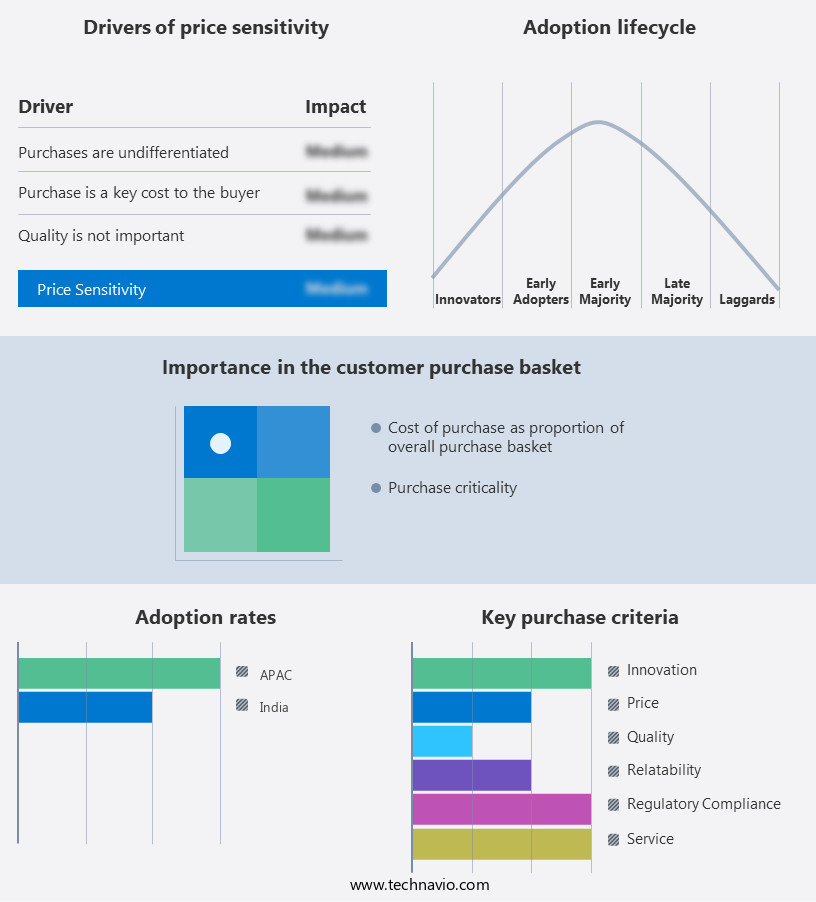
The market forecasting report includes the adoption lifecycle of the market, market growth and forecasting, covering from the innovator's stage to the laggard's stage. It focuses on adoption rates in different regions based on penetration. Furthermore, the market report also includes key purchase criteria and drivers of price sensitivity to help companies evaluate and develop their market growth analysis strategies.
Customer Landscape
Research Analyst Overview
The online grocery market has witnessed significant growth in recent years, fueled by various market dynamics. Urbanization and the increasing prevalence of smartphones and internet penetration have played a pivotal role In the expansion of this sector. The business models of online grocers have evolved, with the emergence of service portals and quick commerce businesses that offer delivery options within a short timeframe. Small-scale grocers and food-delivery platforms have also entered the fray, leveraging e-commerce portals to reach a wider customer base. The convenience offered by online grocery shopping, including time-saving benefits and product selection, has resonated with urban consumers. The shopping experience on digital platforms is a key differentiator, with features such as price comparison and a vast product range that cater to diverse consumer preferences. Product offerings In the online grocery market span across fresh produce, pantry staples, specialty items, and household products, among others.
Brick-and-mortar stores have responded to this trend by integrating their operations with shopping platforms, providing a seamless omnichannel experience for customers. The COVID-19 pandemic and resulting lockdowns have further accelerated the shift towards online grocery shopping, with delivery logistics becoming a critical success factor. Trust and security are essential considerations for consumers when shopping online, with e-commerce technology, mobile applications, and payment gateways playing a crucial role in building confidence. Last-mile delivery solutions have also emerged as a critical component of the online grocery value chain, ensuring timely and efficient delivery of orders. Promotional strategies, subscription models, and membership programs are other tools that online grocers use to attract and retain customers. The delivery type, whether RTE food or scheduled deliveries, also influences consumer choice.
Thus, the online grocery market encompasses a diverse range of product types, including food grains, bread, dairy products, fruits, vegetables, personal care, dry products, baking products, and beverages, among others. Meat products are also gaining popularity as consumers seek out convenient and diverse options. Payment methods, such as cash on delivery and digital payments, offer flexibility to consumers, with the latter gaining traction due to its convenience and security benefits. The e-commerce technology underpinning online grocery platforms continues to evolve, with innovations in logistics, payment gateways, and last-mile delivery solutions shaping the future of the industry.
|
Market Scope |
|
|
Report Coverage |
Details |
|
Page number |
159 |
|
Base year |
2024 |
|
Historic period |
2019-2023 |
|
Forecast period |
2025-2029 |
|
Growth momentum & CAGR |
Accelerate at a CAGR of 21% |
|
Market growth 2025-2029 |
USD 11.02 billion |
|
Market structure |
Fragmented |
|
YoY growth 2024-2025(%) |
20.2 |
|
Key countries |
India and APAC |
|
Competitive landscape |
Leading Companies, Market Positioning of Companies, Competitive Strategies, and Industry Risks |
What are the Key Data Covered in this Market Research and Growth Report?
- CAGR of the market during the forecast period
- Detailed information on factors that will drive the market growth and forecasting between 2025 and 2029
- Precise estimation of the size of the market and its contribution of the market in focus to the parent market
- Accurate predictions about upcoming market growth and trends and changes in consumer behaviour
- Growth of the market across India
- Thorough analysis of the market's competitive landscape and detailed information about companies
- Comprehensive analysis of factors that will challenge the growth of market companies
We can help! Our analysts can customize this market research report to meet your requirements. Get in touch