



Online Baby Products Retailing Market Size 2026-2030
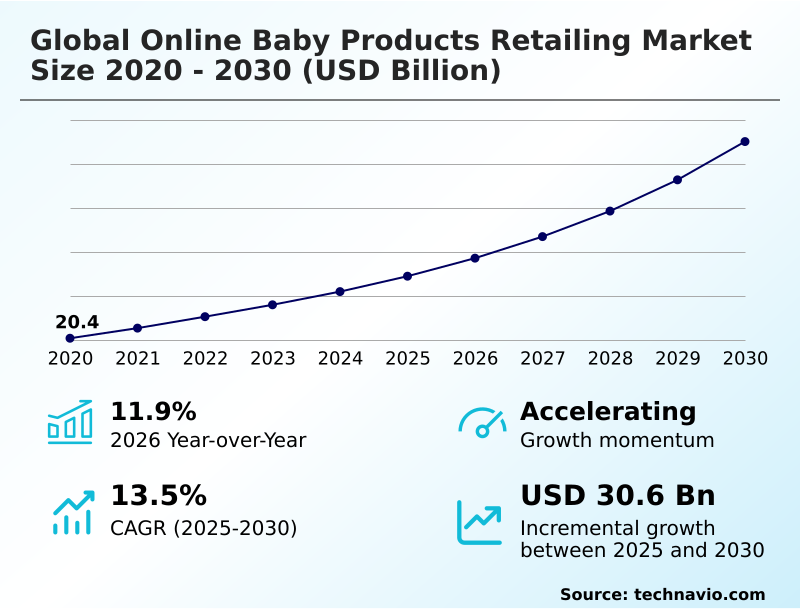
The online baby products retailing market size is valued to increase by USD 30.6 billion, at a CAGR of 13.5% from 2025 to 2030. Competitive pricing and discounts on baby products will drive the online baby products retailing market.
Major Market Trends & Insights
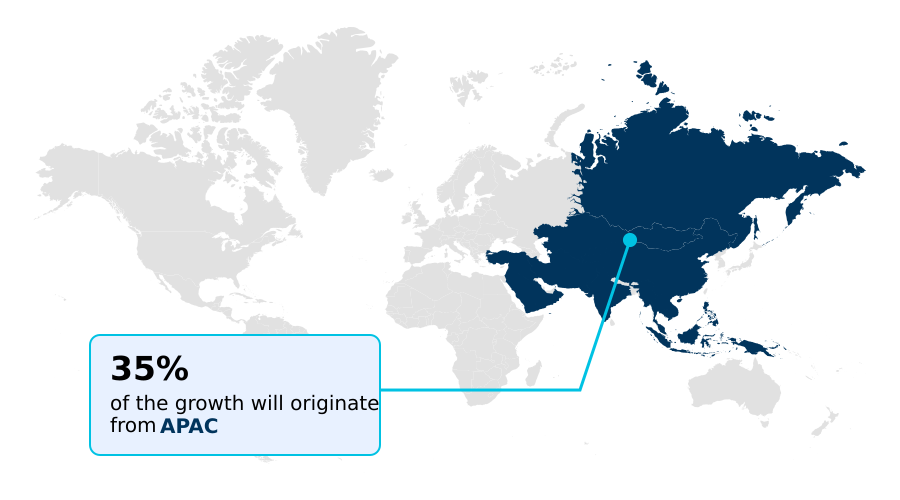
- APAC dominated the market and accounted for a 35% growth during the forecast period.
- By Platform - Mobile segment was valued at USD 23.9 billion in 2024
- By Product - Baby toys segment accounted for the largest market revenue share in 2024
Market Size & Forecast
- Market Opportunities: USD 44.7 billion
- Market Future Opportunities: USD 30.6 billion
- CAGR from 2025 to 2030 : 13.5%
Market Summary
- The online baby products retailing market is undergoing a significant transformation, driven by the increasing need for convenience among modern parents and the expansion of digital infrastructure. A fundamental shift in consumer expectations toward product safety, sustainability, and rapid delivery is reshaping the industry. The integration of advanced logistics, subscription-based delivery models, and personalized digital marketing enables robust market momentum.
- Key trends include the rise of direct-to-consumer platforms and the growing influence of social commerce platforms, which allow for more direct brand engagement. For instance, e-tailers are implementing data-driven customization to manage subscription replenishment models, optimizing inventory of essentials like eco-friendly disposable diapers and reducing holding costs. This strategy ensures product availability while enhancing operational efficiency.
- However, the market also faces challenges from the touch-and-feel gap inherent in e-commerce and the persistent issue of counterfeit goods, which requires investment in technologies like blockchain-based tracking. The continued focus on innovation in both product and delivery is critical for navigating this competitive landscape.
What will be the Size of the Online Baby Products Retailing Market during the forecast period?
Get Key Insights on Market Forecast (PDF) Request Free Sample
How is the Online Baby Products Retailing Market Segmented?
The online baby products retailing industry research report provides comprehensive data (region-wise segment analysis), with forecasts and estimates in "USD billion" for the period 2026-2030, as well as historical data from 2020-2024 for the following segments.
- Platform
- Mobile
- PC and tablet
- Product
- Baby toys
- Baby gear
- Baby apparel
- Baby diaper products
- Others
- Distribution channel
- E commerce platforms
- Brand websites
- Online retail chains
- Others
- Geography
- APAC
- China
- Japan
- India
- North America
- US
- Canada
- Mexico
- Europe
- Germany
- UK
- France
- Middle East and Africa
- Saudi Arabia
- UAE
- South Africa
- South America
- Brazil
- Argentina
- Rest of World (ROW)
- APAC
By Platform Insights
The mobile segment is estimated to witness significant growth during the forecast period.
The mobile segment is the most dynamic component of the online baby products retailing market, fundamentally altering purchasing journeys. This sub-segment thrives on the immediacy offered by handheld devices, with mobile-driven transactions accounting for more than 55% of total sales.
The integration of social commerce platforms and shoppable advertisements allows for frictionless transitions from discovery to purchase. Retailers are now using augmented reality features and AI-driven shopping agents to enhance the experience.
The rise of D2C models and subscription-based delivery models for items like eco-friendly disposable diapers, managed through mobile apps, underscores the platform's dominance.
As digital infrastructure improves, reliance on mobile technology for accessing baby products, including those from cross-border e-commerce channels, is set to intensify, driving long-term market penetration.
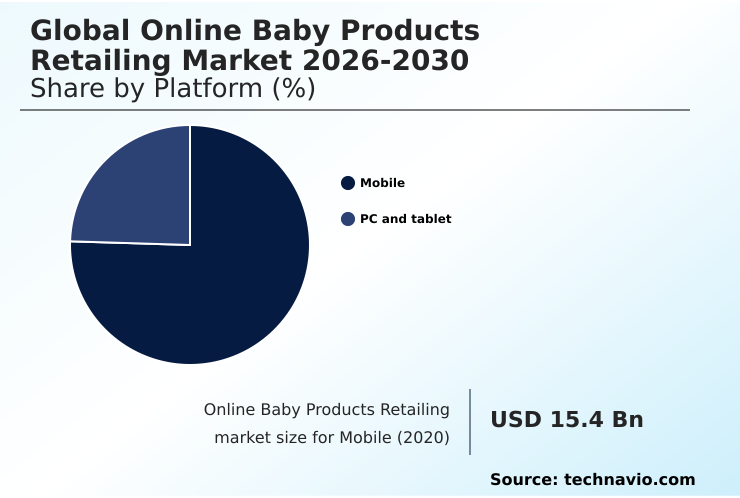
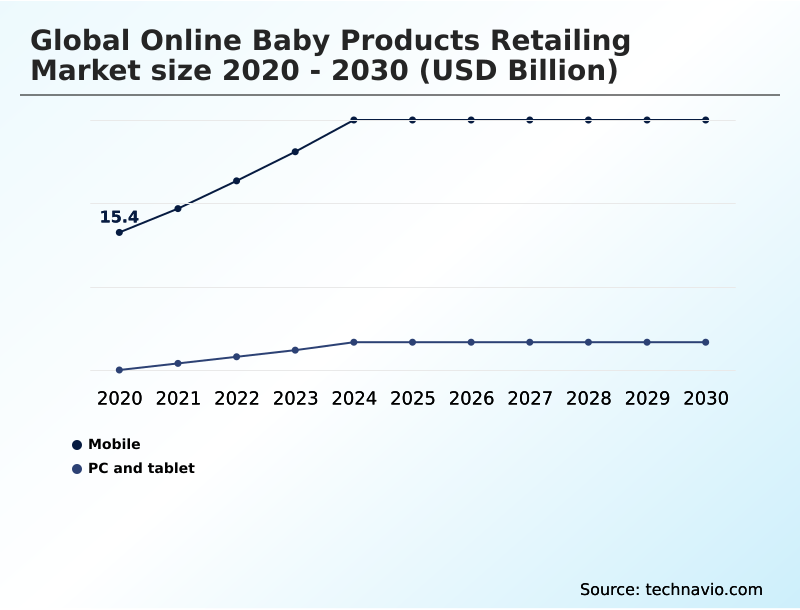
The Mobile segment was valued at USD 23.9 billion in 2024 and showed a gradual increase during the forecast period.
Regional Analysis
APAC is estimated to contribute 35% to the growth of the global market during the forecast period.Technavio’s analysts have elaborately explained the regional trends and drivers that shape the market during the forecast period.
See How Online Baby Products Retailing Market Demand is Rising in APAC Request Free Sample
The geographic landscape of the online baby products retailing market is led by APAC, which accounts for over 35% of the incremental growth, driven by rapid digitization in China and India.
The proliferation of smartphones has made mobile-first transactions a standard, necessitating secure online transactions and robust B2C e-commerce sales infrastructures. The integration of AI-powered mobile assistant tools and personalized shopping assistants helps cater to a diverse consumer base.
Regional logistics providers are expanding cold-chain capabilities to support the growing online demand for fresh, organic baby food, improving supply chain integrity for temperature-sensitive goods by over 30%.
This, combined with the adoption of an omnichannel approach and social commerce features, has revolutionized the consumer journey. Despite challenges, the implementation of blockchain-based tracking and enhanced authentication protocols by leading retailers has helped bolster consumer trust.
Market Dynamics
Our researchers analyzed the data with 2025 as the base year, along with the key drivers, trends, and challenges. A holistic analysis of drivers will help companies refine their marketing strategies to gain a competitive advantage.
- The modern consumer journey in the online baby products retailing market often begins with specific, value-driven searches. Parents are increasingly looking for organic baby apparel online and sustainable nursery furniture trends, signaling a clear preference for health-conscious and eco-friendly items.
- This has fueled the growth of specialized e-commerce niches, where an eco-friendly diaper delivery service or a curated subscription box for baby toys can thrive. In response, retailers are focusing on creating the best online baby registry experiences, integrating these specialized products.
- The rise of the D2C organic baby food sector and the increasing popularity of the online marketplace for used baby gear further illustrate the market's fragmentation and diversification. An effective omnichannel baby product retail strategy, which seamlessly blends online and offline touchpoints, consistently outperforms pure-play digital models, showing a double-digit improvement in customer lifetime value.
- Retailers are also addressing niche demands for hypoallergenic baby skincare online and biodegradable baby wipes in bulk. Moreover, the online rental service for baby equipment is gaining traction as a cost-effective, sustainable option for short-term needs. This dynamic is compelling companies to innovate continuously to meet evolving consumer expectations.
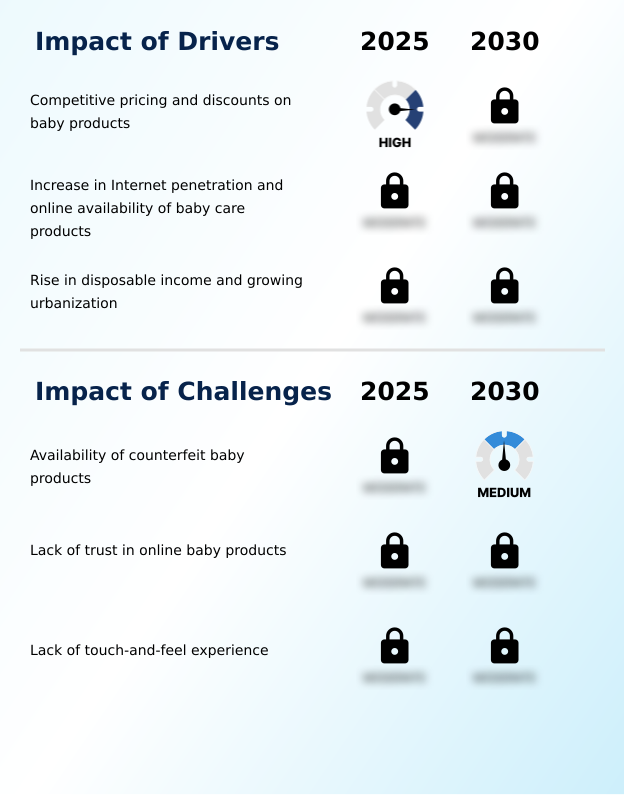
What are the key market drivers leading to the rise in the adoption of Online Baby Products Retailing Industry?
- Competitive pricing and the availability of promotional discounts on baby products serve as a key driver for the market's growth.
- Market growth is primarily fueled by competitive pricing, expanding internet access, and rising disposable incomes. Online platforms leverage dynamic pricing algorithms, which can produce a 10-15% uplift in sales during promotional periods by optimizing discounts in real time.
- The continuous expansion of internet penetration and B2C e-commerce sales into new regions has increased the total addressable market by over 20% in some developing economies. This digital access empowers parents with real-time price comparison tools and personalized product recommendations.
- The convenience of subscription-based delivery models and direct-to-consumer platforms appeals to time-constrained, dual-income households.
- This demand is met by efficient last-mile delivery solutions and a wide array of choices available through online retail marketplaces, reinforcing the shift from physical to digital shopping.
What are the market trends shaping the Online Baby Products Retailing Industry?
- The increasing adoption of omnichannel retailing models is a prominent market trend. This approach integrates digital and physical touchpoints to create a seamless and unified shopping journey for consumers.
- Key trends are reshaping the online baby products retailing market, driven by evolving parental expectations for convenience and transparency. The growth of omnichannel retailing is paramount, as brands that sync digital and physical touchpoints report up to a 25% increase in customer lifetime value. This strategy includes localized fulfillment hubs to support click-and-collect services and curbside pickup.
- Innovations in packaging, such as QR-based authentication and tamper-evident seals, are enhancing consumer trust. The use of eco-conscious manufacturing and user-generated content in marketing campaigns also correlates with an 18% higher conversion rate compared to traditional promotions.
- Furthermore, the integration of live-streaming sales and shoppable advertisements on social media transforms discovery into direct B2C e-commerce sales, making these platforms powerful revenue channels.
What challenges does the Online Baby Products Retailing Industry face during its growth?
- The widespread availability of counterfeit baby products presents a significant challenge that affects the industry's growth and consumer trust.
- Despite strong growth drivers, the market faces significant challenges that temper its potential. The proliferation of counterfeit goods erodes consumer trust and requires constant vigilance. The integration of blockchain-based tracking to verify authenticity has been shown to reduce counterfeit reporting by over 50% for participating brands.
- Another structural hurdle is the lack of a physical touch-and-feel experience, which is crucial for many parents. To mitigate this, platforms offering virtual previews and detailed digital product catalogs for bulky items see a return rate that is approximately 20% lower than those without such features.
- Furthermore, building trust is complicated by concerns over digital payment security and inconsistent quality control among third-party sellers, necessitating investments in secure online transactions and more rigorous seller vetting processes.
Exclusive Technavio Analysis on Customer Landscape
The online baby products retailing market forecasting report includes the adoption lifecycle of the market, covering from the innovator’s stage to the laggard’s stage. It focuses on adoption rates in different regions based on penetration. Furthermore, the online baby products retailing market report also includes key purchase criteria and drivers of price sensitivity to help companies evaluate and develop their market growth analysis strategies.
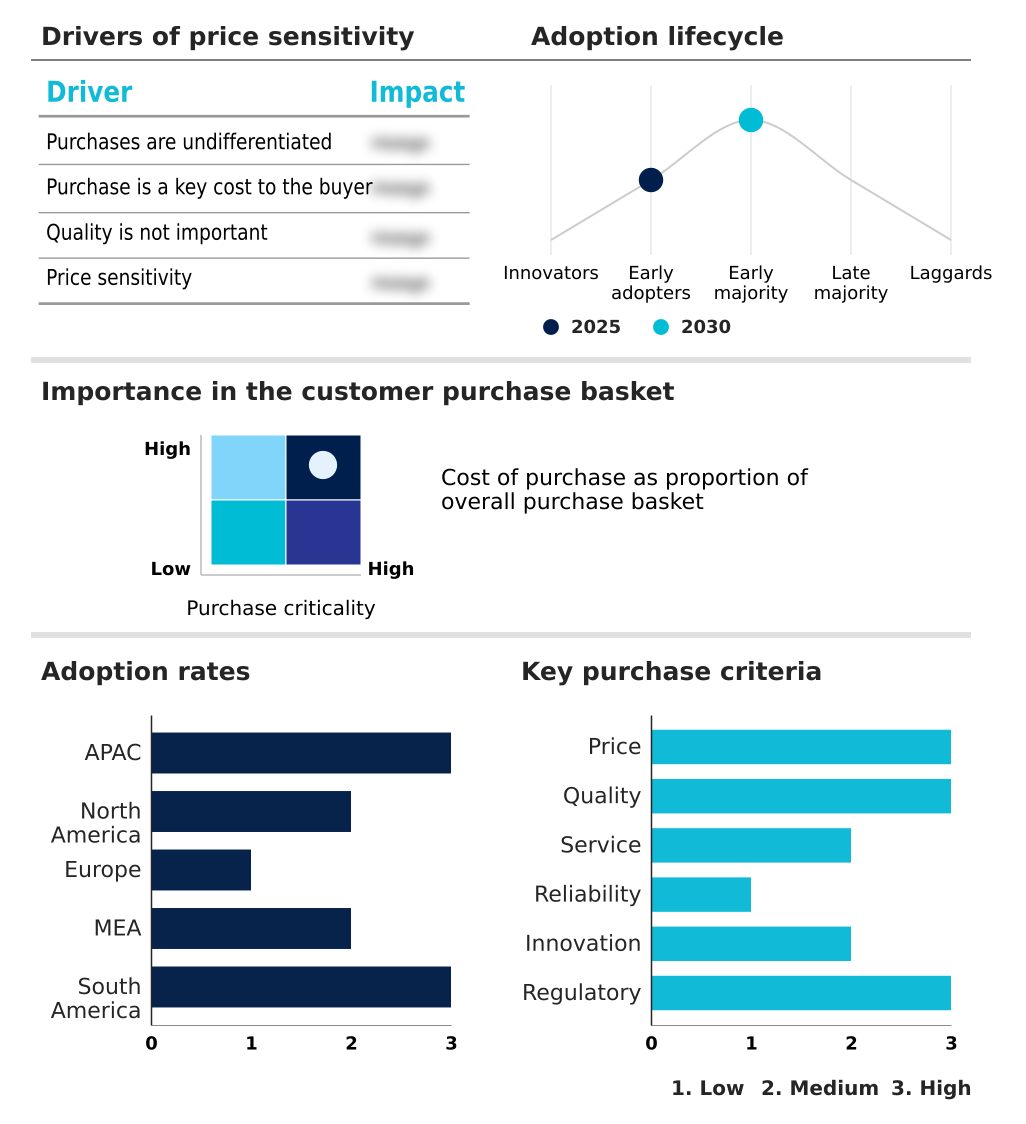
Customer Landscape of Online Baby Products Retailing Industry
Competitive Landscape
Companies are implementing various strategies, such as strategic alliances, online baby products retailing market forecast, partnerships, mergers and acquisitions, geographical expansion, and product/service launches, to enhance their presence in the industry.
Alibaba Group Holding Ltd. - Key offerings center on leveraging expansive digital marketplace infrastructure to facilitate high-volume online retailing of a comprehensive range of baby products.
The industry research and growth report includes detailed analyses of the competitive landscape of the market and information about key companies, including:
- Alibaba Group Holding Ltd.
- Amazon.com Inc.
- Argos Ltd.
- Baby Earth
- Babydash Sdn Bhd
- Babyshop Group
- Best Buy Co. Inc.
- Beyond Inc.
- BrainBees Solutions Ltd.
- Crate and Barrel
- eBay Inc.
- Grupo Bebecar SA
- J Born
- Mumzworld
- Next GmbH
- Rakuten Group Inc.
- Saks Fifth Avenue
- Takealot Online Pty Ltd.
Qualitative and quantitative analysis of companies has been conducted to help clients understand the wider business environment as well as the strengths and weaknesses of key industry players. Data is qualitatively analyzed to categorize companies as pure play, category-focused, industry-focused, and diversified; it is quantitatively analyzed to categorize companies as dominant, leading, strong, tentative, and weak.
Recent Development and News in Online baby products retailing market
- In January 2025, Babyshop initiated its market entry into India, establishing a flagship presence to target the region's expanding consumer base in the online baby products retailing market.
- In February 2025, Amazon.com Inc. integrated generative artificial intelligence tools to offer personalized nursery design recommendations and product safety compatibility checks for parents.
- In February 2025, Alibaba Group Holding Ltd. enhanced its logistics network to improve cross-border delivery speeds for premium baby products, including organic infant formula and sustainable apparel.
- In May 2025, XENA Intelligence Inc. introduced AI-powered baby monitors capable of tracking breathing patterns and sleep quality without requiring wearable sensors.
Dive into Technavio’s robust research methodology, blending expert interviews, extensive data synthesis, and validated models for unparalleled Online Baby Products Retailing Market insights. See full methodology.
| Market Scope | |
|---|---|
| Page number | 302 |
| Base year | 2025 |
| Historic period | 2020-2024 |
| Forecast period | 2026-2030 |
| Growth momentum & CAGR | Accelerate at a CAGR of 13.5% |
| Market growth 2026-2030 | USD 30.6 billion |
| Market structure | Fragmented |
| YoY growth 2025-2026(%) | 11.9% |
| Key countries | China, Japan, India, South Korea, Australia, Indonesia, US, Canada, Mexico, Germany, UK, France, Italy, Spain, The Netherlands, Saudi Arabia, UAE, South Africa, Israel, Turkey, Brazil, Argentina and Chile |
| Competitive landscape | Leading Companies, Market Positioning of Companies, Competitive Strategies, and Industry Risks |
Research Analyst Overview
- The online baby products retailing market is characterized by rapid innovation and shifting consumer priorities toward safety, sustainability, and technological integration. The market's evolution is driven by the demand for certified non-toxic materials and smart nursery technology, compelling brands to invest in R&D. Advanced features like virtual fitting tools and 3D modeling are becoming standard for high-consideration purchases.
- The rise of circular fashion initiatives and the re-commerce market represents a significant boardroom-level consideration, directly impacting ESG strategies and supply chain models. Platforms integrating an AI-powered virtual assistant report a 30% higher user engagement rate for complex products. The adoption of technologies such as AI-driven dynamic pricing, modular gear designs, and temperature-regulating textiles further differentiates competitors.
- Quick commerce services are revolutionizing the delivery of essentials, while the D2C model and omnichannel approach redefine customer relationships. Smart bottle warmers, ergonomic breast pumps, and 3D room planners showcase the industry's focus on practical innovation, supported by robust data-driven customization and augmented reality features.
What are the Key Data Covered in this Online Baby Products Retailing Market Research and Growth Report?
-
What is the expected growth of the Online Baby Products Retailing Market between 2026 and 2030?
-
USD 30.6 billion, at a CAGR of 13.5%
-
-
What segmentation does the market report cover?
-
The report is segmented by Platform (Mobile, and PC and tablet), Product (Baby toys, Baby gear, Baby apparel, Baby diaper products, and Others), Distribution Channel (E commerce platforms, Brand websites, Online retail chains, and Others) and Geography (APAC, North America, Europe, Middle East and Africa, South America)
-
-
Which regions are analyzed in the report?
-
APAC, North America, Europe, Middle East and Africa and South America
-
-
What are the key growth drivers and market challenges?
-
Competitive pricing and discounts on baby products, Availability of counterfeit baby products
-
-
Who are the major players in the Online Baby Products Retailing Market?
-
Alibaba Group Holding Ltd., Amazon.com Inc., Argos Ltd., Baby Earth, Babydash Sdn Bhd, Babyshop Group, Best Buy Co. Inc., Beyond Inc., BrainBees Solutions Ltd., Crate and Barrel, eBay Inc., Grupo Bebecar SA, J Born, Mumzworld, Next GmbH, Rakuten Group Inc., Saks Fifth Avenue and Takealot Online Pty Ltd.
-
Market Research Insights
- The online baby products retailing market is shaped by a confluence of powerful dynamics, including evolving consumer behaviors and technological advancements. Parents are increasingly utilizing parenting community platforms for peer-to-peer product reviews, influencing purchasing decisions away from traditional advertising.
- Retailers are responding by adopting hyper-personalized marketing, which has been shown to increase customer retention rates by over 20% compared to generic campaigns. The implementation of localized fulfillment hubs for contactless delivery options has also become critical, reducing last-mile delivery solution times by up to 40% in dense urban areas.
- This focus on efficiency and personalized engagement, combined with the convenience of subscription replenishment models, defines the current competitive environment. The shift toward ethically sourced baby products and mobile-first transactions further highlights the market's adaptation to modern consumer values and habits.
We can help! Our analysts can customize this online baby products retailing market research report to meet your requirements.
 RIA -
RIA -