



Luxury Vehicle Market Size 2025-2029
The luxury vehicle market size is valued to increase by USD 217 billion, at a CAGR of 6.7% from 2024 to 2029. Rising affluence and expanding high-net-worth demographics will drive the luxury vehicle market.
Major Market Trends & Insights
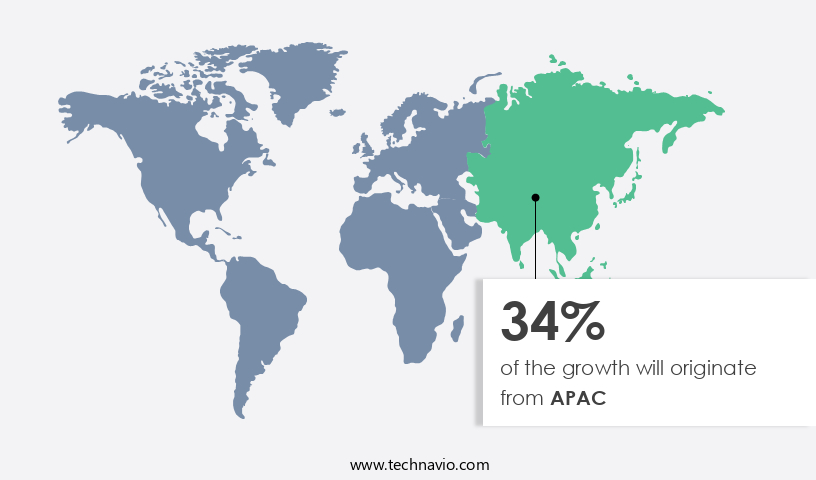
- APAC dominated the market and accounted for a 34% growth during the forecast period.
- By Type - ICE segment was valued at USD 283.20 billion in 2023
- By Vehicle Type - Passenger cars segment accounted for the largest market revenue share in 2023
Market Size & Forecast
- Market Opportunities: USD 67.70 billion
- Market Future Opportunities: USD 217.00 billion
- CAGR from 2024 to 2029 : 6.7%
Market Summary
- The market is experiencing significant growth driven by rising affluence and expanding high-net-worth demographics worldwide. This trend is fueled by the increasing desire for premium experiences and the availability of advanced technologies. One notable development is the integration of autonomous and AI-driven features in luxury vehicles, offering consumers convenience and enhanced safety. However, regulatory pressures and emission standards present challenges for manufacturers. For instance, optimizing supply chains to meet these regulations can lead to substantial cost savings and operational efficiency.
- A recent study revealed that by implementing advanced logistics solutions, one luxury vehicle manufacturer was able to reduce transportation costs by 15% while ensuring full compliance with emission standards. This illustrates the importance of balancing technological innovation with regulatory requirements in the market.
What will be the Size of the Luxury Vehicle Market during the forecast period?
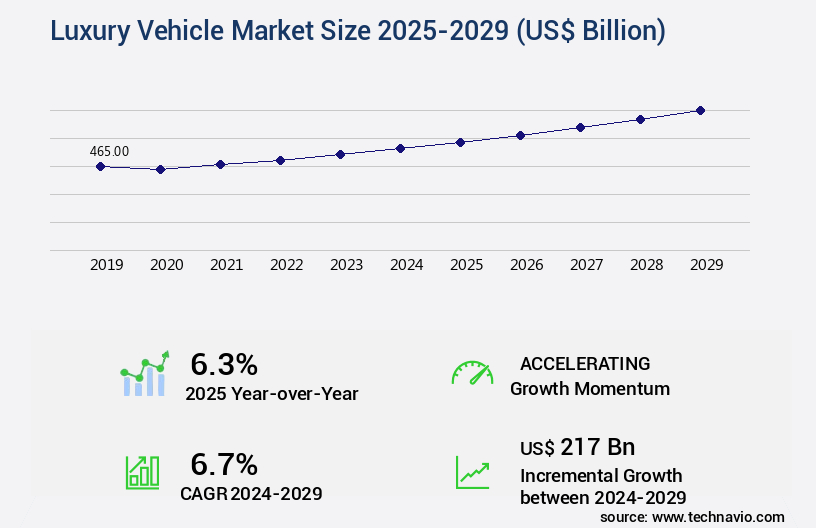
Get Key Insights on Market Forecast (PDF) Request Free Sample
How is the Luxury Vehicle Market Segmented ?
The luxury vehicle industry research report provides comprehensive data (region-wise segment analysis), with forecasts and estimates in "USD billion" for the period 2025-2029, as well as historical data from 2019-2023 for the following segments.
- Type
- ICE
- Electric
- Hybrid
- Vehicle Type
- Passenger cars
- Commercial vehicles
- Variant
- Non-autonomous
- Autonomous
- Geography
- North America
- US
- Canada
- Europe
- France
- Germany
- UK
- APAC
- China
- India
- Japan
- South Korea
- South America
- Brazil
- Rest of World (ROW)
- North America
By Type Insights
The ice segment is estimated to witness significant growth during the forecast period.
The market continues to evolve, with precision engineering components and advanced technologies shaping consumer preferences. ICE vehicles, accounting for approximately 60-65% of sales, remain dominant, particularly in regions where electric vehicle adoption is slow. High-performance engines, such as V8 and V12 configurations, continue to captivate driving enthusiasts, as seen in offerings from Mercedes-AMG, BMW M, and Ferrari. These vehicles boast superior driving dynamics, an auditory experience, and brand heritage that significantly influence purchasing decisions in the ultra-luxury and high-performance segments. Meanwhile, electric and hybrid powertrains gain traction, with infotainment system integration, premium sound systems, and advanced driver-assistance systems becoming increasingly popular.
Luxury vehicle customization, including handcrafted interiors, climate control systems, and vehicle connectivity vehicles solutions, further enhance the customer experience. Lightweight materials engineering, active safety features, and autonomous driving technology are also key areas of focus, with collision avoidance systems, head-up displays, and adaptive cruise control becoming standard features. Over-the-air updates ensure vehicles remain technologically advanced, while ergonomic design principles, advanced chassis technology, and exclusive design features cater to the evolving needs and desires of luxury consumers.
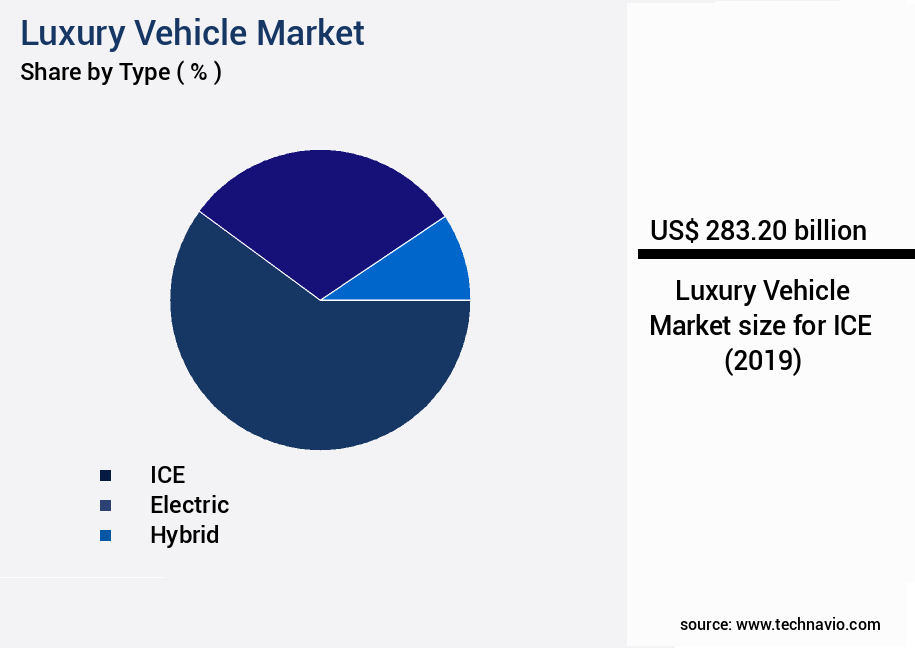
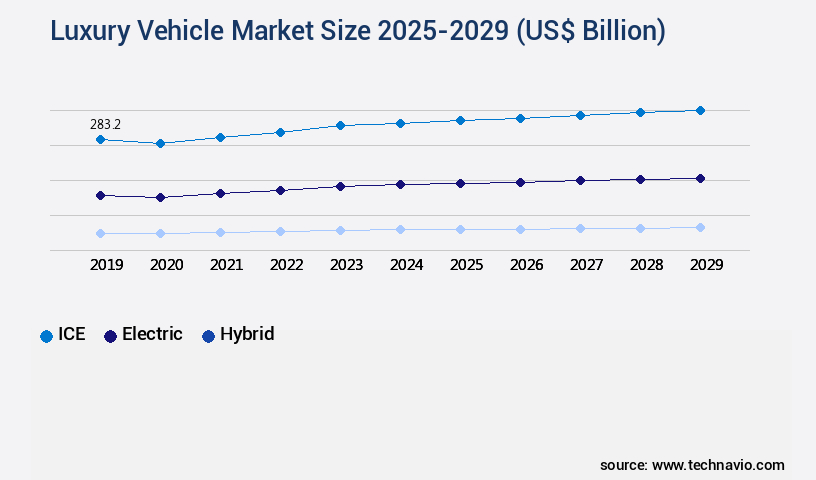
The ICE segment was valued at USD 283.20 billion in 2019 and showed a gradual increase during the forecast period.
Regional Analysis
APAC is estimated to contribute 34% to the growth of the global market during the forecast period.Technavio's analysts have elaborately explained the regional trends and drivers that shape the market during the forecast period.
See How Luxury Vehicle Market Demand is Rising in APAC Request Free Sample
Europe, the cradle of luxury automotive, remains a pivotal player in the global high-end vehicle market. With iconic brands like Mercedes-Benz, BMW, and Audi based in Germany, the region continues to command consumer loyalty and prestige. Germany, in particular, is the epicenter of European automotive engineering, leading the charge towards electrification. The European Union's 2035 ban on internal combustion engine (ICE) vehicles underscores this shift. The UK, France, Italy, and Sweden also contribute significantly, offering unique strengths from engineering excellence to ultra-luxury craftsmanship. For instance, the UK's thriving independent sector specializes in bespoke, handcrafted vehicles.
These countries' collective commitment to innovation and sustainability ensures the European the market's continued evolution and growth. According to recent reports, the European the market is projected to reach over €200 billion by 2025, growing at a steady pace. This growth is driven by a combination of factors, including consumer preferences, technological advancements, and regulatory pressures.
Market Dynamics
Our researchers analyzed the data with 2024 as the base year, along with the key drivers, trends, and challenges. A holistic analysis of drivers will help companies refine their marketing strategies to gain a competitive advantage.
The global luxury vehicle market is witnessing significant transformation as technological innovation, sustainability, and customer experience converge to redefine industry standards. The impact of luxury vehicle design ergonomics plays a pivotal role in driver comfort and long-term usability, while the role of advanced materials in vehicle weight reduction directly enhances fuel efficiency and performance. Safety remains a core focus, with the influence of autonomous driving features on safety and the effect of passive safety systems on accident severity highlighting the integration of intelligent systems to protect occupants. Similarly, the effect of connectivity solutions on driver experience and the integration of infotainment systems with driver assistance demonstrate how digital technologies are enhancing engagement and operational efficiency.
Precision engineering and manufacturing are essential, as evidenced by the application of precision engineering in luxury vehicle production and advanced manufacturing processes, which support both performance and reliability. Electrification and sustainability are increasingly central, with development of electric vehicle battery performance and the importance of sustainability practices in luxury manufacturing shaping product lifecycles. Performance metrics, including the relationship between vehicle dynamics control and handling, as well as the importance of aerodynamic design for fuel efficiency, further underline engineering excellence.
Passenger experience and convenience are enhanced through implementation of noise reduction techniques, effect of climate control systems on passenger comfort, influence of personalized driving experience on customer satisfaction, and application of user interface design in vehicle infotainment. Operational efficiency and reliability are strengthened by the impact of telematics data on vehicle maintenance, the role of cybersecurity protocols in vehicle security, and the role of predictive maintenance in vehicle reliability, ensuring luxury vehicles remain both technologically advanced and dependable.
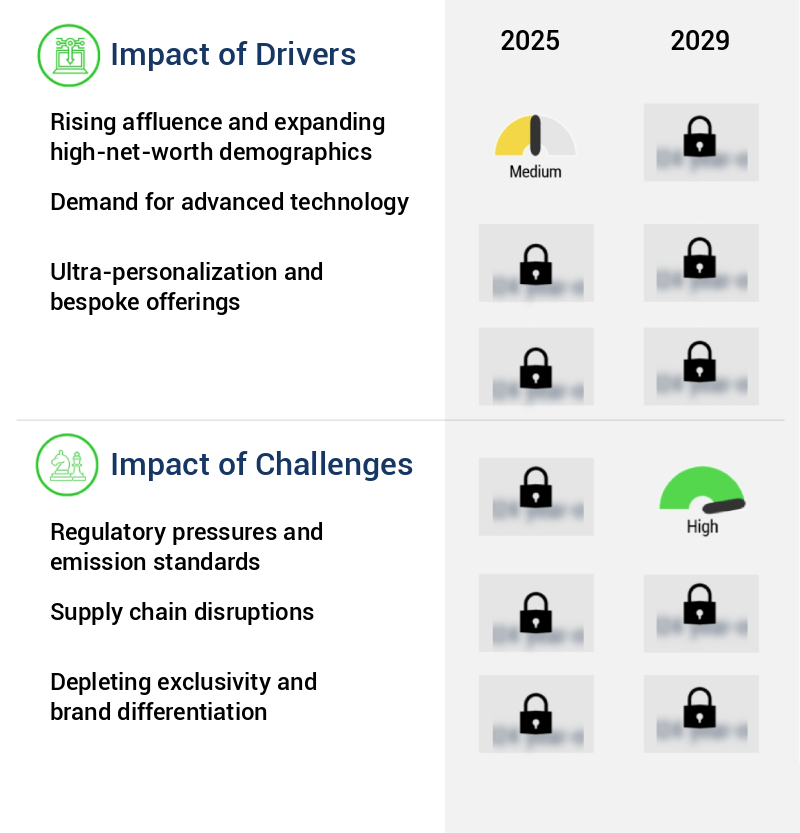
What are the key market drivers leading to the rise in the adoption of Luxury Vehicle Industry?
- The expanding high-net-worth demographic and rising affluence serve as the primary catalyst for market growth.
- The market is experiencing significant growth, driven by the increasing affluence of high-net-worth demographics. Favorable macroeconomic conditions, including resilient equity markets and accommodative interest rate environments, have contributed to substantial wealth creation, particularly in North America. According to recent research, the North American region has seen a notable increase in the population of high-net-worth individuals, fueled by strong financial market performance and robust asset appreciation. Asia-Pacific is also experiencing growth, with varying rates across key markets such as China, India, and Southeast Asia.
- This demographic shift is directly influencing luxury vehicle demand. High-net-worth individuals are not just purchasing vehicles for transportation; they are also seeking expressions of status, lifestyle, and personal identity. As a result, the market is becoming increasingly important for industries such as automotive manufacturing, finance, and marketing. This trend is expected to continue as wealth creation continues and high-net-worth demographics expand globally.
What are the market trends shaping the Luxury Vehicle Industry?
- The upcoming market trend involves autonomous and artificially intelligent luxury experiences. Autonomous and artificially intelligent systems are set to define the future of luxury experiences.
- The market is undergoing significant changes as autonomous driving and artificial intelligence become pivotal components of brand identity. Leading manufacturers are integrating advanced driver assistance systems, such as Mercedes-Benz Drive Pilot and BMW Personal Pilot, which employ LiDAR sensors, 5G connectivity, and AI-based path prediction for hands-free highway driving. These innovations aim to convert travel time into valuable hours for productivity or relaxation, catering to affluent consumers' demands for convenience and exclusivity.
- Artificial intelligence is further revolutionizing in-car interaction through generative AI platforms like Mercedes-Benz MBUX Virtual Assistant, enabling conversational control over vehicle functions. These advancements contribute to improved efficiency and enhanced user experience.
What challenges does the Luxury Vehicle Industry face during its growth?
- The growth of the industry is significantly impacted by regulatory pressures and stringent emission standards.
- The market is undergoing significant transformations due to escalating regulatory pressures. Governments in major markets, such as the European Union, China, and certain US states, are implementing stringent zero-emission mandates. These policies, which include full bans on internal combustion engine (ICE) vehicles by 2035, necessitate drastic changes in luxury automakers' product offerings. The Euro 7 standards, effective from 2025, impose rigorous limits on nitrogen oxide and particulate emissions, making it economically and technically unsustainable to continue producing high-performance ICE models without substantial innovation.
- As a result, luxury vehicle manufacturers are investing heavily in electrification and alternative powertrains to meet evolving market demands and regulatory requirements. This shift is set to redefine the luxury automotive landscape, with electric and hybrid vehicles poised to capture a larger market share.
Exclusive Technavio Analysis on Customer Landscape
The luxury vehicle market forecasting report includes the adoption lifecycle of the market, covering from the innovator's stage to the laggard's stage. It focuses on adoption rates in different regions based on penetration. Furthermore, the luxury vehicle market report also includes key purchase criteria and drivers of price sensitivity to help companies evaluate and develop their market growth analysis strategies.
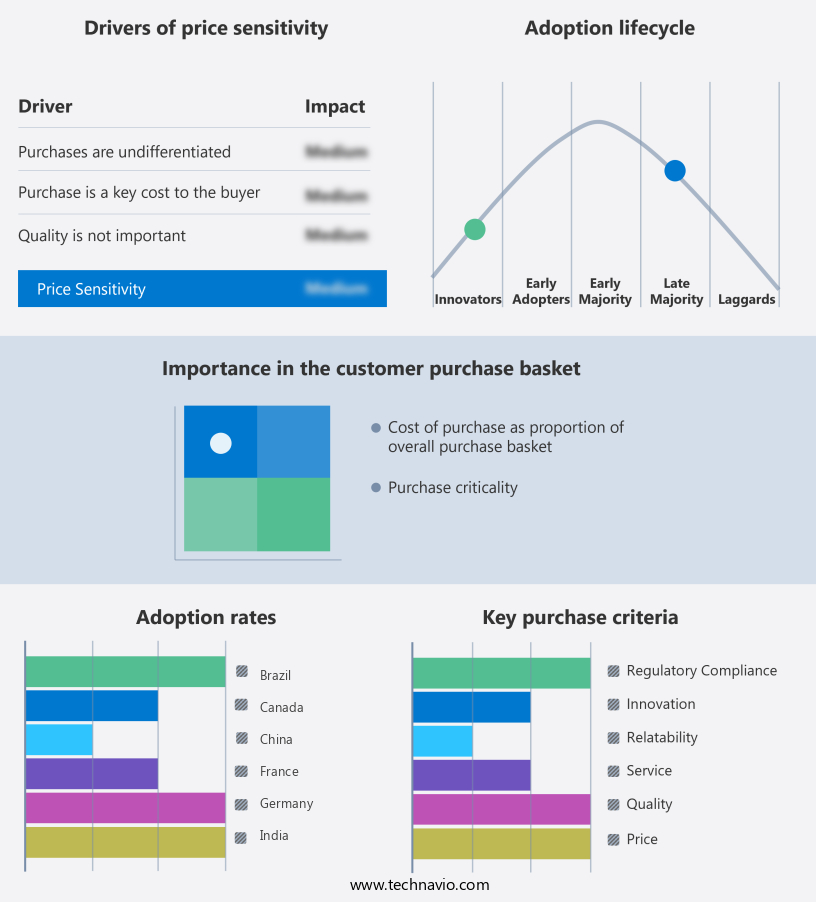
Customer Landscape of Luxury Vehicle Industry
Competitive Landscape
Companies are implementing various strategies, such as strategic alliances, luxury vehicle market forecast, partnerships, mergers and acquisitions, geographical expansion, and product/service launches, to enhance their presence in the industry.
Aston Martin Lagonda ltd - The Aston Martin and Lagonda brands represent the company's luxury vehicle offerings, renowned for their sophistication and high performance. These brands cater to discerning consumers seeking premium automotive experiences.
The industry research and growth report includes detailed analyses of the competitive landscape of the market and information about key companies, including:
- Aston Martin Lagonda ltd
- Bayerische Motoren Werke AG
- BYD Co. Ltd.
- China FAW Group Co. Ltd.
- Dongfeng Motor Corporation Ltd
- Ferrari NV
- General Motors Co.
- Honda Motor Co. Ltd.
- Hyundai Motor Co.
- Lucid Group Inc.
- McLaren Group Ltd.
- Mercedes Benz Group AG
- Nissan Motor Co. Ltd.
- Rivian Automotive LLC
- SAIC Motor Corp. Ltd.
- Tata Motors Ltd.
- Tesla Inc.
- Toyota Motor Corp.
- Volkswagen AG
- Volvo Car Corp.
Qualitative and quantitative analysis of companies has been conducted to help clients understand the wider business environment as well as the strengths and weaknesses of key industry players. Data is qualitatively analyzed to categorize companies as pure play, category-focused, industry-focused, and diversified; it is quantitatively analyzed to categorize companies as dominant, leading, strong, tentative, and weak.
Recent Development and News in Luxury Vehicle Market
- In August 2024, Mercedes-Benz, a leading luxury vehicle manufacturer, unveiled its newest electric SUV, the EQB, at the Pebble Beach Concours d'Elegance (Mercedes-Benz press release, August 2024). This model marks the brand's commitment to expanding its electric vehicle lineup and catering to the growing demand for sustainable luxury vehicles.
- In November 2024, BMW and Intel announced a strategic partnership to develop an autonomous driving platform for luxury vehicles (Intel press release, November 2024). This collaboration combines BMW's expertise in automotive manufacturing and Intel's strengths in technology, aiming to bring self-driving luxury cars to market faster.
- In March 2025, Tesla, the pioneer of electric vehicles, secured a significant investment of USD2 billion from a consortium of Japanese automakers, including Toyota and Daihatsu (Reuters, March 2025). This investment strengthens Tesla's financial position and broadens its partnership network in the Asian market.
- In May 2025, Rolls-Royce launched its first all-electric vehicle, the Spectre, at the World Premiere in London (Rolls-Royce press release, May 2025). This milestone marks the iconic luxury brand's entry into the electric vehicle market, signaling a shift towards sustainable mobility solutions for the affluent customer segment.
Dive into Technavio's robust research methodology, blending expert interviews, extensive data synthesis, and validated models for unparalleled Luxury Vehicle Market insights. See full methodology.
|
Market Scope |
|
|
Report Coverage |
Details |
|
Page number |
226 |
|
Base year |
2024 |
|
Historic period |
2019-2023 |
|
Forecast period |
2025-2029 |
|
Growth momentum & CAGR |
Accelerate at a CAGR of 6.7% |
|
Market growth 2025-2029 |
USD 217 billion |
|
Market structure |
Fragmented |
|
YoY growth 2024-2025(%) |
6.3 |
|
Key countries |
US, China, Germany, UK, Japan, Canada, France, India, South Korea, and Brazil |
|
Competitive landscape |
Leading Companies, Market Positioning of Companies, Competitive Strategies, and Industry Risks |
Research Analyst Overview
- The market continues to evolve, with innovation and technological advancements shaping its landscape. Precision engineering components, such as those found in lane keeping assist systems, climate control systems, and automated parking systems, are becoming standard features in high-end vehicles. These technologies enhance the driving experience and provide greater comfort and convenience for passengers. Moreover, driver monitoring systems and vehicle dynamics control systems are gaining traction, ensuring a safer and more enjoyable ride. Passive safety systems, including seat comfort technology and high-performance engines, continue to prioritize the well-being of occupants. Noise reduction techniques and luxury vehicle customization are also essential aspects of the market, with premium sound systems and infotainment system integration playing significant roles.
- Hybrid powertrains and premium materials sourcing are becoming increasingly popular, as consumers demand eco-friendly and sustainable options. The market is expected to grow by 5% annually, with advanced safety features, such as collision avoidance systems, head-up displays, and adaptive cruise control, driving this growth. Over-the-air updates, handcrafted interiors, and vehicle connectivity solutions further add value to the luxury vehicle experience. For instance, a leading luxury vehicle manufacturer reported a 15% increase in sales due to the integration of advanced driver-assistance systems and ergonomic design principles in their latest models. The continuous integration of cutting-edge technologies and exclusive design features ensures that the market remains a dynamic and evolving sector.
What are the Key Data Covered in this Luxury Vehicle Market Research and Growth Report?
-
What is the expected growth of the Luxury Vehicle Market between 2025 and 2029?
-
USD 217 billion, at a CAGR of 6.7%
-
-
What segmentation does the market report cover?
-
The report is segmented by Type (ICE, Electric, and Hybrid), Vehicle Type (Passenger cars and Commercial vehicles), Variant (Non-autonomous and Autonomous), and Geography (Europe, APAC, North America, Middle East and Africa, and South America)
-
-
Which regions are analyzed in the report?
-
Europe, APAC, North America, Middle East and Africa, and South America
-
-
What are the key growth drivers and market challenges?
-
Rising affluence and expanding high-net-worth demographics, Regulatory pressures and emission standards
-
-
Who are the major players in the Luxury Vehicle Market?
-
Aston Martin Lagonda ltd, Bayerische Motoren Werke AG, BYD Co. Ltd., China FAW Group Co. Ltd., Dongfeng Motor Corporation Ltd, Ferrari NV, General Motors Co., Honda Motor Co. Ltd., Hyundai Motor Co., Lucid Group Inc., McLaren Group Ltd., Mercedes Benz Group AG, Nissan Motor Co. Ltd., Rivian Automotive LLC, SAIC Motor Corp. Ltd., Tata Motors Ltd., Tesla Inc., Toyota Motor Corp., Volkswagen AG, and Volvo Car Corp.
-
Market Research Insights
- The market is a dynamic and ever-evolving industry that prioritizes innovation and excellence. Two key areas of focus are emission control systems and quality control standards. Emission control systems have seen significant advancements, with many manufacturers achieving up to 95% reduction in harmful emissions. This not only meets stringent regulations but also appeals to environmentally-conscious consumers. Moreover, the luxury vehicle industry anticipates a growth of approximately 5% annually over the next decade, driven by consumer demand for advanced technology and personalized experiences.
- For instance, a leading manufacturer reported a 15% increase in sales of electric and hybrid vehicles last year, reflecting the market's shift towards sustainable and high-performance offerings.
We can help! Our analysts can customize this luxury vehicle market research report to meet your requirements.
 RIA -
RIA -