

Language Translation Software Market Analysis, Size, and Forecast 2026-2030: North America (US, Canada, and Mexico), Europe (Germany, UK, and France), APAC (China, Japan, and India), South America (Brazil, Argentina, and Colombia), Middle East and Africa (UAE, Saudi Arabia, and South Africa), and Rest of World (ROW)

Language Translation Software Market Analysis, Size, and Forecast 2026-2030:
North America (US, Canada, and Mexico), Europe (Germany, UK, and France), APAC (China, Japan, and India), South America (Brazil, Argentina, and Colombia), Middle East and Africa (UAE, Saudi Arabia, and South Africa), and Rest of World (ROW)

Published: Jan 2026 288 Pages SKU: IRTNTR72109

Market Overview at a Glance

$13.02 B
Market Opportunity
16.3%
CAGR 2025 - 2030
30%
Europe Growth
$4.97 B
Rule-based machine translation segment 2024

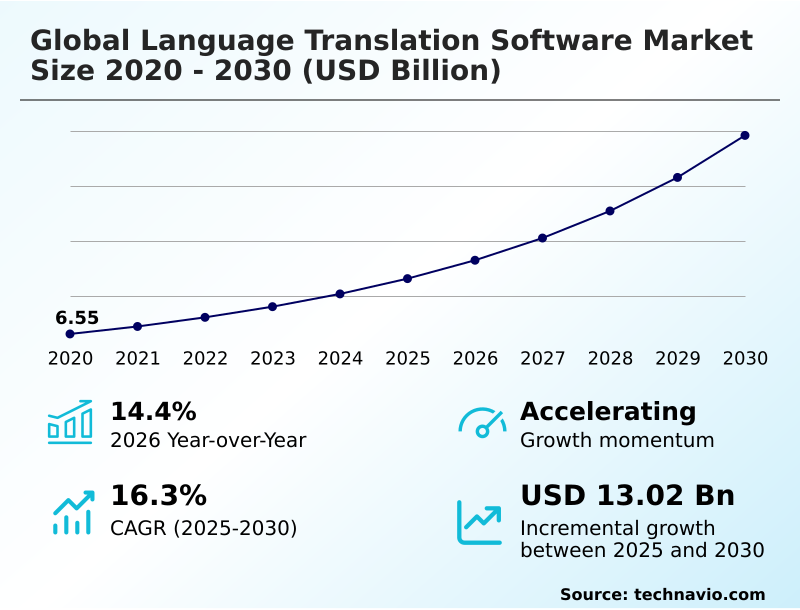
Language Translation Software Market Size 2026-2030

The language translation software market size is valued to increase by USD 13.02 billion, at a CAGR of 16.3% from 2025 to 2030. Accelerating globalization and expansion of cross border e-commerce will drive the language translation software market.

Major Market Trends & Insights

  • Europe dominated the market and accounted for a 30% growth during the forecast period.
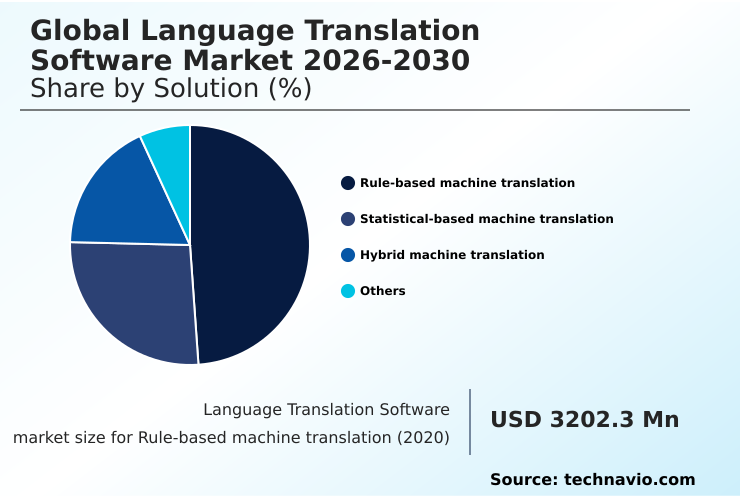
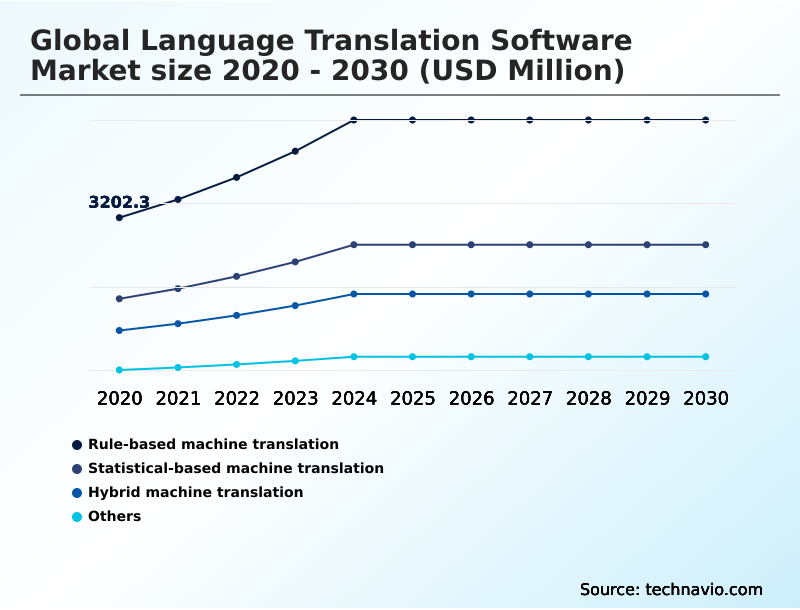
  • By Solution - Rule-based machine translation segment was valued at USD 4.97 billion in 2024
  • By Technology - Neural machine translation segment accounted for the largest market revenue share in 2024

Market Size & Forecast

  • Market Opportunities: USD 18.05 billion
  • Market Future Opportunities: USD 13.02 billion
  • CAGR from 2025 to 2030 : 16.3%

Market Summary

  • The language translation software market is undergoing a significant transformation, driven by advancements in artificial intelligence and the increasing demands of a globalized economy. At the core of this evolution is neural machine translation (NMT), a technology powered by sophisticated deep learning models that deliver highly fluent and contextually aware translations.
  • A key trend shaping the industry is the move toward hyper-personalized output, where adaptive machine translation systems utilize a human-in-the-loop workflow to continuously learn and improve from user corrections. This capability is crucial for achieving domain-specific tuning for specialized sectors.
  • For instance, a global pharmaceutical firm can deploy a fine-tuned NMT model with a secure, private cloud deployment to translate clinical trial data, ensuring both high accuracy in technical terminology and strict data privacy. This focus on customization and security addresses the persistent challenge of maintaining linguistic nuance and brand voice consistency across multiple languages.
  • The seamless integration of these tools into existing enterprise architectures via robust API integration frameworks is enabling companies to automate localization and enhance international communication, making translation an integral part of their digital operations.

What will be the Size of the Language Translation Software Market during the forecast period?
Get Key Insights on Market Forecast (PDF) Request Free Sample

How is the Language Translation Software Market Segmented?

The language translation software industry research report provides comprehensive data (region-wise segment analysis), with forecasts and estimates in "USD million" for the period 2026-2030, as well as historical data from 2020-2024 for the following segments.

  • Solution
    • Rule-based machine translation
    • Statistical-based machine translation
    • Hybrid machine translation
    • Others
  • Technology
    • Neural machine translation
    • Statistical machine translation
    • Human translation
  • End-user
    • Large enterprises
    • SMEs
  • Geography
    • North America
      • US
      • Canada
      • Mexico
    • Europe
      • Germany
      • UK
      • France
    • APAC
      • China
      • Japan
      • India
    • South America
      • Brazil
      • Argentina
      • Colombia
    • Middle East and Africa
      • UAE
      • Saudi Arabia
      • South Africa
    • Rest of World (ROW)

By Solution Insights

The rule-based machine translation segment is estimated to witness significant growth during the forecast period.

The global language translation software market 2026-2030 is significantly shaped by its segmentation, including by solution type. Rule-based machine translation (RBMT) operates on a deterministic framework, relying on extensive linguistic rules and bilingual dictionaries.

Its main advantage is predictability, making it suitable for sectors where terminological consistency is critical, such as legal documentation and technical manuals.

Through custom glossary support and a rigid structure, RBMT can ensure that specific terms are translated with unerring fidelity over 99% of the time. However, this approach struggles with linguistic nuance capture and idiomatic expressions, often producing unnatural-sounding output.

The high cost and effort required for rule creation and the difficulty in scaling to new languages have limited its application in favor of more dynamic technologies like fine-tuned NMT models.
Request Free Sample

The Rule-based machine translation segment was valued at USD 4.97 billion in 2024 and showed a gradual increase during the forecast period.
Request Free Sample

Regional Analysis

Europe is estimated to contribute 30% to the growth of the global market during the forecast period.Technavio’s analysts have elaborately explained the regional trends and drivers that shape the market during the forecast period.
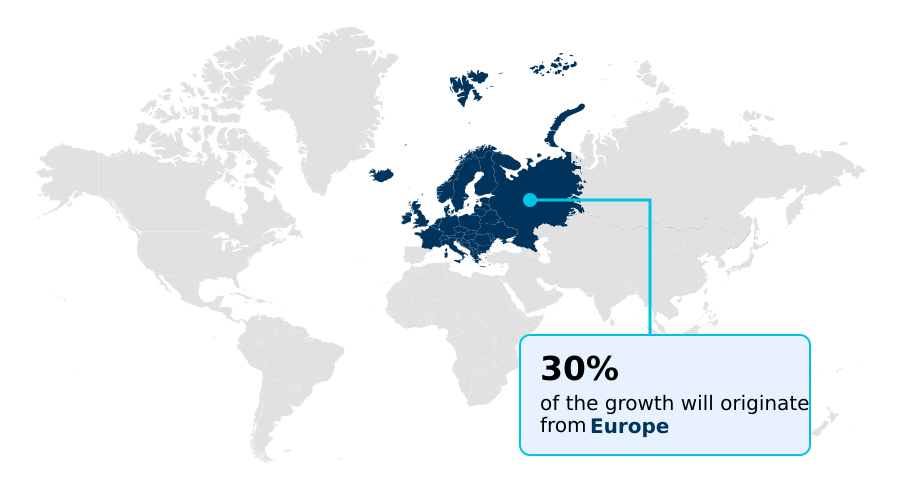
See How Language Translation Software Market Demand is Rising in Europe Request Free Sample

The market's geographic landscape is diverse, with North America leading in technological innovation, driven by stringent regulations that mandate solutions like HIPAA compliant translation.

Europe represents a significant market due to its linguistic variety, where integrated translation management has reportedly reduced localization project overhead by 30%.

Meanwhile, APAC is the fastest-growing region, fueled by booming cross-border e-commerce support, with businesses leveraging automated localization workflows seeing a 15% increase in international conversion rates.

Across all regions, the adoption of contextual AI models is enhancing the quality of multimedia content localization and enabling effective international marketing localization.

The demand for secure on-premises translation solutions is also a global trend, particularly in sensitive sectors like finance and healthcare.

Market Dynamics

Our researchers analyzed the data with 2025 as the base year, along with the key drivers, trends, and challenges. A holistic analysis of drivers will help companies refine their marketing strategies to gain a competitive advantage.

  • Enterprises are strategically evolving their approach to translation, moving beyond basic applications to focus on improving translation quality with LLMs. This shift highlights the benefits of adaptive machine translation for complex tasks, particularly in automating software localization workflows and managing terminology consistency across languages.
  • A critical consideration in this landscape is security, which drives the evaluation of secure on-premises translation solutions and private cloud NMT deployment models. For developers, integrating translation APIs into CMS and ensuring robust multilingual support for CRM platforms are key priorities. Despite progress, challenges in AI dubbing accuracy and real-time speech translation latency remain for multimedia applications.
  • Businesses must also weigh the cost of human-in-the-loop post-editing against the risks associated with the challenges of translating idiomatic expressions. While comparing SMT vs NMT performance is now largely a settled matter, the focus has sharpened on using NMT for domain-specific terminology.
  • For example, using translation software for legal e-discovery can accelerate case review at more than double the speed of manual processes. This is especially vital where enterprise translation data security and HIPAA compliance in healthcare translation are non-negotiable.
  • The growth in localization for global e-commerce and the emergence of edge AI for on-device translation further underscore the industry's complexity, making the task of measuring translation fluency and adequacy a critical and continuous effort.
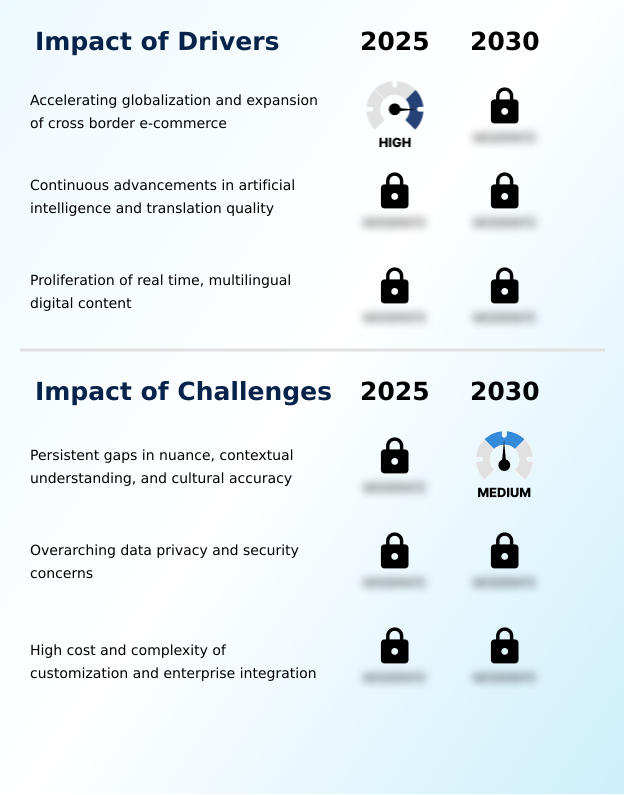
What are the key market drivers leading to the rise in the adoption of Language Translation Software Industry?

  • Accelerating globalization and the expansion of cross-border e-commerce are key drivers for the market.

  • Market growth is primarily driven by globalization and technological maturation. Businesses are increasingly adopting solutions for cross-border e-commerce support and global supply chain communication, with those using real-time communication tools reporting a 20% improvement in international project collaboration.
  • A key technical driver is the advancement of neural machine translation, particularly the use of large language models based on the transformer architecture.
  • This has made high-quality regulatory compliance translation and legal document translation more accessible, reducing reliance on manual processes by over 50% in certain use cases.
  • The need for global brand voice consistency is also fueling demand for effective content management system integration, leveraging deep learning models to improve contextual understanding engine performance.

What are the market trends shaping the Language Translation Software Industry?

  • The market is witnessing a significant shift toward hyper-personalization and adaptive machine translation. This trend focuses on creating dynamic models that learn from user feedback for enhanced accuracy.

  • Key market trends are centered on enhancing translation intelligence and user control. The move toward a hyper-personalized output is a dominant theme, with fine-tuned NMT models delivering a 25% reduction in post-editing efforts compared to generic engines.
  • Another significant development is the rise of the multimodal translation platform, which integrates text, voice, and image translation, increasing engagement with multimedia content localization by up to 40% in international markets. Driven by concerns over enterprise data privacy, the adoption of on-device translation is growing.
  • These adaptive machine translation systems, often part of an automated localization workflow, offer instant translation without sending data to the cloud, a process refined by a human-in-the-loop workflow and robust terminology management.

What challenges does the Language Translation Software Industry face during its growth?

  • Persistent gaps in nuance, contextual understanding, and cultural accuracy represent a key challenge affecting industry growth.

  • Significant challenges persist despite technological advancements. Achieving perfect linguistic nuance capture and cultural accuracy validation remains a primary hurdle, with automated systems still producing contextually inappropriate translations in up to 15% of marketing content, necessitating costly transcreation services.
  • Data privacy is another major concern, as secure translation gateway and private cloud deployment options can increase the total cost of ownership by 30% or more. Integrating legacy translation memory systems with modern API integration frameworks presents ongoing technical difficulties.
  • Furthermore, the complexity of domain-specific tuning for specialized fields such as clinical trial documentation limits adoption for smaller organizations still using older rule-based machine translation or statistical machine translation.

Exclusive Technavio Analysis on Customer Landscape

The language translation software market forecasting report includes the adoption lifecycle of the market, covering from the innovator’s stage to the laggard’s stage. It focuses on adoption rates in different regions based on penetration. Furthermore, the language translation software market report also includes key purchase criteria and drivers of price sensitivity to help companies evaluate and develop their market growth analysis strategies.
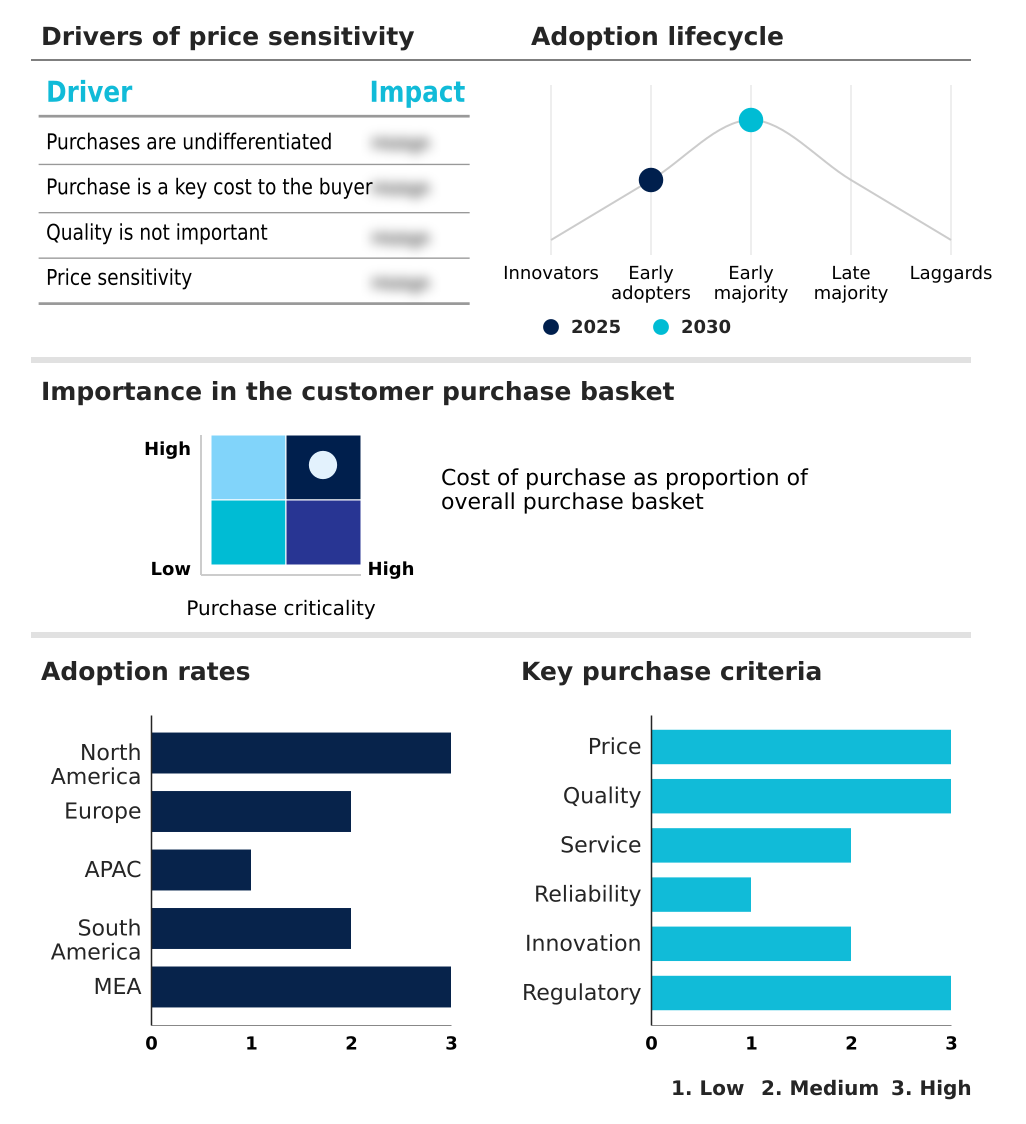
Customer Landscape of Language Translation Software Industry

Competitive Landscape

Companies are implementing various strategies, such as strategic alliances, language translation software market forecast, partnerships, mergers and acquisitions, geographical expansion, and product/service launches, to enhance their presence in the industry.

Acolad Group - The company specializes in AI-driven language technologies, delivering real-time multilingual transcription and automatic speech recognition solutions for various enterprise communication needs.

The industry research and growth report includes detailed analyses of the competitive landscape of the market and information about key companies, including:

  • Acolad Group
  • AppTek
  • Babylon Software Ltd.
  • Google LLC
  • IBM Corp.
  • Keywords Studios Plc
  • Language Line Solutions
  • LILT Inc.
  • Lingotek Inc.
  • Lionbridge Technologies LLC
  • MateCat
  • Microsoft Corp.
  • RR Donnelley and Sons Co.
  • RWS Holdings PLC
  • Smartling Inc.
  • SYSTRAN SA
  • thebigword.
  • Transifex
  • TransPerfect Global Inc.
  • Welocalize Inc.

Qualitative and quantitative analysis of companies has been conducted to help clients understand the wider business environment as well as the strengths and weaknesses of key industry players. Data is qualitatively analyzed to categorize companies as pure play, category-focused, industry-focused, and diversified; it is quantitatively analyzed to categorize companies as dominant, leading, strong, tentative, and weak.

Recent Development and News in Language translation software market

  • In February 2025, Citigroup announced the successful company-wide deployment of a proprietary, secure NMT platform, developed to operate within its private cloud infrastructure for translating sensitive financial and legal documents.
  • In March 2025, Cerner Corporation launched its Cerner Language Access module, integrating a HIPAA-compliant, on-premises neural machine translation engine into its electronic health record (EHR) system to facilitate secure provider-patient communication.
  • In March 2025, Airbus announced a significant update to its proprietary rule-based machine translation platform, enhancing its engine to handle new terminologies related to sustainable aviation fuels and advanced composite materials.
  • In April 2025, Zoom enhanced its live translation feature by incorporating a next-generation, low-latency NMT model capable of providing simultaneous speech-to-speech translation in over 50 languages, with support for custom glossaries.

Dive into Technavio’s robust research methodology, blending expert interviews, extensive data synthesis, and validated models for unparalleled Language Translation Software Market insights. See full methodology.

Market Scope
Page number 288
Base year 2025
Historic period 2020-2024
Forecast period 2026-2030
Growth momentum & CAGR Accelerate at a CAGR of 16.3%
Market growth 2026-2030 USD 13017.8 million
Market structure Fragmented
YoY growth 2025-2026(%) 14.4%
Key countries US, Canada, Mexico, Germany, UK, France, Italy, Spain, The Netherlands, China, Japan, India, South Korea, Australia, Indonesia, Brazil, Argentina, Colombia, UAE, Saudi Arabia, South Africa, Egypt and Turkey
Competitive landscape Leading Companies, Market Positioning of Companies, Competitive Strategies, and Industry Risks

Request Free Sample

Research Analyst Overview

  • The language translation software market's evolution is propelled by the widespread adoption of neural machine translation, which is built upon advanced transformer architecture. This technology is the foundation for a wide range of applications, from multilingual transcription to sophisticated AI dubbing technology.
  • A pivotal trend influencing boardroom decisions is the strategic shift from generic tools to highly specialized platforms offering domain-specific tuning and adaptive machine translation. This investment yields significant returns; for example, organizations using a human-in-the-loop workflow for compliance documentation have reported a reduction in revision cycles by over 20%.
  • While large language models are expanding capabilities, the choice between statistical machine translation, rule-based machine translation, and hybrid machine translation remains use-case-dependent. Core platform components now include robust terminology management and translation memory systems. Furthermore, deployment models such as private cloud deployment and on-device translation engines are gaining traction due to security demands.
  • Seamless API integration framework is essential for achieving full localization automation and delivering effective transcreation services, supported by innovations like speech-to-speech translation, contextual AI models, and neural post-editing with custom glossary support. The development of edge computing translation represents the next frontier in this dynamic field.

What are the Key Data Covered in this Language Translation Software Market Research and Growth Report?

  • What is the expected growth of the Language Translation Software Market between 2026 and 2030?

    • USD 13.02 billion, at a CAGR of 16.3%

  • What segmentation does the market report cover?

    • The report is segmented by Solution (Rule-based machine translation, Statistical-based machine translation, Hybrid machine translation, and Others), Technology (Neural machine translation, Statistical machine translation, and Human translation), End-user (Large enterprises, and SMEs) and Geography (North America, Europe, APAC, South America, Middle East and Africa)

  • Which regions are analyzed in the report?

    • North America, Europe, APAC, South America and Middle East and Africa

  • What are the key growth drivers and market challenges?

    • Accelerating globalization and expansion of cross border e-commerce, Persistent gaps in nuance, contextual understanding, and cultural accuracy

  • Who are the major players in the Language Translation Software Market?

    • Acolad Group, AppTek, Babylon Software Ltd., Google LLC, IBM Corp., Keywords Studios Plc, Language Line Solutions, LILT Inc., Lingotek Inc., Lionbridge Technologies LLC, MateCat, Microsoft Corp., RR Donnelley and Sons Co., RWS Holdings PLC, Smartling Inc., SYSTRAN SA, thebigword., Transifex, TransPerfect Global Inc. and Welocalize Inc.

Market Research Insights

  • Market dynamics are increasingly shaped by the need for efficiency and security. Enterprise adoption of automated localization workflow tools has reduced time-to-market for global product launches by up to 40%. Concurrently, integrating multilingual customer support solutions has been shown to improve satisfaction scores in new markets by over 25%.
  • A focus on enterprise data privacy is paramount, with platforms offering secure translation gateway features seeing a twofold higher adoption rate in regulated industries. The need for brand voice consistency and cultural accuracy validation drives investment in specialized platforms that support real-time communication tools, becoming standard for effective internal and external collaboration.

We can help! Our analysts can customize this language translation software market research report to meet your requirements.

Get in touch

1. Executive Summary

1.1 Market overview

Executive Summary - Chart on Market Overview
Executive Summary - Data Table on Market Overview
Executive Summary - Chart on Global Market Characteristics
Executive Summary - Chart on Market by Geography
Executive Summary - Chart on Market Segmentation by Solution
Executive Summary - Chart on Market Segmentation by Technology
Executive Summary - Chart on Market Segmentation by End-user
Executive Summary - Chart on Incremental Growth
Executive Summary - Data Table on Incremental Growth
Executive Summary - Chart on Company Market Positioning

2. Technavio Analysis

2.1 Analysis of price sensitivity, lifecycle, customer purchase basket, adoption rates, and purchase criteria

2.2 Criticality of inputs and Factors of differentiation

Chart on Overview on criticality of inputs and factors of differentiation

2.3 Factors of disruption

Chart on Overview on factors of disruption

2.4 Impact of drivers and challenges

Chart on Impact of drivers and challenges in 2025 and 2030

3. Market Landscape

3.1 Market ecosystem

Chart on Parent Market
Data Table on - Parent Market

3.2 Market characteristics

Chart on Market characteristics analysis

3.3 Value chain analysis

Chart on Value chain analysis

4. Market Sizing

4.1 Market definition

Data Table on Offerings of companies included in the market definition

4.2 Market segment analysis

Market segments

4.3 Market size 2025

4.4 Market outlook: Forecast for 2025-2030

Chart on Global - Market size and forecast 2025-2030 ($ million)
Data Table on Global - Market size and forecast 2025-2030 ($ million)
Chart on Global Market: Year-over-year growth 2025-2030 (%)
Data Table on Global Market: Year-over-year growth 2025-2030 (%)

5. Historic Market Size

5.1 Global Language Translation Software Market 2020 - 2024

Historic Market Size - Data Table on Global Language Translation Software Market 2020 - 2024 ($ million)

5.2 Solution segment analysis 2020 - 2024

Historic Market Size - Solution Segment 2020 - 2024 ($ million)

5.3 Technology segment analysis 2020 - 2024

Historic Market Size - Technology Segment 2020 - 2024 ($ million)

5.4 End-user segment analysis 2020 - 2024

Historic Market Size - End-user Segment 2020 - 2024 ($ million)

5.5 Geography segment analysis 2020 - 2024

Historic Market Size - Geography Segment 2020 - 2024 ($ million)

5.6 Country segment analysis 2020 - 2024

Historic Market Size - Country Segment 2020 - 2024 ($ million)

6. Qualitative Analysis

6.1 The AI impact on Global Language Translation Software Market

7. Five Forces Analysis

7.1 Five forces summary

Five forces analysis - Comparison between 2025 and 2030

7.2 Bargaining power of buyers

Bargaining power of buyers - Impact of key factors 2025 and 2030

7.3 Bargaining power of suppliers

Bargaining power of suppliers - Impact of key factors in 2025 and 2030

7.4 Threat of new entrants

Threat of new entrants - Impact of key factors in 2025 and 2030

7.5 Threat of substitutes

Threat of substitutes - Impact of key factors in 2025 and 2030

7.6 Threat of rivalry

Threat of rivalry - Impact of key factors in 2025 and 2030

7.7 Market condition

Chart on Market condition - Five forces 2025 and 2030

8. Market Segmentation by Solution

8.1 Market segments

Chart on Solution - Market share 2025-2030 (%)
Data Table on Solution - Market share 2025-2030 (%)

8.2 Comparison by Solution

Chart on Comparison by Solution
Data Table on Comparison by Solution

8.3 Rule-based machine translation - Market size and forecast 2025-2030

Chart on Rule-based machine translation - Market size and forecast 2025-2030 ($ million)
Data Table on Rule-based machine translation - Market size and forecast 2025-2030 ($ million)
Chart on Rule-based machine translation - Year-over-year growth 2025-2030 (%)
Data Table on Rule-based machine translation - Year-over-year growth 2025-2030 (%)

8.4 Statistical-based machine translation - Market size and forecast 2025-2030

Chart on Statistical-based machine translation - Market size and forecast 2025-2030 ($ million)
Data Table on Statistical-based machine translation - Market size and forecast 2025-2030 ($ million)
Chart on Statistical-based machine translation - Year-over-year growth 2025-2030 (%)
Data Table on Statistical-based machine translation - Year-over-year growth 2025-2030 (%)

8.5 Hybrid machine translation - Market size and forecast 2025-2030

Chart on Hybrid machine translation - Market size and forecast 2025-2030 ($ million)
Data Table on Hybrid machine translation - Market size and forecast 2025-2030 ($ million)
Chart on Hybrid machine translation - Year-over-year growth 2025-2030 (%)
Data Table on Hybrid machine translation - Year-over-year growth 2025-2030 (%)

8.6 Others - Market size and forecast 2025-2030

Chart on Others - Market size and forecast 2025-2030 ($ million)
Data Table on Others - Market size and forecast 2025-2030 ($ million)
Chart on Others - Year-over-year growth 2025-2030 (%)
Data Table on Others - Year-over-year growth 2025-2030 (%)

8.7 Market opportunity by Solution

Market opportunity by Solution ($ million)
Data Table on Market opportunity by Solution ($ million)

9. Market Segmentation by Technology

9.1 Market segments

Chart on Technology - Market share 2025-2030 (%)
Data Table on Technology - Market share 2025-2030 (%)

9.2 Comparison by Technology

Chart on Comparison by Technology
Data Table on Comparison by Technology

9.3 Neural machine translation - Market size and forecast 2025-2030

Chart on Neural machine translation - Market size and forecast 2025-2030 ($ million)
Data Table on Neural machine translation - Market size and forecast 2025-2030 ($ million)
Chart on Neural machine translation - Year-over-year growth 2025-2030 (%)
Data Table on Neural machine translation - Year-over-year growth 2025-2030 (%)

9.4 Statistical machine translation - Market size and forecast 2025-2030

Chart on Statistical machine translation - Market size and forecast 2025-2030 ($ million)
Data Table on Statistical machine translation - Market size and forecast 2025-2030 ($ million)
Chart on Statistical machine translation - Year-over-year growth 2025-2030 (%)
Data Table on Statistical machine translation - Year-over-year growth 2025-2030 (%)

9.5 Human translation - Market size and forecast 2025-2030

Chart on Human translation - Market size and forecast 2025-2030 ($ million)
Data Table on Human translation - Market size and forecast 2025-2030 ($ million)
Chart on Human translation - Year-over-year growth 2025-2030 (%)
Data Table on Human translation - Year-over-year growth 2025-2030 (%)

9.6 Market opportunity by Technology

Market opportunity by Technology ($ million)
Data Table on Market opportunity by Technology ($ million)

10. Market Segmentation by End-user

10.1 Market segments

Chart on End-user - Market share 2025-2030 (%)
Data Table on End-user - Market share 2025-2030 (%)

10.2 Comparison by End-user

Chart on Comparison by End-user
Data Table on Comparison by End-user

10.3 Large enterprises - Market size and forecast 2025-2030

Chart on Large enterprises - Market size and forecast 2025-2030 ($ million)
Data Table on Large enterprises - Market size and forecast 2025-2030 ($ million)
Chart on Large enterprises - Year-over-year growth 2025-2030 (%)
Data Table on Large enterprises - Year-over-year growth 2025-2030 (%)

10.4 SMEs - Market size and forecast 2025-2030

Chart on SMEs - Market size and forecast 2025-2030 ($ million)
Data Table on SMEs - Market size and forecast 2025-2030 ($ million)
Chart on SMEs - Year-over-year growth 2025-2030 (%)
Data Table on SMEs - Year-over-year growth 2025-2030 (%)

10.5 Market opportunity by End-user

Market opportunity by End-user ($ million)
Data Table on Market opportunity by End-user ($ million)

11. Customer Landscape

11.1 Customer landscape overview

Analysis of price sensitivity, lifecycle, customer purchase basket, adoption rates, and purchase criteria

12. Geographic Landscape

12.1 Geographic segmentation

Chart on Market share by geography 2025-2030 (%)
Data Table on Market share by geography 2025-2030 (%)

12.2 Geographic comparison

Chart on Geographic comparison
Data Table on Geographic comparison

12.3 North America - Market size and forecast 2025-2030

Chart on North America - Market size and forecast 2025-2030 ($ million)
Data Table on North America - Market size and forecast 2025-2030 ($ million)
Chart on North America - Year-over-year growth 2025-2030 (%)
Data Table on North America - Year-over-year growth 2025-2030 (%)
Chart on Regional Comparison - North America
Data Table on Regional Comparison - North America

12.3.1 US - Market size and forecast 2025-2030

Chart on US - Market size and forecast 2025-2030 ($ million)
Data Table on US - Market size and forecast 2025-2030 ($ million)
Chart on US - Year-over-year growth 2025-2030 (%)
Data Table on US - Year-over-year growth 2025-2030 (%)

12.3.2 Canada - Market size and forecast 2025-2030

Chart on Canada - Market size and forecast 2025-2030 ($ million)
Data Table on Canada - Market size and forecast 2025-2030 ($ million)
Chart on Canada - Year-over-year growth 2025-2030 (%)
Data Table on Canada - Year-over-year growth 2025-2030 (%)

12.3.3 Mexico - Market size and forecast 2025-2030

Chart on Mexico - Market size and forecast 2025-2030 ($ million)
Data Table on Mexico - Market size and forecast 2025-2030 ($ million)
Chart on Mexico - Year-over-year growth 2025-2030 (%)
Data Table on Mexico - Year-over-year growth 2025-2030 (%)

12.4 Europe - Market size and forecast 2025-2030

Chart on Europe - Market size and forecast 2025-2030 ($ million)
Data Table on Europe - Market size and forecast 2025-2030 ($ million)
Chart on Europe - Year-over-year growth 2025-2030 (%)
Data Table on Europe - Year-over-year growth 2025-2030 (%)
Chart on Regional Comparison - Europe
Data Table on Regional Comparison - Europe

12.4.1 Germany - Market size and forecast 2025-2030

Chart on Germany - Market size and forecast 2025-2030 ($ million)
Data Table on Germany - Market size and forecast 2025-2030 ($ million)
Chart on Germany - Year-over-year growth 2025-2030 (%)
Data Table on Germany - Year-over-year growth 2025-2030 (%)

12.4.2 UK - Market size and forecast 2025-2030

Chart on UK - Market size and forecast 2025-2030 ($ million)
Data Table on UK - Market size and forecast 2025-2030 ($ million)
Chart on UK - Year-over-year growth 2025-2030 (%)
Data Table on UK - Year-over-year growth 2025-2030 (%)

12.4.3 France - Market size and forecast 2025-2030

Chart on France - Market size and forecast 2025-2030 ($ million)
Data Table on France - Market size and forecast 2025-2030 ($ million)
Chart on France - Year-over-year growth 2025-2030 (%)
Data Table on France - Year-over-year growth 2025-2030 (%)

12.4.4 Italy - Market size and forecast 2025-2030

Chart on Italy - Market size and forecast 2025-2030 ($ million)
Data Table on Italy - Market size and forecast 2025-2030 ($ million)
Chart on Italy - Year-over-year growth 2025-2030 (%)
Data Table on Italy - Year-over-year growth 2025-2030 (%)

12.4.5 Spain - Market size and forecast 2025-2030

Chart on Spain - Market size and forecast 2025-2030 ($ million)
Data Table on Spain - Market size and forecast 2025-2030 ($ million)
Chart on Spain - Year-over-year growth 2025-2030 (%)
Data Table on Spain - Year-over-year growth 2025-2030 (%)

12.4.6 The Netherlands - Market size and forecast 2025-2030

Chart on The Netherlands - Market size and forecast 2025-2030 ($ million)
Data Table on The Netherlands - Market size and forecast 2025-2030 ($ million)
Chart on The Netherlands - Year-over-year growth 2025-2030 (%)
Data Table on The Netherlands - Year-over-year growth 2025-2030 (%)

12.5 APAC - Market size and forecast 2025-2030

Chart on APAC - Market size and forecast 2025-2030 ($ million)
Data Table on APAC - Market size and forecast 2025-2030 ($ million)
Chart on APAC - Year-over-year growth 2025-2030 (%)
Data Table on APAC - Year-over-year growth 2025-2030 (%)
Chart on Regional Comparison - APAC
Data Table on Regional Comparison - APAC

12.5.1 China - Market size and forecast 2025-2030

Chart on China - Market size and forecast 2025-2030 ($ million)
Data Table on China - Market size and forecast 2025-2030 ($ million)
Chart on China - Year-over-year growth 2025-2030 (%)
Data Table on China - Year-over-year growth 2025-2030 (%)

12.5.2 Japan - Market size and forecast 2025-2030

Chart on Japan - Market size and forecast 2025-2030 ($ million)
Data Table on Japan - Market size and forecast 2025-2030 ($ million)
Chart on Japan - Year-over-year growth 2025-2030 (%)
Data Table on Japan - Year-over-year growth 2025-2030 (%)

12.5.3 India - Market size and forecast 2025-2030

Chart on India - Market size and forecast 2025-2030 ($ million)
Data Table on India - Market size and forecast 2025-2030 ($ million)
Chart on India - Year-over-year growth 2025-2030 (%)
Data Table on India - Year-over-year growth 2025-2030 (%)

12.5.4 South Korea - Market size and forecast 2025-2030

Chart on South Korea - Market size and forecast 2025-2030 ($ million)
Data Table on South Korea - Market size and forecast 2025-2030 ($ million)
Chart on South Korea - Year-over-year growth 2025-2030 (%)
Data Table on South Korea - Year-over-year growth 2025-2030 (%)

12.5.5 Australia - Market size and forecast 2025-2030

Chart on Australia - Market size and forecast 2025-2030 ($ million)
Data Table on Australia - Market size and forecast 2025-2030 ($ million)
Chart on Australia - Year-over-year growth 2025-2030 (%)
Data Table on Australia - Year-over-year growth 2025-2030 (%)

12.5.6 Indonesia - Market size and forecast 2025-2030

Chart on Indonesia - Market size and forecast 2025-2030 ($ million)
Data Table on Indonesia - Market size and forecast 2025-2030 ($ million)
Chart on Indonesia - Year-over-year growth 2025-2030 (%)
Data Table on Indonesia - Year-over-year growth 2025-2030 (%)

12.6 South America - Market size and forecast 2025-2030

Chart on South America - Market size and forecast 2025-2030 ($ million)
Data Table on South America - Market size and forecast 2025-2030 ($ million)
Chart on South America - Year-over-year growth 2025-2030 (%)
Data Table on South America - Year-over-year growth 2025-2030 (%)
Chart on Regional Comparison - South America
Data Table on Regional Comparison - South America

12.6.1 Brazil - Market size and forecast 2025-2030

Chart on Brazil - Market size and forecast 2025-2030 ($ million)
Data Table on Brazil - Market size and forecast 2025-2030 ($ million)
Chart on Brazil - Year-over-year growth 2025-2030 (%)
Data Table on Brazil - Year-over-year growth 2025-2030 (%)

12.6.2 Argentina - Market size and forecast 2025-2030

Chart on Argentina - Market size and forecast 2025-2030 ($ million)
Data Table on Argentina - Market size and forecast 2025-2030 ($ million)
Chart on Argentina - Year-over-year growth 2025-2030 (%)
Data Table on Argentina - Year-over-year growth 2025-2030 (%)

12.6.3 Colombia - Market size and forecast 2025-2030

Chart on Colombia - Market size and forecast 2025-2030 ($ million)
Data Table on Colombia - Market size and forecast 2025-2030 ($ million)
Chart on Colombia - Year-over-year growth 2025-2030 (%)
Data Table on Colombia - Year-over-year growth 2025-2030 (%)

12.7 Middle East and Africa - Market size and forecast 2025-2030

Chart on Middle East and Africa - Market size and forecast 2025-2030 ($ million)
Data Table on Middle East and Africa - Market size and forecast 2025-2030 ($ million)
Chart on Middle East and Africa - Year-over-year growth 2025-2030 (%)
Data Table on Middle East and Africa - Year-over-year growth 2025-2030 (%)
Chart on Regional Comparison - Middle East and Africa
Data Table on Regional Comparison - Middle East and Africa

12.7.1 UAE - Market size and forecast 2025-2030

Chart on UAE - Market size and forecast 2025-2030 ($ million)
Data Table on UAE - Market size and forecast 2025-2030 ($ million)
Chart on UAE - Year-over-year growth 2025-2030 (%)
Data Table on UAE - Year-over-year growth 2025-2030 (%)

12.7.2 Saudi Arabia - Market size and forecast 2025-2030

Chart on Saudi Arabia - Market size and forecast 2025-2030 ($ million)
Data Table on Saudi Arabia - Market size and forecast 2025-2030 ($ million)
Chart on Saudi Arabia - Year-over-year growth 2025-2030 (%)
Data Table on Saudi Arabia - Year-over-year growth 2025-2030 (%)

12.7.3 South Africa - Market size and forecast 2025-2030

Chart on South Africa - Market size and forecast 2025-2030 ($ million)
Data Table on South Africa - Market size and forecast 2025-2030 ($ million)
Chart on South Africa - Year-over-year growth 2025-2030 (%)
Data Table on South Africa - Year-over-year growth 2025-2030 (%)

12.7.4 Egypt - Market size and forecast 2025-2030

Chart on Egypt - Market size and forecast 2025-2030 ($ million)
Data Table on Egypt - Market size and forecast 2025-2030 ($ million)
Chart on Egypt - Year-over-year growth 2025-2030 (%)
Data Table on Egypt - Year-over-year growth 2025-2030 (%)

12.7.5 Turkey - Market size and forecast 2025-2030

Chart on Turkey - Market size and forecast 2025-2030 ($ million)
Data Table on Turkey - Market size and forecast 2025-2030 ($ million)
Chart on Turkey - Year-over-year growth 2025-2030 (%)
Data Table on Turkey - Year-over-year growth 2025-2030 (%)

12.8 Market opportunity by geography

Market opportunity by geography ($ million)
Data Tables on Market opportunity by geography ($ million)

13. Drivers, Challenges, and Opportunity

13.1 Market drivers

Accelerating globalization and expansion of cross border e-commerce
Continuous advancements in artificial intelligence and translation quality
Proliferation of real time, multilingual digital content

13.2 Market challenges

Persistent gaps in nuance, contextual understanding, and cultural accuracy
Overarching data privacy and security concerns
High cost and complexity of customization and enterprise integration

13.3 Impact of drivers and challenges

Impact of drivers and challenges in 2025 and 2030

13.4 Market opportunities

Shift toward hyper-personalization and adaptive machine translation
Rise of on-device and edge translation for privacy and performance
Deep integration into enterprise automation and intelligence platforms

14. Competitive Landscape

14.1 Overview

14.2

Overview on criticality of inputs and factors of differentiation

14.3 Landscape disruption

Overview on factors of disruption

14.4 Industry risks

Impact of key risks on business

15. Competitive Analysis

15.1 Companies profiled

Companies covered

15.2 Company ranking index

15.3 Market positioning of companies

Matrix on companies position and classification

15.4 AppTek

AppTek - Overview
AppTek - Product / Service
AppTek - Key offerings
SWOT

15.5 Google LLC

Google LLC - Overview
Google LLC - Product / Service
Google LLC - Key offerings
SWOT

15.6 IBM Corp.

IBM Corp. - Overview
IBM Corp. - Business segments
IBM Corp. - Key news
IBM Corp. - Key offerings
IBM Corp. - Segment focus
SWOT

15.7 Keywords Studios Plc

Keywords Studios Plc - Overview
Keywords Studios Plc - Business segments
Keywords Studios Plc - Key offerings
Keywords Studios Plc - Segment focus
SWOT

15.8 Language Line Solutions

Language Line Solutions - Overview
Language Line Solutions - Product / Service
Language Line Solutions - Key offerings
SWOT

15.9 LILT Inc.

LILT Inc. - Overview
LILT Inc. - Product / Service
LILT Inc. - Key offerings
SWOT

15.10 Lingotek Inc.

Lingotek Inc. - Overview
Lingotek Inc. - Product / Service
Lingotek Inc. - Key offerings
SWOT

15.11 Lionbridge Technologies LLC

Lionbridge Technologies LLC - Overview
Lionbridge Technologies LLC - Product / Service
Lionbridge Technologies LLC - Key offerings
SWOT

15.12 MateCat

MateCat - Overview
MateCat - Product / Service
MateCat - Key offerings
SWOT

15.13 Microsoft Corp.

Microsoft Corp. - Overview
Microsoft Corp. - Business segments
Microsoft Corp. - Key news
Microsoft Corp. - Key offerings
Microsoft Corp. - Segment focus
SWOT

15.14 Smartling Inc.

Smartling Inc. - Overview
Smartling Inc. - Product / Service
Smartling Inc. - Key offerings
SWOT

15.15 SYSTRAN SA

SYSTRAN SA - Overview
SYSTRAN SA - Product / Service
SYSTRAN SA - Key offerings
SWOT

15.16 thebigword.

thebigword. - Overview
thebigword. - Product / Service
thebigword. - Key offerings
SWOT

15.17 Transifex

Transifex - Overview
Transifex - Product / Service
Transifex - Key offerings
SWOT

15.18 TransPerfect Global Inc.

TransPerfect Global Inc. - Overview
TransPerfect Global Inc. - Product / Service
TransPerfect Global Inc. - Key offerings
SWOT

16. Appendix

16.1 Scope of the report

Market definition
Objectives
Notes and caveats

16.2 Inclusions and exclusions checklist

Inclusions checklist
Exclusions checklist

16.3 Currency conversion rates for US$

16.4 Research methodology

16.5 Data procurement

Information sources

16.6 Data validation

16.7 Validation techniques employed for market sizing

16.8 Data synthesis

16.9 360 degree market analysis

16.10 List of abbreviations

Research Methodology

Technavio presents a detailed picture of the market by way of study, synthesis, and summation of data from multiple sources. The analysts have presented the various facets of the market with a particular focus on identifying the key industry influencers. The data thus presented is comprehensive, reliable, and the result of extensive research, both primary and secondary.

INFORMATION SOURCES

Primary sources

  • Manufacturers and suppliers
  • Channel partners
  • Industry experts
  • Strategic decision makers

Secondary sources

  • Industry journals and periodicals
  • Government data
  • Financial reports of key industry players
  • Historical data
  • Press releases

DATA ANALYSIS

Data Synthesis

  • Collation of data
  • Estimation of key figures
  • Analysis of derived insights

Data Validation

  • Triangulation with data models
  • Reference against proprietary databases
  • Corroboration with industry experts

REPORT WRITING

Qualitative

  • Market drivers
  • Market challenges
  • Market trends
  • Five forces analysis

Quantitative

  • Market size and forecast
  • Market segmentation
  • Geographical insights
  • Competitive landscape

Interested in this report?

Get your sample now to see our research methodology and insights!

Download Now

Frequently Asked Questions

Language Translation Software market growth will increase by USD 13017.8 million during 2026-2030.

The Language Translation Software market is expected to grow at a CAGR of 16.3% during 2026-2030.

Language Translation Software market is segmented by Solution (Rule-based machine translation, Statistical-based machine translation, Hybrid machine translation, Others) Technology (Neural machine translation, Statistical machine translation, Human translation) End-user (Large enterprises, SMEs)

Acolad Group, AppTek, Babylon Software Ltd., Google LLC, IBM Corp., Keywords Studios Plc, Language Line Solutions, LILT Inc., Lingotek Inc., Lionbridge Technologies LLC, MateCat, Microsoft Corp., RR Donnelley and Sons Co., RWS Holdings PLC, Smartling Inc., SYSTRAN SA, thebigword., Transifex, TransPerfect Global Inc., Welocalize Inc. are a few of the key vendors in the Language Translation Software market.

Europe will register the highest growth rate of 30% among the other regions. Therefore, the Language Translation Software market in Europe is expected to garner significant business opportunities for the vendors during the forecast period.

US, Canada, Mexico, Germany, UK, France, Italy, Spain, The Netherlands, China, Japan, India, South Korea, Australia, Indonesia, Brazil, Argentina, Colombia, UAE, Saudi Arabia, South Africa, Egypt, Turkey

  • Accelerating globalization and expansion of cross border e-commerce is the driving factor this market.

The Language Translation Software market vendors should focus on grabbing business opportunities from the Solution segment as it accounted for the largest market share in the base year.