


Ion Exchange Membranes Market Size 2026-2030
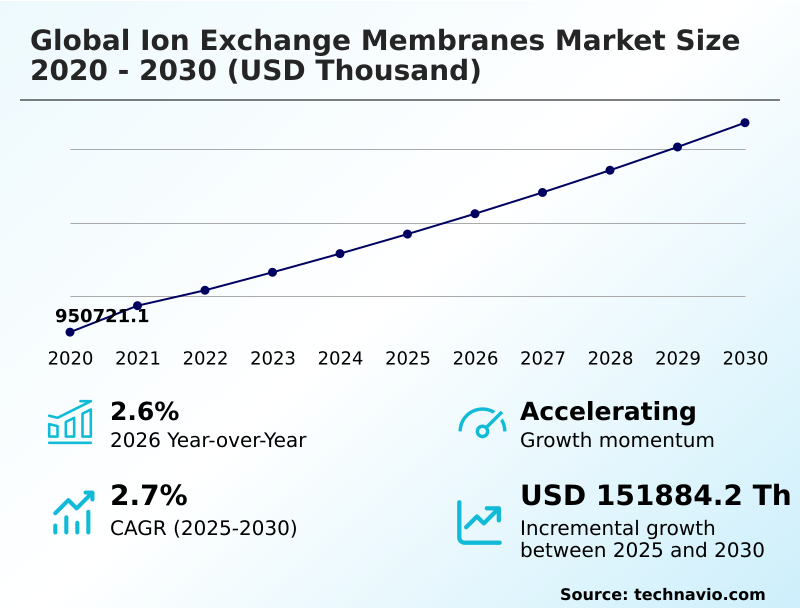
The ion exchange membranes market size is valued to increase by USD 151.88 million, at a CAGR of 2.7% from 2025 to 2030. Rising demand for water treatment and desalination will drive the ion exchange membranes market.
Major Market Trends & Insights
- APAC dominated the market and accounted for a 54.7% growth during the forecast period.
- By Material - Hydrocarbon membrane segment was valued at USD 353.43 million in 2024
- By Application - Water treatment segment accounted for the largest market revenue share in 2024
Market Size & Forecast
- Market Opportunities:
- Market Future Opportunities: USD 151.88 million
- CAGR from 2025 to 2030 : 2.7%
Market Summary
- The ion exchange membranes market is expanding, driven by the critical need for efficient separation technologies in water treatment and clean energy sectors. The demand for ultra-pure water generation in electronics and pharmaceuticals, coupled with the global push for green hydrogen production via water electrolysis, underpins market momentum. Key advancements focus on developing materials with superior ionic conductivity and permselectivity.
- Innovations in polymer matrix structures, including both hydrocarbon membrane and composite membrane designs, aim to enhance mechanical strength and chemical stability. For instance, a facility implementing advanced membranes for resource recovery from waste can improve ion selectivity by 15%, significantly increasing the purity of reclaimed materials.
- However, challenges related to fouling resistance and the high cost of materials like perfluorocarbon membrane types persist. The industry is responding with research into more durable and cost-effective ion-conducting polymers, including those with improved sulfonation techniques, to enable broader adoption in applications like redox flow battery systems and electrodialysis, ensuring long-term viability and performance.
What will be the Size of the Ion Exchange Membranes Market during the forecast period?
Get Key Insights on Market Forecast (PDF) Request Free Sample
How is the Ion Exchange Membranes Market Segmented?
The ion exchange membranes industry research report provides comprehensive data (region-wise segment analysis), with forecasts and estimates in "USD thousand" for the period 2026-2030, as well as historical data from 2020-2024 for the following segments.
- Material
- Hydrocarbon membrane
- Perfluorocarbon membrane
- Inorganic membrane
- Composite membrane
- Partially halogenated membrane
- Application
- Water treatment
- Electrolysis
- Storage batteries
- Electrodialysis
- Others
- Type
- Cation
- Anion
- Amphoteric ion
- Bipolar ion
- Mosaic ion
- Geography
- APAC
- China
- Japan
- India
- North America
- US
- Canada
- Mexico
- Europe
- Germany
- France
- UK
- Middle East and Africa
- Saudi Arabia
- UAE
- South Africa
- South America
- Brazil
- Argentina
- Rest of World (ROW)
- APAC
By Material Insights
The hydrocarbon membrane segment is estimated to witness significant growth during the forecast period.
The hydrocarbon membrane segment is expanding due to demand for cost-effective alternatives to conventional materials. Composed of polyaromatic ion-conducting polymers, these membranes offer balanced performance for water treatment and electrodialysis.
As regulatory scrutiny grows, alternatives like composite membrane and inorganic membrane structures gain traction. Innovations using techniques like cross-linking enhance their chemical stability and permselectivity.
However, long-term durability in highly alkaline environments for applications like water splitting or acid-base production remains a development focus, with some materials showing a 10% improvement in lifespan.
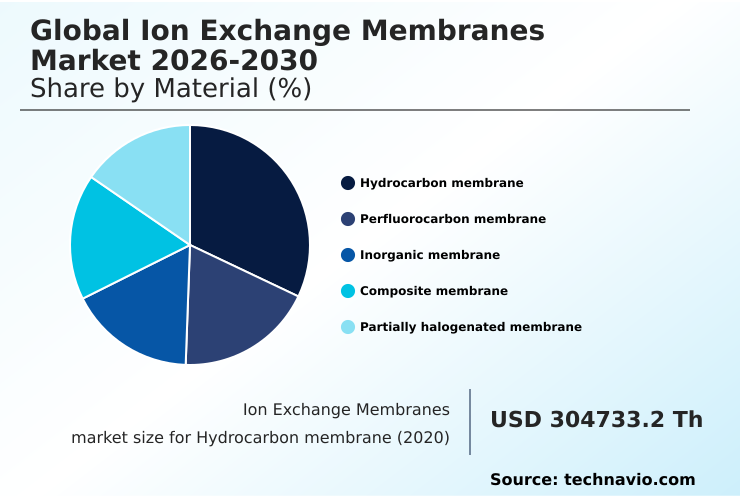
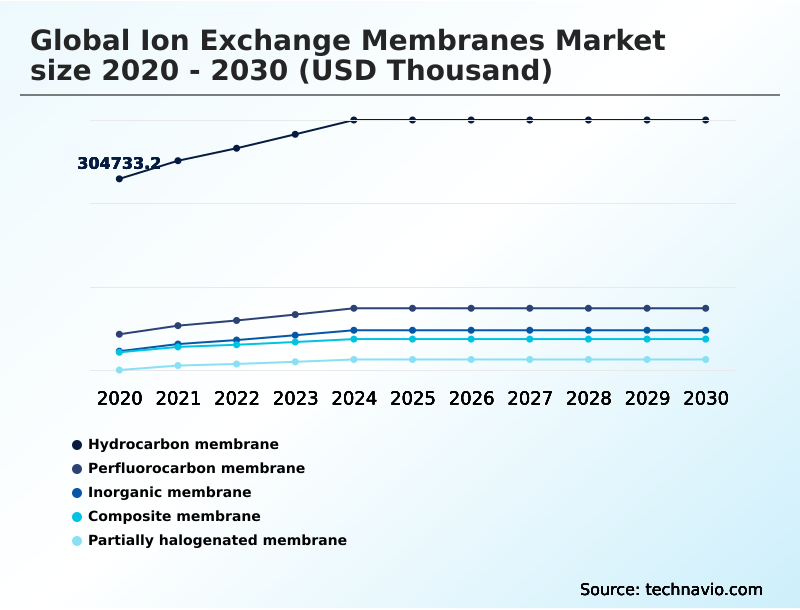
The Hydrocarbon membrane segment was valued at USD 353.43 million in 2024 and showed a gradual increase during the forecast period.
Regional Analysis
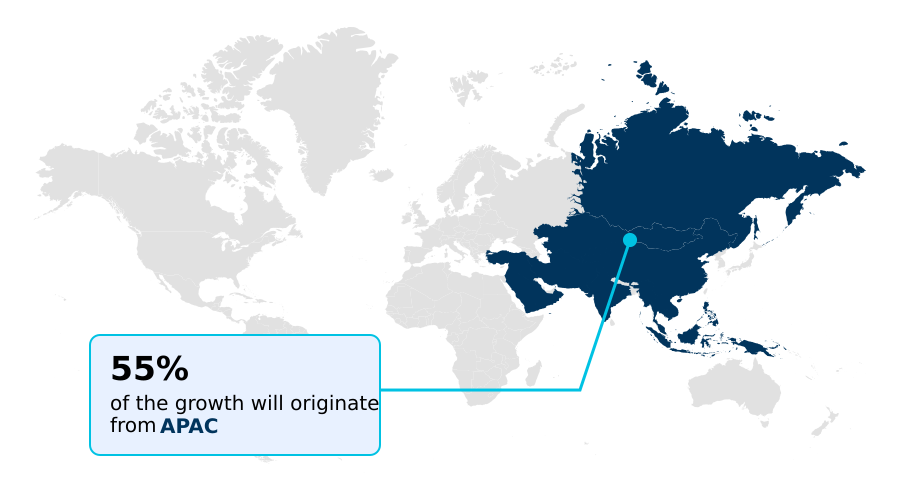
APAC is estimated to contribute 54.7% to the growth of the global market during the forecast period.Technavio’s analysts have elaborately explained the regional trends and drivers that shape the market during the forecast period.
See How Ion Exchange Membranes Market Demand is Rising in APAC Request Free Sample
APAC commands 54.7% of incremental growth, driven by industrial water treatment. The region's demand for cation exchange membrane and anion exchange membrane technologies is high, especially for the chlor-alkali process and electro-deionization. North America, at 28.78%, focuses on green energy.
Europe emphasizes materials science, improving ionic conductivity in perfluorocarbon membrane types through nanoscale phase separation. Across regions, electrodialysis is adopted for specialized applications, with advancements in monovalent selective ion exchange enabling more precise industrial separations.
Market Dynamics
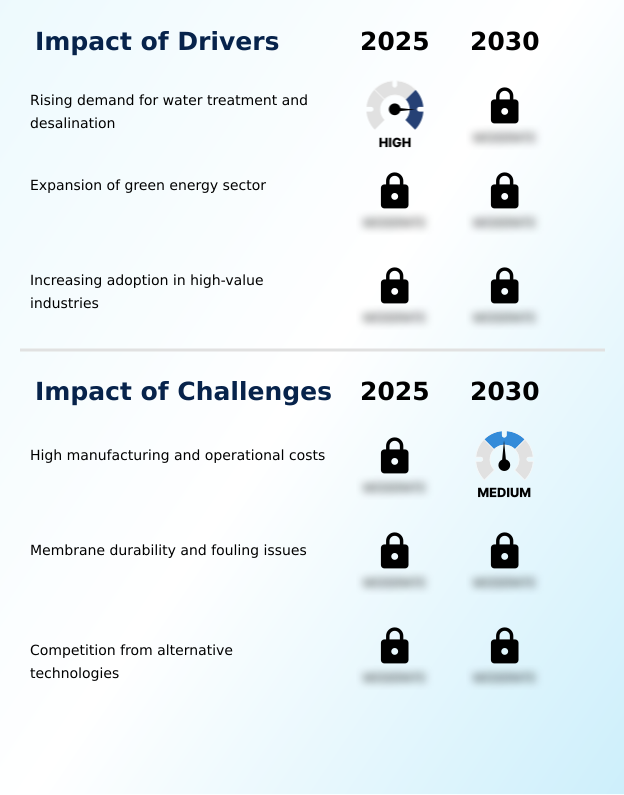
Our researchers analyzed the data with 2025 as the base year, along with the key drivers, trends, and challenges. A holistic analysis of drivers will help companies refine their marketing strategies to gain a competitive advantage.
- The strategic implementation of advanced ion exchange membranes is reshaping industrial processes by enabling highly specific and efficient separations. The use of ion exchange membranes for fuel cells, for instance, is fundamental to the clean energy transition, requiring materials with exceptional proton conductivity and durability.
- Similarly, anion exchange membranes in electrolysis are paving the way for cost-effective green hydrogen by allowing the use of earth-abundant catalysts. In the chemical industry, bipolar membranes for acid-base production are transforming waste streams into valuable commodities, supporting circular economy principles.
- For large-scale water purification, composite membranes for water treatment offer a blend of high flux and mechanical strength, outperforming older technologies in contaminant removal by a significant margin. The advancement of membranes for redox flow battery systems is also critical for grid-scale energy storage, where membrane stability directly impacts battery longevity.
- Furthermore, selective membrane technologies for resource recovery are enabling industries to extract valuable materials from complex waste effluents. The push for high-performance membranes for green hydrogen and membranes in chlor-alkali electrolysis process continues to drive materials innovation.
- Meanwhile, hydrocarbon membranes for electrodialysis applications and perfluorinated membranes for harsh chemical environments cater to specialized industrial needs, demonstrating the technology's versatility and importance.
What are the key market drivers leading to the rise in the adoption of Ion Exchange Membranes Industry?
- The escalating global demand for advanced water treatment and desalination technologies is a primary driver of market expansion.
- The escalating need for clean water propels demand for advanced purification technologies. Systems for brackish water desalination and ultra-pure water generation are critical, driving adoption.
- These materials, including proton exchange membrane types, are integral to achieving zero-liquid discharge goals and facilitate efficient demineralization. A push for circularity creates demand for electrochemical separation for resource recovery from waste.
- In energy, efficient water electrolysis remains a significant driver, with improved ion selectivity in membranes reducing energy consumption by up to 12%.
What are the market trends shaping the Ion Exchange Membranes Industry?
- An intensified focus on membranes engineered for green hydrogen production and large-scale energy storage solutions is shaping the market's trajectory.
- A predominant trend is the deployment of membranes engineered for green energy, especially for green hydrogen production and redox flow battery systems where advanced ionomer materials are critical. Innovations in bipolar membrane and mosaic membrane technologies are enabling more efficient water dissociation.
- In parallel, materials designed as a fuel cell separator or battery separator membrane within a membrane electrode assembly are seeing performance improvements, with enhanced designs boosting efficiency over 15% in next-generation systems.
What challenges does the Ion Exchange Membranes Industry face during its growth?
- High manufacturing and operational costs present a significant challenge, potentially constraining broader market adoption and growth.
- A key challenge remains the high manufacturing cost and operational durability. Issues related to fouling resistance and long-term stability impact total cost of ownership. Enhancing the mechanical strength of the polymer matrix is crucial for extending operational life.
- The stability of the polymer backbone and its functional groups, such as sulfonic acid groups or quaternary ammonium ions, is vital in aggressive chemical environments. Imperfect sulfonation processes can lead to performance degradation, impacting system reliability and increasing maintenance costs by up to 20% over a system's lifecycle.
Exclusive Technavio Analysis on Customer Landscape
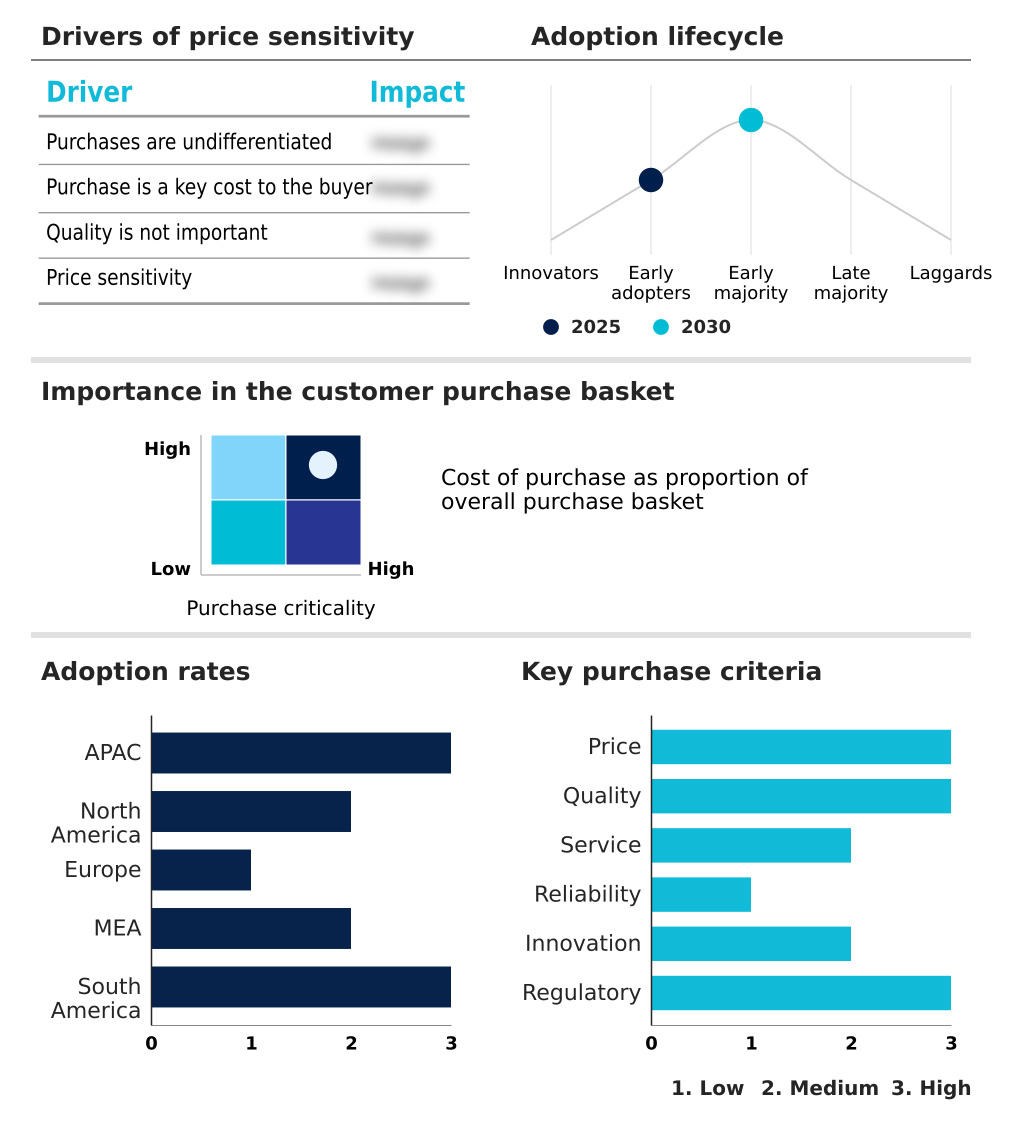
The ion exchange membranes market forecasting report includes the adoption lifecycle of the market, covering from the innovator’s stage to the laggard’s stage. It focuses on adoption rates in different regions based on penetration. Furthermore, the ion exchange membranes market report also includes key purchase criteria and drivers of price sensitivity to help companies evaluate and develop their market growth analysis strategies.
Customer Landscape of Ion Exchange Membranes Industry
Competitive Landscape
Companies are implementing various strategies, such as strategic alliances, ion exchange membranes market forecast, partnerships, mergers and acquisitions, geographical expansion, and product/service launches, to enhance their presence in the industry.
AGC Inc. - Provides high-performance ion exchange membranes for desalination, chlor-alkali production, and industrial separation, enhancing process efficiency.
The industry research and growth report includes detailed analyses of the competitive landscape of the market and information about key companies, including:
- AGC Inc.
- Asahi Kasei Corp.
- ASTOM Corp.
- FUJIFILM Holdings Corp.
- Fumatech BWT GmbH
- Ion Membranes
- Ionomr Innovations Inc.
- Liaoning Yichen Membrane Co.
- MANN HUMMEL International GmbH
- MEGA a.s.
- Membrion Inc.
- Orion Polymer
- Saltworks Technologies Inc.
- SnowPure LLC
- SUEZ SA
- Syensqo SA
- The Chemours Co.
- Tianwei Membrane Technology Co.
- Toray Industries Inc.
- Versogen Inc.
Qualitative and quantitative analysis of companies has been conducted to help clients understand the wider business environment as well as the strengths and weaknesses of key industry players. Data is qualitatively analyzed to categorize companies as pure play, category-focused, industry-focused, and diversified; it is quantitatively analyzed to categorize companies as dominant, leading, strong, tentative, and weak.
Recent Development and News in Ion exchange membranes market
- In August 2024, DuPont announced advancements in its ion exchange membrane technologies, including expanded production capabilities for membranes used in water electrolysis systems for green hydrogen generation.
- In February 2025, Evonik initiated the construction of a pilot plant in Marl, Germany, dedicated to the production of its proprietary anion exchange membranes, which are specifically designed to enable cost-competitive green hydrogen production.
- In March 2025, Austin Water confirmed a partnership with LANXESS to pilot a new generation of monovalent-selective ion exchange membranes in its inland desalination research facility.
- In May 2025, Shell plc advanced the construction of the Holland Hydrogen 1 project at the Port of Rotterdam, a 200 MW renewable hydrogen plant to commercially deploy advanced anion exchange membrane electrolyzers.
Dive into Technavio’s robust research methodology, blending expert interviews, extensive data synthesis, and validated models for unparalleled Ion Exchange Membranes Market insights. See full methodology.
| Market Scope | |
|---|---|
| Page number | 323 |
| Base year | 2025 |
| Historic period | 2020-2024 |
| Forecast period | 2026-2030 |
| Growth momentum & CAGR | Accelerate at a CAGR of 2.7% |
| Market growth 2026-2030 | USD 151884.2 thousand |
| Market structure | Fragmented |
| YoY growth 2025-2026(%) | 2.6% |
| Key countries | China, Japan, India, South Korea, Australia, Indonesia, US, Canada, Mexico, Germany, France, UK, Italy, The Netherlands, Spain, Saudi Arabia, UAE, South Africa, Israel, Turkey, Brazil, Argentina and Chile |
| Competitive landscape | Leading Companies, Market Positioning of Companies, Competitive Strategies, and Industry Risks |
Research Analyst Overview
- The Ion Exchange Membranes market is characterized by a strong emphasis on material science innovation to meet the demands of high-growth sectors. The development of a robust polymer matrix is central to enhancing the mechanical strength and chemical stability of membranes, impacting their performance in applications like water electrolysis and demineralization.
- Anion exchange membrane and cation exchange membrane technologies are at the core of this evolution, with ongoing research focused on improving ionic conductivity and fouling resistance. For boardroom consideration, the choice between a hydrocarbon membrane and a perfluorocarbon membrane involves a strategic trade-off between cost, performance, and regulatory compliance, particularly as environmental standards tighten.
- The adoption of advanced composite membrane designs has led to a 20% improvement in operational lifespan in certain industrial processes. This focus on durability, combined with advancements in technologies such as the proton exchange membrane and bipolar membrane, positions these components as critical enablers for next-generation energy and water systems.
- The effectiveness of sulfonation processes and the resulting ion selectivity are key performance indicators that directly influence system efficiency and overall return on investment.
What are the Key Data Covered in this Ion Exchange Membranes Market Research and Growth Report?
-
What is the expected growth of the Ion Exchange Membranes Market between 2026 and 2030?
-
USD 151.88 million, at a CAGR of 2.7%
-
-
What segmentation does the market report cover?
-
The report is segmented by Material (Hydrocarbon membrane, Perfluorocarbon membrane, Inorganic membrane, Composite membrane, and Partially halogenated membrane), Application (Water treatment, Electrolysis, Storage batteries, Electrodialysis, and Others), Type (Cation, Anion, Amphoteric ion, Bipolar ion, and Mosaic ion) and Geography (APAC, North America, Europe, Middle East and Africa, South America)
-
-
Which regions are analyzed in the report?
-
APAC, North America, Europe, Middle East and Africa and South America
-
-
What are the key growth drivers and market challenges?
-
Rising demand for water treatment and desalination, High manufacturing and operational costs
-
-
Who are the major players in the Ion Exchange Membranes Market?
-
AGC Inc., Asahi Kasei Corp., ASTOM Corp., FUJIFILM Holdings Corp., Fumatech BWT GmbH, Ion Membranes, Ionomr Innovations Inc., Liaoning Yichen Membrane Co., MANN HUMMEL International GmbH, MEGA a.s., Membrion Inc., Orion Polymer, Saltworks Technologies Inc., SnowPure LLC, SUEZ SA, Syensqo SA, The Chemours Co., Tianwei Membrane Technology Co., Toray Industries Inc. and Versogen Inc.
-
Market Research Insights
- Market dynamics are increasingly influenced by the performance of advanced ion-conducting polymers. Innovations in materials science are enabling enhanced electrochemical separation, with some next-generation systems improving resource recovery from waste by over 18%. The development of stable polymer backbone structures is critical for applications like the chlor-alkali process and brackish water desalination.
- As a result, systems utilizing monovalent selective ion exchange technologies now achieve higher purity levels compared to legacy systems. This focus on material integrity and specialized functionality supports the expansion of membrane technologies into more demanding industrial environments, where durability and efficiency are paramount.
We can help! Our analysts can customize this ion exchange membranes market research report to meet your requirements.
 RIA -
RIA -