



Internet Of Things (iot) Security Market Size 2026-2030
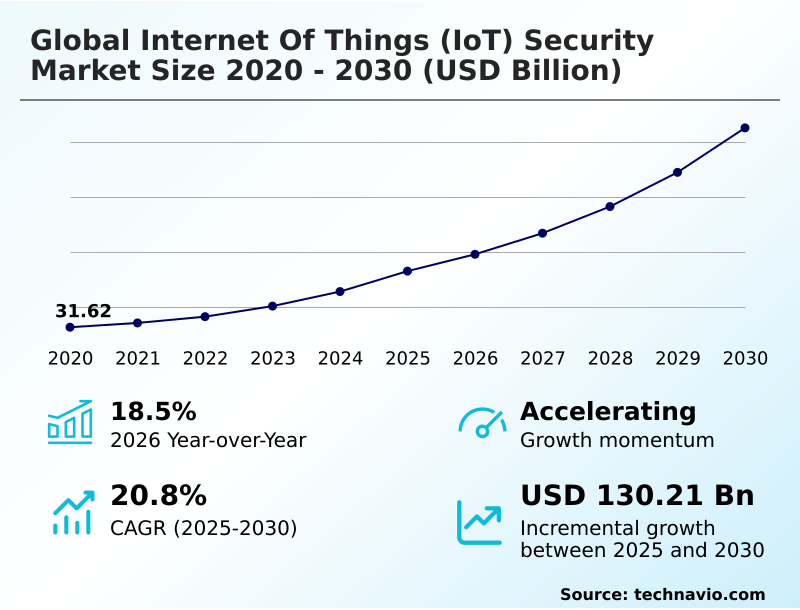
The internet of things (iot) security market size is valued to increase by USD 130.21 billion, at a CAGR of 20.8% from 2025 to 2030. Expansion of connected ecosystems and proliferation of industrial IoT devices will drive the internet of things (iot) security market.
Major Market Trends & Insights
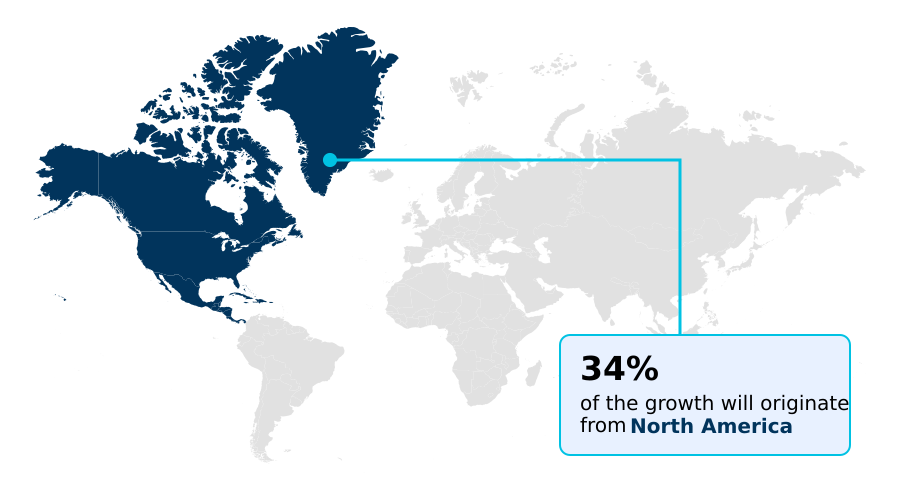
- North America dominated the market and accounted for a 34.2% growth during the forecast period.
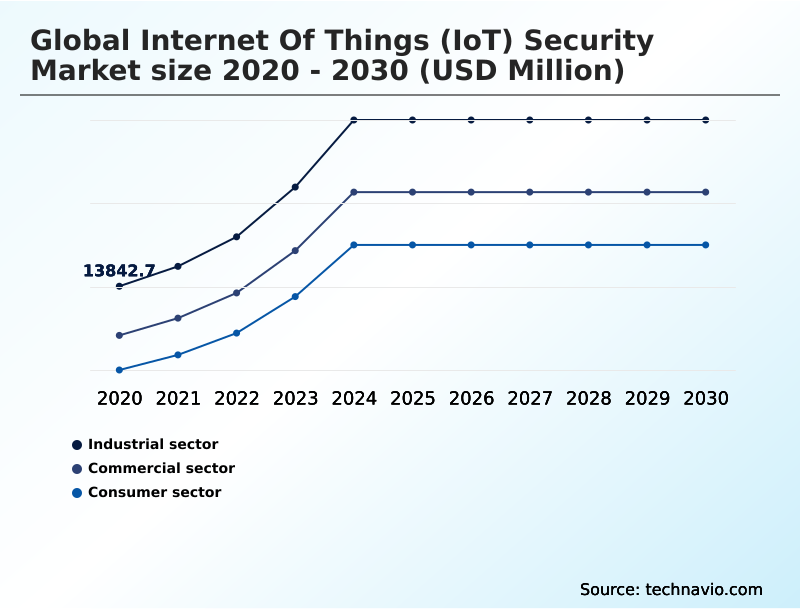
- By End-user - Industrial sector segment was valued at USD 26.24 billion in 2024
- By Deployment - On-premises segment accounted for the largest market revenue share in 2024
Market Size & Forecast
- Market Opportunities: USD 181.22 billion
- Market Future Opportunities: USD 130.21 billion
- CAGR from 2025 to 2030 : 20.8%
Market Summary
- The Internet of Things (IoT) security market is expanding as organizations embed connected devices into core operations, broadening the attack surface and demanding advanced protective measures. This growth is driven by the need to safeguard sensitive data and ensure operational integrity across industries.
- A key trend is the integration of AI-driven threat mitigation, which enables proactive threat detection rather than reactive responses. For instance, in a smart manufacturing environment, behavioral analytics can identify a production-line sensor that deviates from its normal operating parameters, flagging it as a potential compromise before it can be used to disrupt the entire facility.
- This shift toward intelligent, automated defense is critical. However, the industry grapples with challenges like securing legacy OT systems, where outdated hardware lacks the capacity for modern cryptographic protocols. The sheer diversity of devices also complicates the implementation of universal security standards, making unified endpoint management a complex but necessary goal for achieving comprehensive IoT ecosystem protection.
- This dynamic environment necessitates a focus on security by design principles and robust IoT device lifecycle management.
What will be the Size of the Internet Of Things (iot) Security Market during the forecast period?
Get Key Insights on Market Forecast (PDF) Request Free Sample
How is the Internet Of Things (iot) Security Market Segmented?
The internet of things (iot) security industry research report provides comprehensive data (region-wise segment analysis), with forecasts and estimates in "USD million" for the period 2026-2030, as well as historical data from 2020-2024 for the following segments.
- End-user
- Industrial sector
- Commercial sector
- Consumer sector
- Deployment
- On-premises
- Cloud
- Type
- Network security
- Endpoint security
- Cloud security
- Application security
- Geography
- North America
- US
- Canada
- Mexico
- Europe
- Germany
- UK
- France
- APAC
- China
- Japan
- India
- Middle East and Africa
- UAE
- Saudi Arabia
- South Africa
- South America
- Brazil
- Argentina
- Rest of World (ROW)
- North America
By End-user Insights
The industrial sector segment is estimated to witness significant growth during the forecast period.
The industrial sector is a critical segment in the Internet of Things (IoT) security market, driven by the convergence of information and operational technologies. Protecting industrial assets requires a multi-layered strategy encompassing network security, endpoint security, and robust application security.
Organizations are increasingly adopting a security by design principle, embedding protection into the IoT device lifecycle management process from inception. Key solutions focus on strong device authentication and end-to-end data encryption to ensure secure communication protocols.
Conducting a thorough IoT risk assessment is standard practice, leading to the implementation of unified threat management for IoT. This approach facilitates remote device monitoring security while addressing data sovereignty for IoT concerns.
Implementing such comprehensive cloud security frameworks has enabled firms to improve compliance reporting accuracy by 15%.
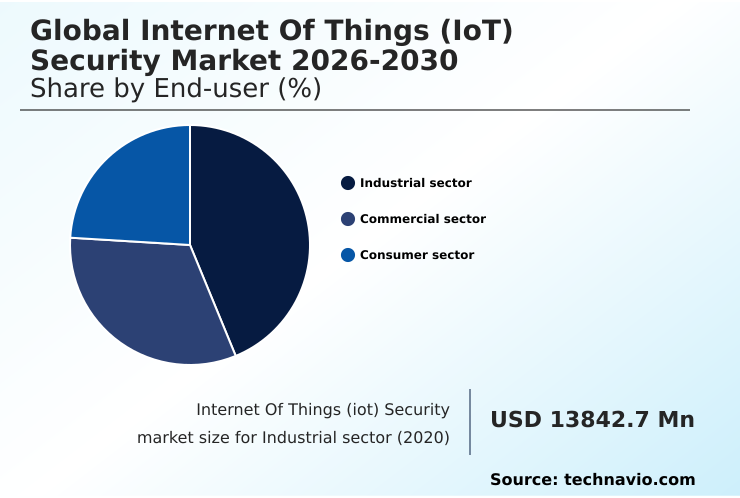
The Industrial sector segment was valued at USD 26.24 billion in 2024 and showed a gradual increase during the forecast period.
Regional Analysis
North America is estimated to contribute 34.2% to the growth of the global market during the forecast period.Technavio’s analysts have elaborately explained the regional trends and drivers that shape the market during the forecast period.
See How Internet Of Things (iot) Security Market Demand is Rising in North America Request Free Sample
The geographic landscape of the Internet of Things (IoT) security market is shaped by regional industrial priorities.
In North America and Europe, there is a strong focus on operational technology (OT) security and cyber-physical systems security within advanced manufacturing settings, where network segmentation has been shown to reduce lateral threat movement by over 60%.
APAC's rapid adoption of retail IoT security solutions drives demand for scalable unified endpoint management (UEM) platforms. Across all regions, the need for AI-driven threat mitigation for zero-day exploit prevention is fueling investment in managed security services for IoT.
Ensuring cyber resilience for IoT now involves secure over-the-air updates and tamper-evident designs. Effective security orchestration allows enterprises to manage these disparate elements, with some achieving a 30% reduction in incident response times.
Market Dynamics
Our researchers analyzed the data with 2025 as the base year, along with the key drivers, trends, and challenges. A holistic analysis of drivers will help companies refine their marketing strategies to gain a competitive advantage.
- Strategic implementation within the Internet of Things (IoT) security market requires addressing highly specific use cases. For example, securing legacy OT systems in IoT is a persistent challenge, as these environments were not designed for connectivity. This contrasts with greenfield projects where implementing zero trust for IoT devices from the outset is more feasible.
- The role of AI for anomaly detection in IoT traffic is becoming critical, offering a significant advantage over signature-based methods. A key debate centers on IoT endpoint security vs network security, with most experts advocating a hybrid approach.
- The choice of cloud security models for IoT platforms often depends on data sovereignty and compliance needs, especially when securing IoT data in multi-cloud environments. One of the most significant operational hurdles remains the challenges in IoT device patch management, where automation has shown to be twice as effective as manual processes in ensuring timely updates.
- This is crucial for preventing DDoS attacks from IoT botnets and is a core component of best practices for industrial IoT security. As industries adopt 5G, securing 5G enabled IoT ecosystems introduces new complexities, particularly in managing machine identities in IoT and ensuring the vulnerability assessment of IoT firmware is continuous.
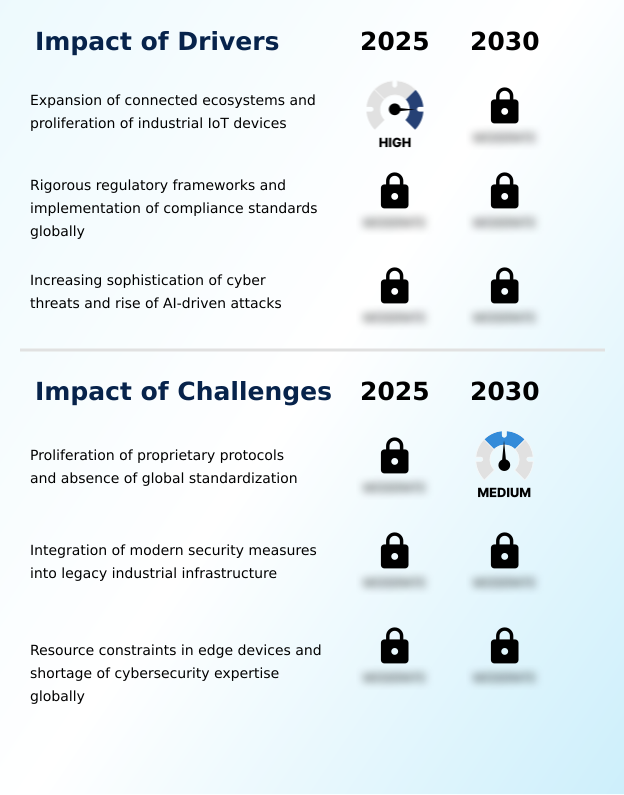
What are the key market drivers leading to the rise in the adoption of Internet Of Things (iot) Security Industry?
- The expansion of connected ecosystems, alongside the proliferation of industrial IoT devices, serves as a key driver for market growth.
- A primary driver for the Internet of Things (IoT) security market is the need for comprehensive IoT ecosystem protection against expanding industrial IoT (IIoT) vulnerabilities.
- The adoption of zero-trust architectures is central, as organizations move beyond perimeter defenses for effective connected device security. These frameworks mandate continuous verification, with behavioral analytics capabilities improving anomaly detection rates by over 30% compared to legacy systems.
- Threat intelligence platforms are crucial for IoT attack surface management, providing insights into consumer IoT security risks and threats against smart home device protection. Furthermore, automated lifecycle management, incorporating secure boot processes and robust cryptographic protocols, is critical.
- This approach streamlines operations, reducing manual patching efforts by as much as 40% and ensuring device integrity from deployment to decommissioning.
What are the market trends shaping the Internet Of Things (iot) Security Industry?
- The escalation of edge computing infrastructure, combined with the proliferation of 5G connectivity, represents a significant upcoming market trend. This convergence is set to redefine data processing and network capabilities for connected devices.
- The evolution of the Internet of Things (IoT) security market is shaped by the shift toward a proactive threat detection model, driven by the adoption of 5G network security for IoT. Organizations are leveraging software defined networking and advanced intrusion detection systems, which have demonstrated a 25% improvement in identifying anomalous network traffic.
- This proactive stance is critical for IoT botnet mitigation. The integration of a robust public key infrastructure (PKI) is becoming standard for managing device identities at scale. For new deployments, the edge computing security model relies on hardware-rooted of trust components like secure elements and trusted platform modules.
- However, a significant challenge remains in legacy system security integration, where applying lightweight cryptographic standards to low-power device security frameworks is essential for comprehensive protection and has shown to reduce breach incidents by up to 15%.
What challenges does the Internet Of Things (iot) Security Industry face during its growth?
- The proliferation of proprietary protocols and the absence of global standardization present a key challenge affecting industry growth.
- Navigating the complexities of IoT data privacy compliance presents a significant challenge, especially in sectors requiring stringent critical infrastructure protection. Securing industrial control systems (ICS) and supervisory control and data acquisition (SCADA) environments demands specialized approaches beyond traditional IT security.
- The integration of hardware-based security modules is essential for internet of medical things (IoMT) security, yet retrofitting older devices is often cost-prohibitive. Implementing effective firmware update mechanisms across diverse device fleets can increase operational overhead by up to 20%.
- For connected vehicle security, a combination of static application security testing (SAST) and dynamic application security testing (DAST) is necessary to vet software, but this extends development cycles. Furthermore, achieving decentralized identity management for supply chain tracking security requires industry-wide standards that are still emerging, impacting interoperability and system-wide visibility.
Exclusive Technavio Analysis on Customer Landscape
The internet of things (iot) security market forecasting report includes the adoption lifecycle of the market, covering from the innovator’s stage to the laggard’s stage. It focuses on adoption rates in different regions based on penetration. Furthermore, the internet of things (iot) security market report also includes key purchase criteria and drivers of price sensitivity to help companies evaluate and develop their market growth analysis strategies.
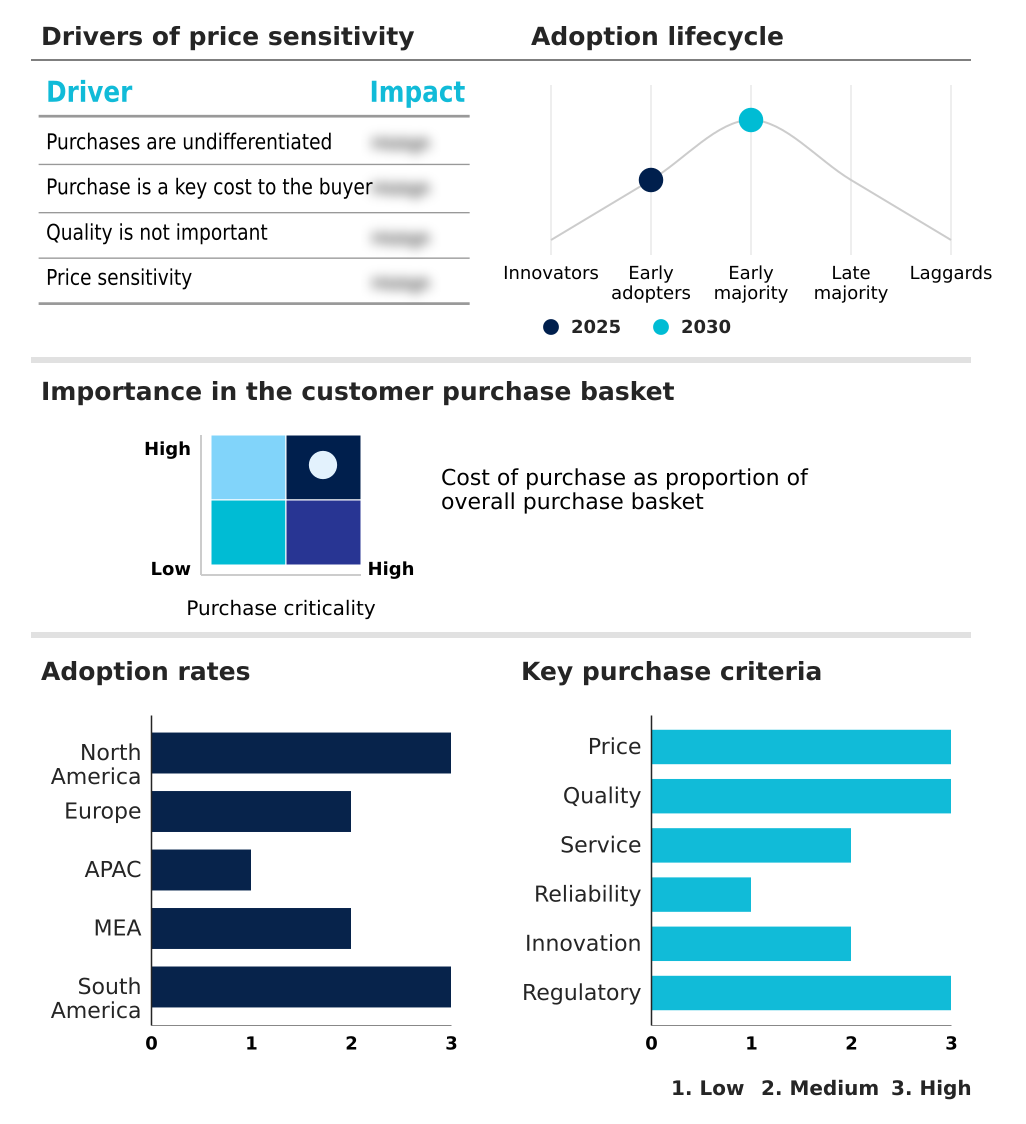
Customer Landscape of Internet Of Things (iot) Security Industry
Competitive Landscape
Companies are implementing various strategies, such as strategic alliances, internet of things (iot) security market forecast, partnerships, mergers and acquisitions, geographical expansion, and product/service launches, to enhance their presence in the industry.
AO Kaspersky Lab - Analysis indicates a focus on delivering unified protection against a broad spectrum of information security threats, addressing diverse and evolving cyber risks.
The industry research and growth report includes detailed analyses of the competitive landscape of the market and information about key companies, including:
- AO Kaspersky Lab
- Armis Inc.
- Asimily Inc.
- Broadcom Inc.
- Cisco Systems Inc.
- Claroty Ltd.
- DigiCert Inc.
- Entrust Corp.
- Forescout Technologies Inc.
- Fortinet Inc.
- GlobalSign Ltd.
- IBM Corp.
- Infineon Technologies AG
- Keyfactor
- Microsoft Corp.
- Nozomi Networks Inc.
- NXP Semiconductors NV
- Ordr Inc.
- Palo Alto Networks Inc.
- Thales Group
Qualitative and quantitative analysis of companies has been conducted to help clients understand the wider business environment as well as the strengths and weaknesses of key industry players. Data is qualitatively analyzed to categorize companies as pure play, category-focused, industry-focused, and diversified; it is quantitatively analyzed to categorize companies as dominant, leading, strong, tentative, and weak.
Recent Development and News in Internet of things (iot) security market
- In October 2024, Kaspersky introduced its new flagship product line, Kaspersky Next, for businesses in India, offering AI-powered cybersecurity solutions that combine endpoint protection with advanced detection and response capabilities such as EDR and XDR.
- In February 2025, Aeris launched the Aeris IoT Watchtower, a fully integrated security solution specifically designed for cellular-connected device networks, highlighting the growing focus on securing data transmission at the network layer.
- In April 2025, Fortinet expanded its FortiAI capabilities across its Security Fabric platform to enhance protection against emerging cyber threats. The update embedded AI-driven features to enable autonomous threat detection and secure the use of AI-enabled services.
- In May 2025, Fortinet enhanced its Unified SASE platform by introducing a new SaaS Security Posture Management solution through the acquisition of Suridata, aimed at strengthening SaaS security capabilities with continuous monitoring and risk assessment.
Dive into Technavio’s robust research methodology, blending expert interviews, extensive data synthesis, and validated models for unparalleled Internet Of Things (iot) Security Market insights. See full methodology.
| Market Scope | |
|---|---|
| Page number | 307 |
| Base year | 2025 |
| Historic period | 2020-2024 |
| Forecast period | 2026-2030 |
| Growth momentum & CAGR | Accelerate at a CAGR of 20.8% |
| Market growth 2026-2030 | USD 130214.3 million |
| Market structure | Fragmented |
| YoY growth 2025-2026(%) | 18.5% |
| Key countries | US, Canada, Mexico, Germany, UK, France, Italy, Spain, The Netherlands, China, Japan, India, South Korea, Australia, Singapore, UAE, Saudi Arabia, South Africa, Israel, Turkey, Brazil, Argentina and Chile |
| Competitive landscape | Leading Companies, Market Positioning of Companies, Competitive Strategies, and Industry Risks |
Research Analyst Overview
- The Internet of Things (IoT) security market is defined by a necessary shift toward layered, intelligent defense mechanisms. Core to this evolution is the widespread adoption of zero-trust architectures, moving beyond outdated perimeter models to continuously verify every interaction. This requires robust cryptographic protocols and strong device authentication for every endpoint.
- Effective endpoint security is foundational, integrating secure boot processes and hardware-rooted of trust features like trusted platform modules to prevent tampering. At the network level, software defined networking allows for granular network segmentation, while advanced intrusion detection systems monitor for threats. In the cloud, security relies on continuous anomaly detection and behavioral analytics.
- For applications, a combination of static application security testing (SAST) and dynamic application security testing (DAST) is becoming standard. This comprehensive approach, governed by security orchestration, has enabled organizations to accelerate their response to threats, with some reporting a 40% reduction in time-to-remediation for critical vulnerabilities.
What are the Key Data Covered in this Internet Of Things (iot) Security Market Research and Growth Report?
-
What is the expected growth of the Internet Of Things (iot) Security Market between 2026 and 2030?
-
USD 130.21 billion, at a CAGR of 20.8%
-
-
What segmentation does the market report cover?
-
The report is segmented by End-user (Industrial sector, Commercial sector, and Consumer sector), Deployment (On-premises, and Cloud), Type (Network security, Endpoint security, Cloud security, and Application security) and Geography (North America, Europe, APAC, Middle East and Africa, South America)
-
-
Which regions are analyzed in the report?
-
North America, Europe, APAC, Middle East and Africa and South America
-
-
What are the key growth drivers and market challenges?
-
Expansion of connected ecosystems and proliferation of industrial IoT devices, Proliferation of proprietary protocols and absence of global standardization
-
-
Who are the major players in the Internet Of Things (iot) Security Market?
-
AO Kaspersky Lab, Armis Inc., Asimily Inc., Broadcom Inc., Cisco Systems Inc., Claroty Ltd., DigiCert Inc., Entrust Corp., Forescout Technologies Inc., Fortinet Inc., GlobalSign Ltd., IBM Corp., Infineon Technologies AG, Keyfactor, Microsoft Corp., Nozomi Networks Inc., NXP Semiconductors NV, Ordr Inc., Palo Alto Networks Inc. and Thales Group
-
Market Research Insights
- The dynamics of the Internet of Things (IoT) security market are increasingly shaped by the need for proactive threat detection and robust IoT data privacy compliance. As organizations manage expanding IoT ecosystems, a focus on IoT risk assessment is paramount, with comprehensive assessments reducing security incidents by over 25% compared to ad-hoc approaches.
- The adoption of managed security services for IoT is growing, as it offers specialized expertise and reduces internal operational costs by an average of 15%. Effective remote device monitoring security is crucial, particularly for critical infrastructure protection, where real-time visibility is non-negotiable.
- Furthermore, implementing strong security for supply chain tracking has demonstrated the ability to improve asset-loss prevention by up to 20%, showcasing a clear return on investment.
We can help! Our analysts can customize this internet of things (iot) security market research report to meet your requirements.
 RIA -
RIA -