

Hypercar Market Size 2026-2030
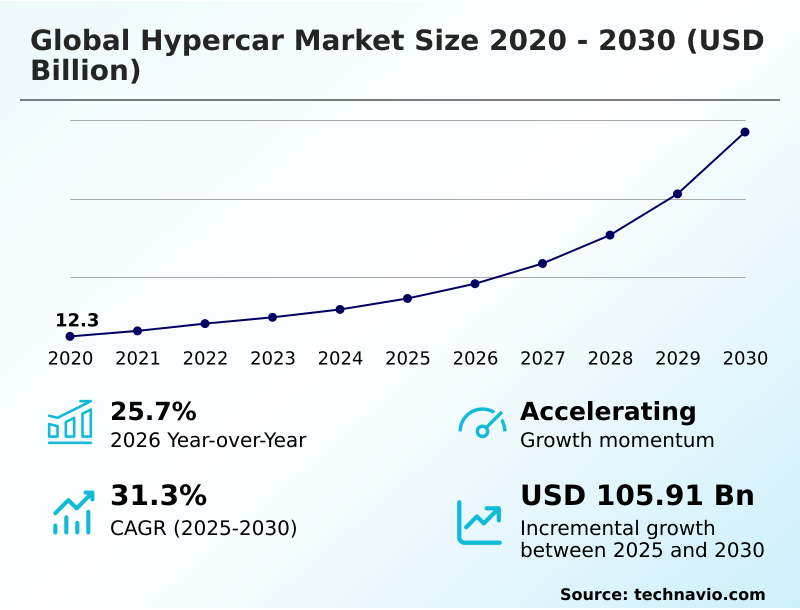
The hypercar market size is valued to increase by USD 105.91 billion, at a CAGR of 31.3% from 2025 to 2030. Rising ultra-high-net-worth individual (UHNWI) population will drive the hypercar market.
Major Market Trends & Insights
- APAC dominated the market and accounted for a 31.2% growth during the forecast period.
- By Powertrain Type - Gasoline segment was valued at USD 26.76 billion in 2024
- By Application - Private segment accounted for the largest market revenue share in 2024
Market Size & Forecast
- Market Opportunities: USD 130.05 billion
- Market Future Opportunities: USD 105.91 billion
- CAGR from 2025 to 2030 : 31.3%
Market Summary
- The hypercar market stands as the apex of automotive engineering, defined by limited-production vehicles that blend extreme performance with bespoke craftsmanship. A primary driver is the expanding global population of ultra-high-net-worth individuals, who seek these machines not only for their dynamic capabilities but also as investment-grade assets with significant collectability value.
- A dominant trend shaping the industry is the strategic shift toward powertrain electrification, with companies integrating sophisticated hybrid powertrain systems and all-electric platforms to deliver unprecedented acceleration and comply with tightening emissions regulations. This transition introduces challenges, including immense development costs and complex supply chain dependencies for specialized components.
- For instance, a manufacturer might leverage a generative design process and additive manufacturing to produce a novel titanium suspension assembly, reducing weight by 25% while bypassing traditional forging suppliers, thereby mitigating specific logistical risks and enhancing vehicle agility.
- The relentless pursuit of engineering supremacy through innovations in active aerodynamics, lightweight carbon fiber monocoques, and advanced thermal management systems ensures the market remains a critical incubator for future automotive technologies.
What will be the Size of the Hypercar Market during the forecast period?
Get Key Insights on Market Forecast (PDF) Request Free Sample
How is the Hypercar Market Segmented?
The hypercar industry research report provides comprehensive data (region-wise segment analysis), with forecasts and estimates in "USD million" for the period 2026-2030, as well as historical data from 2020-2024 for the following segments.
- Powertrain type
- Gasoline
- Hybrid-electric
- Application
- Private
- Racing
- Vehicle type
- Coupe
- Convertible
- Roadster
- Geography
- North America
- US
- Canada
- Mexico
- APAC
- China
- Japan
- India
- Europe
- Italy
- Germany
- UK
- Middle East and Africa
- UAE
- Saudi Arabia
- South Africa
- South America
- Brazil
- Argentina
- Rest of World (ROW)
- North America
By Powertrain Type Insights
The gasoline segment is estimated to witness significant growth during the forecast period.
The gasoline powertrain segment continues to represent the pursuit of engineering supremacy, focusing on mechanical purity and raw driver engagement.
While the industry pivots, this segment refines internal combustion, with the twin-turbocharged V8 remaining a popular architecture for delivering exceptional road-legal performance.
Innovations are not stagnant; development includes advancements in regenerative braking systems adapted for high-output gasoline engines and research into carbon-neutral synthetic fuels to ensure long-term viability against evolving regulations.
These vehicles are defined by their acoustic signatures and linear power delivery, with companies achieving a nearly 10% improvement in thermal efficiency through advanced cooling and material science, maintaining a dedicated following among collectors who prioritize a traditional, visceral driving experience and value a direct connection to the machine.
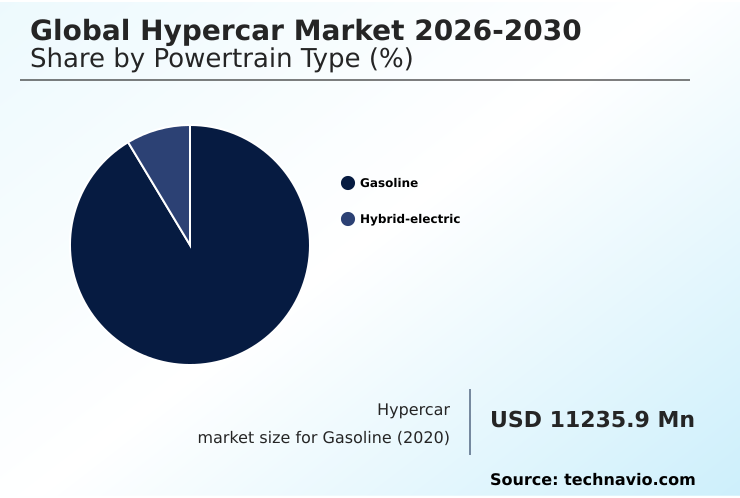
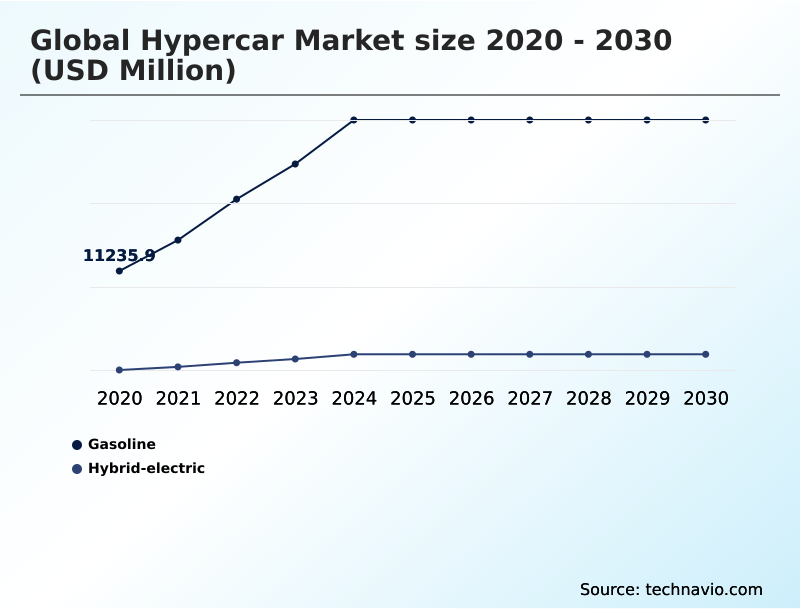
The Gasoline segment was valued at USD 26.76 billion in 2024 and showed a gradual increase during the forecast period.
Regional Analysis
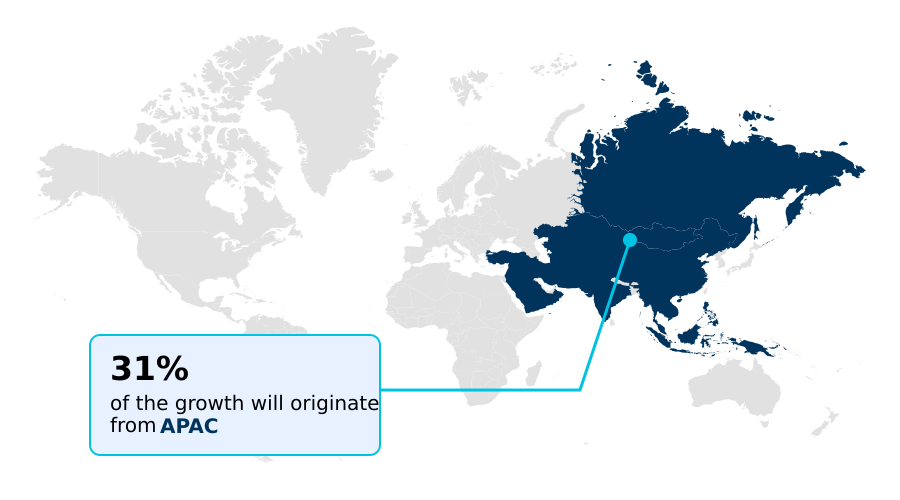
APAC is estimated to contribute 31.2% to the growth of the global market during the forecast period.Technavio’s analysts have elaborately explained the regional trends and drivers that shape the market during the forecast period.
See How Hypercar Market Demand is Rising in APAC Request Free Sample
The geographic landscape of the hypercar market is diversifying, moving beyond its traditional heartland in Europe.
APAC is the fastest-growing region, projected to capture over 31% of the incremental growth opportunity, fueled by rapid wealth creation and a strong appetite for technologically advanced vehicles.
North America remains a vital hub, characterized by a high concentration of collectors and demand for extreme performance. In Europe, stringent regulations are accelerating the development of the hybrid powertrain system and 800-volt architecture.
To serve these expanding global markets effectively, some manufacturers have established localized service centers, achieving a 20% reduction in vehicle servicing times.
This global footprint requires companies to balance homologation standards with regional preferences, from the naturally aspirated V16 engine favored by traditionalists to the all-wheel torque vectoring systems demanded by tech-savvy buyers, all while maintaining high levels of bespoke engineering and aerodynamic efficiency.
Market Dynamics
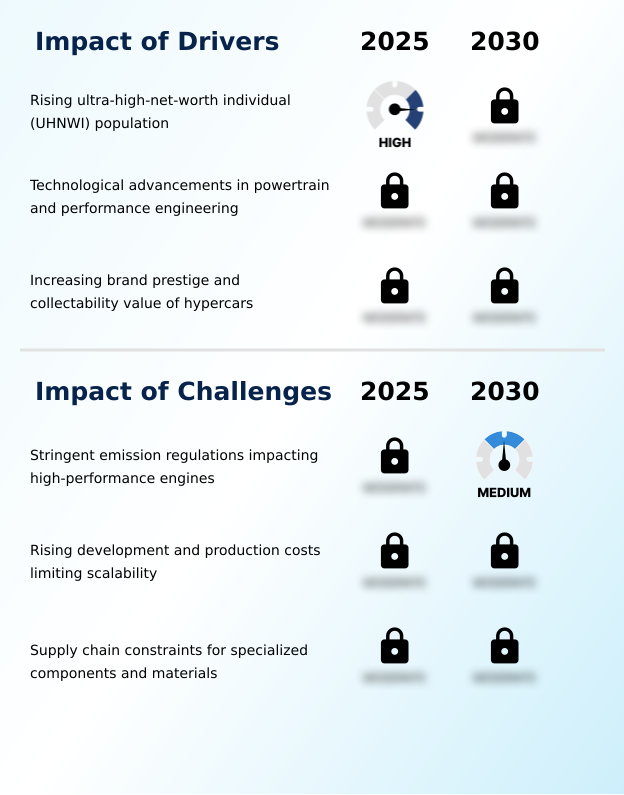
Our researchers analyzed the data with 2025 as the base year, along with the key drivers, trends, and challenges. A holistic analysis of drivers will help companies refine their marketing strategies to gain a competitive advantage.
- The global hypercar market 2026-2030 is navigating a complex period of transformation, heavily influenced by the impact of stringent emission regulations on hypercars. This pressure accelerates technological advancements in powertrain engineering, pushing manufacturers to explore beyond traditional combustion.
- A key area of focus is the role of lightweight materials in hypercars, which is critical for offsetting the weight of batteries in electrified models. The impact of hybrid technology on performance is undeniable, offering instant torque and filling power gaps, while the benefits of electric hypercar powertrains include silent operation and unparalleled acceleration.
- For buyers, the appeal is twofold: extensive customization options for hypercar buyers allow for the creation of unique automotive masterpieces, and the investment value of limited edition hypercars makes them a compelling asset class. Balancing these factors is a significant operational challenge.
- For example, firms that have perfected aerodynamic efficiency optimization in design using advanced computational fluid dynamics report that they can finalize a vehicle's bodywork nearly twice as fast as competitors relying solely on physical wind-tunnel models, showcasing a clear link between digital innovation and speed to market.
- This efficiency is vital in a sector defined by rapid technological evolution and high consumer expectations.
What are the key market drivers leading to the rise in the adoption of Hypercar Industry?
- The key driver for the market is the rising population of ultra-high-net-worth individuals (UHNWI), which continually expands the addressable consumer base for exclusive, high-value automotive assets.
- Market growth is primarily fueled by the expanding population of ultra-high-net-worth individuals and their demand for exclusive, high-value assets. This robust customer base, which has grown by a double-digit percentage in key emerging economies, enables manufacturers to fund ambitious projects.
- The emphasis on bespoke engineering ensures each vehicle is a unique expression of the owner's taste, further enhancing its appeal.
- A key driver is the proven collectability value of these machines, with certain limited production models appreciating by over 30% in the secondary market, reinforcing brand prestige.
- Technological advancements, such as the development of the high-power-density raxial flux motor and the use of a generative design process, allow companies to continuously push performance boundaries and maintain a competitive edge.
What are the market trends shaping the Hypercar Industry?
- A primary market trend is the definitive shift toward powertrain electrification and the proliferation of hybrid hypercars. This evolution is reshaping performance metrics and aligning the sector with global sustainability targets.
- Key trends in the market are reshaping the definition of ultimate performance. The integration of advanced lightweight materials, particularly the carbon fiber monocoque, is fundamental to achieving a superior power-to-weight ratio. These chassis designs are now 20% lighter yet offer 15% greater torsional rigidity than their predecessors, enabling more agile handling.
- Concurrently, active aerodynamics have become a critical differentiator, with systems capable of adjusting in milliseconds to enhance high-speed stability or maximize downforce for cornering. The growing adoption of additive manufacturing allows for the creation of intricate, performance-optimized components that were previously impossible to produce.
- These trends converge to elevate performance benchmarks, ensuring the next generation of hypercars is not only faster in a straight line but also significantly more capable dynamically.
What challenges does the Hypercar Industry face during its growth?
- A key challenge affecting industry growth is the enforcement of stringent global emission regulations, which necessitates significant investment and innovation in high-performance engine and powertrain design.
- The market faces significant operational and financial hurdles that temper its growth trajectory. Stringent homologation standards and emissions regulations necessitate massive investments in powertrain electrification, with development costs for new platforms often exceeding initial budgets by up to 30%.
- These expenses are compounded by a reliance on a fragile supply chain for specialized components like carbon ceramic brakes and advanced electronics. A disruption in the supply of a single component can halt production, impacting revenue forecasts by as much as 20% in a given quarter.
- Furthermore, the complexity of the thermal management system in high-output hybrid and track-focused models requires extensive validation using computational fluid dynamics, adding both time and cost to development cycles.
Exclusive Technavio Analysis on Customer Landscape
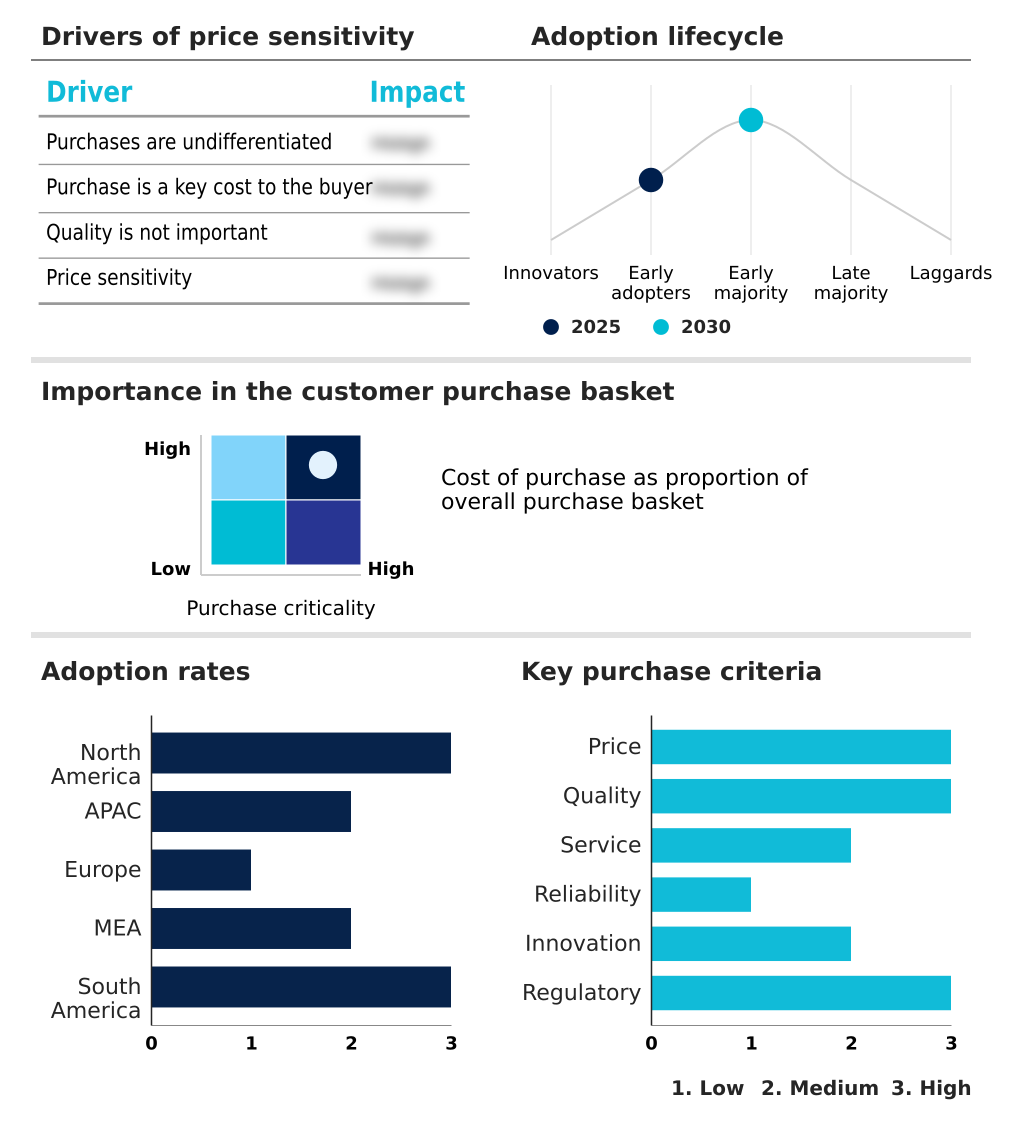
The hypercar market forecasting report includes the adoption lifecycle of the market, covering from the innovator’s stage to the laggard’s stage. It focuses on adoption rates in different regions based on penetration. Furthermore, the hypercar market report also includes key purchase criteria and drivers of price sensitivity to help companies evaluate and develop their market growth analysis strategies.
Customer Landscape of Hypercar Industry
Competitive Landscape
Companies are implementing various strategies, such as strategic alliances, hypercar market forecast, partnerships, mergers and acquisitions, geographical expansion, and product/service launches, to enhance their presence in the industry.
Ajlani Motors - Key offerings include the design and manufacture of limited-production hypercars, emphasizing bespoke engineering, advanced aerodynamics, and high-performance hybrid and electric powertrain systems.
The industry research and growth report includes detailed analyses of the competitive landscape of the market and information about key companies, including:
- Ajlani Motors
- Aspark Co. Ltd.
- Aston Martin Lagonda ltd.
- Automobili Lamborghini SpA
- Automobili Pininfarina GmbH
- Bayerische Motoren Werke AG
- Czinger Vehicles Inc.
- Dr. Ing. h.c. F. Porsche AG
- Ferrari NV
- Hennessey Special Vehicles
- Koenigsegg Automotive AB
- Lotus Cars Ltd.
- McLaren Group Ltd.
- Mercedes Benz Group AG
- Pagani Automobili SpA
- Rimac Automobili
- SSC North America LLC
- Stellantis NV
- Zenvo Automotive AS
Qualitative and quantitative analysis of companies has been conducted to help clients understand the wider business environment as well as the strengths and weaknesses of key industry players. Data is qualitatively analyzed to categorize companies as pure play, category-focused, industry-focused, and diversified; it is quantitatively analyzed to categorize companies as dominant, leading, strong, tentative, and weak.
Recent Development and News in Hypercar market
- In August 2024, Pagani Automobili unveiled the Utopia Roadster during Monterey Car Week, a model powered by a twin-turbo V12 engine and engineered with advanced composites like Carbo-Titanium to match the coupe's weight, reinforcing its commitment to lightweight, internal combustion performance.
- In September 2024, McLaren Group Ltd. introduced the W1, showcasing its lightest and most rigid Aerocell carbon fiber monocoque and a revolutionary active long-tail rear wing capable of generating over 1,000 kilograms of downforce for extreme cornering grip.
- In October 2024, Ferrari NV revealed the F80, a limited-edition hybrid hypercar featuring a 1,200-horsepower V6-based powertrain derived from its motorsport programs. All 799 units, priced at approximately $3.9 million, were pre-sold to preferred clients.
- In February 2025, Zenvo Automotive announced its Aurora hypercar program entered an intensive development phase, featuring the first fire-up of its 1,850-horsepower V12 hybrid engine, with a strategic focus on dealer presence in the Middle East.
Dive into Technavio’s robust research methodology, blending expert interviews, extensive data synthesis, and validated models for unparalleled Hypercar Market insights. See full methodology.
| Market Scope | |
|---|---|
| Page number | 287 |
| Base year | 2025 |
| Historic period | 2020-2024 |
| Forecast period | 2026-2030 |
| Growth momentum & CAGR | Accelerate at a CAGR of 31.3% |
| Market growth 2026-2030 | USD 105907.6 million |
| Market structure | Fragmented |
| YoY growth 2025-2026(%) | 25.7% |
| Key countries | US, Canada, Mexico, China, Japan, India, South Korea, Australia, Singapore, Italy, Germany, UK, France, Spain, The Netherlands, UAE, Saudi Arabia, South Africa, Qatar, Kuwait, Brazil, Argentina and Chile |
| Competitive landscape | Leading Companies, Market Positioning of Companies, Competitive Strategies, and Industry Risks |
Research Analyst Overview
- The hypercar market operates as the automotive industry's foremost innovation laboratory, where the limits of performance are continuously redefined. Central to this evolution is the integration of advanced technologies such as the carbon fiber monocoque for structural rigidity and lightweighting, alongside sophisticated active aerodynamics to manage extreme speeds.
- The strategic pivot toward the hybrid powertrain system and all-electric platforms, featuring technologies like the raxial flux motor and 800-volt architecture, is no longer just an engineering pursuit but a critical boardroom decision. This shift directly influences long-term R&D budgeting and brand positioning in response to evolving environmental compliance mandates.
- The use of a generative design process and additive manufacturing is becoming standard for creating optimized components. Firms leveraging these methods to produce parts like suspension uprights have demonstrated a 30% reduction in material waste while simultaneously increasing component strength.
- This dynamic environment is further characterized by the use of all-wheel torque vectoring, twin-turbocharged V8 engines, computational fluid dynamics, regenerative braking, carbon ceramic brakes, naturally aspirated V16 engines, and the exploration of synthetic fuels to sustain internal combustion's legacy.
What are the Key Data Covered in this Hypercar Market Research and Growth Report?
-
What is the expected growth of the Hypercar Market between 2026 and 2030?
-
USD 105.91 billion, at a CAGR of 31.3%
-
-
What segmentation does the market report cover?
-
The report is segmented by Powertrain Type (Gasoline, and Hybrid-electric), Application (Private, and Racing), Vehicle Type (Coupe, Convertible, and Roadster) and Geography (North America, APAC, Europe, Middle East and Africa, South America)
-
-
Which regions are analyzed in the report?
-
North America, APAC, Europe, Middle East and Africa and South America
-
-
What are the key growth drivers and market challenges?
-
Rising ultra-high-net-worth individual (UHNWI) population, Stringent emission regulations impacting high-performance engines
-
-
Who are the major players in the Hypercar Market?
-
Ajlani Motors, Aspark Co. Ltd., Aston Martin Lagonda ltd., Automobili Lamborghini SpA, Automobili Pininfarina GmbH, Bayerische Motoren Werke AG, Czinger Vehicles Inc., Dr. Ing. h.c. F. Porsche AG, Ferrari NV, Hennessey Special Vehicles, Koenigsegg Automotive AB, Lotus Cars Ltd., McLaren Group Ltd., Mercedes Benz Group AG, Pagani Automobili SpA, Rimac Automobili, SSC North America LLC, Stellantis NV and Zenvo Automotive AS
-
Market Research Insights
- The hypercar market is shaped by a dynamic interplay between technological ambition and client demand for exclusivity. The integration of advanced powertrain electrification is central, with new hybrid systems demonstrating a 20% improvement in thermal management efficiency, enabling sustained peak output. This drive for engineering supremacy is balanced by the need to deliver unique, bespoke engineering for a discerning clientele.
- Limited production models are crucial, as their collectability value often appreciates by over 30% in the secondary market, reinforcing their status as tangible assets. Furthermore, the focus on track-focused models has intensified, with active aerodynamic systems enhancing high-speed stability and grip, solidifying the brand prestige of manufacturers who dominate on the racetrack.
We can help! Our analysts can customize this hypercar market research report to meet your requirements.
 RIA -
RIA -