


Heat Resistant Polymer Market Analysis, Size, and Forecast 2026-2030: North America (US, Canada, and Mexico), Europe (Germany, UK, and France), APAC (China, India, and Japan), Middle East and Africa (Saudi Arabia, UAE, and South Africa), South America (Brazil and Argentina), and Rest of World (ROW)

Heat Resistant Polymer Market Analysis, Size, and Forecast 2026-2030:
North America (US, Canada, and Mexico), Europe (Germany, UK, and France), APAC (China, India, and Japan), Middle East and Africa (Saudi Arabia, UAE, and South Africa), South America (Brazil and Argentina), and Rest of World (ROW)

Published: Jan 2026 307 Pages SKU: IRTNTR74035

Market Overview at a Glance

$8.71 B
Market Opportunity
6.5%
CAGR 2025 - 2030
37.9%
North America Growth
$7.53 B
Transportation segment 2024

Heat Resistant Polymer Market Size 2026-2030

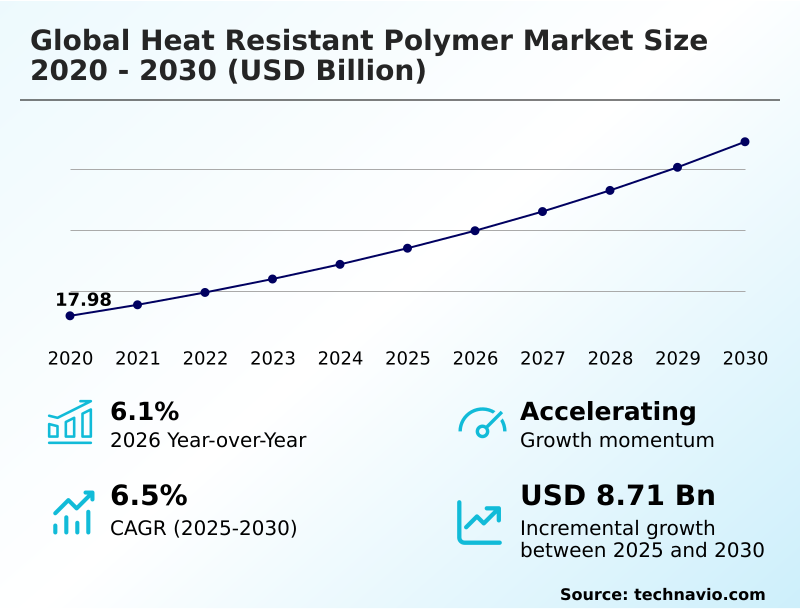
The heat resistant polymer market size is valued to increase by USD 8.71 billion, at a CAGR of 6.5% from 2025 to 2030. Accelerating adoption of high-voltage electric vehicle architectures will drive the heat resistant polymer market.

Major Market Trends & Insights

  • North America dominated the market and accounted for a 37.9% growth during the forecast period.
  • By End-user - Transportation segment was valued at USD 7.53 billion in 2024
  • By Type - Fluoropolymer segment accounted for the largest market revenue share in 2024

Market Size & Forecast

  • Market Opportunities: USD 14.24 billion
  • Market Future Opportunities: USD 8.71 billion
  • CAGR from 2025 to 2030 : 6.5%

Market Summary

  • The heat resistant polymer market is defined by a structural transition from metallic alloys to advanced thermoplastic solutions, driven by demands for energy efficiency and performance durability in critical sectors. This evolution is catalyzed by the electrification of vehicles and miniaturization in electronics, moving polymers from niche to mass-market applications.
  • Key drivers include the need for materials in high voltage architectures that offer superior thermal management and dielectric strength. Concurrently, the industry is navigating a trend toward sustainability, with a focus on bio-circular feedstocks and chemical recycling to reduce carbon footprints without compromising performance. A significant business challenge involves adapting to stringent regulations on substances like perfluoroalkyl substances (PFAS).
  • For instance, an electronics manufacturer must re-engineer its supply chain to source compliant non-fluorinated alternatives for semiconductor processing, investing in new qualification processes to maintain production continuity and avoid liability, which impacts both operational costs and time-to-market. This balancing act between performance innovation and regulatory compliance shapes the strategic direction of the market.

What will be the Size of the Heat Resistant Polymer Market during the forecast period?
Get Key Insights on Market Forecast (PDF) Request Free Sample

How is the Heat Resistant Polymer Market Segmented?

The heat resistant polymer industry research report provides comprehensive data (region-wise segment analysis), with forecasts and estimates in "USD million" for the period 2026-2030, as well as historical data from 2020-2024 for the following segments.

  • End-user
    • Transportation
    • Electronics and electrical
    • Others
  • Type
    • Fluoropolymer
    • Polyphenylene sulfide
    • Polyimides
    • Polyether ether ketone
    • Others
  • Distribution channel
    • Indirect sales
    • Direct sales
  • Geography
    • North America
      • US
      • Canada
      • Mexico
    • Europe
      • Germany
      • UK
      • France
    • APAC
      • China
      • India
      • Japan
    • Middle East and Africa
      • Saudi Arabia
      • UAE
      • South Africa
    • South America
      • Brazil
      • Argentina
    • Rest of World (ROW)

By End-user Insights

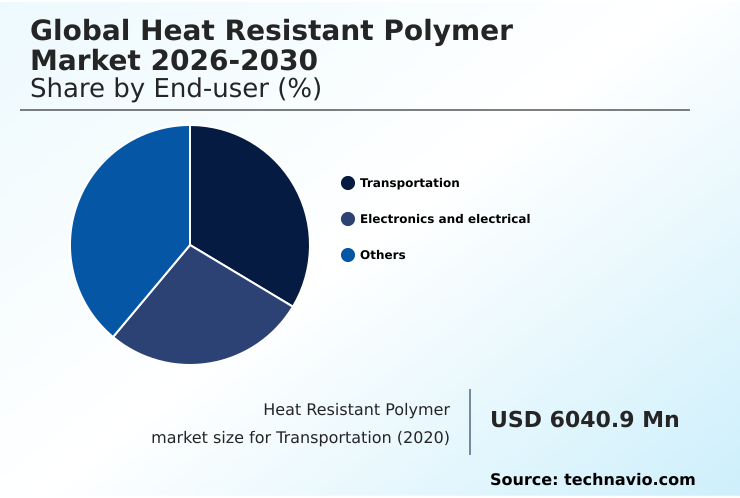
The transportation segment is estimated to witness significant growth during the forecast period.

The transportation segment is a primary innovation engine, driven by electrification and aerospace lightweighting. The industry's move toward high voltage architectures in electric vehicles necessitates advanced polymer composites with superior thermal management solutions and hydrolytic stability.

This shift from traditional metals to high-performance thermoplastics for automotive powertrain systems and aerospace structural parts is critical.

For instance, replacing metallic components in next-generation aircraft engines with structural thermoplastic solutions has been shown to improve fuel efficiency by over 15%.

This strategic pivot supports key circular economy initiatives and enhances the performance of electric vehicle components, driving demand for materials with a high glass transition temperature and excellent electrical insulation properties for applications in urban air mobility and defense technology materials.
Request Free Sample

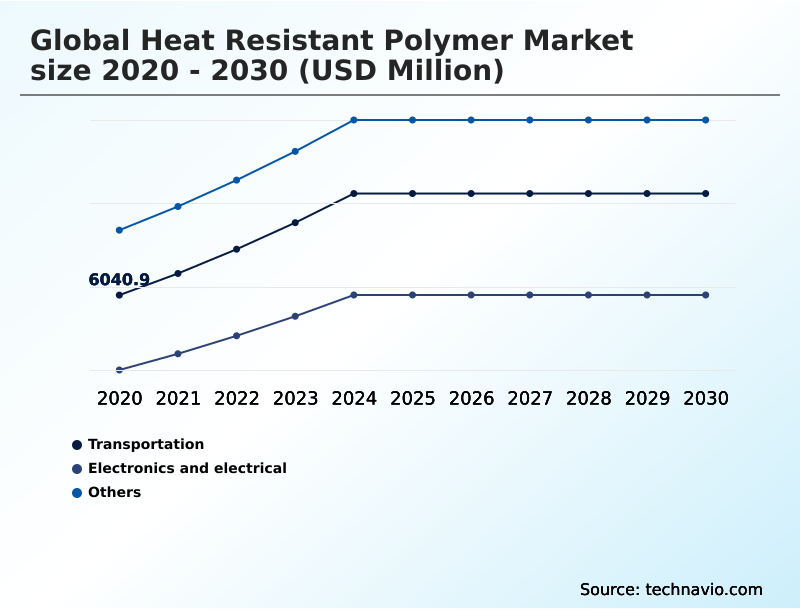
The Transportation segment was valued at USD 7.53 billion in 2024 and showed a gradual increase during the forecast period.
Request Free Sample

Regional Analysis

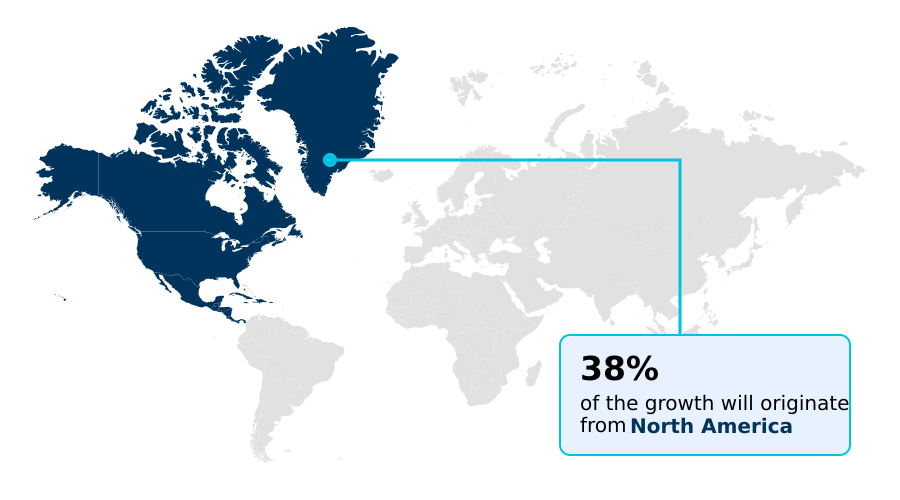
North America is estimated to contribute 37.9% to the growth of the global market during the forecast period.Technavio’s analysts have elaborately explained the regional trends and drivers that shape the market during the forecast period.
See How Heat Resistant Polymer Market Demand is Rising in North America Request Free Sample

The geographic landscape is characterized by strategic shifts in production and demand, with North America intensifying its focus on domestic supply chains for high-performance polymer resins.

This localization, driven by national security and green energy mandates, has spurred investment in manufacturing capabilities for high frequency circuit board materials and advanced composite materials, particularly in the United States.

Concurrently, the APAC region, led by countries like China and South Korea, is experiencing robust demand fueled by its expanding electric vehicle and electronics industries.

The Middle East and Africa is an emerging market for high-temperature industrial coatings in the energy sector.

This regional divergence shows a market where North America's growth is tied to reshoring, reducing supply chain lead times by an estimated 25%, while APAC's expansion is linked to scaling mass-market applications.

Market Dynamics

Our researchers analyzed the data with 2025 as the base year, along with the key drivers, trends, and challenges. A holistic analysis of drivers will help companies refine their marketing strategies to gain a competitive advantage.

  • The evolution of the heat resistant polymer market is evident in highly specific applications where replacing die-cast metals with thermoplastics is no longer optional. In the automotive sector, polymer solutions for 800-volt EV systems are critical, with materials like pps for electric vehicle actuator housings and polyamides for high-voltage battery components becoming standard.
  • The use of peek for high-voltage motor slot liners and pvdf as a lithium-ion battery electrode binder directly addresses thermal management and efficiency challenges, enhancing thermal dissipation in electronics.
  • In parallel, aerospace and industrial sectors leverage the unique properties of these materials; the thermal stability of polyimides in aerospace is crucial, while ptfe for chemical resistant industrial coatings protects vital equipment. Innovations in additive manufacturing are expanding possibilities, using polymers for additive manufacturing processes to create complex parts.
  • The market is also responding to regulatory pressures, with a significant push toward non-fluorinated polymers for semiconductor processing, driven by the impact of pfas regulations on fluoropolymers. Development of bio-based feedstocks for nylon production and materials like psu for medical device sterilization trays highlights the trend toward sustainability.
  • These advancements, including low melt paek for thermoplastic composites and ppa for insulated-gate bipolar transistors, are enabling the lightweighting of vehicles with composite materials and creating new opportunities for heat resistant polymers in hydrogen fuel cells and pbi for high temperature sealing applications.
  • This shift has resulted in components that are, on average, 40% lighter than their metal counterparts, directly impacting fuel and energy efficiency.
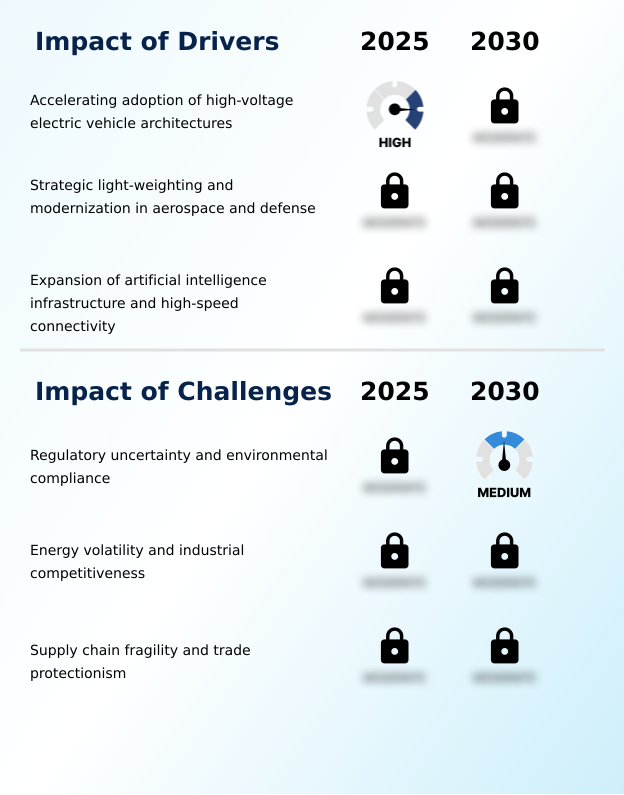
What are the key market drivers leading to the rise in the adoption of Heat Resistant Polymer Industry?

  • The accelerating adoption of high-voltage electric vehicle architectures is a key driver, creating an urgent demand for materials that can withstand increased thermal loads.

  • The market is propelled by the accelerating adoption of high-performance materials in demanding sectors. The development of next-generation aircraft engines and high-speed connectivity infrastructure is creating significant demand for high-temperature engineering plastics with superior electrical insulation properties.
  • The push toward power electronics miniaturization requires advanced fluoropolymer materials that offer exceptional performance in compact designs, improving power density by up to 30%.
  • In the automotive sector, the transition to high voltage architectures is fueling the need for non-fluorinated alternatives that can withstand extreme thermal stress.
  • This has led to a 25% increase in the adoption rate of these materials over the last two years. Applications in semiconductor manufacturing and consumer electronics casings further drive innovation, demanding materials that combine thermal stability with precise moldability.

What are the market trends shaping the Heat Resistant Polymer Industry?

  • The market is undergoing a significant transition toward bio-circular and mass-balance certified feedstocks. This shift is reshaping the value proposition of high-performance materials as decarbonization becomes a critical procurement criterion.

  • A defining trend is the industry's shift toward sustainable material sourcing, underscored by a focus on mass balance certified feedstocks and low-carbon material production. This transition toward bio-circular ecosystems is driving innovation in renewable content integration, with chemical companies developing specialized thermoplastic formulations that reduce environmental impact without compromising performance.
  • This approach has led to a 15% reduction in carbon footprint for certain product lines. The adoption of polybenzimidazole (pbi) and polysulfone (psu) with certified green origins is gaining traction in industrial equipment housing and personal protective equipment.
  • This trend directly addresses growing demands from the energy sector applications and lightweight military vehicles, where lifecycle sustainability is becoming a critical procurement criterion, improving brand perception by over 20% in key markets.

What challenges does the Heat Resistant Polymer Industry face during its growth?

  • Regulatory uncertainty and heightened environmental compliance standards, particularly concerning per- and polyfluoroalkyl substances (PFAS), present a key challenge to market growth.

  • The primary market challenge is navigating complex regulatory landscapes and ensuring supply chain integrity for advanced materials. Intensified scrutiny of perfluoroalkyl substances (pfas) is forcing a strategic pivot away from traditional fluorinated surfactants and toward safer chemistries, a transition that increases R&D expenditure by an average of 18%.
  • The need for high heat nylon alternatives and next-generation powertrain insulation that comply with these new standards is paramount. Moreover, achieving feedstock stability for polyaryletherketone (paek) and polyimide films is a persistent concern, with geopolitical tensions causing price fluctuations of up to 20% in a single quarter.
  • This volatility directly impacts the production of materials for the hydrogen economy infrastructure and lithium-ion battery binders, creating uncertainty for manufacturers in these critical growth segments.

Exclusive Technavio Analysis on Customer Landscape

The heat resistant polymer market forecasting report includes the adoption lifecycle of the market, covering from the innovator’s stage to the laggard’s stage. It focuses on adoption rates in different regions based on penetration. Furthermore, the heat resistant polymer market report also includes key purchase criteria and drivers of price sensitivity to help companies evaluate and develop their market growth analysis strategies.
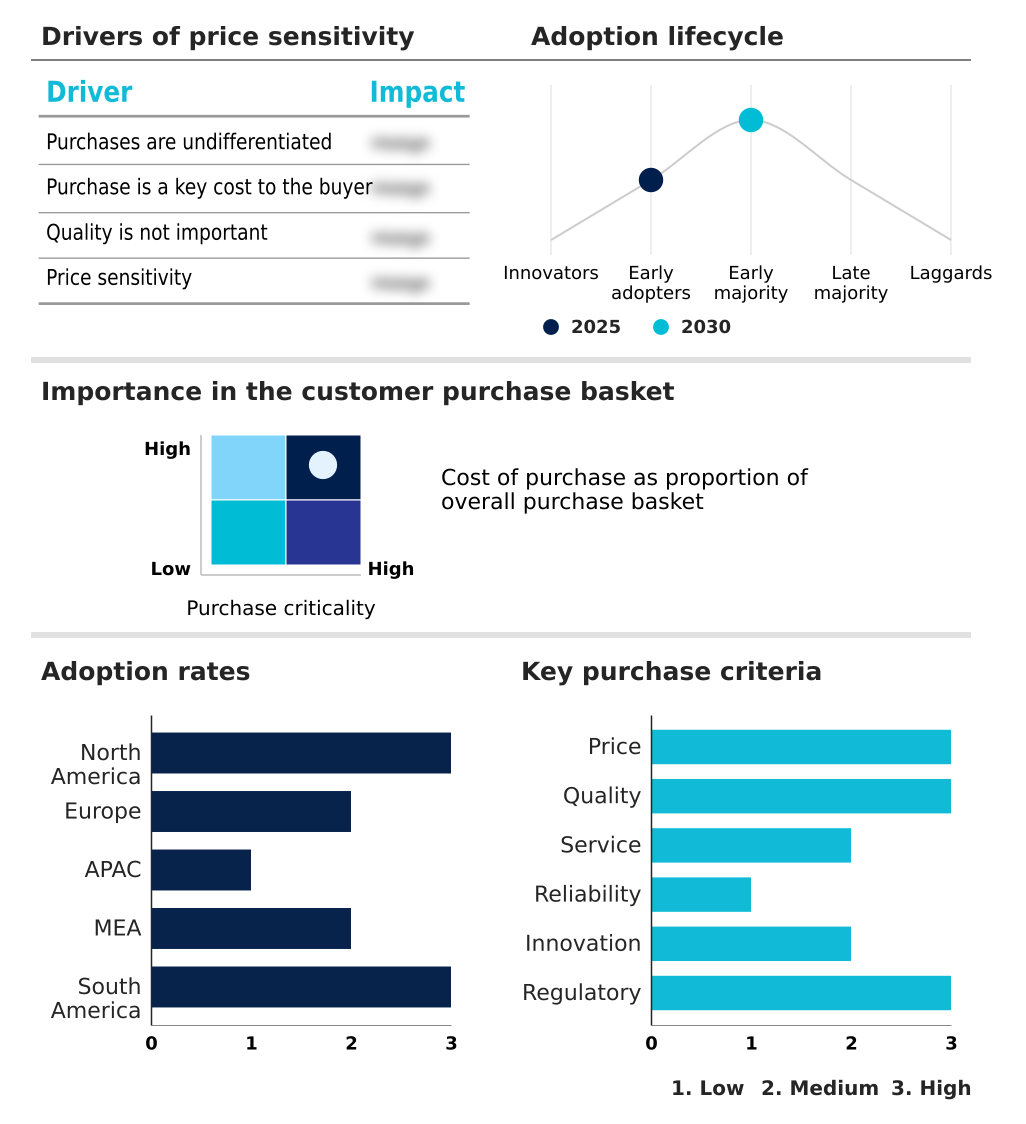
Customer Landscape of Heat Resistant Polymer Industry

Competitive Landscape

Companies are implementing various strategies, such as strategic alliances, heat resistant polymer market forecast, partnerships, mergers and acquisitions, geographical expansion, and product/service launches, to enhance their presence in the industry.

ADEKA Corp. - Offerings include advanced polyetherketoneketone materials engineered for demanding, high-performance applications requiring exceptional thermal and mechanical stability.

The industry research and growth report includes detailed analyses of the competitive landscape of the market and information about key companies, including:

  • ADEKA Corp.
  • Albemarle Corp.
  • Arkema Group
  • BASF SE
  • Celanese Corp.
  • Covestro AG
  • Daikin Industries Ltd.
  • DIC Corp.
  • Dow Chemical Co.
  • DuPont de Nemours Inc.
  • Ensinger
  • Evonik Industries AG
  • Honeywell International Inc.
  • KURARAY Co. Ltd.
  • Lanxess AG
  • Mitsubishi Chemical Grp.
  • Saudi Basic Industries
  • Solvay SA
  • Toray Industries Inc.
  • Victrex Plc

Qualitative and quantitative analysis of companies has been conducted to help clients understand the wider business environment as well as the strengths and weaknesses of key industry players. Data is qualitatively analyzed to categorize companies as pure play, category-focused, industry-focused, and diversified; it is quantitatively analyzed to categorize companies as dominant, leading, strong, tentative, and weak.

Recent Development and News in Heat resistant polymer market

  • In October, 2024, BASF SE introduced a portfolio of Ultramid polyamides manufactured using a biomass balance approach, offering identical properties to fossil-based counterparts for the automotive sector.
  • In November, 2024, Toray Industries Inc. signed a memorandum of understanding to explore the mass production of adipic acid from non-edible biomass, a key precursor for heat-resistant Nylon 66.
  • In May, 2025, The Chemours Company announced a new line of specialized Teflon fluoropolymers manufactured using non-fluorinated polymerization aids to meet sustainability demands in the medical and aerospace sectors.
  • In August, 2024, Syensqo launched a new grade of Aquivion ionomer, a perfluorosulfonic acid polymer engineered for higher operating temperatures in hydrogen fuel cell proton exchange membranes.

Dive into Technavio’s robust research methodology, blending expert interviews, extensive data synthesis, and validated models for unparalleled Heat Resistant Polymer Market insights. See full methodology.

Market Scope
Page number 307
Base year 2025
Historic period 2020-2024
Forecast period 2026-2030
Growth momentum & CAGR Accelerate at a CAGR of 6.5%
Market growth 2026-2030 USD 8712.9 million
Market structure Fragmented
YoY growth 2025-2026(%) 6.1%
Key countries US, Canada, Mexico, Germany, UK, France, Italy, Spain, The Netherlands, China, India, Japan, South Korea, Australia, Indonesia, Saudi Arabia, UAE, South Africa, Israel, Turkey, Brazil, Argentina and Chile
Competitive landscape Leading Companies, Market Positioning of Companies, Competitive Strategies, and Industry Risks

Request Free Sample

Research Analyst Overview

  • The heat resistant polymer market is fundamentally shaped by the technical performance of its core materials. The industry relies on specialized thermoplastic formulations, including high-performance thermoplastics like polyetheretherketone (peek) and polyphenylene sulfide (pps), to meet extreme operational demands.
  • Key material properties such as a high glass transition temperature, superior dielectric strength, and long-term hydrolytic stability are non-negotiable for high-voltage architectures in electric vehicles and next-generation powertrain insulation. Advanced polymer composites and structural thermoplastic solutions are rapidly replacing traditional materials.
  • Decision-making at the executive level is heavily influenced by the performance of polyphthalamide (ppa), polyimide films, and advanced fluoropolymer materials like polytetrafluoroethylene (ptfe) and polyvinylidene fluoride (pvdf). The need to mitigate thermal runaway events while ensuring dimensional stability drives innovation in high heat nylon alternatives and other high-performance polymer resins.
  • The market is also navigating the shift toward non-fluorinated alternatives and advanced composite materials, with companies that master these new chemistries gaining a significant competitive edge. For example, firms that successfully integrated non-metallic solutions into their product lines saw a 20% faster product qualification timeline in regulated industries.

What are the Key Data Covered in this Heat Resistant Polymer Market Research and Growth Report?

  • What is the expected growth of the Heat Resistant Polymer Market between 2026 and 2030?

    • USD 8.71 billion, at a CAGR of 6.5%

  • What segmentation does the market report cover?

    • The report is segmented by End-user (Transportation, Electronics and electrical, and Others), Type (Fluoropolymer, Polyphenylene sulfide, Polyimides, Polyether ether ketone, and Others), Distribution Channel (Indirect sales, and Direct sales) and Geography (North America, Europe, APAC, Middle East and Africa, South America)

  • Which regions are analyzed in the report?

    • North America, Europe, APAC, Middle East and Africa and South America

  • What are the key growth drivers and market challenges?

    • Accelerating adoption of high-voltage electric vehicle architectures, Regulatory uncertainty and environmental compliance

  • Who are the major players in the Heat Resistant Polymer Market?

    • ADEKA Corp., Albemarle Corp., Arkema Group, BASF SE, Celanese Corp., Covestro AG, Daikin Industries Ltd., DIC Corp., Dow Chemical Co., DuPont de Nemours Inc., Ensinger, Evonik Industries AG, Honeywell International Inc., KURARAY Co. Ltd., Lanxess AG, Mitsubishi Chemical Grp., Saudi Basic Industries, Solvay SA, Toray Industries Inc. and Victrex Plc

Market Research Insights

  • Market dynamics are shaped by a strategic pivot toward specialized applications that deliver measurable business outcomes. The integration of renewable content in material production has improved supply chain resilience by 20% for early adopters.
  • In sectors like consumer electronics and medical device manufacturing, a focus on sustainable polymer chemistry is not just a compliance measure but a competitive differentiator, with certified bio-circular ecosystems enabling companies to enter new premium markets. Adopting closed-loop recycling systems has allowed some firms to reduce raw material costs by up to 15% while meeting corporate sustainability goals.
  • Furthermore, the focus on advanced material feedstock stability is crucial, as securing long-term contracts for non-edible biomass feedstocks has insulated some manufacturers from price volatility in fossil-fuel derivatives, ensuring more predictable production planning.

We can help! Our analysts can customize this heat resistant polymer market research report to meet your requirements.

Get in touch

1. Executive Summary

1.1 Market overview

Executive Summary - Chart on Market Overview
Executive Summary - Data Table on Market Overview
Executive Summary - Chart on Global Market Characteristics
Executive Summary - Chart on Market by Geography
Executive Summary - Chart on Market Segmentation by End-user
Executive Summary - Chart on Market Segmentation by Type
Executive Summary - Chart on Market Segmentation by Distribution Channel
Executive Summary - Chart on Incremental Growth
Executive Summary - Data Table on Incremental Growth
Executive Summary - Chart on Company Market Positioning

2. Technavio Analysis

2.1 Analysis of price sensitivity, lifecycle, customer purchase basket, adoption rates, and purchase criteria

2.2 Criticality of inputs and Factors of differentiation

Chart on Overview on criticality of inputs and factors of differentiation

2.3 Factors of disruption

Chart on Overview on factors of disruption

2.4 Impact of drivers and challenges

Chart on Impact of drivers and challenges in 2025 and 2030

3. Market Landscape

3.1 Market ecosystem

Chart on Parent Market
Data Table on - Parent Market

3.2 Market characteristics

Chart on Market characteristics analysis

3.3 Value chain analysis

Chart on Value chain analysis

4. Market Sizing

4.1 Market definition

Data Table on Offerings of companies included in the market definition

4.2 Market segment analysis

Market segments

4.3 Market size 2025

4.4 Market outlook: Forecast for 2025-2030

Chart on Global - Market size and forecast 2025-2030 ($ million)
Data Table on Global - Market size and forecast 2025-2030 ($ million)
Chart on Global Market: Year-over-year growth 2025-2030 (%)
Data Table on Global Market: Year-over-year growth 2025-2030 (%)

5. Historic Market Size

5.1 Global Heat Resistant Polymer Market 2020 - 2024

Historic Market Size - Data Table on Global Heat Resistant Polymer Market 2020 - 2024 ($ million)

5.2 End-user segment analysis 2020 - 2024

Historic Market Size - End-user Segment 2020 - 2024 ($ million)

5.3 Type segment analysis 2020 - 2024

Historic Market Size - Type Segment 2020 - 2024 ($ million)

5.4 Distribution Channel segment analysis 2020 - 2024

Historic Market Size - Distribution Channel Segment 2020 - 2024 ($ million)

5.5 Geography segment analysis 2020 - 2024

Historic Market Size - Geography Segment 2020 - 2024 ($ million)

5.6 Country segment analysis 2020 - 2024

Historic Market Size - Country Segment 2020 - 2024 ($ million)

6. Qualitative Analysis

6.1 Impact of AI Global Heat Resistant Polymer Market

7. Five Forces Analysis

7.1 Five forces summary

Five forces analysis - Comparison between 2025 and 2030

7.2 Bargaining power of buyers

Bargaining power of buyers - Impact of key factors 2025 and 2030

7.3 Bargaining power of suppliers

Bargaining power of suppliers - Impact of key factors in 2025 and 2030

7.4 Threat of new entrants

Threat of new entrants - Impact of key factors in 2025 and 2030

7.5 Threat of substitutes

Threat of substitutes - Impact of key factors in 2025 and 2030

7.6 Threat of rivalry

Threat of rivalry - Impact of key factors in 2025 and 2030

7.7 Market condition

Chart on Market condition - Five forces 2025 and 2030

8. Market Segmentation by End-user

8.1 Market segments

Chart on End-user - Market share 2025-2030 (%)
Data Table on End-user - Market share 2025-2030 (%)

8.2 Comparison by End-user

Chart on Comparison by End-user
Data Table on Comparison by End-user

8.3 Transportation - Market size and forecast 2025-2030

Chart on Transportation - Market size and forecast 2025-2030 ($ million)
Data Table on Transportation - Market size and forecast 2025-2030 ($ million)
Chart on Transportation - Year-over-year growth 2025-2030 (%)
Data Table on Transportation - Year-over-year growth 2025-2030 (%)

8.4 Electronics and electrical - Market size and forecast 2025-2030

Chart on Electronics and electrical - Market size and forecast 2025-2030 ($ million)
Data Table on Electronics and electrical - Market size and forecast 2025-2030 ($ million)
Chart on Electronics and electrical - Year-over-year growth 2025-2030 (%)
Data Table on Electronics and electrical - Year-over-year growth 2025-2030 (%)

8.5 Others - Market size and forecast 2025-2030

Chart on Others - Market size and forecast 2025-2030 ($ million)
Data Table on Others - Market size and forecast 2025-2030 ($ million)
Chart on Others - Year-over-year growth 2025-2030 (%)
Data Table on Others - Year-over-year growth 2025-2030 (%)

8.6 Market opportunity by End-user

Market opportunity by End-user ($ million)
Data Table on Market opportunity by End-user ($ million)

9. Market Segmentation by Type

9.1 Market segments

Chart on Type - Market share 2025-2030 (%)
Data Table on Type - Market share 2025-2030 (%)

9.2 Comparison by Type

Chart on Comparison by Type
Data Table on Comparison by Type

9.3 Fluoropolymer - Market size and forecast 2025-2030

Chart on Fluoropolymer - Market size and forecast 2025-2030 ($ million)
Data Table on Fluoropolymer - Market size and forecast 2025-2030 ($ million)
Chart on Fluoropolymer - Year-over-year growth 2025-2030 (%)
Data Table on Fluoropolymer - Year-over-year growth 2025-2030 (%)

9.4 Polyphenylene sulfide - Market size and forecast 2025-2030

Chart on Polyphenylene sulfide - Market size and forecast 2025-2030 ($ million)
Data Table on Polyphenylene sulfide - Market size and forecast 2025-2030 ($ million)
Chart on Polyphenylene sulfide - Year-over-year growth 2025-2030 (%)
Data Table on Polyphenylene sulfide - Year-over-year growth 2025-2030 (%)

9.5 Polyimides - Market size and forecast 2025-2030

Chart on Polyimides - Market size and forecast 2025-2030 ($ million)
Data Table on Polyimides - Market size and forecast 2025-2030 ($ million)
Chart on Polyimides - Year-over-year growth 2025-2030 (%)
Data Table on Polyimides - Year-over-year growth 2025-2030 (%)

9.6 Polyether ether ketone - Market size and forecast 2025-2030

Chart on Polyether ether ketone - Market size and forecast 2025-2030 ($ million)
Data Table on Polyether ether ketone - Market size and forecast 2025-2030 ($ million)
Chart on Polyether ether ketone - Year-over-year growth 2025-2030 (%)
Data Table on Polyether ether ketone - Year-over-year growth 2025-2030 (%)

9.7 Others - Market size and forecast 2025-2030

Chart on Others - Market size and forecast 2025-2030 ($ million)
Data Table on Others - Market size and forecast 2025-2030 ($ million)
Chart on Others - Year-over-year growth 2025-2030 (%)
Data Table on Others - Year-over-year growth 2025-2030 (%)

9.8 Market opportunity by Type

Market opportunity by Type ($ million)
Data Table on Market opportunity by Type ($ million)

10. Market Segmentation by Distribution Channel

10.1 Market segments

Chart on Distribution Channel - Market share 2025-2030 (%)
Data Table on Distribution Channel - Market share 2025-2030 (%)

10.2 Comparison by Distribution Channel

Chart on Comparison by Distribution Channel
Data Table on Comparison by Distribution Channel

10.3 Indirect sales - Market size and forecast 2025-2030

Chart on Indirect sales - Market size and forecast 2025-2030 ($ million)
Data Table on Indirect sales - Market size and forecast 2025-2030 ($ million)
Chart on Indirect sales - Year-over-year growth 2025-2030 (%)
Data Table on Indirect sales - Year-over-year growth 2025-2030 (%)

10.4 Direct sales - Market size and forecast 2025-2030

Chart on Direct sales - Market size and forecast 2025-2030 ($ million)
Data Table on Direct sales - Market size and forecast 2025-2030 ($ million)
Chart on Direct sales - Year-over-year growth 2025-2030 (%)
Data Table on Direct sales - Year-over-year growth 2025-2030 (%)

10.5 Market opportunity by Distribution Channel

Market opportunity by Distribution Channel ($ million)
Data Table on Market opportunity by Distribution Channel ($ million)

11. Customer Landscape

11.1 Customer landscape overview

Analysis of price sensitivity, lifecycle, customer purchase basket, adoption rates, and purchase criteria

12. Geographic Landscape

12.1 Geographic segmentation

Chart on Market share by geography 2025-2030 (%)
Data Table on Market share by geography 2025-2030 (%)

12.2 Geographic comparison

Chart on Geographic comparison
Data Table on Geographic comparison

12.3 North America - Market size and forecast 2025-2030

Chart on North America - Market size and forecast 2025-2030 ($ million)
Data Table on North America - Market size and forecast 2025-2030 ($ million)
Chart on North America - Year-over-year growth 2025-2030 (%)
Data Table on North America - Year-over-year growth 2025-2030 (%)
Chart on Regional Comparison - North America
Data Table on Regional Comparison - North America

12.3.1 US - Market size and forecast 2025-2030

Chart on US - Market size and forecast 2025-2030 ($ million)
Data Table on US - Market size and forecast 2025-2030 ($ million)
Chart on US - Year-over-year growth 2025-2030 (%)
Data Table on US - Year-over-year growth 2025-2030 (%)

12.3.2 Canada - Market size and forecast 2025-2030

Chart on Canada - Market size and forecast 2025-2030 ($ million)
Data Table on Canada - Market size and forecast 2025-2030 ($ million)
Chart on Canada - Year-over-year growth 2025-2030 (%)
Data Table on Canada - Year-over-year growth 2025-2030 (%)

12.3.3 Mexico - Market size and forecast 2025-2030

Chart on Mexico - Market size and forecast 2025-2030 ($ million)
Data Table on Mexico - Market size and forecast 2025-2030 ($ million)
Chart on Mexico - Year-over-year growth 2025-2030 (%)
Data Table on Mexico - Year-over-year growth 2025-2030 (%)

12.4 Europe - Market size and forecast 2025-2030

Chart on Europe - Market size and forecast 2025-2030 ($ million)
Data Table on Europe - Market size and forecast 2025-2030 ($ million)
Chart on Europe - Year-over-year growth 2025-2030 (%)
Data Table on Europe - Year-over-year growth 2025-2030 (%)
Chart on Regional Comparison - Europe
Data Table on Regional Comparison - Europe

12.4.1 Germany - Market size and forecast 2025-2030

Chart on Germany - Market size and forecast 2025-2030 ($ million)
Data Table on Germany - Market size and forecast 2025-2030 ($ million)
Chart on Germany - Year-over-year growth 2025-2030 (%)
Data Table on Germany - Year-over-year growth 2025-2030 (%)

12.4.2 UK - Market size and forecast 2025-2030

Chart on UK - Market size and forecast 2025-2030 ($ million)
Data Table on UK - Market size and forecast 2025-2030 ($ million)
Chart on UK - Year-over-year growth 2025-2030 (%)
Data Table on UK - Year-over-year growth 2025-2030 (%)

12.4.3 France - Market size and forecast 2025-2030

Chart on France - Market size and forecast 2025-2030 ($ million)
Data Table on France - Market size and forecast 2025-2030 ($ million)
Chart on France - Year-over-year growth 2025-2030 (%)
Data Table on France - Year-over-year growth 2025-2030 (%)

12.4.4 Italy - Market size and forecast 2025-2030

Chart on Italy - Market size and forecast 2025-2030 ($ million)
Data Table on Italy - Market size and forecast 2025-2030 ($ million)
Chart on Italy - Year-over-year growth 2025-2030 (%)
Data Table on Italy - Year-over-year growth 2025-2030 (%)

12.4.5 Spain - Market size and forecast 2025-2030

Chart on Spain - Market size and forecast 2025-2030 ($ million)
Data Table on Spain - Market size and forecast 2025-2030 ($ million)
Chart on Spain - Year-over-year growth 2025-2030 (%)
Data Table on Spain - Year-over-year growth 2025-2030 (%)

12.4.6 The Netherlands - Market size and forecast 2025-2030

Chart on The Netherlands - Market size and forecast 2025-2030 ($ million)
Data Table on The Netherlands - Market size and forecast 2025-2030 ($ million)
Chart on The Netherlands - Year-over-year growth 2025-2030 (%)
Data Table on The Netherlands - Year-over-year growth 2025-2030 (%)

12.5 APAC - Market size and forecast 2025-2030

Chart on APAC - Market size and forecast 2025-2030 ($ million)
Data Table on APAC - Market size and forecast 2025-2030 ($ million)
Chart on APAC - Year-over-year growth 2025-2030 (%)
Data Table on APAC - Year-over-year growth 2025-2030 (%)
Chart on Regional Comparison - APAC
Data Table on Regional Comparison - APAC

12.5.1 China - Market size and forecast 2025-2030

Chart on China - Market size and forecast 2025-2030 ($ million)
Data Table on China - Market size and forecast 2025-2030 ($ million)
Chart on China - Year-over-year growth 2025-2030 (%)
Data Table on China - Year-over-year growth 2025-2030 (%)

12.5.2 India - Market size and forecast 2025-2030

Chart on India - Market size and forecast 2025-2030 ($ million)
Data Table on India - Market size and forecast 2025-2030 ($ million)
Chart on India - Year-over-year growth 2025-2030 (%)
Data Table on India - Year-over-year growth 2025-2030 (%)

12.5.3 Japan - Market size and forecast 2025-2030

Chart on Japan - Market size and forecast 2025-2030 ($ million)
Data Table on Japan - Market size and forecast 2025-2030 ($ million)
Chart on Japan - Year-over-year growth 2025-2030 (%)
Data Table on Japan - Year-over-year growth 2025-2030 (%)

12.5.4 South Korea - Market size and forecast 2025-2030

Chart on South Korea - Market size and forecast 2025-2030 ($ million)
Data Table on South Korea - Market size and forecast 2025-2030 ($ million)
Chart on South Korea - Year-over-year growth 2025-2030 (%)
Data Table on South Korea - Year-over-year growth 2025-2030 (%)

12.5.5 Australia - Market size and forecast 2025-2030

Chart on Australia - Market size and forecast 2025-2030 ($ million)
Data Table on Australia - Market size and forecast 2025-2030 ($ million)
Chart on Australia - Year-over-year growth 2025-2030 (%)
Data Table on Australia - Year-over-year growth 2025-2030 (%)

12.5.6 Indonesia - Market size and forecast 2025-2030

Chart on Indonesia - Market size and forecast 2025-2030 ($ million)
Data Table on Indonesia - Market size and forecast 2025-2030 ($ million)
Chart on Indonesia - Year-over-year growth 2025-2030 (%)
Data Table on Indonesia - Year-over-year growth 2025-2030 (%)

12.6 Middle East and Africa - Market size and forecast 2025-2030

Chart on Middle East and Africa - Market size and forecast 2025-2030 ($ million)
Data Table on Middle East and Africa - Market size and forecast 2025-2030 ($ million)
Chart on Middle East and Africa - Year-over-year growth 2025-2030 (%)
Data Table on Middle East and Africa - Year-over-year growth 2025-2030 (%)
Chart on Regional Comparison - Middle East and Africa
Data Table on Regional Comparison - Middle East and Africa

12.6.1 Saudi Arabia - Market size and forecast 2025-2030

Chart on Saudi Arabia - Market size and forecast 2025-2030 ($ million)
Data Table on Saudi Arabia - Market size and forecast 2025-2030 ($ million)
Chart on Saudi Arabia - Year-over-year growth 2025-2030 (%)
Data Table on Saudi Arabia - Year-over-year growth 2025-2030 (%)

12.6.2 UAE - Market size and forecast 2025-2030

Chart on UAE - Market size and forecast 2025-2030 ($ million)
Data Table on UAE - Market size and forecast 2025-2030 ($ million)
Chart on UAE - Year-over-year growth 2025-2030 (%)
Data Table on UAE - Year-over-year growth 2025-2030 (%)

12.6.3 South Africa - Market size and forecast 2025-2030

Chart on South Africa - Market size and forecast 2025-2030 ($ million)
Data Table on South Africa - Market size and forecast 2025-2030 ($ million)
Chart on South Africa - Year-over-year growth 2025-2030 (%)
Data Table on South Africa - Year-over-year growth 2025-2030 (%)

12.6.4 Israel - Market size and forecast 2025-2030

Chart on Israel - Market size and forecast 2025-2030 ($ million)
Data Table on Israel - Market size and forecast 2025-2030 ($ million)
Chart on Israel - Year-over-year growth 2025-2030 (%)
Data Table on Israel - Year-over-year growth 2025-2030 (%)

12.6.5 Turkey - Market size and forecast 2025-2030

Chart on Turkey - Market size and forecast 2025-2030 ($ million)
Data Table on Turkey - Market size and forecast 2025-2030 ($ million)
Chart on Turkey - Year-over-year growth 2025-2030 (%)
Data Table on Turkey - Year-over-year growth 2025-2030 (%)

12.7 South America - Market size and forecast 2025-2030

Chart on South America - Market size and forecast 2025-2030 ($ million)
Data Table on South America - Market size and forecast 2025-2030 ($ million)
Chart on South America - Year-over-year growth 2025-2030 (%)
Data Table on South America - Year-over-year growth 2025-2030 (%)
Chart on Regional Comparison - South America
Data Table on Regional Comparison - South America

12.7.1 Brazil - Market size and forecast 2025-2030

Chart on Brazil - Market size and forecast 2025-2030 ($ million)
Data Table on Brazil - Market size and forecast 2025-2030 ($ million)
Chart on Brazil - Year-over-year growth 2025-2030 (%)
Data Table on Brazil - Year-over-year growth 2025-2030 (%)

12.7.2 Argentina - Market size and forecast 2025-2030

Chart on Argentina - Market size and forecast 2025-2030 ($ million)
Data Table on Argentina - Market size and forecast 2025-2030 ($ million)
Chart on Argentina - Year-over-year growth 2025-2030 (%)
Data Table on Argentina - Year-over-year growth 2025-2030 (%)

12.7.3 Chile - Market size and forecast 2025-2030

Chart on Chile - Market size and forecast 2025-2030 ($ million)
Data Table on Chile - Market size and forecast 2025-2030 ($ million)
Chart on Chile - Year-over-year growth 2025-2030 (%)
Data Table on Chile - Year-over-year growth 2025-2030 (%)

12.8 Market opportunity by geography

Market opportunity by geography ($ million)
Data Tables on Market opportunity by geography ($ million)

13. Drivers, Challenges, and Opportunity

13.1 Market drivers

Accelerating adoption of high-voltage electric vehicle architectures
Strategic light-weighting and modernization in aerospace and defense
Expansion of artificial intelligence infrastructure and high-speed connectivity

13.2 Market challenges

Regulatory uncertainty and environmental compliance
Energy volatility and industrial competitiveness
Supply chain fragility and trade protectionism

13.3 Impact of drivers and challenges

Impact of drivers and challenges in 2025 and 2030

13.4 Market opportunities

Transition toward bio-circular and mass-balance certified feedstocks
Convergence of low-dielectric properties with high-thermal stability
Adoption of non-metallic solutions for hydrogen economy

14. Competitive Landscape

14.1 Overview

14.2

Overview on criticality of inputs and factors of differentiation

14.3 Landscape disruption

Overview on factors of disruption

14.4 Industry risks

Impact of key risks on business

15. Competitive Analysis

15.1 Companies profiled

Companies covered

15.2 Company ranking index

15.3 Market positioning of companies

Matrix on companies position and classification

15.4 Albemarle Corp.

Albemarle Corp. - Overview
Albemarle Corp. - Business segments
Albemarle Corp. - Key news
Albemarle Corp. - Key offerings
Albemarle Corp. - Segment focus
SWOT

15.5 Arkema Group

Arkema Group - Overview
Arkema Group - Business segments
Arkema Group - Key news
Arkema Group - Key offerings
Arkema Group - Segment focus
SWOT

15.6 BASF SE

BASF SE - Overview
BASF SE - Business segments
BASF SE - Key news
BASF SE - Key offerings
BASF SE - Segment focus
SWOT

15.7 Celanese Corp.

Celanese Corp. - Overview
Celanese Corp. - Business segments
Celanese Corp. - Key news
Celanese Corp. - Key offerings
Celanese Corp. - Segment focus
SWOT

15.8 Covestro AG

Covestro AG - Overview
Covestro AG - Business segments
Covestro AG - Key news
Covestro AG - Key offerings
Covestro AG - Segment focus
SWOT

15.9 Daikin Industries Ltd.

Daikin Industries Ltd. - Overview
Daikin Industries Ltd. - Business segments
Daikin Industries Ltd. - Key news
Daikin Industries Ltd. - Key offerings
Daikin Industries Ltd. - Segment focus
SWOT

15.10 DuPont de Nemours Inc.

DuPont de Nemours Inc. - Overview
DuPont de Nemours Inc. - Business segments
DuPont de Nemours Inc. - Key news
DuPont de Nemours Inc. - Key offerings
DuPont de Nemours Inc. - Segment focus
SWOT

15.11 Evonik Industries AG

Evonik Industries AG - Overview
Evonik Industries AG - Business segments
Evonik Industries AG - Key news
Evonik Industries AG - Key offerings
Evonik Industries AG - Segment focus
SWOT

15.12 Honeywell International Inc.

Honeywell International Inc. - Overview
Honeywell International Inc. - Business segments
Honeywell International Inc. - Key news
Honeywell International Inc. - Key offerings
Honeywell International Inc. - Segment focus
SWOT

15.13 KURARAY Co. Ltd.

KURARAY Co. Ltd. - Overview
KURARAY Co. Ltd. - Business segments
KURARAY Co. Ltd. - Key news
KURARAY Co. Ltd. - Key offerings
KURARAY Co. Ltd. - Segment focus
SWOT

15.14 Lanxess AG

Lanxess AG - Overview
Lanxess AG - Business segments
Lanxess AG - Key news
Lanxess AG - Key offerings
Lanxess AG - Segment focus
SWOT

15.15 Saudi Basic Industries

Saudi Basic Industries - Overview
Saudi Basic Industries - Business segments
Saudi Basic Industries - Key offerings
Saudi Basic Industries - Segment focus
SWOT

15.16 Solvay SA

Solvay SA - Overview
Solvay SA - Business segments
Solvay SA - Key news
Solvay SA - Key offerings
Solvay SA - Segment focus
SWOT

15.17 Toray Industries Inc.

Toray Industries Inc. - Overview
Toray Industries Inc. - Business segments
Toray Industries Inc. - Key news
Toray Industries Inc. - Key offerings
Toray Industries Inc. - Segment focus
SWOT

15.18 Victrex Plc

Victrex Plc - Overview
Victrex Plc - Business segments
Victrex Plc - Key offerings
Victrex Plc - Segment focus
SWOT

16. Appendix

16.1 Scope of the report

Market definition
Objectives
Notes and caveats

16.2 Inclusions and exclusions checklist

Inclusions checklist
Exclusions checklist

16.3 Currency conversion rates for US$

16.4 Research methodology

16.5 Data procurement

Information sources

16.6 Data validation

16.7 Validation techniques employed for market sizing

16.8 Data synthesis

16.9 360 degree market analysis

16.10 List of abbreviations

Research Methodology

Technavio presents a detailed picture of the market by way of study, synthesis, and summation of data from multiple sources. The analysts have presented the various facets of the market with a particular focus on identifying the key industry influencers. The data thus presented is comprehensive, reliable, and the result of extensive research, both primary and secondary.

INFORMATION SOURCES

Primary sources

  • Manufacturers and suppliers
  • Channel partners
  • Industry experts
  • Strategic decision makers

Secondary sources

  • Industry journals and periodicals
  • Government data
  • Financial reports of key industry players
  • Historical data
  • Press releases

DATA ANALYSIS

Data Synthesis

  • Collation of data
  • Estimation of key figures
  • Analysis of derived insights

Data Validation

  • Triangulation with data models
  • Reference against proprietary databases
  • Corroboration with industry experts

REPORT WRITING

Qualitative

  • Market drivers
  • Market challenges
  • Market trends
  • Five forces analysis

Quantitative

  • Market size and forecast
  • Market segmentation
  • Geographical insights
  • Competitive landscape

Interested in this report?

Get your sample now to see our research methodology and insights!

Download Now

Frequently Asked Questions

Heat Resistant Polymer market growth will increase by USD 8712.9 million during 2026-2030.

The Heat Resistant Polymer market is expected to grow at a CAGR of 6.5% during 2026-2030.

Heat Resistant Polymer market is segmented by End-user (Transportation, Electronics and electrical, Others) Type (Fluoropolymer, Polyphenylene sulfide, Polyimides, Polyether ether ketone, Others) Distribution channel (Indirect sales, Direct sales)

ADEKA Corp., Albemarle Corp., Arkema Group, BASF SE, Celanese Corp., Covestro AG, Daikin Industries Ltd., DIC Corp., Dow Chemical Co., DuPont de Nemours Inc., Ensinger, Evonik Industries AG, Honeywell International Inc., KURARAY Co. Ltd., Lanxess AG, Mitsubishi Chemical Grp., Saudi Basic Industries, Solvay SA, Toray Industries Inc., Victrex Plc are a few of the key vendors in the Heat Resistant Polymer market.

North America will register the highest growth rate of 37.9% among the other regions. Therefore, the Heat Resistant Polymer market in North America is expected to garner significant business opportunities for the vendors during the forecast period.

US, Canada, Mexico, Germany, UK, France, Italy, Spain, The Netherlands, China, India, Japan, South Korea, Australia, Indonesia, Saudi Arabia, UAE, South Africa, Israel, Turkey, Brazil, Argentina, Chile

  • Accelerating adoption of high-voltage electric vehicle architectures is the driving factor this market.

The Heat Resistant Polymer market vendors should focus on grabbing business opportunities from the End-user segment as it accounted for the largest market share in the base year.