


Hair Color Market Analysis, Size, and Forecast 2026-2030: Europe (Germany, UK, and France), North America (US, Canada, and Mexico), APAC (China, India, and Japan), South America (Brazil and Argentina), Middle East and Africa (South Africa, Saudi Arabia, and UAE), and Rest of World (ROW)

Hair Color Market Analysis, Size, and Forecast 2026-2030:
Europe (Germany, UK, and France), North America (US, Canada, and Mexico), APAC (China, India, and Japan), South America (Brazil and Argentina), Middle East and Africa (South Africa, Saudi Arabia, and UAE), and Rest of World (ROW)

Published: Mar 2026 304 Pages SKU: IRTNTR70032

Market Overview at a Glance

$11.40 B
Market Opportunity
6%
CAGR 2025 - 2030
30.7%
APAC Growth
$18.54 B
Permanent segment 2024

Hair Color Market Size 2026-2030

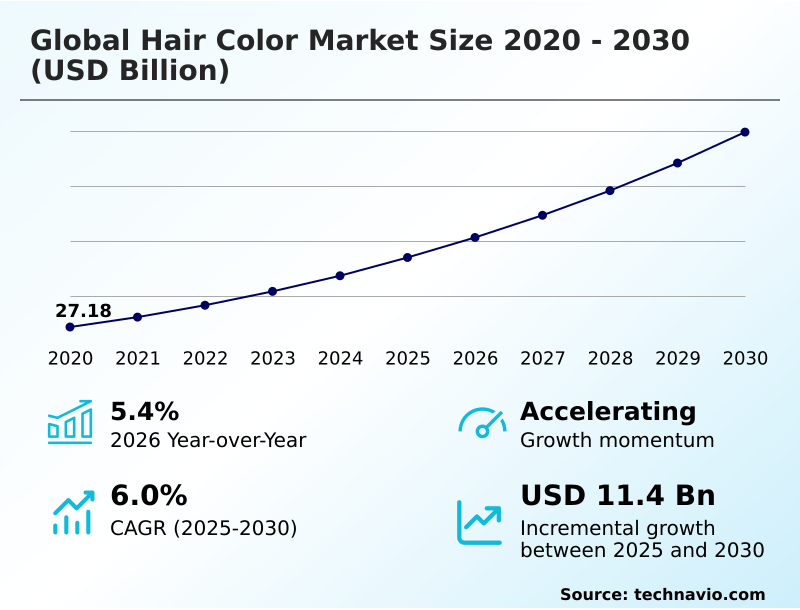
The hair color market size is valued to increase by USD 11.40 billion, at a CAGR of 6% from 2025 to 2030. Increasing fashion consciousness and trend adoption will drive the hair color market.

Major Market Trends & Insights

  • APAC dominated the market and accounted for a 30.7% growth during the forecast period.
  • By Product - Permanent segment was valued at USD 18.54 billion in 2024
  • By End-user - Women segment accounted for the largest market revenue share in 2024

Market Size & Forecast

  • Market Opportunities: USD 17.72 billion
  • Market Future Opportunities: USD 11.40 billion
  • CAGR from 2025 to 2030 : 6%

Market Summary

  • The hair color market is undergoing a significant transformation, driven by a confluence of consumer demand for self-expression and technological innovation. The industry is moving beyond basic color deposition to offer sophisticated at-home hair dye kits and professional salon color that prioritize hair health.
  • A key focus is the development of ammonia-free formulations and organic hair color products that incorporate plant-based pigments and bond-building technology, ensuring damage-free hair coloring. This shift addresses growing consumer health concerns and aligns with the clean beauty movement.
  • For instance, a mid-sized brand navigating this landscape might invest in reformulating its entire line of permanent hair dye to exclude certain chemicals, a process that requires significant R&D to maintain color vibrancy and longevity.
  • This scenario highlights the industry-wide challenge of balancing innovation, such as creating effective hair bleaching agents and hypoallergenic hair dye, with stringent regulatory demands and the high cost of sourcing premium, sustainable ingredients for gray coverage solutions.

What will be the Size of the Hair Color Market during the forecast period?
Get Key Insights on Market Forecast (PDF) Request Free Sample

How is the Hair Color Market Segmented?

The hair color industry research report provides comprehensive data (region-wise segment analysis), with forecasts and estimates in "USD million" for the period 2026-2030, as well as historical data from 2020-2024 for the following segments.

  • Product
    • Permanent
    • Semi-permanent
    • Temporary
    • Highlights and bleach
  • End-user
    • Women
    • Unisex
    • Men
  • Distribution channel
    • Offline
    • Online
  • Geography
    • Europe
      • Germany
      • UK
      • France
    • North America
      • US
      • Canada
      • Mexico
    • APAC
      • China
      • India
      • Japan
    • South America
      • Brazil
      • Argentina
    • Middle East and Africa
      • South Africa
      • Saudi Arabia
      • UAE
    • Rest of World (ROW)

By Product Insights

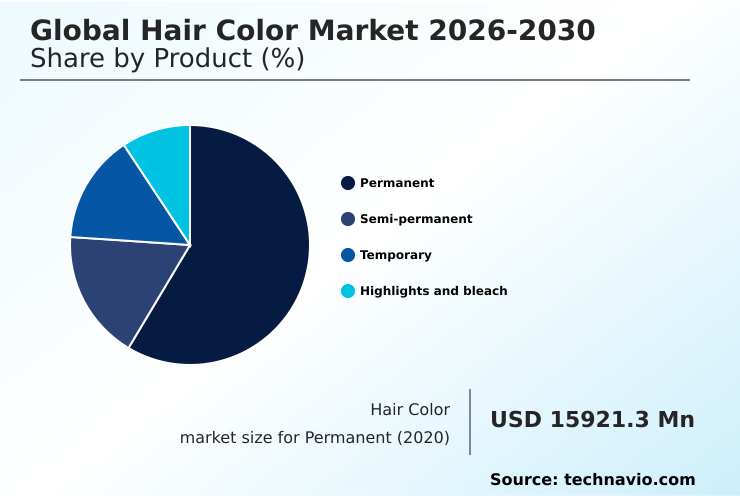
The permanent segment is estimated to witness significant growth during the forecast period.

The permanent segment continues to dominate the market, driven by consistent demand for long-lasting results and reliable gray coverage.

Innovation is centered on enhancing product safety and performance, with a focus on incorporating bond-building technology to minimize damage from hair bleaching agents.

Leading companies are developing advanced permanent hair dye formulations that also offer conditioning benefits, similar to color depositing conditioners.

The rise of direct-to-consumer models has bolstered this segment, with online sales growing by 18% as consumers seek convenient access to at-home balayage kits and root touch-up spray solutions.

The market is also seeing a rise in color gloss treatment options that extend the life of permanent color, alongside better hair color maintenance products for dark hair.
Request Free Sample

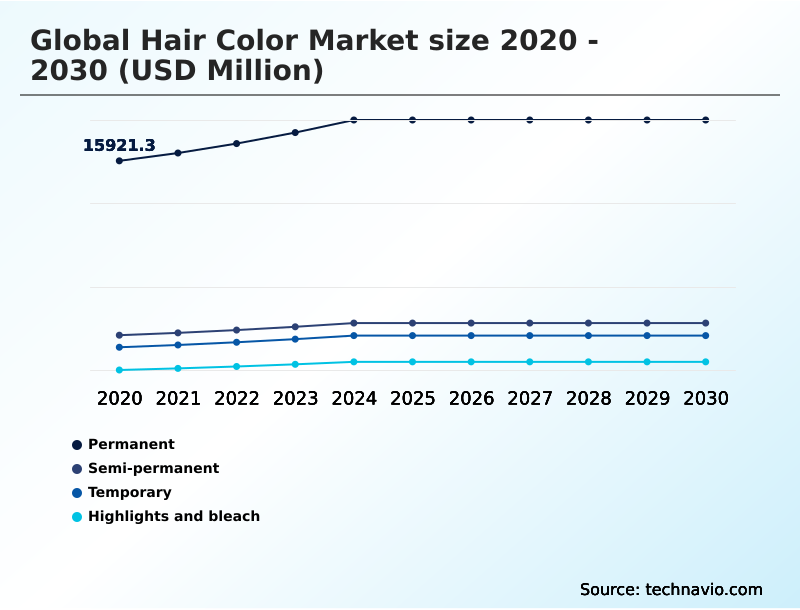
The Permanent segment was valued at USD 18.54 billion in 2024 and showed a gradual increase during the forecast period.
Request Free Sample

Regional Analysis

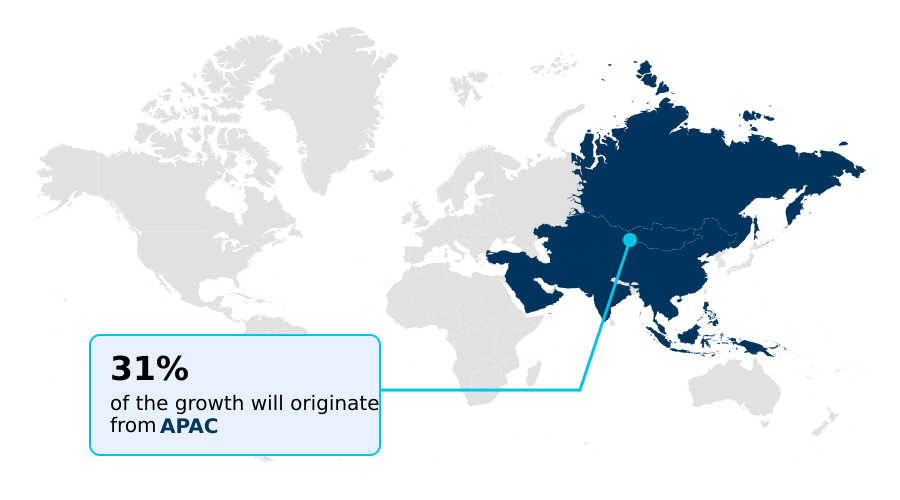
APAC is estimated to contribute 30.7% to the growth of the global market during the forecast period.Technavio’s analysts have elaborately explained the regional trends and drivers that shape the market during the forecast period.
See How Hair Color Market Demand is Rising in APAC Request Free Sample

The global geographic landscape is characterized by diverse regional growth patterns, with APAC poised to contribute 30.7% of the market's incremental growth, expanding at a rate of 7.4%.

This expansion is driven by rising disposable incomes and high demand for gray coverage solutions and professional salon color.

In contrast, North America, growing at 6.2%, exhibits mature market characteristics with a strong focus on premiumization, advanced hair coloring technology, and sophisticated at-home hair dye kits that offer salon quality hair color.

The region's advanced color chemistry and hair dye formulations cater to demand for professional-grade hair color at home and specialized products for dark hair.

European markets prioritize regulatory alignment and sustainability, while South America and the Middle East and Africa show growing interest in both accessible and premium options.

Market Dynamics

Our researchers analyzed the data with 2025 as the base year, along with the key drivers, trends, and challenges. A holistic analysis of drivers will help companies refine their marketing strategies to gain a competitive advantage.

  • The modern consumer journey in the hair color market often begins with specific, need-based online searches, such as finding the best at-home hair color for gray coverage or a temporary hair color for dark hair without bleach. This sophisticated demand drives manufacturers to innovate beyond conventional products.
  • Companies are now focused on educating consumers on how to use bond-building hair color at home to minimize damage and preserve hair integrity. In response to the clean beauty movement, significant investment is directed toward developing and marketing organic hair dye without PPD and ammonia.
  • For instance, creating such a formulation can increase R&D costs by over 25% compared to traditional dyes, a necessary expenditure to capture health-conscious demographics. The enduring debate over professional hair color vs box dye results is being addressed as brands launch salon-grade kits for home use, aiming to bridge the quality gap.
  • This trend reflects a broader industry effort to deliver personalized, safe, and high-performance solutions that align with the precise, long-tail queries of today's discerning consumer, ultimately shaping product development and marketing strategies.
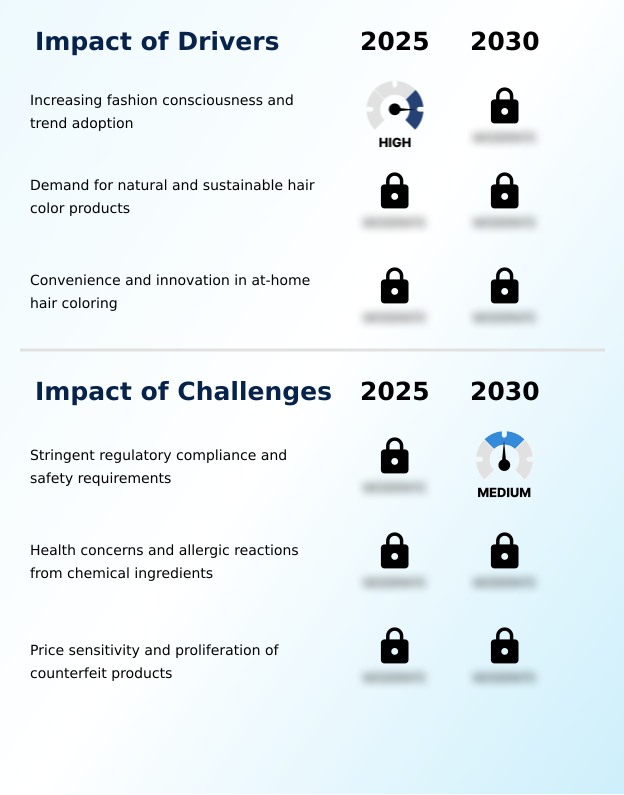
What are the key market drivers leading to the rise in the adoption of Hair Color Industry?

  • Increasing fashion consciousness and the rapid adoption of emerging beauty standards are key drivers propelling growth in the hair color market.

  • Market growth is significantly fueled by rising fashion consciousness and an increasing consumer preference for natural and sustainable products.
  • The demand for clean beauty hair dye has led to a surge in natural hair coloring options, with sales of organic hair color products increasing by 15% in key European retail channels.
  • This driver is compelling brands to develop sustainable hair color products using plant-based pigments that deliver long-lasting hair color.
  • Innovations in vegan hair coloring and keratin-infused color are meeting consumer expectations for performance without compromise, as evidenced by one new at-home product line winning a Product of the Year award.
  • Furthermore, the expansion of men's hair color products is opening new revenue streams for the industry.

What are the market trends shaping the Hair Color Industry?

  • The accelerated adoption of temporary and semi-permanent hair color options represents a prominent market trend, driven by consumer demand for low-commitment experimentation and frequent style changes.

  • Key market trends are centered on personalization and low-commitment options, reshaping product development and consumer engagement. The demand for temporary hair color and semi-permanent color continues to rise, with male consumer adoption in this segment increasing by 15%. This reflects a broader interest in vibrant hair color trends without long-term attachment.
  • Innovations in cream color formulations are enabling more multi-dimensional hair color and semi-permanent hair gloss effects. In parallel, technology is fueling the growth of personalized hair color, with customized hair color subscription services gaining traction.
  • This direct-to-consumer model is supported by strong digital commerce, with online sales for some brands growing by 18%, indicating a clear direction for hair color trends in 2026 and beyond.

What challenges does the Hair Color Industry face during its growth?

  • Stringent regulatory compliance and evolving safety requirements present a significant challenge, impacting product development, manufacturing costs, and global market access.

  • Navigating stringent regulatory compliance and addressing health concerns are primary challenges for the hair color market. The need to develop hair color for sensitive scalp and hypoallergenic hair dye requires significant R&D investment, with reformulation costs to remove targeted hair dye intermediates increasing by over 25%.
  • This pressure is pushing innovation in ammonia-free formulations and products like hair color without PPD and hair color without peroxide. Concurrently, premium hair color brands face margin erosion from counterfeit products, which can account for up to 10% of lost sales in some online marketplaces.
  • Ensuring product safety and performance across hair color for all hair types while managing costs remains a critical balancing act for manufacturers.

Exclusive Technavio Analysis on Customer Landscape

The hair color market forecasting report includes the adoption lifecycle of the market, covering from the innovator’s stage to the laggard’s stage. It focuses on adoption rates in different regions based on penetration. Furthermore, the hair color market report also includes key purchase criteria and drivers of price sensitivity to help companies evaluate and develop their market growth analysis strategies.
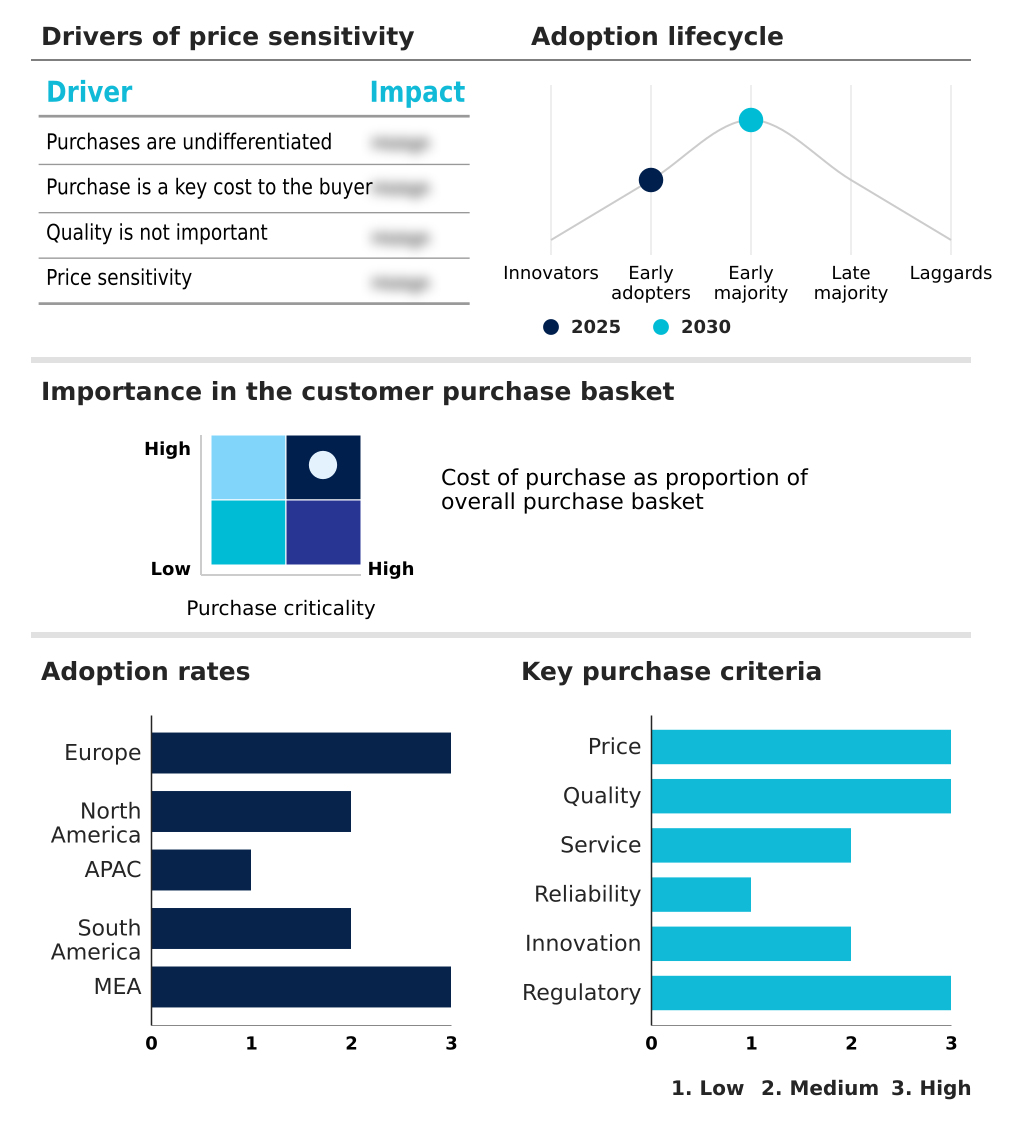
Customer Landscape of Hair Color Industry

Competitive Landscape

Companies are implementing various strategies, such as strategic alliances, hair color market forecast, partnerships, mergers and acquisitions, geographical expansion, and product/service launches, to enhance their presence in the industry.

Amway Corp. - A diversified portfolio addresses mass, premium, and professional segments, demonstrating broad market penetration and coloring innovation.

The industry research and growth report includes detailed analyses of the competitive landscape of the market and information about key companies, including:

  • Amway Corp.
  • Chatters LP
  • Coty Inc.
  • Godrej Enterprises Group
  • Henkel AG and Co. KGaA
  • John Paul Mitchell Systems
  • Kao Corp.
  • Loreal SA
  • Madison Reed Inc.
  • Natulique
  • Natura and Co Holding SA
  • Naturigin
  • Revlon Inc.
  • Shiseido Co. Ltd.
  • Surya Brasil USA
  • The Estee Lauder Co. Inc.
  • Tints of Nature
  • Tish and Snooky NYC Inc.

Qualitative and quantitative analysis of companies has been conducted to help clients understand the wider business environment as well as the strengths and weaknesses of key industry players. Data is qualitatively analyzed to categorize companies as pure play, category-focused, industry-focused, and diversified; it is quantitatively analyzed to categorize companies as dominant, leading, strong, tentative, and weak.

Recent Development and News in Hair color market

  • In August 2024, Madison Reed opened several new color bars in major urban centers to provide professional semi-permanent services and enhance its omnichannel presence.
  • In September 2024, Streax Professional unveiled Huemagic, a next-generation no-ammonia hair color, advancing hair coloring technology for both stylists and consumers by focusing on reduced chemical exposure.
  • In January 2025, Clairol introduced its ColorStrong range, which combines multi-faceted hues with advanced strengthening benefits to appeal to consumers focused on both aesthetics and hair vitality.
  • In May 2025, Schwarzkopf launched the Chapters of Change brand campaign, strategically highlighting hair color as a reflection of life transitions and personal empowerment to deepen consumer engagement.

Dive into Technavio’s robust research methodology, blending expert interviews, extensive data synthesis, and validated models for unparalleled Hair Color Market insights. See full methodology.

Market Scope
Page number 304
Base year 2025
Historic period 2020-2024
Forecast period 2026-2030
Growth momentum & CAGR Accelerate at a CAGR of 6%
Market growth 2026-2030 USD 11402.7 million
Market structure Fragmented
YoY growth 2025-2026(%) 5.4%
Key countries Germany, UK, France, Italy, Spain, The Netherlands, US, Canada, Mexico, China, India, Japan, South Korea, Indonesia, Australia, Brazil, Argentina, Chile, South Africa, Saudi Arabia, UAE, Turkey and Israel
Competitive landscape Leading Companies, Market Positioning of Companies, Competitive Strategies, and Industry Risks

Request Free Sample

Research Analyst Overview

  • The hair color market is characterized by continuous evolution, driven by advancements in color chemistry and a consumer shift toward products that prioritize hair health. The development of sophisticated hair dye formulations, including permanent hair dye and semi-permanent color, now integrates keratin-infused color and bond-building technology to deliver damage-free hair coloring.
  • This focus on hair integrity is a key boardroom consideration, influencing R&D budgets for creating advanced hair bleaching agents and color depositing conditioners. In the professional sphere, new light-based technologies have reduced salon processing times and energy consumption by up to 30%.
  • The demand for cleaner products has spurred innovation in ammonia-free formulations and hypoallergenic hair dye for sensitive scalp, utilizing plant-based pigments. This trend extends from professional salon color to at-home hair dye kits, including personalized hair color options and convenient root touch-up spray formats, all designed to meet the demand for effective gray coverage solutions and vibrant, long-lasting color.

What are the Key Data Covered in this Hair Color Market Research and Growth Report?

  • What is the expected growth of the Hair Color Market between 2026 and 2030?

    • USD 11.40 billion, at a CAGR of 6%

  • What segmentation does the market report cover?

    • The report is segmented by Product (Permanent, Semi-permanent, Temporary, and Highlights and bleach), End-user (Women, Unisex, and Men), Distribution Channel (Offline, and Online) and Geography (Europe, North America, APAC, South America, Middle East and Africa)

  • Which regions are analyzed in the report?

    • Europe, North America, APAC, South America and Middle East and Africa

  • What are the key growth drivers and market challenges?

    • Increasing fashion consciousness and trend adoption, Stringent regulatory compliance and safety requirements

  • Who are the major players in the Hair Color Market?

    • Amway Corp., Chatters LP, Coty Inc., Godrej Enterprises Group, Henkel AG and Co. KGaA, John Paul Mitchell Systems, Kao Corp., Loreal SA, Madison Reed Inc., Natulique, Natura and Co Holding SA, Naturigin, Revlon Inc., Shiseido Co. Ltd., Surya Brasil USA, The Estee Lauder Co. Inc., Tints of Nature and Tish and Snooky NYC Inc.

Market Research Insights

  • Market dynamics are increasingly shaped by personalization and ethical consumerism, with customized hair color subscription services showing significant appeal. The demand for vegan hair coloring and clean beauty hair dye is pushing brands to innovate, leading to a 15% rise in sales for organic options in major retail chains.
  • This shift is compelling companies to offer professional-grade hair color at home, blurring the lines between retail and salon-quality experiences. As a result, brands that effectively communicate transparency and performance see higher engagement, with online sales for some premium lines growing by over 18%. The focus on ingredient-led formulations creates new avenues for market differentiation and value creation.

We can help! Our analysts can customize this hair color market research report to meet your requirements.

Get in touch

1. Executive Summary

1.1 Market overview

Executive Summary - Chart on Market Overview
Executive Summary - Data Table on Market Overview
Executive Summary - Chart on Global Market Characteristics
Executive Summary - Chart on Market by Geography
Executive Summary - Chart on Market Segmentation by Product
Executive Summary - Chart on Market Segmentation by End-user
Executive Summary - Chart on Market Segmentation by Distribution Channel
Executive Summary - Chart on Incremental Growth
Executive Summary - Data Table on Incremental Growth
Executive Summary - Chart on Company Market Positioning

2. Technavio Analysis

2.1 Analysis of price sensitivity, lifecycle, customer purchase basket, adoption rates, and purchase criteria

2.2 Criticality of inputs and Factors of differentiation

Chart on Overview on criticality of inputs and factors of differentiation

2.3 Factors of disruption

Chart on Overview on factors of disruption

2.4 Impact of drivers and challenges

Chart on Impact of drivers and challenges in 2025 and 2030

3. Market Landscape

3.1 Market ecosystem

Chart on Parent Market
Data Table on - Parent Market

3.2 Market characteristics

Chart on Market characteristics analysis

3.3 Value chain analysis

Chart on Value chain analysis

4. Market Sizing

4.1 Market definition

Data Table on Offerings of companies included in the market definition

4.2 Market segment analysis

Market segments

4.3 Market size 2025

4.4 Market outlook: Forecast for 2025-2030

Chart on Global - Market size and forecast 2025-2030 ($ million)
Data Table on Global - Market size and forecast 2025-2030 ($ million)
Chart on Global Market: Year-over-year growth 2025-2030 (%)
Data Table on Global Market: Year-over-year growth 2025-2030 (%)

5. Historic Market Size

5.1 Global Hair Color Market 2020 - 2024

Historic Market Size - Data Table on Global Hair Color Market 2020 - 2024 ($ million)

5.2 Product segment analysis 2020 - 2024

Historic Market Size - Product Segment 2020 - 2024 ($ million)

5.3 End-user segment analysis 2020 - 2024

Historic Market Size - End-user Segment 2020 - 2024 ($ million)

5.4 Distribution Channel segment analysis 2020 - 2024

Historic Market Size - Distribution Channel Segment 2020 - 2024 ($ million)

5.5 Geography segment analysis 2020 - 2024

Historic Market Size - Geography Segment 2020 - 2024 ($ million)

5.6 Country segment analysis 2020 - 2024

Historic Market Size - Country Segment 2020 - 2024 ($ million)

6. Qualitative Analysis

6.1 Impact of AI on Global Hair Color Market

7. Five Forces Analysis

7.1 Five forces summary

Five forces analysis - Comparison between 2025 and 2030

7.2 Bargaining power of buyers

Bargaining power of buyers - Impact of key factors 2025 and 2030

7.3 Bargaining power of suppliers

Bargaining power of suppliers - Impact of key factors in 2025 and 2030

7.4 Threat of new entrants

Threat of new entrants - Impact of key factors in 2025 and 2030

7.5 Threat of substitutes

Threat of substitutes - Impact of key factors in 2025 and 2030

7.6 Threat of rivalry

Threat of rivalry - Impact of key factors in 2025 and 2030

7.7 Market condition

Chart on Market condition - Five forces 2025 and 2030

8. Market Segmentation by Product

8.1 Market segments

Chart on Product - Market share 2025-2030 (%)
Data Table on Product - Market share 2025-2030 (%)

8.2 Comparison by Product

Chart on Comparison by Product
Data Table on Comparison by Product

8.3 Permanent - Market size and forecast 2025-2030

Chart on Permanent - Market size and forecast 2025-2030 ($ million)
Data Table on Permanent - Market size and forecast 2025-2030 ($ million)
Chart on Permanent - Year-over-year growth 2025-2030 (%)
Data Table on Permanent - Year-over-year growth 2025-2030 (%)

8.4 Semi-permanent - Market size and forecast 2025-2030

Chart on Semi-permanent - Market size and forecast 2025-2030 ($ million)
Data Table on Semi-permanent - Market size and forecast 2025-2030 ($ million)
Chart on Semi-permanent - Year-over-year growth 2025-2030 (%)
Data Table on Semi-permanent - Year-over-year growth 2025-2030 (%)

8.5 Temporary - Market size and forecast 2025-2030

Chart on Temporary - Market size and forecast 2025-2030 ($ million)
Data Table on Temporary - Market size and forecast 2025-2030 ($ million)
Chart on Temporary - Year-over-year growth 2025-2030 (%)
Data Table on Temporary - Year-over-year growth 2025-2030 (%)

8.6 Highlights and bleach - Market size and forecast 2025-2030

Chart on Highlights and bleach - Market size and forecast 2025-2030 ($ million)
Data Table on Highlights and bleach - Market size and forecast 2025-2030 ($ million)
Chart on Highlights and bleach - Year-over-year growth 2025-2030 (%)
Data Table on Highlights and bleach - Year-over-year growth 2025-2030 (%)

8.7 Market opportunity by Product

Market opportunity by Product ($ million)
Data Table on Market opportunity by Product ($ million)

9. Market Segmentation by End-user

9.1 Market segments

Chart on End-user - Market share 2025-2030 (%)
Data Table on End-user - Market share 2025-2030 (%)

9.2 Comparison by End-user

Chart on Comparison by End-user
Data Table on Comparison by End-user

9.3 Women - Market size and forecast 2025-2030

Chart on Women - Market size and forecast 2025-2030 ($ million)
Data Table on Women - Market size and forecast 2025-2030 ($ million)
Chart on Women - Year-over-year growth 2025-2030 (%)
Data Table on Women - Year-over-year growth 2025-2030 (%)

9.4 Unisex - Market size and forecast 2025-2030

Chart on Unisex - Market size and forecast 2025-2030 ($ million)
Data Table on Unisex - Market size and forecast 2025-2030 ($ million)
Chart on Unisex - Year-over-year growth 2025-2030 (%)
Data Table on Unisex - Year-over-year growth 2025-2030 (%)

9.5 Men - Market size and forecast 2025-2030

Chart on Men - Market size and forecast 2025-2030 ($ million)
Data Table on Men - Market size and forecast 2025-2030 ($ million)
Chart on Men - Year-over-year growth 2025-2030 (%)
Data Table on Men - Year-over-year growth 2025-2030 (%)

9.6 Market opportunity by End-user

Market opportunity by End-user ($ million)
Data Table on Market opportunity by End-user ($ million)

10. Market Segmentation by Distribution Channel

10.1 Market segments

Chart on Distribution Channel - Market share 2025-2030 (%)
Data Table on Distribution Channel - Market share 2025-2030 (%)

10.2 Comparison by Distribution Channel

Chart on Comparison by Distribution Channel
Data Table on Comparison by Distribution Channel

10.3 Offline - Market size and forecast 2025-2030

Chart on Offline - Market size and forecast 2025-2030 ($ million)
Data Table on Offline - Market size and forecast 2025-2030 ($ million)
Chart on Offline - Year-over-year growth 2025-2030 (%)
Data Table on Offline - Year-over-year growth 2025-2030 (%)

10.4 Online - Market size and forecast 2025-2030

Chart on Online - Market size and forecast 2025-2030 ($ million)
Data Table on Online - Market size and forecast 2025-2030 ($ million)
Chart on Online - Year-over-year growth 2025-2030 (%)
Data Table on Online - Year-over-year growth 2025-2030 (%)

10.5 Market opportunity by Distribution Channel

Market opportunity by Distribution Channel ($ million)
Data Table on Market opportunity by Distribution Channel ($ million)

11. Customer Landscape

11.1 Customer landscape overview

Analysis of price sensitivity, lifecycle, customer purchase basket, adoption rates, and purchase criteria

12. Geographic Landscape

12.1 Geographic segmentation

Chart on Market share by geography 2025-2030 (%)
Data Table on Market share by geography 2025-2030 (%)

12.2 Geographic comparison

Chart on Geographic comparison
Data Table on Geographic comparison

12.3 Europe - Market size and forecast 2025-2030

Chart on Europe - Market size and forecast 2025-2030 ($ million)
Data Table on Europe - Market size and forecast 2025-2030 ($ million)
Chart on Europe - Year-over-year growth 2025-2030 (%)
Data Table on Europe - Year-over-year growth 2025-2030 (%)
Chart on Regional Comparison - Europe
Data Table on Regional Comparison - Europe

12.3.1 Germany - Market size and forecast 2025-2030

Chart on Germany - Market size and forecast 2025-2030 ($ million)
Data Table on Germany - Market size and forecast 2025-2030 ($ million)
Chart on Germany - Year-over-year growth 2025-2030 (%)
Data Table on Germany - Year-over-year growth 2025-2030 (%)

12.3.2 UK - Market size and forecast 2025-2030

Chart on UK - Market size and forecast 2025-2030 ($ million)
Data Table on UK - Market size and forecast 2025-2030 ($ million)
Chart on UK - Year-over-year growth 2025-2030 (%)
Data Table on UK - Year-over-year growth 2025-2030 (%)

12.3.3 France - Market size and forecast 2025-2030

Chart on France - Market size and forecast 2025-2030 ($ million)
Data Table on France - Market size and forecast 2025-2030 ($ million)
Chart on France - Year-over-year growth 2025-2030 (%)
Data Table on France - Year-over-year growth 2025-2030 (%)

12.3.4 Italy - Market size and forecast 2025-2030

Chart on Italy - Market size and forecast 2025-2030 ($ million)
Data Table on Italy - Market size and forecast 2025-2030 ($ million)
Chart on Italy - Year-over-year growth 2025-2030 (%)
Data Table on Italy - Year-over-year growth 2025-2030 (%)

12.3.5 Spain - Market size and forecast 2025-2030

Chart on Spain - Market size and forecast 2025-2030 ($ million)
Data Table on Spain - Market size and forecast 2025-2030 ($ million)
Chart on Spain - Year-over-year growth 2025-2030 (%)
Data Table on Spain - Year-over-year growth 2025-2030 (%)

12.3.6 The Netherlands - Market size and forecast 2025-2030

Chart on The Netherlands - Market size and forecast 2025-2030 ($ million)
Data Table on The Netherlands - Market size and forecast 2025-2030 ($ million)
Chart on The Netherlands - Year-over-year growth 2025-2030 (%)
Data Table on The Netherlands - Year-over-year growth 2025-2030 (%)

12.4 North America - Market size and forecast 2025-2030

Chart on North America - Market size and forecast 2025-2030 ($ million)
Data Table on North America - Market size and forecast 2025-2030 ($ million)
Chart on North America - Year-over-year growth 2025-2030 (%)
Data Table on North America - Year-over-year growth 2025-2030 (%)
Chart on Regional Comparison - North America
Data Table on Regional Comparison - North America

12.4.1 US - Market size and forecast 2025-2030

Chart on US - Market size and forecast 2025-2030 ($ million)
Data Table on US - Market size and forecast 2025-2030 ($ million)
Chart on US - Year-over-year growth 2025-2030 (%)
Data Table on US - Year-over-year growth 2025-2030 (%)

12.4.2 Canada - Market size and forecast 2025-2030

Chart on Canada - Market size and forecast 2025-2030 ($ million)
Data Table on Canada - Market size and forecast 2025-2030 ($ million)
Chart on Canada - Year-over-year growth 2025-2030 (%)
Data Table on Canada - Year-over-year growth 2025-2030 (%)

12.4.3 Mexico - Market size and forecast 2025-2030

Chart on Mexico - Market size and forecast 2025-2030 ($ million)
Data Table on Mexico - Market size and forecast 2025-2030 ($ million)
Chart on Mexico - Year-over-year growth 2025-2030 (%)
Data Table on Mexico - Year-over-year growth 2025-2030 (%)

12.5 APAC - Market size and forecast 2025-2030

Chart on APAC - Market size and forecast 2025-2030 ($ million)
Data Table on APAC - Market size and forecast 2025-2030 ($ million)
Chart on APAC - Year-over-year growth 2025-2030 (%)
Data Table on APAC - Year-over-year growth 2025-2030 (%)
Chart on Regional Comparison - APAC
Data Table on Regional Comparison - APAC

12.5.1 China - Market size and forecast 2025-2030

Chart on China - Market size and forecast 2025-2030 ($ million)
Data Table on China - Market size and forecast 2025-2030 ($ million)
Chart on China - Year-over-year growth 2025-2030 (%)
Data Table on China - Year-over-year growth 2025-2030 (%)

12.5.2 India - Market size and forecast 2025-2030

Chart on India - Market size and forecast 2025-2030 ($ million)
Data Table on India - Market size and forecast 2025-2030 ($ million)
Chart on India - Year-over-year growth 2025-2030 (%)
Data Table on India - Year-over-year growth 2025-2030 (%)

12.5.3 Japan - Market size and forecast 2025-2030

Chart on Japan - Market size and forecast 2025-2030 ($ million)
Data Table on Japan - Market size and forecast 2025-2030 ($ million)
Chart on Japan - Year-over-year growth 2025-2030 (%)
Data Table on Japan - Year-over-year growth 2025-2030 (%)

12.5.4 South Korea - Market size and forecast 2025-2030

Chart on South Korea - Market size and forecast 2025-2030 ($ million)
Data Table on South Korea - Market size and forecast 2025-2030 ($ million)
Chart on South Korea - Year-over-year growth 2025-2030 (%)
Data Table on South Korea - Year-over-year growth 2025-2030 (%)

12.5.5 Indonesia - Market size and forecast 2025-2030

Chart on Indonesia - Market size and forecast 2025-2030 ($ million)
Data Table on Indonesia - Market size and forecast 2025-2030 ($ million)
Chart on Indonesia - Year-over-year growth 2025-2030 (%)
Data Table on Indonesia - Year-over-year growth 2025-2030 (%)

12.5.6 Australia - Market size and forecast 2025-2030

Chart on Australia - Market size and forecast 2025-2030 ($ million)
Data Table on Australia - Market size and forecast 2025-2030 ($ million)
Chart on Australia - Year-over-year growth 2025-2030 (%)
Data Table on Australia - Year-over-year growth 2025-2030 (%)

12.6 South America - Market size and forecast 2025-2030

Chart on South America - Market size and forecast 2025-2030 ($ million)
Data Table on South America - Market size and forecast 2025-2030 ($ million)
Chart on South America - Year-over-year growth 2025-2030 (%)
Data Table on South America - Year-over-year growth 2025-2030 (%)
Chart on Regional Comparison - South America
Data Table on Regional Comparison - South America

12.6.1 Brazil - Market size and forecast 2025-2030

Chart on Brazil - Market size and forecast 2025-2030 ($ million)
Data Table on Brazil - Market size and forecast 2025-2030 ($ million)
Chart on Brazil - Year-over-year growth 2025-2030 (%)
Data Table on Brazil - Year-over-year growth 2025-2030 (%)

12.6.2 Argentina - Market size and forecast 2025-2030

Chart on Argentina - Market size and forecast 2025-2030 ($ million)
Data Table on Argentina - Market size and forecast 2025-2030 ($ million)
Chart on Argentina - Year-over-year growth 2025-2030 (%)
Data Table on Argentina - Year-over-year growth 2025-2030 (%)

12.6.3 Chile - Market size and forecast 2025-2030

Chart on Chile - Market size and forecast 2025-2030 ($ million)
Data Table on Chile - Market size and forecast 2025-2030 ($ million)
Chart on Chile - Year-over-year growth 2025-2030 (%)
Data Table on Chile - Year-over-year growth 2025-2030 (%)

12.7 Middle East and Africa - Market size and forecast 2025-2030

Chart on Middle East and Africa - Market size and forecast 2025-2030 ($ million)
Data Table on Middle East and Africa - Market size and forecast 2025-2030 ($ million)
Chart on Middle East and Africa - Year-over-year growth 2025-2030 (%)
Data Table on Middle East and Africa - Year-over-year growth 2025-2030 (%)
Chart on Regional Comparison - Middle East and Africa
Data Table on Regional Comparison - Middle East and Africa

12.7.1 South Africa - Market size and forecast 2025-2030

Chart on South Africa - Market size and forecast 2025-2030 ($ million)
Data Table on South Africa - Market size and forecast 2025-2030 ($ million)
Chart on South Africa - Year-over-year growth 2025-2030 (%)
Data Table on South Africa - Year-over-year growth 2025-2030 (%)

12.7.2 Saudi Arabia - Market size and forecast 2025-2030

Chart on Saudi Arabia - Market size and forecast 2025-2030 ($ million)
Data Table on Saudi Arabia - Market size and forecast 2025-2030 ($ million)
Chart on Saudi Arabia - Year-over-year growth 2025-2030 (%)
Data Table on Saudi Arabia - Year-over-year growth 2025-2030 (%)

12.7.3 UAE - Market size and forecast 2025-2030

Chart on UAE - Market size and forecast 2025-2030 ($ million)
Data Table on UAE - Market size and forecast 2025-2030 ($ million)
Chart on UAE - Year-over-year growth 2025-2030 (%)
Data Table on UAE - Year-over-year growth 2025-2030 (%)

12.7.4 Turkey - Market size and forecast 2025-2030

Chart on Turkey - Market size and forecast 2025-2030 ($ million)
Data Table on Turkey - Market size and forecast 2025-2030 ($ million)
Chart on Turkey - Year-over-year growth 2025-2030 (%)
Data Table on Turkey - Year-over-year growth 2025-2030 (%)

12.7.5 Israel - Market size and forecast 2025-2030

Chart on Israel - Market size and forecast 2025-2030 ($ million)
Data Table on Israel - Market size and forecast 2025-2030 ($ million)
Chart on Israel - Year-over-year growth 2025-2030 (%)
Data Table on Israel - Year-over-year growth 2025-2030 (%)

12.8 Market opportunity by geography

Market opportunity by geography ($ million)
Data Tables on Market opportunity by geography ($ million)

13. Drivers, Challenges, and Opportunity

13.1 Market drivers

Increasing fashion consciousness and trend adoption
Demand for natural and sustainable hair color products
Convenience and innovation in at-home hair coloring

13.2 Market challenges

Stringent regulatory compliance and safety requirements
Health concerns and allergic reactions from chemical ingredients
Price sensitivity and proliferation of counterfeit products

13.3 Impact of drivers and challenges

Impact of drivers and challenges in 2025 and 2030

13.4 Market opportunities

Rise of temporary and semi-permanent hair color options
Emphasis on personalized and customized hair color solutions
Shift toward richer and dimensional tones

14. Competitive Landscape

14.1 Overview

14.2

Overview on criticality of inputs and factors of differentiation

14.3 Landscape disruption

Overview on factors of disruption

14.4 Industry risks

Impact of key risks on business

15. Competitive Analysis

15.1 Companies profiled

Companies covered

15.2 Company ranking index

15.3 Market positioning of companies

Matrix on companies position and classification

15.4 Amway Corp.

Amway Corp. - Overview
Amway Corp. - Product / Service
Amway Corp. - Key news
Amway Corp. - Key offerings
SWOT

15.5 Chatters LP

Chatters LP - Overview
Chatters LP - Product / Service
Chatters LP - Key offerings
SWOT

15.6 Coty Inc.

Coty Inc. - Overview
Coty Inc. - Business segments
Coty Inc. - Key news
Coty Inc. - Key offerings
Coty Inc. - Segment focus
SWOT

15.7 Godrej Enterprises Group

Godrej Enterprises Group - Overview
Godrej Enterprises Group - Product / Service
Godrej Enterprises Group - Key offerings
SWOT

15.8 Henkel AG and Co. KGaA

Henkel AG and Co. KGaA - Overview
Henkel AG and Co. KGaA - Business segments
Henkel AG and Co. KGaA - Key news
Henkel AG and Co. KGaA - Key offerings
Henkel AG and Co. KGaA - Segment focus
SWOT

15.9 John Paul Mitchell Systems

John Paul Mitchell Systems - Overview
John Paul Mitchell Systems - Product / Service
John Paul Mitchell Systems - Key offerings
SWOT

15.10 Kao Corp.

Kao Corp. - Overview
Kao Corp. - Business segments
Kao Corp. - Key news
Kao Corp. - Key offerings
Kao Corp. - Segment focus
SWOT

15.11 Loreal SA

Loreal SA - Overview
Loreal SA - Business segments
Loreal SA - Key news
Loreal SA - Key offerings
Loreal SA - Segment focus
SWOT

15.12 Madison Reed Inc.

Madison Reed Inc. - Overview
Madison Reed Inc. - Product / Service
Madison Reed Inc. - Key offerings
SWOT

15.13 Natulique

Natulique - Overview
Natulique - Product / Service
Natulique - Key offerings
SWOT

15.14 Natura and Co Holding SA

Natura and Co Holding SA - Overview
Natura and Co Holding SA - Business segments
Natura and Co Holding SA - Key offerings
Natura and Co Holding SA - Segment focus
SWOT

15.15 Naturigin

Naturigin - Overview
Naturigin - Product / Service
Naturigin - Key offerings
SWOT

15.16 Revlon Inc.

Revlon Inc. - Overview
Revlon Inc. - Product / Service
Revlon Inc. - Key offerings
SWOT

15.17 Shiseido Co. Ltd.

Shiseido Co. Ltd. - Overview
Shiseido Co. Ltd. - Business segments
Shiseido Co. Ltd. - Key offerings
Shiseido Co. Ltd. - Segment focus
SWOT

15.18 The Estee Lauder Co. Inc.

The Estee Lauder Co. Inc. - Overview
The Estee Lauder Co. Inc. - Business segments
The Estee Lauder Co. Inc. - Key news
The Estee Lauder Co. Inc. - Key offerings
The Estee Lauder Co. Inc. - Segment focus
SWOT

16. Appendix

16.1 Scope of the report

Market definition
Objectives
Notes and caveats

16.2 Inclusions and exclusions checklist

Inclusions checklist
Exclusions checklist

16.3 Currency conversion rates for US$

16.4 Research methodology

16.5 Data procurement

Information sources

16.6 Data validation

16.7 Validation techniques employed for market sizing

16.8 Data synthesis

16.9 360 degree market analysis

16.10 List of abbreviations

Research Methodology

Technavio presents a detailed picture of the market by way of study, synthesis, and summation of data from multiple sources. The analysts have presented the various facets of the market with a particular focus on identifying the key industry influencers. The data thus presented is comprehensive, reliable, and the result of extensive research, both primary and secondary.

INFORMATION SOURCES

Primary sources

  • Manufacturers and suppliers
  • Channel partners
  • Industry experts
  • Strategic decision makers

Secondary sources

  • Industry journals and periodicals
  • Government data
  • Financial reports of key industry players
  • Historical data
  • Press releases

DATA ANALYSIS

Data Synthesis

  • Collation of data
  • Estimation of key figures
  • Analysis of derived insights

Data Validation

  • Triangulation with data models
  • Reference against proprietary databases
  • Corroboration with industry experts

REPORT WRITING

Qualitative

  • Market drivers
  • Market challenges
  • Market trends
  • Five forces analysis

Quantitative

  • Market size and forecast
  • Market segmentation
  • Geographical insights
  • Competitive landscape

Interested in this report?

Get your sample now to see our research methodology and insights!

Download Now

Frequently Asked Questions

Hair Color market growth will increase by USD 11402.7 million during 2026-2030.

The Hair Color market is expected to grow at a CAGR of 6% during 2026-2030.

Hair Color market is segmented by Product (Permanent, Semi-permanent, Temporary, Highlights and bleach) End-user (Women, Unisex, Men) Distribution channel (Offline, Online)

Amway Corp., Chatters LP, Coty Inc., Godrej Enterprises Group, Henkel AG and Co. KGaA, John Paul Mitchell Systems, Kao Corp., Loreal SA, Madison Reed Inc., Natulique, Natura and Co Holding SA, Naturigin, Revlon Inc., Shiseido Co. Ltd., Surya Brasil USA, The Estee Lauder Co. Inc., Tints of Nature, Tish and Snooky NYC Inc. are a few of the key vendors in the Hair Color market.

APAC will register the highest growth rate of 30.7% among the other regions. Therefore, the Hair Color market in APAC is expected to garner significant business opportunities for the vendors during the forecast period.

Germany, UK, France, Italy, Spain, The Netherlands, US, Canada, Mexico, China, India, Japan, South Korea, Indonesia, Australia, Brazil, Argentina, Chile, South Africa, Saudi Arabia, UAE, Turkey, Israel

  • Increasing fashion consciousness and trend adoption is the driving factor this market.

The Hair Color market vendors should focus on grabbing business opportunities from the Product segment as it accounted for the largest market share in the base year.
RIA - Research AI Assistant
Ask RIA