



Flywheel Energy Storage Market Size 2026-2030
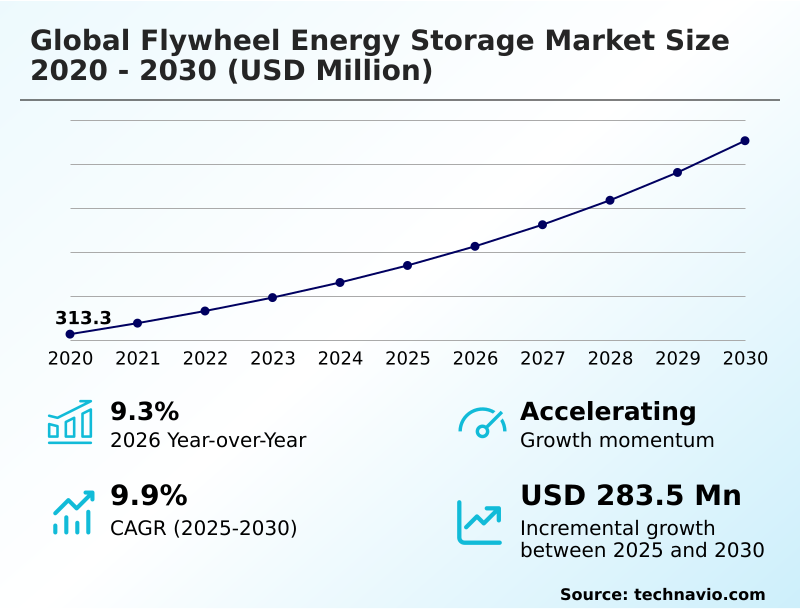
The flywheel energy storage market size is valued to increase by USD 283.5 million, at a CAGR of 9.9% from 2025 to 2030. Critical imperative for grid inertia and microgrid resiliency will drive the flywheel energy storage market.
Major Market Trends & Insights
- North America dominated the market and accounted for a 38.8% growth during the forecast period.
- By Type - Composite rims segment was valued at USD 285.8 million in 2024
- By Technology - UPS segment accounted for the largest market revenue share in 2024
Market Size & Forecast
- Market Opportunities: USD 439.6 million
- Market Future Opportunities: USD 283.5 million
- CAGR from 2025 to 2030 : 9.9%
Market Summary
- The flywheel energy storage market is becoming integral to modernizing energy infrastructure, offering a robust mechanical energy storage solution. A primary market driver is the growing need for grid inertia and synthetic inertia as renewable sources displace traditional power plants, creating demand for fast frequency regulation and ancillary services.
- Key trends include the development of hybrid energy storage systems, where the superior cycle life of a kinetic energy storage system shields batteries from damaging, high-frequency use. For instance, a high-tech manufacturing facility requiring absolute power quality can deploy a flywheel-based ups.
- This system provides instantaneous ride-through power during voltage sags, preventing costly production line stoppages that could occur in milliseconds. This application avoids the large footprint and chemical hazards of battery rooms. However, the technology faces challenges from the high initial capital expenditure compared to electrochemical alternatives and a physical limitation on energy discharge duration.
- Advancements in carbon fiber composites and magnetic levitation are enhancing power density and efficiency, positioning these systems as critical for grid stabilization and industrial resilience. The focus remains on leveraging the long operational life and high-power capabilities of the flywheel rotor.
What will be the Size of the Flywheel Energy Storage Market during the forecast period?
Get Key Insights on Market Forecast (PDF) Request Free Sample
How is the Flywheel Energy Storage Market Segmented?
The flywheel energy storage industry research report provides comprehensive data (region-wise segment analysis), with forecasts and estimates in "USD million" for the period 2026-2030, as well as historical data from 2020-2024 for the following segments.
- Type
- Composite rims
- Steel rims
- Technology
- UPS
- Energy services
- Transportation
- Others
- Component
- Flywheel rotor
- Motor-generator
- Magnetic bearings
- Others
- Geography
- North America
- US
- Canada
- Mexico
- Europe
- Germany
- UK
- France
- APAC
- China
- Japan
- India
- Middle East and Africa
- South Africa
- UAE
- Saudi Arabia
- South America
- Brazil
- Argentina
- Rest of World (ROW)
- North America
By Type Insights
The composite rims segment is estimated to witness significant growth during the forecast period.
The composite rims segment is advancing through the adoption of high-speed rotor designs leveraging advanced carbon fiber composites. These systems are engineered to manage extreme centrifugal force, enabling higher rotational energy storage.
Innovations like the hubless rotor design, created through precision filament winding process, are targeting critical power applications and industrial power quality needs. This architecture enhances round-trip efficiency by over 15% in specific grid scenarios.
Such technology is pivotal for renewable energy integration and providing voltage sag compensation for sensitive loads.
The flywheel rotor in these systems is crucial for applications from railway energy recovery to supplying remote community power, demonstrating a significant shift from traditional steel-based designs.
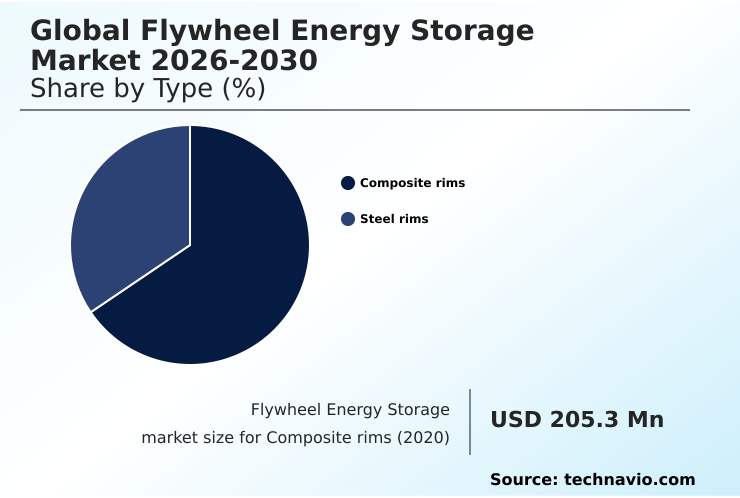
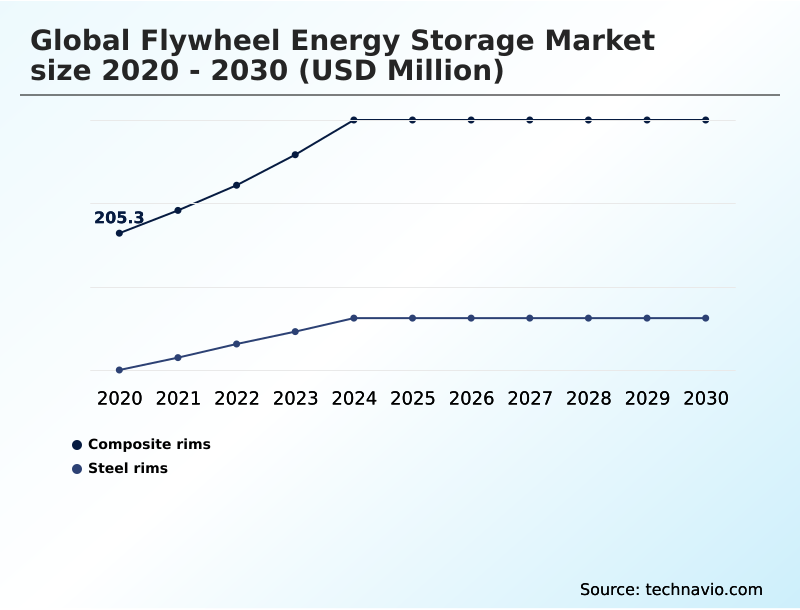
The Composite rims segment was valued at USD 285.8 million in 2024 and showed a gradual increase during the forecast period.
Regional Analysis
North America is estimated to contribute 38.8% to the growth of the global market during the forecast period.Technavio’s analysts have elaborately explained the regional trends and drivers that shape the market during the forecast period.

See How Flywheel Energy Storage Market Demand is Rising in North America Request Free Sample
The geographic landscape of the flywheel energy storage market is led by North America, which commands over 38% of the incremental growth opportunity.
This region's demand is heavily driven by the need for uninterruptible power supply solutions in the rapidly expanding AI data center sector, highlighted by single projects requiring up to 400 MW of power infrastructure.
In Europe, the focus is on grid stabilization services and the decarbonization of heavy industry. Meanwhile, the APAC region is adopting these systems for grid modernization and supporting its vast industrial base.
Across all regions, the technology serves as a key grid-forming asset, providing essential voltage stabilization and fast frequency response. Its role in off-grid power solutions and supporting distributed energy resources is also expanding, especially in areas with underdeveloped grid infrastructure.
Market Dynamics
Our researchers analyzed the data with 2025 as the base year, along with the key drivers, trends, and challenges. A holistic analysis of drivers will help companies refine their marketing strategies to gain a competitive advantage.
- A comprehensive cost-benefit analysis of flywheel UPS systems reveals a complex trade-off when assessing flywheel vs battery for frequency response.
- While the upfront investment for kinetic storage can be higher, a detailed lifecycle cost comparison of flywheel storage often demonstrates superior long-term value, with total cost of ownership potentially being 40% lower over a 20-year span due to minimal degradation and maintenance.
- The high-speed flywheel design for energy density, often leveraging advanced materials, is critical for applications in semiconductor fabrication and data centers. In the transportation sector, the application of flywheels in railway regenerative braking and as flywheel power boosters for grid-constrained chargers showcases their versatility. Specifically, kinetic energy storage for EV fast charging is solving critical infrastructure bottlenecks.
- The debate over carbon fiber rotor vs steel rotor performance continues, with each suited to different applications, from industrial peak shaving to providing synthetic inertia. The impact of magnetic bearing design on flywheel efficiency is a key area of R&D, as is the development of hybrid flywheel-battery storage system designs.
- This technology is also finding a niche in specialized areas, with flywheel technology for directed energy weapons being explored.
- Ultimately, the role of flywheels in grid inertia services and using flywheels for microgrid stabilization are becoming indispensable for a renewable-heavy energy future, especially for systems in off-highway machinery and flywheel UPS for hyperscale data centers, which require both reliability and efficiency.
- Assessing flywheel round-trip efficiency remains a key performance metric for all these applications, as does their integration with renewable energy sources.

What are the key market drivers leading to the rise in the adoption of Flywheel Energy Storage Industry?
- The critical imperative for enhanced grid inertia and improved microgrid resiliency is a key driver for the flywheel energy storage market.
- The market is propelled by the need for synthetic inertia solutions as grids transition to intermittent renewables. Flywheels provide this critical grid inertia, offering instantaneous response to maintain stability.
- This capability is vital for ancillary service contracts and ensuring microgrid resiliency. In the transport sector, flywheels are solving the last mile power problem for EV charging infrastructure support, enabling megawatt-level charging where grid connections are weak.
- For instance, a single 400-megawatt contract for an AI data center highlights the demand for data center power protection. This demand is driven by the need for reliable, high-power density backup that can handle the volatile loads of modern computing.
- The core flywheel rotor technology delivers the necessary power outage ride-through and short-duration discharge needed for these critical systems.
What are the market trends shaping the Flywheel Energy Storage Industry?
- The emergence of hybrid storage architectures, which integrate flywheels with other assets like chemical batteries, is a defining market trend. This approach optimizes system performance by leveraging the distinct advantages of each technology.
- A dominant trend is the move toward hybrid architectures and heavy machinery hybridization, where the flywheel-based UPS offers significant advantages. By integrating a kinetic power booster, industrial operators in construction and mining can achieve diesel generator downsizing by up to 60%, a significant operational efficiency.
- These hybrid systems, which support the decarbonization of heavy industry, leverage the flywheel's high cycle life to handle frequent, high-power events, which can extend the operational lifespan of paired chemical batteries by over 50%. This synergy is creating new opportunities in railway energy recovery and for mission-critical power protection.
- The underlying technologies, such as the power electronics interface and advancements in mechanical energy storage, are enabling more sophisticated grid stabilization services and dynamic load smoothing, reinforcing the value of kinetic solutions in a diverse range of applications.
What challenges does the Flywheel Energy Storage Industry face during its growth?
- A key challenge affecting industry growth is the economic viability gap, which is increasingly driven by the rapidly falling costs of lithium-ion batteries.
- The primary market challenge is the economic competition from electrochemical alternatives, as prices for certain battery cells have fallen by nearly 50% in under a year, amplifying the high initial capital expenditure of flywheel systems. This creates a difficult grid constraint problem for manufacturers.
- Another significant hurdle is the inherent energy discharge duration mismatch; flywheels excel at providing high-power density for seconds or minutes, but the grid increasingly demands storage for four to twelve hours, a range where technologies like the long-duration flywheel are less practical.
- Furthermore, the supply chain for high-performance components like carbon fiber composites and magnetic bearings, essential for managing centrifugal force, is volatile. This dependency limits production scalability for utility-scale frequency regulation and creates risks for projects requiring industrial pulsed power or virtual synchronous generator capabilities.
Exclusive Technavio Analysis on Customer Landscape
The flywheel energy storage market forecasting report includes the adoption lifecycle of the market, covering from the innovator’s stage to the laggard’s stage. It focuses on adoption rates in different regions based on penetration. Furthermore, the flywheel energy storage market report also includes key purchase criteria and drivers of price sensitivity to help companies evaluate and develop their market growth analysis strategies.

Customer Landscape of Flywheel Energy Storage Industry
Competitive Landscape
Companies are implementing various strategies, such as strategic alliances, flywheel energy storage market forecast, partnerships, mergers and acquisitions, geographical expansion, and product/service launches, to enhance their presence in the industry.
ABB Ltd. - Leading providers deliver advanced kinetic energy storage systems designed for grid stabilization, uninterruptible power supply, and industrial power quality, meeting demanding high-cycle, rapid-response application requirements.
The industry research and growth report includes detailed analyses of the competitive landscape of the market and information about key companies, including:
- ABB Ltd.
- Active Power Solutions Ltd.
- Amber Kinetics Inc.
- Beacon Power LLC
- Calnetix Technologies LLC
- Dumarey Group N.V.
- ENERGIESTRO
- EnerSys
- Hitachi Energy Ltd.
- Kinetic Traction Systems Inc.
- Oxto Ltd.
- Parker Hannifin Corp.
- Piller Group GmbH
- PowerTHRU, Inc
- Revterra
- Schneider Electric SE
- Siemens AG
- SOCOMEC Group
- STORNETIC GmbH
- VYCON Inc.
Qualitative and quantitative analysis of companies has been conducted to help clients understand the wider business environment as well as the strengths and weaknesses of key industry players. Data is qualitatively analyzed to categorize companies as pure play, category-focused, industry-focused, and diversified; it is quantitatively analyzed to categorize companies as dominant, leading, strong, tentative, and weak.
Recent Development and News in Flywheel energy storage market
- In November, 2025, Piller Power Systems secured a 400-megawatt contract to supply power infrastructure, including its flywheel-based dynamic UPS technology, for a new artificial intelligence data center in the United States.
- In October, 2025, Amber Kinetics finalized a strategic partnership with Indian Energy, a Native American-owned microgrid developer, to deploy its long-duration flywheel energy storage systems across tribal reservations in the United States.
- In September, 2025, the Dumarey Group successfully deployed its Green Power Peak Power 200 flywheel system at Dubai Harbour to support a heavy-duty tower crane, demonstrating significant fuel and emissions reductions.
- In March, 2025, Zooz Power presented its strategic roadmap at a major industry conference for deploying kinetic power boosters to establish ultra-fast charging corridors along key transport routes with weak grid infrastructure.
Dive into Technavio’s robust research methodology, blending expert interviews, extensive data synthesis, and validated models for unparalleled Flywheel Energy Storage Market insights. See full methodology.
| Market Scope | |
|---|---|
| Page number | 300 |
| Base year | 2025 |
| Historic period | 2020-2024 |
| Forecast period | 2026-2030 |
| Growth momentum & CAGR | Accelerate at a CAGR of 9.9% |
| Market growth 2026-2030 | USD 283.5 million |
| Market structure | Fragmented |
| YoY growth 2025-2026(%) | 9.3% |
| Key countries | US, Canada, Mexico, Germany, UK, France, Italy, Spain, The Netherlands, China, Japan, India, South Korea, Australia, Indonesia, South Africa, UAE, Saudi Arabia, Egypt, Morocco, Brazil, Argentina and Chile |
| Competitive landscape | Leading Companies, Market Positioning of Companies, Competitive Strategies, and Industry Risks |
Research Analyst Overview
- The flywheel energy storage market is evolving from a niche power quality solution to a foundational component of resilient energy systems. The technology's capacity for near-infinite cycle life and high-power density makes it essential for applications requiring rapid frequency regulation and voltage stabilization.
- Systems utilizing advanced carbon fiber composites and magnetic levitation are pushing the boundaries of round-trip efficiency and energy storage capacity. Boardroom decisions are increasingly influenced by the ESG benefits of mechanical energy storage, as it provides a non-flammable, chemical-free alternative for uninterruptible power supply, aligning with corporate sustainability mandates.
- Industrial applications report diesel generator downsizing by as much as 60%, a compelling operational advantage. Key components like the motor-generator and power conversion system, combined with sophisticated rotor balancing and vacuum containment, enable the flywheel-based UPS to function as a reliable grid-forming asset.
- This technology is critical for peak shaving, regenerative braking, and ensuring power quality through its short-duration discharge capability, addressing grid frequency deviation and supporting ancillary services.
- The development of the long-duration flywheel and hubless rotor design, using filament winding process to manage centrifugal force, is further expanding its role beyond that of a simple kinetic power booster to a versatile kinetic energy storage system with an advanced power electronics interface.
What are the Key Data Covered in this Flywheel Energy Storage Market Research and Growth Report?
-
What is the expected growth of the Flywheel Energy Storage Market between 2026 and 2030?
-
USD 283.5 million, at a CAGR of 9.9%
-
-
What segmentation does the market report cover?
-
The report is segmented by Type (Composite rims, and Steel rims), Technology (UPS, Energy services, Transportation, and Others), Component (Flywheel rotor, Motor-generator, Magnetic bearings, and Others) and Geography (North America, Europe, APAC, Middle East and Africa, South America)
-
-
Which regions are analyzed in the report?
-
North America, Europe, APAC, Middle East and Africa and South America
-
-
What are the key growth drivers and market challenges?
-
Critical imperative for grid inertia and microgrid resiliency, Economic viability gap driven by falling lithium-ion costs
-
-
Who are the major players in the Flywheel Energy Storage Market?
-
ABB Ltd., Active Power Solutions Ltd., Amber Kinetics Inc., Beacon Power LLC, Calnetix Technologies LLC, Dumarey Group N.V., ENERGIESTRO, EnerSys, Hitachi Energy Ltd., Kinetic Traction Systems Inc., Oxto Ltd., Parker Hannifin Corp., Piller Group GmbH, PowerTHRU, Inc, Revterra, Schneider Electric SE, Siemens AG, SOCOMEC Group, STORNETIC GmbH and VYCON Inc.
-
Market Research Insights
- Market dynamics are shifting as flywheel systems enable new applications in challenging environments. The technology facilitates the decarbonization of heavy industry, with deployments demonstrating diesel generator downsizing by up to 60% by handling peak loads, a significant business outcome. This is achieved through effective dynamic load smoothing.
- This performance is a key differentiator, particularly as competing battery cell costs fell by nearly 50% in the last year, which pressures the capital expenditure models for kinetic storage. Nevertheless, flywheel technology is proving indispensable for EV charging infrastructure support and mission-critical power protection in data centers.
- Its role in ensuring microgrid resiliency and enabling broader renewable energy integration underscores its value beyond simple cost comparisons, focusing on long-term reliability and operational excellence.
We can help! Our analysts can customize this flywheel energy storage market research report to meet your requirements.