



Flexible Office Market Size 2026-2030
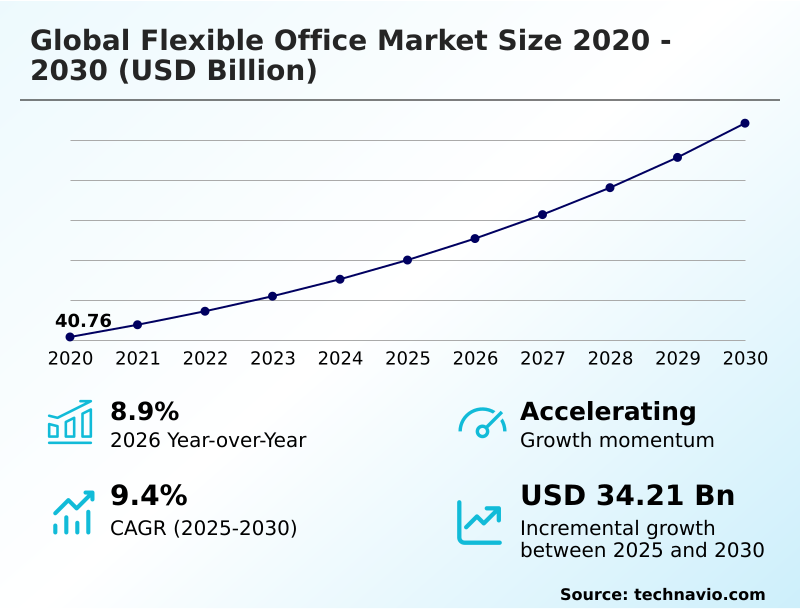
The flexible office market size is valued to increase by USD 34.21 billion, at a CAGR of 9.4% from 2025 to 2030. Rise in shift towards remote and hybrid modes of work will drive the flexible office market.
Major Market Trends & Insights
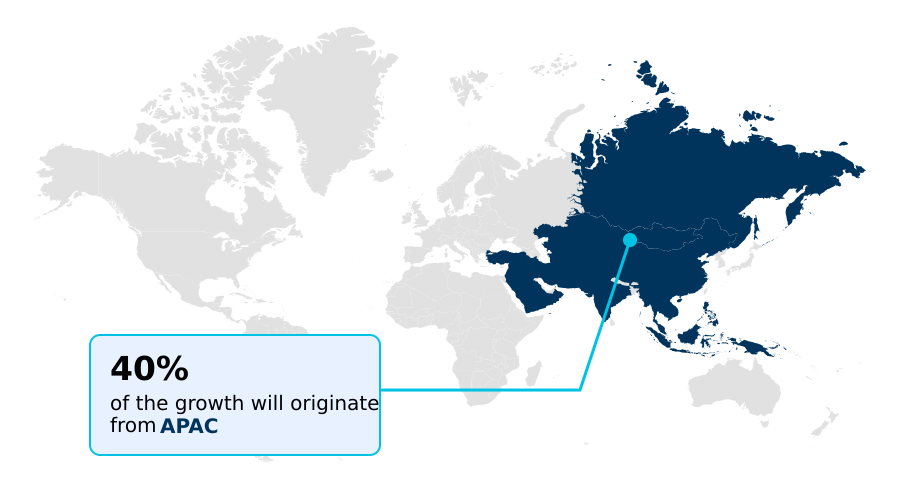
- APAC dominated the market and accounted for a 39.9% growth during the forecast period.
- By Type - Coworking spaces segment was valued at USD 25.19 billion in 2024
- By End-user - IT segment accounted for the largest market revenue share in 2024
Market Size & Forecast
- Market Opportunities: USD 53.44 billion
- Market Future Opportunities: USD 34.21 billion
- CAGR from 2025 to 2030 : 9.4%
Market Summary
- The flexible office market is undergoing a significant transformation, driven by the corporate adoption of hybrid work policies and a strategic shift toward portfolio agility. Organizations are increasingly leveraging these dynamic environments to reduce long-term lease liabilities, enhance talent attraction, and support distributed teams.
- The core offering has evolved beyond shared desks to encompass a range of solutions, including private branded suites, on-demand meeting rooms, and comprehensive managed office services. This model provides the scalability necessary for modern business, allowing companies to expand or contract their physical footprint in response to market changes.
- For instance, a technology firm can establish a new project team in a different region within days by utilizing a turnkey workspace, bypassing the months-long process and capital expenditure associated with traditional office fit-outs. This agile real estate strategy enables operational efficiency and cost control.
- As providers focus on enterprise-grade security and hospitality-led services, flexible workspaces are solidifying their role as an indispensable component of corporate real estate strategy, catering to businesses from startups to large multinational corporations.
What will be the Size of the Flexible Office Market during the forecast period?
Get Key Insights on Market Forecast (PDF) Request Free Sample
How is the Flexible Office Market Segmented?
The flexible office industry research report provides comprehensive data (region-wise segment analysis), with forecasts and estimates in "USD million" for the period 2026-2030, as well as historical data from 2020-2024 for the following segments.
- Type
- Coworking spaces
- Served offices
- Virtual offices
- Hybrid spaces
- End-user
- IT
- BFSI
- Retail and consumer
- Others
- Organization size
- Large enterprise
- SMEs
- Startups
- Geography
- APAC
- China
- Japan
- India
- Europe
- Germany
- UK
- France
- North America
- US
- Canada
- Mexico
- Middle East and Africa
- Saudi Arabia
- UAE
- South Africa
- South America
- Brazil
- Argentina
- Colombia
- Rest of World (ROW)
- APAC
By Type Insights
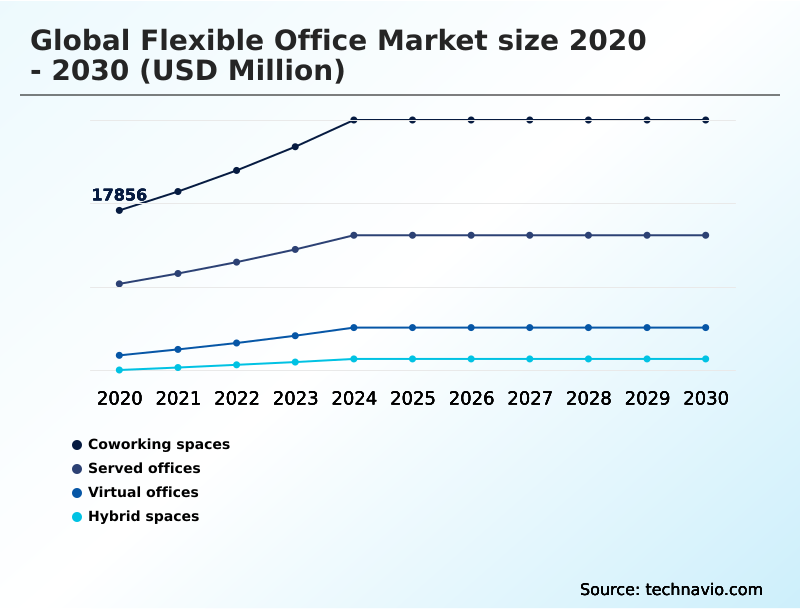
The coworking spaces segment is estimated to witness significant growth during the forecast period.
The market is segmented by offerings such as coworking spaces, serviced offices, and hybrid spaces. Coworking spaces have matured, moving from a growth-at-all-costs model toward sustainable profitability through managed office solutions.
This evolution is validated by strong investor confidence, with one operator's initial public offering being oversubscribed by more than 108 times, signaling a definitive shift toward asset-light management.
This corporate real estate strategy is increasingly favored for its operational cost reduction benefits. Providers are delivering enterprise flex environments and turnkey workspaces to meet rising demand from companies implementing a hub-and-spoke model.
The focus on landlord-operator partnerships and bespoke design solutions further enhances employee productivity and supports business process outsourcing, making these collaborative work environments a core part of modern real estate portfolio optimization.
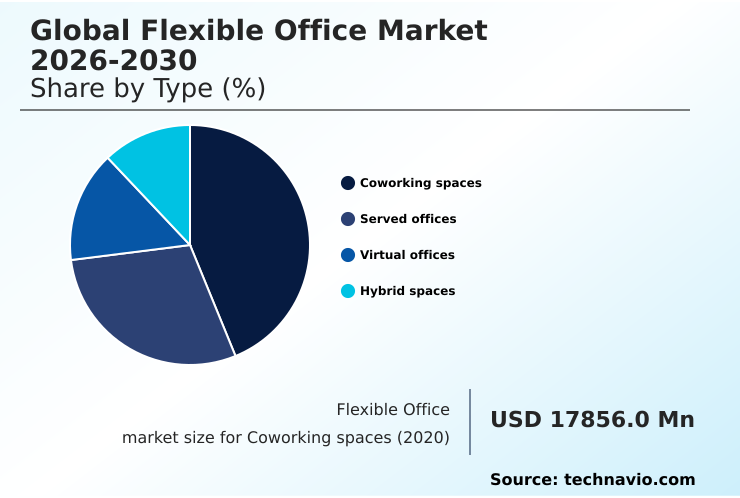
The Coworking spaces segment was valued at USD 25.19 billion in 2024 and showed a gradual increase during the forecast period.
Regional Analysis
APAC is estimated to contribute 39.9% to the growth of the global market during the forecast period.Technavio’s analysts have elaborately explained the regional trends and drivers that shape the market during the forecast period.
See How Flexible Office Market Demand is Rising in APAC Request Free Sample
The geographic landscape of the flexible office market is diversifying, with significant activity extending beyond traditional hubs. The market is segmented by region, including North America, Europe, APAC, Middle East and Africa, and South America.
While mature markets are defined by a flight to quality and amenity-rich environments, emerging regions are experiencing rapid growth driven by government initiatives and corporate expansion.
For example, demand in Riyadh surged by 58% due to programs encouraging international firms to establish regional headquarters.
Overall, APAC is projected to contribute 39.9% of the market's incremental growth, fueled by tier two city expansion and the establishment of satellite offices. This trend reflects the broader adoption of the hub-and-spoke model and workspace-as-a-service concepts.
The demand for virtual offices and flexible leasing terms is also growing globally, supporting the work-from-anywhere capability and talent attraction and retention for distributed workforce models.
Market Dynamics
Our researchers analyzed the data with 2025 as the base year, along with the key drivers, trends, and challenges. A holistic analysis of drivers will help companies refine their marketing strategies to gain a competitive advantage.
- The global flexible office market 2026-2030 is increasingly shaped by sophisticated enterprise requirements that go beyond basic desk rentals. A detailed cost-benefit analysis of coworking spaces reveals that while upfront savings are significant, the true value lies in long-term operational agility. For large enterprises, designing amenity-rich flexible workspaces is now a strategic imperative for talent retention.
- The roi of agile real estate is realized through the adoption of hub-and-spoke real estate models and workspace-as-a-service adoption drivers, which allow companies to scale without massive capital outlay. Managing data security in coworking remains a critical concern, pushing providers to offer enterprise-grade security in shared offices.
- Technology integration in smart offices and the impact of proptech on workspace management are central to optimizing space with utilization data. Turnkey solutions for corporate teams now often include sustainable flexible office certifications and features that focus on integrating wellness into office design, a trend gaining traction faster than traditional sustainability metrics.
- The distinction between lease arbitrage vs management agreements is also becoming a key consideration in operator strategy. Furthermore, the virtual office for business registration is seeing renewed interest due to stricter legal compliance for virtual offices.
- These specialized applications, including flexible office for bpo operations and flexible office solutions for startups, highlight a market that is maturing rapidly to meet diverse corporate needs.
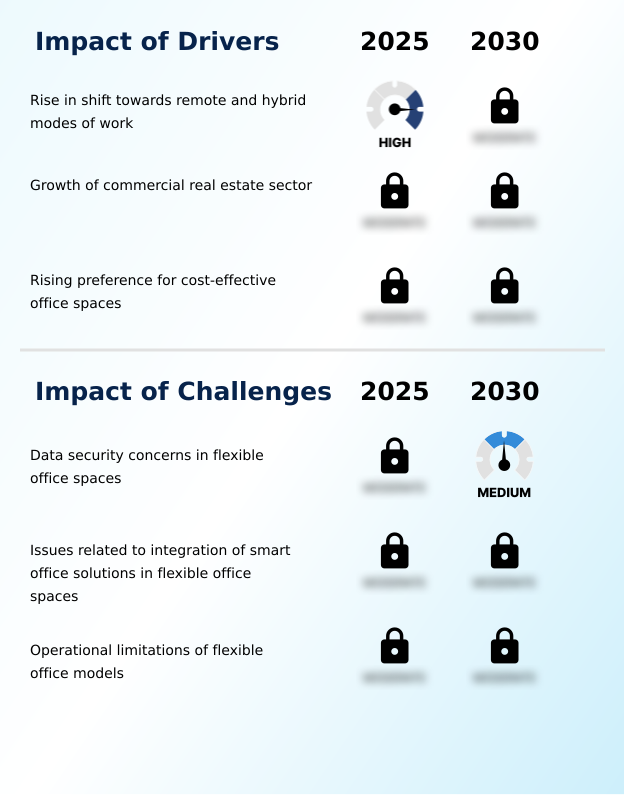
What are the key market drivers leading to the rise in the adoption of Flexible Office Industry?
- The rise in the shift toward remote and hybrid modes of work is a key driver influencing the market's growth.
- Primary market drivers are centered on financial efficiency and operational agility, compelling organizations to adopt new real estate strategies. The focus on capital expenditure avoidance is paramount, with companies increasingly choosing short-term lease agreements over traditional long-term commitments.
- This shift is fueling the demand for premium flexible workspace and has led to a 163% year-over-year surge in demand in nearshoring hotspots.
- Remote work adoption continues to be a significant factor, reinforcing the need for cost-efficient office spaces that enhance employee well-being. The growth of the commercial real estate investment market is also pivotal, as developers create more collaborative work environments.
- This focus has resulted in some operators reporting leasing performance significantly ahead of market rental values, demonstrating the high value placed on flexibility and service.
What are the market trends shaping the Flexible Office Industry?
- The increasing demand for flexible office spaces is a significant market trend. This is driven by the growing need for agile and cost-effective workspace solutions across various industries.
- Key market trends are redefining workspace consumption, driven by the rising adoption of plug-and-play infrastructure and managed partnership agreements. The market is witnessing a pronounced shift towards tier two city expansion as companies seek to attract talent beyond primary metropolitan areas, a strategy that supports decentralized operations.
- This trend is amplified by the growing preference for hybrid work models, which has led to a 23% increase in market growth in some regions. The demand for custom build-outs and bespoke design solutions is also rising, as enterprises want their flexible spaces to reflect their brand and culture.
- The expansion of startup ecosystem hubs is further fueling momentum, with real estate technology (proptech) playing a crucial role in enhancing the user experience. With over 106,000 seats absorbed in a six-month period in one key market, the demand for flexible workspace solutions is clearly accelerating.
What challenges does the Flexible Office Industry face during its growth?
- Data security concerns associated with shared infrastructure in flexible office spaces present a key challenge to market growth.
- The primary challenge facing the market is balancing flexibility with security and operational control. The integration of managed aggregation models introduces complexities in maintaining consistent service levels and data protection across diverse locations.
- Issues arise from the need to secure shared office environments, where the risk of data breaches is perceived to be higher, often mandating the use of robust VPNs and secure platforms. The project-based team spaces model, while agile, can strain IT resources.
- Furthermore, high office vacancy rates in some major cities, reaching up to 22%, create intense price competition, impacting the profitability of office hotelification and other innovative concepts.
- Selecting the right enterprise client solutions is also difficult, as many organizations lack the expertise to integrate new platforms with legacy systems, hindering the adoption of advanced workspace utilization analytics and tenant retention strategies.
Exclusive Technavio Analysis on Customer Landscape
The flexible office market forecasting report includes the adoption lifecycle of the market, covering from the innovator’s stage to the laggard’s stage. It focuses on adoption rates in different regions based on penetration. Furthermore, the flexible office market report also includes key purchase criteria and drivers of price sensitivity to help companies evaluate and develop their market growth analysis strategies.
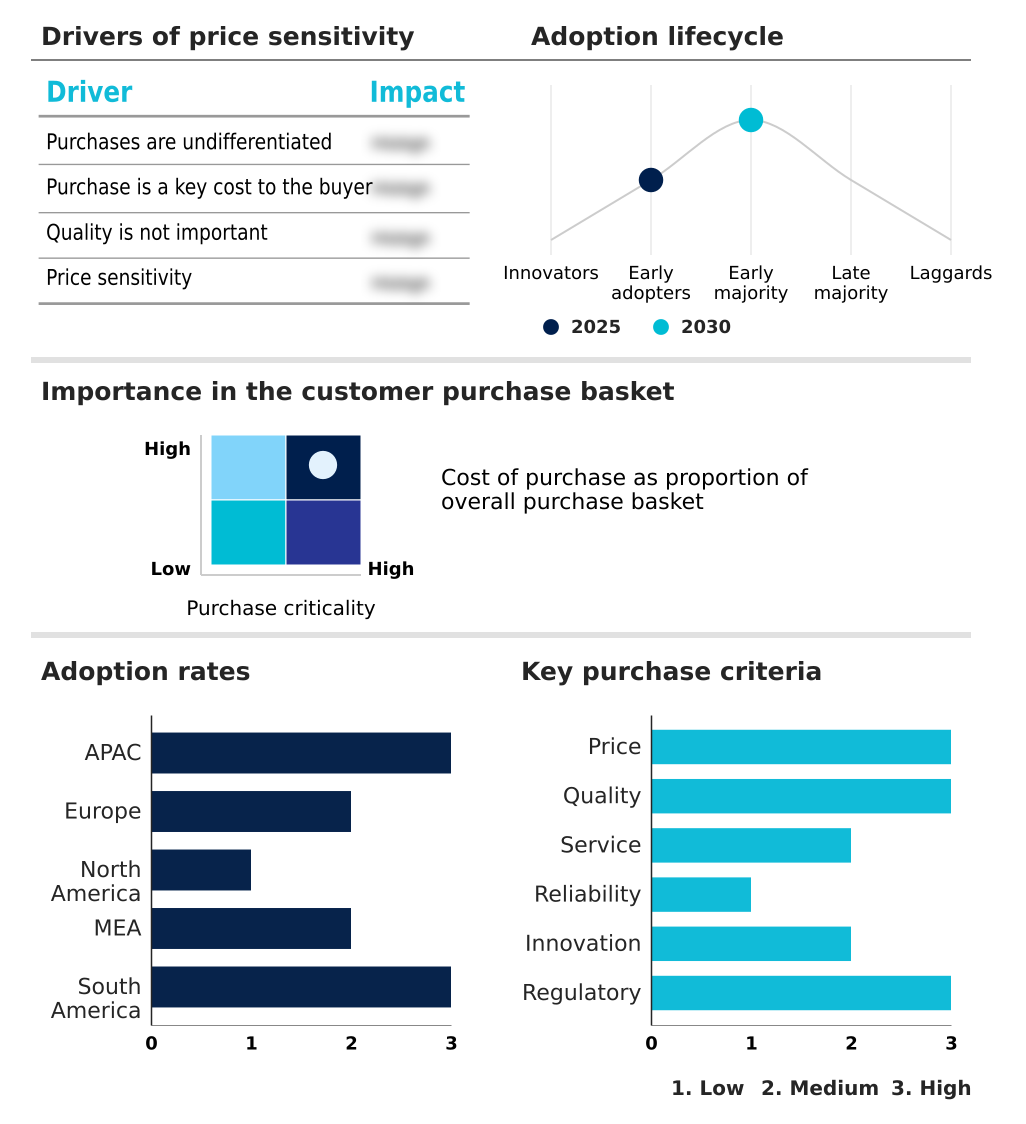
Customer Landscape of Flexible Office Industry
Competitive Landscape
Companies are implementing various strategies, such as strategic alliances, flexible office market forecast, partnerships, mergers and acquisitions, geographical expansion, and product/service launches, to enhance their presence in the industry.
Ally Spaces - Offerings include flexible office solutions such as fully amenitized coworking spaces tailored for businesses of all sizes, supporting agile work environments in prime locations.
The industry research and growth report includes detailed analyses of the competitive landscape of the market and information about key companies, including:
- Ally Spaces
- Awfis Space Solutions Ltd.
- BizSpace Ltd.
- Bond Collective
- CBRE Group Inc.
- Hub Australia Pty Ltd
- Incuspaze Solutions Pvt Ltd.
- Industrious
- International Workplace Group plc
- Mindspace Ltd.
- Premier Office Centers LLC
- Serendipity Labs
- Servcorp Ltd.
- Techspace Group Ltd.
- The Office Group
- United Franchise Group
- Vast Coworking Group
- WeWork Inc.
- Workbar
Qualitative and quantitative analysis of companies has been conducted to help clients understand the wider business environment as well as the strengths and weaknesses of key industry players. Data is qualitatively analyzed to categorize companies as pure play, category-focused, industry-focused, and diversified; it is quantitatively analyzed to categorize companies as dominant, leading, strong, tentative, and weak.
Recent Development and News in Flexible office market
- In May 2024, Awfis Space Solutions Ltd. launched its Initial Public Offering, becoming the first flexible workspace operator in India to be publicly listed and demonstrating strong investor confidence with an oversubscription of more than 108 times.
- In June 2024, WeWork Inc. officially emerged from Chapter 11 bankruptcy in the US and Canada, having eliminated billions in debt and renegotiated numerous leases to focus on sustainable, profitable operations.
- In December 2024, International Workplace Group plc announced plans to open 17 new hybrid working centers in the Philippines, targeting both urban hubs and regional provinces to serve decentralized workforces.
- In January 2025, CBRE Group Inc. announced the acquisition of the remaining equity interest in Industrious to create a new business segment focused on building operations and experience, signaling the maturation of flexible workspace as a core asset class.
Dive into Technavio’s robust research methodology, blending expert interviews, extensive data synthesis, and validated models for unparalleled Flexible Office Market insights. See full methodology.
| Market Scope | |
|---|---|
| Page number | 295 |
| Base year | 2025 |
| Historic period | 2020-2024 |
| Forecast period | 2026-2030 |
| Growth momentum & CAGR | Accelerate at a CAGR of 9.4% |
| Market growth 2026-2030 | USD 34207.1 million |
| Market structure | Fragmented |
| YoY growth 2025-2026(%) | 8.9% |
| Key countries | China, Japan, India, South Korea, Indonesia, Australia, Germany, UK, France, Italy, Spain, The Netherlands, US, Canada, Mexico, Saudi Arabia, UAE, South Africa, Israel, Turkey, Brazil, Argentina and Colombia |
| Competitive landscape | Leading Companies, Market Positioning of Companies, Competitive Strategies, and Industry Risks |
Research Analyst Overview
- The flexible office market is defined by a strategic shift from traditional real estate leasing to dynamic, service-oriented models. Key offerings include coworking spaces, serviced offices, virtual offices, and fully integrated hybrid spaces. The industry's momentum is sustained by the corporate adoption of agile real estate strategy, with a focus on asset-light management and managed office solutions.
- Companies are implementing the core-plus-flex model to optimize their portfolios, utilizing satellite offices and enterprise flex environments to support distributed teams. The workspace-as-a-service concept, facilitated by digital booking systems and smart building technology, is becoming standard. This transition allows for flexible leasing terms and on-demand meeting rooms, which are critical for businesses prioritizing agility.
- The market's evolution is also marked by a move toward hospitality-led service, with operators providing amenity-rich environments and turnkey workspaces. In some premium markets, these fully managed spaces have demonstrated leasing performance significantly ahead of traditional market rental values, reflecting strong demand.
- As a result, providers are increasingly offering private branded suites with enterprise-grade security to attract and retain high-value corporate clients.
What are the Key Data Covered in this Flexible Office Market Research and Growth Report?
-
What is the expected growth of the Flexible Office Market between 2026 and 2030?
-
USD 34.21 billion, at a CAGR of 9.4%
-
-
What segmentation does the market report cover?
-
The report is segmented by Type (Coworking spaces, Served offices, Virtual offices, and Hybrid spaces), End-user (IT, BFSI, Retail and consumer, and Others), Organization Size (Large enterprise, SMEs, and Startups) and Geography (APAC, Europe, North America, Middle East and Africa, South America)
-
-
Which regions are analyzed in the report?
-
APAC, Europe, North America, Middle East and Africa and South America
-
-
What are the key growth drivers and market challenges?
-
Rise in shift towards remote and hybrid modes of work, Data security concerns in flexible office spaces
-
-
Who are the major players in the Flexible Office Market?
-
Ally Spaces, Awfis Space Solutions Ltd., BizSpace Ltd., Bond Collective, CBRE Group Inc., Hub Australia Pty Ltd, Incuspaze Solutions Pvt Ltd., Industrious, International Workplace Group plc, Mindspace Ltd., Premier Office Centers LLC, Serendipity Labs, Servcorp Ltd., Techspace Group Ltd., The Office Group, United Franchise Group, Vast Coworking Group, WeWork Inc. and Workbar
-
Market Research Insights
- The dynamics of the flexible office market are shaped by corporate efforts to optimize real estate portfolios and enhance workforce agility. The adoption of distributed workforce models has become a cornerstone of modern corporate real estate strategy, leading to a 14% year-over-year increase in inquiries for flexible space.
- This flight to quality is evident as companies prioritize premium, amenity-rich environments, causing median desk rates in prime locations to rise by approximately 7%. Businesses are focused on capital expenditure avoidance and operational cost reduction, making the value proposition of flexible leasing highly attractive. Consequently, landlord-operator partnerships are becoming more prevalent, enabling facility management integration and better workspace utilization analytics.
- These trends support talent attraction and retention by offering employees superior work environments and reduced commute times, aligning with evolving return-to-office mandates and employee well-being initiatives.
We can help! Our analysts can customize this flexible office market research report to meet your requirements.
 RIA -
RIA -