


Curing Agent Market Size 2026-2030
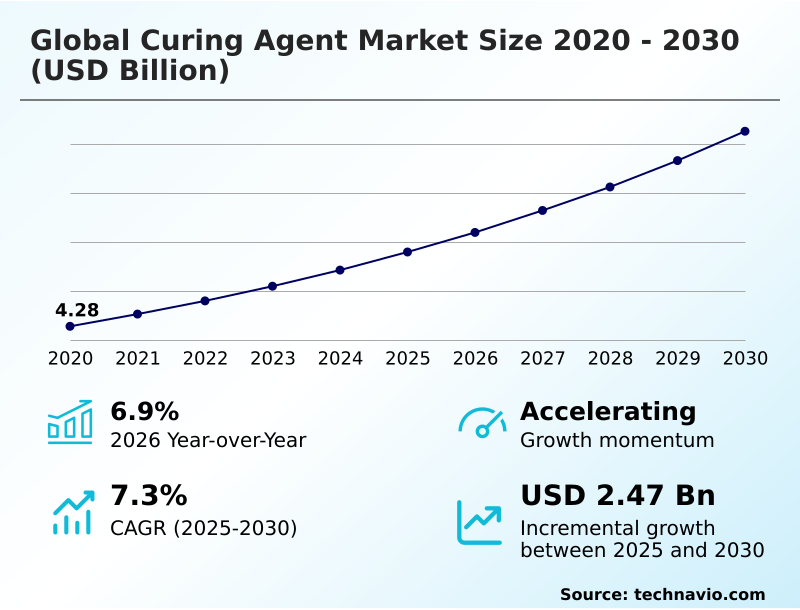
The curing agent market size is valued to increase by USD 2.47 billion, at a CAGR of 7.3% from 2025 to 2030. Increased demand for epoxy resin systems as primer will drive the curing agent market.
Major Market Trends & Insights
- APAC dominated the market and accounted for a 51.3% growth during the forecast period.
- By Type - Epoxy segment was valued at USD 4.15 billion in 2024
- By Form Factor - Liquid segment accounted for the largest market revenue share in 2024
Market Size & Forecast
- Market Opportunities: USD 3.99 billion
- Market Future Opportunities: USD 2.47 billion
- CAGR from 2025 to 2030 : 7.3%
Market Summary
- The curing agent market is defined by its critical role in the polymerization process of thermosetting resins, which are indispensable across industrial sectors. Demand is driven by the need for materials with enhanced mechanical strength, thermal stability, and chemical resistance.
- Key applications include high-performance composites for aerospace and wind energy, durable powder coatings for automotive parts, and robust structural adhesives for construction. A primary trend is the industry's shift toward sustainability, with a focus on developing bio-based alternatives and waterborne systems to comply with stringent regulations on VOC emissions.
- For example, a manufacturer of marine protective coatings must navigate these rules while ensuring their products, which rely on specific amine-based curing agents, meet performance standards for corrosion resistance. This requires significant R&D investment in fast-curing solutions and low-temperature cure technologies to maintain a competitive edge.
- Concurrently, the market faces challenges from raw material price volatility, which affects the cost of inputs like cycloaliphatic amines and polyamidoamines, impacting production planning and profitability. The focus remains on innovation in areas like pot life extension and two-component systems to deliver value.
What will be the Size of the Curing Agent Market during the forecast period?
Get Key Insights on Market Forecast (PDF) Request Free Sample
How is the Curing Agent Market Segmented?
The curing agent industry research report provides comprehensive data (region-wise segment analysis), with forecasts and estimates in "USD million" for the period 2026-2030, as well as historical data from 2020-2024 for the following segments.
- Type
- Epoxy
- Polyurethane
- Silicone Rubber
- Others
- Form factor
- Liquid
- Powder
- Granule
- Application
- Paints and coatings
- Building and construction
- Adhesives and sealants
- Composites
- Others
- Geography
- APAC
- China
- India
- Japan
- Europe
- Germany
- France
- UK
- North America
- US
- Canada
- Mexico
- South America
- Brazil
- Argentina
- Middle East and Africa
- Saudi Arabia
- UAE
- South Africa
- Rest of World (ROW)
- APAC
By Type Insights
The epoxy segment is estimated to witness significant growth during the forecast period.
The epoxy segment, utilizing a specific curing agent for epoxy, functions as the core of the market. Essential cross-linking agents such as anhydride curing agents and polyamidoamines are critical for forming high-performance materials.
These agents are vital for achieving high thermal stability and optimal crosslink density, which dictates the final glass transition temperature.
The expansion in high-strength composite curing for aerospace and the demand for durable powder coatings, which often use powder coating crosslinkers, drive innovation.
There is a notable shift towards specialized technologies like heat-activated curing to optimize manufacturing, with some processes reducing cycle times by 15%.
This segment also supports applications like RIM polyurethane systems and casting polyurethane resins, showing its versatility beyond standard epoxy applications.
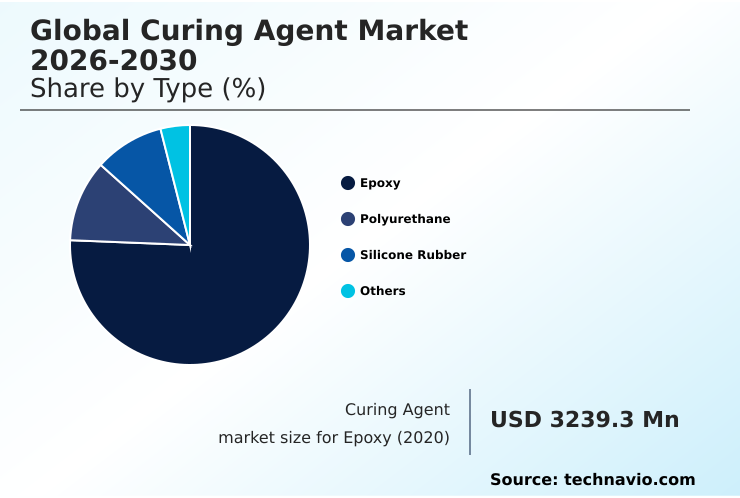
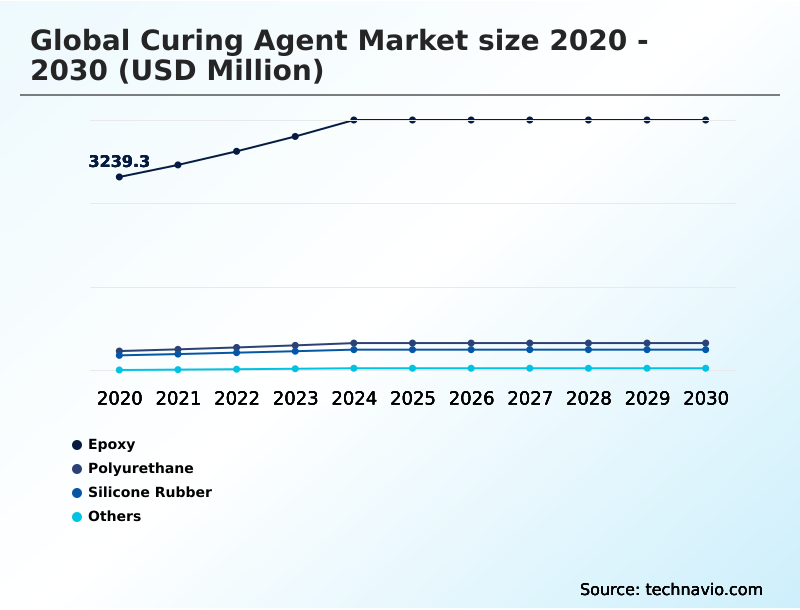
The Epoxy segment was valued at USD 4.15 billion in 2024 and showed a gradual increase during the forecast period.
Regional Analysis
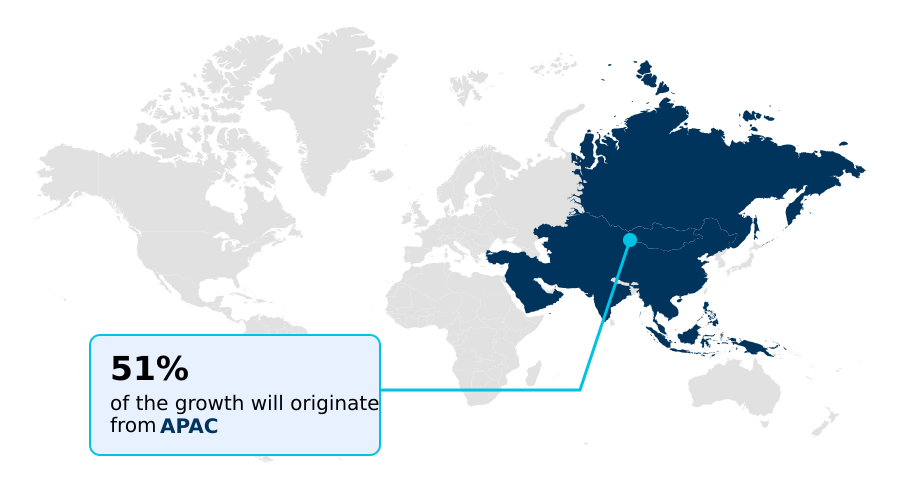
APAC is estimated to contribute 51.3% to the growth of the global market during the forecast period.Technavio’s analysts have elaborately explained the regional trends and drivers that shape the market during the forecast period.
See How Curing Agent Market Demand is Rising in APAC Request Free Sample
The geographic landscape for the cross-linking agent market is diverse. APAC leads, accounting for over 51% of incremental growth, driven by demand for construction adhesive curing and electronic encapsulation resins.
The region's focus is on optimizing the polymerization process to enhance mechanical strength. In contrast, European and North American markets prioritize sustainability, pushing innovation in areas like cycloaliphatic amines for durable coatings.
Here, adoption of low-temperature cure technologies has reduced energy use by 10%. Applications for electrical potting compounds and aerospace composite resin are prominent.
Advanced processes like filament winding epoxy manufacturing and pultrusion resin systems are gaining traction, while niche technologies such as electron beam curing are being explored to reduce gel time and accelerate production.
Market Dynamics
Our researchers analyzed the data with 2025 as the base year, along with the key drivers, trends, and challenges. A holistic analysis of drivers will help companies refine their marketing strategies to gain a competitive advantage.
- The curing agent market is evolving beyond traditional applications, with significant developments in specialized formulations. For instance, the demand for amine curing agent for epoxy flooring is driven by the need for durable, low-VOC solutions in commercial and residential construction.
- Concurrently, regulations are shaping product development, as seen in the push for compliance with waterborne epoxy curing agent regulations, which has spurred innovation. The sustainability trend is also prominent, with a growing focus on bio-based curing agents for composites, particularly in the automotive and aerospace sectors where lightweighting is a priority.
- For manufacturers, optimizing production is key; achieving a low temperature cure epoxy adhesive is a significant competitive advantage, enabling energy savings and broader application windows. Similarly, developing fast curing polyurethane for automotive parts helps OEMs accelerate assembly line speeds. The renewable energy sector's demand for high performance curing agents for wind energy is another critical growth vector.
- Understanding the Global Curing Agent Market 2026-2030 segmentation is crucial for strategic planning. Analyzing the Global Curing agent Market 2026-2030 drivers, such as infrastructure growth, and the Global Curing Agent Market 2026-2030 challenges, like raw material volatility, informs investment decisions. Specific applications like epoxy curing agents for electronic potting require high purity and thermal stability.
- Meanwhile, polyurethane curing for flexible foams is essential in the furniture and automotive seating industries. Formulators are also focusing on silicone rubber curing for sealants used in construction and electronics. Innovations in powder coating curing agent formulation are addressing needs for better finish and durability.
- The market for curing agents for structural adhesives is expanding with the replacement of mechanical fasteners. Finally, the curing agent market growth in APAC is outpacing other regions, presenting significant opportunities, with some supply chains in the region operating with 20% greater efficiency compared to their global counterparts due to localized raw material sourcing and production.
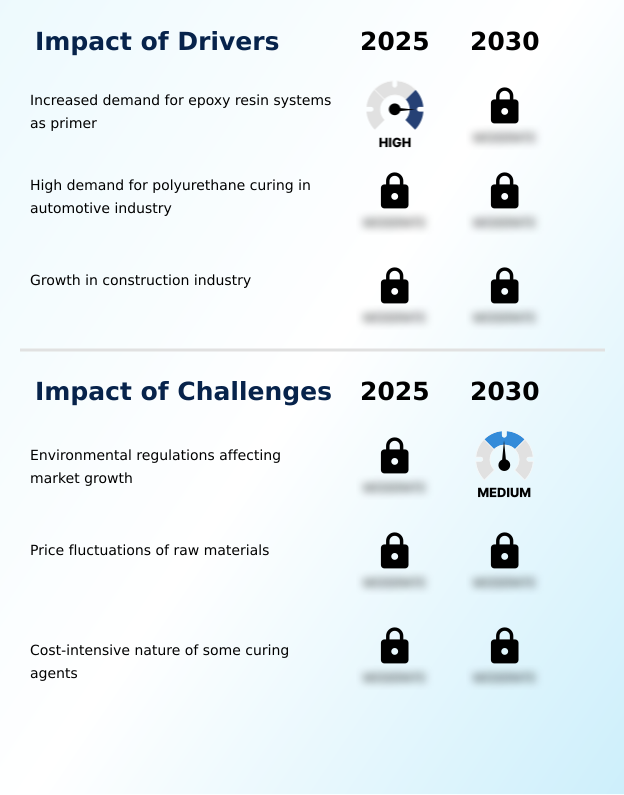
What are the key market drivers leading to the rise in the adoption of Curing Agent Industry?
- The increased demand for epoxy resin systems as a primer is a key driver for the market.
- A primary market driver is the expanding use of epoxy resin systems as high-performance primers, valued for their superior chemical resistance.
- In the automotive industry, the adoption of specialized structural adhesives and automotive coating hardeners has improved peel strength by up to 30%. The growth in construction also fuels demand for products like concrete repair epoxy and epoxy primer hardener.
- The robust demand for polyurethane curing, including for hardener for polyurethane foam, is met with innovations in two-component systems that enable a 10% faster ambient cure for interior components.
- The development of fast-cure epoxy adhesive formulations and emerging isocyanate-free polyurethanes are also critical. Advanced dual-cure systems are further enhancing manufacturing flexibility across various industrial applications.
What are the market trends shaping the Curing Agent Industry?
- The increased adoption of high-performance composites in the wind energy sector is a significant market trend. This is driven by the demand for lighter and more durable turbine blades.
- A key trend shaping the market is the accelerated adoption of high-performance composites, especially within the renewable energy sector, driving demand for specific formulations like a curing agent for wind turbine blades. Innovations focus on fast-curing solutions and latent curing agents that reduce blade production cycles by as much as 15%.
- Another significant trend is the push for eco-friendly curing solutions, including bio-based alternatives and the development of a bio-based epoxy hardener. These solvent-free curing systems not only address regulatory pressures on emissions but also meet consumer demand for greener products.
- Formulations using UV-curable resins and moisture-curing systems show a 20% improvement in pot life extension, enhancing usability in large-scale applications, with some featuring UV-resistant epoxy hardener properties for outdoor durability, alongside versatile cold-cure epoxy systems.
What challenges does the Curing Agent Industry face during its growth?
- Stringent environmental regulations present a key challenge affecting the industry's growth.
- A significant challenge confronting the market is the enforcement of stringent regulations on VOC emissions. This mandates a shift toward formulations like low-VOC paint hardeners and advanced waterborne systems, including water-based polyurethane dispersion technology. This transition requires substantial R&D investment, with reformulation costs for some thermosetting resins increasing by an average of 20%.
- Price volatility of raw materials for amine-based curing agents and isocyanates adds complexity. The cost of developing new amine adducts for coatings and high-solids systems also presents a barrier. Applications from flexible packaging adhesives to epoxy flooring hardener are impacted, pushing for cost-effective, high-performance solutions like high-temperature resistant epoxy and alternatives to traditional phenolic resins.
Exclusive Technavio Analysis on Customer Landscape
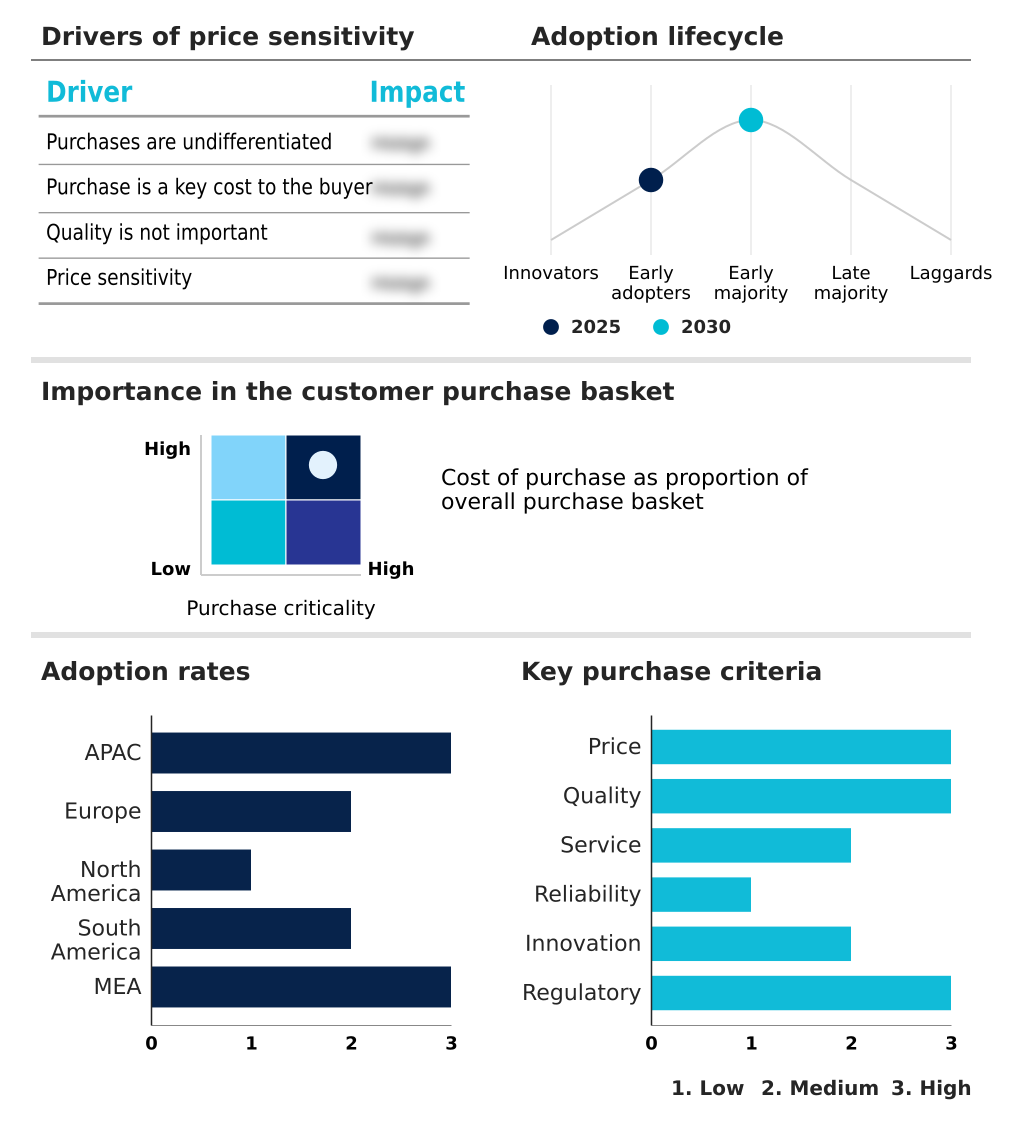
The curing agent market forecasting report includes the adoption lifecycle of the market, covering from the innovator’s stage to the laggard’s stage. It focuses on adoption rates in different regions based on penetration. Furthermore, the curing agent market report also includes key purchase criteria and drivers of price sensitivity to help companies evaluate and develop their market growth analysis strategies.
Customer Landscape of Curing Agent Industry
Competitive Landscape
Companies are implementing various strategies, such as strategic alliances, curing agent market forecast, partnerships, mergers and acquisitions, geographical expansion, and product/service launches, to enhance their presence in the industry.
Advanced Materials - Specializes in advanced curing agent formulations, including modified aliphatic amines and polyamides, catering to high-performance thermosetting resin applications.
The industry research and growth report includes detailed analyses of the competitive landscape of the market and information about key companies, including:
- Advanced Materials
- Air Products and Chemicals Inc
- Atul Ltd.
- BASF SE
- Campbell Plastics Ltd.
- Cardolite Corp.
- Evonik Industries AG
- Hexion Inc.
- Huntsman International LLC
- Kukdo Chemical Co. Ltd.
- Kumho Chemicals Inc.
- LEUNA Harze GmbH
- Mitsubishi Chemical Grp.
- Nan Ya Plastic Corp.
- Olin Corp.
- RPM International Inc.
- Shandong Deyuan Epoxy Resin
- Toray Fine Chemicals Co.
- Vijai Poly Products Pvt. Ltd.
Qualitative and quantitative analysis of companies has been conducted to help clients understand the wider business environment as well as the strengths and weaknesses of key industry players. Data is qualitatively analyzed to categorize companies as pure play, category-focused, industry-focused, and diversified; it is quantitatively analyzed to categorize companies as dominant, leading, strong, tentative, and weak.
Recent Development and News in Curing agent market
- In October 2024, Atul Ltd. completed a 50,000 tons-per-annum capacity expansion of its liquid epoxy resin manufacturing facilities in India to meet growing demand from the coating and construction sectors.
- In October 2024, Mitsubishi Chemical Grp. launched new grades of BENEBiOL, its biomass-based polycarbonate diol, to support the production of more sustainable polyurethane resins.
- In November 2024, Evonik Industries broke ground on the expansion of its specialty amines production plant in Nanjing, China, to increase the supply of curing agents for the wind energy and construction industries.
- In March 2025, Westlake Epoxy introduced its EpoVIVE product line, featuring the EPIKURE 6874-WZ-50 curing agent with bio-circular raw materials, aimed at reducing the carbon footprint of coatings and composites.
Dive into Technavio’s robust research methodology, blending expert interviews, extensive data synthesis, and validated models for unparalleled Curing Agent Market insights. See full methodology.
| Market Scope | |
|---|---|
| Page number | 302 |
| Base year | 2025 |
| Historic period | 2020-2024 |
| Forecast period | 2026-2030 |
| Growth momentum & CAGR | Accelerate at a CAGR of 7.3% |
| Market growth 2026-2030 | USD 2469.1 million |
| Market structure | Fragmented |
| YoY growth 2025-2026(%) | 6.9% |
| Key countries | China, India, Japan, South Korea, Australia, Indonesia, Germany, France, UK, Italy, Spain, The Netherlands, US, Canada, Mexico, Brazil, Argentina, Chile, Saudi Arabia, UAE, South Africa, Israel and Turkey |
| Competitive landscape | Leading Companies, Market Positioning of Companies, Competitive Strategies, and Industry Risks |
Research Analyst Overview
- The curing agent market is fundamentally driven by the need for advanced thermosetting resins with superior performance characteristics. Materials require specific cross-linking agent formulations to achieve desired outcomes like high thermal stability, robust mechanical strength, and excellent chemical resistance. The polymerization process is central, with epoxy resin systems and polyurethane curing methods dominating many high-value applications.
- A significant trend influencing boardroom decisions is the shift towards sustainability, compelling companies to invest in bio-based alternatives and waterborne systems to mitigate risks associated with stringent VOC emissions regulations. For example, firms that have reformulated their products using high-solids systems have demonstrated compliance while also achieving operational efficiencies, such as reducing application-related energy consumption by over 10%.
- This strategic pivot is not just about compliance but also about market positioning, as demand for high-performance composites, structural adhesives, and advanced powder coatings increasingly favors environmentally conscious solutions. Innovations like latent curing agents and fast-curing solutions are crucial for maintaining a competitive edge.
What are the Key Data Covered in this Curing Agent Market Research and Growth Report?
-
What is the expected growth of the Curing Agent Market between 2026 and 2030?
-
USD 2.47 billion, at a CAGR of 7.3%
-
-
What segmentation does the market report cover?
-
The report is segmented by Type (Epoxy, Polyurethane, Silicone Rubber, and Others), Form Factor (Liquid, Powder, and Granule), Application (Paints and coatings, Building and construction, Adhesives and sealants, Composites, and Others) and Geography (APAC, Europe, North America, South America, Middle East and Africa)
-
-
Which regions are analyzed in the report?
-
APAC, Europe, North America, South America and Middle East and Africa
-
-
What are the key growth drivers and market challenges?
-
Increased demand for epoxy resin systems as primer, Environmental regulations affecting market growth
-
-
Who are the major players in the Curing Agent Market?
-
Advanced Materials, Air Products and Chemicals Inc, Atul Ltd., BASF SE, Campbell Plastics Ltd., Cardolite Corp., Evonik Industries AG, Hexion Inc., Huntsman International LLC, Kukdo Chemical Co. Ltd., Kumho Chemicals Inc., LEUNA Harze GmbH, Mitsubishi Chemical Grp., Nan Ya Plastic Corp., Olin Corp., RPM International Inc., Shandong Deyuan Epoxy Resin, Toray Fine Chemicals Co. and Vijai Poly Products Pvt. Ltd.
-
Market Research Insights
- The market dynamics are shaped by a continuous drive for high-performance materials and sustainable formulations. The demand for specific products like a curing agent for epoxy and a hardener for polyurethane foam is strong in industrial coatings and construction.
- In the automotive sector, the use of specialized automotive coating hardeners has been shown to improve scratch resistance by up to 25% compared to previous formulations. Similarly, the adoption of eco-friendly curing solutions, including bio-based epoxy hardeners and solvent-free curing systems, is accelerating.
- For example, manufacturers using low-VOC paint hardeners have successfully reduced emissions by over 40%, aligning with stringent environmental mandates. Innovations in fast-cure epoxy adhesives are critical for manufacturing efficiency, while advanced marine protective coatings extend the service life of maritime assets, reflecting a market focused on performance and regulatory compliance.
We can help! Our analysts can customize this curing agent market research report to meet your requirements.