

Commercial Air Conditioner Market Size 2026-2030
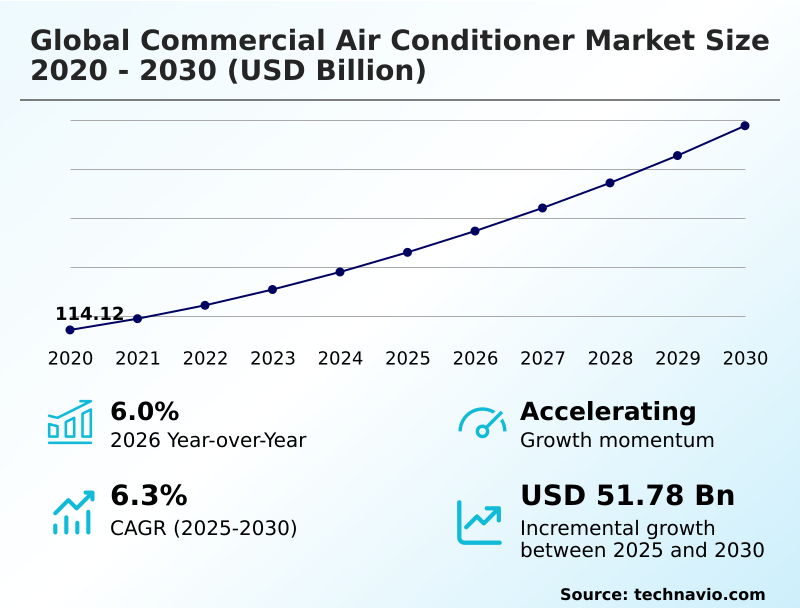
The commercial air conditioner market size is valued to increase by USD 51.78 billion, at a CAGR of 6.3% from 2025 to 2030. Regulatory mandates for energy efficiency and decarbonization will drive the commercial air conditioner market.
Major Market Trends & Insights
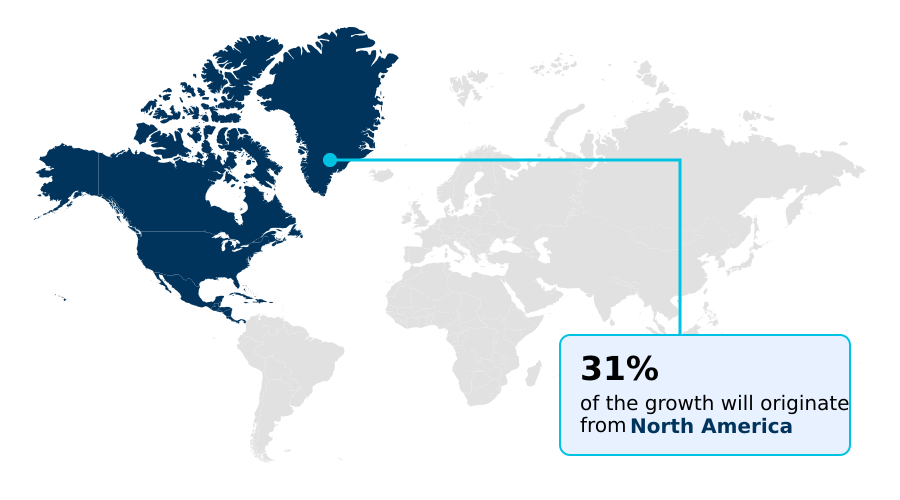
- North America dominated the market and accounted for a 31% growth during the forecast period.
- By Product - Split systems segment was valued at USD 38.94 billion in 2024
- By Technology - Non-inverter segment accounted for the largest market revenue share in 2024
Market Size & Forecast
- Market Opportunities: USD 83.53 billion
- Market Future Opportunities: USD 51.78 billion
- CAGR from 2025 to 2030 : 6.3%
Market Summary
- The commercial air conditioner market is undergoing a significant transformation driven by the convergence of stringent environmental regulations and rapid technological innovation. A key driver is the global mandate to enhance energy efficiency and reduce operational carbon footprints, compelling a transition toward sustainable solutions.
- This shift manifests in the accelerated adoption of advanced systems such as variable refrigerant flow technology and high-performance chillers, particularly in high-growth sectors like data center thermal management and commercial real estate. Concurrently, the integration of smart controls and predictive maintenance capabilities is redefining operational paradigms.
- For instance, a commercial facility can leverage integrated building automation to analyze real-time performance data, optimizing cooling loads to reduce energy consumption while simultaneously scheduling proactive maintenance to prevent downtime. This proactive approach minimizes disruptions and extends equipment lifespan.
- However, the industry faces challenges, including the high upfront capital costs of next-generation equipment and a persistent shortage of skilled technicians qualified to install and service these complex systems.
- The ongoing evolution of refrigerants to options with a lower global warming potential adds another layer of complexity, requiring significant investment in research, development, and workforce training to ensure compliance and safety.
What will be the Size of the Commercial Air Conditioner Market during the forecast period?
Get Key Insights on Market Forecast (PDF) Request Free Sample
How is the Commercial Air Conditioner Market Segmented?
The commercial air conditioner industry research report provides comprehensive data (region-wise segment analysis), with forecasts and estimates in "USD million" for the period 2026-2030, as well as historical data from 2020-2024 for the following segments.
- Product
- Split systems
- VRF systems
- Chillers
- Rooftops
- Others
- Technology
- Non-inverter
- Inverter
- Type
- Ducted AC
- Ductless AC
- Geography
- North America
- US
- Canada
- Mexico
- APAC
- China
- India
- Japan
- Middle East and Africa
- Saudi Arabia
- UAE
- South Africa
- Europe
- Germany
- Italy
- France
- South America
- Brazil
- Argentina
- Rest of World (ROW)
- North America
By Product Insights
The split systems segment is estimated to witness significant growth during the forecast period.
The split systems segment is defined by its versatility and cost-effectiveness, making it a preferred choice for small-to-medium enterprises seeking decentralized climate control.
This market is driven by the commercial retrofit industry's push toward energy-efficient inverter-driven compressors and low-GWP refrigerants like R-32 refrigerant.
Innovations in ducted split systems and cassette air conditioners are increasingly focused on modular zoning and enhancing indoor air quality equipment, with advanced air handling units improving performance.
The shift away from centralized climate control in certain applications allows for greater flexibility.
Upgrading to these systems can improve energy efficiency by up to 25% compared to legacy equipment, a compelling factor influencing total cost of ownership and HVAC system retrofitting decisions.
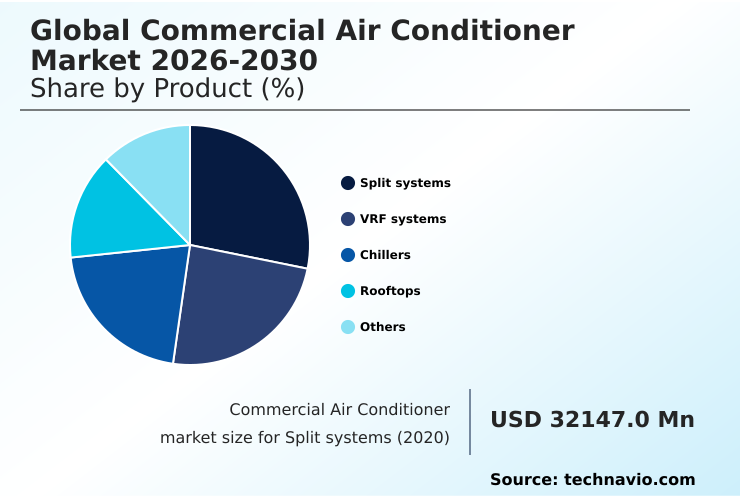
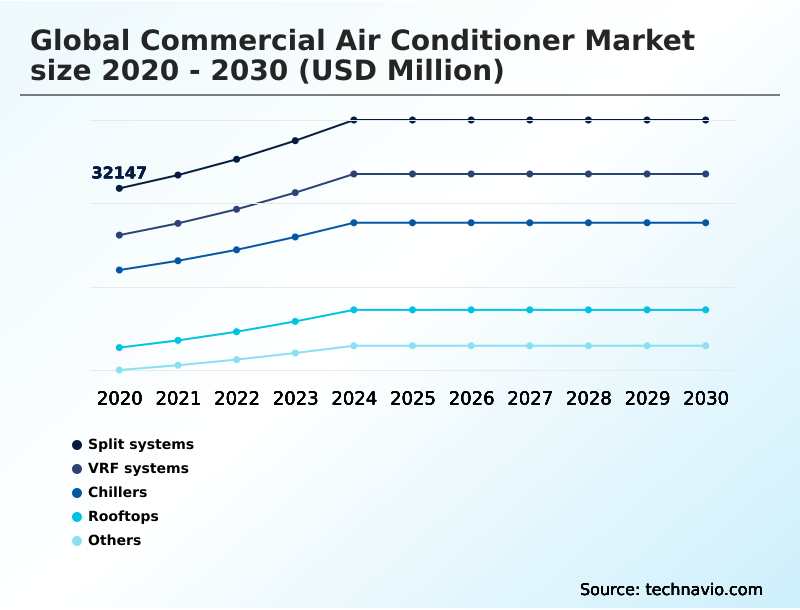
The Split systems segment was valued at USD 38.94 billion in 2024 and showed a gradual increase during the forecast period.
Regional Analysis
North America is estimated to contribute 31% to the growth of the global market during the forecast period.Technavio’s analysts have elaborately explained the regional trends and drivers that shape the market during the forecast period.
See How Commercial Air Conditioner Market Demand is Rising in North America Request Free Sample
The geographic landscape of the commercial air conditioner market is increasingly diverse, with APAC and North America collectively representing over 60% of the market's incremental growth opportunities.
In APAC, rapid urbanization fuels demand for rooftop packaged units and district cooling plants, aligning with sustainable cooling design principles. North America focuses on building energy optimization and retrofits, driven by corporate decarbonization strategy goals.
The impact of nearshoring on industrial HVAC demand is particularly evident in Mexico, boosting sales of specialized equipment. Meanwhile, the Middle East continues to invest in large-scale variable refrigerant flow systems to support its ambitious infrastructure projects.
This regional diversification is compelling manufacturers to adapt their data center thermal management and packaged rooftop unit offerings, with a growing emphasis on air-to-water heat pumps to meet varying climate and regulatory requirements globally.
Market Dynamics
Our researchers analyzed the data with 2025 as the base year, along with the key drivers, trends, and challenges. A holistic analysis of drivers will help companies refine their marketing strategies to gain a competitive advantage.
- Strategic decisions in the commercial air conditioner market now center on the lifecycle operating expenses of cooling systems and ensuring compliance with stringent environmental regulations in HVAC. A core focus is balancing HVAC performance with decarbonization goals, which involves optimizing partial load performance of chillers and navigating the challenges of transitioning to low-GWP refrigerants.
- The energy efficiency of inverter technology vs fixed-speed systems is a key consideration, where inverter systems show performance gains of over 30% in typical operating conditions. Businesses are integrating AI and IOT for smart building management to automate controls and are retrofitting buildings with variable refrigerant flow systems due to their modularity and design flexibility in HVAC retrofits.
- This is crucial for improving indoor air quality with advanced filtration and managing thermal loads in mixed-use developments. The industry is also seeing the impact of nearshoring on industrial hvac demand, particularly for systems with high ambient operating capabilities of hvac.
- The growth of the digital economy necessitates precision cooling for high-density data centers, while urban expansion highlights the benefits of district cooling in urban development for creating sustainable cooling for next-generation smart environments.
- Finally, addressing the future requires developing advanced heat pumps for electrification of heating to reduce the reliance on fossil fuel-based heating and solving structural issues like how to mitigate supply chain disruption for hvac components and address skilled hvac technician shortages.
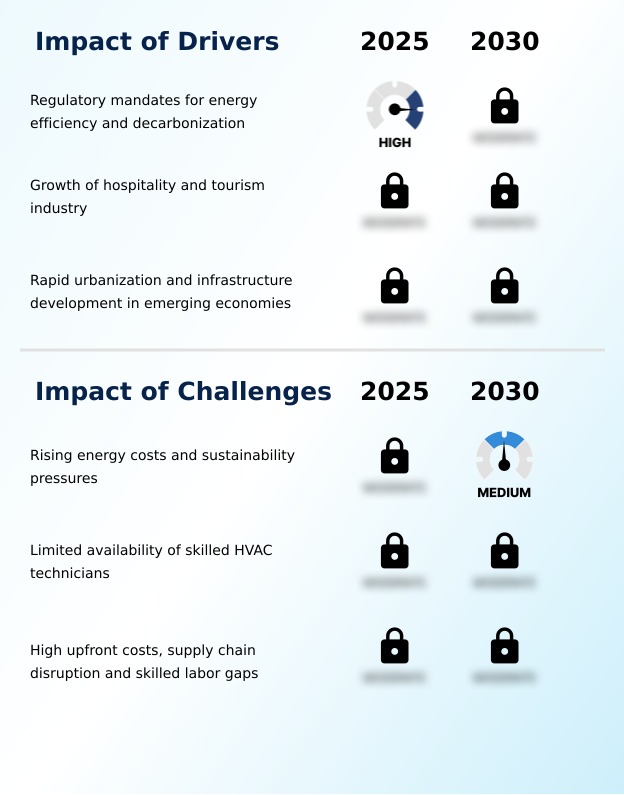
What are the key market drivers leading to the rise in the adoption of Commercial Air Conditioner Industry?
- Regulatory mandates promoting energy efficiency and decarbonization are a primary driver accelerating the adoption of advanced commercial air conditioning systems.
- Market growth is primarily driven by regulatory and economic factors promoting energy efficiency. Green building certifications now mandate the use of high-performance systems like scroll chillers and reverse-cycle chillers to improve indoor environmental quality.
- Rapid urbanization is expanding industrial cooling requirements and cold chain requirements, particularly in emerging economies where new commercial construction accounts for over 60% of demand.
- The hospitality sector's focus on thermal comfort and productivity is increasing installations of hydronic fan coil units and thermodynamic water heaters. This demand is further supported by the need for specialized process cooling solutions and desiccant cooling systems.
- Adherence to these standards helps companies reduce their operational carbon footprint, with certified buildings often commanding a 10% higher asset value.
What are the market trends shaping the Commercial Air Conditioner Industry?
- The market is experiencing a significant shift toward sustainable cooling technologies, driven by the widespread adoption of refrigerants with a low global warming potential.
- Key market trends are centered on achieving net-zero carbon cooling through technological innovation. The transition to low global warming potential refrigerants, including A2L refrigerants and R-454B refrigerant, is accelerating to meet a higher seasonal energy efficiency ratio. In parallel, the integration of AI enables predictive maintenance capabilities that can reduce system downtime by over 25%.
- Advanced technologies like oil-free magnetic bearing compressors and centrifugal compressors are becoming standard in systems designed for sustainable thermal management. These smart systems, often offered through cooling-as-a-service models, provide building automation integration that optimizes performance in real time.
- The adoption of liquid-to-chip cooling solutions for precision cooling technologies is also growing, with some systems improving energy transfer efficiency by up to 40%.
What challenges does the Commercial Air Conditioner Industry face during its growth?
- Rising energy costs and increasing sustainability pressures present a significant challenge to the industry, impacting both operational expenditures and investment decisions.
- The market faces significant challenges related to cost, infrastructure, and workforce. High upfront investment for systems with smart building controls or thermal energy storage technology remains a barrier, with advanced air-cooled chillers and water-cooled chillers costing up to 30% more than conventional units.
- Supply chain volatility for components used in solar-hybrid air conditioning further complicates project timelines, leading to delays of 15% or more. The complexity of modern HVAC building management systems requires precise cooling load calculation and deep knowledge of building energy act compliance, creating a skills gap.
- Many building owners struggle to secure energy performance financing, limiting upgrades that would improve building envelope efficiency and enable multi-zone climate control with technologies like aquifer thermal energy storage.
Exclusive Technavio Analysis on Customer Landscape
The commercial air conditioner market forecasting report includes the adoption lifecycle of the market, covering from the innovator’s stage to the laggard’s stage. It focuses on adoption rates in different regions based on penetration. Furthermore, the commercial air conditioner market report also includes key purchase criteria and drivers of price sensitivity to help companies evaluate and develop their market growth analysis strategies.
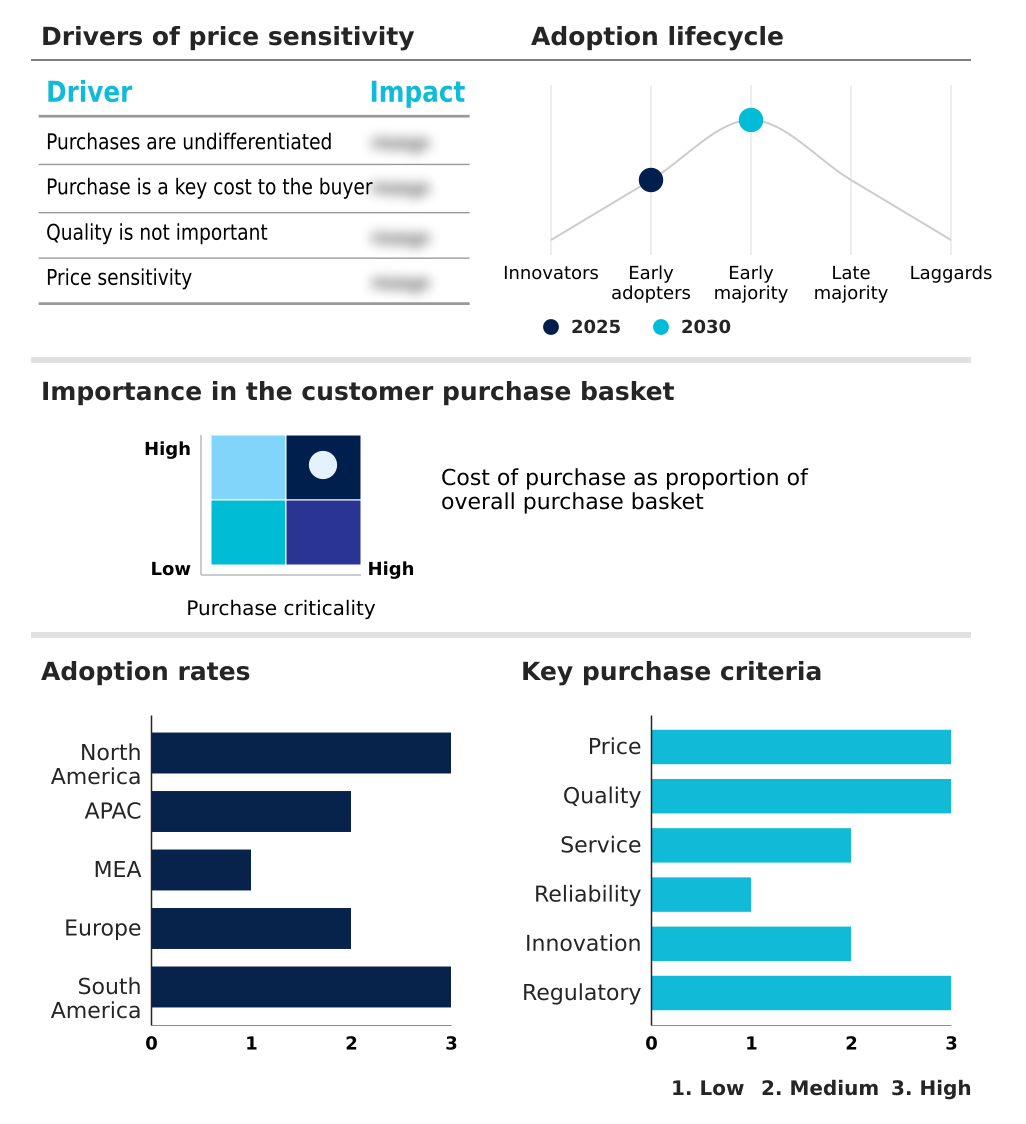
Customer Landscape of Commercial Air Conditioner Industry
Competitive Landscape
Companies are implementing various strategies, such as strategic alliances, commercial air conditioner market forecast, partnerships, mergers and acquisitions, geographical expansion, and product/service launches, to enhance their presence in the industry.
AAON Inc. - Delivers high-efficiency commercial cooling solutions, including chillers, VRF systems, and rooftop units for large-scale buildings, industrial plants, and specialized applications.
The industry research and growth report includes detailed analyses of the competitive landscape of the market and information about key companies, including:
- AAON Inc.
- Blue Star Ltd.
- Carrier Global Corp.
- Copeland LP
- Daikin Industries Ltd.
- Danfoss AS
- Fujitsu General Ltd.
- Haier Smart Home Co. Ltd.
- Hitachi Ltd.
- Honeywell International Inc.
- Johnson Controls International
- Lennox International Inc.
- LG Electronics Inc.
- Mitsubishi Electric Corp.
- Modine Manufacturing Co.
- Panasonic Holdings Corp.
- Samsung Electronics Co. Ltd.
- Toshiba Corp.
- Trane Technologies Plc
- Voltas Ltd.
Qualitative and quantitative analysis of companies has been conducted to help clients understand the wider business environment as well as the strengths and weaknesses of key industry players. Data is qualitatively analyzed to categorize companies as pure play, category-focused, industry-focused, and diversified; it is quantitatively analyzed to categorize companies as dominant, leading, strong, tentative, and weak.
Recent Development and News in Commercial air conditioner market
- In August 2024, Daikin Applied introduced its SWP J-Vintage self-contained HVAC system, which utilizes R-32 refrigerant to support decarbonization in commercial building retrofits.
- In February 2025, Daikin expanded its data center cooling portfolio with the launch of its Pro-C computer room air handler (CRAH) range, designed for modern server facility configurations.
- In February 2025, Carrier Global Corp. highlighted its strategic divestiture of the commercial refrigeration business to intensify its focus on core commercial HVAC segments and aftermarket growth.
- In March 2025, Trane Technologies announced the development of new magnetic bearing and Ascend air-cooled chillers specifically engineered to meet the escalating thermal management needs of data centers.
Dive into Technavio’s robust research methodology, blending expert interviews, extensive data synthesis, and validated models for unparalleled Commercial Air Conditioner Market insights. See full methodology.
| Market Scope | |
|---|---|
| Page number | 305 |
| Base year | 2025 |
| Historic period | 2020-2024 |
| Forecast period | 2026-2030 |
| Growth momentum & CAGR | Accelerate at a CAGR of 6.3% |
| Market growth 2026-2030 | USD 51783.9 million |
| Market structure | Fragmented |
| YoY growth 2025-2026(%) | 6.0% |
| Key countries | US, Canada, Mexico, China, India, Japan, South Korea, Australia, Indonesia, Saudi Arabia, UAE, Egypt, South Africa, Turkey, Germany, Italy, France, Spain, UK, The Netherlands, Brazil, Argentina and Chile |
| Competitive landscape | Leading Companies, Market Positioning of Companies, Competitive Strategies, and Industry Risks |
Research Analyst Overview
- The commercial air conditioner market is rapidly evolving, driven by the need for advanced process cooling solutions and high-density computing infrastructure. Key technologies shaping the landscape include variable refrigerant flow systems and inverter-driven compressors, which offer superior efficiency over older models. Innovations like oil-free magnetic bearing compressors and centrifugal compressors are now standard in high-performance water-cooled chillers and air-cooled chillers.
- The regulatory push toward sustainability mandates the use of low-GWP refrigerants, such as R-32 refrigerant and R-454B refrigerant, classifying them as essential A2L refrigerants. This transition impacts everything from rooftop packaged units and packaged rooftop units to ducted split systems. Modern systems feature building automation integration and predictive maintenance capabilities through smart building controls.
- Enhanced indoor air quality equipment and air handling units are critical, with some designs incorporating solar-hybrid air conditioning and desiccant cooling systems. Heat recovery configurations in air-to-water heat pumps and reverse-cycle chillers are maximizing energy use.
- Specialized equipment like scroll chillers, hydronic fan coil units, cassette air conditioners, thermodynamic water heaters, and systems leveraging aquifer thermal energy storage and thermal energy storage technology address diverse needs, including liquid-to-chip cooling solutions, where facilities report a 15% improvement in thermal management efficiency. This complex ecosystem requires a holistic approach to design and deployment.
What are the Key Data Covered in this Commercial Air Conditioner Market Research and Growth Report?
-
What is the expected growth of the Commercial Air Conditioner Market between 2026 and 2030?
-
USD 51.78 billion, at a CAGR of 6.3%
-
-
What segmentation does the market report cover?
-
The report is segmented by Product (Split systems, VRF systems, Chillers, Rooftops, and Others), Technology (Non-inverter, and Inverter), Type (Ducted AC, and Ductless AC) and Geography (North America, APAC, Middle East and Africa, Europe, South America)
-
-
Which regions are analyzed in the report?
-
North America, APAC, Middle East and Africa, Europe and South America
-
-
What are the key growth drivers and market challenges?
-
Regulatory mandates for energy efficiency and decarbonization, Rising energy costs and sustainability pressures
-
-
Who are the major players in the Commercial Air Conditioner Market?
-
AAON Inc., Blue Star Ltd., Carrier Global Corp., Copeland LP, Daikin Industries Ltd., Danfoss AS, Fujitsu General Ltd., Haier Smart Home Co. Ltd., Hitachi Ltd., Honeywell International Inc., Johnson Controls International, Lennox International Inc., LG Electronics Inc., Mitsubishi Electric Corp., Modine Manufacturing Co., Panasonic Holdings Corp., Samsung Electronics Co. Ltd., Toshiba Corp., Trane Technologies Plc and Voltas Ltd.
-
Market Research Insights
- The commercial air conditioner market is shaped by a focus on lifecycle performance and regulatory compliance. The commercial HVAC aftermarket is expanding as businesses prioritize upgrades over new builds, with retrofits of variable refrigerant flow systems showing a 20% faster installation time compared to traditional ductwork.
- The commercial retrofit industry is a key growth area, driven by corporate decarbonization strategy goals. Adherence to green building certifications is now a standard expectation, influencing multi-zone climate control designs and driving adoption of advanced cooling load calculation methods.
- In applications requiring precise thermal comfort and productivity, systems that integrate building energy optimization can reduce energy consumption by up to 15%, demonstrating a clear return on investment and aligning with stringent building energy act compliance.
We can help! Our analysts can customize this commercial air conditioner market research report to meet your requirements.
 RIA -
RIA -