



Chlorine Market Size 2025-2029
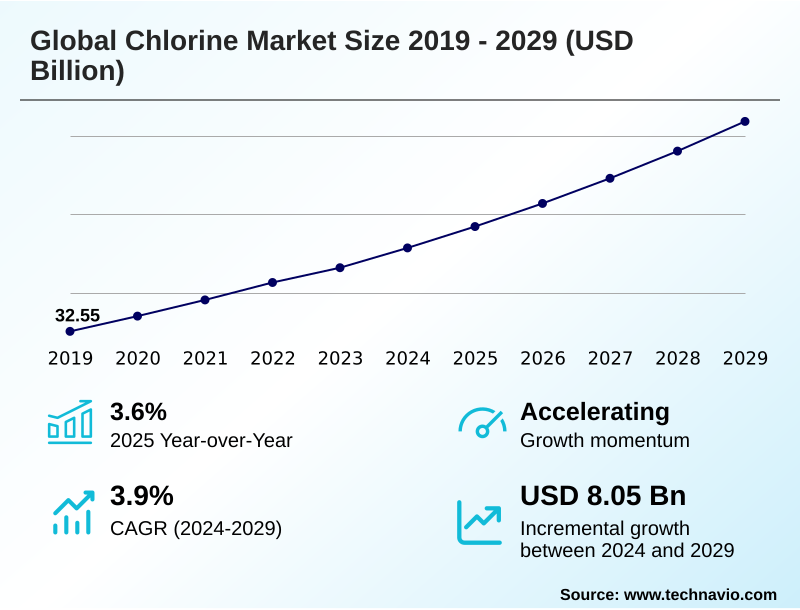
The chlorine market size is valued to increase by USD 8.05 billion, at a CAGR of 3.9% from 2024 to 2029. Surging demand from polyvinyl chloride (PVC) sector as a primary growth catalyst will drive the chlorine market.
Major Market Trends & Insights
- APAC dominated the market and accounted for a 59.2% growth during the forecast period.
- By Application - EDC or PVC segment was valued at USD 13.17 billion in 2023
- By End-user - Water treatment segment accounted for the largest market revenue share in 2023
Market Size & Forecast
- Market Opportunities: USD 13.36 billion
- Market Future Opportunities: USD 8.05 billion
- CAGR from 2024 to 2029 : 3.9%
Market Summary
- The chlorine market is a cornerstone of the chemical industry, with its performance intrinsically linked to broad industrial and economic activity. Demand is principally driven by its role as a key raw material for vinyls, especially in the production of polyvinyl chloride (PVC), which is essential for construction and infrastructure.
- The health of the building sector, therefore, acts as a direct barometer for chlorine consumption. Another critical driver is the non-cyclical demand for water disinfection and wastewater treatment, a need amplified by global population growth and urbanization.
- A significant trend shaping the market is the industry-wide transition to more sustainable chlor-alkali production technologies, such as membrane-cell technology, which offers lower energy consumption and a better environmental profile. This move to the Best Available Technique (BAT) is often mandated by stringent regulations.
- However, producers face the persistent challenge of intense energy dependency, making them vulnerable to volatile electricity markets.
- For example, an integrated chemical manufacturer must strategically manage its energy procurement, potentially through long-term power purchase agreements, to mitigate the impact of price spikes on the production cost of its downstream chemical derivatives, ensuring the profitability of its polyurethane manufacturing and other isocyanate synthesis operations.
What will be the Size of the Chlorine Market during the forecast period?
Get Key Insights on Market Forecast (PDF) Request Free Sample
How is the Chlorine Market Segmented?
The chlorine industry research report provides comprehensive data (region-wise segment analysis), with forecasts and estimates in "USD million" for the period 2025-2029, as well as historical data from 2019-2023 for the following segments.
- Application
- EDC or PVC
- Organic chemicals
- Isocyanates
- Chlorinated intermediates
- Others
- End-user
- Water treatment
- Pharmaceutical
- Chemical
- Others
- Type
- Liquid chlorine
- Chlorine gas
- Solid chlorine compound
- Geography
- APAC
- China
- India
- Japan
- North America
- US
- Canada
- Mexico
- Europe
- Germany
- France
- UK
- South America
- Brazil
- Argentina
- Colombia
- Middle East and Africa
- UAE
- Saudi Arabia
- South Africa
- Rest of World (ROW)
- APAC
By Application Insights
The edc or pvc segment is estimated to witness significant growth during the forecast period.
The EDC/PVC segment is the primary application, serving as a critical indicator for the market. Production of polyvinyl chloride (PVC) starts with reacting chlorine with ethylene to form ethylene dichloride (EDC), which is then converted to vinyl chloride monomer (VCM).
This role as a raw material for vinyls makes it a foundational commodity chemical production process.
The entire value chain, from the chlor-alkali process to downstream chemical derivatives, is shaped by demand in the construction sector, which utilizes over 59% of PVC.
In this vertically integrated manufacturing model, the health of the global building industry directly impacts demand for the primary feedstock for chemical manufacturing. PVC resins are essential for pipes, profiles, and flooring.
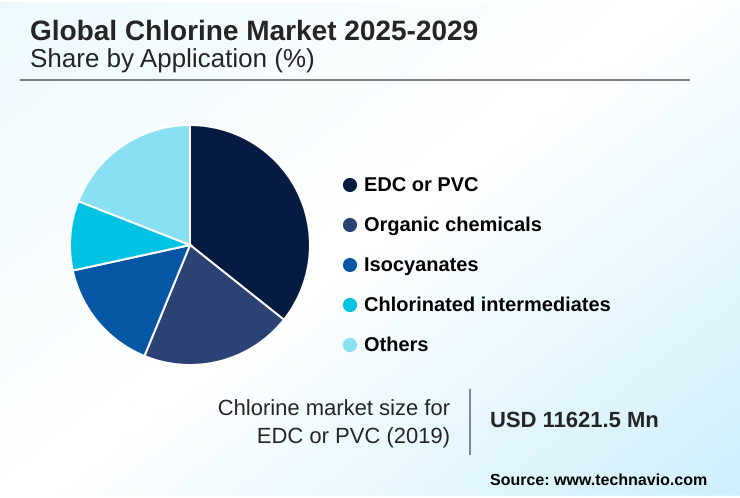
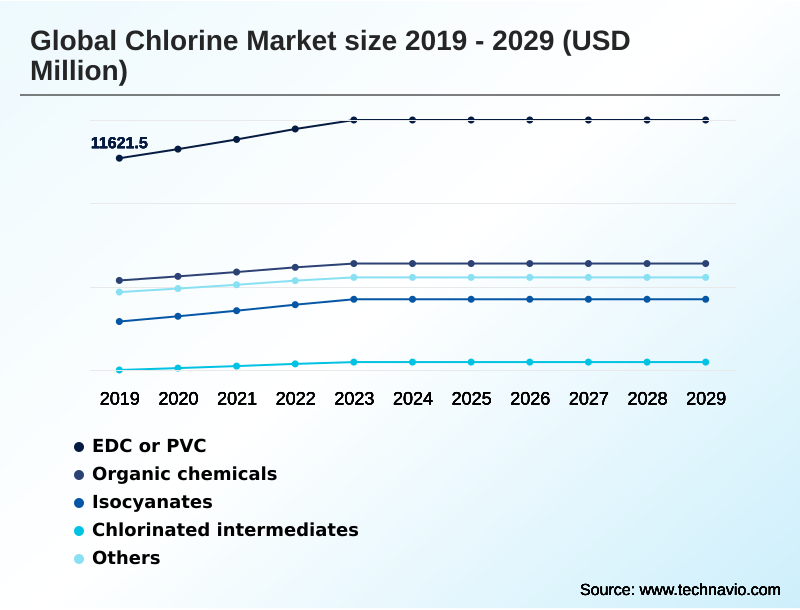
The EDC or PVC segment was valued at USD 13.17 billion in 2023 and showed a gradual increase during the forecast period.
Regional Analysis
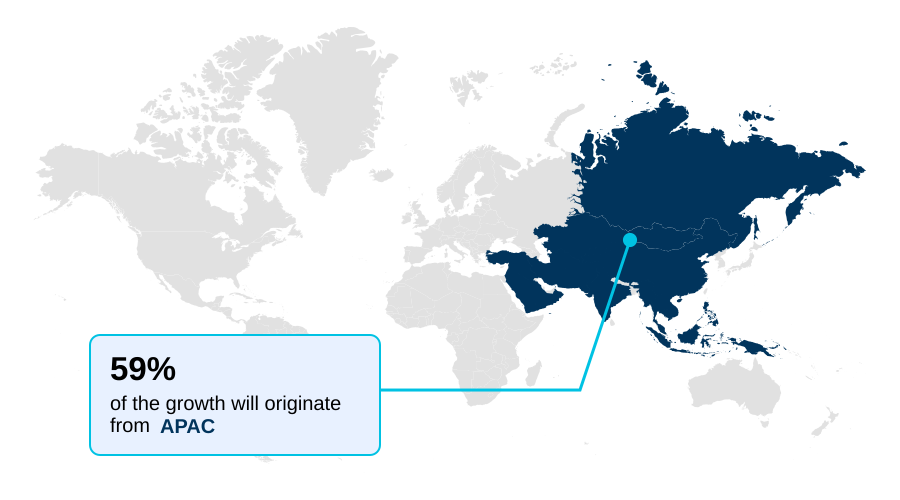
APAC is estimated to contribute 59.2% to the growth of the global market during the forecast period.Technavio’s analysts have elaborately explained the regional trends and drivers that shape the market during the forecast period.
See How Chlorine Market Demand is Rising in APAC Request Free Sample
The geographic landscape is dominated by the APAC region, accounting for nearly 60% of the market's incremental growth. This is driven by massive infrastructure projects and a burgeoning manufacturing sector that consumes chlorine and its co-product, caustic soda.
In contrast, North American producers benefit from low-cost energy for the energy-intensive electrolysis and have established efficient closed-loop chemical processes.
The European market, while mature, is defined by a push for sustainability and efficiency, having fully adopted membrane cell technology, which reduces electricity usage by over 20%. This technology is critical for producing propylene oxide and epichlorohydrin competitively.
The caustic soda market co-production balance is a key strategic consideration in all regions, influencing supply availability.
Market Dynamics
Our researchers analyzed the data with 2024 as the base year, along with the key drivers, trends, and challenges. A holistic analysis of drivers will help companies refine their marketing strategies to gain a competitive advantage.
- Strategic planning is essential for navigating the market's complexities. The primary demand from chlorine applications in pvc production links market health directly to the global construction sector. Concurrently, chlorine use in municipal water treatment provides a stable, non-cyclical foundation. Investment decisions are heavily influenced by chlor-alkali technology investment trends, with a focus on sustainable processes for chlorine production.
- A key operational challenge is managing energy costs in chlorine manufacturing. Safety remains paramount, with stringent protocols for chlorine transportation and storage safety. High-value growth is found where chlorine as a pharmaceutical intermediate and its role of chlorine in crop protection are expanding.
- Strategic discussions center on polyurethane synthesis using chlorine derivatives and the efficiency of chlorine dioxide for pulp bleaching. Firms must also address the environmental impact of chlorine byproducts and organochlorine compound formation concerns. Navigating regional chlorine supply chain logistics and ensuring regulatory compliance for chlor-alkali plants are critical.
- The market is also shaped by the caustic soda market co-production balance and the use of hydrochloric acid as a co-product. Long-term strategy involves developing circular economy models for vinyl products and expanding into high-growth areas like biocide applications in desalination plants, the use of epichlorohydrin production from chlorine, and the market for chlorine derivatives in specialty chemicals.
- Companies with proactive compliance strategies report up to 40% fewer regulatory incidents than those with reactive approaches.
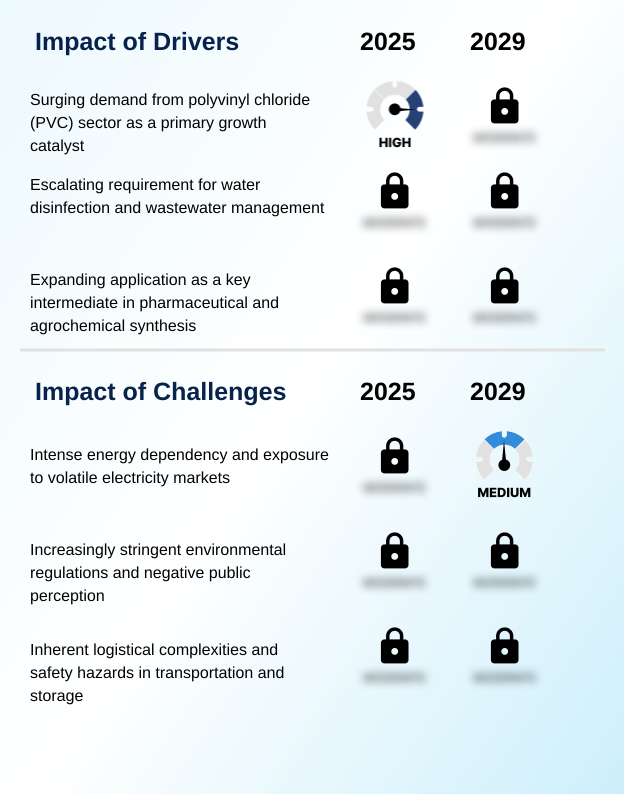
What are the key market drivers leading to the rise in the adoption of Chlorine Industry?
- The primary driver propelling market growth is the surging demand from the polyvinyl chloride (PVC) sector, which serves as a fundamental catalyst for chlorine consumption.
- Growth is propelled by strong demand from end-use industries. The PVC sector remains the largest driver, with chlorine serving as the essential building block for isocyanate synthesis and polyurethane manufacturing.
- Additionally, chlorine's role as a reagent for organic synthesis in the pharmaceutical sector is a significant high-value driver. Its use in active pharmaceutical ingredient synthesis has been shown to improve process yields by 5-8%.
- It also serves as a critical intermediate for agrochemicals and crop protection chemicals, supporting global food security.
- Demand for MDI and TDI, key precursors for polyurethanes, is tied to the automotive and construction industries, making water disinfection a more stable demand pillar.
What are the market trends shaping the Chlorine Industry?
- A key trend influencing market dynamics is the accelerated transition toward more sustainable chlor-alkali production technologies. This shift is driven by environmental regulations and the pursuit of greater operational and energy efficiency.
- A key trend is the accelerated shift toward sustainable production with membrane-cell technology, now the Best Available Technique (BAT). This move, which includes the mercury-cell process phase-out, helps producers manage the diaphragm-cell process replacement and can reduce energy consumption by up to 25%.
- A second powerful trend is the focus on water security, which boosts demand for chlorine as a public health disinfectant. Its use as a disinfectant for municipal water and industrial water systems sanitizer is expanding. This is prompting innovation in sodium hypochlorite and calcium hypochlorite formulations, both critical sanitation chemical products that also find use in swimming pool sanitization.
What challenges does the Chlorine Industry face during its growth?
- A primary challenge affecting industry growth is the intense energy dependency of the chlor-alkali process and the market's resulting exposure to volatile electricity prices.
- The market faces significant challenges, primarily the high costs of the chlor-alkali process, which can increase operating expenses by over 50% during electricity price spikes. This pressure drives the search for green chemistry alternatives. A second major challenge involves logistics and safety.
- As a toxic by inhalation (TIH) material, chlorine requires specialized compressed gas transportation, and new regulations have increased compliance overhead by up to 20%. Concerns over organochlorine compounds and the environmental impact of chlorine byproducts are leading to stricter rules. Managing these issues while producing chlorinated solvents and other chlorinated intermediates requires significant capital investment and operational discipline.
Exclusive Technavio Analysis on Customer Landscape
The chlorine market forecasting report includes the adoption lifecycle of the market, covering from the innovator’s stage to the laggard’s stage. It focuses on adoption rates in different regions based on penetration. Furthermore, the chlorine market report also includes key purchase criteria and drivers of price sensitivity to help companies evaluate and develop their market growth analysis strategies.
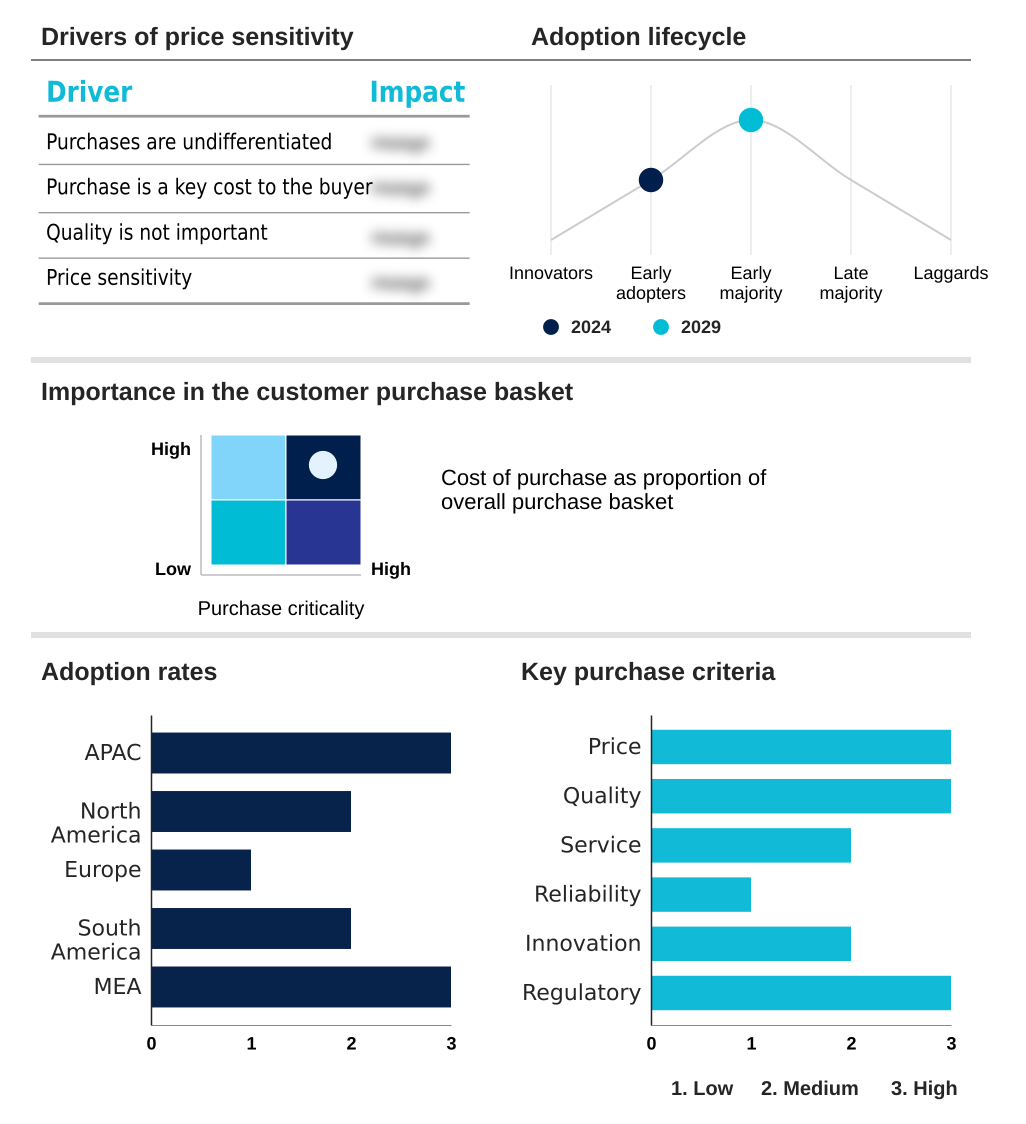
Customer Landscape of Chlorine Industry
Competitive Landscape
Companies are implementing various strategies, such as strategic alliances, chlorine market forecast, partnerships, mergers and acquisitions, geographical expansion, and product/service launches, to enhance their presence in the industry.
Aditya Birla Chemicals - This portfolio of chlor-alkali products, including liquid chlorine and caustic soda, serves key applications in water treatment and chemical processing.
The industry research and growth report includes detailed analyses of the competitive landscape of the market and information about key companies, including:
- Aditya Birla Chemicals
- Asahi Kasei Corp.
- BASF SE
- Braskem SA
- Covestro AG
- Dow Chemical Co.
- Formosa Plastics Corp.
- INEOS Group Holdings S.A.
- Lanxess AG
- Nouryon Chemicals Holding
- Occidental Petroleum Corp.
- Olin Corp.
- Reliance Industries Ltd.
- Saudi Basic Industries
- Shin Etsu Chemical Co. Ltd.
- Tata Chemicals Ltd.
- Tosoh Corp.
- Westlake Corp.
Qualitative and quantitative analysis of companies has been conducted to help clients understand the wider business environment as well as the strengths and weaknesses of key industry players. Data is qualitatively analyzed to categorize companies as pure play, category-focused, industry-focused, and diversified; it is quantitatively analyzed to categorize companies as dominant, leading, strong, tentative, and weak.
Recent Development and News in Chlorine market
- In November 2024, Covestro AG finalizes a 15-year power purchase agreement with a new offshore wind farm to supply its chlor-alkali facility in Antwerp, aiming to reduce energy cost volatility.
- In January 2025, Westlake Corp. completes the debottlenecking of its PVC resin plant in Plaquemine, Louisiana, increasing capacity to meet sustained demand from US infrastructure projects.
- In March 2025, Olin Corp. enters a strategic partnership to supply high-purity calcium hypochlorite for decentralized water treatment systems being deployed across Southeast Asia.
- In September 2024, INEOS Group Holdings S.A. announces the successful conversion of its final diaphragm-cell production line to advanced membrane-cell technology at its facility in Germany, achieving a 20% reduction in electricity consumption.
Dive into Technavio’s robust research methodology, blending expert interviews, extensive data synthesis, and validated models for unparalleled Chlorine Market insights. See full methodology.
| Market Scope | |
|---|---|
| Page number | 311 |
| Base year | 2024 |
| Historic period | 2019-2023 |
| Forecast period | 2025-2029 |
| Growth momentum & CAGR | Accelerate at a CAGR of 3.9% |
| Market growth 2025-2029 | USD 8051.7 million |
| Market structure | Fragmented |
| YoY growth 2024-2025(%) | 3.6% |
| Key countries | China, India, Japan, South Korea, Australia, Indonesia, US, Canada, Mexico, Germany, France, UK, Italy, Spain, The Netherlands, Brazil, Argentina, Colombia, UAE, Saudi Arabia, South Africa, Israel and Turkey |
| Competitive landscape | Leading Companies, Market Positioning of Companies, Competitive Strategies, and Industry Risks |
Research Analyst Overview
- The chlorine market is evolving beyond a simple commodity, driven by a mandatory shift in its foundational chlor-alkali process. The industry-wide mercury-cell process phase-out and replacement of the diaphragm-cell process are now nearly complete, with membrane-cell technology established as the Best Available Technique (BAT).
- This transition, driven by regulatory pressure, is not just about compliance but core strategy, with firms achieving up to a 25% reduction in energy consumption. The market's primary offtake remains the synthesis of ethylene dichloride (EDC) and vinyl chloride monomer (VCM) for polyvinyl chloride (PVC) production.
- However, high-value applications are growing, including the use of chlorine for isocyanate synthesis for polyurethane manufacturing and as a feedstock for propylene oxide via the chlorohydrin process. Phosgene production continues to feed the demand for MDI and TDI. Essential public health applications such as water disinfection and wastewater treatment, using sodium hypochlorite and calcium hypochlorite, provide a stable demand base.
- The versatility of chlorine is further seen in the synthesis of chlorinated intermediates, its use in active pharmaceutical ingredient synthesis and crop protection chemicals, and its role as a biocide for desalination. Even applications like steel pickling with hydrochloric acid (HCl) and elemental chlorine free (ECF) bleaching highlight its industrial breadth.
- Strategic planning must now account for the circular economy in chemicals, the management of organochlorine compounds, and the logistics of a toxic by inhalation (TIH) material.
What are the Key Data Covered in this Chlorine Market Research and Growth Report?
-
What is the expected growth of the Chlorine Market between 2025 and 2029?
-
USD 8.05 billion, at a CAGR of 3.9%
-
-
What segmentation does the market report cover?
-
The report is segmented by Application (EDC or PVC, Organic chemicals, Isocyanates, Chlorinated intermediates, and Others), End-user (Water treatment, Pharmaceutical, Chemical, and Others), Type (Liquid chlorine, Chlorine gas, and Solid chlorine compound) and Geography (APAC, North America, Europe, South America, Middle East and Africa)
-
-
Which regions are analyzed in the report?
-
APAC, North America, Europe, South America and Middle East and Africa
-
-
What are the key growth drivers and market challenges?
-
Surging demand from polyvinyl chloride (PVC) sector as a primary growth catalyst, Intense energy dependency and exposure to volatile electricity markets
-
-
Who are the major players in the Chlorine Market?
-
Aditya Birla Chemicals, Asahi Kasei Corp., BASF SE, Braskem SA, Covestro AG, Dow Chemical Co., Formosa Plastics Corp., INEOS Group Holdings S.A., Lanxess AG, Nouryon Chemicals Holding, Occidental Petroleum Corp., Olin Corp., Reliance Industries Ltd., Saudi Basic Industries, Shin Etsu Chemical Co. Ltd., Tata Chemicals Ltd., Tosoh Corp. and Westlake Corp.
-
Market Research Insights
- Market dynamics are shaped by a complex interplay of industrial demand and operational pressures. As a critical reagent for organic synthesis, chlorine's consumption is tied to manufacturing output, yet its use as a disinfectant for municipal water provides a stable, non-cyclical demand floor. Companies are navigating this landscape by focusing on efficiency.
- The transition to advanced membrane-cell processes from older methods has been shown to reduce electricity consumption by up to 25%, directly impacting production costs. In downstream applications, optimizing the use of chlorine as a bleaching agent for pulp can improve process efficiency by over 10%.
- Furthermore, deploying automated dosing systems for chlorine as an industrial water systems sanitizer can decrease chemical waste by 15%, enhancing both sustainability and profitability. These operational improvements are key to maintaining competitiveness in a market sensitive to energy and regulatory pressures.
We can help! Our analysts can customize this chlorine market research report to meet your requirements.
 RIA -
RIA -