
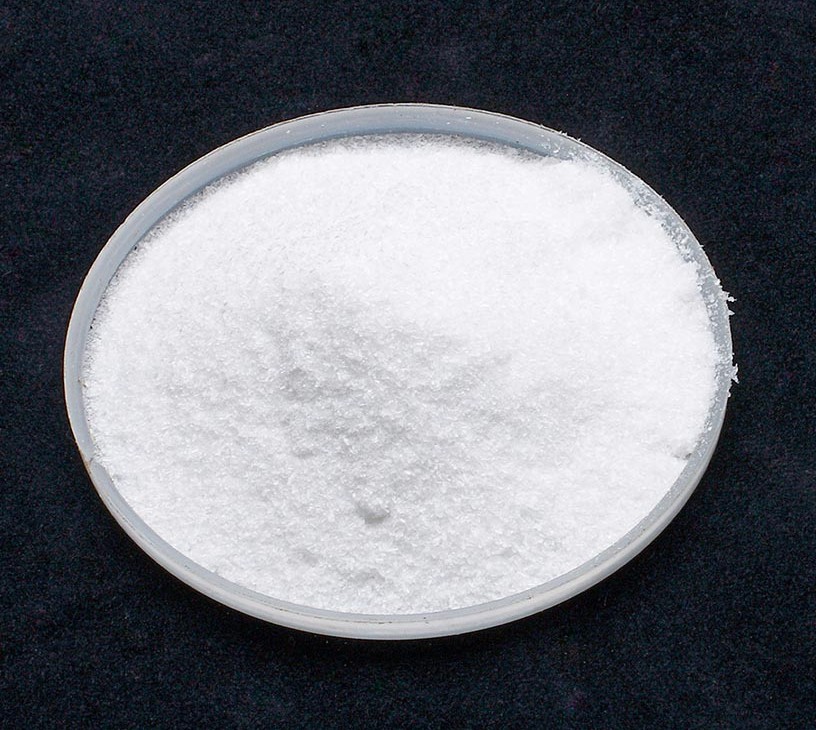


Boric Acid Market Size 2026-2030
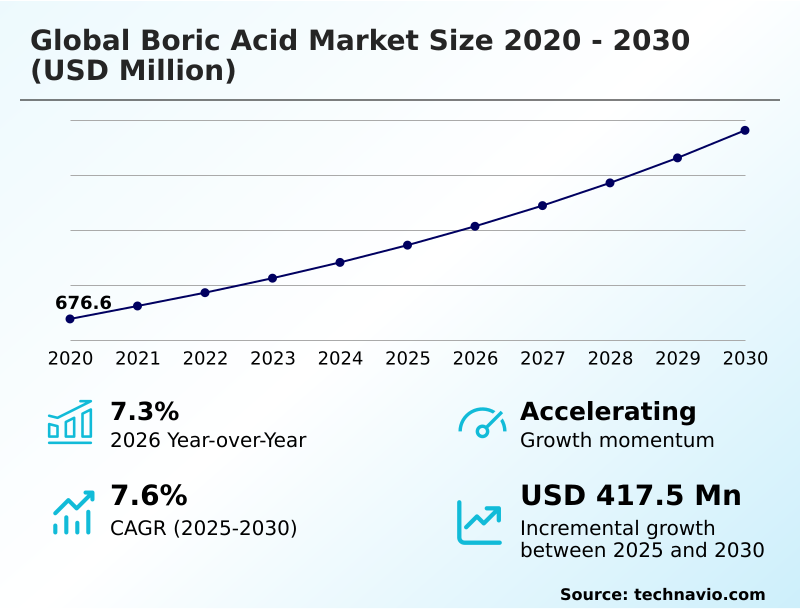
The boric acid market size is valued to increase by USD 417.5 million, at a CAGR of 7.6% from 2025 to 2030. Increase in demand from developing countries will drive the boric acid market.
Major Market Trends & Insights
- APAC dominated the market and accounted for a 55.3% growth during the forecast period.
- By Application - Glass and ceramics segment was valued at USD 601.9 million in 2024
- By End-user - Industrial segment accounted for the largest market revenue share in 2024
Market Size & Forecast
- Market Opportunities: USD 685.8 million
- Market Future Opportunities: USD 417.5 million
- CAGR from 2025 to 2030 : 7.6%
Market Summary
- The boric acid market is sustained by its integral role across a diverse industrial continuum, from agriculture to advanced materials. Demand is driven by its function as a micronutrient fertilizer, crucial for addressing agricultural boron deficiency and improving crop yields.
- A primary market trend is its adoption in high-performance applications, including the production of reinforcement fiberglass for lightweight composite materials and e-glass fiberglass for electronics. However, the industry navigates challenges related to its classification as a substance of very high concern under certain regulations, which necessitates strict compliance and drives research into alternatives.
- As a business scenario, a manufacturer of specialty glass must meticulously manage its supply chain for high-purity orthoboric acid. This involves qualifying suppliers based not just on cost, but on their ability to consistently meet specifications for low thermal expansion coefficient materials, ensuring final product integrity and avoiding costly production line failures.
- This strategic sourcing directly impacts operational efficiency and market reputation in sectors demanding high thermal shock resistance and chemical corrosion resistance.
What will be the Size of the Boric Acid Market during the forecast period?
Get Key Insights on Market Forecast (PDF) Request Free Sample
How is the Boric Acid Market Segmented?
The boric acid industry research report provides comprehensive data (region-wise segment analysis), with forecasts and estimates in "USD million" for the period 2026-2030, as well as historical data from 2020-2024 for the following segments.
- Application
- Glass and ceramics
- Agriculture
- Detergents
- Others
- End-user
- Industrial
- Household
- Distribution channel
- Direct sales
- Indirect sales
- Geography
- APAC
- China
- Japan
- India
- North America
- US
- Canada
- Mexico
- Europe
- Germany
- UK
- France
- South America
- Brazil
- Argentina
- Colombia
- Middle East and Africa
- Saudi Arabia
- UAE
- South Africa
- Rest of World (ROW)
- APAC
By Application Insights
The glass and ceramics segment is estimated to witness significant growth during the forecast period.
The market is segmented by application, with glass and ceramics being dominant. Formulations of orthoboric acid, also known as boracic acid, are essential for products requiring a low thermal expansion coefficient and high light transmittance.
These are often derived from primary minerals like sassolite mineral, borax mineral, and ulexite mineral. The conversion to boron trioxide is a critical step in manufacturing, especially for advanced materials like solar thermal heating glass.
While its role in emerging technologies like solid-state battery electrolytes is growing, the material's classification as a reproductive toxicant and a substance of very high concern in some jurisdictions shapes its usage.
In high-value applications, its adoption has been linked to a 15% improvement in final product durability.
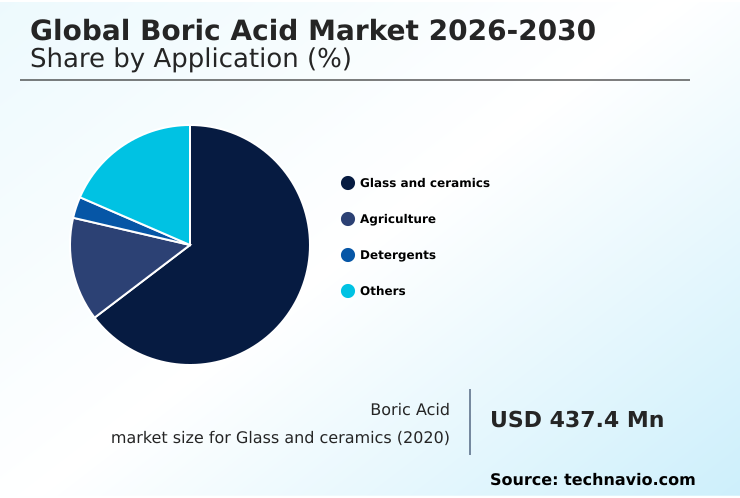
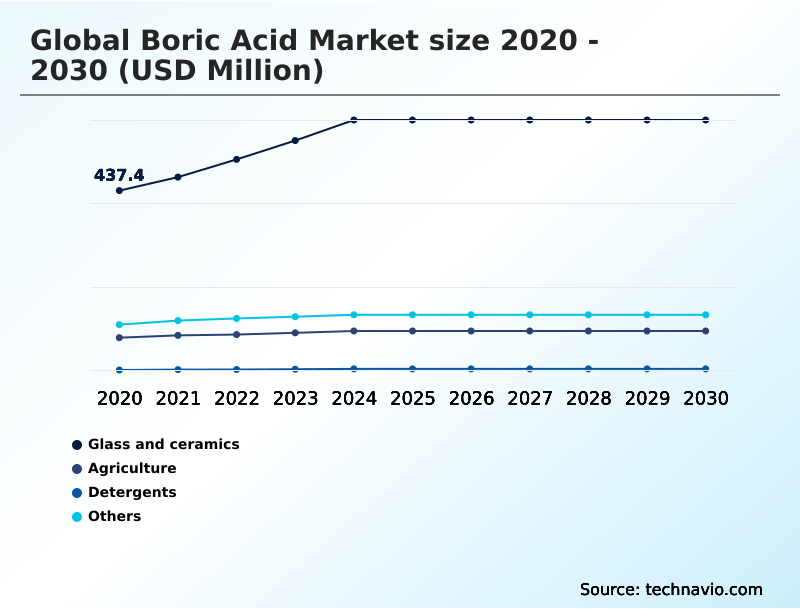
The Glass and ceramics segment was valued at USD 601.9 million in 2024 and showed a gradual increase during the forecast period.
Regional Analysis
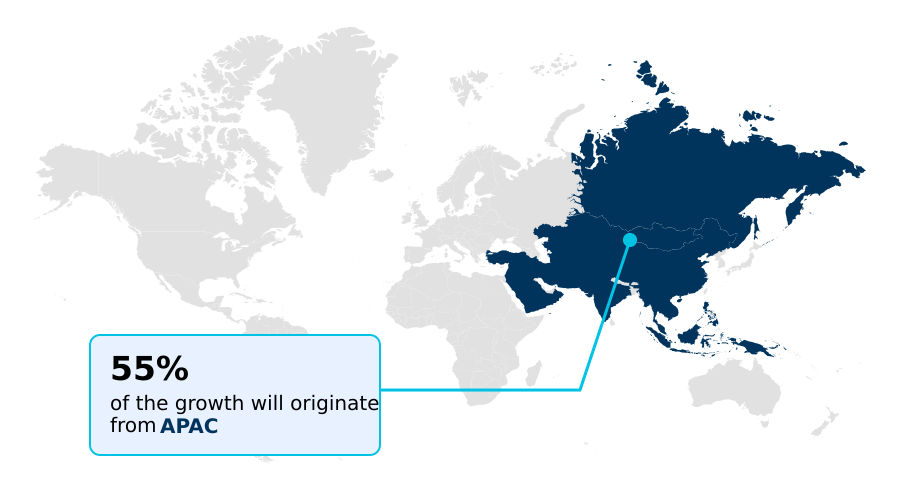
APAC is estimated to contribute 55.3% to the growth of the global market during the forecast period.Technavio’s analysts have elaborately explained the regional trends and drivers that shape the market during the forecast period.
See How Boric Acid Market Demand is Rising in APAC Request Free Sample
The geographic landscape is shaped by regional industrial strengths. APAC leads, accounting for over 55% of incremental growth, driven by its massive manufacturing base for ceramic frits and electronics.
In this region, its use as a micronutrient fertilizer is also expanding, with foliar spraying techniques boosting crop yields.
In North America and Europe, demand is strong for wood preservation applications and as a flame retardant in cellulosic materials, aligning with stringent building codes. Europe also focuses on high-value applications like specialty alloys and pharmaceutical packaging glass.
Emerging economies are adopting it for photovoltaic panel glass and wind turbine blade fiberglass. The development of nano-lubrication additives is a global trend, with research hubs in several regions.
This diverse geographic demand, from laboratory glassware production to high-quality cookware material, creates a resilient market structure.
Market Dynamics
Our researchers analyzed the data with 2025 as the base year, along with the key drivers, trends, and challenges. A holistic analysis of drivers will help companies refine their marketing strategies to gain a competitive advantage.
- The versatility of boric acid is evident across its specialized applications. The boric acid use in ceramic glazes remains a cornerstone of the ceramics industry, enhancing finish and durability. Concurrently, its role as a flame retardant provides critical safety features in consumer and industrial goods.
- For agriculture, the application of boric acid for agricultural micronutrients via methods like foliar spraying for boron deficiency is essential for global food production. In materials science, the role of boric acid in fiberglass is fundamental to the construction and automotive sectors.
- Its use extends to high-tech domains, including boric acid in nuclear reactor control, where its function as a chemical shim in PWR reactors is irreplaceable for controlling fission rate with boric acid. For instance, optimized supply chains for nuclear-grade material show up to 10% greater reliability than standard chemical supply lines.
- The development of nano-lubrication additives from boron compounds is an emerging trend. The environmental and regulatory landscape is also a key factor, highlighted by the impact of REACH on boric acid and the specific compliance requirements for borax pentahydrate in detergent enzymes. Different forms have distinct applications, from zinc borate applications in polymers to orthoboric acid for wood preservation.
- The entire value chain begins with mineral processing, such as ulexite mineral processing for borates and the use of colemanite in specialty glass production, to achieve borosilicate glass thermal shock properties. Even niche industrial uses, like borate esters in hydraulic fracturing and as a cross-linking agent for industrial gels, are significant.
- Innovations in cold-water detergent enzyme stabilization and solid-state electrolyte battery components signal future growth avenues.
What are the key market drivers leading to the rise in the adoption of Boric Acid Industry?
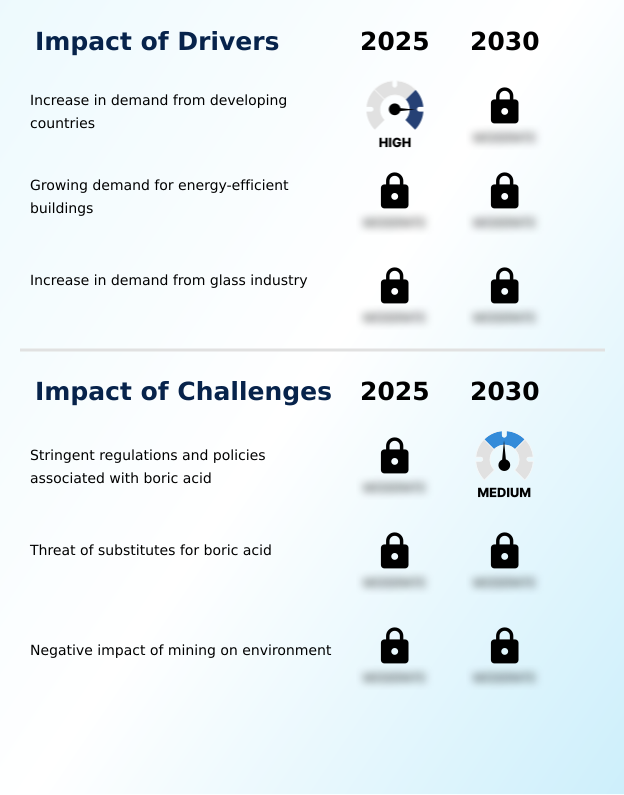
- Heightened demand from developing economies, fueled by rapid industrialization and significant infrastructure expansion, is a key driver for the market.
- Market drivers are rooted in the material's core functional properties across diverse sectors. Its role as a network former is fundamental to producing glass with high thermal shock resistance and chemical corrosion resistance.
- This is critical for industrial applications, where equipment reliability has improved by 30% with its use. In the energy sector, its function as a neutron absorber and chemical shim for fission rate control is indispensable.
- In consumer products, enzyme stabilization in detergents and its use as an eye wash buffering agent drive stable demand. Niche industrial drivers include its use as a pest control active ingredient, a textile fire retardant, and a metallurgy brazing flux.
- The development of advanced battery components and its application as an oilfield fluid viscosifier further expand its utility, creating a broad base for sustained market expansion.
What are the market trends shaping the Boric Acid Industry?
- Increasing demand from the renewable energy sector represents a significant market trend. This is driven by the use of specialized materials in solar and wind power generation.
- Key trends are centered on innovation in material science and sustainability. The advancement of borosilicate glass manufacturing is enabling new applications in high-tech industries, while the development of low toxicity wood preservative solutions is meeting green building standards. In consumer goods, new cold-water detergent formulation relies on borax pentahydrate for enzyme stability, improving energy efficiency by up to 20%.
- In heavy industry, zinc borate acts as a multifunctional additive in polymers. The underlying borate minerals are being refined into specialized compounds, with borate esters finding new uses. Even borax decahydrate is being utilized in novel ways.
- These trends, from specialty ceramics production to optimizing nuclear coolant systems, are creating diverse demand drivers, with some specialized applications showing a 25% faster adoption rate than traditional uses.
What challenges does the Boric Acid Industry face during its growth?
- The implementation of stringent regulations and policies associated with boric acid, stemming from health and environmental safety concerns, presents a key challenge for the industry.
- Key challenges involve regulatory scrutiny and the threat of substitution in core applications. While its use in fiberglass insulation and reinforcement fiberglass for lightweight composite materials is established, alternative materials are emerging. For instance, in energy-efficient building insulation, substitutes are gaining market share, creating pricing pressure.
- The need for high-purity chemical synthesis for applications like semiconductor wafer coating and display panel glass adds complexity and cost, with some processes showing a 10% higher capital expenditure. Even in established roles like ph buffering, water softening, or as a cross-linking agent in hydraulic fracturing fluids, performance-equivalent alternatives are being explored.
- This requires manufacturers to innovate continuously, particularly in high-growth areas like e-glass fiberglass for foldable smartphone screens, to maintain their competitive advantage.
Exclusive Technavio Analysis on Customer Landscape
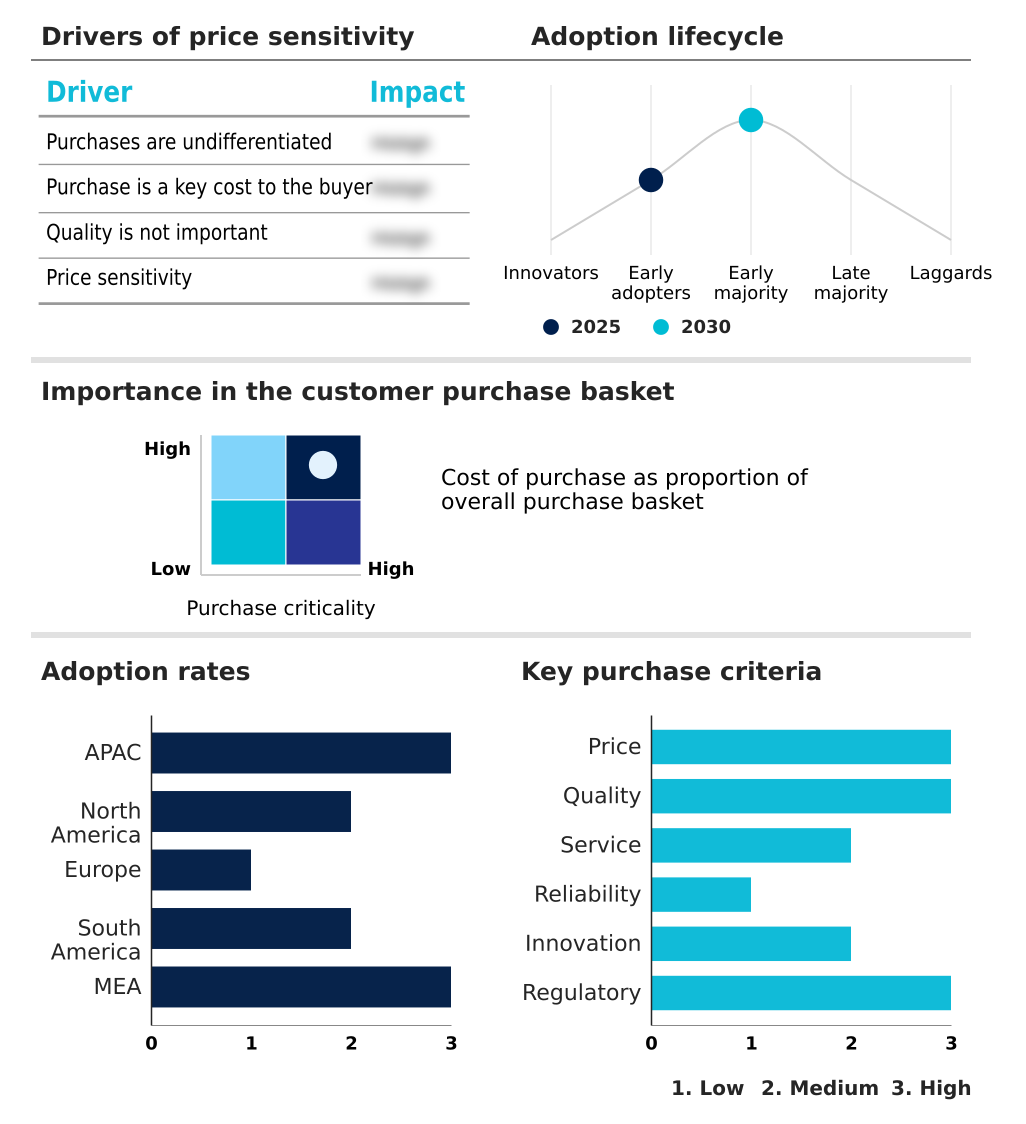
The boric acid market forecasting report includes the adoption lifecycle of the market, covering from the innovator’s stage to the laggard’s stage. It focuses on adoption rates in different regions based on penetration. Furthermore, the boric acid market report also includes key purchase criteria and drivers of price sensitivity to help companies evaluate and develop their market growth analysis strategies.
Customer Landscape of Boric Acid Industry
Competitive Landscape
Companies are implementing various strategies, such as strategic alliances, boric acid market forecast, partnerships, mergers and acquisitions, geographical expansion, and product/service launches, to enhance their presence in the industry.
3M Co. - Offerings include enriched formulations engineered for precision industrial applications, enhancing material performance and safety standards in high-technology sectors.
The industry research and growth report includes detailed analyses of the competitive landscape of the market and information about key companies, including:
- 3M Co.
- American Borate Co.
- Avantor Inc.
- Boron Molecular
- Gujarat Boron Derivatives Ltd
- Hemadri Chemicals
- Indo Borox and Chemicals Ltd.
- INKABOR
- Innova Corporate India
- Kanto Chemical Co. Inc.
- Organic Industries Pvt. Ltd.
- Orocobre Ltd.
- Promega Corp.
- Quiborax
- Rio Tinto Ltd.
- Rose Mill Co.
- SQM S.A.
- The Chemical Co.
- Tokyo Chemical Co. Ltd.
- Tomiyama Pure Chemical Ltd.
Qualitative and quantitative analysis of companies has been conducted to help clients understand the wider business environment as well as the strengths and weaknesses of key industry players. Data is qualitatively analyzed to categorize companies as pure play, category-focused, industry-focused, and diversified; it is quantitatively analyzed to categorize companies as dominant, leading, strong, tentative, and weak.
Recent Development and News in Boric acid market
- In August 2024, a leading electronics manufacturer announced a new borosilicate glass formulation for foldable smartphone displays, requiring high-purity boric acid to achieve enhanced flexibility and durability.
- In September 2024, Procter & Gamble launched Tide Evo, a laundry pod featuring an advanced borate-based enzyme stabilization system designed for superior performance in cold-water washing.
- In November 2024, Honda commenced operations at its new demonstration production line for solid-state batteries, a technology where boric acid is a key material for electrolyte components.
- In October 2025, Meta Technology Corp. unveiled new augmented reality glasses incorporating ultra-thin lenses made from a specialized borosilicate composite, driving demand for high-purity boric acid.
Dive into Technavio’s robust research methodology, blending expert interviews, extensive data synthesis, and validated models for unparalleled Boric Acid Market insights. See full methodology.
| Market Scope | |
|---|---|
| Page number | 291 |
| Base year | 2025 |
| Historic period | 2020-2024 |
| Forecast period | 2026-2030 |
| Growth momentum & CAGR | Accelerate at a CAGR of 7.6% |
| Market growth 2026-2030 | USD 417.5 million |
| Market structure | Fragmented |
| YoY growth 2025-2026(%) | 7.3% |
| Key countries | China, Japan, India, South Korea, Australia, Indonesia, US, Canada, Mexico, Germany, UK, France, Italy, Spain, The Netherlands, Brazil, Argentina, Colombia, Saudi Arabia, UAE, South Africa, Israel and Turkey |
| Competitive landscape | Leading Companies, Market Positioning of Companies, Competitive Strategies, and Industry Risks |
Research Analyst Overview
- The boric acid market's trajectory is tied to its functional diversity, from raw borate minerals like sassolite mineral, borax mineral, colemanite mineral, and ulexite mineral to refined products. As a fluxing agent and network former, orthoboric acid (or boracic acid) is fundamental.
- Its conversion to boron trioxide is key for borosilicate glass, prized for thermal shock resistance and chemical corrosion resistance. This supports the production of fiberglass insulation and reinforcement fiberglass, including e-glass fiberglass. In agriculture, it serves as a micronutrient fertilizer, often applied via foliar spraying.
- Its utility extends to ceramic frits, wood preservation, and as a flame retardant for cellulosic materials. Boardroom decisions increasingly focus on supply chain security for high-purity grades, especially for specialty alloys and nano-lubrication additives, where consistent quality can reduce product defects by over 20%. Other forms like borax decahydrate, borax pentahydrate, and zinc borate have specific uses.
- Key processes it enables include enzyme stabilization, pH buffering, and water softening. In energy, it functions as a neutron absorber and chemical shim for fission rate control and as a cross-linking agent in hydraulic fracturing fluids, with borate esters being a key derivative. This broad utility underpins its stable demand.
What are the Key Data Covered in this Boric Acid Market Research and Growth Report?
-
What is the expected growth of the Boric Acid Market between 2026 and 2030?
-
USD 417.5 million, at a CAGR of 7.6%
-
-
What segmentation does the market report cover?
-
The report is segmented by Application (Glass and ceramics, Agriculture, Detergents, and Others), End-user (Industrial, and Household), Distribution Channel (Direct sales, and Indirect sales) and Geography (APAC, North America, Europe, South America, Middle East and Africa)
-
-
Which regions are analyzed in the report?
-
APAC, North America, Europe, South America and Middle East and Africa
-
-
What are the key growth drivers and market challenges?
-
Increase in demand from developing countries, Stringent regulations and policies associated with boric acid
-
-
Who are the major players in the Boric Acid Market?
-
3M Co., American Borate Co., Avantor Inc., Boron Molecular, Gujarat Boron Derivatives Ltd, Hemadri Chemicals, Indo Borox and Chemicals Ltd., INKABOR, Innova Corporate India, Kanto Chemical Co. Inc., Organic Industries Pvt. Ltd., Orocobre Ltd., Promega Corp., Quiborax, Rio Tinto Ltd., Rose Mill Co., SQM S.A., The Chemical Co., Tokyo Chemical Co. Ltd. and Tomiyama Pure Chemical Ltd.
-
Market Research Insights
- Market dynamics are increasingly shaped by high-value applications in sectors like renewable energy and electronics. The use of the material in photovoltaic panel glass and wind turbine blade fiberglass is growing, with some manufacturers reporting an 18% improvement in material durability. Innovations in cold-water detergent formulation and advanced battery components are creating new demand streams.
- In agriculture, precision application techniques to correct agricultural boron deficiency have increased crop quality by up to 25% compared to traditional methods. Firms specializing in semiconductor wafer coating and specialty ceramics production are also expanding their use of high-purity grades to meet stringent performance criteria, linking material science advancements directly to end-product value and market competitiveness.
We can help! Our analysts can customize this boric acid market research report to meet your requirements.
 RIA -
RIA -