


Biostimulants Market Size 2025-2029
The biostimulants market size is forecast to increase by USD 2.16 billion at a CAGR of 12.4% between 2024 and 2029.
- The market is experiencing significant growth, driven primarily by the increasing demand for these products In the agricultural industry. Biostimulants, which enhance the performance of fertilizers and improve crop yield, are becoming increasingly important as arable land becomes scarcer and the demand for food production continues to rise. The need for sustainable farming practices and the desire to reduce the environmental impact of traditional fertilizers are also contributing factors. However, the market is not without challenges. Biostimulants improve crop water efficiency, promote soil reclamation, and contribute to the production of food products from oilseeds and pulses.
- The high cost of production and the complex regulatory environment are major hurdles for market participants. Additionally, the lack of standardization and the varying effectiveness of different biostimulant products make it difficult for farmers to make informed purchasing decisions. Despite these challenges, the market presents significant opportunities for companies that can offer effective, cost-competitive solutions. The rising demand for biostimulants In the agricultural sector, coupled with the need to increase crop yields and reduce environmental impact, make this an attractive market for investors and companies seeking to capitalize on emerging trends and navigate regulatory complexities.
What will be the Size of the Biostimulants Market during the forecast period?

- The market encompasses a range of products that enhance soil condition, crop quality, and plant growth, contributing to increased crop yield and production in agriculture. Biostimulants include protein hydrolysates, beneficial microorganisms, and other substances derived from natural resources. These products offer solutions to address the challenges of population growth, climate change, and biodiversity loss, which put pressure on land fertility and water resources. Synthetic chemical fertilizers, while effective, can contribute to abiotic stress and climatic scenarios, leading to a growing demand for more sustainable alternatives.
- Biostimulants improve crop water efficiency, promote soil reclamation, and contribute to the production of food products from oilseeds and pulses. The agriculture sector increasingly recognizes the importance of biostimulants in addressing the complexities of modern farming, with applications extending to soil conditioning, crop improvement, and stress mitigation.
How is this Biostimulants Industry segmented?
The biostimulants industry research report provides comprehensive data (region-wise segment analysis), with forecasts and estimates in "USD billion" for the period 2025-2029, as well as historical data from 2019-2023 for the following segments.
- Product
- Acid-based
- Extract-based
- Others
- Application
- Foliar
- Soil
- Seed
- Type
- Fruits and vegetables
- Row crops and cereals
- Turfs and ornaments
- Others
- Geography
- Europe
- France
- Germany
- Italy
- UK
- APAC
- China
- India
- Japan
- South Korea
- North America
- US
- Canada
- South America
- Middle East and Africa
- Europe
By Product Insights
The acid-based segment is estimated to witness significant growth during the forecast period. Biostimulants, including protein hydrolysates and acid-based products such as humic and fulvic acids, play a crucial role in modern agriculture by enhancing crop quality and yield. These biostimulants are derived from natural sources like plant, animal, and microbial residues, as well as the metabolic activities of soil microbes. Acid-based biostimulants, like humic and fulvic acids, have superior soil physicochemical properties that promote root nutrient uptake and lateral root development. They are dark in color, have a higher molecular weight and carbon content, and exhibit a high degree of polymerization. These biostimulants are essential for improving soil organic matter during the initial stages of plant development and boosting crop production in various climatic scenarios.
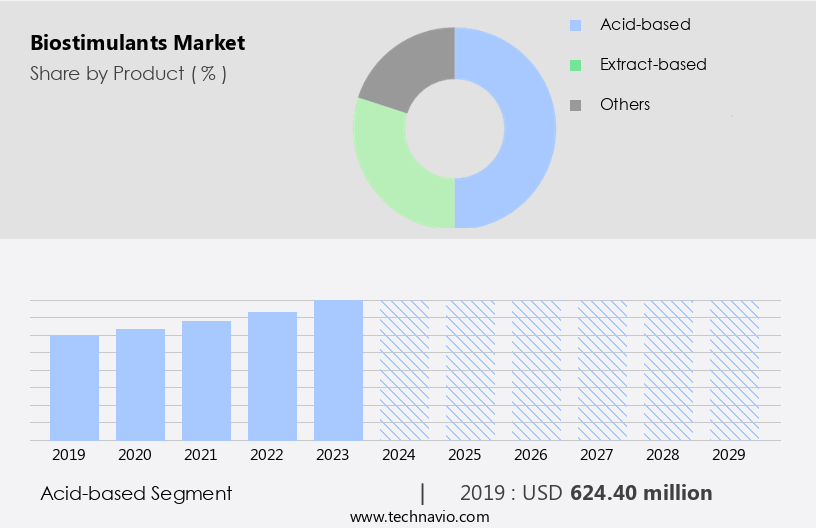
Get a glance at the market report of share of various segments Request Free Sample
The acid-based segment was valued at USD 624.40 million in 2019 and showed a gradual increase during the forecast period.
Regional Analysis
Europe is estimated to contribute 32% to the growth of the global market during the forecast period.Technavio's analysts have elaborately explained the regional trends and drivers that shape the market during the forecast period.
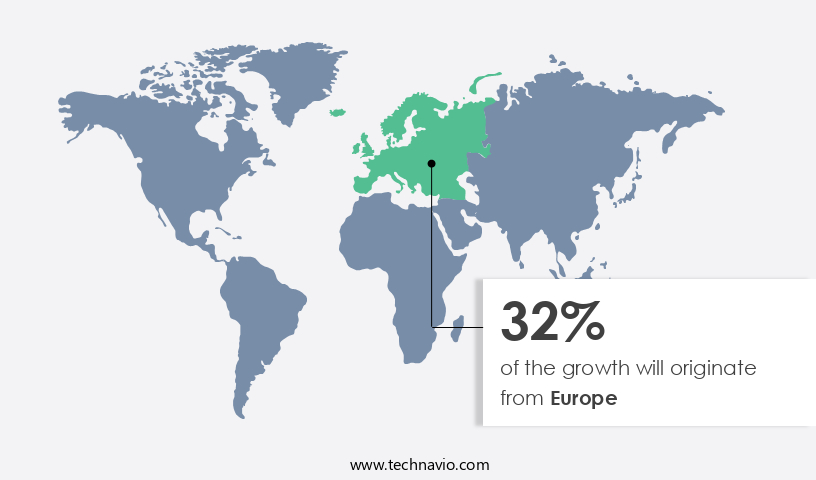
For more insights on the market size of various regions, Request Free Sample
The European market is projected to expand in 2024 due to the growing agricultural activities in key countries like Hungary, Greece, the Czech Republic, and France. These nations dominate Europe's agriculture sector, and their increasing agricultural endeavors will fuel the demand for biostimulants. In Europe, countries such as Belgium, France, Greece, Sweden, the UK, Germany, and Russia are significant meat producers. The rising demand for meat necessitates substantial livestock populations, which require high-quality grass for grazing. Grass cultivation relies on pastureland, and the increasing demand for pastureland will propel the consumption of biostimulants in Europe.
Market Dynamics
Our researchers analyzed the data with 2024 as the base year, along with the key drivers, trends, and challenges. A holistic analysis of drivers will help companies refine their marketing strategies to gain a competitive advantage.
What are the key market drivers leading to the rise In the adoption of Biostimulants Industry?
- Increasing demand for biostimulants in agricultural industry is the key driver of the market. Biostimulants are complex formulations of compounds, substances, and microorganisms that enhance crop performance and soil health in agriculture. These products boost plant metabolism, increasing yield and improving crop quality. They also fortify plants against abiotic stresses and facilitate nutrient absorption, translocation, and use. Additionally, biostimulants enhance desirable plant attributes, such as sugar content, color, and fruit seeding, while promoting water efficiency and soil fertility through the development of beneficial soil microorganisms. Major agricultural producers like China, India, the US, and Brazil, who cultivate significant crops such as wheat, millet, barley, rice, and oilseeds, are key markets for biostimulants.
- The use of biostimulants in India and China is expected to increase, driven by the need to meet the food requirements of their growing populations. The dense populations in these countries have led to higher consumption of food products, encouraging farmers to use biostimulants to boost crop yields. In Europe, biostimulants are widely used in the cultivation of fruits, flax, and horticulture. The biostimulants market in this region is dominated by countries such as Hungary, Greece, France, and the Czech Republic. These countries use biostimulants extensively to improve crop quality and yield. The growth in agricultural output in these regions will continue to benefit the biostimulants market.
What are the market trends shaping the Biostimulants Industry?
- Reduction in arable land is the upcoming market trend. The global agricultural sector faces a pressing challenge as the Food and Agriculture Organization (FAO) of the United Nations projects that the world's arable land will decrease by 11% by 2050 due to urbanization, industrialization, and population growth. Developing nations, such as China and India, require an additional 120 million hectares of land to meet their food demands by 2030.
- To mitigate this issue, enhancing yields from existing farms is essential. Biostimulants, a category of agricultural inputs, play a vital role in improving crop productivity. These organic or synthetic substances boost plant growth and increase nutrient uptake, making them an indispensable tool for sustainable agriculture. By optimizing the use of biostimulants, farmers can effectively address the challenge of feeding a growing population while preserving the limited arable land.
What challenges does the Biostimulants Industry face during its growth?
- Rise in demand for fertilizers is a key challenge affecting the industry growth. Micronutrients, essential trace elements for plants, play a crucial role in enhancing crop quality and soil fertility, despite their small quantity requirements. Deficiencies In these nutrients, such as zinc, iron, phosphorus, and magnesium, can hinder essential plant functions, leading to low yields, stunted growth, and abnormalities.
- Micronutrients are vital for various stages of plant growth, making them indispensable for optimal crop production. In horticulture, these nutrients enhance the nutritional content of fruits and vegetables. Furthermore, they are integral components of fertilizers, widely used to boost soil fertility. By addressing micronutrient deficiencies, farmers can improve crop health, yield, and overall productivity. The Biostimulants Market is witnessing significant growth due to increasing demand for sustainable agriculture and eco-friendly crop production methods. Biostimulants, including plant biostimulants, are substances that enhance or stimulate the growth, survival, and overall quality of plants. They can be applied through seed treatment, soil treatment, or water irrigation. The European Nitrates Directive has led to a surge in the use of biostimulants as a viable alternative to nitrate-based fertilizers. Plant biostimulants contain primary metabolites such as amino acids, carbohydrates, and vitamins, and secondary metabolites like auxins, gibberellins, and cytokinins. These substances improve nutrient uptake, drought tolerance, and resistance to biotic and abiotic stresses.
Exclusive Customer Landscape
The biostimulants market forecasting report includes the adoption lifecycle of the market, covering from the innovator's stage to the laggard's stage. It focuses on adoption rates in different regions based on penetration. Furthermore, the biostimulants market report also includes key purchase criteria and drivers of price sensitivity to help companies evaluate and develop their market growth analysis strategies.

Customer Landscape
Key Companies & Market Insights
Companies are implementing various strategies, such as strategic alliances, biostimulants market forecast, partnerships, mergers and acquisitions, geographical expansion, and product/service launches, to enhance their presence In the industry.
ADAMA Ltd. - The company offers biostimulants such as Brevis.
The industry research and growth report includes detailed analyses of the competitive landscape of the market and information about key companies, including:
- Atlantica Agricola
- Bayer AG
- Bioiberica S.A.U.
- Biolchim Spa
- Biostadt India Ltd.
- Biovert SL
- Crop Demetra Ltd.
- FMC Corp.
- Haifa Negev technologies Ltd.
- Idai Nature S.L
- Italpollina Spa
- Koppert
- Micromix Plant Health Ltd.
- Novozymes AS
- OMEX
- RAG Stiftung
- SEIPASA SA
- SICIT Group Spa
- UPL Ltd.
Qualitative and quantitative analysis of companies has been conducted to help clients understand the wider business environment as well as the strengths and weaknesses of key industry players. Data is qualitatively analyzed to categorize companies as pure play, category-focused, industry-focused, and diversified; it is quantitatively analyzed to categorize companies as dominant, leading, strong, tentative, and weak.
Research Analyst Overview
Biostimulants have emerged as a significant segment In the global agricultural industry, offering solutions to address the challenges posed by population growth, climate change, and the depletion of natural resources. These innovative products are designed to enhance soil condition, improve crop quality, and boost crop yield, making them essential tools for modern farming practices. Biostimulants are substances that accelerate plant growth, increase crop yield, and improve crop quality. They differ from synthetic chemical fertilizers, as they are derived from natural sources such as protein hydrolysates, humic substances, biopolymers, microbial-derived enzymes, and foliar treatments. These substances work by stimulating the plant's natural growth processes, enhancing its ability to absorb nutrients and water, and increasing its resistance to abiotic stress.
In addition, the agriculture sector faces numerous challenges, including the need to feed a growing population, mitigate the effects of climate change, and preserve biodiversity. Biostimulants offer a sustainable solution to these challenges by improving crop water efficiency, enhancing soil reclamation, and promoting crop production in various climatic scenarios. One of the primary benefits of biostimulants is their ability to improve soil condition. They enhance soil aeration, water retention, and microbial capability, leading to better nutrient availability and improved crop health. Biostimulants also help to maintaIn the pH level, ensuring optimal growing conditions for crops. Biostimulants have been shown to be effective in various crops, including oilseeds and pulses, durum wheat, and podded crops.
Furthermore, they can be applied as seed treatments, foliar treatments, or soil treatments, depending on the specific crop requirements. The use of biostimulants offers numerous benefits for farmers, including increased farm yield, improved crop quality, and enhanced environmental sustainability. However, there are also challenges associated with their use, such as shelf-life and government regulations. Environmental concerns are a significant factor In the market. Biostimulants are often derived from renewable sources, making them a more sustainable alternative to synthetic fertilizers. However, there are still concerns regarding their impact on soil degradation and the potential for contamination of water sources. The market is expected to continue growing as farmers seek sustainable solutions to the challenges facing the agriculture sector.
In addition, the industry outlook is positive, with increasing demand for products that can improve crop production while minimizing environmental impact. They enhance crop growth, improve soil condition, and promote environmental sustainability. While there are challenges associated with their use, the benefits far outweigh the drawbacks. The market is expected to continue growing as farmers seek innovative solutions to meet the demands of a growing population and mitigate the effects of climate change.
|
Market Scope |
|
|
Report Coverage |
Details |
|
Page number |
219 |
|
Base year |
2024 |
|
Historic period |
2019-2023 |
|
Forecast period |
2025-2029 |
|
Growth momentum & CAGR |
Accelerate at a CAGR of 12.4% |
|
Market growth 2025-2029 |
USD 2.16 billion |
|
Market structure |
Fragmented |
|
YoY growth 2024-2025(%) |
10.0 |
|
Key countries |
US, Germany, China, UK, Japan, France, Italy, India, South Korea, and Canada |
|
Competitive landscape |
Leading Companies, market growth and forecasting , Market Positioning of Companies, Competitive Strategies, and Industry Risks |
What are the Key Data Covered in this Biostimulants Market Research and Growth Report?
- CAGR of the Biostimulants industry during the forecast period
- Detailed information on factors that will drive the growth and forecasting between 2025 and 2029
- Precise estimation of the size of the market and its contribution of the industry in focus to the parent market
- Accurate predictions about upcoming growth and trends and changes in consumer behaviour
- Growth of the market across Europe, APAC, North America, South America, and Middle East and Africa
- Thorough analysis of the market's competitive landscape and detailed information about companies
- Comprehensive analysis of factors that will challenge the biostimulants market growth of industry companies
We can help! Our analysts can customize this biostimulants market research report to meet your requirements.
 RIA -
RIA -