

Biorefinery Market Analysis North America, Europe, APAC, South America, Middle East and Africa - US, Canada, China, Japan, UK - Size and Forecast 2024-2028

Biorefinery Market Analysis North America, Europe, APAC, South America, Middle East and Africa - US, Canada, China, Japan, UK - Size and Forecast 2024-2028

Published: Aug 2024 154 Pages SKU: IRTNTR73152

Market Overview at a Glance

$656.1 Mn
Market Opportunity
11.64%
CAGR
10.12
YoY growth 2023-2024(%)

Biorefinery Market Size 2024-2028

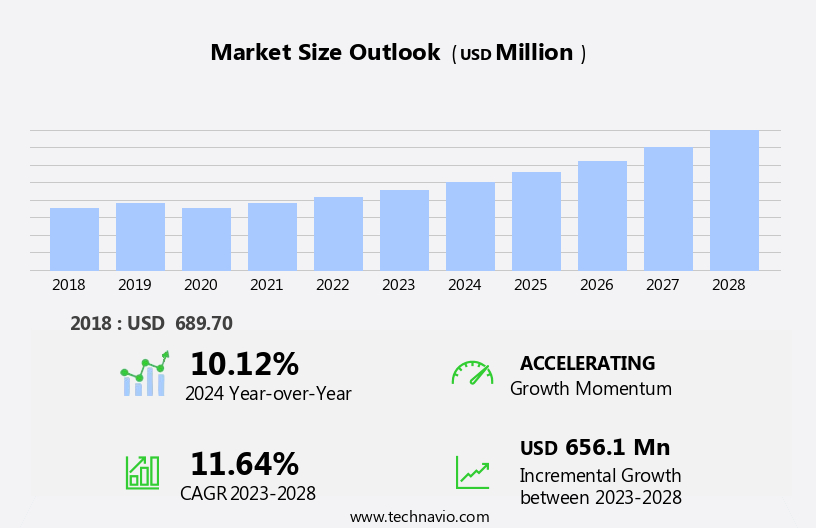
The biorefinery market size is forecast to increase by USD 656.1 million, at a CAGR of 11.64% between 2023 and 2028.

  • The market is experiencing significant growth, driven by the increasing demand for sustainable energy resources. As the world shifts towards renewable energy sources to reduce reliance on fossil fuels and promote energy independence, biorefineries are gaining traction as a viable solution. However, this market landscape is not without challenges. An unexpected plunge in crude oil and natural gas prices poses a significant threat to the competitiveness of biorefineries. Despite this, companies can capitalize on the market's potential by focusing on innovation and efficiency.
  • For instance, the integration of advanced technologies, such as enzyme engineering and microbial optimization, can enhance the production process and reduce costs. Additionally, partnerships and collaborations between industry players and research institutions can lead to breakthroughs in biorefinery technology and sustainability. Navigating these challenges and seizing opportunities requires a strategic approach, with a focus on continuous improvement and adaptation to market dynamics.

What will be the Size of the Biorefinery Market during the forecast period?
Biorefinery Market Size

Explore in-depth regional segment analysis with market size data - historical 2018-2022 and forecasts 2024-2028 - in the full report.  
Request Free Sample

The market continues to evolve, driven by advancements in various sectors. Supply chain management plays a crucial role in optimizing the production and distribution of lignocellulosic biomass, such as corn stover and agricultural residues, for biomass conversion. Hydrothermal liquefaction and pretreatment processes are refined to enhance the efficiency of enzyme production from lignocellulosic biomass, which is essential for the conversion of cellulosic ethanol and biocrude oil. Profitability analysis and investment analysis are integral to the biorefinery industry, as they influence feedstock sourcing and capacity utilization. Biogas refinement and biogas production from waste biomass, including wood chips and sugarcane bagasse, contribute to the reduction of carbon footprint and the generation of renewable energy.

Process economics and biomass conversion technologies, such as enzymatic hydrolysis and fermentation technologies, are continually improving to increase the economic viability of biorefineries. The integration of genetic engineering and metabolic engineering in the production of biofuels, such as vegetable oils, animal fats, and algae biofuels, is revolutionizing the industry. Biorefineries also address environmental concerns by converting waste biomass into valuable products, including biogas upgrading and energy efficiency improvements. Regulatory compliance and biorefinery optimization are essential to ensure the long-term sustainability and profitability of these operations. The ongoing evolution of the market reflects the dynamic nature of the industry and its commitment to innovation and sustainability.

How is this Biorefinery Industry segmented?

The biorefinery industry research report provides comprehensive data (region-wise segment analysis), with forecasts and estimates in "USD million" for the period 2024-2028, as well as historical data from 2018-2022 for the following segments.

  • Technology
    • Industrial biotechnology
    • Physico-chemical
    • Thermochemical
  • Geography
    • North America
      • US
      • Canada
    • Europe
      • UK
    • APAC
      • China
      • Japan
    • Rest of World (ROW)

By Technology Insights

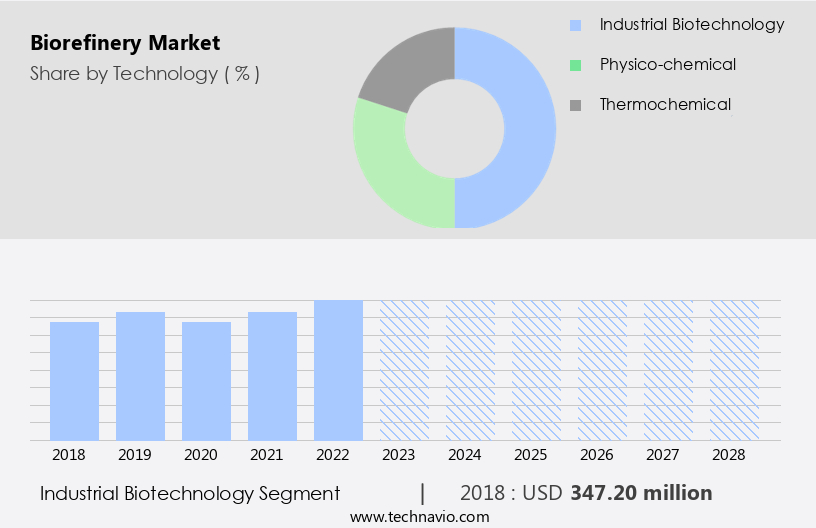
The industrial biotechnology segment is estimated to witness significant growth during the forecast period.

The market is witnessing significant growth, driven by the industrial biotechnology segment. According to the Biotechnology Innovation Organization, this sector is projected to reach USD 852.55 billion by 2030. Hydrothermal liquefaction, pretreatment processes, enzyme production, and biomass conversion are integral parts of industrial biotechnology, which plays a crucial role in the biorefinery industry. Lignocellulosic biomass, such as corn stover and wood chips, serves as a primary feedstock for biorefineries. Enzymatic hydrolysis and fermentation technologies are employed to convert this feedstock into biofuels like cellulosic ethanol and biogas. Genetic engineering and metabolic engineering are employed to optimize microorganisms and microbes for improved enzyme production and biomass conversion efficiency.

Animal fats, vegetable oils, and municipal solid waste are also utilized as feedstocks for biorefineries, contributing to the market's diversity. Biogas production from agricultural residues and wastewater treatment is another application of biorefinery technology, which is gaining traction due to its environmental benefits. Investment analysis, process economics, and regulatory compliance are essential factors influencing the market. Renewable diesel, energy efficiency, and biocrude oil are emerging areas of focus, offering potential for increased profitability. Biogas upgrading and anaerobic digestion are crucial processes in biorefineries, ensuring the production of high-quality biogas and reducing the carbon footprint. Process integration and optimization are key trends in the biorefinery industry, enabling efficient conversion of various feedstocks into valuable bio-based products and fuels.

Algae biofuels, although still in the development stage, hold immense potential for the future of the market. Overall, the market is a dynamic and evolving industry, driven by technological advancements, economic viability, and environmental concerns.
Biorefinery Market Size

Request Free Sample

The Industrial biotechnology segment was valued at USD 347.20 million in 2018 and showed a gradual increase during the forecast period.

Regional Analysis

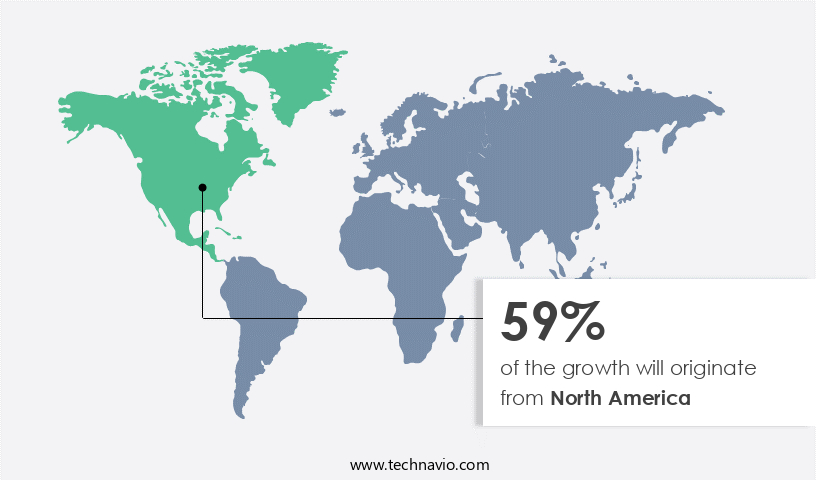
North America is estimated to contribute 59% to the growth of the global market during the forecast period. Technavio's analysts have elaborately explained the regional trends and drivers that shape the market during the forecast period.
Biorefinery Market Share by Geography

 Request Free Sample

The North American market is poised for significant growth due to increasing environmental concerns and stringent regulations aimed at reducing greenhouse gas emissions and limiting the consumption of non-renewable products. This region is a major hub for bio-based products, including biofuels and biochemicals. The presence of numerous recognized manufacturers and technological advancements in the US, the largest market in the region, further bolsters market growth. Lignocellulosic biomass, such as corn stover and wood chips, is a primary feedstock in the biorefinery industry. Pretreatment processes and enzymatic hydrolysis are crucial steps in converting this biomass into biofuels and biochemicals.

Hydrothermal liquefaction and biomass conversion technologies play a significant role in this process. Profitability analysis and investment analysis are essential aspects of the market. Feedstock sourcing and capacity utilization are critical factors in ensuring the economic viability of biorefineries. Regulatory compliance is another significant challenge, as biorefineries must adhere to strict environmental regulations. Genetic engineering and metabolic engineering are used to improve strains for increased productivity and efficiency in the production of biofuels and biochemicals. Animal fats, vegetable oils, and municipal solid waste are other feedstocks used in the biorefinery industry. Biogas production from agricultural residues, wastewater treatment, and anaerobic digestion are integral parts of the biorefinery process.

Biogas refinement, energy efficiency, and biogas upgrading are essential to optimize biogas production and reduce the carbon footprint. Cellulosic ethanol, renewable diesel, and biocrude oil are some of the biofuels produced in biorefineries. Algae biofuels and metabolic engineering are emerging trends in the industry. Fermentation technologies and process control are essential to ensure the efficient production of these biofuels. Process integration and optimization are crucial for maximizing the efficiency and profitability of biorefineries. The market is expected to continue evolving as technological advancements and regulatory requirements shape the industry landscape.

Market Dynamics

Our researchers analyzed the data with 2023 as the base year, along with the key drivers, trends, and challenges. A holistic analysis of drivers will help companies refine their marketing strategies to gain a competitive advantage.

What are the key market drivers leading to the rise in the adoption of Biorefinery Industry?

  • The surge in demand for renewable energy sources serves as the primary market catalyst. 
  • The global population is projected to grow by 34% from 2015 to 2050, reaching 9.2 billion, according to the World Bank Group. Simultaneously, urbanization rates are escalating, leading to a significant rise in energy demand. IRENA's recent data indicates a 48% increase in global energy demand by 2041. To meet this growing energy demand while reducing environmental impact, the market is gaining traction. Biorefineries convert agricultural residues into renewable diesel, biogas upgrading, biocrude oil, and other bio-based products through anaerobic digestion and biorefinery optimization.
  • This process integration enhances energy efficiency and reduces greenhouse gas emissions. Biorefineries contribute to economic viability by generating revenue from waste and reducing reliance on fossil fuels. The environmental benefits of biorefineries include a decrease in carbon footprint and the production of renewable energy. These factors make biorefineries a promising solution to meet the world's increasing energy demands while minimizing environmental impact.

What are the market trends shaping the Biorefinery Industry?

  • Energy independence is gaining significant traction as the next market trend. It refers to the ability of a country or organization to produce all the energy it needs, reducing reliance on external sources.
  • Biorefineries have emerged as a promising solution for energy-independent nations, focusing on the conversion of lignocellulosic biomass into biofuels and value-added products. The global market for biorefineries is experiencing significant growth due to the increasing demand for sustainable energy sources and the environmental benefits of biomass utilization. The biorefinery process involves various stages such as feedstock sourcing, pretreatment processes, enzyme production, hydrothermal liquefaction, and biogas refinement. Effective supply chain management is crucial for the profitability analysis of biorefineries, ensuring the availability and cost-effectiveness of feedstocks. Pretreatment processes, including enzymatic hydrolysis, are essential for breaking down the complex structure of lignocellulosic biomass into simpler sugars, facilitating the fermentation process.
  • Capacity utilization is another critical factor in the profitability of biorefineries, as underutilized capacity can lead to increased operational costs. Investment analysis plays a significant role in the development of biorefineries. Governments and private investors are investing heavily in this sector to reduce their dependence on energy imports and contribute to a more sustainable energy future. The production of enzymes and biogas refinement are also essential components of the biorefinery value chain, contributing to the overall profitability and sustainability of the process.

What challenges does the Biorefinery Industry face during its growth?

  • The unexpected plunge in crude oil and natural gas prices poses a significant challenge to the industry's growth trajectory. This downturn in energy commodity markets requires companies to adapt and innovate in order to mitigate the financial impact and maintain profitability. 
  • The market faces challenges due to fluctuating prices of crude oil, coal, and natural gas. These fossil fuels significantly impact the economics of biomass conversion processes in biorefineries. The COVID-19 pandemic led to a decrease in industrial production and oil consumption, causing a further decline in crude oil prices in 2020. The volatility in crude oil prices, resulting from ongoing trade tensions between major economies, has negatively influenced the growth of the market. Despite a recent revival in crude oil prices, the unexpected price drop is likely to have lasting effects on the industry.
  • Biomass feedstocks, such as corn stover, wood chips, sugarcane bagasse, waste biomass, vegetable oils, and biogas production, offer sustainable alternatives to fossil fuels in biofuel production. Genetic engineering and advanced bioconversion technologies are essential to optimizing process economics and reducing the carbon footprint of biorefineries. Key feedstocks and technologies continue to evolve, ensuring the industry's long-term growth and innovation.

Exclusive Customer Landscape

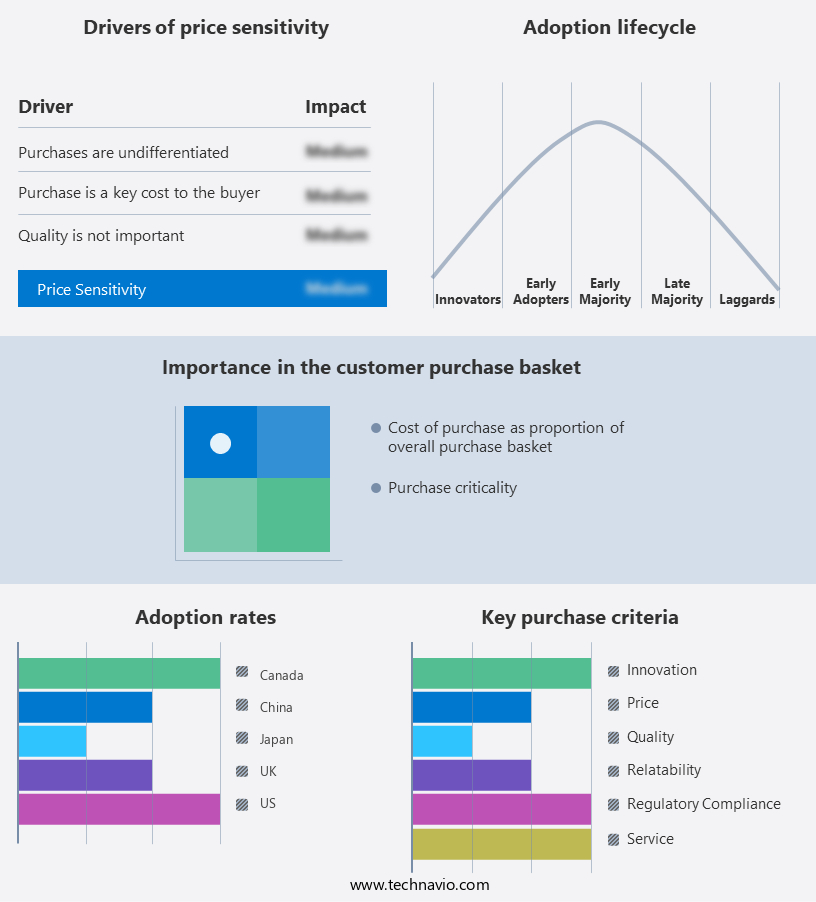
The biorefinery market forecasting report includes the adoption lifecycle of the market, covering from the innovator's stage to the laggard's stage. It focuses on adoption rates in different regions based on penetration. Furthermore, the biorefinery market report also includes key purchase criteria and drivers of price sensitivity to help companies evaluate and develop their market growth analysis strategies.
Biorefinery Market Share by Geography

 Customer Landscape

Key Companies & Market Insights

Companies are implementing various strategies, such as strategic alliances, biorefinery market forecast, partnerships, mergers and acquisitions, geographical expansion, and product/service launches, to enhance their presence in the industry.

Abengoa SA - This company specializes in constructing biorefineries, transforming diverse feedstocks such as urban waste, wood, agriculture, livestock, agrifood, and industrial waste into valuable bioenergy, biofuels, heat, cold, and electricity. 

The industry research and growth report includes detailed analyses of the competitive landscape of the market and information about key companies, including:

  • Abengoa SA
  • ALTO INGREDIENTS Inc.
  • BP Plc
  • Cargill Inc.
  • Darling Ingredients Inc.
  • Honeywell International Inc.
  • Neste Corp.
  • POET LLC
  • Renewable Energy Group Inc.
  • Sinopec Shanghai Petrochemical Co. Ltd.
  • Valero Energy Corp.

Qualitative and quantitative analysis of companies has been conducted to help clients understand the wider business environment as well as the strengths and weaknesses of key industry players. Data is qualitatively analyzed to categorize companies as pure play, category-focused, industry-focused, and diversified; it is quantitatively analyzed to categorize companies as dominant, leading, strong, tentative, and weak.

Recent Development and News in Biorefinery Market

  • In January 2024, Danish biotech company Novozymes and Dutch chemical company DSM announced a strategic partnership to jointly develop and commercialize enzyme technologies for the production of bio-based chemicals and materials (Novozymes Press Release, 2024).
  • In March 2024, LanzaTech, a global leader in gas fermentation technology, raised USD 120 million in a Series E funding round, led by Siemens Energy and Temasek, to accelerate the commercialization of its Gas2Chem technology (LanzaTech Press Release, 2024).
  • In May 2024, DuPont announced the acquisition of Danish biotech firm Mycobacterium Production A/S, a leading producer of single-cell proteins for animal nutrition, to expand its biotech capabilities and enter the animal nutrition market (DuPont Press Release, 2024).
  • In February 2025, the European Commission approved the €2.2 billion Bio-based Industries Joint Undertaking (BBI JU) for the period 2021-2027, which aims to support the development and implementation of advanced biorefining technologies in Europe (European Commission Press Release, 2025).

Research Analyst Overview

  • The market is experiencing significant activity and trends, driven by the convergence of energy security, technological innovation, and environmental sustainability. Ionic liquids are emerging as key players in the production of bio-based chemicals and materials, offering advantages in process intensification and resource efficiency. The market penetration of bio-based plastics and bio-based products is gaining momentum, driven by the circular economy and green chemistry. Infrastructure development and investment opportunities abound in the areas of hydrogen production, carbon sequestration, and biomass gasification, enabling the production of syngas and bio-based chemicals through Fischer-Tropsch synthesis.
  • Policy and regulation are shaping the market, with a focus on supercritical fluids and solid-acid catalysts to optimize industrial symbiosis and enhance sustainability. The integration of renewable energy sources and the pursuit of sustainable development continue to shape the biorefinery landscape, providing ample opportunities for innovation and growth.

Dive into Technavio's robust research methodology, blending expert interviews, extensive data synthesis, and validated models for unparalleled Biorefinery Market insights. See full methodology.

Market Scope

Report Coverage

Details

Page number

154

Base year

2023

Historic period

2018-2022

Forecast period

2024-2028

Growth momentum & CAGR

Accelerate at a CAGR of 11.64%

Market growth 2024-2028

USD 656.1 million

Market structure

Concentrated

YoY growth 2023-2024(%)

10.12

Key countries

US, Canada, China, Japan, and UK

Competitive landscape

Leading Companies, Market Positioning of Companies, Competitive Strategies, and Industry Risks

Request Free Sample

What are the Key Data Covered in this Biorefinery Market Research and Growth Report?

  • CAGR of the Biorefinery industry during the forecast period
  • Detailed information on factors that will drive the growth and forecasting between 2024 and 2028
  • Precise estimation of the size of the market and its contribution of the industry in focus to the parent market
  • Accurate predictions about upcoming growth and trends and changes in consumer behaviour
  • Growth of the market across North America, Europe, APAC, South America, and Middle East and Africa
  • Thorough analysis of the market's competitive landscape and detailed information about companies
  • Comprehensive analysis of factors that will challenge the biorefinery market growth of industry companies

We can help! Our analysts can customize this biorefinery market research report to meet your requirements.

Get in touch

1 Executive Summary

  • 1.1 Market overview
    • Executive Summary - Chart on Market Overview
    • Executive Summary - Data Table on Market Overview
    • Executive Summary - Chart on Global Market Characteristics
    • Executive Summary - Chart on Market by Geography
    • Executive Summary - Chart on Market Segmentation by Technology
    • Executive Summary - Chart on Incremental Growth
    • Executive Summary - Data Table on Incremental Growth
    • Executive Summary - Chart on Company Market Positioning

2 Market Landscape

  • 2.1 Market ecosystem
    • Parent Market
    • Data Table on - Parent Market
  • 2.2 Market characteristics
    • Market characteristics analysis
  • 2.3 Value chain analysis
    • Value Chain Analysis

3 Market Sizing

  • 3.1 Market definition
    • Offerings of companies included in the market definition
  • 3.2 Market segment analysis
    • Market segments
  • 3.3 Market size 2023
    • 3.4 Market outlook: Forecast for 2023-2028
      • Chart on Global - Market size and forecast 2023-2028 ($ million)
      • Data Table on Global - Market size and forecast 2023-2028 ($ million)
      • Chart on Global Market: Year-over-year growth 2023-2028 (%)
      • Data Table on Global Market: Year-over-year growth 2023-2028 (%)

    4 Historic Market Size

    • 4.1 Global Biorefinery Market 2018 - 2022
      • Historic Market Size - Data Table on Global Biorefinery Market 2018 - 2022 ($ million)
    • 4.2 Technology segment analysis 2018 - 2022
      • Historic Market Size - Technology Segment 2018 - 2022 ($ million)
    • 4.3 Geography segment analysis 2018 - 2022
      • Historic Market Size - Geography Segment 2018 - 2022 ($ million)
    • 4.4 Country segment analysis 2018 - 2022
      • Historic Market Size - Country Segment 2018 - 2022 ($ million)

    5 Five Forces Analysis

    • 5.1 Five forces summary
      • Five forces analysis - Comparison between 2023 and 2028
    • 5.2 Bargaining power of buyers
      • Bargaining power of buyers - Impact of key factors 2023 and 2028
    • 5.3 Bargaining power of suppliers
      • Bargaining power of suppliers - Impact of key factors in 2023 and 2028
    • 5.4 Threat of new entrants
      • Threat of new entrants - Impact of key factors in 2023 and 2028
    • 5.5 Threat of substitutes
      • Threat of substitutes - Impact of key factors in 2023 and 2028
    • 5.6 Threat of rivalry
      • Threat of rivalry - Impact of key factors in 2023 and 2028
    • 5.7 Market condition
      • Chart on Market condition - Five forces 2023 and 2028

    6 Market Segmentation by Technology

    • 6.1 Market segments
      • Chart on Technology - Market share 2023-2028 (%)
      • Data Table on Technology - Market share 2023-2028 (%)
    • 6.2 Comparison by Technology
      • Chart on Comparison by Technology
      • Data Table on Comparison by Technology
    • 6.3 Industrial biotechnology - Market size and forecast 2023-2028
      • Chart on Industrial biotechnology - Market size and forecast 2023-2028 ($ million)
      • Data Table on Industrial biotechnology - Market size and forecast 2023-2028 ($ million)
      • Chart on Industrial biotechnology - Year-over-year growth 2023-2028 (%)
      • Data Table on Industrial biotechnology - Year-over-year growth 2023-2028 (%)
    • 6.4 Physico-chemical - Market size and forecast 2023-2028
      • Chart on Physico-chemical - Market size and forecast 2023-2028 ($ million)
      • Data Table on Physico-chemical - Market size and forecast 2023-2028 ($ million)
      • Chart on Physico-chemical - Year-over-year growth 2023-2028 (%)
      • Data Table on Physico-chemical - Year-over-year growth 2023-2028 (%)
    • 6.5 Thermochemical - Market size and forecast 2023-2028
      • Chart on Thermochemical - Market size and forecast 2023-2028 ($ million)
      • Data Table on Thermochemical - Market size and forecast 2023-2028 ($ million)
      • Chart on Thermochemical - Year-over-year growth 2023-2028 (%)
      • Data Table on Thermochemical - Year-over-year growth 2023-2028 (%)
    • 6.6 Market opportunity by Technology
      • Market opportunity by Technology ($ million)
      • Data Table on Market opportunity by Technology ($ million)

    7 Customer Landscape

    • 7.1 Customer landscape overview
      • Analysis of price sensitivity, lifecycle, customer purchase basket, adoption rates, and purchase criteria

    8 Geographic Landscape

    • 8.1 Geographic segmentation
      • Chart on Market share by geography 2023-2028 (%)
      • Data Table on Market share by geography 2023-2028 (%)
    • 8.2 Geographic comparison
      • Chart on Geographic comparison
      • Data Table on Geographic comparison
    • 8.3 North America - Market size and forecast 2023-2028
      • Chart on North America - Market size and forecast 2023-2028 ($ million)
      • Data Table on North America - Market size and forecast 2023-2028 ($ million)
      • Chart on North America - Year-over-year growth 2023-2028 (%)
      • Data Table on North America - Year-over-year growth 2023-2028 (%)
    • 8.4 Europe - Market size and forecast 2023-2028
      • Chart on Europe - Market size and forecast 2023-2028 ($ million)
      • Data Table on Europe - Market size and forecast 2023-2028 ($ million)
      • Chart on Europe - Year-over-year growth 2023-2028 (%)
      • Data Table on Europe - Year-over-year growth 2023-2028 (%)
    • 8.5 APAC - Market size and forecast 2023-2028
      • Chart on APAC - Market size and forecast 2023-2028 ($ million)
      • Data Table on APAC - Market size and forecast 2023-2028 ($ million)
      • Chart on APAC - Year-over-year growth 2023-2028 (%)
      • Data Table on APAC - Year-over-year growth 2023-2028 (%)
    • 8.6 South America - Market size and forecast 2023-2028
      • Chart on South America - Market size and forecast 2023-2028 ($ million)
      • Data Table on South America - Market size and forecast 2023-2028 ($ million)
      • Chart on South America - Year-over-year growth 2023-2028 (%)
      • Data Table on South America - Year-over-year growth 2023-2028 (%)
    • 8.7 Middle East and Africa - Market size and forecast 2023-2028
      • Chart on Middle East and Africa - Market size and forecast 2023-2028 ($ million)
      • Data Table on Middle East and Africa - Market size and forecast 2023-2028 ($ million)
      • Chart on Middle East and Africa - Year-over-year growth 2023-2028 (%)
      • Data Table on Middle East and Africa - Year-over-year growth 2023-2028 (%)
    • 8.8 US - Market size and forecast 2023-2028
      • Chart on US - Market size and forecast 2023-2028 ($ million)
      • Data Table on US - Market size and forecast 2023-2028 ($ million)
      • Chart on US - Year-over-year growth 2023-2028 (%)
      • Data Table on US - Year-over-year growth 2023-2028 (%)
    • 8.9 Canada - Market size and forecast 2023-2028
      • Chart on Canada - Market size and forecast 2023-2028 ($ million)
      • Data Table on Canada - Market size and forecast 2023-2028 ($ million)
      • Chart on Canada - Year-over-year growth 2023-2028 (%)
      • Data Table on Canada - Year-over-year growth 2023-2028 (%)
    • 8.10 China - Market size and forecast 2023-2028
      • Chart on China - Market size and forecast 2023-2028 ($ million)
      • Data Table on China - Market size and forecast 2023-2028 ($ million)
      • Chart on China - Year-over-year growth 2023-2028 (%)
      • Data Table on China - Year-over-year growth 2023-2028 (%)
    • 8.11 Japan - Market size and forecast 2023-2028
      • Chart on Japan - Market size and forecast 2023-2028 ($ million)
      • Data Table on Japan - Market size and forecast 2023-2028 ($ million)
      • Chart on Japan - Year-over-year growth 2023-2028 (%)
      • Data Table on Japan - Year-over-year growth 2023-2028 (%)
    • 8.12 UK - Market size and forecast 2023-2028
      • Chart on UK - Market size and forecast 2023-2028 ($ million)
      • Data Table on UK - Market size and forecast 2023-2028 ($ million)
      • Chart on UK - Year-over-year growth 2023-2028 (%)
      • Data Table on UK - Year-over-year growth 2023-2028 (%)
    • 8.13 Market opportunity by geography
      • Market opportunity by geography ($ million)
      • Data Tables on Market opportunity by geography ($ million)

    9 Drivers, Challenges, and Opportunity/Restraints

    • 9.1 Market drivers
      • 9.2 Market challenges
        • 9.3 Impact of drivers and challenges
          • Impact of drivers and challenges in 2023 and 2028
        • 9.4 Market opportunities/restraints

          10 Competitive Landscape

          • 10.1 Overview
            • 10.2 Competitive Landscape
              • Overview on criticality of inputs and factors of differentiation
            • 10.3 Landscape disruption
              • Overview on factors of disruption
            • 10.4 Industry risks
              • Impact of key risks on business

            11 Competitive Analysis

            • 11.1 Companies profiled
              • Companies covered
            • 11.2 Market positioning of companies
              • Matrix on companies position and classification
            • 11.3 Abengoa SA
              • Abengoa SA - Overview
              • Abengoa SA - Product / Service
              • Abengoa SA - Key offerings
            • 11.4 ALTO INGREDIENTS Inc.
              • ALTO INGREDIENTS Inc. - Overview
              • ALTO INGREDIENTS Inc. - Business segments
              • ALTO INGREDIENTS Inc. - Key news
              • ALTO INGREDIENTS Inc. - Key offerings
              • ALTO INGREDIENTS Inc. - Segment focus
            • 11.5 BP Plc
              • BP Plc - Overview
              • BP Plc - Business segments
              • BP Plc - Key news
              • BP Plc - Key offerings
              • BP Plc - Segment focus
            • 11.6 Cargill Inc.
              • Cargill Inc. - Overview
              • Cargill Inc. - Product / Service
              • Cargill Inc. - Key news
              • Cargill Inc. - Key offerings
            • 11.7 Honeywell International Inc.
              • Honeywell International Inc. - Overview
              • Honeywell International Inc. - Business segments
              • Honeywell International Inc. - Key news
              • Honeywell International Inc. - Key offerings
              • Honeywell International Inc. - Segment focus
            • 11.8 Neste Corp.
              • Neste Corp. - Overview
              • Neste Corp. - Business segments
              • Neste Corp. - Key news
              • Neste Corp. - Key offerings
              • Neste Corp. - Segment focus
            • 11.9 POET LLC
              • POET LLC - Overview
              • POET LLC - Product / Service
              • POET LLC - Key offerings
            • 11.10 Renewable Energy Group Inc.
              • Renewable Energy Group Inc. - Overview
              • Renewable Energy Group Inc. - Business segments
              • Renewable Energy Group Inc. - Key news
              • Renewable Energy Group Inc. - Key offerings
              • Renewable Energy Group Inc. - Segment focus
            • 11.11 Sinopec Shanghai Petrochemical Co. Ltd.
              • Sinopec Shanghai Petrochemical Co. Ltd. - Overview
              • Sinopec Shanghai Petrochemical Co. Ltd. - Business segments
              • Sinopec Shanghai Petrochemical Co. Ltd. - Key news
              • Sinopec Shanghai Petrochemical Co. Ltd. - Key offerings
              • Sinopec Shanghai Petrochemical Co. Ltd. - Segment focus
            • 11.12 Valero Energy Corp.
              • Valero Energy Corp. - Overview
              • Valero Energy Corp. - Business segments
              • Valero Energy Corp. - Key offerings
              • Valero Energy Corp. - Segment focus

            12 Appendix

            • 12.1 Scope of the report
              • 12.2 Inclusions and exclusions checklist
                • Inclusions checklist
                • Exclusions checklist
              • 12.3 Currency conversion rates for US$
                • Currency conversion rates for US$
              • 12.4 Research methodology
                • Research methodology
              • 12.5 Data procurement
                • Information sources
              • 12.6 Data validation
                • Data validation
              • 12.7 Validation techniques employed for market sizing
                • Validation techniques employed for market sizing
              • 12.8 Data synthesis
                • Data synthesis
              • 360 degree market analysis
                • 360 degree market analysis
              • 12.10 List of abbreviations
                • List of abbreviations

              Research Methodology

              Technavio presents a detailed picture of the market by way of study, synthesis, and summation of data from multiple sources. The analysts have presented the various facets of the market with a particular focus on identifying the key industry influencers. The data thus presented is comprehensive, reliable, and the result of extensive research, both primary and secondary.

              INFORMATION SOURCES

              Primary sources

              • Manufacturers and suppliers
              • Channel partners
              • Industry experts
              • Strategic decision makers

              Secondary sources

              • Industry journals and periodicals
              • Government data
              • Financial reports of key industry players
              • Historical data
              • Press releases

              DATA ANALYSIS

              Data Synthesis

              • Collation of data
              • Estimation of key figures
              • Analysis of derived insights

              Data Validation

              • Triangulation with data models
              • Reference against proprietary databases
              • Corroboration with industry experts

              REPORT WRITING

              Qualitative

              • Market drivers
              • Market challenges
              • Market trends
              • Five forces analysis

              Quantitative

              • Market size and forecast
              • Market segmentation
              • Geographical insights
              • Competitive landscape

              Interested in this report?

              Get your sample now to see our research methodology and insights!

              Download Now

              Frequently Asked Questions

              Biorefinery market growth will increase by $ 656.1 mn during 2024-2028.

              The Biorefinery market is expected to grow at a CAGR of 11.64% during 2024-2028.

              Biorefinery market is segmented by Technology( Industrial biotechnology, Physico-chemical, Thermochemical)

              Abengoa SA, ALTO INGREDIENTS Inc., BP Plc, Cargill Inc., Darling Ingredients Inc., Honeywell International Inc., Neste Corp., POET LLC, Renewable Energy Group Inc., Sinopec Shanghai Petrochemical Co. Ltd., Valero Energy Corp. are a few of the key vendors in the Biorefinery market.

              North America will register the highest growth rate of 59% among the other regions. Therefore, the Biorefinery market in North America is expected to garner significant business opportunities for the vendors during the forecast period.

              US, Canada, China, Japan, UK

              • Increasing demand for sustainable energy resourcesThe global population is on the rise is the driving factor this market.
              • along with the improvement in the population standard of living. According to the World Bank Group is the driving factor this market.
              • the global population is anticipated to grow by 34% during 2015-2050 to reach 9.2 billion in 2050. The urbanization rate is increasing at a rapid pace. The income levels of people are multiplying is the driving factor this market.
              • which has led to an increase in the demand for energy.According to the recent data published by International renewable energy agency (IRENA) is the driving factor this market.
              • in 2021 is the driving factor this market.
              • the global energy demand was expected to increase by 48% in the next 20 years is the driving factor this market.
              • owing to an increase in the global population. Currently is the driving factor this market.
              • 80% of the energy demand is met by fossil fuels. However is the driving factor this market.
              • rapidly depleting fossil fuel reserves coupled with the negative environmental impact have driven research toward biofuel production. Conventional resources such as fossil fuels are depleting fast because of the rapid increase in energy demand is the driving factor this market.
              • resulting in a significant imbalance in demand and supply of energy. This disproportion in energy demand and supply has created enormous pressure on both consumers and the environment is the driving factor this market.
              • forcing mankind to seek sustainable energy resources.Another important factor that prompts the reliance on sustainable energy resources is the rapidly changing climatic conditions. Emissions of CO2 and other greenhouse gases have led to global warming is the driving factor this market.
              • which has resulted in climate change and an increase in sea levels. This has adversely affected biodiversity is the driving factor this market.
              • freshwater supply is the driving factor this market.
              • precipitation patterns is the driving factor this market.
              • the supply of food is the driving factor this market.
              • agricultural production is the driving factor this market.
              • and the safety of people inhabiting low-lying coastal areas. Consumption of fossil fuels contributes significantly to CO2 emissions. Generally is the driving factor this market.
              • developed nations have higher carbon footprints and higher CO2 emissions per country. This is largely due to their more robust energy industries is the driving factor this market.
              • which burn large amounts of fossil fuels to provide electricity is the driving factor this market.
              • and a larger percentage of residents who own their own automobiles is the driving factor this market.
              • which contribute greatly to emissions. Industries such as manufacturing and meat production are also noted contributors. These factors have increased the need for sustainable energy resources is the driving factor this market.
              • such as biomass is the driving factor this market.
              • which will not result in a further increase in the amount of greenhouse gas emissions in the earth atmosphere.Biomass is an environmentally benign is the driving factor this market.
              • renewable energy source that is used to make a variety of valuable chemicals and biofuels. As a result is the driving factor this market.
              • the number of biorefineries being built has increased is the driving factor this market.
              • which are required to manufacture renewable chemicals is the driving factor this market.
              • biofuels is the driving factor this market.
              • and other bio-based commodities from biomass. As a result of its system dynamics is the driving factor this market.
              • biorefineries have gotten a lot of attention since they may generate several products from a single waste feedstock. Bioethanol is the driving factor this market.
              • biohydrogen is the driving factor this market.
              • bio-jet fuel is the driving factor this market.
              • biomethane is the driving factor this market.
              • and biodiesel have all been investigated in various combinations in a biorefinery system and have all showed significant promise. For instance is the driving factor this market.
              • lignocellulosic biorefineries have the potential to contribute to a green economy as bioethanol has emerged as a valuable competitor to fossil-derived fuels owing to its compatibility with current infrastructure and its clean-burning nature. Thus is the driving factor this market.
              • the growth of the global biorefinery market is expected to be highly driven by the increasing demand for sustainable energy resources. is the driving factor this market.

              The Biorefinery market vendors should focus on grabbing business opportunities from the Industrial biotechnology segment as it accounted for the largest market share in the base year.