


Batteries For Smart Wearables Market Analysis, Size, and Forecast 2025-2029: APAC (Australia, China, India, Japan, South Korea), North America (US, Canada, and Mexico), Europe (Germany, UK), South America , and Middle East and Africa

Batteries For Smart Wearables Market Analysis, Size, and Forecast 2025-2029:
APAC (Australia, China, India, Japan, South Korea), North America (US, Canada, and Mexico), Europe (Germany, UK), South America , and Middle East and Africa

Published: Apr 2025 232 Pages SKU: IRTNTR44860

Market Overview at a Glance

$280.1 Mn
Market Opportunity
11.2%
CAGR
10.2
YoY growth 2024-2025(%)

Batteries For Smart Wearables Market Size 2025-2029

The batteries for smart wearables market size is forecast to increase by USD 280.1 million, at a CAGR of 11.2% between 2024 and 2029.

  • The market is witnessing significant growth, driven by the increasing popularity of wearable devices and the rising trend of raising capital for product development via crowdfunding campaigns. This dynamic market landscape presents both opportunities and challenges for key players. The widening product portfolio of smart wearables, from fitness trackers to health monitors and smartwatches, is fueling the demand for advanced batteries that can support extended usage and diverse features. However, the challenge of low battery life remains a significant obstacle, as users seek devices with longer battery life to minimize frequent charging.
  • To capitalize on this market potential, companies must focus on developing batteries with improved energy density, fast charging capabilities, and efficient power management systems. By addressing these challenges, players can differentiate their offerings and cater to the evolving needs of the smart wearables market.

What will be the Size of the Batteries For Smart Wearables Market during the forecast period?
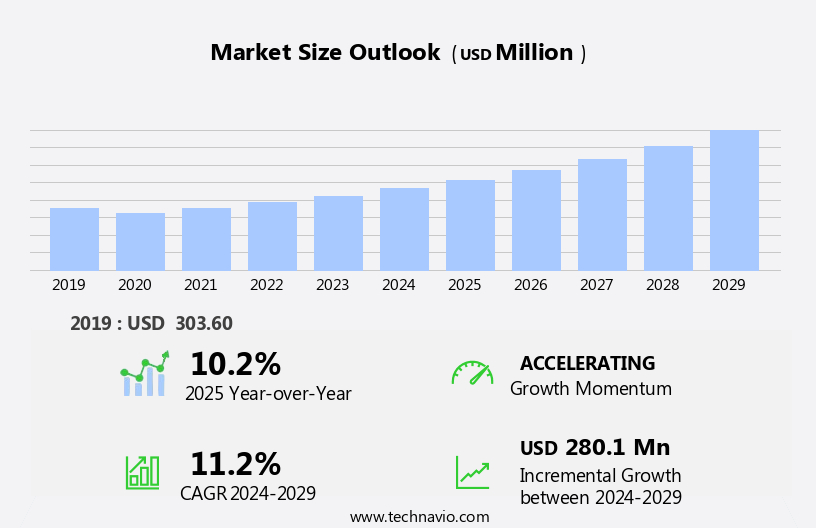
Batteries For Smart Wearables Market Size

Explore in-depth regional segment analysis with market size data - historical 2019-2023 and forecasts 2025-2029 - in the full report.  
Request Free Sample

The market continues to evolve, driven by technological innovations and consumer preferences. Lithium polymer batteries are commonly used due to their lightweight properties and energy efficiency. However, power management and quality control are crucial for ensuring optimal battery life and consumer satisfaction. Health data security is a significant concern, leading to the integration of biometric authentication and encryption technologies. Supply chain management and product lifecycle management are essential for maintaining regulatory compliance and reducing return rates. Wearable sensors, such as heart rate monitors and SpO2 sensors, require reliable power sources for continuous health monitoring. Bluetooth connectivity and mobile app integration enable seamless data transfer and real-time coaching.

The market dynamics are shaped by consumer preferences for comfort and ergonomics, design aesthetics, and user interface. Warranty programs and customer support are essential for building brand loyalty and addressing any issues that may arise. OLED and AMOLED displays offer vibrant colors and high contrast, enhancing the user experience. Wi-Fi connectivity and NFC technology enable contactless payments and expanded functionality. Product differentiation is achieved through technological innovation and software updates, ensuring a competitive advantage. Energy efficiency and wearable sensors are key areas of focus for improving battery life and expanding health monitoring capabilities. The market for smart wearables is diverse, encompassing activity trackers, sleep trackers, fitness coaches, and health monitors.

GPS tracking and heart rate sensors are common features, while some devices offer advanced capabilities such as payment systems and notification alerts. The ongoing unfolding of market activities highlights the importance of continuous product development and adaptability to consumer needs. Regulatory compliance and data privacy are critical considerations for companies operating in this dynamic market.

How is this Batteries For Smart Wearables Industry segmented?

The batteries for smart wearables industry research report provides comprehensive data (region-wise segment analysis), with forecasts and estimates in "USD million" for the period 2025-2029, as well as historical data from 2019-2023 for the following segments.

  • Product
    • Li-ion battery
    • Li-Po battery
    • Others
  • Application
    • Smartwatches
    • Wireless headphones
    • Head mounted display (HMDs)
    • Others
  • End-user
    • Consumer electronics
    • Healthcare
    • Industrial
    • Others
  • Geography
    • North America
      • US
      • Canada
      • Mexico
    • Europe
      • Germany
      • UK
    • APAC
      • Australia
      • China
      • India
      • Japan
      • South Korea
    • Rest of World (ROW)

By Product Insights

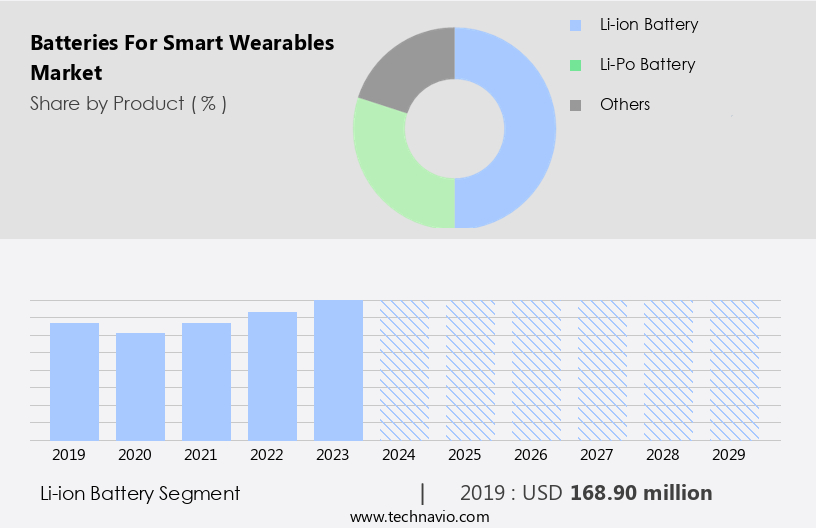
The Li-ion battery segment is estimated to witness significant growth during the forecast period.

The market experiences continuous growth, driven by the increasing popularity of devices such as activity trackers, sleep trackers, and smartwatches. Lithium polymer batteries have emerged as the preferred choice due to their high energy density, longer lifespan, and lightweight properties. These batteries enable smart wearables to offer extended usage hours and support advanced features like wi-fi connectivity, heart rate sensors, and GPS tracking. Consumer preferences prioritize long battery life, ensuring a strong demand for high-quality batteries with efficient power management. Case materials and design aesthetics are essential factors in consumer decision-making, with water resistance and ergonomic straps being desirable features.

Warranty programs and customer support are crucial elements in maintaining customer satisfaction and loyalty. Technological innovation in charging technology, sensor integration, and energy efficiency continues to shape the market landscape. Competitive advantage is achieved through product differentiation, offering features like biometric authentication, NFC technology, and mobile app integration. Data privacy and regulatory compliance are essential considerations, with health data security being a significant concern for consumers. Manufacturers focus on product lifecycle management and supply chain optimization to ensure efficient production and timely delivery. OLED and AMOLED displays, along with comfortable and ergonomic strap materials, contribute to the overall user experience.

GPS chipsets and heartrate sensors are essential components for fitness enthusiasts, while payment systems and notification alerts cater to the convenience-driven consumer. In the evolving smart wearables market, battery technology plays a pivotal role in enabling advanced functionalities and enhancing user experience. The market's future growth is expected to be influenced by factors like software updates, health monitoring, and wearable sensor integration.
Batteries For Smart Wearables Market Size

Request Free Sample

The Li-ion battery segment was valued at USD 168.90 million in 2019 and showed a gradual increase during the forecast period.

Regional Analysis

North America is estimated to contribute 35% to the growth of the global market during the forecast period.Technavio's analysts have elaborately explained the regional trends and drivers that shape the market during the forecast period.
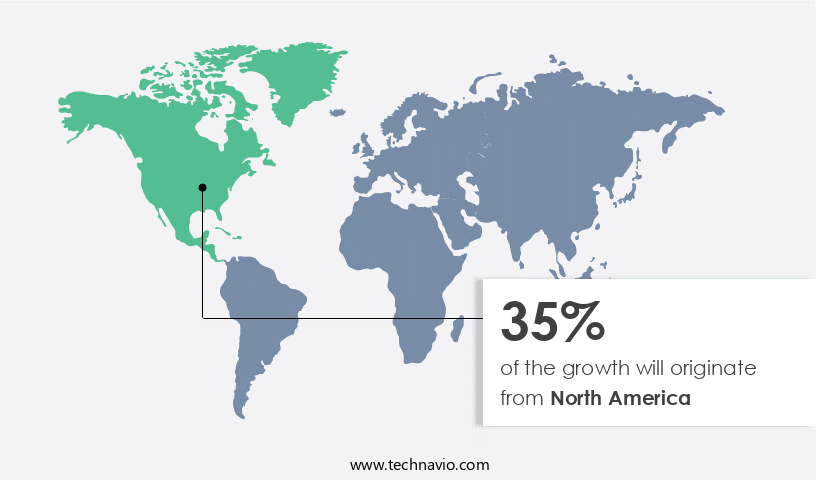
Batteries For Smart Wearables Market Share by Geography

 Request Free Sample

The market in the Asia Pacific region is experiencing significant growth, driven by increasing demand from both developed and developing countries such as China, Japan, South Korea, and India. The large population base in APAC presents a substantial target audience for companies looking to expand their revenue and market presence. The region's growth is further fueled by the rising disposable income and widespread smartphone penetration. However, the high price point of smart wearables remains a challenge in the region. To address consumer preferences, companies are focusing on advanced charging technology, lightweight materials, and longer battery life.

Lithium polymer batteries are increasingly being adopted due to their energy efficiency and lightweight properties. Power management systems and quality control measures are also crucial to ensure optimal battery performance and user satisfaction. Wearable technology continues to evolve, with fitness coaching, heart rate monitors, and sleep trackers gaining popularity. Wi-fi connectivity, Bluetooth, and NFC technology enable seamless mobile app integration and real-time data transfer. Wearables with OLED and AMOLED displays offer enhanced user interfaces and design aesthetics. Data privacy and regulatory compliance are critical concerns for consumers. Companies are implementing biometric authentication, health data security, and return rate management to build trust and loyalty.

Product lifecycle management and supply chain optimization are essential for maintaining a competitive advantage. Advancements in sensor technology, energy efficiency, and technological innovation are driving product differentiation. Features such as GPS tracking, wearable sensors, and SPO2 sensors offer valuable health monitoring capabilities. Companies are also integrating payment systems, notification alerts, and software updates to enhance user experience. Comfort and ergonomics are essential considerations for wearable devices. Water resistance and durable case materials ensure the longevity of the devices. Companies are exploring various strap materials and GPS chipsets to cater to diverse consumer preferences. In conclusion, the market in APAC is expected to continue its growth trajectory, driven by consumer preferences, technological innovation, and a large target audience.

Companies must focus on delivering high-quality products, ensuring data privacy, and maintaining competitive pricing strategies to capture market share.

Market Dynamics

Our researchers analyzed the data with 2024 as the base year, along with the key drivers, trends, and challenges. A holistic analysis of drivers will help companies refine their marketing strategies to gain a competitive advantage.

In the dynamic world of technology, batteries play a pivotal role in powering the functionality of smart wearables, from fitness trackers and smartwatches to augmented reality glasses and hearables. The market is witnessing significant growth, fueled by advancements in battery technology and the increasing popularity of wearable devices. Lithium-ion batteries, with their high energy density and long life span, dominate this market. However, other types, such as solid-state and kinetic energy batteries, are gaining traction due to their unique benefits. Size, weight, and compatibility are crucial factors in this market, as batteries must efficiently power devices while remaining compact and lightweight. Additionally, factors like charging speed, durability, and environmental sustainability are driving innovation in battery technology. The future of batteries for smart wearables promises longer battery life, faster charging, and eco-friendly solutions, making these devices more convenient and accessible to consumers.

What are the key market drivers leading to the rise in the adoption of Batteries For Smart Wearables Industry?

  • Crowdfunding campaigns serve as a crucial avenue for securing capital for product development in the market. This financing method has emerged as a significant key driver, enabling entrepreneurs and businesses to bring innovative ideas to fruition. 
  • The smart wearables market, including sleep trackers, is experiencing significant growth due to increasing customer demand for advanced health monitoring and convenience. Crowdfunding platforms, such as Kickstarter and Indiegogo, have emerged as a popular funding source for new product development in this industry. These platforms enable companies to reach their target audience directly, creating awareness and resulting in lower customer acquisition costs compared to traditional channels. Moreover, the interaction between manufacturers and potential customers during the product development stage allows for valuable feedback and product customization. This customer engagement contributes to higher customer satisfaction and brand loyalty.
  • Key features of smart wearables, such as user interface, operating systems, comfort and ergonomics, display technology, data privacy, regulatory compliance, GPS tracking, and wearable sensors, are essential factors driving market growth. Companies prioritize these aspects to ensure their products cater to consumers' needs and preferences. Pricing strategies also play a crucial role in the market's dynamics. Companies must balance affordability with advanced features to attract and retain customers. Additionally, ensuring data privacy and regulatory compliance are essential for maintaining customer trust and market acceptance. In conclusion, the smart wearables market, driven by innovative product development, customer engagement, and advanced features, continues to expand, offering numerous opportunities for businesses.

What are the market trends shaping the Batteries For Smart Wearables Industry?

  • Smart wearables are gaining popularity in the market, with an increasing trend towards expanding product portfolios in this sector. To stay competitive, companies are continuously introducing new and advanced wearable devices.
  • The market for batteries in smart wearables is experiencing significant growth due to the increasing popularity of devices such as heart rate monitors, fitness trackers, and payment systems. These gadgets offer features like mobile app integration, notification alerts, and sensor technology, making them essential for tech-savvy consumers. NFC technology is also gaining traction, providing contactless payment solutions and enhancing product differentiation. Energy efficiency is a key consideration for battery manufacturers, as users demand long-lasting power sources that do not compromise design aesthetics or technological innovation.
  • As the competition intensifies, companies are focusing on developing advanced battery solutions to gain a competitive advantage. The integration of heart rate sensors and other sensor technologies further increases the demand for reliable and efficient batteries in smart wearables.

What challenges does the Batteries For Smart Wearables Industry face during its growth?

  • A low battery life is a significant challenge that can hinder industry growth by limiting the usage and effectiveness of technological devices. 
  • Smart wearables, including those with SP O2 sensors and Bluetooth connectivity, continue to gain popularity for health monitoring and convenience. However, one challenge persists: battery life. Despite advancements in display technology, using features such as OLED and AMOLED, and the addition of biometric authentication and water resistance, battery capacity has remained stagnant. For instance, a typical smartwatch may last only five hours with GPS and music enabled, requiring frequent charging. This inconvenience can lead to underutilization of the device's capabilities.
  • With battery capacities ranging from 150 mAh to 300 mAh, the size of batteries in these compact devices has not significantly changed due to unaltered density rates. Effective product lifecycle management, including software updates, and supply chain optimization are crucial to mitigate the impact of this limitation. Health data security is another essential consideration in the development and implementation of these devices.

Exclusive Customer Landscape

The batteries for smart wearables market forecasting report includes the adoption lifecycle of the market, covering from the innovator's stage to the laggard's stage. It focuses on adoption rates in different regions based on penetration. Furthermore, the batteries for smart wearables market report also includes key purchase criteria and drivers of price sensitivity to help companies evaluate and develop their market growth analysis strategies.
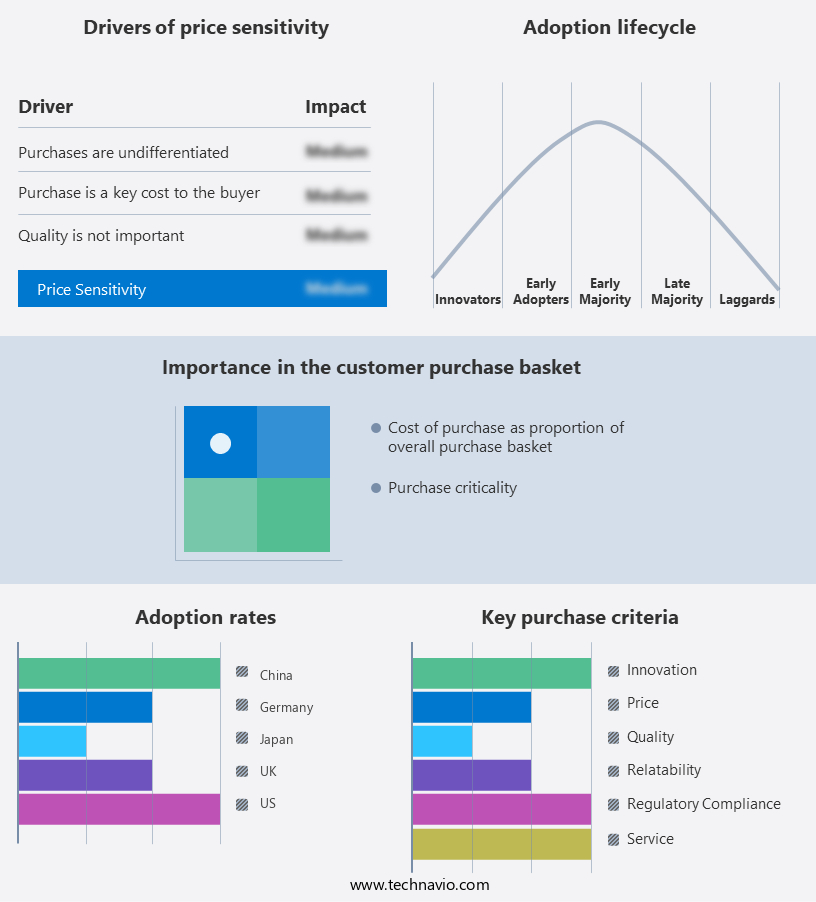
Batteries For Smart Wearables Market Share by Geography

 Customer Landscape

Key Companies & Market Insights

Companies are implementing various strategies, such as strategic alliances, batteries for smart wearables market forecast, partnerships, mergers and acquisitions, geographical expansion, and product/service launches, to enhance their presence in the industry.

Apple Inc. - Energizer's 357, 303, 371, and 390 batteries deliver reliable power, enhancing user experience. My research focuses on maximizing efficiency and extending device life.

The industry research and growth report includes detailed analyses of the competitive landscape of the market and information about key companies, including:

  • Apple Inc.
  • Artek Energy Pvt. Ltd.
  • Energizer Holdings Inc.
  • Enfucell
  • GMB CORP.
  • Ilika
  • Imprint Energy
  • ITEN
  • Jenax Inc.
  • LiPol Battery Co. Ltd.
  • Molex LLC
  • Montana Tech Components AG
  • Panasonic Holdings Corp.
  • Samsung Electronics Co. Ltd.
  • Shenzhen Grepow Battery Co. Ltd.
  • STMicroelectronics NV
  • TDK Corp.
  • The Duracell Co.
  • Ultralife Corp.

Qualitative and quantitative analysis of companies has been conducted to help clients understand the wider business environment as well as the strengths and weaknesses of key industry players. Data is qualitatively analyzed to categorize companies as pure play, category-focused, industry-focused, and diversified; it is quantitatively analyzed to categorize companies as dominant, leading, strong, tentative, and weak.

Recent Development and News in Batteries For Smart Wearables Market

  • In January 2024, Samsung SDI, a leading global battery manufacturer, announced the mass production of its new 1.6 Ah, 5.2V lithium-ion batteries for smart wearables, boasting a 20% increase in capacity compared to its previous models (Samsung SDI Press Release).
  • In March 2024, Apple and Panasonic formed a strategic partnership to collaborate on the development and production of solid-state batteries for future Apple Watch models. This partnership aimed to improve the wearable's battery life and miniaturize the battery design (Apple Investor Relations).
  • In April 2025, CATL (Contemporary Amperex Technology Co. Limited), the world's largest lithium-ion battery manufacturer, raised USD 3 billion in a funding round to expand its production capacity and invest in research and development for batteries tailored to the smart wearables market (Reuters).
  • In May 2025, the European Union approved the "Battery Regulation" that sets strict safety, environmental, and recycling standards for batteries used in wearable devices, aiming to ensure consumer safety and reduce the environmental impact of battery production and disposal (European Commission Press Release).

Research Analyst Overview

  • The smart wearables market is experiencing dynamic growth, integrating advanced features such as augmented reality and virtual reality for enhanced user experience. Mental health monitoring, medication reminders, and personalized wellness programs are becoming essential components, driven by cloud computing and big data analytics. Device management platforms ensure seamless integration with healthcare systems, telemedicine, and emergency SOS features. Machine learning and artificial intelligence enable medical-grade accuracy in blood pressure monitoring, stress level detection, and fall detection. Sustainability initiatives are prioritized with the use of recyclable materials and ethical sourcing. Product recall management and over-the-air updates maintain consumer trust.
  • Smart home integration and remote camera control add convenience, while predictive analytics offer proactive health risk assessments. Electrocardiogram (ECG) and electrodermal activity (EDA) monitoring provide valuable health insights. Voice assistants streamline daily tasks, and healthcare and smart home integration offer a holistic approach to wellness. Remote patient monitoring and emergency SOS features ensure peace of mind for users and caregivers alike.

Dive into Technavio's robust research methodology, blending expert interviews, extensive data synthesis, and validated models for unparalleled Batteries For Smart Wearables Market insights. See full methodology.

Market Scope

Report Coverage

Details

Page number

232

Base year

2024

Historic period

2019-2023

Forecast period

2025-2029

Growth momentum & CAGR

Accelerate at a CAGR of 11.2%

Market growth 2025-2029

USD 280.1 million

Market structure

Fragmented

YoY growth 2024-2025(%)

10.2

Key countries

US, China, Japan, Canada, India, South Korea, Australia, Mexico, UK, and Germany

Competitive landscape

Leading Companies, Market Positioning of Companies, Competitive Strategies, and Industry Risks

Request Free Sample

What are the Key Data Covered in this Batteries For Smart Wearables Market Research and Growth Report?

  • CAGR of the Batteries For Smart Wearables industry during the forecast period
  • Detailed information on factors that will drive the growth and forecasting between 2025 and 2029
  • Precise estimation of the size of the market and its contribution of the industry in focus to the parent market
  • Accurate predictions about upcoming growth and trends and changes in consumer behaviour
  • Growth of the market across APAC, North America, Europe, South America, and Middle East and Africa
  • Thorough analysis of the market's competitive landscape and detailed information about companies
  • Comprehensive analysis of factors that will challenge the batteries for smart wearables market growth of industry companies

We can help! Our analysts can customize this batteries for smart wearables market research report to meet your requirements.

Get in touch

1 Executive Summary

  • 1.1 Market overview
    • Executive Summary - Chart on Market Overview
    • Executive Summary - Data Table on Market Overview
    • Executive Summary - Chart on Global Market Characteristics
    • Executive Summary - Chart on Market by Geography
    • Executive Summary - Chart on Market Segmentation by Product
    • Executive Summary - Chart on Market Segmentation by Application
    • Executive Summary - Chart on Market Segmentation by End-user
    • Executive Summary - Chart on Incremental Growth
    • Executive Summary - Data Table on Incremental Growth
    • Executive Summary - Chart on Company Market Positioning

2 Technavio Analysis

  • 2.1 Analysis of price sensitivity, lifecycle, customer purchase basket, adoption rates, and purchase criteria
    • Analysis of price sensitivity, lifecycle, customer purchase basket, adoption rates, and purchase criteria
  • 2.2 Criticality of inputs and Factors of differentiation
    • Overview on criticality of inputs and factors of differentiation
  • 2.3 Factors of disruption
    • Overview on factors of disruption
  • 2.4 Impact of drivers and challenges
    • Impact of drivers and challenges in 2024 and 2029

3 Market Landscape

  • 3.1 Market ecosystem
    • Parent Market
    • Data Table on - Parent Market
  • 3.2 Market characteristics
    • Market characteristics analysis
  • 3.3 Value chain analysis
    • Value chain analysis

4 Market Sizing

  • 4.1 Market definition
    • Offerings of companies included in the market definition
  • 4.2 Market segment analysis
    • Market segments
  • 4.3 Market size 2024
    • 4.4 Market outlook: Forecast for 2024-2029
      • Chart on Global - Market size and forecast 2024-2029 ($ million)
      • Data Table on Global - Market size and forecast 2024-2029 ($ million)
      • Chart on Global Market: Year-over-year growth 2024-2029 (%)
      • Data Table on Global Market: Year-over-year growth 2024-2029 (%)

    5 Historic Market Size

    • 5.1 Global Batteries For Smart Wearables Market 2019 - 2023
      • Historic Market Size - Data Table on Global Batteries For Smart Wearables Market 2019 - 2023 ($ million)
    • 5.2 Product segment analysis 2019 - 2023
      • Historic Market Size - Product Segment 2019 - 2023 ($ million)
    • 5.3 Application segment analysis 2019 - 2023
      • Historic Market Size - Application Segment 2019 - 2023 ($ million)
    • 5.4 End-user segment analysis 2019 - 2023
      • Historic Market Size - End-user Segment 2019 - 2023 ($ million)
    • 5.5 Geography segment analysis 2019 - 2023
      • Historic Market Size - Geography Segment 2019 - 2023 ($ million)
    • 5.6 Country segment analysis 2019 - 2023
      • Historic Market Size - Country Segment 2019 - 2023 ($ million)

    6 Qualitative Analysis

    • 6.1 Impact of AI on Global Batteries for Smart Wearables Market

      7 Five Forces Analysis

      • 7.1 Five forces summary
        • Five forces analysis - Comparison between 2024 and 2029
      • 7.2 Bargaining power of buyers
        • Bargaining power of buyers - Impact of key factors 2024 and 2029
      • 7.3 Bargaining power of suppliers
        • Bargaining power of suppliers - Impact of key factors in 2024 and 2029
      • 7.4 Threat of new entrants
        • Threat of new entrants - Impact of key factors in 2024 and 2029
      • 7.5 Threat of substitutes
        • Threat of substitutes - Impact of key factors in 2024 and 2029
      • 7.6 Threat of rivalry
        • Threat of rivalry - Impact of key factors in 2024 and 2029
      • 7.7 Market condition
        • Chart on Market condition - Five forces 2024 and 2029

      8 Market Segmentation by Product

      • 8.1 Market segments
        • Chart on Product - Market share 2024-2029 (%)
        • Data Table on Product - Market share 2024-2029 (%)
      • 8.2 Comparison by Product
        • Chart on Comparison by Product
        • Data Table on Comparison by Product
      • 8.3 Li-ion battery - Market size and forecast 2024-2029
        • Chart on Li-ion battery - Market size and forecast 2024-2029 ($ million)
        • Data Table on Li-ion battery - Market size and forecast 2024-2029 ($ million)
        • Chart on Li-ion battery - Year-over-year growth 2024-2029 (%)
        • Data Table on Li-ion battery - Year-over-year growth 2024-2029 (%)
      • 8.4 Li-Po battery - Market size and forecast 2024-2029
        • Chart on Li-Po battery - Market size and forecast 2024-2029 ($ million)
        • Data Table on Li-Po battery - Market size and forecast 2024-2029 ($ million)
        • Chart on Li-Po battery - Year-over-year growth 2024-2029 (%)
        • Data Table on Li-Po battery - Year-over-year growth 2024-2029 (%)
      • 8.5 Others - Market size and forecast 2024-2029
        • Chart on Others - Market size and forecast 2024-2029 ($ million)
        • Data Table on Others - Market size and forecast 2024-2029 ($ million)
        • Chart on Others - Year-over-year growth 2024-2029 (%)
        • Data Table on Others - Year-over-year growth 2024-2029 (%)
      • 8.6 Market opportunity by Product
        • Market opportunity by Product ($ million)
        • Data Table on Market opportunity by Product ($ million)

      9 Market Segmentation by Application

      • 9.1 Market segments
        • Chart on Application - Market share 2024-2029 (%)
        • Data Table on Application - Market share 2024-2029 (%)
      • 9.2 Comparison by Application
        • Chart on Comparison by Application
        • Data Table on Comparison by Application
      • 9.3 Smartwatches - Market size and forecast 2024-2029
        • Chart on Smartwatches - Market size and forecast 2024-2029 ($ million)
        • Data Table on Smartwatches - Market size and forecast 2024-2029 ($ million)
        • Chart on Smartwatches - Year-over-year growth 2024-2029 (%)
        • Data Table on Smartwatches - Year-over-year growth 2024-2029 (%)
      • 9.4 Wireless headphones - Market size and forecast 2024-2029
        • Chart on Wireless headphones - Market size and forecast 2024-2029 ($ million)
        • Data Table on Wireless headphones - Market size and forecast 2024-2029 ($ million)
        • Chart on Wireless headphones - Year-over-year growth 2024-2029 (%)
        • Data Table on Wireless headphones - Year-over-year growth 2024-2029 (%)
      • 9.5 Head mounted display (HMDs) - Market size and forecast 2024-2029
        • Chart on Head mounted display (HMDs) - Market size and forecast 2024-2029 ($ million)
        • Data Table on Head mounted display (HMDs) - Market size and forecast 2024-2029 ($ million)
        • Chart on Head mounted display (HMDs) - Year-over-year growth 2024-2029 (%)
        • Data Table on Head mounted display (HMDs) - Year-over-year growth 2024-2029 (%)
      • 9.6 Others - Market size and forecast 2024-2029
        • Chart on Others - Market size and forecast 2024-2029 ($ million)
        • Data Table on Others - Market size and forecast 2024-2029 ($ million)
        • Chart on Others - Year-over-year growth 2024-2029 (%)
        • Data Table on Others - Year-over-year growth 2024-2029 (%)
      • 9.7 Market opportunity by Application
        • Market opportunity by Application ($ million)
        • Data Table on Market opportunity by Application ($ million)

      10 Market Segmentation by End-user

      • 10.1 Market segments
        • Chart on End-user - Market share 2024-2029 (%)
        • Data Table on End-user - Market share 2024-2029 (%)
      • 10.2 Comparison by End-user
        • Chart on Comparison by End-user
        • Data Table on Comparison by End-user
      • 10.3 Consumer electronics - Market size and forecast 2024-2029
        • Chart on Consumer electronics - Market size and forecast 2024-2029 ($ million)
        • Data Table on Consumer electronics - Market size and forecast 2024-2029 ($ million)
        • Chart on Consumer electronics - Year-over-year growth 2024-2029 (%)
        • Data Table on Consumer electronics - Year-over-year growth 2024-2029 (%)
      • 10.4 Healthcare - Market size and forecast 2024-2029
        • Chart on Healthcare - Market size and forecast 2024-2029 ($ million)
        • Data Table on Healthcare - Market size and forecast 2024-2029 ($ million)
        • Chart on Healthcare - Year-over-year growth 2024-2029 (%)
        • Data Table on Healthcare - Year-over-year growth 2024-2029 (%)
      • 10.5 Industrial - Market size and forecast 2024-2029
        • Chart on Industrial - Market size and forecast 2024-2029 ($ million)
        • Data Table on Industrial - Market size and forecast 2024-2029 ($ million)
        • Chart on Industrial - Year-over-year growth 2024-2029 (%)
        • Data Table on Industrial - Year-over-year growth 2024-2029 (%)
      • 10.6 Others - Market size and forecast 2024-2029
        • Chart on Others - Market size and forecast 2024-2029 ($ million)
        • Data Table on Others - Market size and forecast 2024-2029 ($ million)
        • Chart on Others - Year-over-year growth 2024-2029 (%)
        • Data Table on Others - Year-over-year growth 2024-2029 (%)
      • 10.7 Market opportunity by End-user
        • Market opportunity by End-user ($ million)
        • Data Table on Market opportunity by End-user ($ million)

      11 Customer Landscape

      • 11.1 Customer landscape overview
        • Analysis of price sensitivity, lifecycle, customer purchase basket, adoption rates, and purchase criteria

      12 Geographic Landscape

      • 12.1 Geographic segmentation
        • Chart on Market share by geography 2024-2029 (%)
        • Data Table on Market share by geography 2024-2029 (%)
      • 12.2 Geographic comparison
        • Chart on Geographic comparison
        • Data Table on Geographic comparison
      • 12.3 APAC - Market size and forecast 2024-2029
        • Chart on APAC - Market size and forecast 2024-2029 ($ million)
        • Data Table on APAC - Market size and forecast 2024-2029 ($ million)
        • Chart on APAC - Year-over-year growth 2024-2029 (%)
        • Data Table on APAC - Year-over-year growth 2024-2029 (%)
      • 12.4 North America - Market size and forecast 2024-2029
        • Chart on North America - Market size and forecast 2024-2029 ($ million)
        • Data Table on North America - Market size and forecast 2024-2029 ($ million)
        • Chart on North America - Year-over-year growth 2024-2029 (%)
        • Data Table on North America - Year-over-year growth 2024-2029 (%)
      • 12.5 Europe - Market size and forecast 2024-2029
        • Chart on Europe - Market size and forecast 2024-2029 ($ million)
        • Data Table on Europe - Market size and forecast 2024-2029 ($ million)
        • Chart on Europe - Year-over-year growth 2024-2029 (%)
        • Data Table on Europe - Year-over-year growth 2024-2029 (%)
      • 12.6 South America - Market size and forecast 2024-2029
        • Chart on South America - Market size and forecast 2024-2029 ($ million)
        • Data Table on South America - Market size and forecast 2024-2029 ($ million)
        • Chart on South America - Year-over-year growth 2024-2029 (%)
        • Data Table on South America - Year-over-year growth 2024-2029 (%)
      • 12.7 Middle East and Africa - Market size and forecast 2024-2029
        • Chart on Middle East and Africa - Market size and forecast 2024-2029 ($ million)
        • Data Table on Middle East and Africa - Market size and forecast 2024-2029 ($ million)
        • Chart on Middle East and Africa - Year-over-year growth 2024-2029 (%)
        • Data Table on Middle East and Africa - Year-over-year growth 2024-2029 (%)
      • 12.8 US - Market size and forecast 2024-2029
        • Chart on US - Market size and forecast 2024-2029 ($ million)
        • Data Table on US - Market size and forecast 2024-2029 ($ million)
        • Chart on US - Year-over-year growth 2024-2029 (%)
        • Data Table on US - Year-over-year growth 2024-2029 (%)
      • 12.9 China - Market size and forecast 2024-2029
        • Chart on China - Market size and forecast 2024-2029 ($ million)
        • Data Table on China - Market size and forecast 2024-2029 ($ million)
        • Chart on China - Year-over-year growth 2024-2029 (%)
        • Data Table on China - Year-over-year growth 2024-2029 (%)
      • 12.10 Japan - Market size and forecast 2024-2029
        • Chart on Japan - Market size and forecast 2024-2029 ($ million)
        • Data Table on Japan - Market size and forecast 2024-2029 ($ million)
        • Chart on Japan - Year-over-year growth 2024-2029 (%)
        • Data Table on Japan - Year-over-year growth 2024-2029 (%)
      • 12.11 Canada - Market size and forecast 2024-2029
        • Chart on Canada - Market size and forecast 2024-2029 ($ million)
        • Data Table on Canada - Market size and forecast 2024-2029 ($ million)
        • Chart on Canada - Year-over-year growth 2024-2029 (%)
        • Data Table on Canada - Year-over-year growth 2024-2029 (%)
      • 12.12 India - Market size and forecast 2024-2029
        • Chart on India - Market size and forecast 2024-2029 ($ million)
        • Data Table on India - Market size and forecast 2024-2029 ($ million)
        • Chart on India - Year-over-year growth 2024-2029 (%)
        • Data Table on India - Year-over-year growth 2024-2029 (%)
      • 12.13 South Korea - Market size and forecast 2024-2029
        • Chart on South Korea - Market size and forecast 2024-2029 ($ million)
        • Data Table on South Korea - Market size and forecast 2024-2029 ($ million)
        • Chart on South Korea - Year-over-year growth 2024-2029 (%)
        • Data Table on South Korea - Year-over-year growth 2024-2029 (%)
      • 12.14 Australia - Market size and forecast 2024-2029
        • Chart on Australia - Market size and forecast 2024-2029 ($ million)
        • Data Table on Australia - Market size and forecast 2024-2029 ($ million)
        • Chart on Australia - Year-over-year growth 2024-2029 (%)
        • Data Table on Australia - Year-over-year growth 2024-2029 (%)
      • 12.15 UK - Market size and forecast 2024-2029
        • Chart on UK - Market size and forecast 2024-2029 ($ million)
        • Data Table on UK - Market size and forecast 2024-2029 ($ million)
        • Chart on UK - Year-over-year growth 2024-2029 (%)
        • Data Table on UK - Year-over-year growth 2024-2029 (%)
      • 12.16 Mexico - Market size and forecast 2024-2029
        • Chart on Mexico - Market size and forecast 2024-2029 ($ million)
        • Data Table on Mexico - Market size and forecast 2024-2029 ($ million)
        • Chart on Mexico - Year-over-year growth 2024-2029 (%)
        • Data Table on Mexico - Year-over-year growth 2024-2029 (%)
      • 12.17 Germany - Market size and forecast 2024-2029
        • Chart on Germany - Market size and forecast 2024-2029 ($ million)
        • Data Table on Germany - Market size and forecast 2024-2029 ($ million)
        • Chart on Germany - Year-over-year growth 2024-2029 (%)
        • Data Table on Germany - Year-over-year growth 2024-2029 (%)
      • 12.18 Market opportunity by geography
        • Market opportunity by geography ($ million)
        • Data Tables on Market opportunity by geography ($ million)

      13 Drivers, Challenges, and Opportunity/Restraints

      • 13.1 Market drivers
        • 13.2 Market challenges
          • 13.3 Impact of drivers and challenges
            • Impact of drivers and challenges in 2024 and 2029
          • 13.4 Market opportunities/restraints

            14 Competitive Landscape

            • 14.1 Overview
              • 14.2 Competitive Landscape
                • Overview on criticality of inputs and factors of differentiation
              • 14.3 Landscape disruption
                • Overview on factors of disruption
              • 14.4 Industry risks
                • Impact of key risks on business

              15 Competitive Analysis

              • 15.1 Companies profiled
                • Companies covered
              • 15.2 Company ranking index
                • Company ranking index
              • 15.3 Market positioning of companies
                • Matrix on companies position and classification
              • 15.4 Energizer Holdings Inc.
                • Energizer Holdings Inc. - Overview
                • Energizer Holdings Inc. - Product / Service
                • Energizer Holdings Inc. - Key offerings
                • SWOT
              • 15.5 Enfucell
                • Enfucell - Overview
                • Enfucell - Product / Service
                • Enfucell - Key offerings
                • SWOT
              • 15.6 GMB CORP.
                • GMB CORP. - Overview
                • GMB CORP. - Product / Service
                • GMB CORP. - Key offerings
                • SWOT
              • 15.7 Ilika
                • Ilika - Overview
                • Ilika - Product / Service
                • Ilika - Key offerings
                • SWOT
              • 15.8 Imprint Energy
                • Imprint Energy - Overview
                • Imprint Energy - Product / Service
                • Imprint Energy - Key offerings
                • SWOT
              • 15.9 ITEN
                • ITEN - Overview
                • ITEN - Product / Service
                • ITEN - Key offerings
                • SWOT
              • 15.10 Jenax Inc.
                • Jenax Inc. - Overview
                • Jenax Inc. - Product / Service
                • Jenax Inc. - Key offerings
                • SWOT
              • 15.11 LiPol Battery Co. Ltd.
                • LiPol Battery Co. Ltd. - Overview
                • LiPol Battery Co. Ltd. - Product / Service
                • LiPol Battery Co. Ltd. - Key offerings
                • SWOT
              • 15.12 Molex LLC
                • Molex LLC - Overview
                • Molex LLC - Product / Service
                • Molex LLC - Key offerings
                • SWOT
              • 15.13 Panasonic Holdings Corp.
                • Panasonic Holdings Corp. - Overview
                • Panasonic Holdings Corp. - Business segments
                • Panasonic Holdings Corp. - Key news
                • Panasonic Holdings Corp. - Key offerings
                • Panasonic Holdings Corp. - Segment focus
                • SWOT
              • 15.14 Samsung Electronics Co. Ltd.
                • Samsung Electronics Co. Ltd. - Overview
                • Samsung Electronics Co. Ltd. - Business segments
                • Samsung Electronics Co. Ltd. - Key news
                • Samsung Electronics Co. Ltd. - Key offerings
                • Samsung Electronics Co. Ltd. - Segment focus
                • SWOT
              • 15.15 STMicroelectronics NV
                • STMicroelectronics NV - Overview
                • STMicroelectronics NV - Business segments
                • STMicroelectronics NV - Key news
                • STMicroelectronics NV - Key offerings
                • STMicroelectronics NV - Segment focus
                • SWOT
              • 15.16 TDK Corp.
                • TDK Corp. - Overview
                • TDK Corp. - Business segments
                • TDK Corp. - Key news
                • TDK Corp. - Key offerings
                • TDK Corp. - Segment focus
                • SWOT
              • 15.17 The Duracell Co.
                • The Duracell Co. - Overview
                • The Duracell Co. - Product / Service
                • The Duracell Co. - Key offerings
                • SWOT
              • 15.18 Ultralife Corp.
                • Ultralife Corp. - Overview
                • Ultralife Corp. - Business segments
                • Ultralife Corp. - Key news
                • Ultralife Corp. - Key offerings
                • Ultralife Corp. - Segment focus
                • SWOT

              16 Appendix

              • 16.1 Scope of the report
                • 16.2 Inclusions and exclusions checklist
                  • Inclusions checklist
                  • Exclusions checklist
                • 16.3 Currency conversion rates for US$
                  • Currency conversion rates for US$
                • 16.4 Research methodology
                  • Research methodology
                • 16.5 Data procurement
                  • Information sources
                • 16.6 Data validation
                  • Data validation
                • 16.7 Validation techniques employed for market sizing
                  • Validation techniques employed for market sizing
                • 16.8 Data synthesis
                  • Data synthesis
                • 16.9 360 degree market analysis
                  • 360 degree market analysis
                • 16.10 List of abbreviations
                  • List of abbreviations

                Research Methodology

                Technavio presents a detailed picture of the market by way of study, synthesis, and summation of data from multiple sources. The analysts have presented the various facets of the market with a particular focus on identifying the key industry influencers. The data thus presented is comprehensive, reliable, and the result of extensive research, both primary and secondary.

                INFORMATION SOURCES

                Primary sources

                • Manufacturers and suppliers
                • Channel partners
                • Industry experts
                • Strategic decision makers

                Secondary sources

                • Industry journals and periodicals
                • Government data
                • Financial reports of key industry players
                • Historical data
                • Press releases

                DATA ANALYSIS

                Data Synthesis

                • Collation of data
                • Estimation of key figures
                • Analysis of derived insights

                Data Validation

                • Triangulation with data models
                • Reference against proprietary databases
                • Corroboration with industry experts

                REPORT WRITING

                Qualitative

                • Market drivers
                • Market challenges
                • Market trends
                • Five forces analysis

                Quantitative

                • Market size and forecast
                • Market segmentation
                • Geographical insights
                • Competitive landscape

                Interested in this report?

                Get your sample now to see our research methodology and insights!

                Download Now

                Frequently Asked Questions

                Batteries For Smart Wearables market growth will increase by $ 280.1 mn during 2025-2029.

                The Batteries For Smart Wearables market is expected to grow at a CAGR of 11.2% during 2025-2029.

                Batteries For Smart Wearables market is segmented by Product( Li-ion battery, Li-Po battery, Others) Application( Smartwatches, Wireless headphones, Head mounted display (HMDs), Others) End-user( Consumer electronics, Healthcare, Industrial, Others, Middle East and Africa)

                Apple Inc., Artek Energy Pvt. Ltd., Energizer Holdings Inc., Enfucell, GMB CORP., Ilika, Imprint Energy, ITEN, Jenax Inc., LiPol Battery Co. Ltd., Molex LLC, Montana Tech Components AG, Panasonic Holdings Corp., Samsung Electronics Co. Ltd., Shenzhen Grepow Battery Co. Ltd., STMicroelectronics NV, TDK Corp., The Duracell Co., Ultralife Corp. are a few of the key vendors in the Batteries For Smart Wearables market.

                North America will register the highest growth rate of 35% among the other regions. Therefore, the Batteries For Smart Wearables market in North America is expected to garner significant business opportunities for the vendors during the forecast period.

                US, China, Japan, Canada, India, South Korea, Australia, Mexico, UK, Germany

                • Raising capital for product development via crowdfunding campaignsCrowd funding has become a driver in the smart wearables industry for raising capital for the development of new products. Crowdfunding platforms like Kickstarter and Indiegogo are receiving more recognition. Campaigns run by smart wearable manufacturers on these platforms create awareness of the product among the target audience group and lead to lower cost-per-acquisition of customers compared with other channels. Thus is the driving factor this market.
                • it is a preferred channel for multiple companies. It also allows companies to communicate and receive feedback from the target audience directly by involving them during the product development stage is the driving factor this market.
                • helping companies develop the right products for the target market. Venture capitalists are funding minor players in this market to develop new products that would help them tap this market. The capital being raised is used for the manufacturing of more smart wearables is the driving factor this market.
                • thereby increasing the number of total units produced. This is the driving factor this market.
                • in turn is the driving factor this market.
                • results in an increased demand for batteries for smart wearables is the driving factor this market.
                • which in turn will drive the growth of the global batteries for smart wearables market during the forecast period. is the driving factor this market.

                The Batteries For Smart Wearables market vendors should focus on grabbing business opportunities from the Li-ion battery segment as it accounted for the largest market share in the base year.