



Aviation Market Size 2025-2029
The aviation market size is forecast to increase by USD 715.6 billion, at a CAGR of 8.4% between 2024 and 2029.
- The market is experiencing significant shifts, driven by the increasing emphasis on efficiency within the airline industry. This push for improved productivity is leading to the adoption of advanced technologies, such as radio-frequency identification (RFID), to streamline operations and enhance passenger experience. Simultaneously, the aviation sector faces complexities in its supply chain due to the rapid pace of technological advancement.
- These challenges necessitate agile and adaptive strategies from industry players to effectively manage their supply chains and mitigate potential disruptions. Companies seeking to capitalize on market opportunities and navigate these challenges must stay abreast of emerging technologies and maintain a flexible, innovative approach to business operations.
What will be the Size of the Aviation Market during the forecast period?
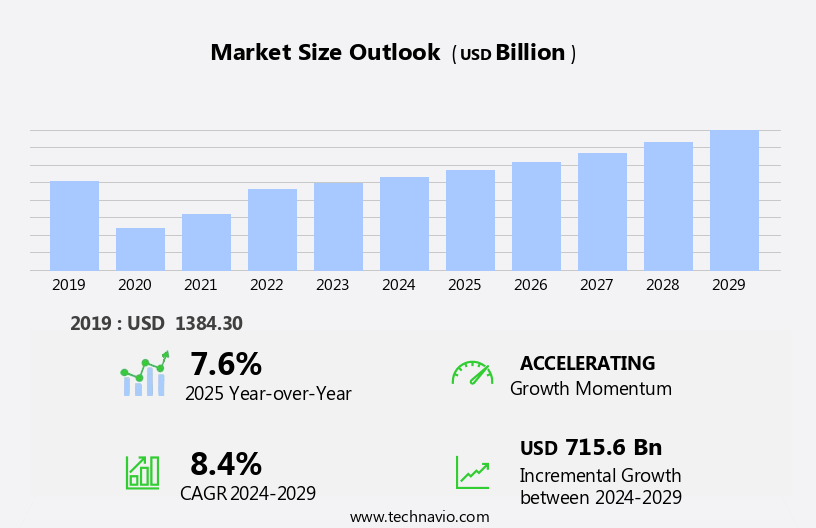
Explore in-depth regional segment analysis with market size data - historical 2019-2023 and forecasts 2025-2029 - in the full report.
Request Free Sample
The market continues to evolve, with dynamic interplay between various sectors shaping its landscape. Aircraft leasing and financing facilitate fleet management for airlines, enabling operational flexibility and cost efficiency. Aircraft insurance mitigates risks, ensuring financial security for lessors and lessees. In the realm of airline operations, supply chain management optimizes processes, enhancing efficiency and reducing costs. Business travelers demand superior passenger experience, driving investments in communication systems, passenger services, and crew scheduling. General aviation, including business jets and rotary-wing aircraft, caters to diverse needs, from executive travel to emergency medical services. Safety remains a top priority, with continuous advancements in aviation safety regulations, accident investigation techniques, and aviation law.
The aerospace industry innovates in aircraft design, materials, and propulsion systems, such as turbine engines and noise reduction technologies. Air traffic management and aviation training adapt to growing global trade and increasing air traffic volumes. Embracing technology, aviation incorporates advanced navigation systems, flight control systems, and airport infrastructure to improve efficiency and reduce emissions. The ongoing integration of these elements underscores the continuous dynamism of the market.
How is this Aviation Industry segmented?
The aviation industry research report provides comprehensive data (region-wise segment analysis), with forecasts and estimates in "USD billion" for the period 2025-2029, as well as historical data from 2019-2023 for the following segments.
- Type
- Commercial aviation
- Military aviation
- General aviation
- Revenue Stream
- Passenger
- Freight
- Component
- Aircraft engines
- Airframe systems
- Avionics
- Cabin interiors
- Landing gears
- Geography
- North America
- US
- Canada
- Europe
- France
- Germany
- UK
- Middle East and Africa
- UAE
- APAC
- China
- India
- Japan
- South Korea
- Rest of World (ROW)
- North America
.
By Type Insights
The commercial aviation segment is estimated to witness significant growth during the forecast period.
The market encompasses various sectors, including defense industry, freight forwarding, jet engines, fixed-wing aircraft, rotary-wing aircraft, aviation law, safety regulations, aerospace industry, navigation systems, ground handling, aviation security, military aviation, aircraft design, aircraft financing, fleet management, aircraft maintenance, baggage handling, passenger experience, passenger services, air traffic management, aviation training, airline ticketing, cargo operations, fuel efficiency, aircraft certification, air traffic control, air transportation, global trade, business jets, aircraft leasing, aircraft insurance, airline operations, supply chain management, business travel, general aviation, communication systems, aviation safety, route planning, pilot training, flight control systems, crew scheduling, airport infrastructure, and emissions reduction. The commercial aviation segment, which includes general aviation and scheduled airline services, is experiencing notable growth in market revenue.
Commercial aviation is utilized for diverse transportation needs, such as tourism, passenger travel, business travel, and freight transportation. Factors fueling this growth include the expanding middle-class population with increasing disposable income and the emergence of low-cost airline companies. Major components of commercial aviation consist of the wings, power plants, fuselage, tail or empennage, and landing gear. Commercial aviation plays a crucial role in various industries, including tourism, transportation of goods, and business travel. The demand for commercial aviation is driven by factors like the increasing number of air passengers, the need for efficient cargo transportation, and the growing preference for air travel over other modes of transportation.
In the realm of defense industry, there is a constant focus on developing advanced technologies for military aviation, including jet engines, fixed-wing aircraft, and rotary-wing aircraft. These advancements are aimed at enhancing the capabilities of military aircraft and improving their operational efficiency. Freight forwarding companies are increasingly adopting advanced technologies, such as navigation systems and communication systems, to streamline their operations and improve the efficiency of cargo transportation. Aviation security measures, including security screening and airport infrastructure, are continually evolving to ensure the safety and security of passengers and cargo. Safety regulations and aviation law are essential components of the aviation industry, with a focus on ensuring the highest safety standards for all types of aviation operations.
Accident investigation and maintenance technician training play a critical role in maintaining the safety and reliability of aircraft. The aerospace industry is at the forefront of innovation, with a constant focus on designing and manufacturing advanced aircraft, including turbine engines and noise reduction technologies, to enhance the passenger experience and improve fuel efficiency. Aircraft certification and air traffic management are essential processes to ensure the safe and efficient operation of commercial and military aircraft. The market is a dynamic and diverse industry, with various sectors and components working together to meet the evolving transportation needs of businesses and individuals.
The market is driven by factors such as the growth in disposable income, the emergence of low-cost airline companies, and the constant pursuit of innovation and technological advancements.
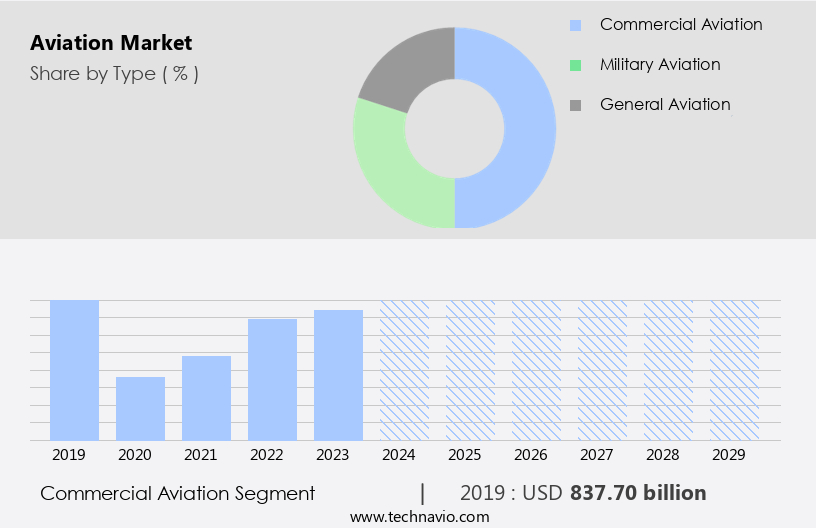
The Commercial aviation segment was valued at USD 837.70 billion in 2019 and showed a gradual increase during the forecast period.
Regional Analysis
APAC is estimated to contribute 54% to the growth of the global market during the forecast period.Technavio's analysts have elaborately explained the regional trends and drivers that shape the market during the forecast period.
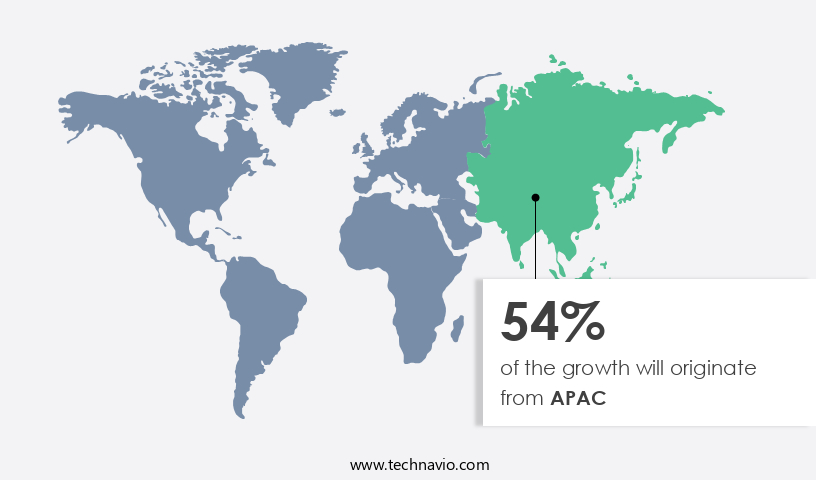
The Asia-Pacific (APAC) region is a significant contributor to The market, marked by substantial growth and investment in infrastructure and technology. Countries such as China, India, Japan, and Southeast Asian nations are leading this expansion, fueled by expanding middle-class populations, increased tourism, and extensive business travel. The APAC region is home to some of the world's busiest airports and fastest-growing airlines, generating a substantial portion of global aviation traffic. China and India stand out as crucial markets due to their vast populations and emerging economic influence. China is aggressively building new airports and expanding existing ones, while India is modernizing its aviation infrastructure to accommodate the growing demand.
The aerospace industry plays a pivotal role in this growth, with jet engines and fixed-wing aircraft being the primary focus. Safety regulations, aviation law, and accident investigation are crucial aspects of the industry, ensuring the highest standards for passenger safety. Military aviation also contributes significantly to the market, with aircraft design, rotary-wing aircraft, and turbine engines being essential components. Passenger experience and services are becoming increasingly important, with noise reduction and fuel efficiency being key considerations. Aircraft financing, fleet management, and maintenance are essential for aircraft operators, while baggage handling, boarding processes, and crew scheduling are critical for efficient airline operations.
Communication systems, aviation safety, and route planning are also vital components of the aviation industry. The freight forwarding sector is another significant contributor to the market, with cargo operations and supply chain management being essential elements. Air traffic management and air traffic control are crucial for ensuring the smooth flow of air traffic, while aviation training and pilot training are essential for maintaining the highest safety standards. Aircraft manufacturing, piston engines, security screening, and aircraft leasing are other essential components of the market. The global trade sector relies heavily on air transportation, making the aviation industry a vital cog in the wheel of international business.
Business jets and aircraft insurance are essential for corporate clients, while general aviation caters to individual needs. Emissions reduction and airport infrastructure are also critical areas of focus for the industry, ensuring sustainable growth and development.
Market Dynamics
Our researchers analyzed the data with 2024 as the base year, along with the key drivers, trends, and challenges. A holistic analysis of drivers will help companies refine their marketing strategies to gain a competitive advantage.
What are the key market drivers leading to the rise in the adoption of Aviation Industry?
- The significant improvement in airline efficiency serves as the primary market catalyst.
- The aviation industry is focusing on enhancing energy efficiency to meet global climate goals. The increasing average number of passengers and cargo weight per flight contributes to better aircraft utilization, resulting in improved energy efficiency. According to industry reports, aviation energy efficiency needs to improve by more than 3% per year by 2040. Governments and international organizations are taking steps to facilitate this improvement. Under the Paris Agreement on Climate Change and related frameworks, several countries have set targets for enhancing efficiency in domestic aviation. The International Civil Aviation Organization (ICAO) has implemented policies to improve aircraft efficiency and limit CO2 emissions from international flights.
- Turbine engines, which power most commercial aircraft, are a significant contributor to this improvement. Noise reduction, passenger experience, and passenger services are also essential areas of focus in the aviation industry. Aircraft financing, fleet management, aircraft maintenance, baggage handling, and boarding processes are critical aspects of the aviation industry that require continuous optimization. Piston engines, although less common in commercial aviation, also play a role in improving efficiency in certain applications. Security screening is another crucial factor in the aviation industry, ensuring safe and secure travel for passengers. Overall, the aviation industry is making strides in enhancing energy efficiency and sustainability while maintaining a focus on passenger comfort and safety.
What are the market trends shaping the Aviation Industry?
- The emerging market trend necessitates a shift towards radio-frequency identification (RFID) technology. This advanced system offers numerous benefits, including enhanced inventory management and contactless data transfer.
- RFID technology plays a significant role in the aviation industry, particularly in air traffic management and maintenance operations. This technology uses electromagnetic fields to transfer data wirelessly to track tags attached to objects, including aircraft. RFID tags are advantageous for aviation as they enable real-time tracking of aircraft, improving air traffic management efficiency. In the maintenance sector, RFID tags provide access to an aircraft's full maintenance history, allowing technicians to identify defective parts promptly, thereby reducing flight delays and cancellations. Additionally, RFID tags are beneficial for aviation training institutions, enabling them to manage their inventory of training equipment and simulators efficiently.
- Furthermore, RFID technology is used in airline ticketing and cargo operations, enhancing air transportation's overall productivity and fuel efficiency. Aircraft manufacturers and maintenance companies can also use RFID tags to verify the authenticity of parts during purchase or use, ensuring aircraft safety and compliance with aircraft certification requirements. Overall, RFID technology is an essential tool for the aviation industry, contributing to global trade by streamlining operations and enhancing safety and efficiency.
What challenges does the Aviation Industry face during its growth?
- The intricacies of supply chain management posed by the rapid advancement of technology represent a significant challenge to the industry's growth trajectory.
- The aviation industry is experiencing significant changes as new technologies and advanced platforms are integrated into aircraft manufacturing. While new aircraft incorporate the latest composites, structures, and electrical systems, the older fleet in operation worldwide may not be compatible with these advancements, leading to challenges in the supply chain for aircraft parts and materials. The aviation supply base faces ongoing issues in keeping up with the demands of Original Equipment Manufacturers (OEMs) for advanced technologies. The high cost of integrating these technologies into aircraft line maintenance further complicates matters. The introduction of new advanced platforms, such as the B787 MAX, A330neo, A320neo, and Bombardier C-Series, has increased the demand for upgrading older fleets.
- This pressure on spare part manufacturers and suppliers to make their products available on time is a pressing concern. Aircraft leasing companies, airlines, and general aviation operators all rely on efficient supply chain management for business travel and airline operations. Effective communication systems, aviation safety, route planning, pilot training, flight control systems, crew scheduling, and airport infrastructure are all crucial elements that require seamless integration for optimal performance. Ensuring a reliable and efficient supply chain is essential for maintaining a competitive edge in the aviation industry.
Exclusive Customer Landscape
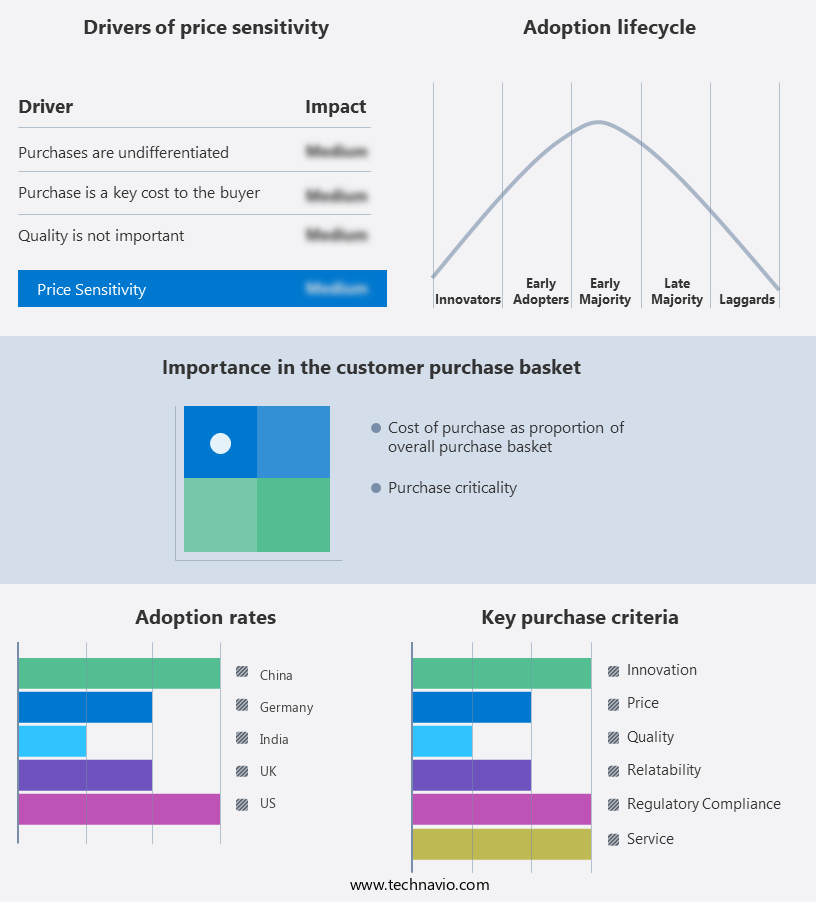
The aviation market forecasting report includes the adoption lifecycle of the market, covering from the innovator's stage to the laggard's stage. It focuses on adoption rates in different regions based on penetration. Furthermore, the aviation market report also includes key purchase criteria and drivers of price sensitivity to help companies evaluate and develop their market growth analysis strategies.
Customer Landscape
Key Companies & Market Insights
Companies are implementing various strategies, such as strategic alliances, aviation market forecast, partnerships, mergers and acquisitions, geographical expansion, and product/service launches, to enhance their presence in the industry.
Airbus SE - The company specializes in aviation services, focusing on passenger aircraft. Our team of experienced analysts provides comprehensive research and insights to optimize operational efficiency and enhance safety standards. Leveraging advanced data analytics and industry expertise, we deliver actionable recommendations to clients seeking to maximize their aviation investments. Our services span fleet management, route optimization, market analysis, and regulatory compliance, ensuring our clients remain competitive and agile in the dynamic aviation industry.
The industry research and growth report includes detailed analyses of the competitive landscape of the market and information about key companies, including:
- Airbus SE
- BAE Systems Plc
- Bombardier Inc.
- DAHER
- Dassault Aviation SA
- Embraer SA
- General Dynamics Corp.
- General Electric Co.
- Leonardo Spa
- Lockheed Martin Corp.
- Northrop Grumman Corp.
- Pilatus Aircraft Ltd.
- RTX Corp.
- Rolls Royce Holdings Plc
- Saab AB
- Safran SA
- Textron Inc.
- Thales Group
- The Boeing Co.
- United Aircraft Corp.
Qualitative and quantitative analysis of companies has been conducted to help clients understand the wider business environment as well as the strengths and weaknesses of key industry players. Data is qualitatively analyzed to categorize companies as pure play, category-focused, industry-focused, and diversified; it is quantitatively analyzed to categorize companies as dominant, leading, strong, tentative, and weak.
Recent Development and News in Aviation Market
- In February 2023, Boeing and SpaceX announced a strategic collaboration to develop a new generation of reusable liquid hydrogen rocket engines for commercial aviation applications (Boeing press release). This partnership represents a significant technological advancement in the aviation industry, aiming to reduce carbon emissions and increase efficiency in air travel.
- In July 2024, Airbus and Rolls-Royce signed a major strategic partnership to develop and manufacture hybrid-electric regional aircraft, marking a significant shift towards sustainable aviation (Airbus press release). The partnership aims to produce zero-emission aircraft by 2035, addressing the growing demand for eco-friendly transportation solutions.
- In October 2024, United Airlines completed the acquisition of a majority stake in Mesa Air Group, a regional airline, for approximately USD1.2 billion (United Airlines press release). This acquisition is a key geographic expansion for United, enabling the airline to expand its domestic network and strengthen its regional operations.
- In March 2025, the European Union Aviation Safety Agency (EASA) granted certification for the Boeing 737 MAX to resume commercial flights, following a nearly two-year grounding due to safety concerns (Reuters). This regulatory approval represents a significant milestone for Boeing and the aviation industry, allowing the 737 MAX to return to service and restore market confidence.
Research Analyst Overview
- The market is experiencing significant advancements, with the integration of lightweight materials and artificial intelligence (AI) driving innovation in various sectors. Air taxi services and delivery services are exploring the use of composite materials to enhance fuel efficiency and reduce carbon footprint. In urban air mobility, AI and machine learning are powering autonomous flight and data analytics for optimized traffic management. Aerial photography, remote sensing, and space exploration are benefiting from advanced imaging technologies and AI-driven data processing. Electric aircraft, propelled by electric propulsion and sustainable aviation fuels, are gaining traction in the market. Virtual reality (VR) and augmented reality (AR) are revolutionizing flight training through simulation software and immersive experiences.
- Hybrid aircraft and supersonic flight are also under development, aiming to reduce travel time and improve efficiency. Big data and AI are transforming maintenance and operations, enabling predictive maintenance and real-time performance monitoring. Space tourism is growing, with AI and VR enhancing the customer experience and reducing costs through remote monitoring and simulation. Hypersonic flight and remote sensing are pushing the boundaries of aviation technology, offering new opportunities for exploration and commercial applications.
Dive into Technavio's robust research methodology, blending expert interviews, extensive data synthesis, and validated models for unparalleled Aviation Market insights. See full methodology.
|
Market Scope |
|
|
Report Coverage |
Details |
|
Page number |
212 |
|
Base year |
2024 |
|
Historic period |
2019-2023 |
|
Forecast period |
2025-2029 |
|
Growth momentum & CAGR |
Accelerate at a CAGR of 8.4% |
|
Market growth 2025-2029 |
USD 715.6 billion |
|
Market structure |
Fragmented |
|
YoY growth 2024-2025(%) |
7.6 |
|
Key countries |
US, China, Germany, Japan, UK, India, France, Canada, UAE, and South Korea |
|
Competitive landscape |
Leading Companies, Market Positioning of Companies, Competitive Strategies, and Industry Risks |
What are the Key Data Covered in this Aviation Market Research and Growth Report?
- CAGR of the Aviation industry during the forecast period
- Detailed information on factors that will drive the growth and forecasting between 2025 and 2029
- Precise estimation of the size of the market and its contribution of the industry in focus to the parent market
- Accurate predictions about upcoming growth and trends and changes in consumer behaviour
- Growth of the market across APAC, Europe, North America, Middle East and Africa, and South America
- Thorough analysis of the market's competitive landscape and detailed information about companies
- Comprehensive analysis of factors that will challenge the aviation market growth of industry companies
We can help! Our analysts can customize this aviation market research report to meet your requirements.
 RIA -
RIA -