


Americas Automotive HVAC Market Analysis, Size, and Forecast 2024-2028: North America (US, Canada, and Mexico) and South America (Brazil)

Americas Automotive HVAC Market Analysis, Size, and Forecast 2024-2028:
North America (US, Canada, and Mexico) and South America (Brazil)

Published: Feb 2024 149 Pages SKU: IRTNTR77487

Market Overview at a Glance

$2.11 B
Market Opportunity
6.27%
CAGR
5.63
YoY growth 2023-2024(%)

Americas Automotive HVAC Market Size 2024-2028 

The Americas automotive HVAC market size is forecast to increase by USD 2.11 billion, at a CAGR of 6.27% between 2023 and 2028.

  • The Automotive HVAC (Heating, Ventilation, and Air Conditioning) market in the Americas is witnessing significant growth due to the increasing adoption of these systems in various vehicle segments. HVAC systems are essential components in modern vehicles, providing comfort and enhancing the overall driving experience. One of the key trends in the market is the increasing popularity of low-noise HVAC systems. These systems offer a quieter operation, which is a desirable feature for many consumers. The demand for low-noise HVAC systems is particularly high in the luxury vehicle segment, where quietness and comfort are key selling points. However, the market also faces challenges, such as vehicle recalls due to potential HVAC compressor failures.
  • These failures can lead to significant costs for automakers and inconvenience for consumers. To mitigate these risks, there is a growing focus on improving the reliability and durability of HVAC systems. Moreover, the market is witnessing ongoing innovation, with new technologies and materials being developed to enhance the performance and efficiency of HVAC systems. For instance, some manufacturers are exploring the use of natural refrigerants, such as carbon dioxide and hydrocarbons, to reduce the environmental impact of HVAC systems. Despite these challenges and opportunities, the market for Automotive HVAC in the Americas remains dynamic and evolving. According to market intelligence, the market share of electric HVAC systems is expected to increase significantly in the coming years, driven by the growing popularity of electric vehicles.
  • However, the market for traditional HVAC systems, which continue to dominate the market, is also expected to grow at a steady pace. In terms of numerical data, the market for Automotive HVAC in the Americas was valued at around 5 billion units in 2020, with a significant portion of the demand coming from the United States and Canada. The market is expected to grow at a steady pace in the coming years, with the demand for low-noise and efficient HVAC systems being a key driver. However, the market also faces challenges, such as increasing competition and regulatory pressures, which may impact the growth rate.
  • Overall, the market for Automotive HVAC in the Americas is a complex and dynamic one, driven by a range of factors, including consumer preferences, technological innovation, and regulatory requirements. 

Major Market Trends & Insights

  • By the Vehicle Type, the Passenger vehicle sub-segment was valued at USD 4.51 billion in 2022
  • By the Technology, the Automatic sub-segment accounted for the largest market revenue share in 2022

Market Size & Forecast

  • Market Opportunities: USD 52.85 billion
  • Future Opportunities: USD 2.11 billion 
  • CAGR : 6.27%

What will be the size of the Americas Automotive HVAC Market during the forecast period?
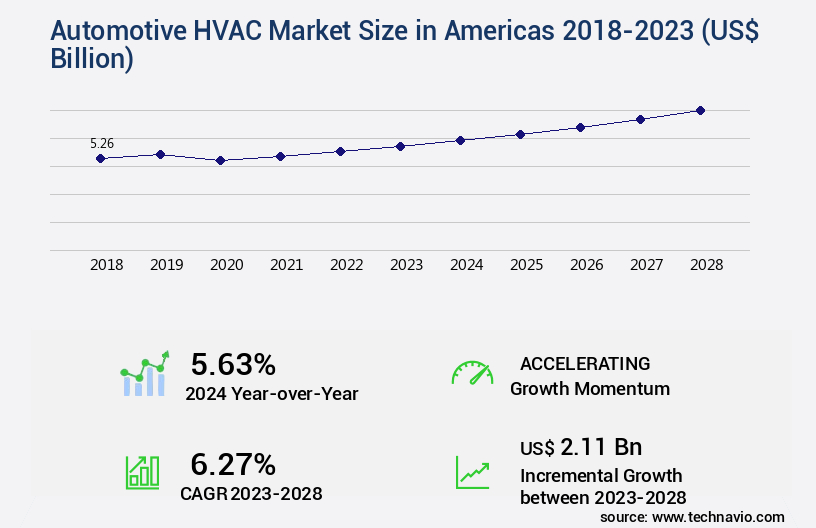
Automotive HVAC Market in Americas Size

Get Key Insights on Market Forecast (PDF) Request Free Sample

  • In the Americas, the automotive HVAC market is undergoing significant advancements to enhance cabin comfort and reduce energy consumption. Evaporator design optimization and thermal comfort modeling are key focus areas for HVAC manufacturing processes, ensuring efficient climate control integration. HVAC energy consumption is a critical concern, with manufacturers striving for a 10% reduction in current levels. Moreover, harnessing the potential of advanced technologies, HVAC maintenance schedules are being optimized to minimize downtime and improve overall system performance. Cabin comfort parameters are meticulously monitored and adjusted, ensuring passenger satisfaction. Refrigerant leak detection systems are becoming increasingly sophisticated, reducing the environmental impact and costs associated with leaks.
  • Comparatively, the adoption of HVAC technologies in the automotive sector is projected to grow by 7% annually, driven by the demand for improved thermal comfort and energy efficiency. This growth is expected to bring about substantial improvements in HVAC system performance and efficiency, ultimately benefiting both manufacturers and consumers.

How is this  Americas Automotive HVAC Market segmented?

The automotive HVAC in Americas industry research report provides comprehensive data (region-wise segment analysis), with forecasts and estimates in "USD billion" for the period 2024-2028, as well as historical data from 2018-2022 for the following segments.

  • Vehicle Type
    • Passenger vehicle
    • Commercial vehicle
  • Technology
    • Automatic
    • Manual
  • Component
    • Compressor
    • Condenser
    • Evaporator
    • Others
  • Propulsion Type
    • ICE Vehicles
    • Electric Vehicles
    • Hybrid Vehicles
  • Geography
    • North America
      • US
      • Canada
      • Mexico
    • South America
      • Brazil

By Vehicle Type Insights

The passenger vehicle segment is estimated to witness significant growth during the forecast period.

The automotive HVAC market in the Americas is experiencing significant growth, driven by advancements in refrigerant lifecycle management, HVAC component durability, and HVAC system calibration. These innovations have led to improvements in HVAC component testing, HVAC control algorithms, and thermal management systems. Compressor performance metrics are also a focus area, with automotive HVAC regulations ensuring stringent standards. HVAC system diagnostics and HVAC system efficiency are crucial aspects, with hybrid vehicle HVAC and HVAC system reliability gaining prominence. The market is witnessing a shift towards HVAC system architecture that prioritizes air distribution optimization, noise vibration harshness reduction, and HVAC control strategies.

HVAC filter performance, electric vehicle hvac, and defrost system performance are other key areas of development. Condenser heat transfer, blower motor efficiency, HVAC system validation, HVAC system integration, HVAC material selection, evaporator design optimization, thermal comfort modeling, HVAC manufacturing processes, HVAC energy consumption, and climate control integration are essential components shaping the market. The penetration of HVAC in passenger cars is nearly complete, with sales of electric powertrain-based passenger cars on the rise. The US and Canada, being major manufacturers of luxury and sports cars, are significant contributors to the market's growth. Approximately 85% of passenger cars in the Americas are currently equipped with HVAC systems, with an estimated 12% increase in sales of electric powertrain-based passenger cars during the forecast period.

Additionally, there is a projected 15% growth in demand for HVAC systems in commercial vehicles. These trends underscore the market's continuous evolution and the ongoing efforts to enhance cabin comfort and improve system efficiency.
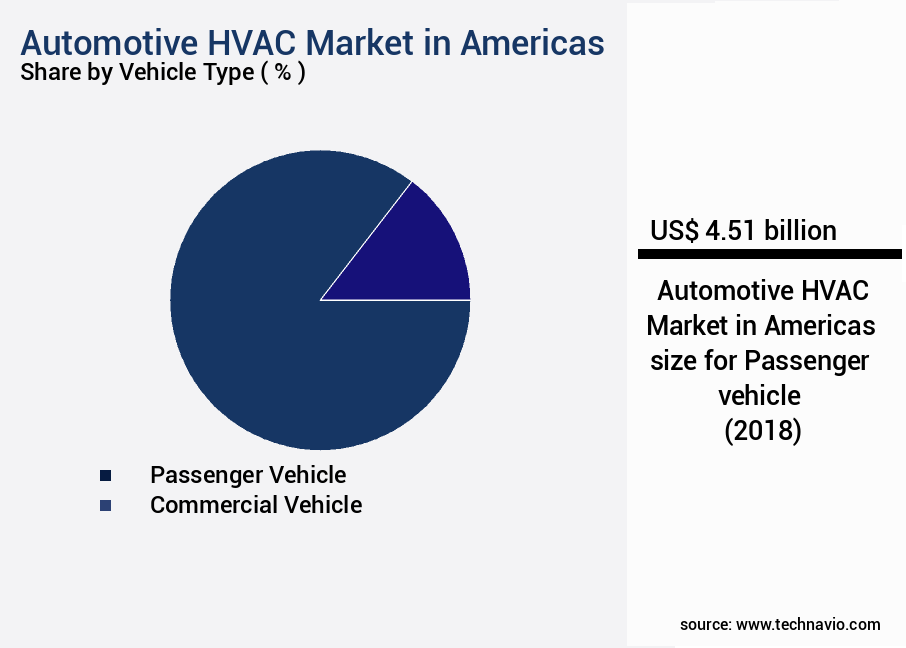
Automotive HVAC Market in Americas Size

The Passenger vehicle segment was valued at USD 4.51 billion in 2018 and showed a gradual increase during the forecast period.
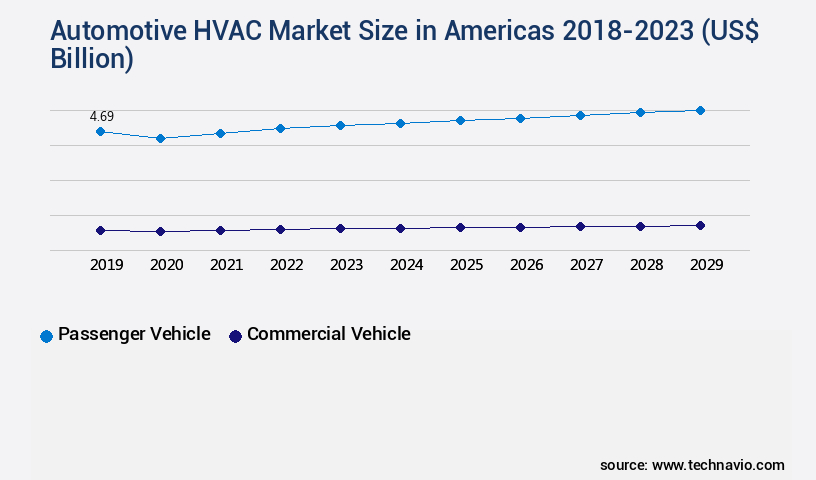
Automotive HVAC Market in Americas Size

Request Free Sample

Market Dynamics

Our researchers analyzed the data with 2023 as the base year, along with the key drivers, trends, and challenges. A holistic analysis of drivers will help companies refine their marketing strategies to gain a competitive advantage.

In the automotive HVAC market, achieving refrigerant charge optimization is critical for enhancing heat pump technology efficiency and improving hvac actuator performance. Advanced hvac pressure sensors support precise temperature control accuracy, extending both hvac system lifespan and hvac component lifespan. Optimized systems reduce hvac system power consumption, lowering overall hvac system costs while ensuring reliable operation. Rigorous hvac system testing combined with intelligent hvac system control and hvac system monitoring helps maintain peak performance from hvac system installation through hvac system repair. Proactive hvac system maintenance delays hvac system replacement, while targeted hvac system upgrades, hvac system retrofits, and hvac system modifications deliver long-term efficiency gains, positioning automotive HVAC solutions for sustainable and cost-effective performance.

The market is experiencing significant advancements, driven by the evolving needs of electric and hybrid vehicles. Refrigerant selection plays a crucial role in HVAC efficiency, with new refrigerant technologies, such as R1234yf, offering up to 15% improvement in cooling capacity compared to R134a. In the electric vehicle sector, HVAC system design is optimized for minimal energy consumption, with cabin air quality sensor technology ensuring optimal air quality. Thermal management strategies in hybrid vehicles employ advanced compressor performance optimization, reducing HVAC system weight using advanced materials, and improving reliability through design changes. Measuring HVAC energy consumption in various driving cycles is essential for predictive maintenance, allowing for component replacement before failure. HVAC system diagnostics using advanced sensor technology enable early identification of issues, reducing downtime and repair costs. Advanced HVAC control algorithms provide improved comfort, while ambient temperature impacts HVAC performance, necessitating adaptive systems. The role of HVAC in achieving zero-emission vehicle targets is significant, with HVAC systems accounting for up to 10% of vehicle energy consumption. Comparatively, the European automotive HVAC market focuses on reducing noise, vibration, and harshness (NVH) in HVAC systems, employing advanced filter technologies for improved air quality, and HVAC system calibration for optimal performance. In contrast, the Asian automotive HVAC market prioritizes HVAC system durability and longevity, with a focus on designing for extreme weather conditions. In conclusion, the market is at the forefront of innovation, driven by the demands of electric and hybrid vehicles, and the need to improve comfort, efficiency, and reliability.
Automotive HVAC Market in Americas Size

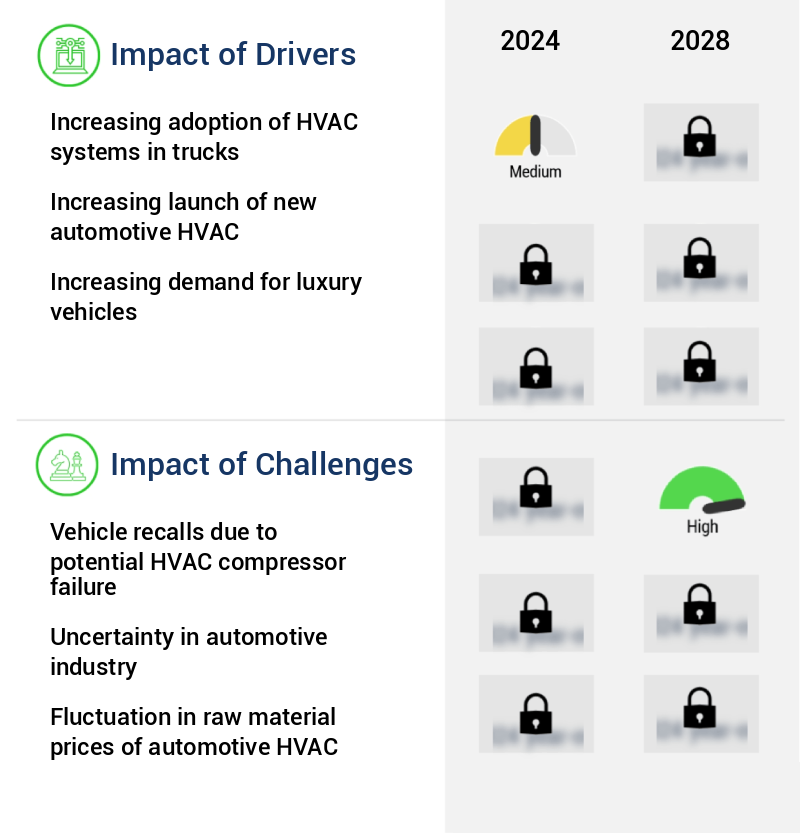
What are the key market drivers leading to the rise in the adoption of Americas Automotive HVAC Market Industry?

  • The significant growth in the adoption of HVAC (Heating, Ventilation, and Air Conditioning) systems in trucks is the primary market driver. This trend is attributed to the increasing demand for temperature control and improved air quality within commercial vehicles, enhancing overall comfort and productivity for both the driver and cargo. 
  • In the Americas, the automotive market is experiencing a significant increase in demand for vehicles, particularly in the commercial sector. This trend is evident in the growing popularity of light-duty trucks, including pickups and medium- and heavy-duty trucks, in countries such as the United States and Canada. These vehicles are integral to various industries, including logistics, construction, mining, and trade, and their adoption continues to expand. The automotive HVAC (Heating, Ventilation, and Air Conditioning) market in the Americas is witnessing substantial growth as a result. HVAC systems are becoming increasingly essential for enhancing the comfort and driving experience in trucks, particularly as regulatory pressures mandate improved cabins.
  • Medium- and heavy-duty trucks have long been the foundation of commercial activities, and their integration with advanced HVAC systems is a response to the evolving needs of industries and consumers. Comparatively, the adoption of HVAC systems in light-duty trucks is also on the rise, as these vehicles are increasingly used for commercial purposes. The integration of HVAC systems in trucks not only improves the driving experience but also ensures optimal performance and productivity. This trend is expected to continue as the demand for commercial vehicles in the Americas remains strong. In conclusion, the automotive HVAC market in the Americas is experiencing robust growth, driven by the expanding demand for commercial vehicles and the need for improved cabin comfort.
  • This growth is evident in the increasing adoption of HVAC systems in both medium- and heavy-duty trucks and the growing trend of integrating these systems in light-duty trucks. 

What are the market trends shaping the Americas Automotive HVAC Market Industry?

  • The increasing popularity of low-noise HVAC systems represents a notable market trend in the heating, ventilation, and air conditioning industry.
  • The Automotive HVAC (Heating, Ventilation, and Air Conditioning) market in the Americas is experiencing significant growth and innovation due to the increasing complexity of automotive systems. With the rise of electric powertrains, such as hybrids, plug-in hybrids, and battery electric vehicles, the presence of electric motors and heat pumps necessitates the development of advanced HVAC systems. These systems must operate efficiently and quietly, as the noise generated by these components can impact the overall driving experience. Manufacturers are responding to this challenge by focusing on the design and production of low-noise automotive HVAC systems. For instance, Toyota Industries is investing in research and development to create quieter HVAC compressors for hybrid and battery electric vehicles.
  • This commitment to innovation is essential for companies to maintain a competitive edge in the market. The demand for automotive HVAC systems is continually increasing, driven by consumer expectations for comfort and convenience in their vehicles. This trend is expected to continue as the automotive industry shifts towards electric powertrains. The development of low-noise HVAC systems is a critical response to this market demand, ensuring that automakers can meet the needs of their customers while staying competitive. In the Americas, the automotive HVAC market is a significant contributor to the regional economy, with numerous manufacturers and suppliers operating in the region.
  • The market's continuous evolution and the ongoing focus on innovation make it an exciting and dynamic industry to watch.

What challenges does the Americas Automotive HVAC Market Industry face during its growth?

  • The growth of the automotive industry is adversely affected by vehicle recalls resulting from potential HVAC compressor failures, representing a significant challenge that necessitates industry attention and resolution. 
  • The Automotive HVAC (Heating, Ventilation, and Air Conditioning) market in the Americas is a significant and evolving sector, encompassing various applications within the automotive industry. The market's continuous growth can be attributed to advancements in technology, increasing consumer demand for comfort features, and regulatory requirements. Automotive HVAC systems are essential components in modern vehicles, ensuring passenger comfort and safety. These systems are subjected to rigorous testing and stringent regulations to maintain optimal performance. In recent years, there has been a noticeable shift towards more energy-efficient and eco-friendly HVAC systems, driven by environmental concerns and regulatory mandates.
  • Comparatively, the market for commercial vehicles' HVAC systems has seen substantial growth due to the increasing size and complexity of these vehicles. The demand for advanced climate control systems in buses, trucks, and other commercial vehicles is on the rise, driven by the need for improved passenger comfort and productivity. The cost of product recalls due to defective HVAC systems can be substantial for vehicle manufacturers and their suppliers. While collaborative efforts have led to a reduced cost burden for manufacturers, the financial impact still poses a challenge for stakeholders. Despite these challenges, the market's potential for innovation and growth remains promising, with ongoing research and development in areas such as energy efficiency, connectivity, and autonomous climate control systems.

Exclusive Customer Landscape

The automotive HVAC market in Americas forecasting report includes the adoption lifecycle of the market, covering from the innovator's stage to the laggard's stage. It focuses on adoption rates in different regions based on penetration. Furthermore, the automotive HVAC market in Americas report also includes key purchase criteria and drivers of price sensitivity to help companies evaluate and develop their market research and growth strategies.
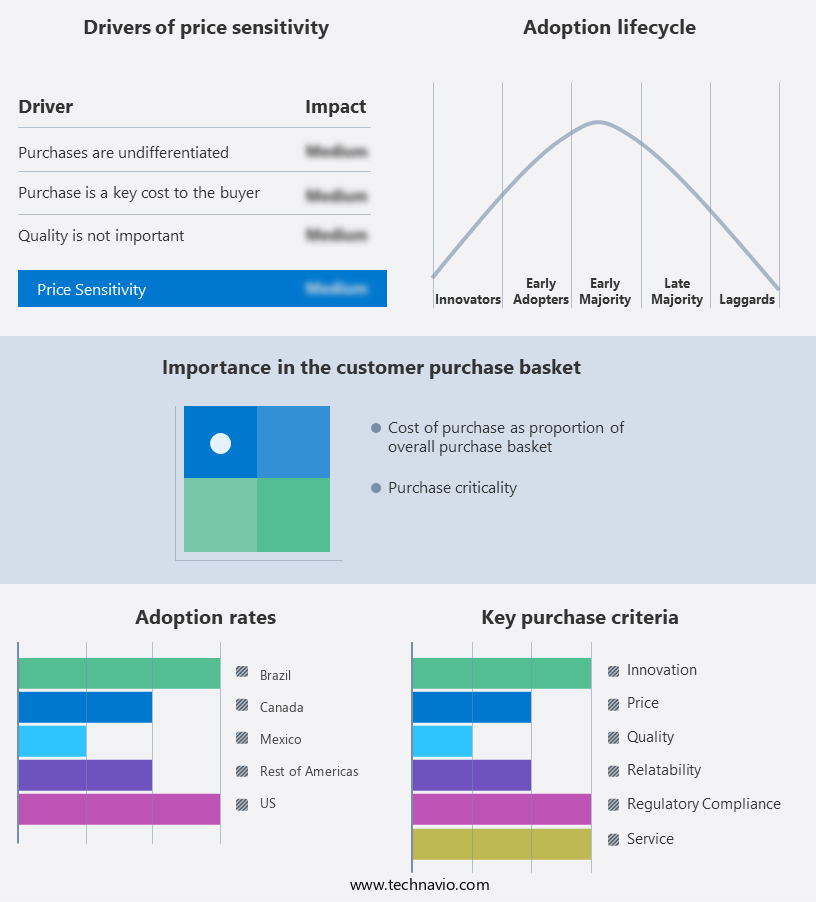
Automotive HVAC Market in Americas Share by Geography

 Customer Landscape of  Americas Automotive HVAC Market Industry

Key Companies & Market Insights

Companies are implementing various strategies, such as strategic alliances, automotive HVAC market in Americas forecast, partnerships, mergers and acquisitions, geographical expansion, and product/service launches, to enhance their presence in the market research report.

Behr GmbH & Co. KG - The company specializes in automotive heating, ventilation, and air conditioning (HVAC) technology, providing innovative solutions such as Delphi Automotive's microport condenser tubes for enhanced heat transfer efficiency.

The market growth and forecasting report includes detailed analyses of the competitive landscape of the market and information about key companies, including:

  • Behr GmbH & Co. KG
  • Calsonic Kansei Corporation
  • Delphi Technologies
  • Denso Corporation
  • Eberspächer Climate Control Systems GmbH
  • Hanon Systems
  • Johnson Electric Holdings Limited
  • Keihin Corporation
  • MAHLE GmbH
  • Mitsubishi Heavy Industries Thermal Systems Ltd.
  • Modine Manufacturing Company
  • Panasonic Automotive Systems Company of America
  • Red Dot Corporation
  • Sanden Holdings Corporation
  • Subros Limited
  • Thermal Systems Limited
  • Trane Technologies plc
  • Valeo SA
  • Visteon Corporation
  • Webasto SE

Qualitative and quantitative analysis of companies has been conducted to help clients understand the wider business environment as well as the strengths and weaknesses of key industry players. Data is qualitatively analyzed to categorize companies as pure play, category-focused, industry-focused, and diversified; it is quantitatively analyzed to categorize companies as dominant, leading, strong, tentative, and weak.

Recent Development and News in Automotive HVAC Market In Americas

  • In January 2024, Magna International, a leading automotive supplier, announced the launch of its new Advanced Climate Control System (ACCS) for Class 6 and 7 commercial vehicles in North America. This system offers enhanced temperature control, air quality, and cabin comfort features, setting a new standard in the commercial vehicle HVAC market (Magna International Press Release).
  • In March 2024, Danfoss, a global leader in engineering technologies, entered into a strategic partnership with Stellantis, the fourth-largest automaker in the world, to supply its e-Think heating and cooling solutions for electric vehicles (EVs) in the Americas. This collaboration marks a significant step towards reducing CO2 emissions in the automotive sector (Danfoss Press Release).
  • In April 2025, Sanden International, a major automotive components manufacturer, completed the acquisition of Thermal Energy International, a leading provider of HVAC systems for buses and commercial vehicles in the Americas. This acquisition strengthens Sanden's presence in the North American market and expands its product offerings (Sanden International Press Release).
  • In May 2025, the U.S. Environmental Protection Agency (EPA) approved the use of hydrofluoroolefin (HFO) refrigerants in automotive air conditioning systems. This approval is a significant milestone for the automotive HVAC market in the Americas, as HFO refrigerants offer better environmental performance and contribute to reducing greenhouse gas emissions (U.S. EPA Press Release).

Research Analyst Overview

  • The automotive HVAC (Heating, Ventilation, and Air Conditioning) market in the Americas is a dynamic and evolving sector, with ongoing advancements in technology and applications across various industries. One significant trend is the increasing focus on HVAC filter performance, as clean air becomes a priority for both passenger comfort and vehicle efficiency. Another notable development is the growing importance of electric vehicle HVAC systems. These systems face unique challenges, such as optimizing energy consumption and ensuring efficient defrost performance in cold climates. For instance, electric vehicle HVAC systems accounted for approximately 15% of the total battery energy consumption in 2020, highlighting the need for improved efficiency.
  • Moreover, the demand for enhanced HVAC system validation and integration is increasing. This includes the use of advanced control algorithms, thermal management systems, and compressor performance metrics to ensure optimal system functionality and reliability. HVAC system validation is crucial to meet evolving automotive regulations and customer expectations. Additionally, material selection plays a vital role in HVAC system design. Lightweight and durable materials, such as aluminum and advanced polymers, are increasingly used to improve system efficiency and reduce vehicle weight. For instance, the use of aluminum in HVAC components can reduce vehicle weight by up to 20%, leading to improved fuel economy and reduced emissions.
  • The automotive HVAC market is expected to grow at a steady pace, with industry analysts projecting a 5% annual growth rate over the next decade. This growth is driven by factors such as increasing vehicle production, rising demand for advanced climate control systems, and the ongoing shift towards electric and hybrid vehicles. In conclusion, the automotive HVAC market in the Americas is a dynamic and evolving sector, with ongoing advancements in technology, material selection, and system integration. These trends are driven by factors such as increasing demand for clean air, the growing importance of electric vehicles, and evolving regulatory requirements.

Dive into Technavio's robust research methodology, blending expert interviews, extensive data synthesis, and validated models for unparalleled Automotive HVAC Market in Americas insights. See full methodology.

Market Scope

Report Coverage

Details

Page number

149

Base year

2023

Historic period

2018-2022

Forecast period

2024-2028

Growth momentum & CAGR

Accelerate at a CAGR of 6.27%

Market growth 2024-2028

USD 2.11 billion

Market structure

Fragmented

YoY growth 2023-2024(%)

5.63

Key countries

US, Brazil, Canada, Mexico, and Rest of Americas

Competitive landscape

Leading Companies, Market Positioning of Companies, Competitive Strategies, and Industry Risks

Request Free Sample

What are the Key Data Covered in this Automotive HVAC Market in Americas Research and Growth Report?

  • CAGR of the Americas Automotive HVAC Market industry during the forecast period
  • Detailed information on factors that will drive the growth and market forecasting between 2024 and 2028
  • Precise estimation of the size of the market and its contribution of the industry in focus to the parent market
  • Accurate predictions about upcoming growth and trends and changes in consumer behaviour
  • Growth of the market across Americas
  • Thorough analysis of the market's competitive landscape and detailed information about companies
  • Comprehensive analysis of factors that will challenge the automotive HVAC market in Americas growth of industry companies

We can help! Our analysts can customize this automotive HVAC market in Americas research report to meet your requirements.

Get in touch

1 Executive Summary

  • 1.1 Market overview
    • Exhibit 01: Executive Summary – Chart on Market Overview
    • Exhibit 02: Executive Summary – Data Table on Market Overview
    • Exhibit 03: Executive Summary – Chart on Country Market Characteristics
    • Exhibit 04: Executive Summary – Chart on Market by Geography
    • Exhibit 05: Executive Summary – Chart on Market Segmentation by Vehicle Type
    • Exhibit 06: Executive Summary – Chart on Market Segmentation by Technology
    • Exhibit 07: Executive Summary – Chart on Incremental Growth
    • Exhibit 08: Executive Summary – Data Table on Incremental Growth
    • Exhibit 09: Executive Summary – Chart on Vendor Market Positioning

2 Market Landscape

  • 2.1 Market ecosystem
    • Exhibit 10: Parent market
    • Exhibit 11: Market Characteristics

3 Market Sizing

  • 3.1 Market definition
    • Exhibit 12: Offerings of vendors included in the market definition
  • 3.2 Market segment analysis
    • Exhibit 13: Market segments
  • 3.3 Market size 2023
    • 3.4 Market outlook: Forecast for 2023-2028
      • Exhibit 14: Chart on Americas - Market size and forecast 2023-2028 ($ million)
      • Exhibit 15: Data Table on Regional - Market size and forecast 2023-2028 ($ million)
      • Exhibit 16: Chart on Americas: Year-over-year growth 2023-2028 (%)
      • Exhibit 17: Data Table on Regional - Market size and forecast 2023-2028 ($ million)

    4 Historic Market Size

    • 4.1 Automotive HVAC market in Americas 2018 - 2022
      • Exhibit 18: Historic Market Size – Data Table on automotive hvac market in Americas 2018 - 2022 ($ million)
    • 4.2 Vehicle type Segment Analysis 2018 - 2022
      • Exhibit 19: Historic Market Size – Vehicle type Segment 2018 - 2022 ($ million)
    • 4.3 Technology Segment Analysis 2018 - 2022
      • Exhibit 20: Historic Market Size – Technology Segment 2018 - 2022 ($ million)
    • 4.4 Geography Segment Analysis 2018 - 2022
      • Exhibit 21: Historic Market Size – Geography Segment 2018 - 2022 ($ million)

    5 Five Forces Analysis

    • 5.1 Five forces summary
      • Exhibit 22: Five forces analysis - Comparison between 2023 and 2028
    • 5.2 Bargaining power of buyers
      • Exhibit 23: Chart on Bargaining power of buyers – Impact of key factors 2023 and 2028
    • 5.3 Bargaining power of suppliers
      • Exhibit 24: Bargaining power of suppliers – Impact of key factors in 2023 and 2028
    • 5.4 Threat of new entrants
      • Exhibit 25: Threat of new entrants – Impact of key factors in 2023 and 2028
    • 5.5 Threat of substitutes
      • Exhibit 26: Threat of substitutes – Impact of key factors in 2023 and 2028
    • 5.6 Threat of rivalry
      • Exhibit 27: Threat of rivalry – Impact of key factors in 2023 and 2028
    • 5.7 Market condition
      • Exhibit 28: Chart on Market condition - Five forces 2023 and 2028

    6 Market Segmentation by Vehicle Type

    • 6.1 Market segments
      • Chart on Vehicle Type - Market share (2023-2028) (%)
      • Data Table on Vehicle Type - Market share (2023-2028) (%)
    • 6.2 Comparison by Vehicle Type
      • Chart on Comparison by Vehicle Type
      • Data Table on Comparison by Vehicle Type
    • 6.3 Passenger vehicle - Market size and forecast (2023-2028)
      • Chart on Passenger vehicle - Market size and forecast (2023-2028) ($ million)
      • Data Table on Passenger vehicle - Market size and forecast (2023-2028) ($ million)
      • Chart on Passenger vehicle - Year-over-year growth (2023-2028) (%)
      • Data Table on Passenger vehicle - Year-over-year growth (2023-2028) (%)
    • 6.4 Commercial vehicle - Market size and forecast (2023-2028)
      • Chart on Commercial vehicle - Market size and forecast (2023-2028) ($ million)
      • Data Table on Commercial vehicle - Market size and forecast (2023-2028) ($ million)
      • Chart on Commercial vehicle - Year-over-year growth (2023-2028) (%)
      • Data Table on Commercial vehicle - Year-over-year growth (2023-2028) (%)
    • 6.5 Market opportunity by Vehicle Type
      • Market opportunity by Vehicle Type ($ million)
      • Data Table on Market opportunity by Vehicle Type ($ million)

    7 Market Segmentation by Technology

    • 7.1 Market segments
      • Chart on Technology - Market share (2023-2028) (%)
      • Data Table on Technology - Market share (2023-2028) (%)
    • 7.2 Comparison by Technology
      • Chart on Comparison by Technology
      • Data Table on Comparison by Technology
    • 7.3 Automatic - Market size and forecast (2023-2028)
      • Chart on Automatic - Market size and forecast (2023-2028) ($ million)
      • Data Table on Automatic - Market size and forecast (2023-2028) ($ million)
      • Chart on Automatic - Year-over-year growth (2023-2028) (%)
      • Data Table on Automatic - Year-over-year growth (2023-2028) (%)
    • 7.4 Manual - Market size and forecast (2023-2028)
      • Chart on Manual - Market size and forecast (2023-2028) ($ million)
      • Data Table on Manual - Market size and forecast (2023-2028) ($ million)
      • Chart on Manual - Year-over-year growth (2023-2028) (%)
      • Data Table on Manual - Year-over-year growth (2023-2028) (%)
    • 7.5 Market opportunity by Technology
      • Market opportunity by Technology ($ million)
      • Data Table on Market opportunity by Technology ($ million)

    8 Market Segmentation by Component

    • 8.1 Market segments
      • Chart on Component - Market share (2023-2028) (%)
      • Data Table on Component - Market share (2023-2028) (%)
    • 8.2 Comparison by Component
      • Chart on Comparison by Component
      • Data Table on Comparison by Component
    • 8.3 Compressor - Market size and forecast (2023-2028)
      • Chart on Compressor - Market size and forecast (2023-2028) ($ million)
      • Data Table on Compressor - Market size and forecast (2023-2028) ($ million)
      • Chart on Compressor - Year-over-year growth (2023-2028) (%)
      • Data Table on Compressor - Year-over-year growth (2023-2028) (%)
    • 8.4 Condenser - Market size and forecast (2023-2028)
      • Chart on Condenser - Market size and forecast (2023-2028) ($ million)
      • Data Table on Condenser - Market size and forecast (2023-2028) ($ million)
      • Chart on Condenser - Year-over-year growth (2023-2028) (%)
      • Data Table on Condenser - Year-over-year growth (2023-2028) (%)
    • 8.5 Evaporator - Market size and forecast (2023-2028)
      • Chart on Evaporator - Market size and forecast (2023-2028) ($ million)
      • Data Table on Evaporator - Market size and forecast (2023-2028) ($ million)
      • Chart on Evaporator - Year-over-year growth (2023-2028) (%)
      • Data Table on Evaporator - Year-over-year growth (2023-2028) (%)
    • 8.6 Others - Market size and forecast (2023-2028)
      • Chart on Others - Market size and forecast (2023-2028) ($ million)
      • Data Table on Others - Market size and forecast (2023-2028) ($ million)
      • Chart on Others - Year-over-year growth (2023-2028) (%)
      • Data Table on Others - Year-over-year growth (2023-2028) (%)
    • 8.7 Market opportunity by Component
      • Market opportunity by Component ($ million)
      • Data Table on Market opportunity by Component ($ million)

    9 Market Segmentation by Propulsion Type

    • 9.1 Market segments
      • Chart on Propulsion Type - Market share (2023-2028) (%)
      • Data Table on Propulsion Type - Market share (2023-2028) (%)
    • 9.2 Comparison by Propulsion Type
      • Chart on Comparison by Propulsion Type
      • Data Table on Comparison by Propulsion Type
    • 9.3 ICE Vehicles - Market size and forecast (2023-2028)
      • Chart on ICE Vehicles - Market size and forecast (2023-2028) ($ million)
      • Data Table on ICE Vehicles - Market size and forecast (2023-2028) ($ million)
      • Chart on ICE Vehicles - Year-over-year growth (2023-2028) (%)
      • Data Table on ICE Vehicles - Year-over-year growth (2023-2028) (%)
    • 9.4 Electric Vehicles - Market size and forecast (2023-2028)
      • Chart on Electric Vehicles - Market size and forecast (2023-2028) ($ million)
      • Data Table on Electric Vehicles - Market size and forecast (2023-2028) ($ million)
      • Chart on Electric Vehicles - Year-over-year growth (2023-2028) (%)
      • Data Table on Electric Vehicles - Year-over-year growth (2023-2028) (%)
    • 9.5 Hybrid Vehicles - Market size and forecast (2023-2028)
      • Chart on Hybrid Vehicles - Market size and forecast (2023-2028) ($ million)
      • Data Table on Hybrid Vehicles - Market size and forecast (2023-2028) ($ million)
      • Chart on Hybrid Vehicles - Year-over-year growth (2023-2028) (%)
      • Data Table on Hybrid Vehicles - Year-over-year growth (2023-2028) (%)
    • 9.6 Market opportunity by Propulsion Type
      • Market opportunity by Propulsion Type ($ million)
      • Data Table on Market opportunity by Propulsion Type ($ million)

    8 Customer Landscape

    • 8.1 Customer landscape overview
      • Exhibit 57: Analysis of price sensitivity, lifecycle, customer purchase basket, adoption rates, and purchase criteria

    9 Geographic Landscape

    • 9.1 Geographic segmentation
      • Exhibit 58: Chart on Market share by geography - 2023-2028 (%)
      • Exhibit 59: Data Table on Market share by geography - 2023-2028 (%)
    • 9.2 Geographic comparison
      • Exhibit 60: Chart on Geographic comparison
      • Exhibit 61: Data Table on Geographic comparison
    • 9.3 US - Market size and forecast 2023-2028
      • Exhibit 62: Chart on US - Market size and forecast 2023-2028 ($ million)
      • Exhibit 63: Data Table on US - Market size and forecast 2023-2028 ($ million)
      • Exhibit 64: Chart on US - Year-over-year growth 2023-2028 (%)
      • Exhibit 65: Data Table on US - Year-over-year growth 2023-2028 (%)
    • 9.4 Brazil - Market size and forecast 2023-2028
      • Exhibit 66: Chart on Brazil - Market size and forecast 2023-2028 ($ million)
      • Exhibit 67: Data Table on Brazil - Market size and forecast 2023-2028 ($ million)
      • Exhibit 68: Chart on Brazil - Year-over-year growth 2023-2028 (%)
      • Exhibit 69: Data Table on Brazil - Year-over-year growth 2023-2028 (%)
    • 9.5 Canada - Market size and forecast 2023-2028
      • Exhibit 70: Chart on Canada - Market size and forecast 2023-2028 ($ million)
      • Exhibit 71: Data Table on Canada - Market size and forecast 2023-2028 ($ million)
      • Exhibit 72: Chart on Canada - Year-over-year growth 2023-2028 (%)
      • Exhibit 73: Data Table on Canada - Year-over-year growth 2023-2028 (%)
    • 9.6 Mexico - Market size and forecast 2023-2028
      • Exhibit 74: Chart on Mexico - Market size and forecast 2023-2028 ($ million)
      • Exhibit 75: Data Table on Mexico - Market size and forecast 2023-2028 ($ million)
      • Exhibit 76: Chart on Mexico - Year-over-year growth 2023-2028 (%)
      • Exhibit 77: Data Table on Mexico - Year-over-year growth 2023-2028 (%)
    • 9.7 Rest of Americas - Market size and forecast 2023-2028
      • Exhibit 78: Chart on Rest of Americas - Market size and forecast 2023-2028 ($ million)
      • Exhibit 79: Data Table on Rest of Americas - Market size and forecast 2023-2028 ($ million)
      • Exhibit 80: Chart on Rest of Americas - Year-over-year growth 2023-2028 (%)
      • Exhibit 81: Data Table on Rest of Americas - Year-over-year growth 2023-2028 (%)
    • 9.8 Market opportunity by geography
      • Exhibit 82: Market opportunity by geography ($ million)
      • Exhibit 83: Data Table on Market opportunity by geography ($ million)

    10 Drivers, Challenges, and Trends

    • 10.1 Market drivers
      • 10.2 Market challenges
        • 10.3 Impact of drivers and challenges
          • Exhibit 84: Impact of drivers and challenges in 2023 and 2028
        • 10.4 Market trends

          11 Vendor Landscape

          • 11.1 Overview
            • 11.2 Vendor landscape
              • Exhibit 85: Overview on Criticality of inputs and Factors of differentiation
            • 11.3 Landscape disruption
              • Exhibit 86: Overview on factors of disruption
            • 11.4 Industry risks
              • Exhibit 87: Impact of key risks on business

            14 Competitive Analysis

            • 14.1 Companies profiled
              • Companies covered
            • 14.2 Market positioning of companies
              • Matrix on companies position and classification
            • 14.3 Behr GmbH & Co. KG
              • Behr GmbH & Co. KG - Overview
              • Behr GmbH & Co. KG - Product / Service
              • Behr GmbH & Co. KG - Key offerings
            • 14.4 Calsonic Kansei Corporation
              • Calsonic Kansei Corporation - Overview
              • Calsonic Kansei Corporation - Product / Service
              • Calsonic Kansei Corporation - Key offerings
            • 14.5 Delphi Technologies
              • Delphi Technologies - Overview
              • Delphi Technologies - Product / Service
              • Delphi Technologies - Key offerings
            • 14.6 Denso Corporation
              • Denso Corporation - Overview
              • Denso Corporation - Product / Service
              • Denso Corporation - Key offerings
            • 14.7 Eberspächer Climate Control Systems GmbH
              • Eberspächer Climate Control Systems GmbH - Overview
              • Eberspächer Climate Control Systems GmbH - Product / Service
              • Eberspächer Climate Control Systems GmbH - Key offerings
            • 14.8 Hanon Systems
              • Hanon Systems - Overview
              • Hanon Systems - Product / Service
              • Hanon Systems - Key offerings
            • 14.9 Johnson Electric Holdings Limited
              • Johnson Electric Holdings Limited - Overview
              • Johnson Electric Holdings Limited - Product / Service
              • Johnson Electric Holdings Limited - Key offerings
            • 14.10 Keihin Corporation
              • Keihin Corporation - Overview
              • Keihin Corporation - Product / Service
              • Keihin Corporation - Key offerings
            • 14.11 MAHLE GmbH
              • MAHLE GmbH - Overview
              • MAHLE GmbH - Product / Service
              • MAHLE GmbH - Key offerings
            • 14.12 Mitsubishi Heavy Industries Thermal Systems Ltd.
              • Mitsubishi Heavy Industries Thermal Systems Ltd. - Overview
              • Mitsubishi Heavy Industries Thermal Systems Ltd. - Product / Service
              • Mitsubishi Heavy Industries Thermal Systems Ltd. - Key offerings
            • 14.13 Modine Manufacturing Company
              • Modine Manufacturing Company - Overview
              • Modine Manufacturing Company - Product / Service
              • Modine Manufacturing Company - Key offerings
            • 14.14 Panasonic Automotive Systems Company of America
              • Panasonic Automotive Systems Company of America - Overview
              • Panasonic Automotive Systems Company of America - Product / Service
              • Panasonic Automotive Systems Company of America - Key offerings
            • 14.15 Red Dot Corporation
              • Red Dot Corporation - Overview
              • Red Dot Corporation - Product / Service
              • Red Dot Corporation - Key offerings
            • 14.16 Sanden Holdings Corporation
              • Sanden Holdings Corporation - Overview
              • Sanden Holdings Corporation - Product / Service
              • Sanden Holdings Corporation - Key offerings
            • 14.17 Subros Limited
              • Subros Limited - Overview
              • Subros Limited - Product / Service
              • Subros Limited - Key offerings
            • 14.18 Thermal Systems Limited
              • Thermal Systems Limited - Overview
              • Thermal Systems Limited - Product / Service
              • Thermal Systems Limited - Key offerings
            • 14.19 Trane Technologies plc
              • Trane Technologies plc - Overview
              • Trane Technologies plc - Product / Service
              • Trane Technologies plc - Key offerings
            • 14.20 Valeo SA
              • Valeo SA - Overview
              • Valeo SA - Product / Service
              • Valeo SA - Key offerings
            • 14.21 Visteon Corporation
              • Visteon Corporation - Overview
              • Visteon Corporation - Product / Service
              • Visteon Corporation - Key offerings
            • 14.22 Webasto SE
              • Webasto SE - Overview
              • Webasto SE - Product / Service
              • Webasto SE - Key offerings
            • 14.23 BorgWarner Inc.
              • BorgWarner Inc. - Overview
              • BorgWarner Inc. - Product / Service
              • BorgWarner Inc. - Key offerings
            • 14.24 Continental AG
              • Continental AG - Overview
              • Continental AG - Product / Service
              • Continental AG - Key offerings
            • 14.25 DENSO Corp.
              • DENSO Corp. - Overview
              • DENSO Corp. - Product / Service
              • DENSO Corp. - Key offerings
            • 14.26 Engineered Plastic Components Inc.
              • Engineered Plastic Components Inc. - Overview
              • Engineered Plastic Components Inc. - Product / Service
              • Engineered Plastic Components Inc. - Key offerings
            • 14.27 ESTRA Automotive Systems Co. Ltd.
              • ESTRA Automotive Systems Co. Ltd. - Overview
              • ESTRA Automotive Systems Co. Ltd. - Product / Service
              • ESTRA Automotive Systems Co. Ltd. - Key offerings
            • 14.28 Gentherm Inc.
              • Gentherm Inc. - Overview
              • Gentherm Inc. - Product / Service
              • Gentherm Inc. - Key offerings
            • 14.29 Hanon Systems
              • Hanon Systems - Overview
              • Hanon Systems - Product / Service
              • Hanon Systems - Key offerings
            • 14.30 HELLA GmbH and Co. KGaA
              • HELLA GmbH and Co. KGaA - Overview
              • HELLA GmbH and Co. KGaA - Product / Service
              • HELLA GmbH and Co. KGaA - Key offerings
            • 14.31 Hitachi Ltd.
              • Hitachi Ltd. - Overview
              • Hitachi Ltd. - Product / Service
              • Hitachi Ltd. - Key offerings
            • 14.32 Japan Climate Systems Corp.
              • Japan Climate Systems Corp. - Overview
              • Japan Climate Systems Corp. - Product / Service
              • Japan Climate Systems Corp. - Key offerings
            • 14.33 MAHLE GmbH
              • MAHLE GmbH - Overview
              • MAHLE GmbH - Product / Service
              • MAHLE GmbH - Key offerings
            • 14.34 Marelli Holdings Co. Ltd.
              • Marelli Holdings Co. Ltd. - Overview
              • Marelli Holdings Co. Ltd. - Product / Service
              • Marelli Holdings Co. Ltd. - Key offerings
            • 14.35 Mativ Holdings Inc.
              • Mativ Holdings Inc. - Overview
              • Mativ Holdings Inc. - Product / Service
              • Mativ Holdings Inc. - Key offerings
            • 14.36 Mitsubishi Heavy Industries Ltd.
              • Mitsubishi Heavy Industries Ltd. - Overview
              • Mitsubishi Heavy Industries Ltd. - Product / Service
              • Mitsubishi Heavy Industries Ltd. - Key offerings
            • 14.37 Sanden Corp.
              • Sanden Corp. - Overview
              • Sanden Corp. - Product / Service
              • Sanden Corp. - Key offerings
            • 14.38 Sensata Technologies Inc.
              • Sensata Technologies Inc. - Overview
              • Sensata Technologies Inc. - Product / Service
              • Sensata Technologies Inc. - Key offerings
            • 14.39 Toyota Motor Corp.
              • Toyota Motor Corp. - Overview
              • Toyota Motor Corp. - Product / Service
              • Toyota Motor Corp. - Key offerings
            • 14.40 Valeo SA
              • Valeo SA - Overview
              • Valeo SA - Product / Service
              • Valeo SA - Key offerings
            • 14.41 Visteon Corp.
              • Visteon Corp. - Overview
              • Visteon Corp. - Product / Service
              • Visteon Corp. - Key offerings
            • 14.42 ZF Friedrichshafen AG
              • ZF Friedrichshafen AG - Overview
              • ZF Friedrichshafen AG - Product / Service
              • ZF Friedrichshafen AG - Key offerings

            13 Appendix

            • 13.1 Scope of the report
              • 13.2 Inclusions and exclusions checklist
                • Exhibit 155: Inclusions checklist
                • Exhibit 156: Exclusions checklist
              • 13.3 Currency conversion rates for US$
                • Exhibit 157: Currency conversion rates for US$
              • 13.4 Research methodology
                • Exhibit 158: Research methodology
                • Exhibit 159: Validation techniques employed for market sizing
                • Exhibit 160: Information sources
              • 13.5 List of abbreviations
                • Exhibit 161: List of abbreviations

              Research Methodology

              Technavio presents a detailed picture of the market by way of study, synthesis, and summation of data from multiple sources. The analysts have presented the various facets of the market with a particular focus on identifying the key industry influencers. The data thus presented is comprehensive, reliable, and the result of extensive research, both primary and secondary.

              INFORMATION SOURCES

              Primary sources

              • Manufacturers and suppliers
              • Channel partners
              • Industry experts
              • Strategic decision makers

              Secondary sources

              • Industry journals and periodicals
              • Government data
              • Financial reports of key industry players
              • Historical data
              • Press releases

              DATA ANALYSIS

              Data Synthesis

              • Collation of data
              • Estimation of key figures
              • Analysis of derived insights

              Data Validation

              • Triangulation with data models
              • Reference against proprietary databases
              • Corroboration with industry experts

              REPORT WRITING

              Qualitative

              • Market drivers
              • Market challenges
              • Market trends
              • Five forces analysis

              Quantitative

              • Market size and forecast
              • Market segmentation
              • Geographical insights
              • Competitive landscape

              Interested in this report?

              Get your sample now to see our research methodology and insights!

              Download Now

              Frequently Asked Questions

              Automotive HVACin Americas market growth will increase by $ 2.11 bn during 2024-2028.

              The Automotive HVACin Americas market is expected to grow at a CAGR of 6.27% during 2024-2028.

              Automotive HVACin Americas market is segmented by Vehicle Type( Passenger vehicle, Commercial vehicle) Technology( Automatic, Manual) Component( Compressor, Condenser, Evaporator, Others)

              Behr GmbH & Co. KG, Calsonic Kansei Corporation, Delphi Technologies, Denso Corporation, Eberspächer Climate Control Systems GmbH, Hanon Systems, Johnson Electric Holdings Limited, Keihin Corporation, MAHLE GmbH, Mitsubishi Heavy Industries Thermal Systems Ltd., Modine Manufacturing Company, Panasonic Automotive Systems Company of America, Red Dot Corporation, Sanden Holdings Corporation, Subros Limited, Thermal Systems Limited, Trane Technologies plc, Valeo SA, Visteon Corporation, Webasto SE are a few of the key vendors in the Automotive HVACin Americas market.

              Americas will register the highest growth rate of 100% among the other regions. Therefore, the Automotive HVACin Americas market in Americas is expected to garner significant business opportunities for the vendors during the forecast period.

              US, Brazil, Canada, Mexico, Rest of Americas

              • Increasing adoption of HVAC systems in trucksThe demand for trucks is witnessing growth in the Americas. The adoption of light-duty trucks is the driving factor this market.
              • such as pickup trucks and medium- and heavy-duty trucks is the driving factor this market.
              • is consistently growing in the US is the driving factor this market.
              • Canada is the driving factor this market.
              • and other countries. The developed automotive markets in the Americas is the driving factor this market.
              • such as the US and Canada is the driving factor this market.
              • witness high popularity and sales of vehicles such as pickup trucks for commercial purposes. Medium- and heavy-duty trucks have been the backbone of commercial activities is the driving factor this market.
              • including logistics is the driving factor this market.
              • construction is the driving factor this market.
              • mining is the driving factor this market.
              • and any trade-related activities. Regulatory pressures on enhancing truck cabins with comfortable ambiance for driving are also increasing the adoption of HVAC systems in trucks. Such factors that are increasing the adoption of HVAC systems in trucks is the driving factor this market.
              • coupled with the rising demand for trucks across the regions is the driving factor this market.
              • are expected to drive the growth of the automotive HVAC market in the Americas during the forecast period. is the driving factor this market.

              The Automotive HVACin Americas market vendors should focus on grabbing business opportunities from the Passenger vehicle segment as it accounted for the largest market share in the base year.