


Aircraft Paint Market Size 2026-2030
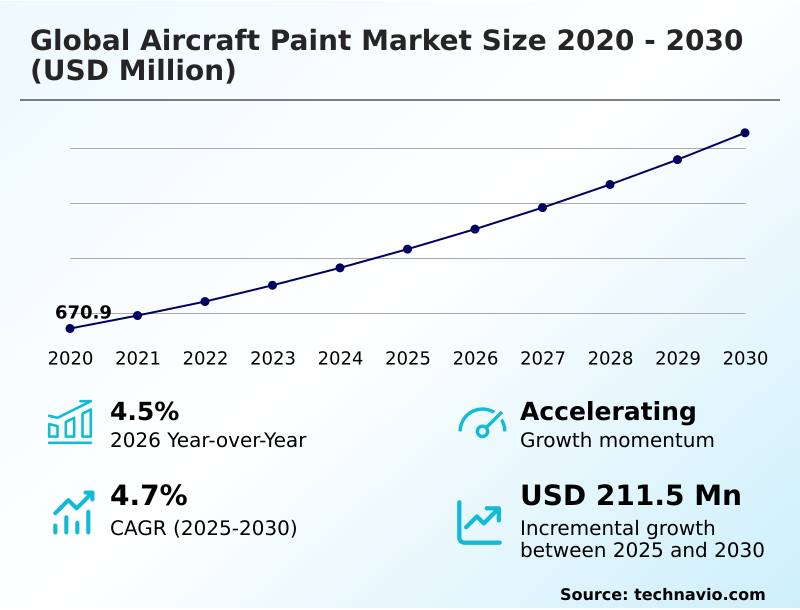
The aircraft paint market size is valued to increase by USD 211.5 million, at a CAGR of 4.7% from 2025 to 2030. Sustained expansion of global aircraft fleet and robust MRO activity will drive the aircraft paint market.
Major Market Trends & Insights
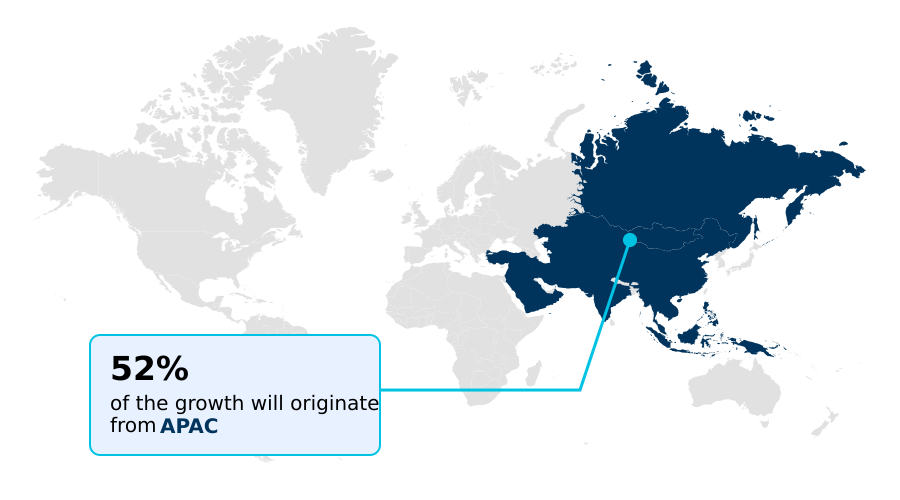
- APAC dominated the market and accounted for a 52% growth during the forecast period.
- By End-user - Commercial segment was valued at USD 446.2 million in 2024
- By Type - Liquid coating segment accounted for the largest market revenue share in 2024
Market Size & Forecast
- Market Opportunities: USD 355.8 million
- Market Future Opportunities: USD 211.5 million
- CAGR from 2025 to 2030 : 4.7%
Market Summary
- The aircraft paint market is defined by a critical balance between high-performance protection and stringent regulatory adherence. Growth is propelled by the dual demand streams of new aircraft production and the non-discretionary maintenance, repair, and overhaul (MRO) sector.
- For every new aircraft, a complex exterior livery system is required, while the existing global fleet undergoes a regular aircraft refinishing cycle to ensure airframe corrosion control and exterior durability. A significant trend is the industry-wide pivot toward sustainable aviation coatings, with heavy investment in low-VOC formulation and chromate-free primer technologies to meet environmental mandates without compromising performance.
- For instance, an MRO facility evaluating a new waterborne basecoat must validate that its gloss and color retention and intercoat adhesion testing results are comparable to legacy systems. This process is complicated by the lengthy and expensive aerospace coating qualification required for any new paint formulation chemistry.
- Navigating these technical and regulatory hurdles while delivering lightweight paint technology that enhances fuel efficiency remains the central dynamic for market participants.
What will be the Size of the Aircraft Paint Market during the forecast period?
Get Key Insights on Market Forecast (PDF) Request Free Sample
How is the Aircraft Paint Market Segmented?
The aircraft paint industry research report provides comprehensive data (region-wise segment analysis), with forecasts and estimates in "USD million" for the period 2026-2030, as well as historical data from 2020-2024 for the following segments.
- End-user
- Commercial
- Military
- General aviation
- Type
- Liquid coating
- Powder coating
- Special coatings
- Application
- Exterior paint
- Interior paint
- Geography
- APAC
- China
- Japan
- India
- Europe
- Germany
- UK
- France
- North America
- US
- Canada
- Mexico
- Middle East and Africa
- Saudi Arabia
- UAE
- South Africa
- South America
- Brazil
- Argentina
- Rest of World (ROW)
- APAC
By End-user Insights
The commercial segment is estimated to witness significant growth during the forecast period.
The commercial aviation sector remains the dominant end-user, driven by relentless demand from both new aircraft manufacturing and rigorous maintenance schedules. Coatings must satisfy stringent OEM coating specifications while providing flawless brand aesthetics.
The focus is on advanced aviation coating solutions that offer long-term performance.
For instance, the use of a high-performance chromate-free primer and polyurethane topcoat system can extend the time between repainting, reducing an aircraft's time out of service by up to 15%.
This dual demand from production lines and MRO paint application creates a resilient market, where innovations in low-VOC formulation and aerodynamic surface coating are critical for gaining a competitive edge in developing comprehensive aerospace finishing systems and lightweight paint technology.
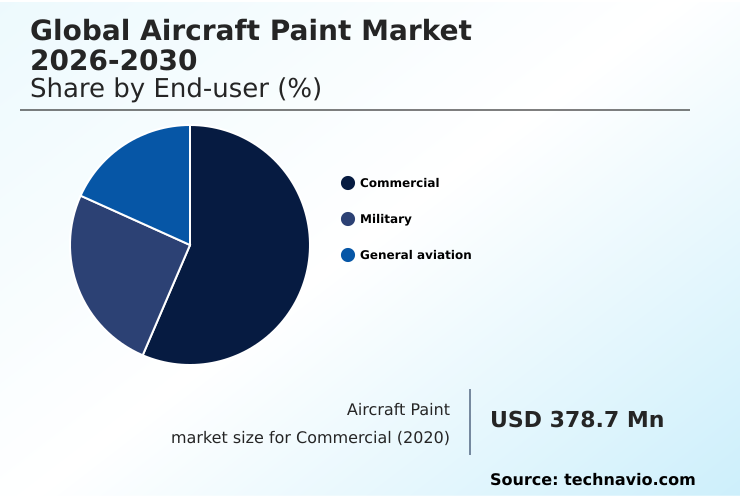
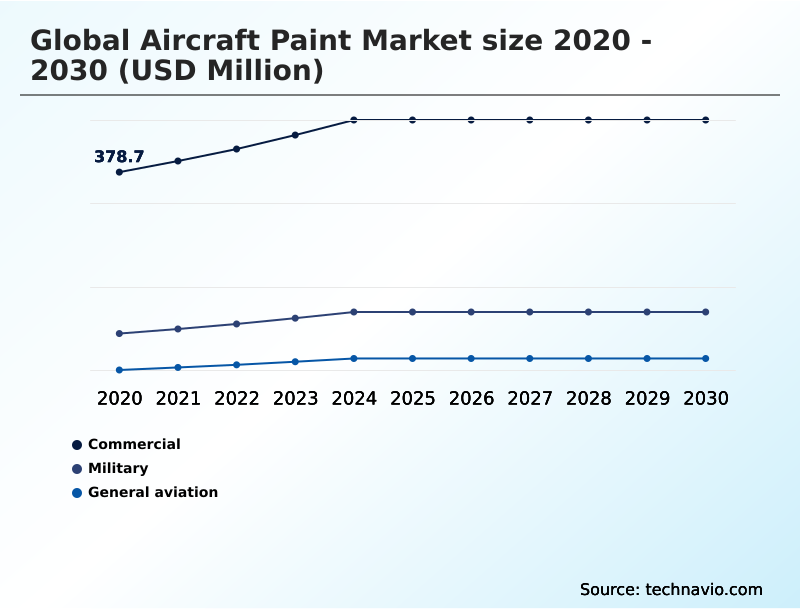
The Commercial segment was valued at USD 446.2 million in 2024 and showed a gradual increase during the forecast period.
Regional Analysis
APAC is estimated to contribute 52% to the growth of the global market during the forecast period.Technavio’s analysts have elaborately explained the regional trends and drivers that shape the market during the forecast period.
See How Aircraft Paint Market Demand is Rising in APAC Request Free Sample
The geographic landscape of the market is experiencing a significant shift, with APAC emerging as the primary growth engine, expanding at a rate of 5.1%, notably faster than the 3.9% growth in the mature European market.
This expansion is driven by massive fleet growth in countries like China and India and the establishment of major MRO hubs. North America remains a substantial market due to its large existing fleet and robust defense sector.
Suppliers are focused on improving coating application efficiency and achieving precise dry film thickness measurement to serve these diverse regions. Ensuring consistent gloss and color retention and passing intercoat adhesion testing are critical for aerospace coating qualification globally.
Success depends on delivering advanced surface protection with long-lasting topcoats and high-temperature engine coatings that meet varied regional standards for paint formulation chemistry and chemical agent resistant coatings.
Market Dynamics
Our researchers analyzed the data with 2025 as the base year, along with the key drivers, trends, and challenges. A holistic analysis of drivers will help companies refine their marketing strategies to gain a competitive advantage.
- Strategic decision-making in the aircraft coatings sector involves a complex evaluation of interconnected factors, extending from the production line to in-service maintenance. Aerospace engineers are tasked with understanding the full impact of lightweight paint technology on fuel efficiency while simultaneously navigating the challenges of switching to sustainable aviation coatings.
- A key part of this is assessing the advantages of chromate-free primers in aviation, particularly for new aluminum airframes. The qualification process for OEM coating specifications is rigorous, demanding thorough testing protocols for hydraulic fluid resistant paint and other materials. In the MRO environment, the focus shifts to operational excellence.
- Managers seek methods for improving coating application efficiency and reducing paint cure time in MRO operations. This includes implementing best practices for applying polyurethane topcoat and optimizing the aircraft paint stripping process, especially when dealing with advanced composite substrates.
- A successful transition to newer technologies, such as comparing waterborne basecoat and solvent-borne systems, requires a comprehensive cost-benefit analysis of drag reduction coatings. Furthermore, achieving consistent dry film thickness measurement is crucial for both performance and compliance with regulations for low-VOC formulation in aerospace.
- This holistic approach ensures that advancements in aerodynamic surface coating technology and innovations in chemical agent resistant coatings deliver both enhanced aircraft performance and extended exterior durability, from thermal barrier coating for engine components to the final livery.
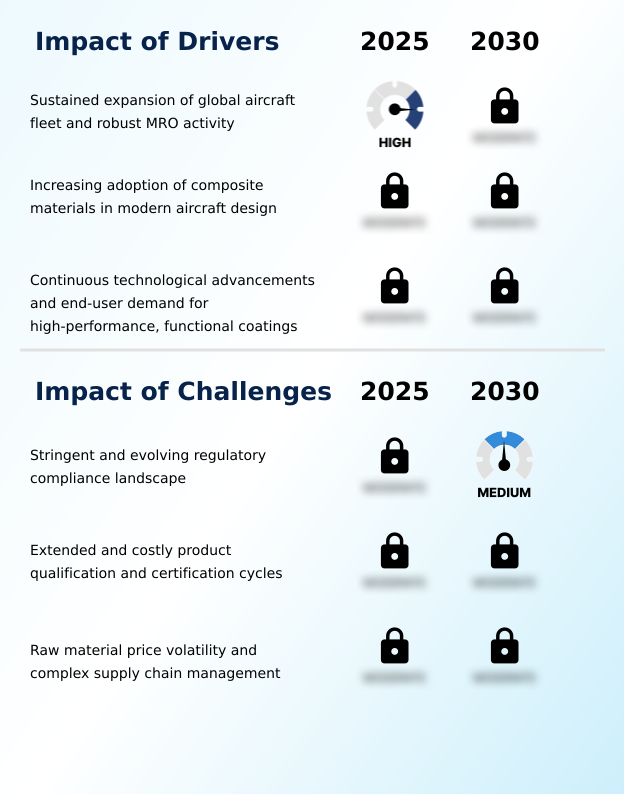
What are the key market drivers leading to the rise in the adoption of Aircraft Paint Industry?
- The sustained expansion of the global aircraft fleet, combined with robust and cyclical maintenance, repair, and overhaul activity, serves as the primary driver for market growth.
- Market growth is fundamentally driven by the relentless expansion of the global aircraft fleet and the non-discretionary nature of MRO activities.
- The demand for new aircraft translates directly into consumption of OEM-specified exterior livery system products, with a single wide-body aircraft requiring hundreds of gallons of regulatory compliant paint.
- The aftermarket is equally robust, as the global in-service fleet of tens of thousands of aircraft requires a complete repaint every 5 to 10 years to maintain aircraft exterior durability and structural integrity.
- This creates a consistent demand for specialized functional coatings, ranging from flexible wing coating for aerodynamic surfaces to thermal barrier coating for engine components. The need for high-quality cabin interior finishes and durable military aircraft coatings further diversifies demand.
- This dual-stream requirement for both new builds and maintenance, involving products like erosion resistant coating and structural adhesive primer, ensures a resilient and predictable growth trajectory.
What are the market trends shaping the Aircraft Paint Industry?
- The market is witnessing a fundamental shift toward eco-efficient and sustainable coating systems, a movement driven by stringent global regulations and a heightened focus on lifecycle costs.
- A defining trend is the industry-wide pivot toward sustainable aviation coatings, driven by regulatory pressure and operational efficiency goals. This shift is accelerating the adoption of technologies such as waterborne basecoat and high-solids coatings, which significantly lower VOC emissions. Waterborne systems now achieve VOC levels below 250 g/L, a reduction of over 50% from traditional solvent-based paints.
- The development of drag reduction coatings, which can improve fuel efficiency by up to 2%, is another key innovation. The goal is to extend the aircraft refinishing cycle through more durable formulations, including advanced UV resistant clearcoat options that prevent degradation.
- This focus on sustainability is also compelling innovation in ablative coating and anti-static coating technologies, enhancing both safety and performance while prioritizing airframe corrosion control and compatibility with composite substrate coating techniques.
What challenges does the Aircraft Paint Industry face during its growth?
- The stringent and continuously evolving regulatory compliance landscape governing chemical composition and emissions presents a key challenge to the aircraft paint industry.
- A formidable challenge is the intricate and costly process of developing and qualifying new coating technologies amidst a stringent regulatory environment. The transition to eco-efficient coatings, while necessary, forces significant R&D investment to create high-performance alternatives.
- For instance, the qualification for a new fuel tank coating or hydraulic fluid resistant paint can take over five years and thousands of testing hours to complete. Developing a deicing fluid resistant coating that also meets new environmental standards can increase a product line's R&D budget by over 25%.
- These complexities impact the entire supply chain, from the paint stripping process and surface preparation techniques to final application. The need to balance performance in commercial airline livery and general aviation paint schemes with compliance makes paint cure time reduction and the integration of robotic paint application critical but challenging goals.
Exclusive Technavio Analysis on Customer Landscape
The aircraft paint market forecasting report includes the adoption lifecycle of the market, covering from the innovator’s stage to the laggard’s stage. It focuses on adoption rates in different regions based on penetration. Furthermore, the aircraft paint market report also includes key purchase criteria and drivers of price sensitivity to help companies evaluate and develop their market growth analysis strategies.
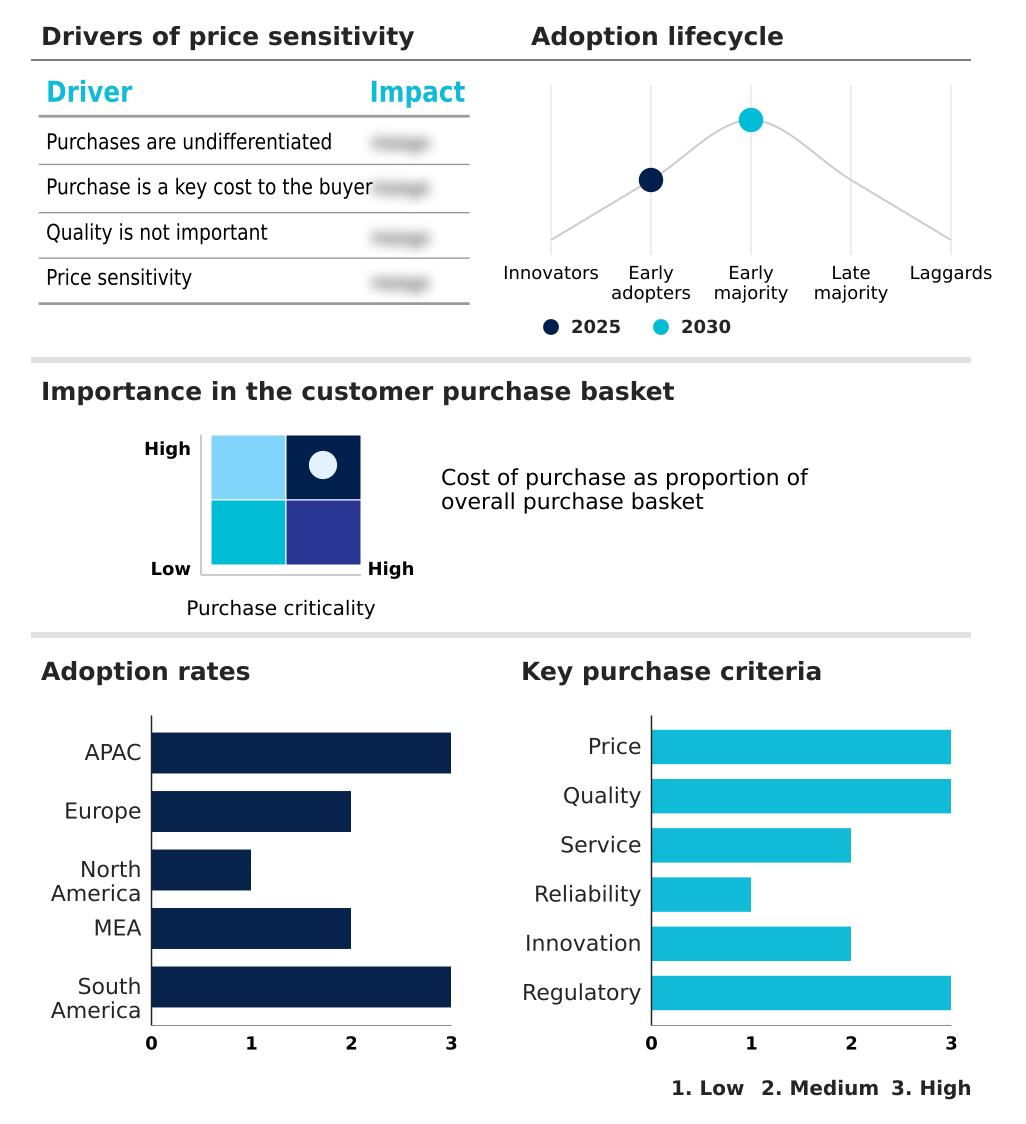
Customer Landscape of Aircraft Paint Industry
Competitive Landscape
Companies are implementing various strategies, such as strategic alliances, aircraft paint market forecast, partnerships, mergers and acquisitions, geographical expansion, and product/service launches, to enhance their presence in the industry.
3M Co. - Offerings include advanced aviation coating solutions and aerospace finishing systems, from lightweight paint technology to specialized functional coatings for extreme operational demands.
The industry research and growth report includes detailed analyses of the competitive landscape of the market and information about key companies, including:
- 3M Co.
- Akzo Nobel NV
- APS Materials Inc.
- APV Engineered Coatings LLC
- Axalta Coating Systems Ltd.
- BASF SE
- Chromalloy Gas Turbine LLC
- DuPont de Nemours Inc.
- Henkel AG and Co. KGaA
- Hentzen Coatings Inc.
- Hisco Inc.
- Indestructible Paint Ltd.
- Ionbond
- Linde Plc
- Mankiewicz Gebr. and Co.
- OC Oerlikon Corp.
- PPG Industries Inc.
- The Sherwin Williams Co.
- Walter Wurdack Inc.
Qualitative and quantitative analysis of companies has been conducted to help clients understand the wider business environment as well as the strengths and weaknesses of key industry players. Data is qualitatively analyzed to categorize companies as pure play, category-focused, industry-focused, and diversified; it is quantitatively analyzed to categorize companies as dominant, leading, strong, tentative, and weak.
Recent Development and News in Aircraft paint market
- In May, 2025, PPG announced a USD 380 million investment to construct a new manufacturing facility in Shelby, North Carolina, dedicated to producing aerospace coatings and sealants, with construction scheduled to begin in October 2025.
- In January, 2025, private jet operator flyExclusive was recognized in the annual Sherwin-Williams Aerospace Coatings calendar, highlighting the exceptional custom paint schemes on its Hawker 800XP and Beechcraft 350 aircraft.
- In December, 2024, Japan Airlines began deploying a new riblet-shaped, drag-reducing coating on its Boeing 787 fleet, a technology designed to manage airflow and improve overall fuel efficiency.
- In November, 2024, AkzoNobel highlighted its deepening collaboration with China's aerospace sector by announcing it had set a new record for color use and application on the COMAC C919 aircraft.
Dive into Technavio’s robust research methodology, blending expert interviews, extensive data synthesis, and validated models for unparalleled Aircraft Paint Market insights. See full methodology.
| Market Scope | |
|---|---|
| Page number | 293 |
| Base year | 2025 |
| Historic period | 2020-2024 |
| Forecast period | 2026-2030 |
| Growth momentum & CAGR | Accelerate at a CAGR of 4.7% |
| Market growth 2026-2030 | USD 211.5 million |
| Market structure | Fragmented |
| YoY growth 2025-2026(%) | 4.5% |
| Key countries | China, Japan, India, South Korea, Australia, Indonesia, Germany, UK, France, Italy, Spain, The Netherlands, US, Canada, Mexico, Saudi Arabia, UAE, South Africa, Israel, Turkey, Brazil, Argentina and Chile |
| Competitive landscape | Leading Companies, Market Positioning of Companies, Competitive Strategies, and Industry Risks |
Research Analyst Overview
- The aircraft paint market is characterized by continuous technological evolution, where innovation is driven by the dual demands of operational performance and environmental compliance. The development of advanced coating systems, from a foundational corrosion-inhibiting primer to a final UV resistant clearcoat, is a complex process. Key advancements are seen in low-VOC formulation and high-solids coatings, designed to meet stringent regulations.
- For boardroom consideration, the adoption of a superior exterior livery system with extended durability can reduce repainting cycles, decreasing aircraft-on-ground time by as much as 15% over an asset's lifespan. This directly impacts operational budgets and asset availability.
- The industry is pushing the boundaries with materials like flexible wing coating and thermal barrier coating, while ensuring core performance metrics such as intercoat adhesion testing and gloss and color retention are met. The transition to chromate-free primer and the optimization of the paint stripping process through new surface preparation techniques are central to modernizing operations.
- Success hinges on mastering coating application efficiency and precise dry film thickness measurement for every layer, including specialized products like fuel tank coating, anti-static coating, and hydraulic fluid resistant paint, ensuring comprehensive advanced surface protection.
What are the Key Data Covered in this Aircraft Paint Market Research and Growth Report?
-
What is the expected growth of the Aircraft Paint Market between 2026 and 2030?
-
USD 211.5 million, at a CAGR of 4.7%
-
-
What segmentation does the market report cover?
-
The report is segmented by End-user (Commercial, Military, and General aviation), Type (Liquid coating, Powder coating, and Special coatings), Application (Exterior paint, and Interior paint) and Geography (APAC, Europe, North America, Middle East and Africa, South America)
-
-
Which regions are analyzed in the report?
-
APAC, Europe, North America, Middle East and Africa and South America
-
-
What are the key growth drivers and market challenges?
-
Sustained expansion of global aircraft fleet and robust MRO activity, Stringent and evolving regulatory compliance landscape
-
-
Who are the major players in the Aircraft Paint Market?
-
3M Co., Akzo Nobel NV, APS Materials Inc., APV Engineered Coatings LLC, Axalta Coating Systems Ltd., BASF SE, Chromalloy Gas Turbine LLC, DuPont de Nemours Inc., Henkel AG and Co. KGaA, Hentzen Coatings Inc., Hisco Inc., Indestructible Paint Ltd., Ionbond, Linde Plc, Mankiewicz Gebr. and Co., OC Oerlikon Corp., PPG Industries Inc., The Sherwin Williams Co. and Walter Wurdack Inc.
-
Market Research Insights
- Market dynamics are shaped by the tension between performance innovation and regulatory constraints. The push for eco-efficient coatings has spurred significant R&D in sustainable aviation coatings and long-lasting topcoats. For example, advanced lightweight paint technology can reduce an aircraft's total weight by over 200 pounds, directly contributing to a fuel efficiency gain of nearly 1%.
- Simultaneously, the adoption of robotic paint application in MRO paint application settings has improved transfer efficiency by over 20%, reducing material waste and ensuring consistent quality. This pursuit of operational gains is balanced by the need for regulatory compliant paint, where specialized functional coatings must meet strict OEM coating specifications.
- The industry's evolution is marked by these competing priorities, driving the development of advanced aviation coating solutions that are both high-performing and environmentally responsible.
We can help! Our analysts can customize this aircraft paint market research report to meet your requirements.