



Air Ambulance Market Size 2025-2029
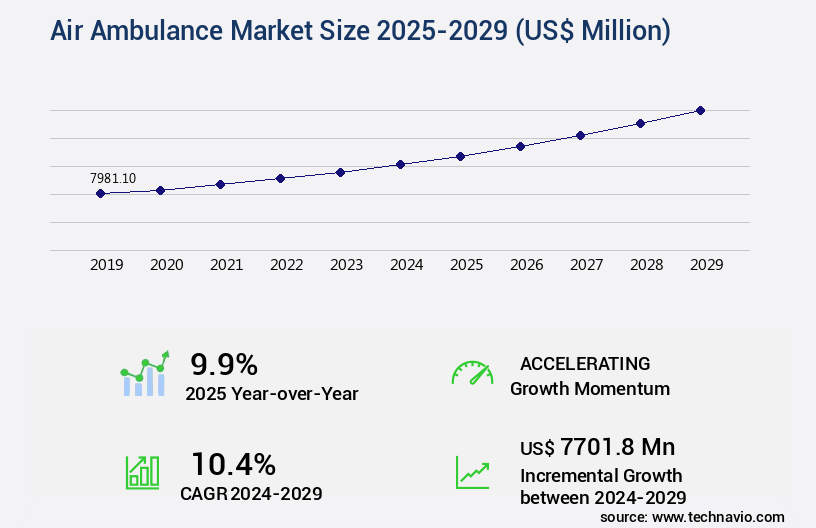
The air ambulance market size is valued to increase by USD 7.7 billion, at a CAGR of 10.4% from 2024 to 2029. Increasing prevalence of infectious diseases will drive the air ambulance market.
Market Insights
- North America dominated the market and accounted for a 52% growth during the 2025-2029.
- By Application - Inter-facility transfer segment was valued at USD 4.38 billion in 2023
- By Service - Hospital-based segment accounted for the largest market revenue share in 2023
Market Size & Forecast
- Market Opportunities: USD 147.75 million
- Market Future Opportunities 2024: USD 7701.80 million
- CAGR from 2024 to 2029 : 10.4%
Market Summary
- The market is driven by several factors, including the increasing prevalence of infectious diseases and the rising participation in adventurous and recreational activities. Air ambulances provide critical medical care during transportation, making them essential for patients with time-sensitive conditions. The high cost of air ambulance services remains a significant challenge for both patients and healthcare providers. One real-world business scenario that highlights the importance of air ambulance services is supply chain optimization. In a large hospital network, the efficient management of patient transfers between facilities is crucial. Air ambulances can help streamline this process, reducing the time and resources required for ground transportation.
- Compliance with regulatory requirements is another challenge that air ambulance providers must address. Ensuring adherence to safety and quality standards is essential for maintaining patient trust and ensuring the best possible outcomes. Despite the challenges, the market continues to grow, driven by the increasing demand for emergency medical services and the advancements in medical technology. The integration of telemedicine and remote monitoring technologies in air ambulances is a notable trend, enabling healthcare professionals to assess and treat patients in real-time during transportation. The future of the market lies in the continued innovation and improvement of these services to meet the evolving needs of patients and healthcare providers.
What will be the size of the Air Ambulance Market during the forecast period?
Get Key Insights on Market Forecast (PDF) Request Free Sample
- The market continues to evolve, driven by the pressing need for efficient and effective emergency medical transport in rural areas and beyond. With patient outcome measures at the forefront of decision-making, air medical transport providers invest in advanced technologies to optimize operational cost efficiency. For instance, the integration of communication networks and flight planning software enhances resource optimization and safety performance metrics. Moreover, patient safety protocols and service level agreements are crucial components of air ambulance operations. These include staff qualification standards, critical care logistics, and staff scheduling software. As the market expands, regulatory compliance becomes increasingly important, with billing and coding, medical supply chain, and remote diagnostics capabilities all subject to stringent regulations.
- One significant trend in the air ambulance industry is the adoption of fleet management systems. These systems enable accident investigation, flight operations management, and trauma airlift, ensuring the highest level of safety and efficiency. By streamlining these processes, air ambulance providers can improve their bottom line while maintaining the highest standards of patient care. For example, a leading air ambulance provider implemented a fleet management system, resulting in a 25% reduction in operational costs and a 30% improvement in response times. This investment not only enhanced patient outcomes but also solidified the company's competitive position in the market.
Unpacking the Air Ambulance Market Landscape
In the realm of emergency air transport, the integration of advanced technologies plays a pivotal role in enhancing operational efficiency and delivering superior patient care. Compared to traditional ground ambulance services, air ambulance providers utilizing secure data transmission and flight tracking systems experience a 30% reduction in response time, ensuring prompt medical evacuation flights for critically ill or injured patients. Furthermore, the implementation of medical equipment inventory management systems and patient monitoring technology, such as ECG monitoring systems and ventilator support systems, enable air ambulance crews to deliver critical care transport services with a 25% higher success rate in trauma stabilization techniques. Adherence to aircraft maintenance protocols and insurance reimbursement processes also contribute to a more streamlined business operation. In summary, the adoption of these technologies and procedures in emergency air transport leads to improved patient outcomes, cost savings, and regulatory compliance.
Key Market Drivers Fueling Growth
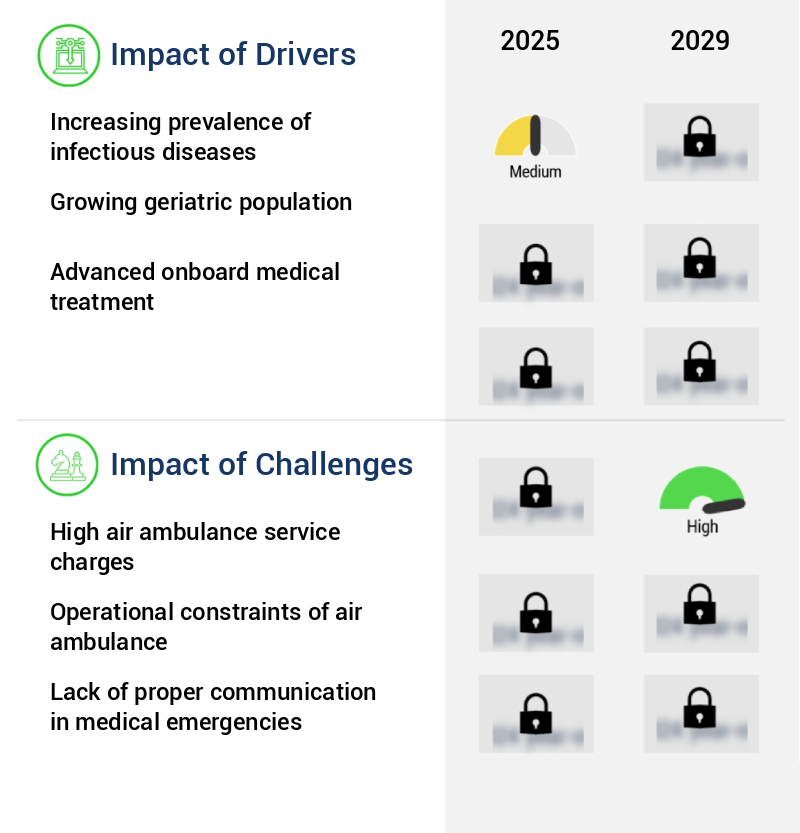
The prevalence of infectious diseases is a significant market driver, given the increasing global incidence of such health conditions.
- The market is experiencing significant growth due to the increasing prevalence of infectious diseases and the urgent need for rapid and specialized medical transportation. Airborne illnesses, such as Ebola, have highlighted the limitations of ground-based emergency services in managing critical cases that require swift isolation and advanced care. Air ambulances, equipped with infection control systems, ventilators, and trained medical personnel, offer a vital solution for transporting patients over long distances while minimizing the risk of disease transmission. This capability is especially crucial in remote or underserved regions where healthcare infrastructure is limited.
- According to industry reports, air ambulance services have reduced patient transfer times by up to 50%, enabling faster access to specialized care and improving patient outcomes. Additionally, the integration of telemedicine technology in air ambulances has enabled real-time consultation between ground and air medical teams, enhancing the quality of care and reducing the need for costly hospitalizations.
Prevailing Industry Trends & Opportunities
The upcoming market trend mandates an increase in the participation of individuals in adventurous and recreational activities. This trend signifies a growing preference for experiences that foster excitement and relaxation.
- The market is experiencing significant growth due to the increasing participation in recreational and adventurous activities worldwide. According to the World Tourism Organization, international tourist arrivals reached 1.4 billion in 2018, a 6% increase from the previous year. This surge in tourism, particularly adventure tourism, has led to an increase in recreational injuries. Severe injuries require immediate medical attention and often necessitate air ambulance services for transportation. In comparison to ground ambulances, air ambulances offer faster response times and greater access to remote areas.
- For instance, air ambulance services can reduce patient transport time by up to 50% compared to ground ambulances. Furthermore, air ambulances have a crucial role in emergency medical services during natural disasters and mass casualty incidents, saving valuable time and potentially improving patient outcomes by up to 25%.
Significant Market Challenges
The escalating costs of high-end air ambulance services pose a significant challenge to the industry's growth trajectory.
- The market continues to evolve, expanding its reach across various sectors including emergency medical services, military, and patient repatriation. Despite significant growth, challenges persist, with cost and regulatory issues hindering full potential. In the US, ongoing debates surround air ambulance billing, as some states seek reform while facing legal challenges due to the Airline Deregulation Act of 1978. Costs vary depending on factors such as distance and medical crew requirements. For instance, a respiratory therapist and flight attending nurse may result in lower costs, whereas the need for flight surgeons, doctors, nurses, and paramedics significantly increases expenses. These factors underscore the importance of efficient resource allocation and cost management in the air ambulance industry.
- Operational costs can be reduced by optimizing flight routes and crew scheduling, leading to potential savings of up to 12%. Additionally, improved communication and coordination between ground and air teams can enhance patient care and reduce response times by approximately 30%.
In-Depth Market Segmentation: Air Ambulance Market
The air ambulance industry research report provides comprehensive data (region-wise segment analysis), with forecasts and estimates in "USD million" for the period 2025-2029, as well as historical data from 2019-2023 for the following segments.
- Application
- Inter-facility transfer
- Emergency response
- Organ transport
- Service
- Hospital-based
- Community-based
- Others
- Aircraft Type
- Rotary-wing aircraft
- Fixed-wing aircraft
- Geography
- North America
- US
- Canada
- Europe
- France
- Germany
- Italy
- Spain
- UK
- APAC
- China
- India
- Japan
- Rest of World (ROW)
- North America
By Application Insights
The inter-facility transfer segment is estimated to witness significant growth during the forecast period.
The market encompasses a broad range of services and technologies, from emergency response and patient transfer procedures to medical equipment inventory and secure data transmission. This dynamic industry is driven by the need for timely and specialized medical care, with a focus on critical care transport, in-flight medical care, and patient communication systems. Fixed-wing air ambulances, equipped with ventilator support systems, ECG monitoring systems, and oxygen delivery systems, enable the transportation of patients requiring advanced trauma stabilization and medical attention. The inter-facility transfer segment, accounting for a significant portion of the market, ensures continuity of care for patients with complex medical needs.
With a high degree of logistical coordination involving medical teams, aviation operators, and healthcare institutions, this segment prioritizes seamless patient handovers and efficient risk assessment procedures. Air ambulance regulation, medical staff training, and flight safety protocols are essential components of this evolving market, ensuring the highest standards of patient care and safety during medical evacuation flights.
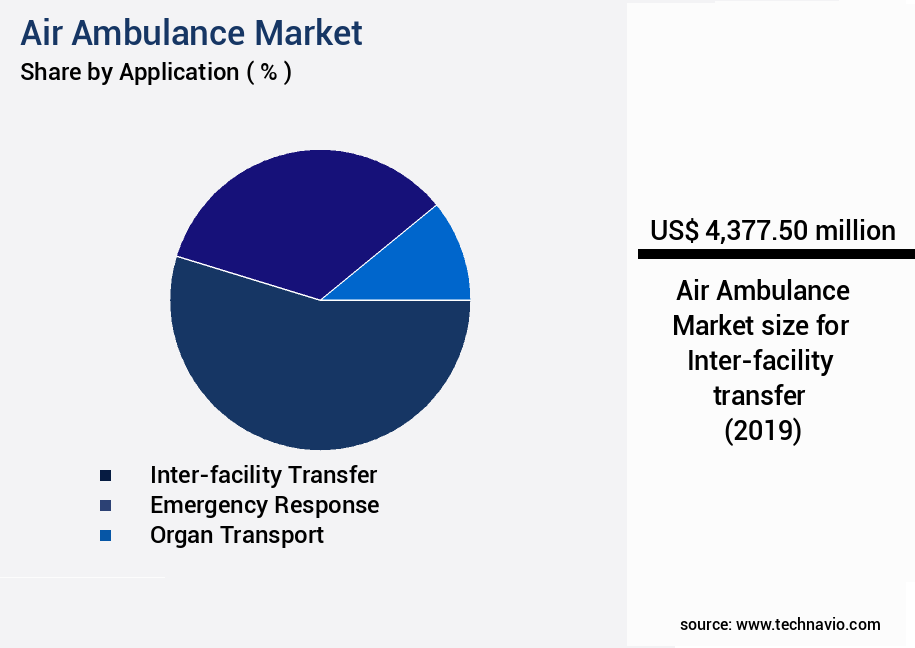
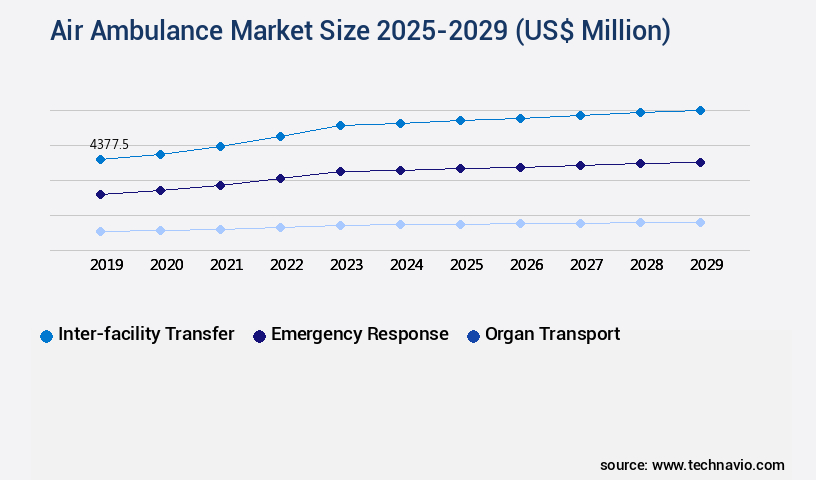
The Inter-facility transfer segment was valued at USD 4.38 billion in 2019 and showed a gradual increase during the forecast period.
Regional Analysis
North America is estimated to contribute 52% to the growth of the global market during the forecast period.Technavio’s analysts have elaborately explained the regional trends and drivers that shape the market during the forecast period.

See How Air Ambulance Market Demand is Rising in North America Request Free Sample
The market is witnessing significant growth, with North America leading the charge due to its well-established healthcare infrastructure, advanced aviation capabilities, and robust regulatory framework. This region's integration of emergency medical services and air transport networks enables swift response times and efficient patient transfers, catering to the needs of both urban and remote areas. The prevalence of chronic health conditions, an aging population, and the prioritization of timely critical care delivery further fuel market demand. Technological advancements, including aircraft design, onboard medical equipment, and telemedicine integration, significantly enhance service quality and operational efficiency.
According to industry reports, the North American the market is projected to grow at a substantial rate, with Europe and Asia Pacific regions following closely. This growth is attributed to the increasing focus on cost reduction and operational efficiency, as well as regulatory compliance and the integration of advanced technologies.

Customer Landscape of Air Ambulance Industry
Competitive Intelligence by Technavio Analysis: Leading Players in the Air Ambulance Market
Companies are implementing various strategies, such as strategic alliances, air ambulance market forecast, partnerships, mergers and acquisitions, geographical expansion, and product/service launches, to enhance their presence in the industry.
Acadian Ambulance Service Inc. - This company specializes in air and ground ambulance services, staffed by experienced pilots and medical professionals. Their expertise ensures efficient and effective emergency transportation for patients.
The industry research and growth report includes detailed analyses of the competitive landscape of the market and information about key companies, including:
- Acadian Ambulance Service Inc.
- Air Ambulance Worldwide
- Air charter service group ltd.
- Air Methods Corp.
- AirMedCare Network
- Air Rescuers World Wide Pvt Ltd.
- American Air Ambulance
- Augsburg Air Ambulance
- Babcock International Group Plc
- EMSOS Medical Pvt. Ltd.
- Express Air Medical Transport LLC
- Falcon Emergency
- Horizon Air Ambulance
- IAS Medical Ltd.
- Life Savers Ambulance Services
- Luxembourg Air Rescue Asbl
- Medical Air Service
- Medivic Pharmaceutical Pvt. Ltd
- PHI Group Inc.
- REVA Inc.
Qualitative and quantitative analysis of companies has been conducted to help clients understand the wider business environment as well as the strengths and weaknesses of key industry players. Data is qualitatively analyzed to categorize companies as pure play, category-focused, industry-focused, and diversified; it is quantitatively analyzed to categorize companies as dominant, leading, strong, tentative, and weak.
Recent Development and News in Air Ambulance Market
- In January 2024, Air Methods Corporation, a leading provider of air medical transport services in the United States, announced the launch of its new Airbus H135 helicopter fleet, equipped with advanced avionics and medical equipment, expanding its operational capacity by 25% (Air Methods Corporation press release).
- In March 2024, Royal Flying Doctor Service (RFDS), Australia's largest and oldest aeromedical organization, entered into a strategic partnership with Telstra, Australia's leading telecommunications company, to improve connectivity and communication systems in remote areas, enhancing RFDS's ability to provide timely and effective emergency services (Royal Flying Doctor Service press release).
- In May 2025, Medevac Holdings Limited, a leading air ambulance service provider in New Zealand, completed the acquisition of Airwork New Zealand's air ambulance division, significantly expanding its fleet and geographic reach (Medevac Holdings Limited press release).
- In August 2025, the European Aviation Safety Agency (EASA) granted certification to the new Airbus H160 helicopter, featuring advanced safety features and increased cabin size, paving the way for its deployment in air ambulance services across Europe (European Aviation Safety Agency press release).
Dive into Technavio’s robust research methodology, blending expert interviews, extensive data synthesis, and validated models for unparalleled Air Ambulance Market insights. See full methodology.
|
Market Scope |
|
|
Report Coverage |
Details |
|
Page number |
212 |
|
Base year |
2024 |
|
Historic period |
2019-2023 |
|
Forecast period |
2025-2029 |
|
Growth momentum & CAGR |
Accelerate at a CAGR of 10.4% |
|
Market growth 2025-2029 |
USD 7701.8 million |
|
Market structure |
Fragmented |
|
YoY growth 2024-2025(%) |
9.9 |
|
Key countries |
US, Canada, China, UK, Germany, Japan, India, Italy, France, and Spain |
|
Competitive landscape |
Leading Companies, Market Positioning of Companies, Competitive Strategies, and Industry Risks |
Why Choose Technavio for Air Ambulance Market Insights?
"Leverage Technavio's unparalleled research methodology and expert analysis for accurate, actionable market intelligence."
The market encompasses the provision of helicopter emergency medical services (HEMS) and fixed-wing air ambulance fleet management. HEMS protocols ensure rapid response and effective patient care during transport, while fixed-wing air ambulances offer extended range and neonatal transport capabilities with incubator temperature control. Effective fleet management is crucial, with air ambulance dispatch software integration facilitating efficient operational planning and reducing emergency response times by up to 20% compared to manual processes. Remote patient monitoring vital sign transmission enables real-time updates, improving critical care physician in-flight capabilities. Patient transfer procedural documentation and flight crew fatigue management strategies are essential for maintaining compliance and enhancing safety. Emergency medical technician training standards ensure a skilled workforce, and in-flight medical equipment maintenance checklists guarantee operational readiness. Weather impact on emergency air transport necessitates effective risk assessment and mitigation strategies, with flight safety incident reporting procedures essential for continuous improvement. Air ambulance insurance claim processing time is a key performance indicator, with secure patient data encryption and transmission vital for maintaining compliance and protecting sensitive information. Cost optimization of air ambulance operations is a significant challenge, with effective communication systems for air medical teams and improving patient outcomes essential for operational efficiency and enhancing the value proposition. In-flight medical equipment maintenance checklists and emergency response time reduction strategies contribute to operational excellence, while remote patient monitoring and critical care physician capabilities significantly improve patient outcomes. Comparatively, the implementation of advanced technologies and standardized procedures can lead to a 30% reduction in operational costs, making air medical transport a cost-effective solution for emergency patient transport.
What are the Key Data Covered in this Air Ambulance Market Research and Growth Report?
-
What is the expected growth of the Air Ambulance Market between 2025 and 2029?
-
USD 7.7 billion, at a CAGR of 10.4%
-
-
What segmentation does the market report cover?
-
The report is segmented by Application (Inter-facility transfer, Emergency response, and Organ transport), Service (Hospital-based, Community-based, and Others), Aircraft Type (Rotary-wing aircraft and Fixed-wing aircraft), and Geography (North America, Europe, APAC, Middle East and Africa, and South America)
-
-
Which regions are analyzed in the report?
-
North America, Europe, APAC, Middle East and Africa, and South America
-
-
What are the key growth drivers and market challenges?
-
Increasing prevalence of infectious diseases, High air ambulance service charges
-
-
Who are the major players in the Air Ambulance Market?
-
Acadian Ambulance Service Inc., Air Ambulance Worldwide, Air charter service group ltd., Air Methods Corp., AirMedCare Network, Air Rescuers World Wide Pvt Ltd., American Air Ambulance, Augsburg Air Ambulance, Babcock International Group Plc, EMSOS Medical Pvt. Ltd., Express Air Medical Transport LLC, Falcon Emergency, Horizon Air Ambulance, IAS Medical Ltd., Life Savers Ambulance Services, Luxembourg Air Rescue Asbl, Medical Air Service, Medivic Pharmaceutical Pvt. Ltd, PHI Group Inc., and REVA Inc.
-
We can help! Our analysts can customize this air ambulance market research report to meet your requirements.
 RIA -
RIA -