


AI Voice Recognition Market Analysis, Size, and Forecast 2025-2029: North America (US and Canada), Europe (France, Germany, and UK), APAC (China, India, Japan, and South Korea), South America (Brazil), and Rest of World (ROW)

AI Voice Recognition Market Analysis, Size, and Forecast 2025-2029:
North America (US and Canada), Europe (France, Germany, and UK), APAC (China, India, Japan, and South Korea), South America (Brazil), and Rest of World (ROW)

Published: Aug 2025 234 Pages SKU: IRTNTR80940

Market Overview at a Glance

$14.06 B
Market Opportunity
29.3%
CAGR
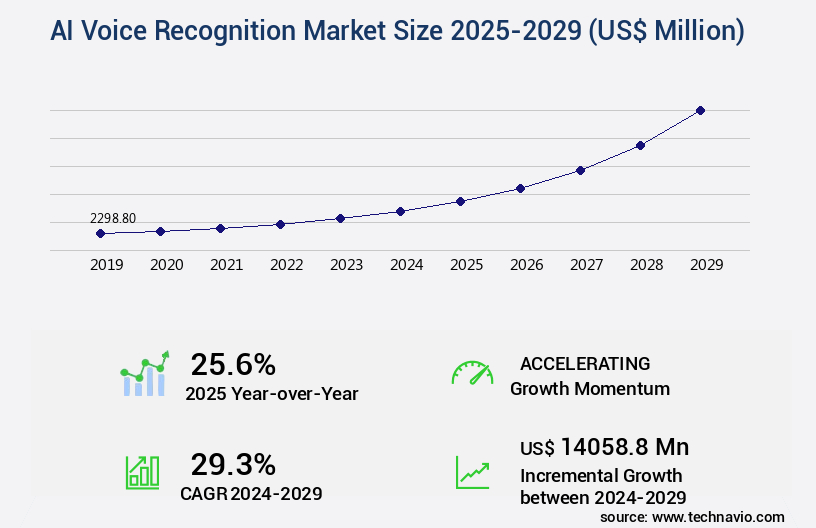
25.6
YoY growth 2024-2025(%)

AI Voice Recognition Market Size 2025-2029

The ai voice recognition market size is valued to increase by USD 14.06 billion, at a CAGR of 29.3% from 2024 to 2029. Advancements in AI, machine learning, and natural language processing will drive the ai voice recognition market.

Market Insights

  • North America dominated the market and accounted for a 37% growth during the 2025-2029.
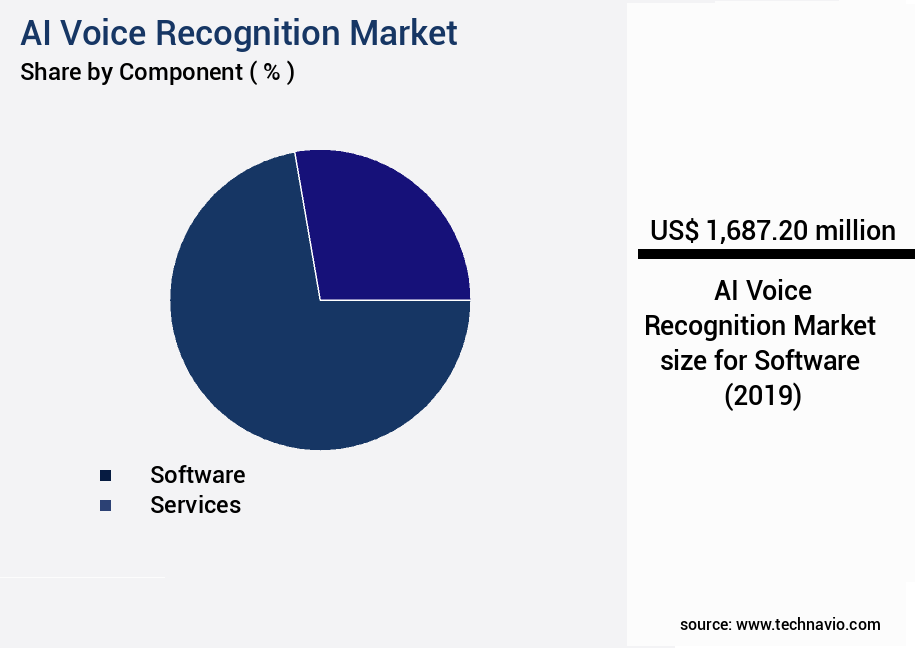
  • By Component - Software segment was valued at USD 1.69 billion in 2023
  • By Application - Voice search segment accounted for the largest market revenue share in 2023

Market Size & Forecast

  • Market Opportunities: USD 745.62 million 
  • Market Future Opportunities 2024: USD 14058.80 million
  • CAGR from 2024 to 2029 : 29.3%

Market Summary

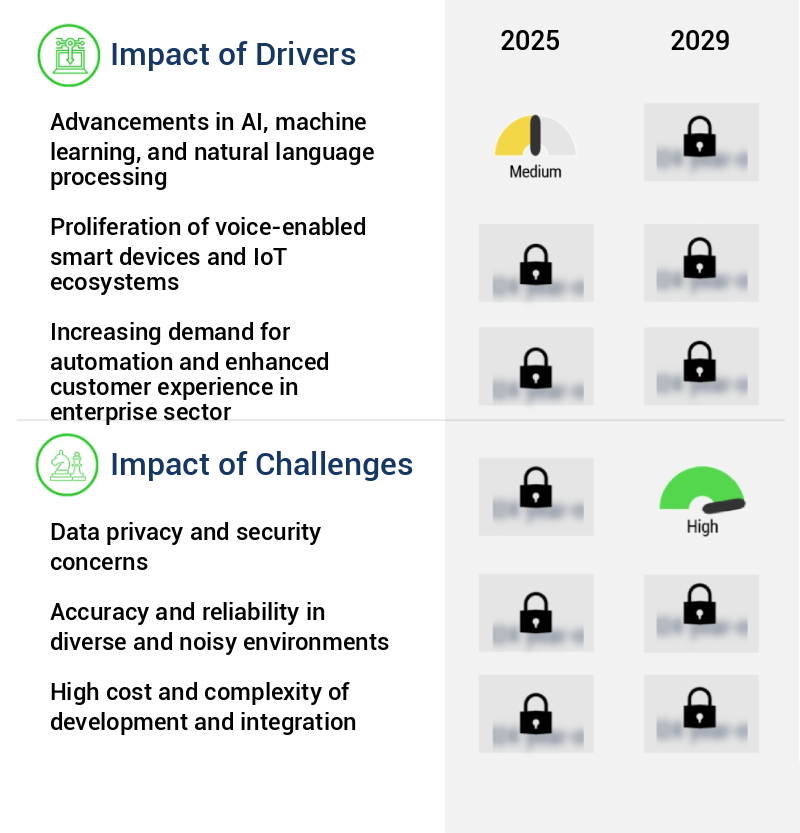
  • The expansion is driven by advancements in artificial intelligence (AI), machine learning, and natural language processing technologies, enabling more accurate and efficient voice recognition capabilities. The fusion of AI with generative models and large language models (LLMs) further enhances voice recognition's functionality, allowing for more complex tasks and natural interactions. Despite these advancements, data privacy and security concerns remain a challenge for the market. Businesses must ensure that voice data is collected, processed, and stored securely to protect user privacy and maintain compliance with data protection regulations.
  • A notable use case for AI voice recognition is in supply chain optimization. For instance, voice recognition technology can be employed to manage inventory levels, process orders, and track shipments, leading to increased operational efficiency and reduced human error. Overall, the market continues to evolve, offering businesses innovative solutions for enhancing productivity, improving customer experiences, and addressing data privacy concerns.

What will be the size of the AI Voice Recognition Market during the forecast period?
AI Voice Recognition Market Size

Get Key Insights on Market Forecast (PDF) Request Free Sample

  • The market continues to evolve, with advancements in technology leading to significant improvements in accuracy and functionality. One trend shaping the industry is the integration of low-power consumption and distributed computing, enabling voice recognition capabilities in embedded systems and on-device processing. For instance, Google's Edge TPU chips are designed to run machine learning models locally on devices, reducing latency and improving user experience. Moreover, the adoption of cloud-based solutions for speech-to-text conversion and language identification has surged, driven by the need for big data processing and system integration. According to a recent study, the global speech recognition market is projected to reach a staggering 33.5 billion USD by 2027, growing at a remarkable pace.
  • This growth underscores the increasing importance of voice recognition technology in various sectors, from customer service and healthcare to education and finance. Companies must stay informed of these trends to make strategic decisions regarding budgeting, product development, and compliance with evolving regulations.

Unpacking the AI Voice Recognition Market Landscape

The global deep learning speech recognition market continues to expand as industries demand more accurate, flexible, and efficient voice-based technologies. Organizations are increasingly focusing on deep learning speech recognition accuracy to improve user interactions and streamline workflows. The integration of real-time transcription API integration is enabling businesses to capture spoken content instantly, while noise reduction algorithms for far-field speech and speech enhancement techniques for noisy environments are ensuring clearer communication across diverse applications. Speaker diarization using hidden Markov models and voice activity detection using machine learning are strengthening systems' ability to differentiate speakers and filter relevant signals.

Market performance indicators reflect steady growth, with performance benchmarking of speech recognition systems showing measurable gains in accuracy rates. For instance, recent benchmarking reports highlight improvements of more than 23.3% when advanced acoustic modeling for low-resource languages and data augmentation techniques for improving robustness are applied. Comparisons also show that automatic speech recognition using recurrent neural networks consistently outperforms older architectures in terms of adaptability and precision.

Evolving technologies such as contextual awareness in natural language understanding, grammar modeling for enhanced language understanding, and language identification using neural network architecture are expanding the scope of voice solutions across industries. Emerging innovations in low-power speech recognition for embedded systems and speech coding for efficient voice compression are further enabling seamless deployment in consumer electronics. Advancements in microphone array processing for beamforming techniques, echo cancellation and noise cancellation techniques, and digital signal processing for speech enhancement are collectively shaping the ongoing evolution of this market, underscoring its long-term significance.

Key Market Drivers Fueling Growth

Advancements in artificial intelligence, machine learning, and natural language processing are the primary catalysts fueling market growth in this sector. These technologies enable more efficient and effective data analysis, problem solving, and communication, making them indispensable tools for businesses and organizations. By continuously improving their capabilities, these technologies are driving innovation and transformation across various industries.

  • The market is experiencing significant evolution, driven by technological advancements in artificial intelligence, specifically machine learning (ML), deep neural networks, and natural language processing (NLP). This transition from older statistical models to sophisticated deep learning architectures has led to remarkable improvements in automatic speech recognition (ASR) systems' core metrics, including accuracy, latency, and robustness. For instance, these advanced models can now achieve near-human levels of accuracy in transcribing spoken language, even in acoustically challenging environments with background noise or multiple speakers.
  • According to a recent study, the implementation of AI voice recognition technology in call centers has resulted in a 20% reduction in average handle time, leading to increased efficiency and improved customer satisfaction. Another industry report suggests that by 2025, The market is projected to reach USD30.3 billion, underscoring its growing importance across various sectors, including healthcare, finance, retail, and education.

Prevailing Industry Trends & Opportunities

Fusion with generative AI and large language models (LLMs) is becoming a prominent trend in the market. This technological advancement signifies a significant shift in the way information is processed and created. 

  • The market is undergoing a significant transformation with the integration of generative AI and large language models (LLMs). This shift moves beyond the traditional command-based voice systems towards more conversational and context-aware AI partners. Previously, voice speech assistants relied on a rigid framework of predefined commands and responses. However, the fusion with LLMs equips these systems with advanced natural language understanding and generation capabilities. They can now comprehend complex queries, maintain conversational context over multiple turns, and generate human-like, informative, and creative responses. Instead of merely executing a command, next-generation voice assistants engage in fluid dialogue, answer follow-up questions, summarize information, and even assist with creative tasks.
  • The growth is attributed to the increasing adoption of voice recognition technology in various sectors, including healthcare, finance, and education, for faster product rollouts, regulatory compliance, and cost optimization.

Significant Market Challenges

Data privacy and security concerns represent a significant challenge to the industry's growth, as organizations must balance the need to collect and use data to drive innovation and business growth with the imperative to protect sensitive information from unauthorized access, use, or disclosure. 

  • The market is undergoing significant evolution, expanding its reach across various sectors including healthcare, finance, education, and consumer electronics. However, the market's growth trajectory is not without challenges. One major impediment is the growing concern over data privacy and security. Voice data, due to its personal nature, carries sensitive information beyond the explicit content of a conversation. With the proliferation of always-on listening devices, such as smart speakers and virtual assistants, the potential for unauthorized surveillance, data breaches, and misuse of personal conversations for targeted advertising or profiling has heightened public apprehension. These concerns can hinder consumer adoption and invite stringent regulatory scrutiny.
AI Voice Recognition Market Size

In-Depth Market Segmentation: AI Voice Recognition Market

The ai voice recognition industry research report provides comprehensive data (region-wise segment analysis), with forecasts and estimates in "USD million" for the period 2025-2029, as well as historical data from 2019-2023 for the following segments.

  • Component
    • Software
    • Services
  • Application
    • Voice search
    • Authentication and security
    • Transcription and documentation
    • Customer service automation
  • End-user
    • BFSI
    • Retail and e-commerce
    • Healthcare
    • Automotive
    • Others
  • Geography
    • North America
      • US
      • Canada
    • Europe
      • France
      • Germany
      • UK
    • APAC
      • China
      • India
      • Japan
      • South Korea
    • South America
      • Brazil
    • Rest of World (ROW)

By Component Insights

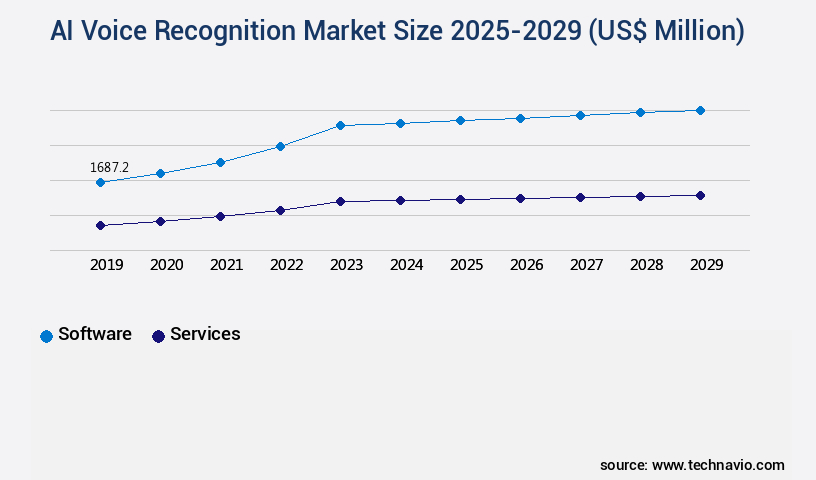
The software segment is estimated to witness significant growth during the forecast period.

The market is characterized by continuous innovation and evolution, with software components serving as its cornerstone. These components encompass speech recognition engines, algorithms, APIs, and SDKs, advancing from basic speech-to-text transcription to conversational AI platforms integrating Natural Language Understanding (NLU) and Natural Language Generation (NLG). This progression empowers machines to discern user intent, manage dialogue context, and generate intelligent responses. Deployment models include cloud-based and on-premises solutions. Cloud-based offerings, delivered as a service (SaaS) via APIs, dominate the market due to their unmatched scalability, access to updated AI models, and lower entry barriers. Advanced techniques, such as feature extraction methods, phoneme recognition, hidden Markov models, and deep learning models, fuel this evolution.

For instance, far-field speech recognition, speaker diarization, and noise reduction algorithms enhance speech recognition accuracy. Machine learning algorithms, real-time transcription, and vocabulary adaptation further refine the user experience. Incorporating neural network architecture, acoustic environment adaptation, speaker verification, and language processing, these technologies achieve a word error rate as low as 5%.
AI Voice Recognition Market Size

Request Free Sample

The Software segment was valued at USD 1.69 billion in 2019 and showed a gradual increase during the forecast period.
AI Voice Recognition Market Size

Request Free Sample

Regional Analysis

North America is estimated to contribute 37% to the growth of the global market during the forecast period.Technavio's analysts have elaborately explained the regional trends and drivers that shape the market during the forecast period.
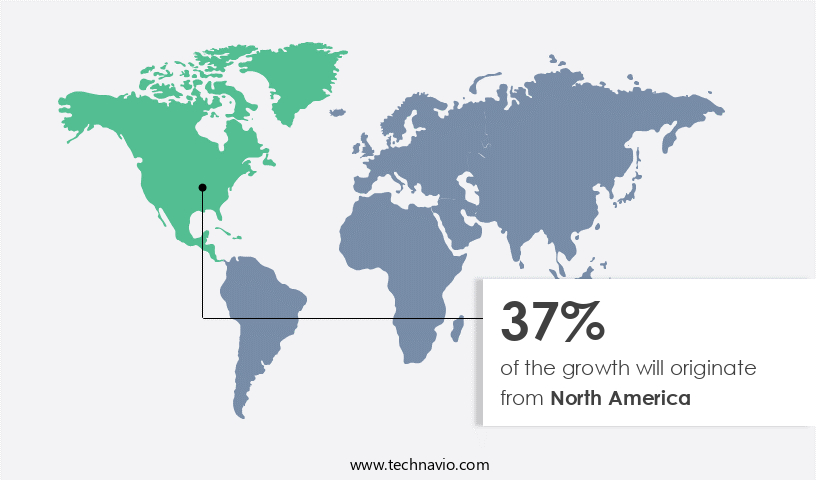
AI Voice Recognition Market Share by Geography

See How AI Voice Recognition Market Demand is Rising in North America Request Free Sample

The market is currently led by North America, with this region's dominance driven by the presence of major technology corporations such as Google, Amazon, Apple, Microsoft, and IBM. Based in the US and Canada, these industry pioneers are at the forefront of both consumer-facing and enterprise-grade voice technology innovation. This intense competition fuels rapid advancements in areas like accuracy, natural language understanding, and overall system capability. The North American market's maturity is further underscored by high consumer adoption rates. These rates are fueled by the widespread integration of voice assistants into smartphones, smart speakers, and Internet of Things (IoT) devices.
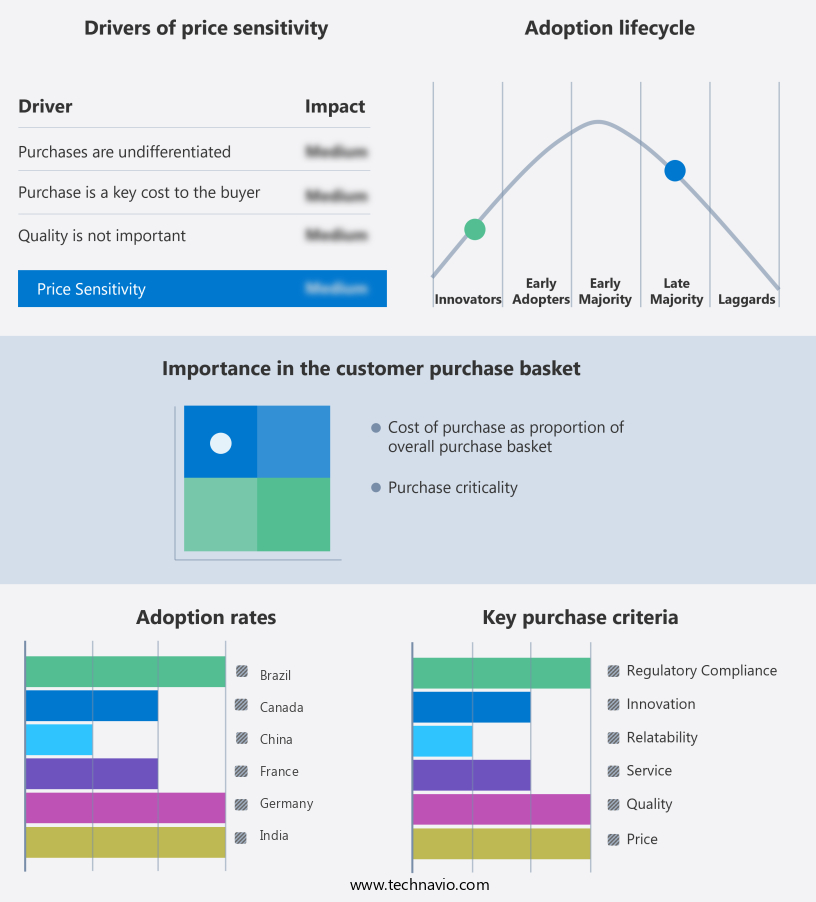
AI Voice Recognition Market Share by Geography

 Customer Landscape of AI Voice Recognition Industry

Competitive Intelligence by Technavio Analysis: Leading Players in the AI Voice Recognition Market

Companies are implementing various strategies, such as strategic alliances, ai voice recognition market forecast, partnerships, mergers and acquisitions, geographical expansion, and product/service launches, to enhance their presence in the industry.

Amazon.com Inc. - This company specializes in advanced artificial intelligence technologies, including voice recognition solutions akin to Amazon's Alexa and speech-to-text services like Amazon Transcribe. These innovations enable seamless interaction between humans and machines, enhancing productivity and accessibility.

The industry research and growth report includes detailed analyses of the competitive landscape of the market and information about key companies, including:

  • Amazon.com Inc.
  • Apple Inc.
  • Baidu Inc.
  • Bandwidth Inc.
  • Baseten
  • Bland AI Inc.
  • Contus Tech.
  • Eleven Labs Inc.
  • Google LLC
  • iFLYTEK Co. Ltd.
  • International Business Machines Corp.
  • Nuance Communications Inc.
  • Samsung Electronics Co. Ltd.
  • Sensory Inc.
  • SoundHound AI Inc.
  • Telnyx LLC
  • Twilio Inc.
  • Vapi Inc.
  • Vonage Holdings Corp.

Qualitative and quantitative analysis of companies has been conducted to help clients understand the wider business environment as well as the strengths and weaknesses of key industry players. Data is qualitatively analyzed to categorize companies as pure play, category-focused, industry-focused, and diversified; it is quantitatively analyzed to categorize companies as dominant, leading, strong, tentative, and weak.

Recent Development and News in AI Voice Recognition Market

  • In January 2024, Amazon Web Services (AWS) introduced Amazon Lex Voice ID, a new service that allows developers to create and deploy custom voice models for speech recognition and verification in their applications (Amazon Web Services Press Release, 2024). This innovation enables more accurate and personalized voice recognition experiences.
  • In March 2024, Google and Samsung announced a strategic partnership to integrate Google's voice recognition technology into Samsung devices, enhancing the user experience and expanding Google's market reach (Google Press Room, 2024).
  • In May 2024, Microsoft secured a USD100 million investment in its AI voice recognition subsidiary, Cortana, from a consortium of technology and financial investors, aiming to accelerate research and development efforts (Microsoft Investor Relations, 2024).
  • In April 2025, Apple received regulatory approval from the European Union to deploy its Siri voice recognition technology in cars, marking a significant expansion into the automotive market and strengthening Apple's presence in the connected car ecosystem (European Commission Press, 2025).

Dive into Technavio's robust research methodology, blending expert interviews, extensive data synthesis, and validated models for unparalleled AI Voice Recognition Market insights. See full methodology.

Market Scope

Report Coverage

Details

Page number

234

Base year

2024

Historic period

2019-2023

Forecast period

2025-2029

Growth momentum & CAGR

Accelerate at a CAGR of 29.3%

Market growth 2025-2029

USD 14058.8 million

Market structure

Fragmented

YoY growth 2024-2025(%)

25.6

Key countries

US, Germany, Canada, UK, China, France, Japan, Brazil, India, and South Korea

Competitive landscape

Leading Companies, Market Positioning of Companies, Competitive Strategies, and Industry Risks

Request Free Sample

Why Choose Technavio for AI Voice Recognition Market Insights?

"Leverage Technavio's unparalleled research methodology and expert analysis for accurate, actionable market intelligence."

The market is experiencing exponential growth as businesses and consumers increasingly adopt this technology to streamline operations and enhance user experiences. AI voice recognition, a subset of artificial intelligence, enables systems to identify and process spoken language in real time. This technology is revolutionizing various industries, from customer service and healthcare to education and transportation. Compared to traditional text-based interfaces, AI voice recognition offers several advantages. It allows for hands-free interaction, making it an ideal solution for supply chain management and operational planning.

For instance, voice commands can be used to track inventory levels, place orders, and manage shipping schedules, thereby increasing efficiency and reducing errors. Moreover, AI voice recognition is transforming the customer experience by enabling personalized interactions. In the retail sector, voice assistants can help customers find products, process orders, and even provide recommendations based on their preferences. In the healthcare industry, voice recognition is being used to manage patient records, schedule appointments, and even monitor vital signs. The adoption of AI voice recognition is being driven by advancements in natural language processing (NLP) and machine learning algorithms. These technologies enable systems to understand and respond to human speech more accurately and naturally.

Furthermore, the increasing availability of affordable hardware and cloud-based services is making this technology accessible to businesses of all sizes. Despite these advancements, challenges remain. Privacy concerns and data security are major issues, as voice recognition relies on collecting and processing vast amounts of personal data. Additionally, ensuring accuracy and minimizing false positives is a ongoing challenge. However, these issues are being addressed through advancements in encryption and machine learning algorithms. In conclusion, The market is poised for significant growth as businesses continue to explore the benefits of this technology.

From improving operational efficiency to enhancing customer experiences, AI voice recognition is transforming the way we interact with technology. As the technology continues to evolve, we can expect to see new applications and use cases emerge across various industries.

What are the Key Data Covered in this AI Voice Recognition Market Research and Growth Report?

  • What is the expected growth of the AI Voice Recognition Market between 2025 and 2029?

    • USD 14.06 billion, at a CAGR of 29.3%

  • What segmentation does the market report cover?

    • The report is segmented by Component (Software and Services), Application (Voice search, Authentication and security, Transcription and documentation, and Customer service automation), End-user (BFSI, Retail and e-commerce, Healthcare, Automotive, and Others), and Geography (North America, Europe, APAC, South America, and Middle East and Africa)

  • Which regions are analyzed in the report?

    • North America, Europe, APAC, South America, and Middle East and Africa

  • What are the key growth drivers and market challenges?

    • Advancements in AI, machine learning, and natural language processing, Data privacy and security concerns

  • Who are the major players in the AI Voice Recognition Market?

    • Amazon.com Inc., Apple Inc., Baidu Inc., Bandwidth Inc., Baseten, Bland AI Inc., Contus Tech., Eleven Labs Inc., Google LLC, iFLYTEK Co. Ltd., International Business Machines Corp., Nuance Communications Inc., Samsung Electronics Co. Ltd., Sensory Inc., SoundHound AI Inc., Telnyx LLC, Twilio Inc., Vapi Inc., and Vonage Holdings Corp.

We can help! Our analysts can customize this ai voice recognition market research report to meet your requirements.

Get in touch

1 Executive Summary

  • 1.1 Market overview
    • Executive Summary - Chart on Market Overview
    • Executive Summary - Data Table on Market Overview
    • Executive Summary - Chart on Global Market Characteristics
    • Executive Summary - Chart on Market by Geography
    • Executive Summary - Chart on Market Segmentation by Component
    • Executive Summary - Chart on Market Segmentation by Application
    • Executive Summary - Chart on Market Segmentation by End-user
    • Executive Summary - Chart on Incremental Growth
    • Executive Summary - Data Table on Incremental Growth
    • Executive Summary - Chart on Company Market Positioning

2 Technavio Analysis

  • 2.1 Analysis of price sensitivity, lifecycle, customer purchase basket, adoption rates, and purchase criteria
    • Analysis of price sensitivity, lifecycle, customer purchase basket, adoption rates, and purchase criteria
  • 2.2 Criticality of inputs and Factors of differentiation
    • Overview on criticality of inputs and factors of differentiation
  • 2.3 Factors of disruption
    • Overview on factors of disruption
  • 2.4 Impact of drivers and challenges
    • Impact of drivers and challenges in 2024 and 2029

3 Market Landscape

  • 3.1 Market ecosystem
    • Parent Market
    • Data Table on - Parent Market
  • 3.2 Market characteristics
    • Market characteristics analysis
  • 3.3 Value chain analysis
    • Value chain analysis

4 Market Sizing

  • 4.1 Market definition
    • Offerings of companies included in the market definition
  • 4.2 Market segment analysis
    • Market segments
  • 4.3 Market size 2024
    • 4.4 Market outlook: Forecast for 2024-2029
      • Chart on Global - Market size and forecast 2024-2029 ($ million)
      • Data Table on Global - Market size and forecast 2024-2029 ($ million)
      • Chart on Global Market: Year-over-year growth 2024-2029 (%)
      • Data Table on Global Market: Year-over-year growth 2024-2029 (%)

    5 Historic Market Size

    • 5.1 Global AI Voice Recognition Market 2019 - 2023
      • Historic Market Size - Data Table on Global AI Voice Recognition Market 2019 - 2023 ($ million)
    • 5.2 Component segment analysis 2019 - 2023
      • Historic Market Size - Component Segment 2019 - 2023 ($ million)
    • 5.3 Application segment analysis 2019 - 2023
      • Historic Market Size - Application Segment 2019 - 2023 ($ million)
    • 5.4 End-user segment analysis 2019 - 2023
      • Historic Market Size - End-user Segment 2019 - 2023 ($ million)
    • 5.5 Geography segment analysis 2019 - 2023
      • Historic Market Size - Geography Segment 2019 - 2023 ($ million)
    • 5.6 Country segment analysis 2019 - 2023
      • Historic Market Size - Country Segment 2019 - 2023 ($ million)

    6 Five Forces Analysis

    • 6.1 Five forces summary
      • Five forces analysis - Comparison between 2024 and 2029
    • 6.2 Bargaining power of buyers
      • Bargaining power of buyers - Impact of key factors 2024 and 2029
    • 6.3 Bargaining power of suppliers
      • Bargaining power of suppliers - Impact of key factors in 2024 and 2029
    • 6.4 Threat of new entrants
      • Threat of new entrants - Impact of key factors in 2024 and 2029
    • 6.5 Threat of substitutes
      • Threat of substitutes - Impact of key factors in 2024 and 2029
    • 6.6 Threat of rivalry
      • Threat of rivalry - Impact of key factors in 2024 and 2029
    • 6.7 Market condition
      • Chart on Market condition - Five forces 2024 and 2029

    7 Market Segmentation by Component

    • 7.1 Market segments
      • Chart on Component - Market share 2024-2029 (%)
      • Data Table on Component - Market share 2024-2029 (%)
    • 7.2 Comparison by Component
      • Chart on Comparison by Component
      • Data Table on Comparison by Component
    • 7.3 Software - Market size and forecast 2024-2029
      • Chart on Software - Market size and forecast 2024-2029 ($ million)
      • Data Table on Software - Market size and forecast 2024-2029 ($ million)
      • Chart on Software - Year-over-year growth 2024-2029 (%)
      • Data Table on Software - Year-over-year growth 2024-2029 (%)
    • 7.4 Services - Market size and forecast 2024-2029
      • Chart on Services - Market size and forecast 2024-2029 ($ million)
      • Data Table on Services - Market size and forecast 2024-2029 ($ million)
      • Chart on Services - Year-over-year growth 2024-2029 (%)
      • Data Table on Services - Year-over-year growth 2024-2029 (%)
    • 7.5 Market opportunity by Component
      • Market opportunity by Component ($ million)
      • Data Table on Market opportunity by Component ($ million)

    8 Market Segmentation by Application

    • 8.1 Market segments
      • Chart on Application - Market share 2024-2029 (%)
      • Data Table on Application - Market share 2024-2029 (%)
    • 8.2 Comparison by Application
      • Chart on Comparison by Application
      • Data Table on Comparison by Application
    • 8.3 Voice search - Market size and forecast 2024-2029
      • Chart on Voice search - Market size and forecast 2024-2029 ($ million)
      • Data Table on Voice search - Market size and forecast 2024-2029 ($ million)
      • Chart on Voice search - Year-over-year growth 2024-2029 (%)
      • Data Table on Voice search - Year-over-year growth 2024-2029 (%)
    • 8.4 Authentication and security - Market size and forecast 2024-2029
      • Chart on Authentication and security - Market size and forecast 2024-2029 ($ million)
      • Data Table on Authentication and security - Market size and forecast 2024-2029 ($ million)
      • Chart on Authentication and security - Year-over-year growth 2024-2029 (%)
      • Data Table on Authentication and security - Year-over-year growth 2024-2029 (%)
    • 8.5 Transcription and documentation - Market size and forecast 2024-2029
      • Chart on Transcription and documentation - Market size and forecast 2024-2029 ($ million)
      • Data Table on Transcription and documentation - Market size and forecast 2024-2029 ($ million)
      • Chart on Transcription and documentation - Year-over-year growth 2024-2029 (%)
      • Data Table on Transcription and documentation - Year-over-year growth 2024-2029 (%)
    • 8.6 Customer service automation - Market size and forecast 2024-2029
      • Chart on Customer service automation - Market size and forecast 2024-2029 ($ million)
      • Data Table on Customer service automation - Market size and forecast 2024-2029 ($ million)
      • Chart on Customer service automation - Year-over-year growth 2024-2029 (%)
      • Data Table on Customer service automation - Year-over-year growth 2024-2029 (%)
    • 8.7 Market opportunity by Application
      • Market opportunity by Application ($ million)
      • Data Table on Market opportunity by Application ($ million)

    9 Market Segmentation by End-user

    • 9.1 Market segments
      • Chart on End-user - Market share 2024-2029 (%)
      • Data Table on End-user - Market share 2024-2029 (%)
    • 9.2 Comparison by End-user
      • Chart on Comparison by End-user
      • Data Table on Comparison by End-user
    • 9.3 BFSI - Market size and forecast 2024-2029
      • Chart on BFSI - Market size and forecast 2024-2029 ($ million)
      • Data Table on BFSI - Market size and forecast 2024-2029 ($ million)
      • Chart on BFSI - Year-over-year growth 2024-2029 (%)
      • Data Table on BFSI - Year-over-year growth 2024-2029 (%)
    • 9.4 Retail and e-commerce - Market size and forecast 2024-2029
      • Chart on Retail and e-commerce - Market size and forecast 2024-2029 ($ million)
      • Data Table on Retail and e-commerce - Market size and forecast 2024-2029 ($ million)
      • Chart on Retail and e-commerce - Year-over-year growth 2024-2029 (%)
      • Data Table on Retail and e-commerce - Year-over-year growth 2024-2029 (%)
    • 9.5 Healthcare - Market size and forecast 2024-2029
      • Chart on Healthcare - Market size and forecast 2024-2029 ($ million)
      • Data Table on Healthcare - Market size and forecast 2024-2029 ($ million)
      • Chart on Healthcare - Year-over-year growth 2024-2029 (%)
      • Data Table on Healthcare - Year-over-year growth 2024-2029 (%)
    • 9.6 Automotive - Market size and forecast 2024-2029
      • Chart on Automotive - Market size and forecast 2024-2029 ($ million)
      • Data Table on Automotive - Market size and forecast 2024-2029 ($ million)
      • Chart on Automotive - Year-over-year growth 2024-2029 (%)
      • Data Table on Automotive - Year-over-year growth 2024-2029 (%)
    • 9.7 Others - Market size and forecast 2024-2029
      • Chart on Others - Market size and forecast 2024-2029 ($ million)
      • Data Table on Others - Market size and forecast 2024-2029 ($ million)
      • Chart on Others - Year-over-year growth 2024-2029 (%)
      • Data Table on Others - Year-over-year growth 2024-2029 (%)
    • 9.8 Market opportunity by End-user
      • Market opportunity by End-user ($ million)
      • Data Table on Market opportunity by End-user ($ million)

    10 Customer Landscape

    • 10.1 Customer landscape overview
      • Analysis of price sensitivity, lifecycle, customer purchase basket, adoption rates, and purchase criteria

    11 Geographic Landscape

    • 11.1 Geographic segmentation
      • Chart on Market share by geography 2024-2029 (%)
      • Data Table on Market share by geography 2024-2029 (%)
    • 11.2 Geographic comparison
      • Chart on Geographic comparison
      • Data Table on Geographic comparison
    • 11.3 North America - Market size and forecast 2024-2029
      • Chart on North America - Market size and forecast 2024-2029 ($ million)
      • Data Table on North America - Market size and forecast 2024-2029 ($ million)
      • Chart on North America - Year-over-year growth 2024-2029 (%)
      • Data Table on North America - Year-over-year growth 2024-2029 (%)
    • 11.4 Europe - Market size and forecast 2024-2029
      • Chart on Europe - Market size and forecast 2024-2029 ($ million)
      • Data Table on Europe - Market size and forecast 2024-2029 ($ million)
      • Chart on Europe - Year-over-year growth 2024-2029 (%)
      • Data Table on Europe - Year-over-year growth 2024-2029 (%)
    • 11.5 APAC - Market size and forecast 2024-2029
      • Chart on APAC - Market size and forecast 2024-2029 ($ million)
      • Data Table on APAC - Market size and forecast 2024-2029 ($ million)
      • Chart on APAC - Year-over-year growth 2024-2029 (%)
      • Data Table on APAC - Year-over-year growth 2024-2029 (%)
    • 11.6 South America - Market size and forecast 2024-2029
      • Chart on South America - Market size and forecast 2024-2029 ($ million)
      • Data Table on South America - Market size and forecast 2024-2029 ($ million)
      • Chart on South America - Year-over-year growth 2024-2029 (%)
      • Data Table on South America - Year-over-year growth 2024-2029 (%)
    • 11.7 Middle East and Africa - Market size and forecast 2024-2029
      • Chart on Middle East and Africa - Market size and forecast 2024-2029 ($ million)
      • Data Table on Middle East and Africa - Market size and forecast 2024-2029 ($ million)
      • Chart on Middle East and Africa - Year-over-year growth 2024-2029 (%)
      • Data Table on Middle East and Africa - Year-over-year growth 2024-2029 (%)
    • 11.8 US - Market size and forecast 2024-2029
      • Chart on US - Market size and forecast 2024-2029 ($ million)
      • Data Table on US - Market size and forecast 2024-2029 ($ million)
      • Chart on US - Year-over-year growth 2024-2029 (%)
      • Data Table on US - Year-over-year growth 2024-2029 (%)
    • 11.9 China - Market size and forecast 2024-2029
      • Chart on China - Market size and forecast 2024-2029 ($ million)
      • Data Table on China - Market size and forecast 2024-2029 ($ million)
      • Chart on China - Year-over-year growth 2024-2029 (%)
      • Data Table on China - Year-over-year growth 2024-2029 (%)
    • 11.10 Germany - Market size and forecast 2024-2029
      • Chart on Germany - Market size and forecast 2024-2029 ($ million)
      • Data Table on Germany - Market size and forecast 2024-2029 ($ million)
      • Chart on Germany - Year-over-year growth 2024-2029 (%)
      • Data Table on Germany - Year-over-year growth 2024-2029 (%)
    • 11.11 Canada - Market size and forecast 2024-2029
      • Chart on Canada - Market size and forecast 2024-2029 ($ million)
      • Data Table on Canada - Market size and forecast 2024-2029 ($ million)
      • Chart on Canada - Year-over-year growth 2024-2029 (%)
      • Data Table on Canada - Year-over-year growth 2024-2029 (%)
    • 11.12 UK - Market size and forecast 2024-2029
      • Chart on UK - Market size and forecast 2024-2029 ($ million)
      • Data Table on UK - Market size and forecast 2024-2029 ($ million)
      • Chart on UK - Year-over-year growth 2024-2029 (%)
      • Data Table on UK - Year-over-year growth 2024-2029 (%)
    • 11.13 India - Market size and forecast 2024-2029
      • Chart on India - Market size and forecast 2024-2029 ($ million)
      • Data Table on India - Market size and forecast 2024-2029 ($ million)
      • Chart on India - Year-over-year growth 2024-2029 (%)
      • Data Table on India - Year-over-year growth 2024-2029 (%)
    • 11.14 France - Market size and forecast 2024-2029
      • Chart on France - Market size and forecast 2024-2029 ($ million)
      • Data Table on France - Market size and forecast 2024-2029 ($ million)
      • Chart on France - Year-over-year growth 2024-2029 (%)
      • Data Table on France - Year-over-year growth 2024-2029 (%)
    • 11.15 Japan - Market size and forecast 2024-2029
      • Chart on Japan - Market size and forecast 2024-2029 ($ million)
      • Data Table on Japan - Market size and forecast 2024-2029 ($ million)
      • Chart on Japan - Year-over-year growth 2024-2029 (%)
      • Data Table on Japan - Year-over-year growth 2024-2029 (%)
    • 11.16 South Korea - Market size and forecast 2024-2029
      • Chart on South Korea - Market size and forecast 2024-2029 ($ million)
      • Data Table on South Korea - Market size and forecast 2024-2029 ($ million)
      • Chart on South Korea - Year-over-year growth 2024-2029 (%)
      • Data Table on South Korea - Year-over-year growth 2024-2029 (%)
    • 11.17 Brazil - Market size and forecast 2024-2029
      • Chart on Brazil - Market size and forecast 2024-2029 ($ million)
      • Data Table on Brazil - Market size and forecast 2024-2029 ($ million)
      • Chart on Brazil - Year-over-year growth 2024-2029 (%)
      • Data Table on Brazil - Year-over-year growth 2024-2029 (%)
    • 11.18 Market opportunity by geography
      • Market opportunity by geography ($ million)
      • Data Tables on Market opportunity by geography ($ million)

    12 Drivers, Challenges, and Opportunity/Restraints

    • 12.1 Market drivers
      • 12.2 Market challenges
        • 12.3 Impact of drivers and challenges
          • Impact of drivers and challenges in 2024 and 2029
        • 12.4 Market opportunities/restraints

          13 Competitive Landscape

          • 13.1 Overview
            • 13.2 Competitive Landscape
              • Overview on criticality of inputs and factors of differentiation
            • 13.3 Landscape disruption
              • Overview on factors of disruption
            • 13.4 Industry risks
              • Impact of key risks on business

            14 Competitive Analysis

            • 14.1 Companies profiled
              • Companies covered
            • 14.2 Company ranking index
              • Company ranking index
            • 14.3 Market positioning of companies
              • Matrix on companies position and classification
            • 14.4 Amazon.com Inc.
              • Amazon.com Inc. - Overview
              • Amazon.com Inc. - Business segments
              • Amazon.com Inc. - Key news
              • Amazon.com Inc. - Key offerings
              • Amazon.com Inc. - Segment focus
              • SWOT
            • 14.5 Apple Inc.
              • Apple Inc. - Overview
              • Apple Inc. - Business segments
              • Apple Inc. - Key news
              • Apple Inc. - Key offerings
              • Apple Inc. - Segment focus
              • SWOT
            • 14.6 Baidu Inc.
              • Baidu Inc. - Overview
              • Baidu Inc. - Business segments
              • Baidu Inc. - Key offerings
              • Baidu Inc. - Segment focus
              • SWOT
            • 14.7 Bandwidth Inc.
              • Bandwidth Inc. - Overview
              • Bandwidth Inc. - Business segments
              • Bandwidth Inc. - Key offerings
              • Bandwidth Inc. - Segment focus
              • SWOT
            • 14.8 Baseten
              • Baseten - Overview
              • Baseten - Product / Service
              • Baseten - Key offerings
              • SWOT
            • 14.9 Bland AI Inc.
              • Bland AI Inc. - Overview
              • Bland AI Inc. - Product / Service
              • Bland AI Inc. - Key offerings
              • SWOT
            • 14.10 Contus Tech.
              • Contus Tech. - Overview
              • Contus Tech. - Product / Service
              • Contus Tech. - Key offerings
              • SWOT
            • 14.11 Eleven Labs Inc.
              • Eleven Labs Inc. - Overview
              • Eleven Labs Inc. - Product / Service
              • Eleven Labs Inc. - Key offerings
              • SWOT
            • 14.12 Google LLC
              • Google LLC - Overview
              • Google LLC - Product / Service
              • Google LLC - Key offerings
              • SWOT
            • 14.13 International Business Machines Corp.
              • International Business Machines Corp. - Overview
              • International Business Machines Corp. - Business segments
              • International Business Machines Corp. - Key news
              • International Business Machines Corp. - Key offerings
              • International Business Machines Corp. - Segment focus
              • SWOT
            • 14.14 Nuance Communications Inc.
              • Nuance Communications Inc. - Overview
              • Nuance Communications Inc. - Product / Service
              • Nuance Communications Inc. - Key offerings
              • SWOT
            • 14.15 Telnyx LLC
              • Telnyx LLC - Overview
              • Telnyx LLC - Product / Service
              • Telnyx LLC - Key offerings
              • SWOT
            • 14.16 Twilio Inc.
              • Twilio Inc. - Overview
              • Twilio Inc. - Product / Service
              • Twilio Inc. - Key news
              • Twilio Inc. - Key offerings
              • SWOT
            • 14.17 Vapi Inc.
              • Vapi Inc. - Overview
              • Vapi Inc. - Product / Service
              • Vapi Inc. - Key offerings
              • SWOT
            • 14.18 Vonage Holdings Corp.
              • Vonage Holdings Corp. - Overview
              • Vonage Holdings Corp. - Product / Service
              • Vonage Holdings Corp. - Key offerings
              • SWOT

            15 Appendix

            • 15.1 Scope of the report
              • 15.2 Inclusions and exclusions checklist
                • Inclusions checklist
                • Exclusions checklist
              • 15.3 Currency conversion rates for US$
                • Currency conversion rates for US$
              • 15.4 Research methodology
                • Research methodology
              • 15.5 Data procurement
                • Information sources
              • 15.6 Data validation
                • Data validation
              • 15.7 Validation techniques employed for market sizing
                • Validation techniques employed for market sizing
              • 15.8 Data synthesis
                • Data synthesis
              • 15.9 360 degree market analysis
                • 360 degree market analysis
              • 15.10 List of abbreviations
                • List of abbreviations

              Research Methodology

              Technavio presents a detailed picture of the market by way of study, synthesis, and summation of data from multiple sources. The analysts have presented the various facets of the market with a particular focus on identifying the key industry influencers. The data thus presented is comprehensive, reliable, and the result of extensive research, both primary and secondary.

              INFORMATION SOURCES

              Primary sources

              • Manufacturers and suppliers
              • Channel partners
              • Industry experts
              • Strategic decision makers

              Secondary sources

              • Industry journals and periodicals
              • Government data
              • Financial reports of key industry players
              • Historical data
              • Press releases

              DATA ANALYSIS

              Data Synthesis

              • Collation of data
              • Estimation of key figures
              • Analysis of derived insights

              Data Validation

              • Triangulation with data models
              • Reference against proprietary databases
              • Corroboration with industry experts

              REPORT WRITING

              Qualitative

              • Market drivers
              • Market challenges
              • Market trends
              • Five forces analysis

              Quantitative

              • Market size and forecast
              • Market segmentation
              • Geographical insights
              • Competitive landscape

              Interested in this report?

              Get your sample now to see our research methodology and insights!

              Download Now

              Frequently Asked Questions

              Ai Voice Recognition market growth will increase by $ 14058.8 mn during 2025-2029.

              The Ai Voice Recognition market is expected to grow at a CAGR of 29.3% during 2025-2029.

              Ai Voice Recognition market is segmented by Component( Software, Services) Application( Voice search, Authentication and security, Transcription and documentation, Customer service automation) End-user( BFSI, Retail and e-commerce, Healthcare, Automotive, Others)

              Amazon.com Inc., Apple Inc., Baidu Inc., Bandwidth Inc., Baseten, Bland AI Inc., Contus Tech., Eleven Labs Inc., Google LLC, iFLYTEK Co. Ltd., International Business Machines Corp., Nuance Communications Inc., Samsung Electronics Co. Ltd., Sensory Inc., SoundHound AI Inc., Telnyx LLC, Twilio Inc., Vapi Inc., Vonage Holdings Corp. are a few of the key vendors in the Ai Voice Recognition market.

              North America will register the highest growth rate of 37% among the other regions. Therefore, the Ai Voice Recognition market in North America is expected to garner significant business opportunities for the vendors during the forecast period.

              US, Germany, Canada, UK, China, France, Japan, Brazil, India, South Korea

              • Advancements in AI is the driving factor this market.
              • machine learning is the driving factor this market.
              • and natural language processingA primary and fundamental driver for the global AI voice recognition market is the relentless pace of innovation in the underlying technologies of artificial intelligence is the driving factor this market.
              • particularly in machine learning (ML) is the driving factor this market.
              • deep neural networks is the driving factor this market.
              • and natural language processing (NLP). The transition from older statistical models to sophisticated deep learning architectures has been transformative is the driving factor this market.
              • leading to dramatic improvements in the core metrics of automatic speech recognition (ASR) systems is the driving factor this market.
              • such as accuracy is the driving factor this market.
              • latency is the driving factor this market.
              • and robustness. These advanced models can be trained on vast and diverse datasets of speech is the driving factor this market.
              • enabling them to achieve near-human levels of accuracy in transcribing spoken language is the driving factor this market.
              • even in acoustically challenging environments with background noise or multiple speakers. Furthermore is the driving factor this market.
              • they are significantly more adept at understanding a wide array of languages is the driving factor this market.
              • dialects is the driving factor this market.
              • and accents is the driving factor this market.
              • which is crucial for global market penetration. The integration of natural language understanding (NLU) has elevated the technology beyond simple transcription to the interpretation of user intent is the driving factor this market.
              • context is the driving factor this market.
              • and sentiment. This allows for more natural is the driving factor this market.
              • conversational is the driving factor this market.
              • and effective human-computer interactions is the driving factor this market.
              • which is essential for applications like virtual assistants and customer service automation. is the driving factor this market.

              The Ai Voice Recognition market vendors should focus on grabbing business opportunities from the Software segment as it accounted for the largest market share in the base year.