


AI In Consumer Electronics Market Size 2025-2029
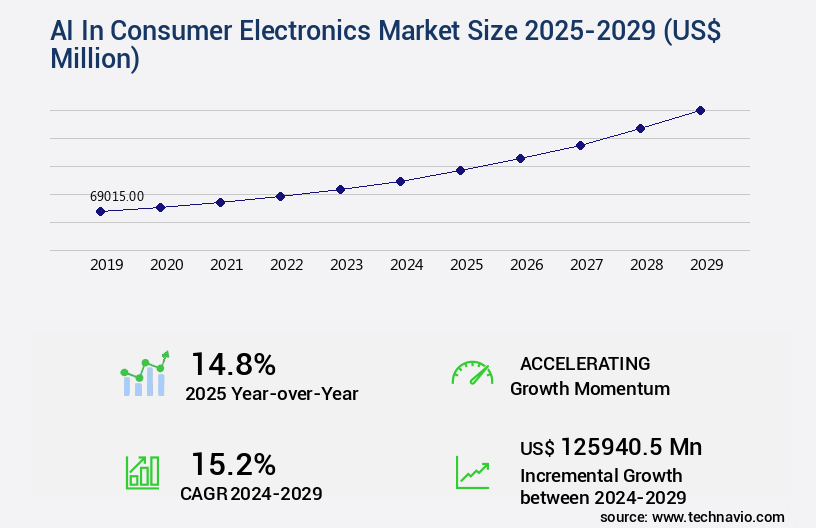
The ai in consumer electronics market size is valued to increase by USD 125.94 billion, at a CAGR of 15.2% from 2024 to 2029. Increasing consumer demand for enhanced personalization and intuitive user experiences will drive the ai in consumer electronics market.
Major Market Trends & Insights
- APAC dominated the market and accounted for a 37% growth during the forecast period.
- By Technology - Machine learning segment was valued at USD 32 billion in 2023
- By Application - Personalized recommendations segment accounted for the largest market revenue share in 2023
Market Size & Forecast
- Market Opportunities: USD 259.68 million
- Market Future Opportunities: USD 125940.50 million
- CAGR from 2024 to 2029 : 15.2%
Market Summary
- In the dynamic consumer electronics market, artificial intelligence (AI) has emerged as a key driver of innovation and growth. The relentless pursuit of enhanced personalization and intuitive user experiences fuels the demand for AI integration in various devices. From voice assistants in smartphones and smart speakers to predictive analytics in wearable technology, AI is transforming the way consumers interact with their devices. Simultaneously, on-device AI processing is gaining traction as a response to the increasing data demands and the need for real-time responses. This trend enables devices to learn from user behavior and adapt accordingly, providing a more personalized and efficient user experience.
- However, the proliferation of AI in consumer electronics is not without challenges. Heightened concerns regarding data privacy and security have become a significant hurdle for manufacturers and developers. Ensuring user data is protected while allowing for seamless AI integration is a delicate balance that must be maintained. Despite these challenges, the future of AI in consumer electronics remains promising. As technology continues to evolve, we can expect AI to become more sophisticated and integrated into our daily lives, offering new opportunities for innovation and convenience.
What will be the Size of the AI In Consumer Electronics Market during the forecast period?
Get Key Insights on Market Forecast (PDF) Request Free Sample
How is the AI In Consumer Electronics Market Segmented ?
The ai in consumer electronics industry research report provides comprehensive data (region-wise segment analysis), with forecasts and estimates in "USD million" for the period 2025-2029, as well as historical data from 2019-2023 for the following segments.
- Technology
- Machine learning
- Natural language processing
- Others
- Application
- Personalized recommendations
- Predictive maintenance
- Enhanced security
- Energy management
- Others
- Product
- Computing devices
- Home appliances
- Entertainment devices
- Communication devices
- Others
- Geography
- North America
- US
- Canada
- Europe
- France
- Germany
- UK
- APAC
- Australia
- China
- India
- Japan
- South Korea
- Rest of World (ROW)
- North America
By Technology Insights
The machine learning segment is estimated to witness significant growth during the forecast period.
Machine learning is a transformative force in the consumer electronics market, fueling the intelligence layer of modern devices and enabling them to learn from data, identify patterns, and adapt to user behavior. This segment powers a range of applications, from content recommendation engines in smart TVs to energy-efficient battery management systems in smartphones and wearables. Intel's December 2023 launch of Core Ultra processors, featuring integrated Neural Processing Units (NPUs), underscores the growing importance of on-device AI and machine learning. These NPUs accelerate local workloads, reducing reliance on cloud-based services and enhancing privacy. AI applications span from natural language processing and biometric authentication to computer vision systems and robotics process automation.
This growth is driven by advancements in explainable AI techniques, real-time data processing, and edge computing devices, among other factors. The integration of AI into consumer electronics continues to evolve, shaping the future of human-computer interaction, privacy, and user experiences.
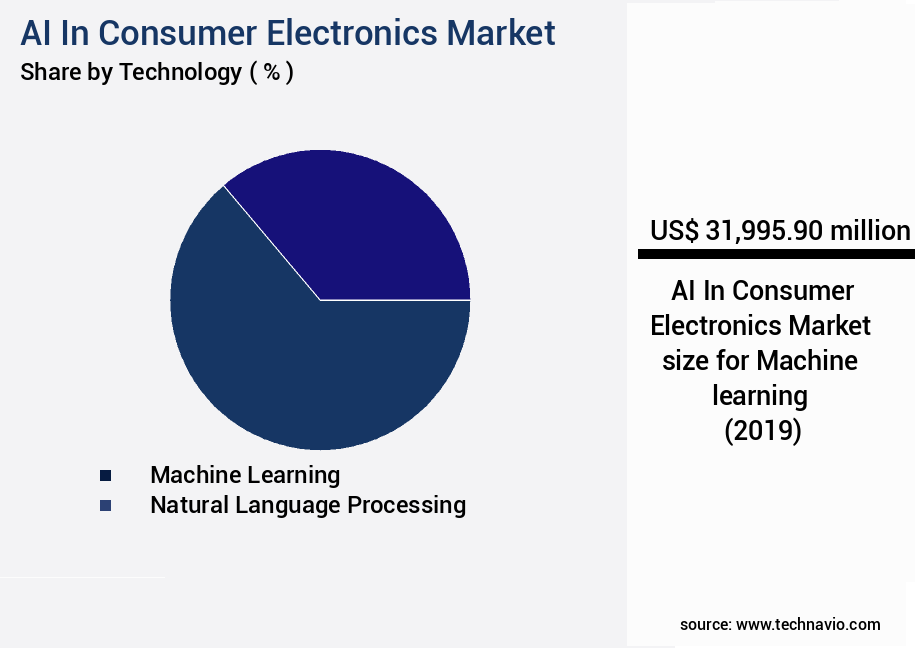
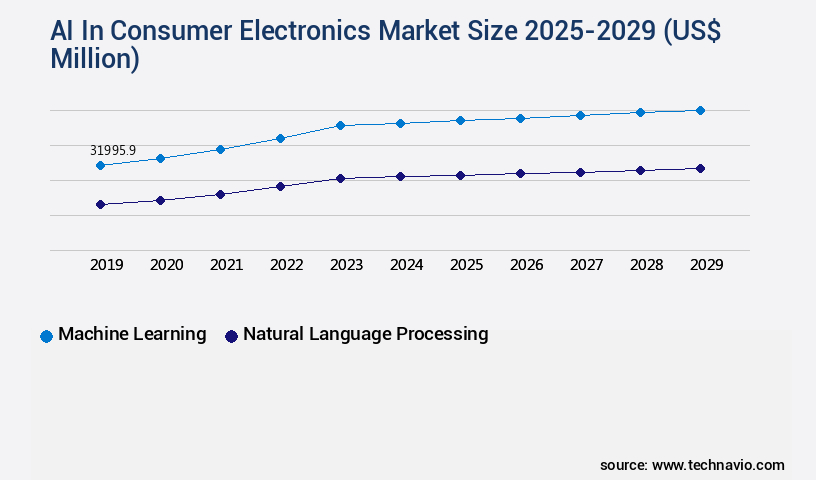
The Machine learning segment was valued at USD 32 billion in 2019 and showed a gradual increase during the forecast period.
Regional Analysis
APAC is estimated to contribute 37% to the growth of the global market during the forecast period.Technavio's analysts have elaborately explained the regional trends and drivers that shape the market during the forecast period.
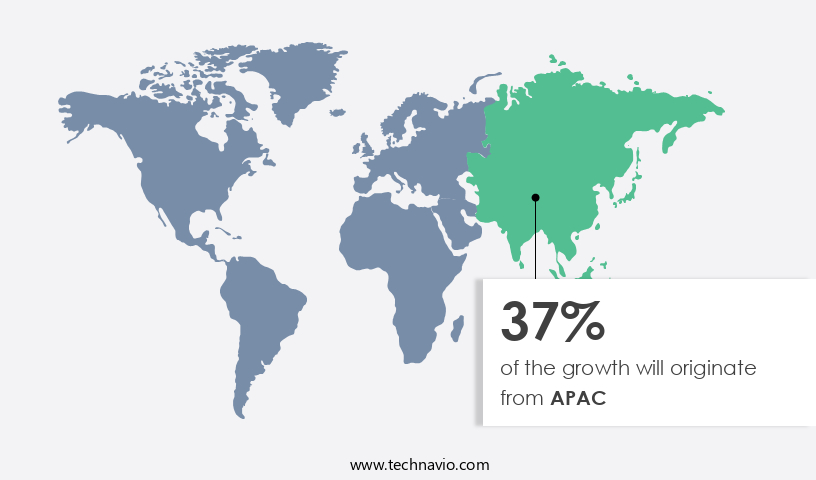
See How AI In Consumer Electronics Market Demand is Rising in APAC Request Free Sample
The Asia-Pacific region plays a pivotal role in the dynamic global the market, serving as a significant manufacturing hub and a burgeoning consumer base. Leading electronics manufacturers in the region, such as Samsung Electronics from South Korea and Sony Group Corporation from Japan, are spearheading AI innovation. In January 2024, Samsung introduced the Galaxy AI suite, integrating advanced generative AI features into its flagship smartphones, setting a new industry standard.
Likewise, Sony's August 2023 release of the A7C II camera featured a dedicated AI processing unit, enabling unparalleled subject recognition and autofocus capabilities. These instances underscore the region's commitment to AI integration and its impact on the competitive landscape.
Market Dynamics
Our researchers analyzed the data with 2024 as the base year, along with the key drivers, trends, and challenges. A holistic analysis of drivers will help companies refine their marketing strategies to gain a competitive advantage.
The market is experiencing rapid growth as technology companies integrate advanced artificial intelligence (AI) capabilities into various consumer devices. One notable application is AI-powered image recognition in smart TVs, enabling more personalized viewing experiences and improved content recommendations. Natural language processing (NLP) for virtual assistants is another key trend, allowing consumers to interact with their devices using voice commands and text queries. In the realm of personalized recommendations, deep learning models are being employed to analyze user behavior and preferences, providing tailored suggestions for movies, music, and other content. Computer vision systems are also being integrated into augmented reality applications, enhancing user experiences and enabling new forms of interaction. AI is also being used to optimize the performance of consumer electronics through machine learning algorithms for predictive maintenance, ensuring devices run efficiently and reducing downtime. IoT device integration with AI-powered home automation is another area of growth, allowing for more intelligent and energy-efficient homes. Data security protocols are a critical consideration in the consumer electronics market, with AI playing a role in detecting anomalies and protecting against cyber threats. Human-computer interaction design is also essential, ensuring AI assistants are intuitive and easy to use. Facial recognition technology is becoming increasingly common in mobile phones and gesture recognition systems are being used for smart home control. Speech synthesis technology is enabling more natural and expressive voice-activated devices, while contextual awareness systems in smart appliances are allowing for more personalized and convenient experiences.
Anomaly detection systems are being used to identify and address issues in consumer electronics before they become major problems. Reinforcement learning techniques are being employed in robotics to enable more advanced and autonomous systems. Neural network architectures are being used for object detection and image segmentation techniques in medical imaging. AI bias mitigation strategies are being developed to address concerns around facial recognition technology, while privacy-preserving AI techniques are being employed in data analytics to protect consumer data. Federated learning approaches are being adopted in consumer electronics to enable AI capabilities without the need for centralized data processing, ensuring data privacy and reducing latency.
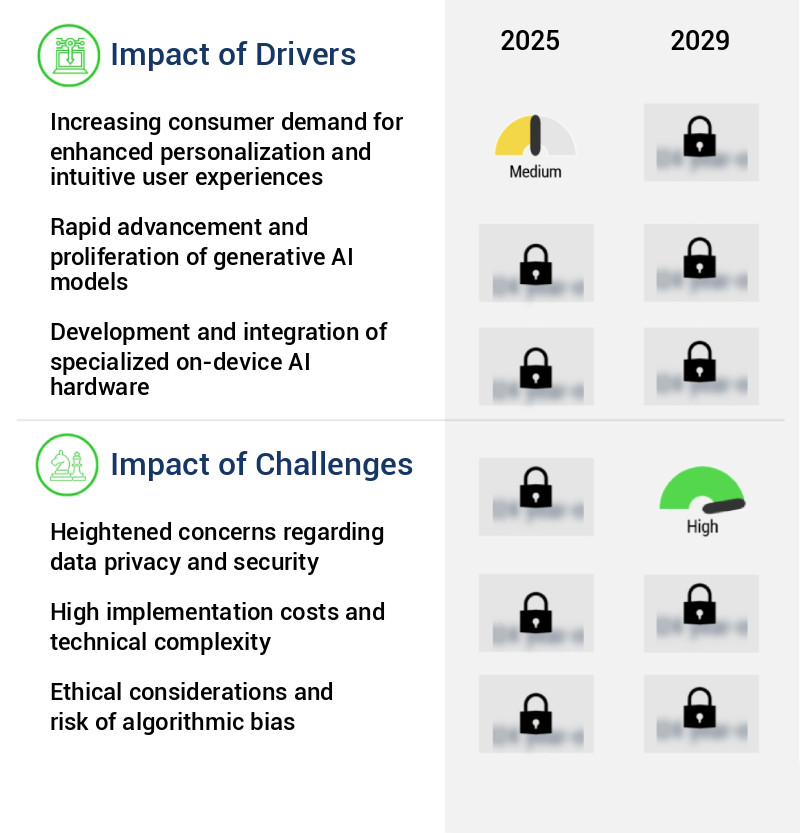
What are the key market drivers leading to the rise in the adoption of AI In Consumer Electronics Industry?
- The market is propelled forward by the escalating consumer preference for personalized experiences and intuitive user interfaces.
- The market is experiencing a significant shift as consumers increasingly demand devices that offer personalized, intuitive, and seamless experiences. Modern users no longer settle for static, one-size-fits-all functionality; they expect products that learn their habits, anticipate their needs, and adapt to their unique contexts. Artificial intelligence (AI) is the driving force behind this trend, transforming passive electronics into proactive, intelligent partners. Machine learning algorithms analyze user interaction data to tailor content recommendations on streaming platforms and optimize the operational settings of smart home appliances. This results in a highly engaging and frictionless user experience that fosters brand loyalty and ecosystem lock-in.
What are the market trends shaping the AI In Consumer Electronics Industry?
- The trend in the market is toward the proliferation of on-device artificial intelligence processing. On-device artificial intelligence processing is an emerging market trend.
- The market is experiencing a significant transformation, with a growing emphasis on on-device or edge AI processing. This shift from cloud-dependent AI marks a pivotal change in device architecture and user experience. By performing complex AI computations directly on the hardware, edge AI reduces latency, enabling real-time responsiveness for advanced features like instant language translation. Additionally, it ensures data privacy and security, as sensitive personal information remains on the user's device.
- Furthermore, edge AI offers robust offline functionality, allowing core AI features to operate effectively without a constant internet connection. This trend reflects the increasing importance of reducing latency, enhancing privacy, and ensuring offline functionality in the consumer electronics industry.
What challenges does the AI In Consumer Electronics Industry face during its growth?
- The escalating importance of safeguarding data privacy and security presents a significant challenge to the industry's growth trajectory.
- The market is undergoing significant evolution, with applications spanning various sectors such as healthcare, education, and entertainment. This advancement is marked by the increasing integration of AI capabilities into everyday devices, from smartphones to smart homes. However, the data-intensive nature of AI raises critical concerns around data privacy and security. According to recent studies, approximately 64% of consumers are concerned about the amount of personal data collected by their devices. Furthermore, 51% of consumers are hesitant to adopt new AI technologies due to data security concerns.
- These vulnerabilities necessitate robust data governance frameworks, clear consent mechanisms, and stringent data protection regulations.
Exclusive Technavio Analysis on Customer Landscape
The ai in consumer electronics market forecasting report includes the adoption lifecycle of the market, covering from the innovator's stage to the laggard's stage. It focuses on adoption rates in different regions based on penetration. Furthermore, the ai in consumer electronics market report also includes key purchase criteria and drivers of price sensitivity to help companies evaluate and develop their market growth analysis strategies.
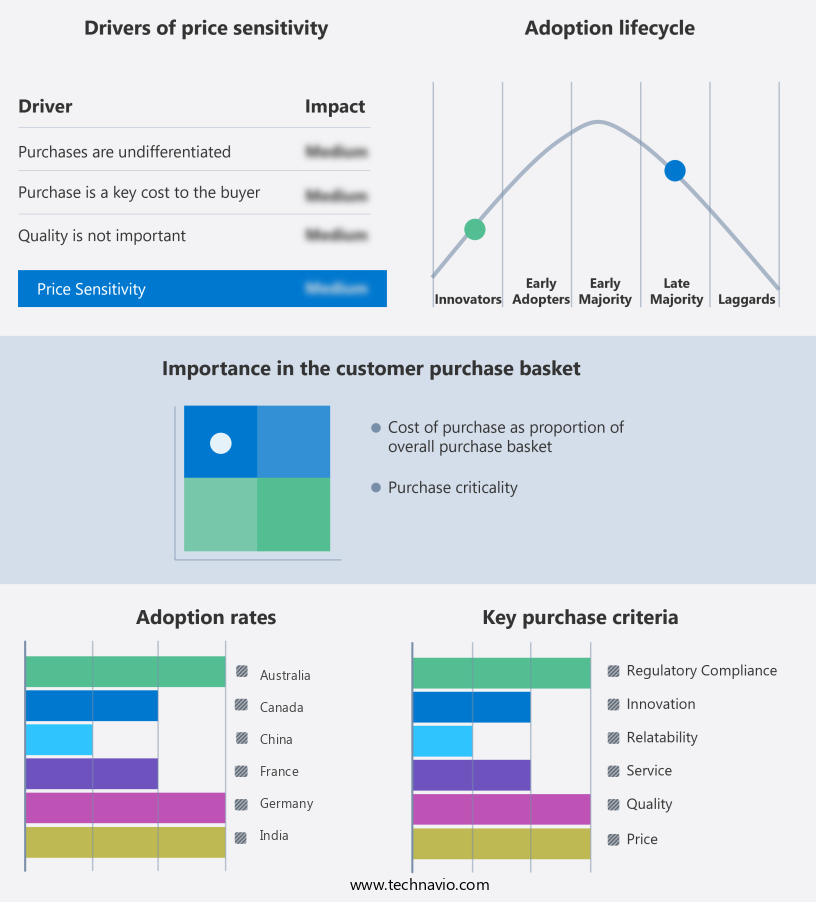
Customer Landscape of AI In Consumer Electronics Industry
Competitive Landscape
Companies are implementing various strategies, such as strategic alliances, ai in consumer electronics market forecast, partnerships, mergers and acquisitions, geographical expansion, and product/service launches, to enhance their presence in the industry.
Acer Inc. - This company pioneers artificial intelligence integration in consumer electronics, including Alexa-enabled smart speakers, Fire TV devices with voice control, Ring smart home security cameras featuring AI detection, and Kindle e-readers delivering personalized recommendations.
The industry research and growth report includes detailed analyses of the competitive landscape of the market and information about key companies, including:
- Acer Inc.
- Amazon.com Inc.
- Apple Inc.
- ASUSTeK Computer Inc.
- Bose Corp.
- Canon Inc.
- Dell Technologies Inc.
- Google LLC
- Haier Smart Home Co. Ltd.
- Hisense International Co. Ltd.
- HP Inc.
- Huawei Technologies Co. Ltd.
- Lenovo Group Ltd.
- LG Electronics Inc.
- Microsoft Corp.
- Nikon Corp.
- Panasonic Holdings Corp.
- Samsung Electronics Co. Ltd.
- Sony Group Corp.
- TCL Industries Holdings Co. Ltd.
- Xiaomi Inc.
Qualitative and quantitative analysis of companies has been conducted to help clients understand the wider business environment as well as the strengths and weaknesses of key industry players. Data is qualitatively analyzed to categorize companies as pure play, category-focused, industry-focused, and diversified; it is quantitatively analyzed to categorize companies as dominant, leading, strong, tentative, and weak.
Recent Development and News in AI In Consumer Electronics Market
- In January 2025, Apple Inc. Unveiled the HomePod Mini, a compact and affordable smart speaker featuring an S5 chip with an A8 core, enabling advanced on-device processing and faster response times for Siri. This strategic product expansion underlined Apple's commitment to integrating AI technology into its consumer electronics (Reuters, 2025).
- In March 2025, Amazon and Microsoft announced a multi-year collaboration to integrate Amazon's Alexa with Microsoft's Teams communication platform. This partnership aimed to provide users with a more seamless experience, allowing them to make voice calls, join meetings, and manage their calendars using Alexa-enabled devices (Bloomberg, 2025).
- In May 2025, Google's DeepMind AI division secured a strategic investment of USD500 million from SoftBank's Vision Fund 2. The funding would support DeepMind's research and development efforts in AI, particularly in areas like healthcare, climate change, and scientific research (Wall Street Journal, 2025).
- In August 2024, Samsung Electronics announced its entry into the smart home security market with the launch of SmartThings Sense, an AI-powered home security system. The system could detect and identify various activities within a home using sensors and AI algorithms, offering users enhanced security and convenience (Samsung Press Release, 2024).
Dive into Technavio's robust research methodology, blending expert interviews, extensive data synthesis, and validated models for unparalleled AI In Consumer Electronics Market insights. See full methodology.
|
Market Scope |
|
|
Report Coverage |
Details |
|
Page number |
255 |
|
Base year |
2024 |
|
Historic period |
2019-2023 |
|
Forecast period |
2025-2029 |
|
Growth momentum & CAGR |
Accelerate at a CAGR of 15.2% |
|
Market growth 2025-2029 |
USD 125940.5 million |
|
Market structure |
Fragmented |
|
YoY growth 2024-2025(%) |
14.8 |
|
Key countries |
US, China, India, UK, Japan, Canada, Germany, South Korea, France, and Australia |
|
Competitive landscape |
Leading Companies, Market Positioning of Companies, Competitive Strategies, and Industry Risks |
Research Analyst Overview
- The consumer electronics market continues to evolve, with artificial intelligence (AI) playing an increasingly significant role in driving innovation and growth. Smart home integration, facilitated by AI, is a prime example of this trend. According to recent market research, the global smart home market is projected to reach a value of USD151.4 billion by 2023, growing at a compound annual growth rate (CAGR) of 12.6% during the forecast period. Natural language processing (NLP) and biometric authentication methods are two AI technologies that have gained traction in the consumer electronics sector. NLP enables AI-powered voice assistants to understand and respond to human speech, while biometric authentication methods use machine learning algorithms to analyze sensor data from facial recognition technology or fingerprint scanners for secure access.
- Real-time data processing, enabled by edge computing devices, is another key application of AI in consumer electronics. Machine learning algorithms and contextual awareness systems are used to analyze sensor data in real-time, enabling predictive maintenance models and energy efficiency metrics. Explainable AI techniques are becoming increasingly important as AI becomes more integrated into consumer electronics. These techniques enable users to understand how AI systems make decisions, fostering trust and transparency. For instance, a leading smartphone manufacturer has reported a 20% increase in user engagement with its AI-powered camera system after implementing explainable AI techniques. AI ethics considerations are also becoming a critical factor in the consumer electronics market.
- Privacy-preserving AI and personalized user experiences, achieved through federated learning approaches and recommendation engines, are essential to building trust with consumers and ensuring that AI applications are used in a responsible and ethical manner. Robotics process automation and reinforcement learning techniques are also gaining popularity in the consumer electronics sector, with applications ranging from manufacturing to logistics and customer service. In conclusion, the consumer electronics market is undergoing continuous transformation, with AI playing a pivotal role in driving innovation and growth. From smart home integration and natural language processing to real-time data processing and explainable AI techniques, the applications of AI in consumer electronics are diverse and evolving.
- With the global AI market projected to reach USD602.35 billion by 2025, the potential for growth and innovation is immense.
What are the Key Data Covered in this AI In Consumer Electronics Market Research and Growth Report?
-
What is the expected growth of the AI In Consumer Electronics Market between 2025 and 2029?
-
USD 125.94 billion, at a CAGR of 15.2%
-
-
What segmentation does the market report cover?
-
The report is segmented by Technology (Machine learning, Natural language processing, and Others), Application (Personalized recommendations, Predictive maintenance, Enhanced security, Energy management, and Others), Product (Computing devices, Home appliances, Entertainment devices, Communication devices, and Others), and Geography (APAC, North America, Europe, Middle East and Africa, and South America)
-
-
Which regions are analyzed in the report?
-
APAC, North America, Europe, Middle East and Africa, and South America
-
-
What are the key growth drivers and market challenges?
-
Increasing consumer demand for enhanced personalization and intuitive user experiences, Heightened concerns regarding data privacy and security
-
-
Who are the major players in the AI In Consumer Electronics Market?
-
Acer Inc., Amazon.com Inc., Apple Inc., ASUSTeK Computer Inc., Bose Corp., Canon Inc., Dell Technologies Inc., Google LLC, Haier Smart Home Co. Ltd., Hisense International Co. Ltd., HP Inc., Huawei Technologies Co. Ltd., Lenovo Group Ltd., LG Electronics Inc., Microsoft Corp., Nikon Corp., Panasonic Holdings Corp., Samsung Electronics Co. Ltd., Sony Group Corp., TCL Industries Holdings Co. Ltd., and Xiaomi Inc.
-
Market Research Insights
- The market for AI in consumer electronics is a dynamic and ever-evolving landscape. Two significant statistics illustrate its continuous growth. First, the number of IoT devices with integrated AI capabilities is projected to reach 75% of all connected devices by 2025, signifying a substantial industry expansion. Second, a recent study reveals that AI adoption in smart appliance control has led to a 20% increase in energy efficiency for users.
- This trend underscores the potential for AI to optimize consumer electronics, enhancing user experience and driving efficiency gains. Despite these advancements, challenges persist, including computational complexity, data privacy compliance, and power consumption optimization. Integrating AI into consumer electronics requires addressing these issues while ensuring model interpretability, hardware acceleration, and scalability.
We can help! Our analysts can customize this ai in consumer electronics market research report to meet your requirements.
 RIA -
RIA -