



AI-Driven Customer Support Agents Market Size 2025-2029
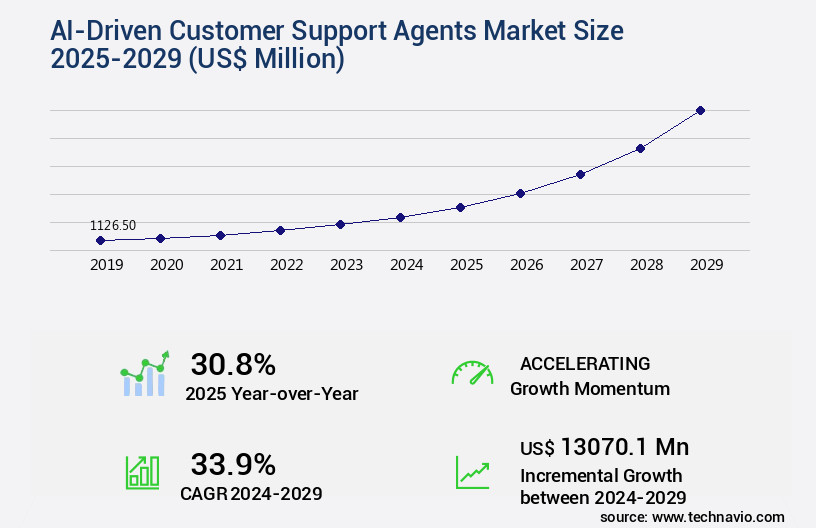
The ai-driven customer support agents market size is valued to increase by USD 13.07 billion, at a CAGR of 33.9% from 2024 to 2029. Increasing demand for enhanced customer experience and operational efficiency will drive the ai-driven customer support agents market.
Major Market Trends & Insights
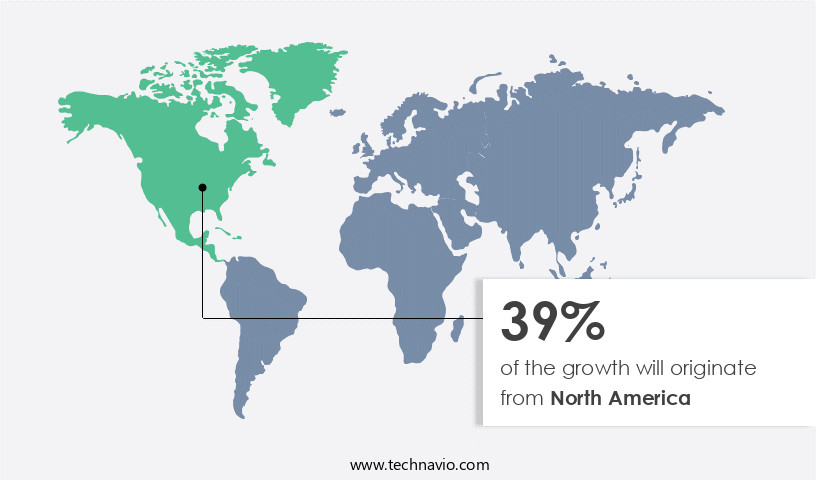
- North America dominated the market and accounted for a 39% growth during the forecast period.
- By Deployment - Cloud-based segment was valued at USD 620.30 billion in 2023
- By Solution - Chatbots segment accounted for the largest market revenue share in 2023
Market Size & Forecast
- Market Opportunities: USD 1.00 million
- Market Future Opportunities: USD 13070.10 million
- CAGR from 2024 to 2029 : 33.9%
Market Summary
- Amidst the business world's relentless pursuit of superior customer experience and operational efficiency, the market has emerged as a game-changer. This market's expansion is fueled by the integration of advanced artificial intelligence (AI) technologies, enabling hyper-personalized and proactive customer engagement. However, this progress is not without challenges. Integration complexities and data security concerns loom large, necessitating robust solutions and strategic partnerships. AI-driven customer support agents offer businesses the ability to automate repetitive tasks, reduce response times, and enhance overall customer satisfaction.
- These agents employ natural language processing (NLP) and machine learning algorithms to understand customer queries and provide accurate, contextually relevant responses. Moreover, these agents can learn from previous interactions, continually improving their performance and delivering increasingly personalized experiences. This human-like interaction, coupled with the ability to handle multiple queries simultaneously, makes AI-driven customer support agents an indispensable asset for businesses. Despite these benefits, the market's growth is not without hurdles. Integration complexities arise due to the need for seamless integration with existing systems and processes. Data security concerns are another challenge, as sensitive customer information must be protected.
- Addressing these challenges requires a strategic approach, including careful planning, robust security measures, and strategic partnerships with technology providers. By navigating these complexities, businesses can reap the rewards of AI-driven customer support agents, including improved customer satisfaction, reduced operational costs, and increased operational efficiency.
What will be the Size of the AI-Driven Customer Support Agents Market during the forecast period?
Get Key Insights on Market Forecast (PDF) Request Free Sample
How is the AI-Driven Customer Support Agents Market Segmented ?
The ai-driven customer support agents industry research report provides comprehensive data (region-wise segment analysis), with forecasts and estimates in "USD million" for the period 2025-2029, as well as historical data from 2019-2023 for the following segments.
- Deployment
- Cloud-based
- On-premises
- Solution
- Chatbots
- Virtual assistants
- Automated ticketing
- Voice-based support
- Others
- End-user
- BFSI
- Healthcare and life science
- Retails and e-commerce
- Media and entertainment
- Others
- Geography
- North America
- US
- Canada
- Europe
- France
- Germany
- UK
- APAC
- Australia
- China
- India
- Japan
- South Korea
- Rest of World (ROW)
- North America
By Deployment Insights
The cloud-based segment is estimated to witness significant growth during the forecast period.
In the ever-evolving landscape of customer support, AI-driven agents have emerged as a game-changer, revolutionizing the way businesses engage with their clients. Cloud-based AI solutions, in particular, have gained significant traction, offering flexible and scalable alternatives to traditional on-premises systems. These platforms employ advanced technologies such as automated routing protocols, speech-to-text conversion, and intent recognition technology, to name a few. Agent training datasets and performance monitoring metrics are continually refined through deep learning algorithms and natural language processing, ensuring optimal user experience. Multi-lingual support systems, knowledge base management, and sentiment analysis tools are integrated to cater to diverse customer needs.
Compliance with data privacy regulations is ensured through robust security protocols and entity extraction methods. Conversational AI platforms, human-in-the-loop systems, and escalation management systems enable seamless handover between AI and human agents. Contextual awareness engines, dialogue management systems, and reinforcement learning techniques are employed to provide personalized interactions. Chatbot development platforms and text-to-speech synthesis offer enhanced accessibility, while machine learning models and feedback loop mechanisms facilitate predictive analytics. Knowledge graph integration and predictive analytics models further enhance the system's ability to understand and respond to customer queries effectively. According to recent estimates, AI-driven customer support agents are expected to handle over 60% of all customer queries by 2024, underscoring their growing importance in the business world.
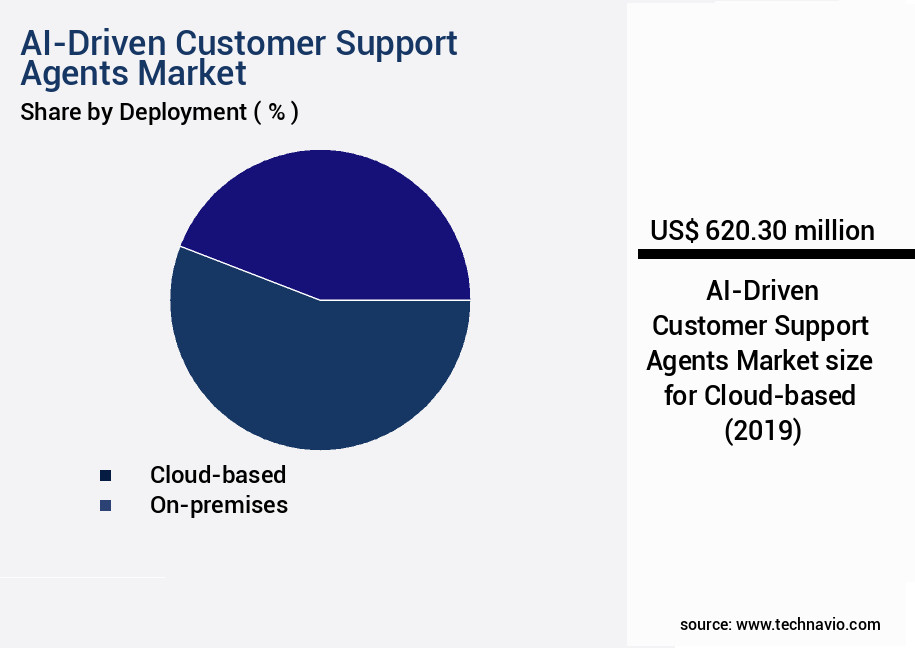
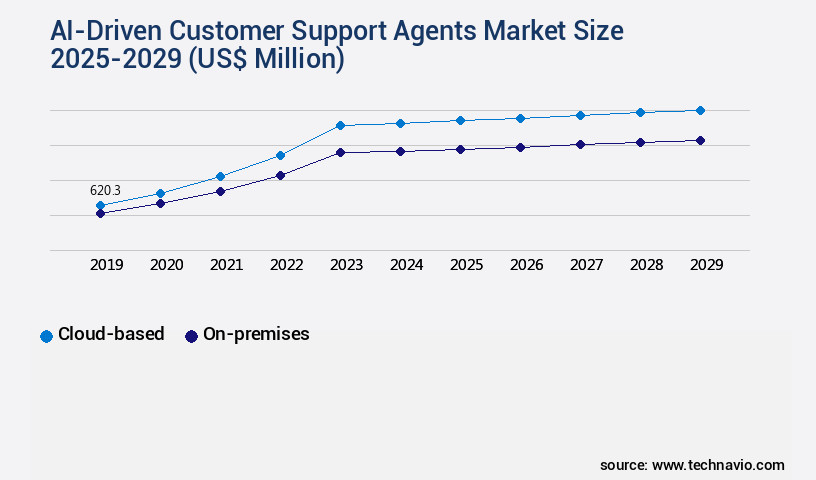
The Cloud-based segment was valued at USD 620.30 billion in 2019 and showed a gradual increase during the forecast period.
Regional Analysis
North America is estimated to contribute 39% to the growth of the global market during the forecast period.Technavio's analysts have elaborately explained the regional trends and drivers that shape the market during the forecast period.
See How AI-Driven Customer Support Agents Market Demand is Rising in North America Request Free Sample
The market is witnessing significant growth, with North America leading the charge. This region's dominance is attributed to a high concentration of technology companies, advanced digital infrastructure, and a strong focus on customer experience innovation. The United States, in particular, is at the forefront of AI adoption, with various sectors, including technology, finance, retail, and healthcare, implementing AI solutions to manage high call volumes, reduce operational costs, and provide round-the-clock support.
Market Dynamics
Our researchers analyzed the data with 2024 as the base year, along with the key drivers, trends, and challenges. A holistic analysis of drivers will help companies refine their marketing strategies to gain a competitive advantage.
The market is experiencing significant growth as businesses seek to enhance their customer engagement strategies. This market is characterized by advanced technologies such as contextual understanding of customer interactions, sentiment analysis using deep learning, and automated routing based on customer intent. Human-in-the-loop for ai agent training ensures that these agents continue to learn and improve, while performance metrics for conversational ai provide valuable insights into their effectiveness. Knowledge graph integration for faq retrieval enables ai agents to quickly and accurately answer common customer queries, while multi-lingual support using nlp techniques expands their reach. Data privacy compliance in ai agents is a critical consideration, as these agents handle sensitive customer information. Predictive analytics for customer churn prevention and a/b testing of chatbot dialogue flows are essential tools for optimizing customer support operations. Reinforcement learning for improved agent responses and dialogue management using machine learning enable ai agents to provide more personalized and effective support. Intent recognition with natural language processing and entity extraction from customer conversations help ai agents understand and respond to customer queries more accurately. Speech-to-text accuracy improvements and text-to-speech quality enhancement enhance the customer experience. Customer journey mapping with ai agents and personalization strategies in customer support ensure that each interaction is tailored to the individual customer's needs. Escalation management for complex customer issues and feedback loop mechanisms for continuous improvement are essential components of a successful ai-driven customer support strategy.
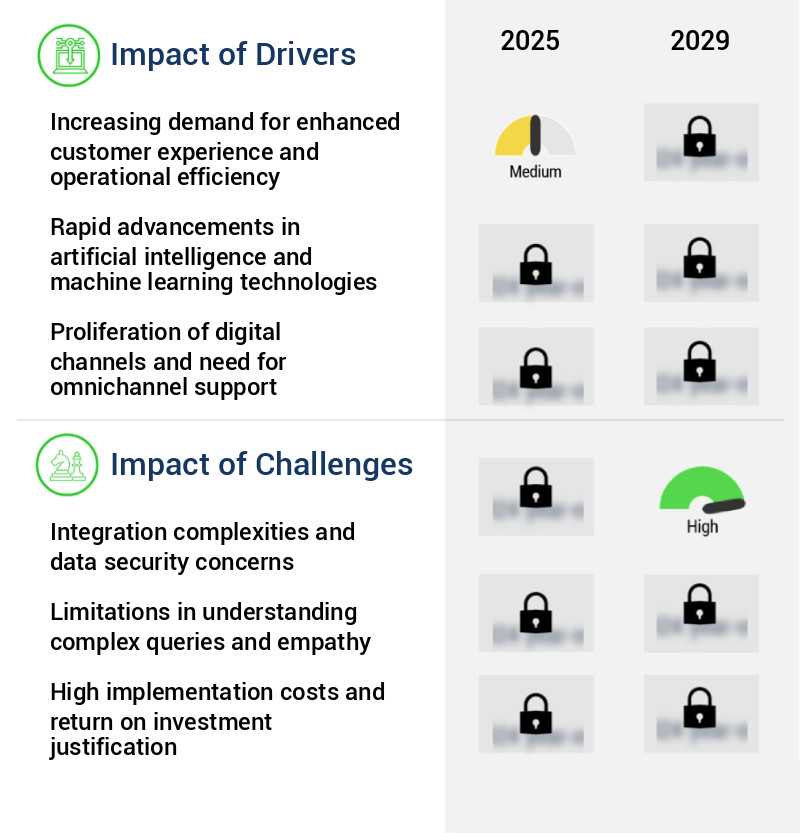
What are the key market drivers leading to the rise in the adoption of AI-Driven Customer Support Agents Industry?
- The market is propelled forward by the escalating need for superior customer experience and heightened operational efficiency.
- The market is experiencing significant growth as businesses strive to enhance customer experiences and boost operational efficiency. Across various sectors, the demand for instant, accurate, and personalized support available around the clock is escalating. Traditional human-centric models face limitations in scalability, availability, and cost, making it challenging to meet these demands. AI-driven agents offer a viable solution by providing immediate responses to common queries, guiding customers through processes, and resolving issues without human intervention. This capability significantly reduces customer wait times and frustration, leading to increased satisfaction and loyalty. According to recent studies, the adoption of AI in customer service is projected to reach 90% by 2025, up from 35% in 2020.
- Furthermore, AI-driven agents can handle up to 80% of customer queries, freeing up human agents to focus on more complex issues. This efficient distribution of tasks leads to substantial cost savings and improved overall customer service quality.
What are the market trends shaping the AI-Driven Customer Support Agents Industry?
- The upcoming market trend involves hyper-personalization and proactive customer engagement. Hyper-personalization and proactive customer engagement are the key elements of the current market trend.
- The market is witnessing a significant evolution, with a growing emphasis on hyper-personalization and proactive engagement. Going beyond traditional inquiry resolution, businesses are utilizing AI to anticipate customer needs, provide tailored recommendations, and initiate support before issues arise. This shift is driven by advanced analytics and machine learning algorithms that process extensive customer data, including past interactions, purchase history, browsing behavior, and demographic information, to generate individualized customer profiles. AI agents can then leverage these insights to deliver personalized content, suggest pertinent products or services, and offer proactive notifications regarding order statuses, service disruptions, or potential concerns. The integration of AI in customer support is transforming various sectors, with applications extending to industries such as healthcare, retail, and finance.
- According to recent studies, AI-driven customer support agents are handling over 20% of customer interactions, and this number is projected to increase further in the coming years. The benefits of AI in customer support are undeniable, offering businesses a competitive edge through enhanced customer experiences and improved operational efficiency.
What challenges does the AI-Driven Customer Support Agents Industry face during its growth?
- The integration complexities and data security concerns represent significant challenges that can hinder industry growth. It is essential to address these issues with a professional approach, ensuring seamless integration processes and implementing robust security measures to protect sensitive data and maintain trust with stakeholders.
- AI-driven customer support agents have gained significant traction in various sectors due to their ability to enhance efficiency and provide personalized, round-the-clock assistance. However, integrating these advanced systems into existing enterprise structures poses challenges. The complexity of merging AI agents with legacy CRM systems, ERP platforms, and communication channels necessitates deep technical expertise and custom development. Many organizations grapple with fragmented IT infrastructures, further complicating the deployment process. According to recent studies, the global AI in customer service market is projected to reach a value of USD1.25 billion by 2027, growing at a substantial rate. Another report indicates that AI customer service adoption is projected to increase by 150% in the next few years.
- Despite these promising figures, the integration process remains a significant hurdle, underscoring the need for strategic planning and technical proficiency.
Exclusive Technavio Analysis on Customer Landscape
The ai-driven customer support agents market forecasting report includes the adoption lifecycle of the market, covering from the innovator's stage to the laggard's stage. It focuses on adoption rates in different regions based on penetration. Furthermore, the ai-driven customer support agents market report also includes key purchase criteria and drivers of price sensitivity to help companies evaluate and develop their market growth analysis strategies.
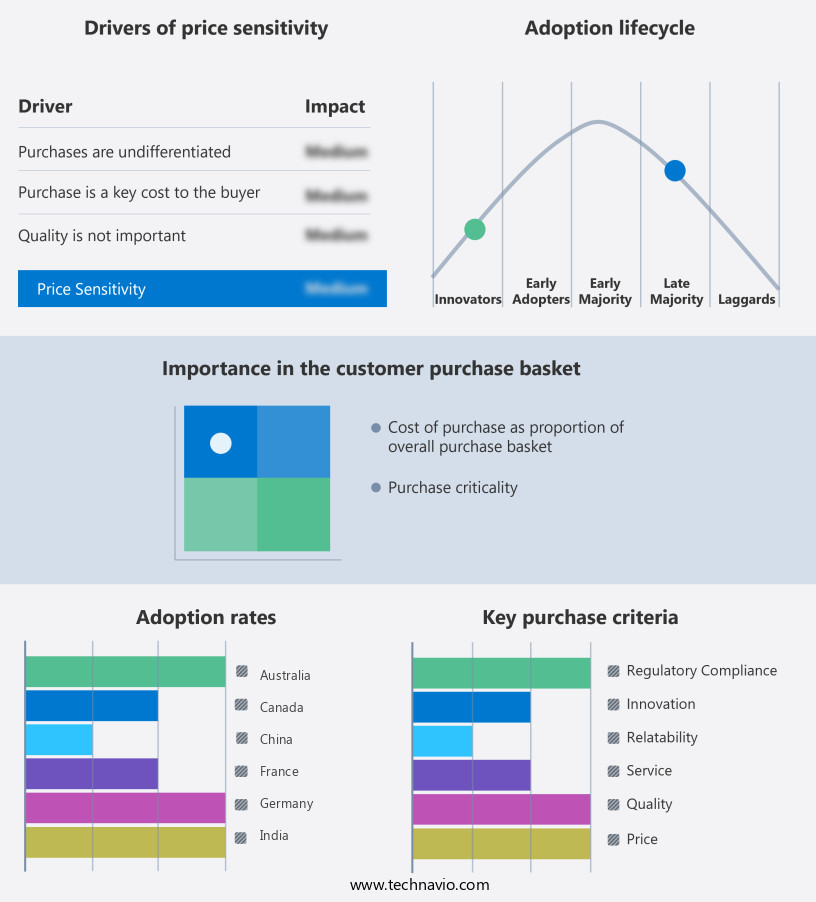
Customer Landscape of AI-Driven Customer Support Agents Industry
Competitive Landscape
Companies are implementing various strategies, such as strategic alliances, ai-driven customer support agents market forecast, partnerships, mergers and acquisitions, geographical expansion, and product/service launches, to enhance their presence in the industry.
Adobe Inc. - Adobe Experience Cloud's Adobe Journey Optimizer integrates AI-driven customer support agents, such as AI Assistant. This advanced technology enhances interface and orchestration capabilities, enabling AI to guide operations and personalization within the platform. By leveraging AI, businesses can optimize customer experiences more effectively.
The industry research and growth report includes detailed analyses of the competitive landscape of the market and information about key companies, including:
- Adobe Inc.
- AI Superior GmbH
- Amazon Web Services Inc.
- Five9 Inc.
- Freshworks Inc.
- Genesys Telecommunications Laboratories Inc.
- Google LLC
- HubSpot Inc.
- Intercom Inc.
- Kustomer
- Microsoft Corp.
- NICE Ltd.
- Oracle Corp.
- Salesforce Inc.
- SAP SE
- ServiceNow Inc.
- Sprinklr Inc.
- Tidio LLC
- Verint Systems Inc.
- Zendesk Inc.
Qualitative and quantitative analysis of companies has been conducted to help clients understand the wider business environment as well as the strengths and weaknesses of key industry players. Data is qualitatively analyzed to categorize companies as pure play, category-focused, industry-focused, and diversified; it is quantitatively analyzed to categorize companies as dominant, leading, strong, tentative, and weak.
Recent Development and News in AI-Driven Customer Support Agents Market
- In January 2024, IBM announced the integration of Watson Assistant into its Power Automate platform, enabling businesses to deploy AI-driven customer support agents across various industries (IBM Press Release). This expansion aimed to streamline customer interactions and improve response times.
- In March 2024, Microsoft and Amazon Web Services (AWS) formed a strategic partnership to integrate Microsoft's customer service platform, Dynamics 365, with Amazon Connect, AWS's contact center solution. This collaboration allowed businesses to leverage both companies' AI technologies for enhanced customer support services (Microsoft News Center).
- In April 2025, Google Cloud announced a USD200 million investment in its AI-driven customer support agent platform, Google Contact Center AI. The funding aimed to accelerate product development and expand its market share, positioning Google as a major player in the AI customer support space (Google Cloud Blog).
- In May 2025, Zendesk, a leading customer service software company, acquired Momentive Global, the creator of SurveyMonkey, for USD429 million. The acquisition aimed to integrate Momentive's AI-driven survey tools into Zendesk's customer support platform, enhancing the company's ability to gather and analyze customer feedback (Zendesk Press Release).
Dive into Technavio's robust research methodology, blending expert interviews, extensive data synthesis, and validated models for unparalleled AI-Driven Customer Support Agents Market insights. See full methodology.
|
Market Scope |
|
|
Report Coverage |
Details |
|
Page number |
244 |
|
Base year |
2024 |
|
Historic period |
2019-2023 |
|
Forecast period |
2025-2029 |
|
Growth momentum & CAGR |
Accelerate at a CAGR of 33.9% |
|
Market growth 2025-2029 |
USD 13070.1 million |
|
Market structure |
Fragmented |
|
YoY growth 2024-2025(%) |
30.8 |
|
Key countries |
US, China, Germany, Japan, UK, Canada, France, India, South Korea, and Australia |
|
Competitive landscape |
Leading Companies, Market Positioning of Companies, Competitive Strategies, and Industry Risks |
Research Analyst Overview
- The AI-driven customer support agent market continues to evolve, with automated routing protocols streamlining interaction channels and speech-to-text conversion enabling seamless communication. Agent training datasets, performance monitoring metrics, and customer journey mapping are essential components, ensuring optimal agent performance and customer satisfaction. Deep learning algorithms and intent recognition technology power conversational AI platforms, while natural language processing enhances user experience. Multi-lingual support systems and knowledge base management cater to diverse customer needs, with data privacy regulations ensuring secure handling of sensitive information. Conversational AI platforms employ human-in-the-loop systems and escalation management systems for complex queries, while contextual awareness engines and virtual assistant frameworks provide personalized interactions.
- Reinforcement learning techniques and personalization strategies improve agent performance, and sentiment analysis tools gauge customer emotions. FAQ integration methods and chatbot development platforms offer self-service options, reducing response times. Predictive analytics models and knowledge graph integration provide proactive solutions, enhancing customer experience. Security protocols compliance and entity extraction methods maintain data security, and text-to-speech synthesis offers accessibility options. Machine learning models and feedback loop mechanisms continually refine agent responses, ensuring continuous improvement. The market for AI-driven customer support agents is projected to grow by 20% annually, underscoring its transformative impact on customer service. For instance, a leading retailer implemented an AI-powered customer support system, resulting in a 30% reduction in response times and a 25% increase in customer satisfaction ratings.
- This illustrates the potential of AI in streamlining support processes and improving overall customer experience.
What are the Key Data Covered in this AI-Driven Customer Support Agents Market Research and Growth Report?
-
What is the expected growth of the AI-Driven Customer Support Agents Market between 2025 and 2029?
-
USD 13.07 billion, at a CAGR of 33.9%
-
-
What segmentation does the market report cover?
-
The report is segmented by Deployment (Cloud-based and On-premises), Solution (Chatbots, Virtual assistants, Automated ticketing, Voice-based support, and Others), End-user (BFSI, Healthcare and life science, Retails and e-commerce, Media and entertainment, and Others), and Geography (North America, APAC, Europe, Middle East and Africa, and South America)
-
-
Which regions are analyzed in the report?
-
North America, APAC, Europe, Middle East and Africa, and South America
-
-
What are the key growth drivers and market challenges?
-
Increasing demand for enhanced customer experience and operational efficiency, Integration complexities and data security concerns
-
-
Who are the major players in the AI-Driven Customer Support Agents Market?
-
Adobe Inc., AI Superior GmbH, Amazon Web Services Inc., Five9 Inc., Freshworks Inc., Genesys Telecommunications Laboratories Inc., Google LLC, HubSpot Inc., Intercom Inc., Kustomer, Microsoft Corp., NICE Ltd., Oracle Corp., Salesforce Inc., SAP SE, ServiceNow Inc., Sprinklr Inc., Tidio LLC, Verint Systems Inc., and Zendesk Inc.
-
Market Research Insights
- The market for AI-driven customer support agents continues to evolve, with increasing adoption by businesses seeking to enhance their customer experience. According to recent industry reports, the market is expected to grow by over 20% annually in the coming years. For instance, a large retailer reported a 15% increase in customer satisfaction scores after implementing an AI-powered chatbot solution. This technology allows for 24/7 availability, quick response times, and the ability to handle multiple queries simultaneously. Additionally, AI agents can leverage natural language processing techniques for contextual understanding and intent classification accuracy, providing personalized interactions for each customer.
- Furthermore, they can integrate with FAQ chatbot systems, incident management tools, and KPI dashboards to streamline operations and improve overall efficiency. Data security measures and privacy compliance standards are also prioritized in the development of these solutions, ensuring customer information remains protected.
We can help! Our analysts can customize this ai-driven customer support agents market research report to meet your requirements.
 RIA -
RIA -