


AI Clinical Care Market Analysis, Size, and Forecast 2025-2029: North America (US, Canada, and Mexico), APAC (China, Japan, and India), Europe (Germany, UK, and France), South America (Brazil, Argentina, and Colombia), Middle East and Africa (Israel, UAE, and Saudi Arabia), and Rest of World (ROW)

AI Clinical Care Market Analysis, Size, and Forecast 2025-2029:
North America (US, Canada, and Mexico), APAC (China, Japan, and India), Europe (Germany, UK, and France), South America (Brazil, Argentina, and Colombia), Middle East and Africa (Israel, UAE, and Saudi Arabia), and Rest of World (ROW)

Published: Dec 2025 299 Pages SKU: IRTNTR81044

Market Overview at a Glance

$23.02 B
Market Opportunity
21.4%
CAGR 2024 - 2029
40.1%
North America Growth
$5.83 B
ML segment 2023

AI Clinical Care Market Size 2025-2029

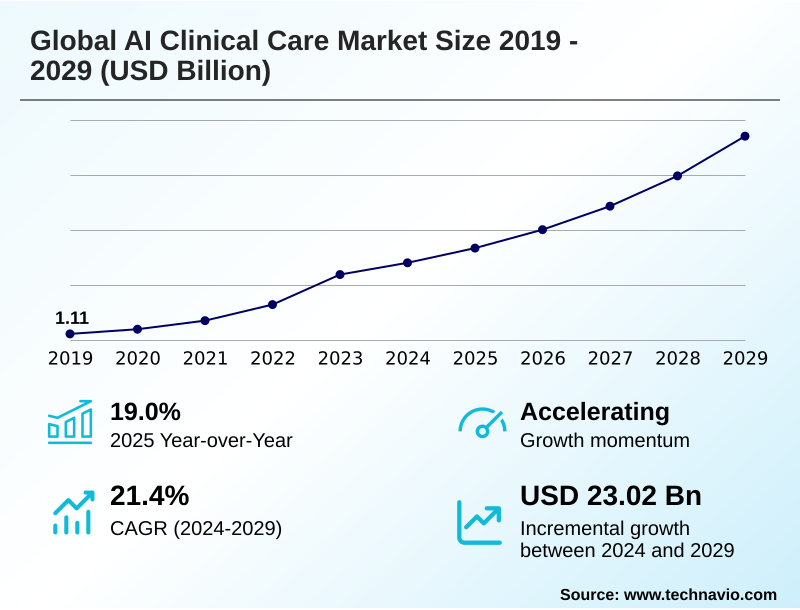
The ai clinical care market size is valued to increase by USD 23.02 billion, at a CAGR of 21.4% from 2024 to 2029. Proliferation of complex healthcare data and imperative for advanced analytics will drive the ai clinical care market.

Major Market Trends & Insights

  • North America dominated the market and accounted for a 40.1% growth during the forecast period.
  • By Technology - ML segment was valued at USD 5.83 billion in 2023
  • By Application - Diagnostic imaging segment accounted for the largest market revenue share in 2023

Market Size & Forecast

  • Market Opportunities: USD 35.95 billion
  • Market Future Opportunities: USD 23.02 billion
  • CAGR from 2024 to 2029 : 21.4%

Market Summary

  • The AI clinical care market is undergoing transformative expansion, driven by the convergence of immense healthcare datasets and powerful computational capabilities. This shift enables a move from reactive treatment to proactive, personalized health management. Key drivers include the pressing need to improve operational efficiency in strained healthcare systems and enhance the accuracy of diagnostics.
  • A primary trend is the integration of generative AI into clinical workflows, automating documentation and augmenting decision-making. For instance, in a hospital setting, AI platforms analyze real-time patient data streams to predict the onset of critical conditions like sepsis, allowing for early intervention that significantly improves patient outcomes.
  • These systems simultaneously optimize resource allocation by forecasting patient admission rates and managing bed capacity, enhancing patient flow. However, the market faces challenges related to data governance, patient privacy, and the need for clear interoperability standards.
  • The development of explainable AI is crucial to building clinical trust, while ongoing efforts to mitigate algorithmic bias are essential for ensuring equitable care and addressing ethical concerns.

What will be the Size of the AI Clinical Care Market during the forecast period?
Get Key Insights on Market Forecast (PDF) Request Free Sample

How is the AI Clinical Care Market Segmented?

The ai clinical care industry research report provides comprehensive data (region-wise segment analysis), with forecasts and estimates in "USD million" for the period 2025-2029, as well as historical data from 2019-2023 for the following segments.

  • Technology
    • ML
    • NLP
    • Computer Vision
  • Application
    • Diagnostic imaging
    • Predictive analytics
    • Virtual health assistants
  • End-user
    • Hospitals
    • Clinics
    • Research institutions
    • Telehealth providers
  • Geography
    • North America
      • US
      • Canada
      • Mexico
    • APAC
      • China
      • Japan
      • India
    • Europe
      • Germany
      • UK
      • France
    • South America
      • Brazil
      • Argentina
      • Colombia
    • Middle East and Africa
      • Israel
      • UAE
      • Saudi Arabia
    • Rest of World (ROW)

By Technology Insights

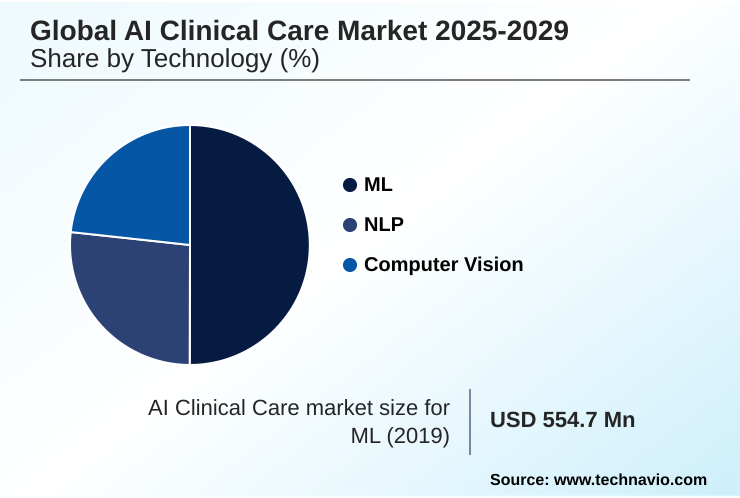
The ml segment is estimated to witness significant growth during the forecast period.

The market is segmented by technology, application, and geography.

Machine Learning (ML) is the dominant technology, crucial for predictive analytics and diagnostic imaging, where tools for automated polyp detection and advanced medical image segmentation have led to a 19% improvement in diagnostic error reduction.

Application segments are led by diagnostic imaging and virtual health assistants. Geographically, North America leads, but all regions grapple with data governance and health data privacy.

Establishing robust interoperability standards is vital for effective patient flow management and using real-world evidence for AI in population health. Strong AI ethics in healthcare guide innovations in AI-assisted surgery, clinical trial matching, and therapeutic intervention, ensuring responsible deployment.
Request Free Sample

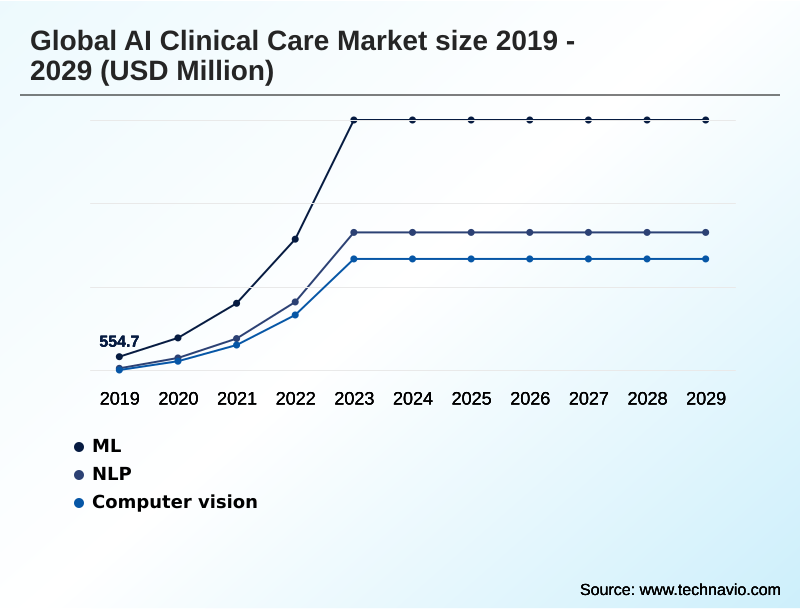
The ML segment was valued at USD 5.83 billion in 2023 and showed a gradual increase during the forecast period.
Request Free Sample

Regional Analysis

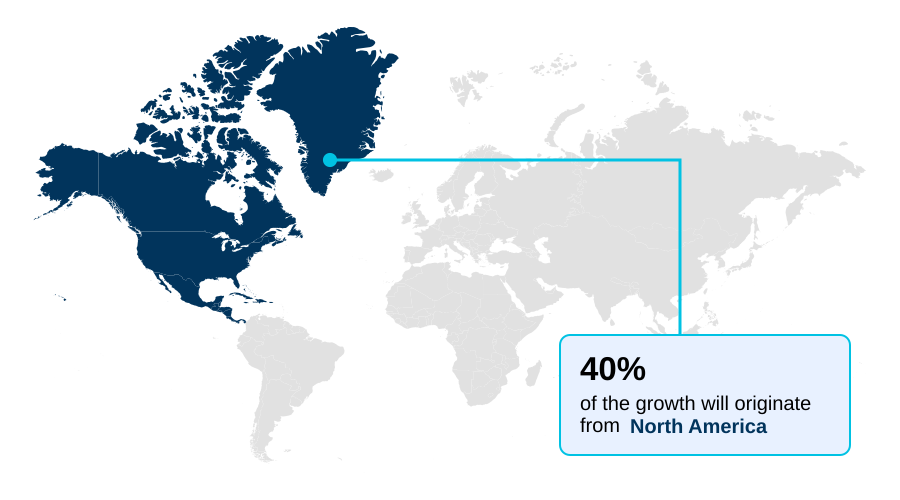
North America is estimated to contribute 40.1% to the growth of the global market during the forecast period.Technavio’s analysts have elaborately explained the regional trends and drivers that shape the market during the forecast period.
See How AI Clinical Care Market Demand is Rising in North America Request Free Sample

North America leads the market, contributing over 40% of the incremental growth, driven by advanced infrastructure and high investment in AI-enabled medical devices.

The region excels in applying deep learning algorithms to real-time data streams for applications in AI in cardiology and precision oncology.

The push for clinical data harmonization across systems facilitates complex tasks like cohort identification for trials and patient risk stratification.

In APAC, which shows the fastest growth rate, the focus is on scalable solutions that leverage genomic sequencing analysis for treatment pathway personalization. Across all regions, the implementation of health equity algorithm auditing is becoming critical.

Europe is focused on technologies like ambient clinical intelligence and automated medical coding, with deployments showing a 20% improvement in billing accuracy.

Market Dynamics

Our researchers analyzed the data with 2024 as the base year, along with the key drivers, trends, and challenges. A holistic analysis of drivers will help companies refine their marketing strategies to gain a competitive advantage.

  • Strategic imperatives in healthcare are accelerating the adoption of AI for early disease detection, which leverages predictive models for patient outcomes to enable proactive interventions. A core application is the use of NLP for unstructured clinical data, transforming narrative notes into actionable insights. In diagnostics, computer vision in radiology workflow is becoming standard practice for reducing diagnostic errors with AI.
  • This technology is crucial for improving hospital operational efficiency by streamlining workflows and reducing manual review times, with some facilities reporting a greater than two-fold increase in case throughput for certain imaging studies. The paradigm is shifting toward AI for personalized treatment plans, which are informed by a holistic view of the patient.
  • The growth of generative AI for patient communication through virtual assistants is enhancing engagement and education. A significant focus is the AI role in chronic disease management, where AI in remote patient monitoring provides continuous oversight. The industry is also investing heavily in machine learning in drug discovery to shorten development timelines.
  • Key enablers include SaaS models for clinical AI and effective clinical decision support system integration. Addressing technical and ethical hurdles, such as finding solutions for federated learning for data privacy and processes for AI algorithm validation process, is critical. Furthermore, a top priority is addressing algorithmic bias in healthcare to ensure equitable outcomes.
  • The expansion of AI applications in telehealth is also broadening access to care, highlighting the cost-effectiveness of AI in healthcare when deployed thoughtfully after training AI on electronic health records. Finally, generative AI for diagnostic support acts as a cognitive assistant for clinicians.
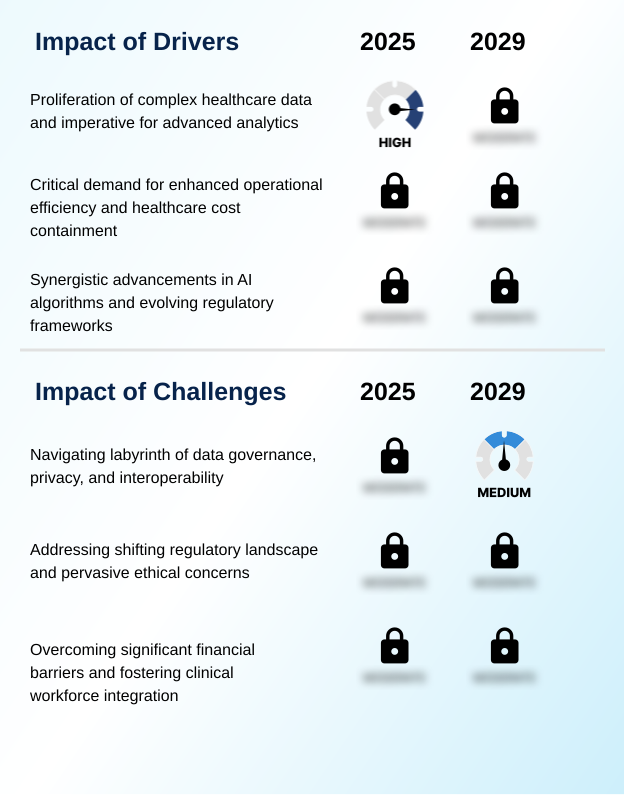
What are the key market drivers leading to the rise in the adoption of AI Clinical Care Industry?

  • The market is primarily driven by the proliferation of complex healthcare data and the corresponding imperative for advanced analytics to derive actionable clinical insights.

  • The proliferation of electronic health records (EHR) provides the necessary data to drive market growth, fueling innovations in drug discovery and improvements in diagnostic accuracy.
  • A clear regulatory pathway for Software as a Medical Device (SaMD) encourages development, while techniques like federated learning address data privacy concerns.
  • The need for operational efficiency is a major driver, with robotic process automation (RPA) and cognitive automation streamlining administrative tasks. Technologies like AI-driven triage and clinical note summarization are reducing physician administrative time by up to 40%.
  • The demand for patient-facing tools like virtual health assistants and systems for automated insulin delivery is also increasing, while developers actively work to mitigate algorithmic bias to ensure equitable outcomes across diverse populations.

What are the market trends shaping the AI Clinical Care Industry?

  • A prominent market trend is the integration of generative AI for clinical documentation and diagnostic support. This is reshaping clinical workflows and augmenting decision-making processes.

  • A transformative trend is the rapid integration of generative AI into clinical workflows, with large language models enhancing clinical decision support. The application of natural language processing automates documentation, while advancements in computer vision and medical imaging analysis are central to AI in radiology. These multimodal AI systems process diverse data inputs, leading to augmented clinical intelligence.
  • The focus on explainable AI (XAI) is growing to ensure trust in systems performing predictive risk scoring and computational pathology. This shift enables more sophisticated predictive analytics, with some platforms improving diagnostic report generation speeds by over 50% compared to manual methods, while maintaining high accuracy rates of up to 98%.

What challenges does the AI Clinical Care Industry face during its growth?

  • A key challenge affecting industry growth involves navigating the complexities of data governance, patient privacy regulations, and system interoperability.

  • A significant challenge is integrating AI-powered diagnostics into existing hospital systems, which requires extensive clinical workflow optimization. The deployment of machine learning models for applications like personalized medicine and genomic data analysis faces hurdles related to data quality and infrastructure costs. Although remote patient monitoring and point-of-care diagnostics offer immense potential, their widespread adoption is hindered by reimbursement complexities.
  • The development of a digital twin in healthcare or advanced AI for sepsis detection requires significant investment. Furthermore, ensuring that tools like intelligent chatbots provide clinically valid advice is a key concern. Successfully implementing care coordination platforms and tools for AI-powered drug screening or digital pathology often results in a 15% reduction in redundant testing but requires substantial upfront capital.

Exclusive Technavio Analysis on Customer Landscape

The ai clinical care market forecasting report includes the adoption lifecycle of the market, covering from the innovator’s stage to the laggard’s stage. It focuses on adoption rates in different regions based on penetration. Furthermore, the ai clinical care market report also includes key purchase criteria and drivers of price sensitivity to help companies evaluate and develop their market growth analysis strategies.
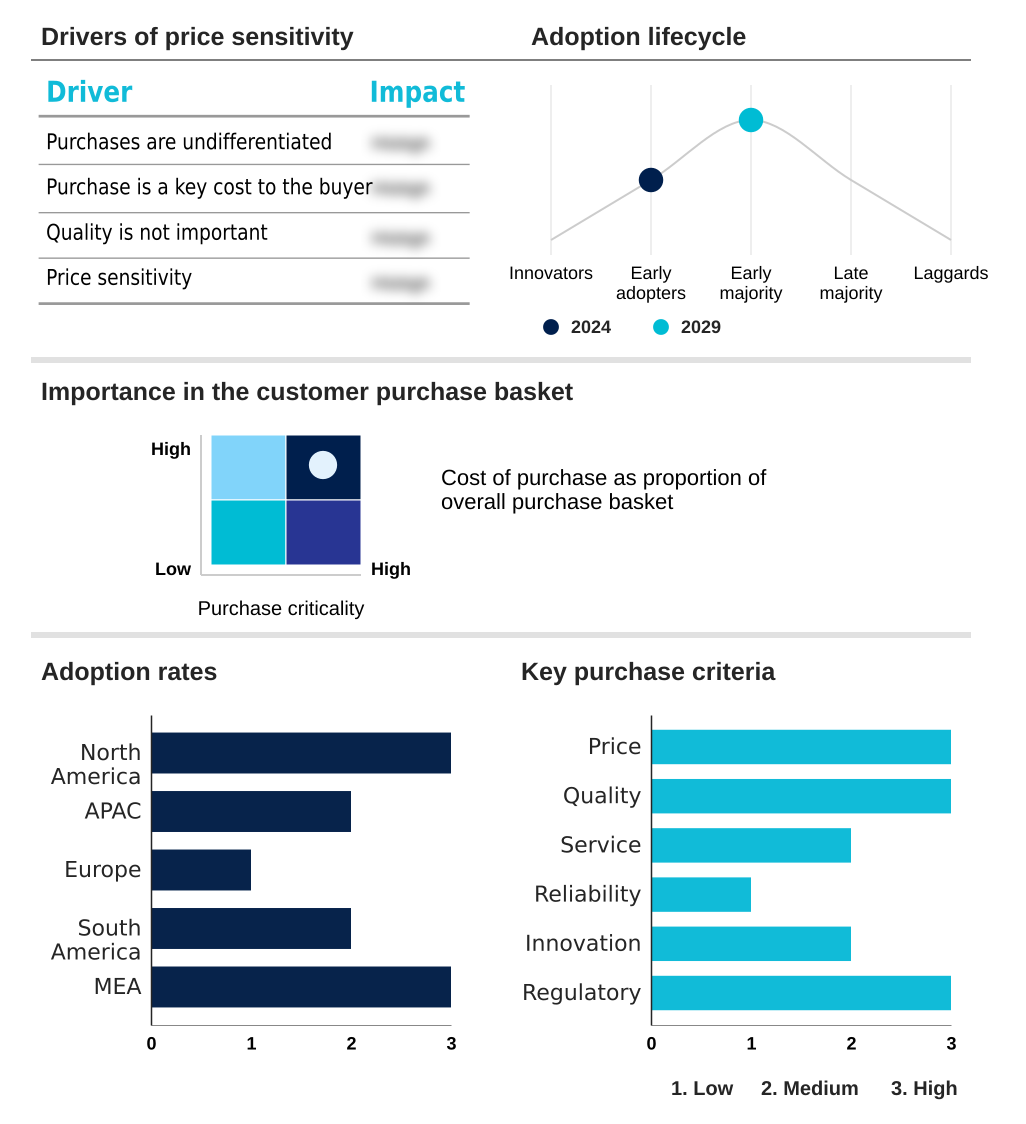
Customer Landscape of AI Clinical Care Industry

Competitive Landscape

Companies are implementing various strategies, such as strategic alliances, ai clinical care market forecast, partnerships, mergers and acquisitions, geographical expansion, and product/service launches, to enhance their presence in the industry.

Aidoc Medical Ltd. - Offerings focus on an AI operating system using multiple FDA-cleared algorithms to expedite patient treatment through advanced medical imaging analysis and improve care quality.

The industry research and growth report includes detailed analyses of the competitive landscape of the market and information about key companies, including:

  • Aidoc Medical Ltd.
  • Amazon Web Services Inc.
  • Butterfly Network Inc.
  • Epic Systems Corp.
  • GE Healthcare Technologies
  • Google LLC
  • Koninklijke Philips NV
  • Medtronic Plc
  • Merative L.P.
  • Microsoft Corp.
  • Oracle Corp.
  • Owkin Inc.
  • PathAI Inc.
  • Qure.ai Technologies Pvt. Ltd.
  • Siemens Healthineers AG
  • Tempus Labs Inc.
  • Viz.ai Inc.

Qualitative and quantitative analysis of companies has been conducted to help clients understand the wider business environment as well as the strengths and weaknesses of key industry players. Data is qualitatively analyzed to categorize companies as pure play, category-focused, industry-focused, and diversified; it is quantitatively analyzed to categorize companies as dominant, leading, strong, tentative, and weak.

Recent Development and News in Ai clinical care market

  • In September 2024, Prenosis Inc. received De Novo marketing authorization from the US Food and Drug Administration for its Sepsis ImmunoScore, establishing a new regulatory category for AI-based sepsis diagnosis software.
  • In November 2024, AI Singapore and the National University Health System (NUHS) initiated a strategic collaboration to develop Southeast Asia's first large language model tailored for regional clinical and biomedical data.
  • In January 2025, Microsoft Corp. announced the general availability of its DAX Copilot, a solution using ambient AI to automatically generate clinical summaries from physician-patient conversations, integrating directly into EHR systems.
  • In April 2025, Annalise.ai secured US FDA 510(k) clearance for its Annalise Triage solution, an AI tool designed to identify and flag critical findings on chest X-rays to help radiologists prioritize urgent cases.

Dive into Technavio’s robust research methodology, blending expert interviews, extensive data synthesis, and validated models for unparalleled AI Clinical Care Market insights. See full methodology.

Market Scope
Page number 299
Base year 2024
Historic period 2019-2023
Forecast period 2025-2029
Growth momentum & CAGR Accelerate at a CAGR of 21.4%
Market growth 2025-2029 USD 23018.9 million
Market structure Fragmented
YoY growth 2024-2025(%) 19.0%
Key countries US, Canada, Mexico, China, Japan, India, South Korea, Australia, Indonesia, Germany, UK, France, Italy, The Netherlands, Spain, Brazil, Argentina, Colombia, Israel, UAE, Saudi Arabia, South Africa and Turkey
Competitive landscape Leading Companies, Market Positioning of Companies, Competitive Strategies, and Industry Risks

Request Free Sample

Research Analyst Overview

  • The AI clinical care market's architecture is built on machine learning models and deep learning algorithms that process real-time data streams and electronic health records (EHR) to enhance diagnostic accuracy. Key applications include medical imaging analysis, digital pathology, and AI-powered diagnostics, all governed by evolving interoperability standards.
  • The drive for personalized medicine relies on sophisticated genomic data analysis and treatment pathway personalization. This necessitates strict data governance and health data privacy, often addressed through techniques like federated learning.
  • For boardroom strategy, the approval pathway for Software as a Medical Device (SaMD) is a critical consideration, as regulatory clearance can improve market entry speed by up to 30% compared to traditional hardware. Innovations in natural language processing are transforming clinical documentation and enabling effective clinical trial matching and cohort identification.
  • Simultaneously, tools for remote patient monitoring, AI-assisted surgery, and automated medical coding are driving clinical workflow optimization. The ultimate goal is to leverage real-world evidence for superior therapeutic intervention, while actively mitigating algorithmic bias and upholding principles of ambient clinical intelligence and patient-centric care through effective patient risk stratification.

What are the Key Data Covered in this AI Clinical Care Market Research and Growth Report?

  • What is the expected growth of the AI Clinical Care Market between 2025 and 2029?

    • USD 23.02 billion, at a CAGR of 21.4%

  • What segmentation does the market report cover?

    • The report is segmented by Technology (ML, NLP, Computer vision), Application (Diagnostic imaging, Predictive analytics, Virtual health assistants), End-user (Hospitals, Clinics, Research institutions, Telehealth providers) and Geography (North America, APAC, Europe, South America, Middle East and Africa)

  • Which regions are analyzed in the report?

    • North America, APAC, Europe, South America and Middle East and Africa

  • What are the key growth drivers and market challenges?

    • Proliferation of complex healthcare data and imperative for advanced analytics, Navigating labyrinth of data governance, privacy, and interoperability

  • Who are the major players in the AI Clinical Care Market?

    • Aidoc Medical Ltd., Amazon Web Services Inc., Butterfly Network Inc., Epic Systems Corp., GE Healthcare Technologies, Google LLC, Koninklijke Philips NV, Medtronic Plc, Merative L.P., Microsoft Corp., Oracle Corp., Owkin Inc., PathAI Inc., Qure.ai Technologies Pvt. Ltd., Siemens Healthineers AG, Tempus Labs Inc. and Viz.ai Inc.

Market Research Insights

  • Market dynamics reflect a push for augmented clinical intelligence to achieve significant diagnostic error reduction, with some AI-enabled medical devices improving accuracy by over 20%. Care coordination platforms are optimizing patient flow management, cutting wait times by 15%. Innovations span from computational pathology and medical image segmentation to AI-driven triage.
  • Patient engagement is enhanced by virtual health assistants and intelligent chatbots, while clinical tools target automated polyp detection and AI for sepsis detection. In specialized fields, AI in cardiology and precision oncology are advancing rapidly. Foundational trust is being built via explainable AI (XAI) and health equity algorithm auditing.
  • Efficiency is driven by robotic process automation (RPA), cognitive automation, and clinical note summarization, supporting broader AI in population health initiatives.

We can help! Our analysts can customize this ai clinical care market research report to meet your requirements.

Get in touch

1. Executive Summary

1.1 Market overview

Executive Summary - Chart on Market Overview
Executive Summary - Data Table on Market Overview
Executive Summary - Chart on Global Market Characteristics
Executive Summary - Chart on Market by Geography
Executive Summary - Chart on Market Segmentation by Technology
Executive Summary - Chart on Market Segmentation by Application
Executive Summary - Chart on Market Segmentation by End-user
Executive Summary - Chart on Incremental Growth
Executive Summary - Data Table on Incremental Growth
Executive Summary - Chart on Company Market Positioning

2. Technavio Analysis

2.1 Analysis of price sensitivity, lifecycle, customer purchase basket, adoption rates, and purchase criteria

2.2 Criticality of inputs and Factors of differentiation

Chart on Overview on criticality of inputs and factors of differentiation

2.3 Factors of disruption

Chart on Overview on factors of disruption

2.4 Impact of drivers and challenges

Chart on Impact of drivers and challenges in 2024 and 2029

3. Market Landscape

3.1 Market ecosystem

Chart on Parent Market
Data Table on - Parent Market

3.2 Market characteristics

Chart on Market characteristics analysis

3.3 Value chain analysis

Chart on Value chain analysis

4. Market Sizing

4.1 Market definition

Data Table on Offerings of companies included in the market definition

4.2 Market segment analysis

Market segments

4.3 Market size 2024

4.4 Market outlook: Forecast for 2024-2029

Chart on Global - Market size and forecast 2024-2029 ($ million)
Data Table on Global - Market size and forecast 2024-2029 ($ million)
Chart on Global Market: Year-over-year growth 2024-2029 (%)
Data Table on Global Market: Year-over-year growth 2024-2029 (%)

5. Historic Market Size

5.1 Global AI Clinical Care Market 2019 - 2023

Historic Market Size - Data Table on Global AI Clinical Care Market 2019 - 2023 ($ million)

5.2 Technology segment analysis 2019 - 2023

Historic Market Size - Technology Segment 2019 - 2023 ($ million)

5.3 Application segment analysis 2019 - 2023

Historic Market Size - Application Segment 2019 - 2023 ($ million)

5.4 End-user segment analysis 2019 - 2023

Historic Market Size - End-user Segment 2019 - 2023 ($ million)

5.5 Geography segment analysis 2019 - 2023

Historic Market Size - Geography Segment 2019 - 2023 ($ million)

5.6 Country segment analysis 2019 - 2023

Historic Market Size - Country Segment 2019 - 2023 ($ million)

6. Five Forces Analysis

6.1 Five forces summary

Five forces analysis - Comparison between 2024 and 2029

6.2 Bargaining power of buyers

Bargaining power of buyers - Impact of key factors 2024 and 2029

6.3 Bargaining power of suppliers

Bargaining power of suppliers - Impact of key factors in 2024 and 2029

6.4 Threat of new entrants

Threat of new entrants - Impact of key factors in 2024 and 2029

6.5 Threat of substitutes

Threat of substitutes - Impact of key factors in 2024 and 2029

6.6 Threat of rivalry

Threat of rivalry - Impact of key factors in 2024 and 2029

6.7 Market condition

Chart on Market condition - Five forces 2024 and 2029

7. Market Segmentation by Technology

7.1 Market segments

Chart on Technology - Market share 2024-2029 (%)
Data Table on Technology - Market share 2024-2029 (%)

7.2 Comparison by Technology

Chart on Comparison by Technology
Data Table on Comparison by Technology

7.3 ML - Market size and forecast 2024-2029

Chart on ML - Market size and forecast 2024-2029 ($ million)
Data Table on ML - Market size and forecast 2024-2029 ($ million)
Chart on ML - Year-over-year growth 2024-2029 (%)
Data Table on ML - Year-over-year growth 2024-2029 (%)

7.4 NLP - Market size and forecast 2024-2029

Chart on NLP - Market size and forecast 2024-2029 ($ million)
Data Table on NLP - Market size and forecast 2024-2029 ($ million)
Chart on NLP - Year-over-year growth 2024-2029 (%)
Data Table on NLP - Year-over-year growth 2024-2029 (%)

7.5 Computer Vision - Market size and forecast 2024-2029

Chart on Computer Vision - Market size and forecast 2024-2029 ($ million)
Data Table on Computer Vision - Market size and forecast 2024-2029 ($ million)
Chart on Computer Vision - Year-over-year growth 2024-2029 (%)
Data Table on Computer Vision - Year-over-year growth 2024-2029 (%)

7.6 Market opportunity by Technology

Market opportunity by Technology ($ million)
Data Table on Market opportunity by Technology ($ million)

8. Market Segmentation by Application

8.1 Market segments

Chart on Application - Market share 2024-2029 (%)
Data Table on Application - Market share 2024-2029 (%)

8.2 Comparison by Application

Chart on Comparison by Application
Data Table on Comparison by Application

8.3 Diagnostic imaging - Market size and forecast 2024-2029

Chart on Diagnostic imaging - Market size and forecast 2024-2029 ($ million)
Data Table on Diagnostic imaging - Market size and forecast 2024-2029 ($ million)
Chart on Diagnostic imaging - Year-over-year growth 2024-2029 (%)
Data Table on Diagnostic imaging - Year-over-year growth 2024-2029 (%)

8.4 Predictive analytics - Market size and forecast 2024-2029

Chart on Predictive analytics - Market size and forecast 2024-2029 ($ million)
Data Table on Predictive analytics - Market size and forecast 2024-2029 ($ million)
Chart on Predictive analytics - Year-over-year growth 2024-2029 (%)
Data Table on Predictive analytics - Year-over-year growth 2024-2029 (%)

8.5 Virtual health assistants - Market size and forecast 2024-2029

Chart on Virtual health assistants - Market size and forecast 2024-2029 ($ million)
Data Table on Virtual health assistants - Market size and forecast 2024-2029 ($ million)
Chart on Virtual health assistants - Year-over-year growth 2024-2029 (%)
Data Table on Virtual health assistants - Year-over-year growth 2024-2029 (%)

8.6 Market opportunity by Application

Market opportunity by Application ($ million)
Data Table on Market opportunity by Application ($ million)

9. Market Segmentation by End-user

9.1 Market segments

Chart on End-user - Market share 2024-2029 (%)
Data Table on End-user - Market share 2024-2029 (%)

9.2 Comparison by End-user

Chart on Comparison by End-user
Data Table on Comparison by End-user

9.3 Hospitals - Market size and forecast 2024-2029

Chart on Hospitals - Market size and forecast 2024-2029 ($ million)
Data Table on Hospitals - Market size and forecast 2024-2029 ($ million)
Chart on Hospitals - Year-over-year growth 2024-2029 (%)
Data Table on Hospitals - Year-over-year growth 2024-2029 (%)

9.4 Clinics - Market size and forecast 2024-2029

Chart on Clinics - Market size and forecast 2024-2029 ($ million)
Data Table on Clinics - Market size and forecast 2024-2029 ($ million)
Chart on Clinics - Year-over-year growth 2024-2029 (%)
Data Table on Clinics - Year-over-year growth 2024-2029 (%)

9.5 Research institutions - Market size and forecast 2024-2029

Chart on Research institutions - Market size and forecast 2024-2029 ($ million)
Data Table on Research institutions - Market size and forecast 2024-2029 ($ million)
Chart on Research institutions - Year-over-year growth 2024-2029 (%)
Data Table on Research institutions - Year-over-year growth 2024-2029 (%)

9.6 Telehealth providers - Market size and forecast 2024-2029

Chart on Telehealth providers - Market size and forecast 2024-2029 ($ million)
Data Table on Telehealth providers - Market size and forecast 2024-2029 ($ million)
Chart on Telehealth providers - Year-over-year growth 2024-2029 (%)
Data Table on Telehealth providers - Year-over-year growth 2024-2029 (%)

9.7 Market opportunity by End-user

Market opportunity by End-user ($ million)
Data Table on Market opportunity by End-user ($ million)

10. Customer Landscape

10.1 Customer landscape overview

Analysis of price sensitivity, lifecycle, customer purchase basket, adoption rates, and purchase criteria

11. Geographic Landscape

11.1 Geographic segmentation

Chart on Market share by geography 2024-2029 (%)
Data Table on Market share by geography 2024-2029 (%)

11.2 Geographic comparison

Chart on Geographic comparison
Data Table on Geographic comparison

11.3 North America - Market size and forecast 2024-2029

Chart on North America - Market size and forecast 2024-2029 ($ million)
Data Table on North America - Market size and forecast 2024-2029 ($ million)
Chart on North America - Year-over-year growth 2024-2029 (%)
Data Table on North America - Year-over-year growth 2024-2029 (%)
Chart on Regional Comparison - North America
Data Table on Regional Comparison - North America

11.3.1 US - Market size and forecast 2024-2029

Chart on US - Market size and forecast 2024-2029 ($ million)
Data Table on US - Market size and forecast 2024-2029 ($ million)
Chart on US - Year-over-year growth 2024-2029 (%)
Data Table on US - Year-over-year growth 2024-2029 (%)

11.3.2 Canada - Market size and forecast 2024-2029

Chart on Canada - Market size and forecast 2024-2029 ($ million)
Data Table on Canada - Market size and forecast 2024-2029 ($ million)
Chart on Canada - Year-over-year growth 2024-2029 (%)
Data Table on Canada - Year-over-year growth 2024-2029 (%)

11.3.3 Mexico - Market size and forecast 2024-2029

Chart on Mexico - Market size and forecast 2024-2029 ($ million)
Data Table on Mexico - Market size and forecast 2024-2029 ($ million)
Chart on Mexico - Year-over-year growth 2024-2029 (%)
Data Table on Mexico - Year-over-year growth 2024-2029 (%)

11.4 APAC - Market size and forecast 2024-2029

Chart on APAC - Market size and forecast 2024-2029 ($ million)
Data Table on APAC - Market size and forecast 2024-2029 ($ million)
Chart on APAC - Year-over-year growth 2024-2029 (%)
Data Table on APAC - Year-over-year growth 2024-2029 (%)
Chart on Regional Comparison - APAC
Data Table on Regional Comparison - APAC

11.4.1 China - Market size and forecast 2024-2029

Chart on China - Market size and forecast 2024-2029 ($ million)
Data Table on China - Market size and forecast 2024-2029 ($ million)
Chart on China - Year-over-year growth 2024-2029 (%)
Data Table on China - Year-over-year growth 2024-2029 (%)

11.4.2 Japan - Market size and forecast 2024-2029

Chart on Japan - Market size and forecast 2024-2029 ($ million)
Data Table on Japan - Market size and forecast 2024-2029 ($ million)
Chart on Japan - Year-over-year growth 2024-2029 (%)
Data Table on Japan - Year-over-year growth 2024-2029 (%)

11.4.3 India - Market size and forecast 2024-2029

Chart on India - Market size and forecast 2024-2029 ($ million)
Data Table on India - Market size and forecast 2024-2029 ($ million)
Chart on India - Year-over-year growth 2024-2029 (%)
Data Table on India - Year-over-year growth 2024-2029 (%)

11.4.4 South Korea - Market size and forecast 2024-2029

Chart on South Korea - Market size and forecast 2024-2029 ($ million)
Data Table on South Korea - Market size and forecast 2024-2029 ($ million)
Chart on South Korea - Year-over-year growth 2024-2029 (%)
Data Table on South Korea - Year-over-year growth 2024-2029 (%)

11.4.5 Australia - Market size and forecast 2024-2029

Chart on Australia - Market size and forecast 2024-2029 ($ million)
Data Table on Australia - Market size and forecast 2024-2029 ($ million)
Chart on Australia - Year-over-year growth 2024-2029 (%)
Data Table on Australia - Year-over-year growth 2024-2029 (%)

11.4.6 Indonesia - Market size and forecast 2024-2029

Chart on Indonesia - Market size and forecast 2024-2029 ($ million)
Data Table on Indonesia - Market size and forecast 2024-2029 ($ million)
Chart on Indonesia - Year-over-year growth 2024-2029 (%)
Data Table on Indonesia - Year-over-year growth 2024-2029 (%)

11.5 Europe - Market size and forecast 2024-2029

Chart on Europe - Market size and forecast 2024-2029 ($ million)
Data Table on Europe - Market size and forecast 2024-2029 ($ million)
Chart on Europe - Year-over-year growth 2024-2029 (%)
Data Table on Europe - Year-over-year growth 2024-2029 (%)
Chart on Regional Comparison - Europe
Data Table on Regional Comparison - Europe

11.5.1 Germany - Market size and forecast 2024-2029

Chart on Germany - Market size and forecast 2024-2029 ($ million)
Data Table on Germany - Market size and forecast 2024-2029 ($ million)
Chart on Germany - Year-over-year growth 2024-2029 (%)
Data Table on Germany - Year-over-year growth 2024-2029 (%)

11.5.2 UK - Market size and forecast 2024-2029

Chart on UK - Market size and forecast 2024-2029 ($ million)
Data Table on UK - Market size and forecast 2024-2029 ($ million)
Chart on UK - Year-over-year growth 2024-2029 (%)
Data Table on UK - Year-over-year growth 2024-2029 (%)

11.5.3 France - Market size and forecast 2024-2029

Chart on France - Market size and forecast 2024-2029 ($ million)
Data Table on France - Market size and forecast 2024-2029 ($ million)
Chart on France - Year-over-year growth 2024-2029 (%)
Data Table on France - Year-over-year growth 2024-2029 (%)

11.5.4 Italy - Market size and forecast 2024-2029

Chart on Italy - Market size and forecast 2024-2029 ($ million)
Data Table on Italy - Market size and forecast 2024-2029 ($ million)
Chart on Italy - Year-over-year growth 2024-2029 (%)
Data Table on Italy - Year-over-year growth 2024-2029 (%)

11.5.5 The Netherlands - Market size and forecast 2024-2029

Chart on The Netherlands - Market size and forecast 2024-2029 ($ million)
Data Table on The Netherlands - Market size and forecast 2024-2029 ($ million)
Chart on The Netherlands - Year-over-year growth 2024-2029 (%)
Data Table on The Netherlands - Year-over-year growth 2024-2029 (%)

11.5.6 Spain - Market size and forecast 2024-2029

Chart on Spain - Market size and forecast 2024-2029 ($ million)
Data Table on Spain - Market size and forecast 2024-2029 ($ million)
Chart on Spain - Year-over-year growth 2024-2029 (%)
Data Table on Spain - Year-over-year growth 2024-2029 (%)

11.6 South America - Market size and forecast 2024-2029

Chart on South America - Market size and forecast 2024-2029 ($ million)
Data Table on South America - Market size and forecast 2024-2029 ($ million)
Chart on South America - Year-over-year growth 2024-2029 (%)
Data Table on South America - Year-over-year growth 2024-2029 (%)
Chart on Regional Comparison - South America
Data Table on Regional Comparison - South America

11.6.1 Brazil - Market size and forecast 2024-2029

Chart on Brazil - Market size and forecast 2024-2029 ($ million)
Data Table on Brazil - Market size and forecast 2024-2029 ($ million)
Chart on Brazil - Year-over-year growth 2024-2029 (%)
Data Table on Brazil - Year-over-year growth 2024-2029 (%)

11.6.2 Argentina - Market size and forecast 2024-2029

Chart on Argentina - Market size and forecast 2024-2029 ($ million)
Data Table on Argentina - Market size and forecast 2024-2029 ($ million)
Chart on Argentina - Year-over-year growth 2024-2029 (%)
Data Table on Argentina - Year-over-year growth 2024-2029 (%)

11.6.3 Colombia - Market size and forecast 2024-2029

Chart on Colombia - Market size and forecast 2024-2029 ($ million)
Data Table on Colombia - Market size and forecast 2024-2029 ($ million)
Chart on Colombia - Year-over-year growth 2024-2029 (%)
Data Table on Colombia - Year-over-year growth 2024-2029 (%)

11.7 Middle East and Africa - Market size and forecast 2024-2029

Chart on Middle East and Africa - Market size and forecast 2024-2029 ($ million)
Data Table on Middle East and Africa - Market size and forecast 2024-2029 ($ million)
Chart on Middle East and Africa - Year-over-year growth 2024-2029 (%)
Data Table on Middle East and Africa - Year-over-year growth 2024-2029 (%)
Chart on Regional Comparison - Middle East and Africa
Data Table on Regional Comparison - Middle East and Africa

11.7.1 Israel - Market size and forecast 2024-2029

Chart on Israel - Market size and forecast 2024-2029 ($ million)
Data Table on Israel - Market size and forecast 2024-2029 ($ million)
Chart on Israel - Year-over-year growth 2024-2029 (%)
Data Table on Israel - Year-over-year growth 2024-2029 (%)

11.7.2 UAE - Market size and forecast 2024-2029

Chart on UAE - Market size and forecast 2024-2029 ($ million)
Data Table on UAE - Market size and forecast 2024-2029 ($ million)
Chart on UAE - Year-over-year growth 2024-2029 (%)
Data Table on UAE - Year-over-year growth 2024-2029 (%)

11.7.3 Saudi Arabia - Market size and forecast 2024-2029

Chart on Saudi Arabia - Market size and forecast 2024-2029 ($ million)
Data Table on Saudi Arabia - Market size and forecast 2024-2029 ($ million)
Chart on Saudi Arabia - Year-over-year growth 2024-2029 (%)
Data Table on Saudi Arabia - Year-over-year growth 2024-2029 (%)

11.7.4 South Africa - Market size and forecast 2024-2029

Chart on South Africa - Market size and forecast 2024-2029 ($ million)
Data Table on South Africa - Market size and forecast 2024-2029 ($ million)
Chart on South Africa - Year-over-year growth 2024-2029 (%)
Data Table on South Africa - Year-over-year growth 2024-2029 (%)

11.7.5 Turkey - Market size and forecast 2024-2029

Chart on Turkey - Market size and forecast 2024-2029 ($ million)
Data Table on Turkey - Market size and forecast 2024-2029 ($ million)
Chart on Turkey - Year-over-year growth 2024-2029 (%)
Data Table on Turkey - Year-over-year growth 2024-2029 (%)

11.8 Market opportunity by geography

Market opportunity by geography ($ million)
Data Tables on Market opportunity by geography ($ million)

12. Drivers, Challenges, and Opportunity

12.1 Market drivers

Proliferation of complex healthcare data and imperative for advanced analytics
Critical demand for enhanced operational efficiency and healthcare cost containment
Synergistic advancements in AI algorithms and evolving regulatory frameworks

12.2 Market challenges

Navigating labyrinth of data governance, privacy, and interoperability
Addressing shifting regulatory landscape and pervasive ethical concerns
Overcoming significant financial barriers and fostering clinical workforce integration

12.3 Impact of drivers and challenges

Impact of drivers and challenges in 2024 and 2029

12.4 Market opportunities

Generative AI for clinical documentation and diagnostic support
Hyper-personalization of treatment pathways via predictive analytics
Integration of generative AI clinical decision support

13. Competitive Landscape

13.1 Overview

13.2

Overview on criticality of inputs and factors of differentiation

13.3 Landscape disruption

Overview on factors of disruption

13.4 Industry risks

Impact of key risks on business

14. Competitive Analysis

14.1 Companies profiled

Companies covered

14.2 Company ranking index

14.3 Market positioning of companies

Matrix on companies position and classification

14.4 Aidoc Medical Ltd.

Aidoc Medical Ltd. - Overview
Aidoc Medical Ltd. - Product / Service
Aidoc Medical Ltd. - Key offerings
SWOT

14.5 Amazon Web Services Inc.

Amazon Web Services Inc. - Overview
Amazon Web Services Inc. - Product / Service
Amazon Web Services Inc. - Key news
Amazon Web Services Inc. - Key offerings
SWOT

14.6 Butterfly Network Inc.

Butterfly Network Inc. - Overview
Butterfly Network Inc. - Product / Service
Butterfly Network Inc. - Key offerings
SWOT

14.7 Epic Systems Corp.

Epic Systems Corp. - Overview
Epic Systems Corp. - Product / Service
Epic Systems Corp. - Key offerings
SWOT

14.8 GE Healthcare Technologies

GE Healthcare Technologies - Overview
GE Healthcare Technologies - Business segments
GE Healthcare Technologies - Key news
GE Healthcare Technologies - Key offerings
GE Healthcare Technologies - Segment focus
SWOT

14.9 Google LLC

Google LLC - Overview
Google LLC - Product / Service
Google LLC - Key offerings
SWOT

14.10 Koninklijke Philips NV

Koninklijke Philips NV - Overview
Koninklijke Philips NV - Business segments
Koninklijke Philips NV - Key news
Koninklijke Philips NV - Key offerings
Koninklijke Philips NV - Segment focus
SWOT

14.11 Medtronic Plc

Medtronic Plc - Overview
Medtronic Plc - Business segments
Medtronic Plc - Key news
Medtronic Plc - Key offerings
Medtronic Plc - Segment focus
SWOT

14.12 Microsoft Corp.

Microsoft Corp. - Overview
Microsoft Corp. - Business segments
Microsoft Corp. - Key news
Microsoft Corp. - Key offerings
Microsoft Corp. - Segment focus
SWOT

14.13 Oracle Corp.

Oracle Corp. - Overview
Oracle Corp. - Business segments
Oracle Corp. - Key news
Oracle Corp. - Key offerings
Oracle Corp. - Segment focus
SWOT

14.14 PathAI Inc.

PathAI Inc. - Overview
PathAI Inc. - Product / Service
PathAI Inc. - Key offerings
SWOT

14.15 Qure.ai Technologies Pvt. Ltd.

Qure.ai Technologies Pvt. Ltd. - Overview
Qure.ai Technologies Pvt. Ltd. - Product / Service
Qure.ai Technologies Pvt. Ltd. - Key offerings
SWOT

14.16 Siemens Healthineers AG

Siemens Healthineers AG - Overview
Siemens Healthineers AG - Business segments
Siemens Healthineers AG - Key news
Siemens Healthineers AG - Key offerings
Siemens Healthineers AG - Segment focus
SWOT

14.17 Tempus Labs Inc.

Tempus Labs Inc. - Overview
Tempus Labs Inc. - Product / Service
Tempus Labs Inc. - Key offerings
SWOT

14.18 Viz.ai Inc.

Viz.ai Inc. - Overview
Viz.ai Inc. - Product / Service
Viz.ai Inc. - Key offerings
SWOT

15. Appendix

15.1 Scope of the report

Market definition
Objectives
Notes and caveats

15.2 Inclusions and exclusions checklist

Inclusions checklist
Exclusions checklist

15.3 Currency conversion rates for US$

15.4 Research methodology

15.5 Data procurement

Information sources

15.6 Data validation

15.7 Validation techniques employed for market sizing

15.8 Data synthesis

15.9 360 degree market analysis

15.10 List of abbreviations

Research Methodology

Technavio presents a detailed picture of the market by way of study, synthesis, and summation of data from multiple sources. The analysts have presented the various facets of the market with a particular focus on identifying the key industry influencers. The data thus presented is comprehensive, reliable, and the result of extensive research, both primary and secondary.

INFORMATION SOURCES

Primary sources

  • Manufacturers and suppliers
  • Channel partners
  • Industry experts
  • Strategic decision makers

Secondary sources

  • Industry journals and periodicals
  • Government data
  • Financial reports of key industry players
  • Historical data
  • Press releases

DATA ANALYSIS

Data Synthesis

  • Collation of data
  • Estimation of key figures
  • Analysis of derived insights

Data Validation

  • Triangulation with data models
  • Reference against proprietary databases
  • Corroboration with industry experts

REPORT WRITING

Qualitative

  • Market drivers
  • Market challenges
  • Market trends
  • Five forces analysis

Quantitative

  • Market size and forecast
  • Market segmentation
  • Geographical insights
  • Competitive landscape

Interested in this report?

Get your sample now to see our research methodology and insights!

Download Now

Frequently Asked Questions

AI Clinical Care market growth will increase by USD 23018.9 million during 2025-2029.

The AI Clinical Care market is expected to grow at a CAGR of 21.4% during 2025-2029.

AI Clinical Care market is segmented by Technology (ML, NLP, Computer Vision) Application (Diagnostic imaging, Predictive analytics, Virtual health assistants) End-user (Hospitals, Clinics, Research institutions, Telehealth providers)

Aidoc Medical Ltd., Amazon Web Services Inc., Butterfly Network Inc., Epic Systems Corp., GE Healthcare Technologies, Google LLC, Koninklijke Philips NV, Medtronic Plc, Merative L.P., Microsoft Corp., Oracle Corp., Owkin Inc., PathAI Inc., Qure.ai Technologies Pvt. Ltd., Siemens Healthineers AG, Tempus Labs Inc., Viz.ai Inc. are a few of the key vendors in the AI Clinical Care market.

North America will register the highest growth rate of 40.1% among the other regions. Therefore, the AI Clinical Care market in North America is expected to garner significant business opportunities for the vendors during the forecast period.

US, Canada, Mexico, China, Japan, India, South Korea, Australia, Indonesia, Germany, UK, France, Italy, The Netherlands, Spain, Brazil, Argentina, Colombia, Israel, UAE, Saudi Arabia, South Africa, Turkey

  • Proliferation of complex healthcare data and imperative for advanced analytics is the driving factor this market.

The AI Clinical Care market vendors should focus on grabbing business opportunities from the Technology segment as it accounted for the largest market share in the base year.