



Agricultural Equipment Finance Market Size 2026-2030
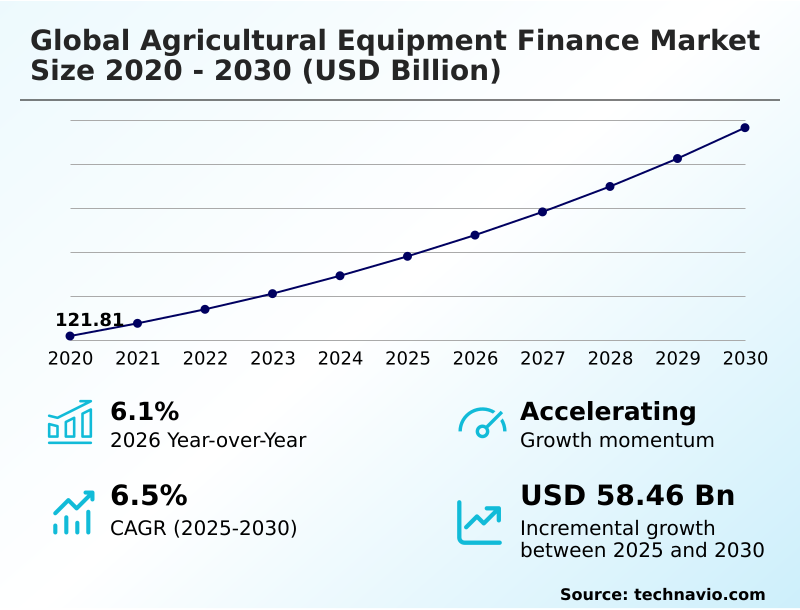
The agricultural equipment finance market size is valued to increase by USD 58.46 billion, at a CAGR of 6.5% from 2025 to 2030. Quick and easy access to credit will drive the agricultural equipment finance market.
Major Market Trends & Insights
- APAC dominated the market and accounted for a 44.1% growth during the forecast period.
- By Type - Lease segment was valued at USD 108.50 billion in 2024
- By Product - Tractors segment accounted for the largest market revenue share in 2024
Market Size & Forecast
- Market Opportunities: USD 94.70 billion
- Market Future Opportunities: USD 58.46 billion
- CAGR from 2025 to 2030 : 6.5%
Market Summary
- The agricultural equipment finance market is undergoing a significant transformation, driven by the dual needs for enhanced productivity and operational sustainability. Key drivers include the digitalization of lending and the availability of government credit guarantee schemes, which improve access to capital for a wider range of producers.
- A major trend is the shift from traditional ownership to access-based solutions, reflected in the popularity of operating lease agreements and emerging equipment-as-a-service models. This allows agribusinesses to adopt high-tech machinery without substantial upfront investment. However, challenges persist, including managing credit risk assessment in volatile commodity markets and navigating complex regulatory landscapes.
- For instance, a large farming cooperative may utilize a blended finance model to acquire a fleet of autonomous harvesters, combining a commercial loan with a government grant for sustainable technology. This approach optimizes their debt service coverage while leveraging sustainability-linked lending to lower borrowing costs, demonstrating how sophisticated financial structuring is essential for modern agricultural competitiveness.
What will be the Size of the Agricultural Equipment Finance Market during the forecast period?
Get Key Insights on Market Forecast (PDF) Request Free Sample
How is the Agricultural Equipment Finance Market Segmented?
The agricultural equipment finance industry research report provides comprehensive data (region-wise segment analysis), with forecasts and estimates in "USD million" for the period 2026-2030, as well as historical data from 2020-2024 for the following segments.
- Type
- Lease
- Loan
- Line of credit
- Product
- Tractors
- Harvesters
- Haying equipment
- Others
- Area
- Small farms
- Medium farms
- Large farms
- Geography
- APAC
- China
- Japan
- India
- North America
- US
- Canada
- Mexico
- Europe
- Germany
- UK
- France
- South America
- Brazil
- Argentina
- Colombia
- Middle East and Africa
- Saudi Arabia
- UAE
- South Africa
- Rest of World (ROW)
- APAC
By Type Insights
The lease segment is estimated to witness significant growth during the forecast period.
The lease segment is increasingly pivotal, offering usership over ownership and mitigating the high capital costs of advanced machinery.
Through operating lease agreements, businesses can access cutting-edge technology, including autonomous machinery leasing, while transferring the residual value risk to the lessor. This structure is advantageous for managing cash flow and preserving credit lines for other operational needs.
Firms are leveraging sophisticated agreements like the terminal rental adjustment clause and even synthetic lease agreements in complex cross-border leasing structures. Unlike traditional debt financing or structured loan products, leasing supports faster technology adoption cycles.
This shift, which can improve a farm's reported liquidity ratios by over 15%, is pushing the industry toward equipment-as-a-service models and away from balance sheet liabilities, while also optimizing benefits from capital allowance schemes.
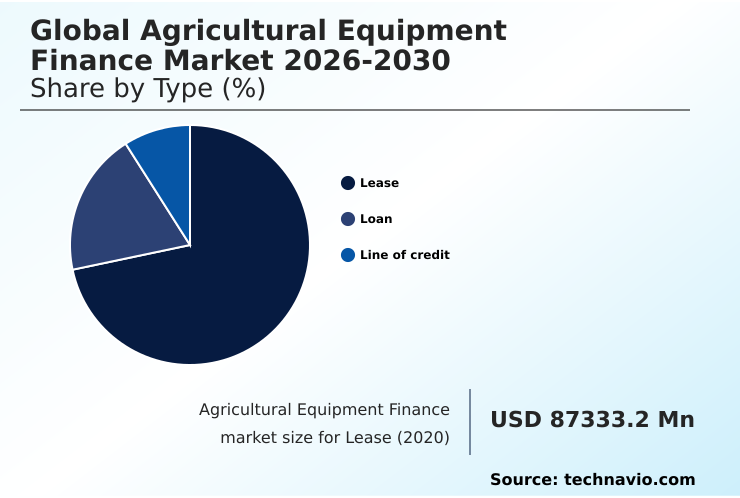
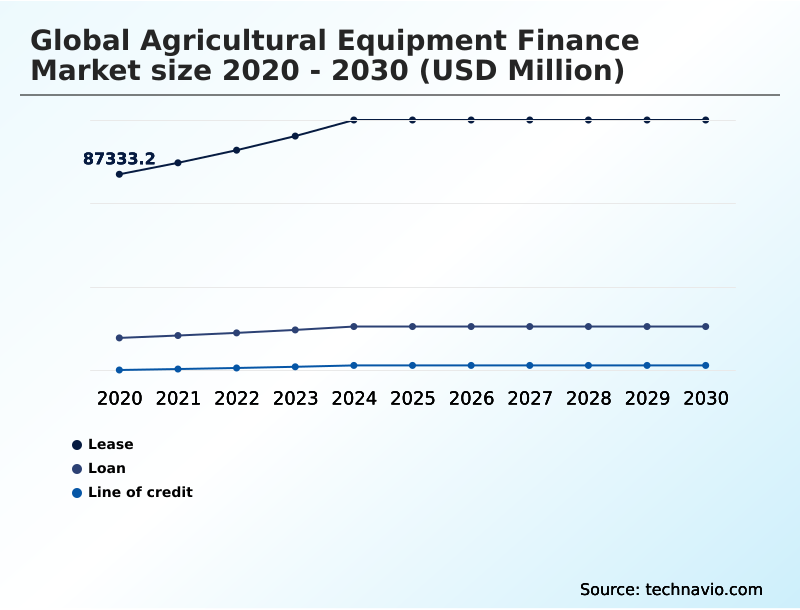
The Lease segment was valued at USD 108.50 billion in 2024 and showed a gradual increase during the forecast period.
Regional Analysis
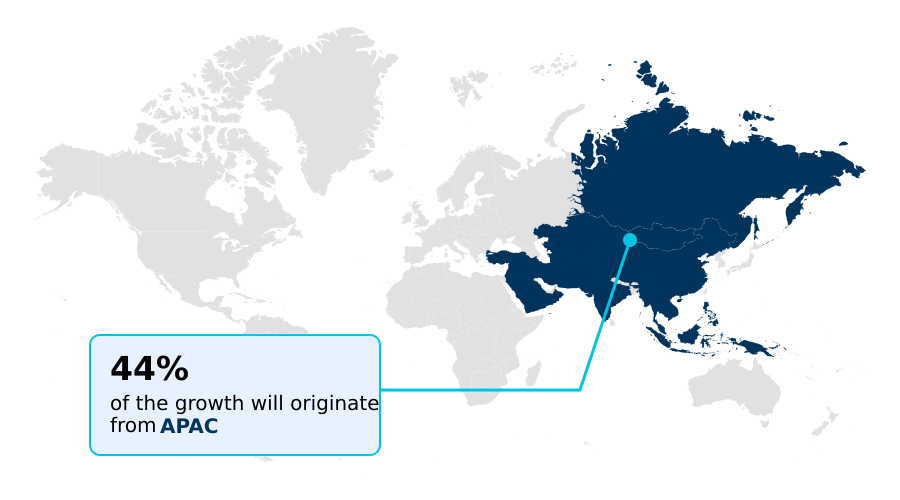
APAC is estimated to contribute 44.1% to the growth of the global market during the forecast period.Technavio’s analysts have elaborately explained the regional trends and drivers that shape the market during the forecast period.
See How Agricultural Equipment Finance Market Demand is Rising in APAC Request Free Sample
The geographic landscape is highly varied, reflecting diverse economic conditions and agricultural practices. In North America, debt financing for large-scale operations is common, while cooperative funding models are prevalent in Europe.
APAC is seeing a surge in demand, contributing over 44% of the market's incremental growth, driven by mechanization in countries like India and China. South America utilizes unique mechanisms like payment-in-kind financing to hedge against currency volatility.
Across regions, lenders use metrics like debt service coverage to evaluate creditworthiness for everything from asset-based lending to complex multi-asset credit lines.
Specialized products such as floor plan lending for dealers and rental fleet financing are adapting to regional needs, with some entities utilizing tax-exempt financing for specific public-private projects.
Market Dynamics
Our researchers analyzed the data with 2025 as the base year, along with the key drivers, trends, and challenges. A holistic analysis of drivers will help companies refine their marketing strategies to gain a competitive advantage.
- Strategic decision-making in agricultural finance requires a nuanced understanding of evolving equipment and credit landscapes. The debate over financing autonomous tractors versus traditional models highlights the industry's technological pivot, where lifecycle costs and software subscriptions are now key variables. For seasonal operations, leasing combines for seasonal harvesting cycles offers a capital-efficient alternative to ownership.
- As technology becomes more integrated, demand for credit solutions for precision agriculture retrofits is growing, allowing farms to upgrade existing assets. The macroeconomic environment plays a critical role, as seen in the impact of interest rates on equipment loans. This is amplified by the fintech disruption in rural credit markets, which introduces new lending paradigms.
- In volatile economies, risk mitigation in barter trade financing remains a vital tool. Lenders are developing new underwriting models for high-tech farm equipment and structuring loans for large farm consolidation to support industry trends.
- Addressing the needs of smaller operations through asset-based lending for smallholder farmers and understanding the unique needs of financing strategies for agricultural technology startups are crucial for market inclusivity. The tax benefits of equipment leasing versus buying continue to be a major consideration, often amplified by dealer financing incentives for new machinery.
- The secondary market also presents opportunities, necessitating clear strategies for financing options for used agricultural equipment. Furthermore, the integration of ESG criteria integration in agricultural lending is becoming standard practice, while optimizing cash flow with revolving credit lines remains a core financial strategy. The government subsidy impact on loan affordability can significantly alter purchasing decisions.
- Advanced financial mechanisms, including emerging securitization trends in agricultural equipment loans and the use of digital platforms for small farm financing, are addressing longstanding issues.
- Finally, navigating managing currency risk in cross-border financing and overcoming collateral challenges in emerging agricultural markets are essential for global operations, with successful strategies reducing credit-related losses by more than a third compared to traditional approaches.
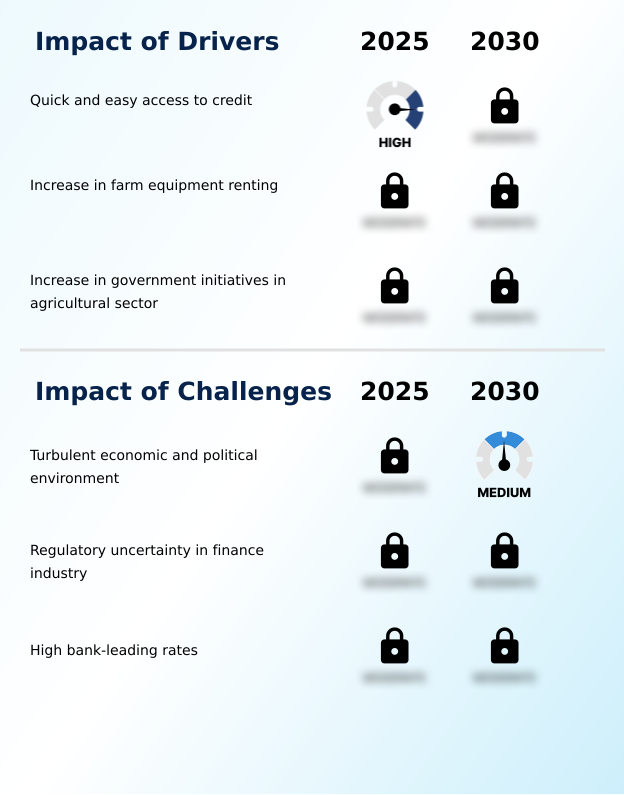
What are the key market drivers leading to the rise in the adoption of Agricultural Equipment Finance Industry?
- Quick and easy access to credit, facilitated by digital platforms and alternative finance providers, serves as a key driver for market growth.
- Government initiatives and a focus on sustainability are significant drivers. Programs offering interest rate subvention and credit guarantee schemes lower the entry barrier for acquiring modern machinery, increasing retail credit origination.
- These supports enable investments in precision agriculture financing, which can boost crop yields by up to 20%.
- The growing emphasis on ESG criteria has led to the expansion of green finance programs and sustainability-linked lending, providing preferential terms for eco-friendly equipment. Financial institutions are leveraging strong wholesale funding facilities to support these initiatives.
- In developing regions, blended finance models and micro-lending schemes are crucial for providing access to working capital loans, while globally, a focus on digital efficiency is improving the entire credit lifecycle from origination to servicing.
What are the market trends shaping the Agricultural Equipment Finance Industry?
- The modernization of agricultural equipment through the integration of advanced technologies is a primary trend shaping the market. This evolution is driving demand for innovative financing solutions that accommodate higher-value, technologically sophisticated machinery.
- Market evolution is characterized by the adoption of advanced technologies that streamline credit delivery. The rise of fintech lending platforms is transforming access to capital, with some platforms reporting a 40% reduction in processing times through digital loan origination and automated underwriting engines.
- These systems utilize AI-powered risk modeling and digital credit scoring to assess applicants who lack traditional credit histories. Concurrently, usage-based finance models and telematics-driven underwriting are gaining traction, aligning payment structures with actual equipment use. This innovation extends to transactional security, where blockchain-based contracts enhance transparency.
- While traditional instruments like hire purchase contracts and revolving lines of credit remain relevant, the market is shifting toward more flexible and data-centric financial products that better serve modern agricultural needs.
What challenges does the Agricultural Equipment Finance Industry face during its growth?
- A turbulent economic and political environment, characterized by market instability and regulatory shifts, presents a key challenge to the industry's growth trajectory.
- Economic volatility and regulatory pressures create significant market challenges. Lenders face heightened complexity in credit risk assessment, with fluctuating asset values complicating collateral valuation models and tightening loan-to-value ratios. This environment can increase the rate of non-performing assets by over 5% in stressed regions, demanding robust portfolio risk management. Financiers employ predictive financial analytics to navigate these uncertainties.
- The intricate processes behind the securitization of loans and asset securitization are also under scrutiny. Furthermore, specialized areas like dealer inventory financing and aftermarket parts financing are impacted by supply chain disruptions and shifting demand, requiring more dynamic and responsive risk frameworks to maintain market stability and liquidity.
Exclusive Technavio Analysis on Customer Landscape
The agricultural equipment finance market forecasting report includes the adoption lifecycle of the market, covering from the innovator’s stage to the laggard’s stage. It focuses on adoption rates in different regions based on penetration. Furthermore, the agricultural equipment finance market report also includes key purchase criteria and drivers of price sensitivity to help companies evaluate and develop their market growth analysis strategies.
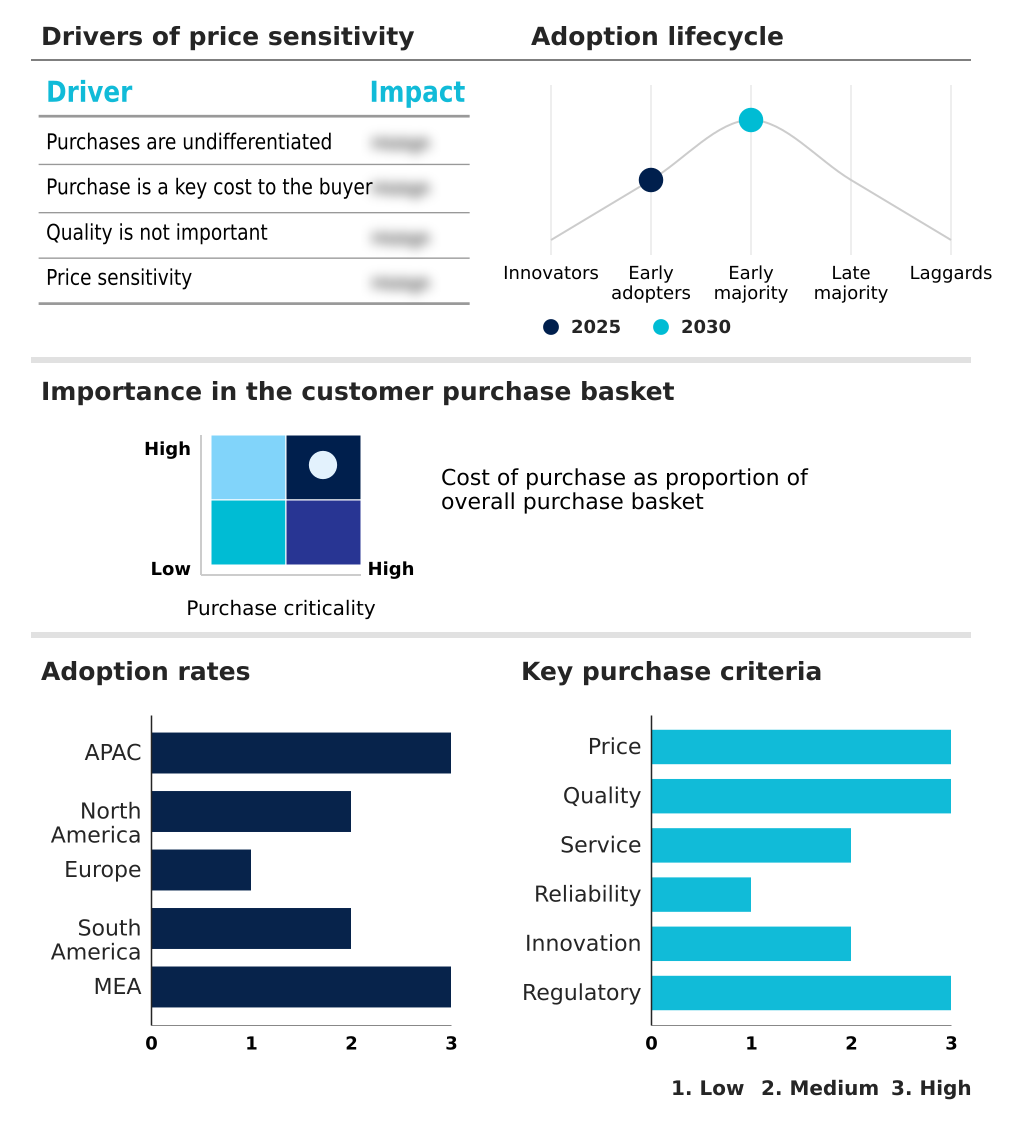
Customer Landscape of Agricultural Equipment Finance Industry
Competitive Landscape
Companies are implementing various strategies, such as strategic alliances, agricultural equipment finance market forecast, partnerships, mergers and acquisitions, geographical expansion, and product/service launches, to enhance their presence in the industry.
Adani Group - Delivers specialized agricultural equipment finance, including tractor loan services, through a dedicated capital subsidiary, targeting key rural credit needs.
The industry research and growth report includes detailed analyses of the competitive landscape of the market and information about key companies, including:
- Adani Group
- AGCO Corp.
- Agricultural Bank of China Ltd.
- Argo Tractors SpA
- Barclays PLC
- BlackRock Inc.
- BNP Paribas SA
- Citigroup Inc.
- Deere and Co.
- ICICI Bank Ltd.
- IDFC FIRST Bank Ltd.
- IndusInd Bank Ltd.
- JPMorgan Chase and Co.
- Key Corp.
- Larsen and Toubro Ltd.
- Mahindra and Mahindra Ltd.
- Rabobank Group
- State Bank of India
- Wells Fargo and Co.
Qualitative and quantitative analysis of companies has been conducted to help clients understand the wider business environment as well as the strengths and weaknesses of key industry players. Data is qualitatively analyzed to categorize companies as pure play, category-focused, industry-focused, and diversified; it is quantitatively analyzed to categorize companies as dominant, leading, strong, tentative, and weak.
Recent Development and News in Agricultural equipment finance market
- In April 2025, Deere and Co. introduced a pilot program for usage-based financing in North America, allowing agricultural producers to pay for autonomous machinery based on acreage covered rather than fixed monthly installments.
- In May 2025, CNH Industrial announced an updated strategic business plan that pivots toward an 'Iron + Tech' approach, signaling a greater focus on precision technology and software as key value drivers for equipment financing.
- In March 2025, AGCO Finance launched a strategic sustainability initiative, introducing a specialized loan program with reduced interest rates for mid-sized operators investing in equipment compatible with regenerative agriculture practices.
- In March 2025, the United States Department of Agriculture announced a focused grant program aimed at subsidizing interest rates for precision agriculture equipment to encourage the adoption of sustainable farming practices among producers.
Dive into Technavio’s robust research methodology, blending expert interviews, extensive data synthesis, and validated models for unparalleled Agricultural Equipment Finance Market insights. See full methodology.
| Market Scope | |
|---|---|
| Page number | 300 |
| Base year | 2025 |
| Historic period | 2020-2024 |
| Forecast period | 2026-2030 |
| Growth momentum & CAGR | Accelerate at a CAGR of 6.5% |
| Market growth 2026-2030 | USD 58463.9 million |
| Market structure | Fragmented |
| YoY growth 2025-2026(%) | 6.1% |
| Key countries | China, Japan, India, South Korea, Australia, Indonesia, US, Canada, Mexico, Germany, UK, France, Italy, Spain, The Netherlands, Brazil, Argentina, Colombia, Saudi Arabia, UAE, South Africa, Turkey and Israel |
| Competitive landscape | Leading Companies, Market Positioning of Companies, Competitive Strategies, and Industry Risks |
Research Analyst Overview
- The agricultural equipment finance market is evolving beyond simple transactions into a complex ecosystem of structured financial solutions. Boardroom decisions are increasingly focused on leveraging finance to manage technological obsolescence and operational risk. Instruments like operating lease agreements and hire purchase contracts are being complemented by sophisticated structured loan products.
- Effective credit risk assessment now relies on advanced collateral valuation models to manage loan-to-value ratios and mitigate residual value risk. Lenders are optimizing amortization schedules for various forms of debt financing, including working capital loans and revolving lines of credit.
- To maintain liquidity, institutions utilize wholesale funding facilities and explore the securitization of loans, while government credit guarantee schemes and interest rate subvention programs influence retail credit origination. In certain regions, payment-in-kind financing offers a hedge against currency volatility.
- The rise of fintech lending platforms using digital credit scoring and blockchain-based contracts has enabled a 30% reduction in processing times, fundamentally altering how floor plan lending and asset-based lending are managed, thereby impacting the entire landscape of non-performing assets and debt service coverage.
What are the Key Data Covered in this Agricultural Equipment Finance Market Research and Growth Report?
-
What is the expected growth of the Agricultural Equipment Finance Market between 2026 and 2030?
-
USD 58.46 billion, at a CAGR of 6.5%
-
-
What segmentation does the market report cover?
-
The report is segmented by Type (Lease, Loan, and Line of credit), Product (Tractors, Harvesters, Haying equipment, and Others), Area (Small farms, Medium farms, and Large farms) and Geography (APAC, North America, Europe, South America, Middle East and Africa)
-
-
Which regions are analyzed in the report?
-
APAC, North America, Europe, South America and Middle East and Africa
-
-
What are the key growth drivers and market challenges?
-
Quick and easy access to credit, Turbulent economic and political environment
-
-
Who are the major players in the Agricultural Equipment Finance Market?
-
Adani Group, AGCO Corp., Agricultural Bank of China Ltd., Argo Tractors SpA, Barclays PLC, BlackRock Inc., BNP Paribas SA, Citigroup Inc., Deere and Co., ICICI Bank Ltd., IDFC FIRST Bank Ltd., IndusInd Bank Ltd., JPMorgan Chase and Co., Key Corp., Larsen and Toubro Ltd., Mahindra and Mahindra Ltd., Rabobank Group, State Bank of India and Wells Fargo and Co.
-
Market Research Insights
- The market's dynamism is driven by technological integration and innovative financial products. The adoption of telematics-driven underwriting has enabled some lenders to reduce default rates by up to 15% by using real-time equipment data. Usage-based finance models are reshaping asset acquisition, aligning costs directly with operational output.
- The expansion of green finance programs offers tangible benefits, with producers securing interest rate reductions of 50 basis points for investing in low-emission machinery. Furthermore, AI-powered risk modeling and automated underwriting engines are accelerating credit decisions, with approval times in certain segments being cut in half.
- These advancements, combined with digital loan origination and sophisticated portfolio risk management, are creating a more efficient, responsive, and data-centric financing ecosystem that supports both lender stability and agricultural productivity.
We can help! Our analysts can customize this agricultural equipment finance market research report to meet your requirements.
 RIA -
RIA -