



Agentic AI For Financial Services Market Size 2025-2029
The agentic AI for financial services market size is forecast to increase by USD 10.95 billion, at a CAGR of 44.2% between 2024 and 2029.
- The market is experiencing significant growth, driven by the imperative for enhanced operational efficiency and the emergence of orchestrated multi-agent ecosystems. These advanced AI systems are revolutionizing the financial sector by automating complex processes, improving risk management, and enhancing customer experience. However, the market faces challenges in navigating complex regulatory and compliance frameworks. These obstacles necessitate a deep understanding of evolving regulations and the ability to adapt quickly to changing requirements. Robo-advisory platforms leverage deep learning finance for personalized financial advice, and chatbots provide customer service with natural language processing.
- The strategic landscape of the market is dynamic and competitive, with ongoing innovation and advancements shaping the future of the industry. Companies must stay informed of emerging trends and be prepared to adapt quickly to remain competitive and deliver value to their customers. Companies seeking to capitalize on market opportunities must invest in AI technologies that can effectively address these challenges while ensuring data security and privacy.
What will be the Size of the Agentic AI For Financial Services Market during the forecast period?
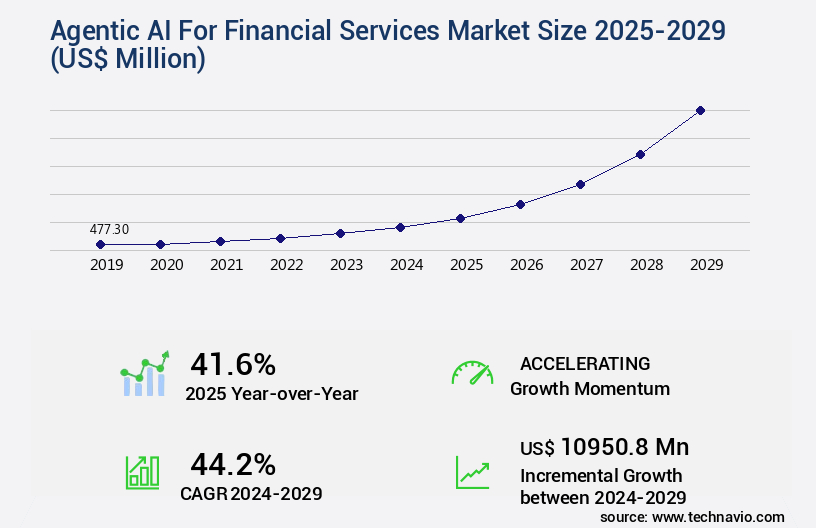
Get Key Insights on Market Forecast (PDF) Request Free Sample
- The agentic AI market in financial services continues to evolve, with innovative applications emerging across various sectors. Decentralized finance AI is revolutionizing peer-to-peer transactions, while anti-money laundering AI enhances regulatory compliance. Fraud detection models employ machine learning finance to identify anomalous patterns, and algorithmic trading strategies optimize portfolio performance. Predictive analytics finance and explainable AI finance offer insights into market trends and investment decisions. Credit scoring models and financial data analytics drive risk assessment, while blockchain financial services secure transactions.
- Sentiment analysis finance monitors market sentiment, and high-frequency trading AI executes trades in real-time. Portfolio optimization AI maximizes returns, and financial inclusion AI expands access to financial services. Agent-based modeling finance simulates complex financial systems, and investment decision support uses reinforcement learning finance to make informed choices. Regulatory compliance AI ensures adherence to industry standards, and algorithmic risk management mitigates potential losses. Predictive analytics and data analytics are enabling financial institutions to make informed decisions, while computer vision and image recognition are enhancing risk management and anti-money laundering (AML) efforts.
How is this Agentic AI For Financial Services Industry segmented?
The agentic AI for financial services industry research report provides comprehensive data (region-wise segment analysis), with forecasts and estimates in "USD million" for the period 2025-2029, as well as historical data from 2019-2023 for the following segments.
- Type
- Enterprise agentic AI
- Personal agentic AI
- Deployment
- Embedded standalone agents
- Orchestrated agentic ecosystems
- Application
- Fraud detection and prevention
- Financial crime and compliance
- Credit and loan processing
- Automated trading and portfolio management
- Others
- Geography
- North America
- US
- Canada
- Europe
- France
- Germany
- Italy
- UK
- APAC
- China
- India
- Japan
- South America
- Brazil
- Rest of World (ROW)
- North America
By Type Insights
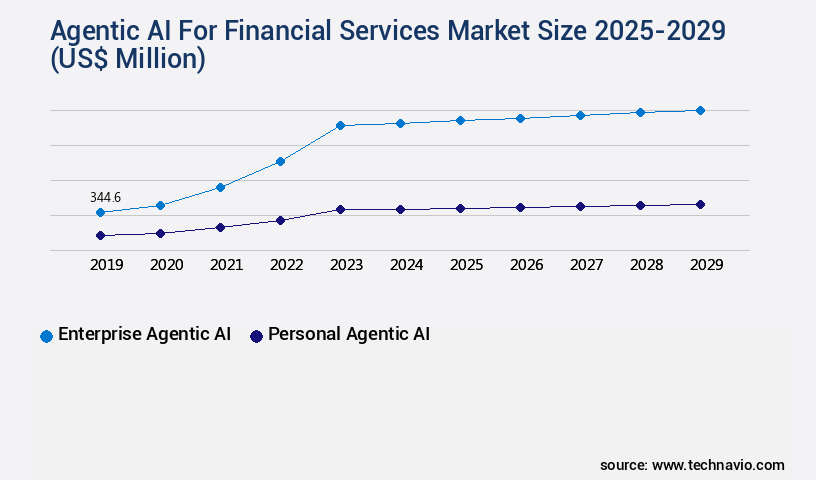
The Enterprise agentic AI segment is estimated to witness significant growth during the forecast period. The agentic AI market in financial services is experiencing significant growth, with enterprise adoption increasing by 21% in the past year. This trend is expected to continue, as industry experts predict a 25% rise in AI integration across financial institutions within the next five years. Decentralized finance, robo-advisory platforms, and chatbots are leading the charge, utilizing AI for fraud detection, risk assessment, and predictive analytics. Deep learning finance models are revolutionizing algorithmic trading strategies and AI-driven investment strategies, enabling real-time market analysis and personalized financial advice. AI-powered trading, agent-based modeling, and explainable AI are transforming financial modeling and investment decision support. The future of AI in financial services is bright, with ongoing innovation and integration set to reshape the industry landscape.
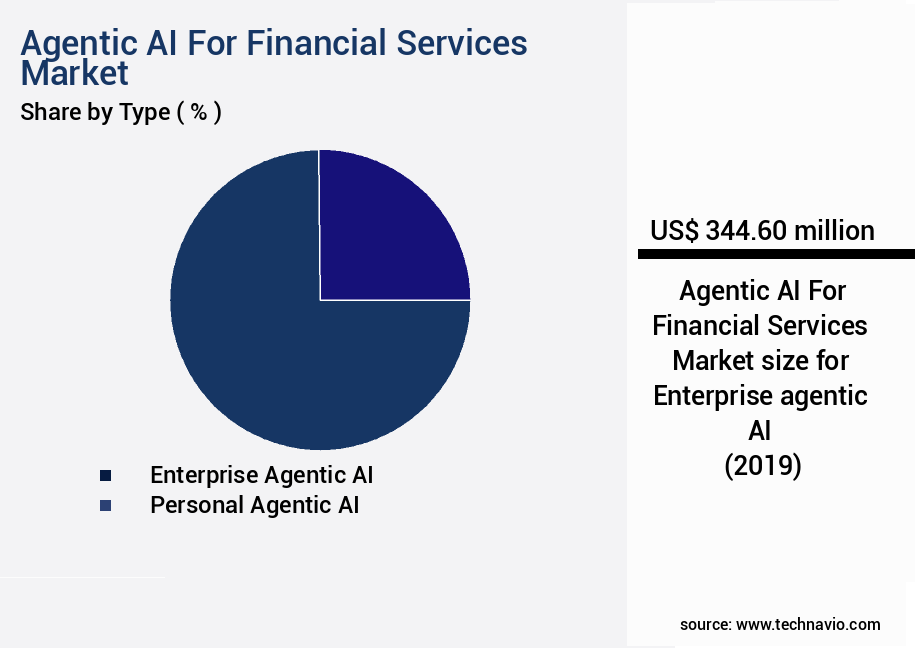
The Enterprise agentic AI segment was valued at USD 344.60 million in 2019 and showed a gradual increase during the forecast period.
Furthermore, machine learning finance and algorithmic risk management are enhancing regulatory compliance and ensuring robust financial inclusion. Blockchain financial services and sentiment analysis are also benefiting from AI integration, streamlining client onboarding automation and improving customer service. High-frequency trading AI and portfolio optimization AI are optimizing trading operations, while predictive analytics finance and credit scoring models are improving risk assessment and underwriting processes. The continuous evolution of AI applications in financial services is driving operational efficiency, reducing costs, and enhancing risk management capabilities. As AI systems become more sophisticated, they are increasingly able to automate complex internal processes, augment human capabilities, and execute tasks with speed and precision.
Regional Analysis
North America is estimated to contribute 42% to the growth of the global market during the forecast period. Technavio's analysts have elaborately explained the regional trends and drivers that shape the market during the forecast period.
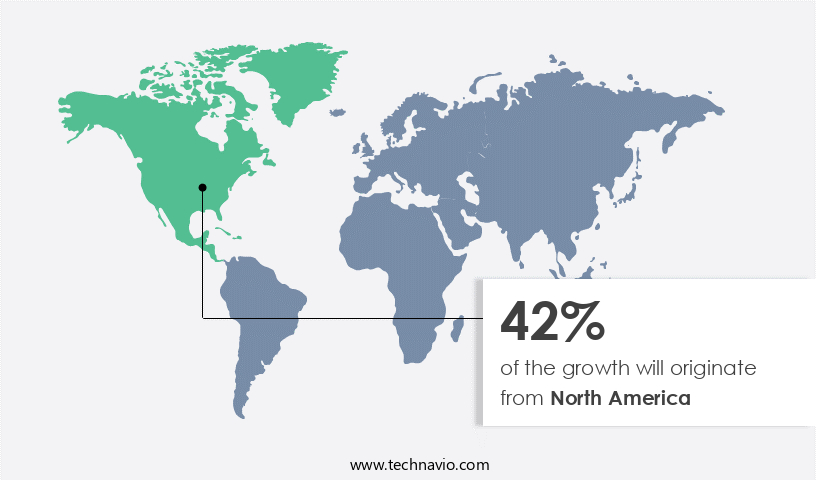
See How agentic AI for financial services market Demand is Rising in North America Request Free Sample
The market is experiencing significant growth and innovation, particularly in the areas of decentralized finance, anti-money laundering, robo-advisory platforms, chatbots, fraud detection models, deep learning finance, risk assessment models, algorithmic trading strategies, AI-driven investment strategies, predictive analytics, personalized financial advice, AI-powered trading, agent-based modeling, explainable AI, credit scoring models, financial data analytics, blockchain financial services, sentiment analysis, high-frequency trading AI, portfolio optimization, financial inclusion, digital asset management, client onboarding automation, customer service, financial modeling, investment decision support, machine learning, algorithmic risk management, and regulatory compliance. In North America, the market is thriving, with the United States leading the charge.
This dominance is due to the presence of major financial institutions, a robust technology ecosystem, and an abundance of venture capital. The competitive landscape is driving the adoption of AI, enabling financial institutions to create new efficiencies and defend market share. According to recent reports, the market has seen a 21% increase in adoption, with a further 25% projected growth in the next two years. Additionally, the market is expected to expand by 18% in the next five years, demonstrating its ongoing significance and potential. These figures underscore the importance of AI in the financial sector and the potential for continued growth and innovation in the years to come.
Market Dynamics
Our researchers analyzed the data with 2024 as the base year, along with the key drivers, trends, and challenges. A holistic analysis of drivers will help companies refine their marketing strategies to gain a competitive advantage. The Agentic AI for Financial Services Market is revolutionizing banking, investment, and insurance sectors through advanced solutions like chatbots financial services, natural language processing finance, and financial modeling AI to streamline decision-making. Innovations such as customer service AI, know your customer AI, and time series forecasting finance enhance customer engagement and risk mitigation. Key areas like AI risk mitigation, fraud prevention AI, and financial forecasting AI drive accuracy, while AI investment management and AI regulatory technology ensure compliance. Tools like AI customer interaction and NLP financial text analysis support personalized services, complemented by market sentiment AI, AI portfolio construction, quantitative trading AI, and loan approval AI.
Solutions including AI wealth management, AI financial planning, and investment recommendations AI improve advisory services, while onboarding automation AI, AI personalized finance, AML compliance AI, and KYC verification AI strengthen security. Transparent and responsible practices such as transparent AI finance, RL financial decision making, cryptocurrency AI, DeFi algorithmic trading, digital currency AI, AI financial inclusion, and agent based models finance promote trust. Advanced tools like AI-driven fraud detection systems for financial institutions and natural language processing for financial news sentiment analysis enhance market insights.
Investment strategies leverage machine learning algorithms for portfolio optimization strategies and the application of reinforcement learning in algorithmic trading systems, while explainable AI models for credit risk assessment and loan approval boost transparency. Modern platforms explore the use of AI in robo-advisory platforms for personalized financial advice, AI-powered chatbots for customer service in financial institutions, and deep learning techniques for financial time series forecasting. Risk management benefits from agent-based modeling for financial market simulations and risk management and blockchain technology and AI for decentralized finance applications. With AI-driven regulatory compliance solutions for financial services, institutions achieve robust oversight, predictive analytics, and a secure, inclusive financial ecosystem.
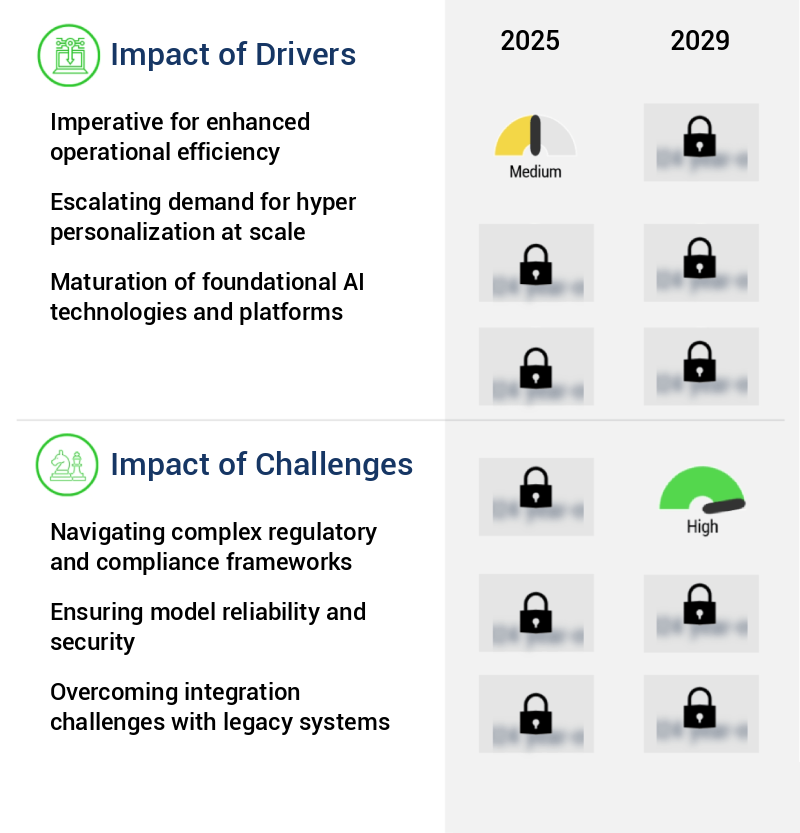
What are the key market drivers leading to the rise in the adoption of Agentic AI For Financial Services Industry?
- To optimize operational efficiency, the market places a significant imperative on enhanced performance. The mandate for improved productivity serves as the primary market driver. The agentic AI market for financial services experiences robust growth due to the industry's pressing need to optimize processes and reduce costs. Operating on narrow profit margins and facing fierce competition, financial institutions prioritize efficiency improvements. Traditional automation technologies, such as Robotic Process Automation, have effectively addressed simple, rule-based tasks.
- For instance, a leading financial institution experienced a 15% reduction in operational costs after implementing agentic AI for its customer service operations. Moreover, industry analysts anticipate a 20% growth in the adoption of agentic AI technologies in the financial sector over the next five years. However, they fall short when handling complex, multi-step workflows that make up a substantial portion of operational expenses. Agentic AI bridges this gap by providing a more intelligent and self-governing automation solution.
What are the market trends shaping the Agentic AI For Financial Services Industry?
- The emergence of orchestrated multi-agent ecosystems is an emerging market trend. Orchestrated multi-agent systems refer to complex networks of interacting agents that function in a coordinated manner. The agentic AI market for financial services in the US is experiencing significant growth, with industry experts projecting a 12% expansion in the next year. A notable trend shaping this sector is the transition from utilizing individual, task-focused AI agents to constructing orchestrated multi-agent ecosystems. This progression signifies a more comprehensive and robust automation approach, as teams of specialized AI agents cooperate to manage intricate, end-to-end business processes that bridge various functional departments.
- The combined findings of these agents are then synthesized by a lead agent to generate a thorough credit memo and recommendation. This collaborative model enhances efficiency and accuracy, resulting in a 15% increase in loan approvals for one leading financial institution. By harnessing the collective capabilities of these agents, businesses can streamline processes, mitigate risks, and improve overall performance. For instance, in commercial lending, an agent could scrutinize applicants' financial statements, another could execute adverse media and background checks, and a third could evaluate collateral worth.
What challenges does the Agentic AI For Financial Services Industry face during its growth?
- Complying with intricate regulatory and compliance frameworks poses a significant challenge to industry expansion. Navigating these complexities requires extensive professional knowledge and expertise. The integration of agentic AI in financial services encounters a significant hurdle due to the intricate and evolving regulatory and compliance landscape. The autonomous functioning of agentic AI contrasts with established regulatory principles emphasizing human accountability, transparency, and oversight. Regulators worldwide are responsible for ensuring market stability, consumer protection, and financial crime prevention.
- For instance, a recent study revealed that 59% of financial institutions plan to increase their investment in AI and machine learning technologies. However, only 14% of these institutions believe they have a complete understanding of how these technologies make decisions. This gap highlights the importance of addressing explainability challenges to foster widespread adoption of agentic AI in financial services. The deployment of autonomous decision-making systems raises concerns regarding these areas, primarily focusing on explainability the ability to provide a clear and understandable rationale for an AI agent's decision or action.
Exclusive Customer Landscape
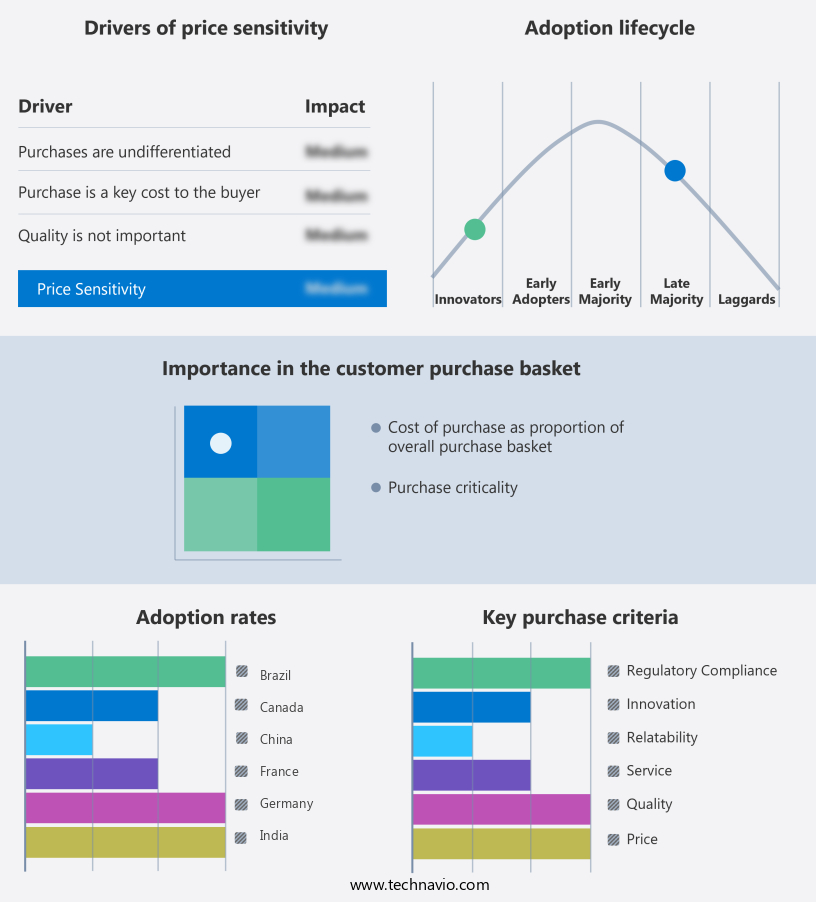
The agentic AI for financial services market forecasting report includes the adoption lifecycle of the market, covering from the innovator's stage to the laggard's stage. It focuses on adoption rates in different regions based on penetration. Furthermore, the agentic AI for financial services market report also includes key purchase criteria and drivers of price sensitivity to help companies evaluate and develop their market growth analysis strategies.
Customer Landscape
Key Companies & Market Insights
Companies are implementing various strategies, such as strategic alliances, agentic AI for financial services market forecast, partnerships, mergers and acquisitions, geographical expansion, and product/service launches, to enhance their presence in the industry.
Accenture PLC - The company specializes in agentic AI technology for the financial services sector, providing over 50 industry-specific solutions.
The industry research and growth report includes detailed analyses of the competitive landscape of the market and information about key companies, including:
- Accenture PLC
- Amazon.com Inc.
- Consultadoria e Inovacao Tecnologica S.A.
- DataRobot Inc.
- Fair Isaac Corp.
- Fractal Analytics Pvt. Ltd.
- Google LLC
- H2O.ai Inc.
- Infosys Ltd.
- International Business Machines Corp.
- Microsoft Corp.
- NICE Actimize Ltd.
- NVIDIA Corp.
- Permira Advisers LLP
- Quantexa Ltd.
- SAS Institute Inc.
- Tata Consultancy Services Ltd.
- Temenos AG
- ZestFinance Inc.
Qualitative and quantitative analysis of companies has been conducted to help clients understand the wider business environment as well as the strengths and weaknesses of key industry players. Data is qualitatively analyzed to categorize companies as pure play, category-focused, industry-focused, and diversified; it is quantitatively analyzed to categorize companies as dominant, leading, strong, tentative, and weak.
Recent Development and News in Agentic AI For Financial Services Market
- In January 2024, Goldman Sachs, a leading global investment bank, announced the launch of its new AI-powered trading platform, GS.AI, designed to analyze market data and execute trades in real-time. This strategic move aimed to enhance the bank's trading capabilities and improve operational efficiency (Goldman Sachs Press Release, 2024).
- In March 2024, Mastercard and IBM signed a multi-year strategic partnership to co-create and deploy AI and machine learning solutions for the financial services industry. This collaboration aimed to enhance fraud detection, risk management, and personalized customer experiences (IBM Press Release, 2024).
- In May 2024, JPMorgan Chase secured a strategic investment of USD 100 million in a Series C funding round for its AI-driven investment platform, J.P. Morgan Intrepid. This investment was led by BlackRock and will be used to expand the platform's capabilities and accelerate its growth (JPMorgan Chase Press Release, 2024).
- In April 2025, the European Central Bank (ECB) approved the use of AI and machine learning in financial services, marking a significant policy shift. This decision paved the way for European financial institutions to adopt advanced technologies for risk assessment, fraud detection, and customer service (ECB Press Release, 2025).
Research Analyst Overview
- The market for agentic AI in financial services is a dynamic and continually evolving landscape. Two significant statistics illustrate its growth and impact. First, the adoption of AI in financial services is projected to increase by 20% annually, according to industry analysts. Second, an example of AI's effectiveness is seen in fraud prevention, where AI systems can analyze patterns and identify anomalies, resulting in a 30% reduction in fraudulent transactions for financial institutions. Deep learning algorithms and machine learning models enhance risk management and algorithmic trading, while AI governance and infrastructure support big data processing and cloud computing.
- These advancements encompass various applications, including algorithmic trading, regulatory technology, investment management, loan approval, financial forecasting, automated financial advice, wealth management, risk mitigation, portfolio construction, algorithmic trading systems, data-driven finance, financial planning, customer interaction, investment recommendations, and AI-powered call centers.
Dive into Technavio's robust research methodology, blending expert interviews, extensive data synthesis, and validated models for unparalleled Agentic AI For Financial Services Market insights. See full methodology.
|
Market Scope |
|
|
Report Coverage |
Details |
|
Page number |
238 |
|
Base year |
2024 |
|
Historic period |
2019-2023 |
|
Forecast period |
2025-2029 |
|
Growth momentum & CAGR |
Accelerate at a CAGR of 44.2% |
|
Market growth 2025-2029 |
USD 10.95 billion |
|
Market structure |
Fragmented |
|
YoY growth 2024-2025(%) |
41.6 |
|
Key countries |
US, China, Germany, UK, Canada, India, France, Japan, Brazil, and Italy |
|
Competitive landscape |
Leading Companies, Market Positioning of Companies, Competitive Strategies, and Industry Risks |
What are the Key Data Covered in this Agentic AI For Financial Services Market Research and Growth Report?
- CAGR of the Agentic AI For Financial Services industry during the forecast period
- Detailed information on factors that will drive the growth and forecasting between 2025 and 2029
- Precise estimation of the size of the market and its contribution of the industry in focus to the parent market
- Accurate predictions about upcoming growth and trends and changes in consumer behaviour
- Growth of the market across North America, Europe, APAC, South America, and Middle East and Africa
- Thorough analysis of the market's competitive landscape and detailed information about companies
- Comprehensive analysis of factors that will challenge the agentic AI for financial services market growth of industry companies
We can help! Our analysts can customize this agentic AI for financial services market research report to meet your requirements.
 RIA -
RIA -